Gibson Hummingbird Standard: The Guitar That Roars
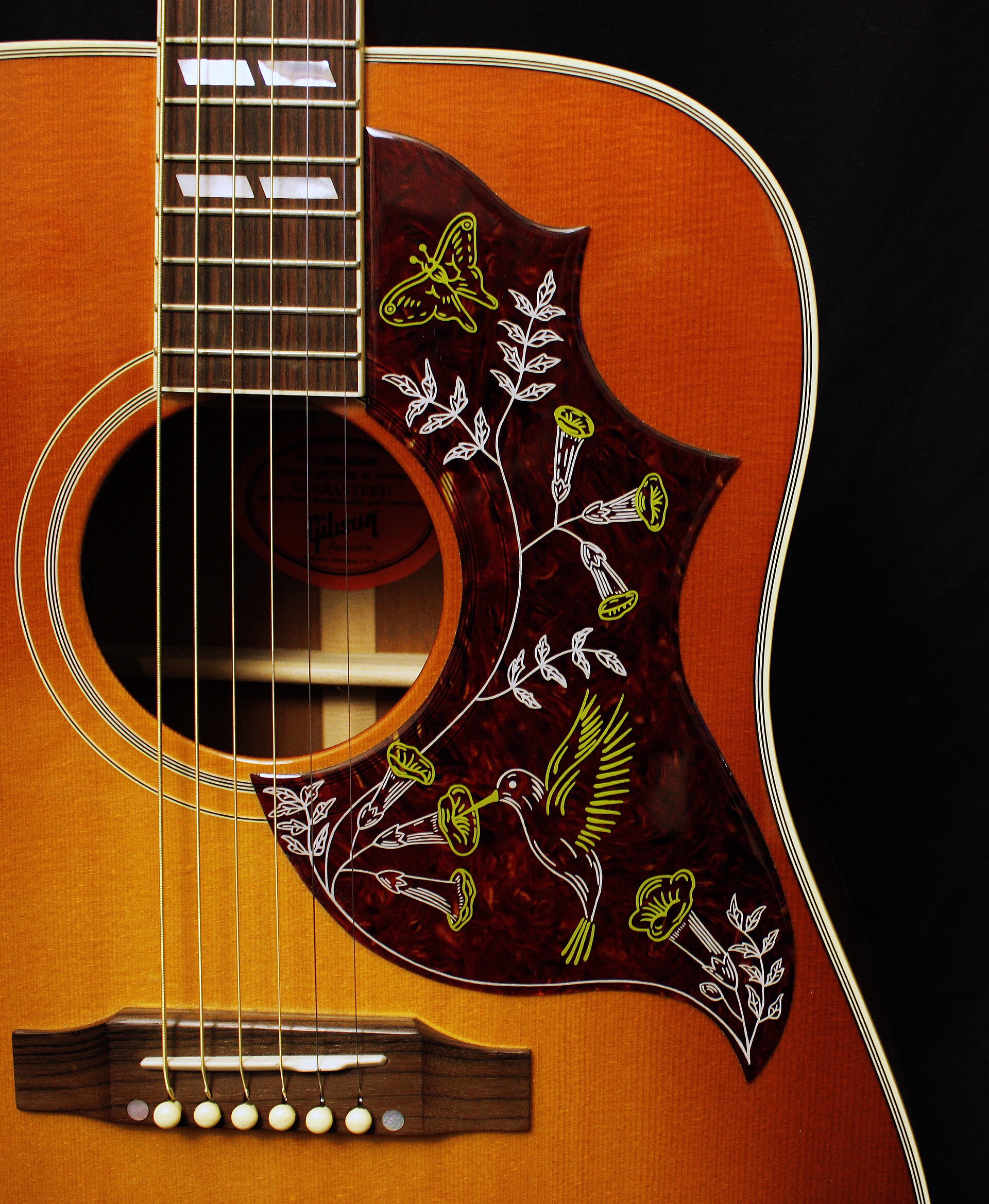
A Gibson Hummingbird (2005).
The Gibson Hummingbird Standard is acoustic rock power in its purest form. History, tonewoods, setup guides, and the full buying guide.
In the spring of 1968, Keith Richards sat in his bedroom in West Sussex with a portable cassette recorder and a Gibson Hummingbird. He had a riff — a big, open-tuned thing in open D, capo’d to E — and he wanted to capture it before it disappeared. He hit record on the cassette machine, turned it up until the preamp clipped and distorted, and played. The resulting recording was the bedrock of “Jumpin’ Jack Flash,” one of the most elemental rock and roll recordings ever made, built not on electric guitars and studio equipment but on an acoustic guitar and an overloaded cassette deck. That sound — saturated, percussive, enormous — would not have worked without the Hummingbird’s specific qualities: its loud, forward projection, its percussive attack, its ability to generate physical force even in an intimate setting.

He did the same thing with “Street Fighting Man,” the same process, the same guitar in open D, the same cassette machine pushed into distortion. These were not acoustic guitar songs that happened to be recorded cleverly. They were rock songs played on an acoustic guitar that was loud and powerful enough to become the bedrock of a recording that sounded like a full band. That is what the Gibson Hummingbird Standard does. It is the loudest, most projecting, most physically assertive acoustic Gibson makes. It is the guitar for players who want to strum hard and be heard.
The Hummingbird is also, indisputably, the most beautiful acoustic guitar Gibson has ever produced. That pickguard — the hand-engraved tortoiseshell plate decorated with hummingbirds, flowers, and vines — is one of the most distinctive visual statements in all of acoustic guitar design. The Heritage Cherry Sunburst finish, which has been the model’s signature since its introduction in 1960, has a warmth and depth that photographs struggle to capture. When you walk on stage with a Gibson Hummingbird, people notice. This is not incidental to the guitar’s appeal — it is integral to it. The Hummingbird is a statement as much as it is an instrument.
Origins: Kalamazoo, 1960
The Gibson Hummingbird arrived in 1960 as something genuinely new in Gibson’s acoustic lineup: the company’s first square-shouldered dreadnought. For decades, Gibson’s flat-top acoustics had been characterised by the rounded, sloped-shoulder body shape that distinguished the J-45 and its predecessors from the squarer Martin dreadnought design. The J-45’s round shoulders produced a particular tonal character — warm, mid-forward, vocal-friendly — but the squarer Martin body, with its more angular upper bouts, produced more volume and more bass extension. Gibson, wanting a guitar that could compete directly with the Martin D-28 in terms of projection and presence, introduced the square-shouldered Hummingbird to fill that gap.
The structural difference between a square-shoulder and a round-shoulder acoustic is not merely cosmetic. The upper bout of a square-shouldered guitar is larger, which increases the total vibrating surface area of the top and changes the internal air volume of the body. The result, generally, is more volume, more bass extension, and a slightly more forceful attack compared to the round-shoulder equivalent with identical tonewoods. The Hummingbird and the J-45 share the same Sitka spruce and mahogany construction, but the Hummingbird is the louder, more projecting, more physically assertive of the two — a product of that body shape difference as much as any other factor.
Gibson positioned the Hummingbird as a premium instrument from the outset. The first production year, 1960, saw only 156 units shipped — a small run that has made first-year examples extraordinarily rare and valuable today. The guitar retailed at a price above the J-45, reflecting its ornate cosmetics and premium appointments: the distinctive engraved pickguard with the hummingbird motif, double parallelogram mother-of-pearl fretboard inlays, gold hardware, and the cherry sunburst finish that was, in the context of 1960, a dramatic visual departure from the understated sunburst of the workhorse J-45.
The formula was immediately successful. By 1963, three years into production, Gibson was shipping over 1,300 Hummingbirds annually — an eightfold increase from the first year. The guitar’s appeal was direct: it sounded powerful, it projected well, and it looked extraordinary. Musicians who had previously compromised by choosing between looks and tone discovered that the Hummingbird offered both without qualification.
The Hummingbird and the Stones: Acoustic Rock at Its Purest
The connection between Keith Richards and the Gibson Hummingbird is among the most important artist-instrument relationships in rock history, not because Richards played it exclusively or for the longest time, but because of what he did with it. The Beggar’s Banquet sessions of 1968 — the album that marked the Rolling Stones’ decisive turn away from psychedelia and toward their roots in American blues and country — featured the Hummingbird as the central creative tool for some of the most powerful music Richards ever made.
“Jumpin’ Jack Flash” and “Street Fighting Man” are the definitive examples. Both were built from home recordings Richards made on his Hummingbird, running the cassette recorder’s preamp into saturation to create a naturally distorted acoustic sound — the kind of sound that only works when the source instrument is loud enough and projecting enough to clip a preamp decisively. The Hummingbird, with its square-shouldered body pushing out more decibels than a round-shoulder ever would, was exactly right for the purpose.
Brian Jones, Richards’s guitar partner in the Stones, also played a Hummingbird, and the instrument can be seen in numerous photographs and film clips from the band’s peak period. The Hummingbird’s visual presence — that cherry sunburst and that unmistakeable pickguard — made it one of the defining visual signifiers of the Stones at their most iconic.
Beyond Richards and Jones, the Hummingbird attracted a remarkable range of players across the decades. Jimmy Page used one during Led Zeppelin sessions, and “Babe I’m Gonna Leave You” from the first Zeppelin album showcases the instrument’s ability to move from delicate fingerpicking to aggressive strumming within a single track — the dynamic range that the Hummingbird’s responsive top provides being essential to the arrangement. Tom Petty reached for one throughout his career; Sheryl Crow made the guitar a regular companion (though her primary signature instrument was a related Gibson Country Western, a square-shouldered dreadnought with strong Hummingbird DNA); Michelle Branch, Grace Potter, Thom Yorke, Marcus King, Jeff Lynne, Charlie Starr — the list of Hummingbird players spans rock, country, Americana, and folk in a way that reflects the guitar’s genuine versatility despite its reputation as a “strummer’s guitar.”
Tonewoods: The Hummingbird’s Voice Explained
The Hummingbird Standard uses the same essential tonewood combination as the J-45: a solid Sitka spruce top and solid mahogany back and sides. Understanding how those materials interact in the specific context of the Hummingbird’s square-shouldered body reveals why the instrument sounds the way it does — and why it sounds different from its round-shouldered sibling.
Sitka Spruce: Projection and Attack
Sitka spruce is the dominant top wood for acoustic guitars across price ranges and manufacturers, and for good reason. Its stiffness-to-weight ratio — the relationship between how rigid the wood is and how little it weighs — is among the highest of any commonly available tonewood. This means a Sitka top can vibrate freely and responsively across a wide dynamic range while projecting sound efficiently. On the Hummingbird, the Sitka top’s natural brightness and clear attack are magnified by the larger surface area of the square-shouldered body: more top vibrating means more volume, more projection, and a slightly more aggressive initial transient when you strike a chord.
The hand-scalloped X-bracing on the Hummingbird Standard — the same technique used on the J-45 — reduces brace mass without compromising structural integrity, allowing the top to vibrate more freely than a heavier, non-scalloped brace pattern would permit. This is the primary reason why Gibson acoustics from Bozeman sound different from factory acoustics with computer-routed bracing: the hand-scalloped approach introduces natural variations that affect how the top resonates, producing a slightly more organic and complex sound that uniform machine-cut bracing cannot replicate.
Mahogany: Warmth Against the Power
Mahogany back and sides — the same combination the J-45 uses — provide warmth and midrange focus that counterbalance the Sitka top’s brightness. On the J-45’s round-shoulder body, this produces a relatively warm, intimate guitar. On the Hummingbird’s larger square-shoulder body, the same mahogany provides warmth while the body geometry adds the volume and projection that the round-shoulder body cannot match. The result is a guitar that is simultaneously warm and powerful — rich in the midrange, present in the bass, clear in the treble — rather than the bright, projecting character you might expect from a square-shouldered guitar with rosewood back and sides.
This combination is what makes the Hummingbird work across genres. A rosewood-backed square-shoulder dreadnought — the Martin D-28 being the classic example — has a wider, more complex frequency response with pronounced bass and treble extension. It is brilliant and somewhat demanding; EQ it incorrectly on a PA and it becomes harsh. The mahogany Hummingbird has a more forgiving tonal character — less low-end coloration, warmer, more self-contained — while still delivering the volume and projection that mahogany round-shoulders cannot match. It is, in this sense, the most versatile large-bodied acoustic Gibson makes.
The 24.75-inch Scale: Shorter, Warmer, Faster
Like all Gibson acoustics, the Hummingbird uses a 24.75-inch scale length — shorter than the Martin standard of 25.4 inches. This shorter scale reduces string tension, which has several sonic and physical consequences. Lower string tension produces a slightly warmer, more compressed character in the bass register; it makes the guitar slightly easier to play at light gauges; and it gives the instrument a particular “bounce” or elasticity in the way notes speak that longer-scale acoustics do not have. Electric guitar players transitioning to acoustic often find the Gibson scale length more immediately comfortable — it is closer to what they are accustomed to. The trade-off is slightly less bass extension and slightly less sustain compared to a longer-scale instrument at the same string gauge, though the Hummingbird’s body size compensates significantly for this.
The Pickguard: Visual Identity as Design Statement
No discussion of the Hummingbird is complete without addressing the pickguard, because the pickguard is not simply a functional accessory on this guitar — it is the instrument’s face. The large, tortoiseshell-style plate that sweeps along the bass side of the body from below the soundhole toward the lower bout is adorned with an intricate engraving of a hummingbird in flight, surrounded by flowers and foliage. In some versions, the image is hand-painted; in others (including the current Standard), it is engraved and embedded in the pickguard material itself.
The Hummingbird pickguard is one of the most recognisable design elements in acoustic guitar history. It is conspicuous, elaborate, and completely without apology. In the context of 1960, when most acoustic guitars were relatively austere in their visual presentation, the Hummingbird’s pickguard announced that this was a guitar for players who believed that looking good and playing well were not mutually exclusive. The double parallelogram mother-of-pearl fretboard inlays, the gold hardware (Grover Rotomatic tuners on the current Standard), and the Heritage Cherry Sunburst finish complete the visual package.
Some players find the Hummingbird’s looks too conspicuous — too much decoration, too much presence for the singer-songwriter who prefers to disappear behind their instrument. Those players should buy the J-45. The Hummingbird exists for the musician who walks on stage and wants to be looked at, who understands that a guitar is a visual instrument as much as an acoustic one, and who has chosen the most beautiful of the Gibson acoustic lineup without hesitation.
Setup and Playability: Getting the Best from the Hummingbird
The Hummingbird Standard ships from Gibson’s Bozeman, Montana factory with a PLEK-processed setup and LR Baggs VTC electronics. It is stage and studio ready from day one, but there are setup choices that significantly affect how the guitar performs — and some that are specific to the Hummingbird’s particular character as a loud, projecting instrument.
Action and String Height
The Hummingbird’s square-shouldered body generates more volume than a round-shouldered guitar, and this extra projection makes the consequences of action choices more audible. High action produces more volume and sustain, but makes the guitar physically harder to play; low action reduces fretting effort but can introduce buzzing when the guitar is played hard. Factory action on current Hummingbird Standards runs around 5/64″ on the bass strings and 4/64″ on the treble strings at the 12th fret. For strummers who attack the guitar aggressively — the Keith Richards school of playing — this is appropriate or even slightly low; consider going up to 6/64″ bass for maximum projection without buzz if you play hard and loud. For fingerpickers, the standard factory setup is usually ideal.
String Gauge and Material
The Hummingbird’s square-shoulder body rewards medium gauge strings more than most acoustics — the extra tension of a .013–.056 set brings out the instrument’s natural projection and bass response in a way that light gauges do not fully realise. That said, the guitar is comfortable with lights if you play primarily at low volumes or for extended sessions where hand fatigue matters. For the full Hummingbird experience — the Keith Richards sound, the chest-vibrating bass, the powerful projection — medium phosphor bronze strings are the choice.
- Medium gauge phosphor bronze (.013–.056): The definitive Hummingbird string. Full bass, clear treble, excellent projection. The guitar sounds like itself with these strings.
- Light gauge phosphor bronze (.012–.054): Easier to play, slightly warmer and less projecting. The right choice for extended fingerpicking or if you play with a delicate touch.
- 80/20 bronze (any gauge): Brighter and more trebly than phosphor bronze. Can add sparkle and definition to the Hummingbird’s naturally warm character. Loses brightness faster than phosphor bronze.
- Nashville tuning strings: If you want to experiment with Richards’s open-tuning approach, Nashville stringing — replacing the four lowest strings with strings tuned an octave higher — produces the jangly, chiming character that defines “Jumpin’ Jack Flash” and “Street Fighting Man.” This is not a standard setup; it is a creative experiment worth trying.
Saddle, Nut, and Bridge Pins
The current Hummingbird Standard ships with a TUSQ saddle and nut. As with any acoustic, a bone saddle and nut upgrade improves tonal transfer and adds a modest but audible improvement in definition and sustain. Cost is low; results are real. Bridge pin material also affects tone — bone or ebony pins over plastic improve clarity and note definition. The Hummingbird’s belly-up rosewood bridge is a classic Gibson design that has been part of the model since its introduction.
Open Tunings and the Hummingbird
The Hummingbird is an extraordinarily good open-tuning guitar. The square-shoulder body’s projection and bass response combine with open tunings’ natural resonance to create a sound that is large, harmonically complex, and immediately compelling. Open D and open G (or their capo’d equivalents, open E and open A) bring out the best in the instrument. The guitar’s mahogany back and sides provide enough warmth to prevent the wide-open resonance of open tunings from becoming harsh or thin. If you play in open tunings, the Hummingbird rewards that approach more than most acoustic guitars.
Tone Recipes: The Hummingbird in Different Contexts
The Keith Richards Approach — Cassette Machine Overdrive
The authentic Richards technique requires a cheap recording device with an overloaded preamp — but the modern equivalent is a small tube amp with its input gain pushed, or a clean preamp fed into a very light overdrive pedal. The Hummingbird’s volume does the heavy lifting; the distortion is colouring a signal that is already loud and assertive.
- Tuning: Open D (D-A-D-F#-A-D) or open G (D-G-D-G-B-D); capo to taste
- Strings: Medium gauge phosphor bronze (.013–.056)
- Pick attack: Hard and rhythmic — Richards plays with authority, not delicacy
- Recording approach: If capturing acoustic direct, run the LR Baggs VTC into a preamp and push the gain until the signal begins to saturate naturally
- Pro tip: The Hummingbird’s projection means that in a room, it records well with a single microphone placed 18–24 inches away — further back than you might expect, because the guitar pushes a lot of air
Stage Power — The Hummingbird Live
For live performance, the Hummingbird is one of the most effective acoustic guitars available. The LR Baggs VTC pickup captures the guitar’s natural character cleanly; its projection means it can compete with a band without excessive amplification.
- Pickup: LR Baggs VTC to DI, signal to the front-of-house desk
- PA EQ: Start flat; cut at 250Hz if the low-end is bloomy on stage; add a slight presence boost at 3kHz if the guitar needs more definition cutting through a band
- Stage monitoring: The Hummingbird’s natural projection means you need less monitor level than you might expect — the guitar is already loud, and excessive monitoring risks feedback
- Feedback management: The fully hollow mahogany body is susceptible to feedback at high monitor levels. Angle the guitar away from monitors; use the soundhole volume control to manage gain
- Pro tip: At medium volume without amplification, the Hummingbird can hold its own in a small acoustic duo or trio setting — the square-shoulder projection genuinely makes it loud enough for intimate unamplified performance
Studio Recording — Capturing the Full Hummingbird
The Hummingbird records differently from the J-45 — its greater projection and slightly more percussive attack require more careful microphone placement to capture fully without the low-end becoming too dominant.
- Primary mic: Small-diaphragm condenser at the 12th fret, 20–24 inches from the guitar — further back than for a J-45, because the Hummingbird projects more aggressively
- Room mic (optional): Large-diaphragm condenser at 4–6 feet from the guitar in a good-sounding room. The Hummingbird’s volume fills room ambience naturally; blending a room mic adds depth and space
- EQ: Often a gentle cut at 200–250Hz is needed to control the low-end in the mix; the Hummingbird’s bass response is a strength in isolation but can compete with kick drum and bass guitar without this
- Pro tip: Record the Hummingbird with your best microphone. Its projection and dynamic range reward premium capture equipment. A large-diaphragm condenser positioned to one side of the soundhole at 18 inches produces a stunning full-frequency image of what the guitar is doing.
Fingerpicking and Delicate Work
The Hummingbird is not only a strummer’s guitar, despite its reputation. Its wide dynamic range means it responds beautifully to light touch — the square-shoulder body produces warmth and sustain even at low volumes that round-shoulder guitars of similar construction often cannot match.
- Strings: Light gauge phosphor bronze (.012–.054)
- Technique: Thumb and fingers, with the right hand positioned toward the soundhole for maximum warmth. The Hummingbird’s mahogany back and sides prevent the fingerpicked notes from becoming too bright or trebly at the soundhole position.
- Action: Lowest comfortable setup — the Hummingbird’s natural volume means you do not need high action to produce a full sound at fingerpicking dynamics
- Pro tip: Play without a pick. The Hummingbird’s response to the flesh of a fingertip is warmer and more complex than pick-driven playing, and the instrument’s natural projection means that the warmth of fingerstyle never sacrifices audibility
Because the Hummingbird is an acoustic instrument, tone is shaped by playing technique, string choice, physical setup, and pickup/amplification choices rather than by amp settings. Here are four approaches that draw out different dimensions of the guitar’s character.
Current Models: The Hummingbird Family in 2026
Gibson produces several Hummingbird variants from their Bozeman, Montana operation, ranging from the accessible Standard to premium Custom Shop reissues.
Hummingbird Standard
The core model. Solid Sitka spruce top, solid mahogany back and sides, hand-scalloped X-bracing, mahogany neck with SlimTaper profile, rosewood fingerboard with double parallelogram inlays, Grover Rotomatic Keystone tuners, LR Baggs VTC pickup system, Heritage Cherry Sunburst finish. Hardshell case included. Built in Bozeman, Montana. This is the guitar that every Hummingbird discussion is fundamentally about: a complete, professional-grade instrument with outstanding build quality and the authentic Hummingbird voice.
Hummingbird Standard Rosewood
The Standard with solid Indian rosewood back and sides replacing the mahogany. The tonal shift is significant: the rosewood variant is wider and more complex in its frequency response, with more pronounced bass extension and more air in the treble. For players who want the Hummingbird’s square-shoulder projection combined with rosewood’s wider frequency spread, this is an excellent option — louder, brighter, and more harmonically complex than the mahogany Standard, but potentially less forgiving in a mix. Also available in an EC (electro-cutaway) variant for players who need upper-fret access.
Hummingbird Original / True Vintage
Higher-spec variants with thermally cured spruce tops — a process that artificially ages the wood by exposing it to elevated temperatures, crystallising the wood’s sugars and making the top behave acoustically more like a well-seasoned vintage instrument. Gold Gotoh green-button tulip tuners replace the Grovere Rotomatics of the Standard, vintage-style cherry burst finish, and hand-painted rather than embedded pickguard artwork. No electronics from the factory. The choice for players who want the closest possible approximation to a 1960s Hummingbird in a new instrument.
Gibson Custom 1960 Hummingbird Reissue
The Custom Shop’s definitive take on the original specification: thermally aged red spruce top, historic neck profile, Murphy Lab ageing options. These are premium instruments at premium prices, intended for players and collectors who want a Hummingbird built as close as possible to the way the first ones were built in Kalamazoo in 1960. The difference between a good Custom Shop Hummingbird and a good Standard is real and audible; how much it is worth is a personal calculation.
Vintage Hummingbirds (1960–1968)
Early-production Hummingbirds — particularly first-year 1960 examples and instruments from the early 1960s through approximately 1965 — are among the most collectible acoustic guitars in existence. Only 156 units were shipped in 1960; subsequent years saw higher volumes, but pre-1969 Hummingbirds (before the bracing changes that some collectors believe affected tone) are universally sought after. Be prepared for prices of $5,000 to $20,000 or more for clean original examples from the first half of the 1960s. The non-scalloped X-bracing of 1960s Hummingbirds is a specific detail to verify; check the headstock angle, the tuner style, and the pickguard for period-correct details. Provenance documentation adds significant value.
The Hummingbird vs. the Competition
The Hummingbird’s primary internal competition is the J-45. Gibson themselves acknowledge this — the two guitars use the same core tonewoods, the same scale length, the same factory, and are built to essentially the same construction standards. What separates them is the body shape and what that body shape does to the sound. The J-45 round-shoulder is warmer, more intimate, more vocal-friendly; the Hummingbird square-shoulder is louder, more projecting, more physically assertive. If you primarily record and want the guitar to sit naturally in a mix, the J-45. If you primarily perform live or want the maximum acoustic presence, the Hummingbird.
Against the Martin D-28 — the other obvious square-shouldered dreadnought comparison — the Hummingbird is warmer and more midrange-focused, where the D-28 is brighter and more bass-extended. The rosewood-backed Martin projects differently: more frequency spread, more complexity, and for some ears a more overtly impressive sound. The mahogany Hummingbird is more immediately useful in a mix; the rosewood D-28 is more striking in isolation. Both are great; they are genuinely different tools.
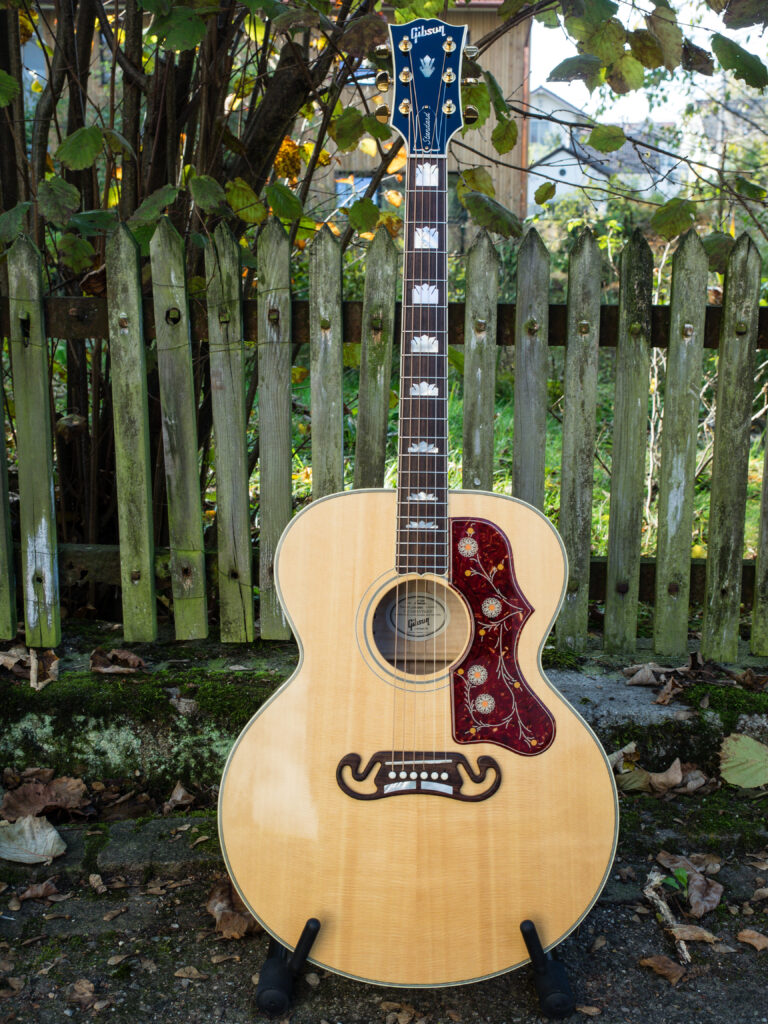
The Gibson SJ-200 is the jumbo above the Hummingbird in Gibson’s acoustic hierarchy — larger body, maple back and sides, even louder and more projecting. The SJ-200 is a different instrument category: a showpiece, a stage guitar built for presence and visual impact. The Hummingbird is more versatile in the studio. The SJ-200 is louder and more dramatic on stage.
Who Should Play the Gibson Hummingbird Standard?
The Hummingbird is the right guitar for players who want power and presence from an acoustic — who strum harder than most, who play live without amplification or with minimal amplification, who want a guitar that can fill a room without electronics. It is the choice for musicians who believe in the acoustic guitar as a physical, powerful instrument rather than as a delicate studio tool.
It is also an excellent guitar for players who have been playing electric guitars and find most acoustics insufficiently loud and projecting in comparison. The Hummingbird’s square-shoulder body generates enough volume and physical presence to feel satisfying to a player accustomed to the authority of an electric guitar through an amp. This is why so many rock guitarists — Richards, Page, Petty — reached for it: the Hummingbird plays like an acoustic guitar that knows it could have been a rock star.
And it is, without any qualification, the guitar for musicians who care about how their instrument looks. In a world where visual presentation matters — on stage, in photographs, in music videos — the Hummingbird is as beautiful an acoustic guitar as has ever been made. The heritage cherry sunburst, the engraved pickguard, the gold hardware: this is a guitar that was designed to be looked at, and it succeeds absolutely.
Buying Guide Summary
Under $2,500 — Hummingbird Standard: The entry point and, for most players, the correct choice. Solid tonewoods, excellent LR Baggs electronics, Bozeman build quality. Try multiple examples if you can — there is variation unit-to-unit, and the best Hummingbird Standards are exceptional guitars. Factory setup is generally good; a professional setup after purchase will optimise the action for your playing style.
$2,500–$4,000 — Hummingbird Original / True Vintage: The thermally aged top and vintage-correct appointments make this the serious player’s choice for getting as close as possible to a vintage Hummingbird’s character without paying vintage prices. No factory pickup system — you will need to add electronics if you perform live.
$4,000–$8,000 — Gibson Custom 1960 Hummingbird Reissue: The Custom Shop version, with all the premium build choices and ageing options. For collectors and serious players who want the definitive modern Hummingbird experience.
$5,000–$20,000+ — Vintage (1960–1968): The originals. First-year 1960 examples are extraordinarily rare; early-1960s examples are highly collectible. Expect to pay a premium for condition and originality. Have any vintage instrument authenticated before purchase — the Hummingbird’s desirability makes it a target for refinishes and part-swaps.
Frequently Asked Questions
What is the main difference between the Hummingbird and the J-45?
The body shape is the primary difference, and it produces real tonal consequences. The Hummingbird’s square-shoulder dreadnought body is larger in its upper bout than the J-45’s round-shoulder body, which produces more volume, more bass extension, and a slightly more aggressive attack. The J-45 is warmer, more intimate, and more naturally vocal-friendly; the Hummingbird is louder, more projecting, and more powerful. Both use the same Sitka spruce and mahogany construction. Players who record primarily often prefer the J-45; players who perform live or strum hard often prefer the Hummingbird.
Why did Keith Richards use the Hummingbird for “Jumpin’ Jack Flash” and “Street Fighting Man”?
Richards was exploring open tunings and home recording techniques in 1968, and he found that recording the Hummingbird on a cassette machine with the preamp pushed into distortion produced a saturated, powerful sound that worked as the foundation for both tracks. The Hummingbird’s projection and volume were essential to the technique — a quieter acoustic would not have overloaded the cassette preamp with sufficient force to create the sound he was after. The combination of open D tuning, the Hummingbird’s assertive attack, and the cassette distortion produced something that sounded like a full band from a single acoustic guitar.
Is the Hummingbird good for fingerpicking?
Yes, though it requires adjustment from players who associate the guitar primarily with strumming. The Hummingbird’s wide dynamic range means that at low fingerpicking volumes, the guitar still sounds full and resonant — the square-shoulder body projects well even when played gently. The mahogany back and sides provide warmth that prevents fingerpicked notes from becoming bright or thin. Some fingerpickers find the Hummingbird’s projection too much in an intimate setting; if that is a concern, lighter strings (.012–.054) and a somewhat lower action will reduce the volume and make the guitar more manageable at quiet dynamics.
Does the Hummingbird Standard come with a pickup?
Yes — the Standard includes the LR Baggs VTC (Vintage Tone Control) undersaddle pickup system with soundhole-mounted volume and tone controls. This is one of the better acoustic pickup systems available at this price point. The Hummingbird Original and True Vintage models do not include factory electronics. The Custom Shop 1960 Reissue is available with or without electronics depending on the specific configuration.
How does the Hummingbird compare to the Martin D-28?
Both are square-shouldered dreadnoughts with spruce tops, but the tonal difference is significant. The D-28 uses rosewood back and sides, producing a wider frequency response — more pronounced bass extension and more treble sparkle — and tends toward a brighter, more complex character. The Hummingbird’s mahogany back and sides produce a warmer, more midrange-forward sound that is somewhat easier to EQ in a mix. The D-28 is typically louder in a pure acoustic context; the Hummingbird is more forgiving in a recording or PA context. Many players own both for different applications.
What makes a vintage 1960s Hummingbird valuable?
First-year (1960) examples are extraordinarily rare — only 156 were made, and finding a clean original is a genuine collector’s achievement. More broadly, pre-1969 Hummingbirds are valued for their non-scalloped X-bracing (which changed in the late 1960s and early 1970s with additions that affected tone), their Honduran mahogany back and sides (replaced by other mahogany sources over time), their period-correct adjustable saddle designs, and the tonal benefits of aged Sitka spruce tops. The best vintage Hummingbirds have an openness, complexity, and depth of tone that new instruments, however well-built, cannot quite match — though the gap has narrowed considerably with thermally aged tops and improved construction at Bozeman.
Is the Hummingbird a good guitar for recording?
Excellent, with some considerations. The Hummingbird’s greater volume and projection compared to the J-45 means that microphone placement matters — you typically want to position the microphone slightly further from the body (20–24 inches rather than 12–18) to avoid overwhelming the capsule or capturing too much low-end. A gentle high-pass filter or low-mid cut at 200–250Hz often improves the Hummingbird’s behaviour in a mix, where its natural bass response can compete with bass guitar and kick drum. The guitar records beautifully once these considerations are addressed, with a warmth and presence that is immediately recognisable as “acoustic guitar done right.”
Image credits
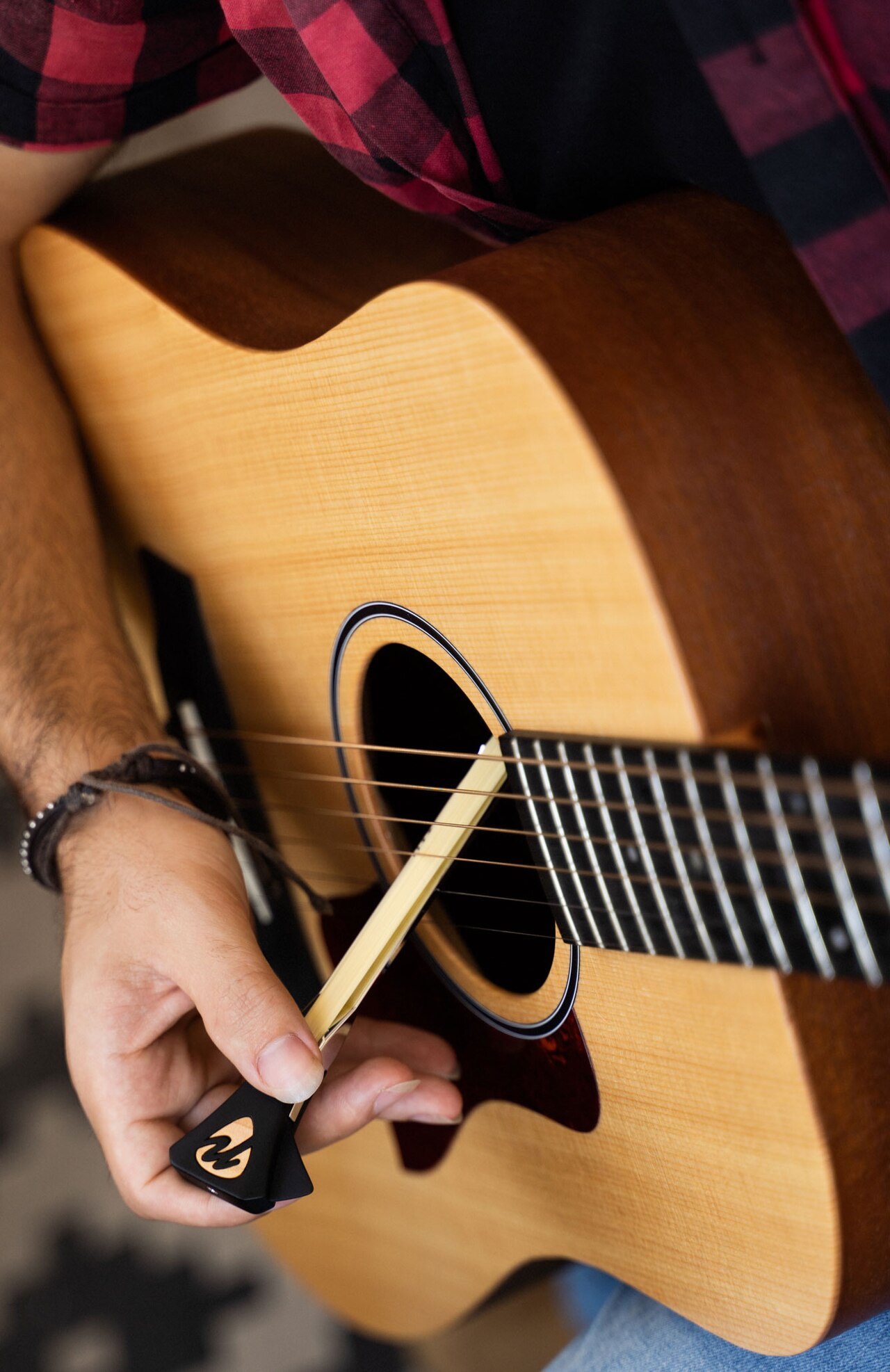
- Hands playing an acoustic guitar: Shixart1985, Wikimedia Commons, CC BY 2.0.
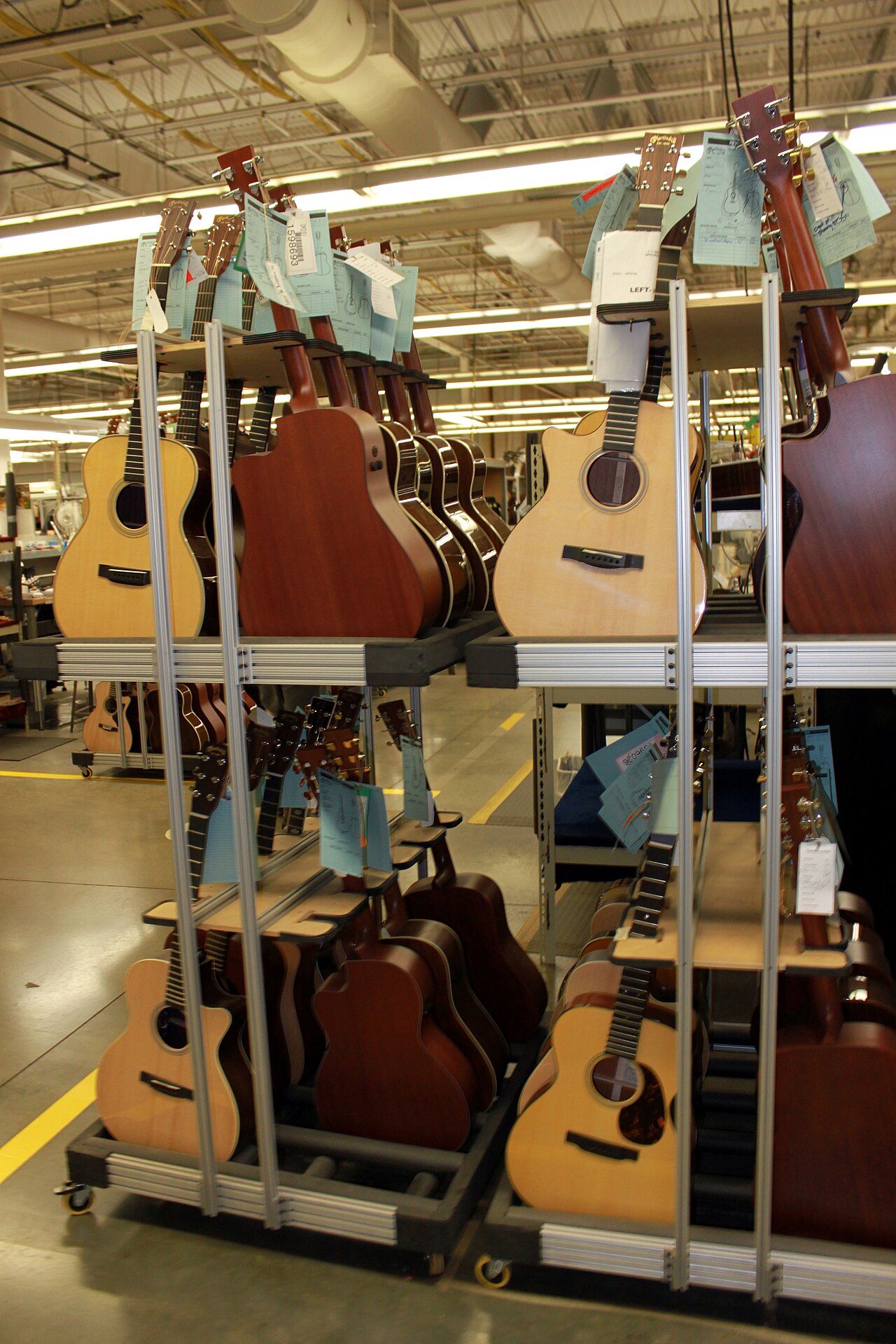
- Racks of acoustic guitars in a factory: Joseph Brent from New York, USA, Wikimedia Commons, CC BY-SA 2.0.
- A hand picking an acoustic guitar: Jonathanshenhav, Wikimedia Commons, CC BY-SA 4.0.
- Keith Richards: Raph_PH, Wikimedia Commons, CC BY 2.0.
- Top image: photo by John Tuggle, via Wikimedia Commons, CC BY 2.0.
Latest News
Related

On This Day
Tuesday 10 November
From this week: