
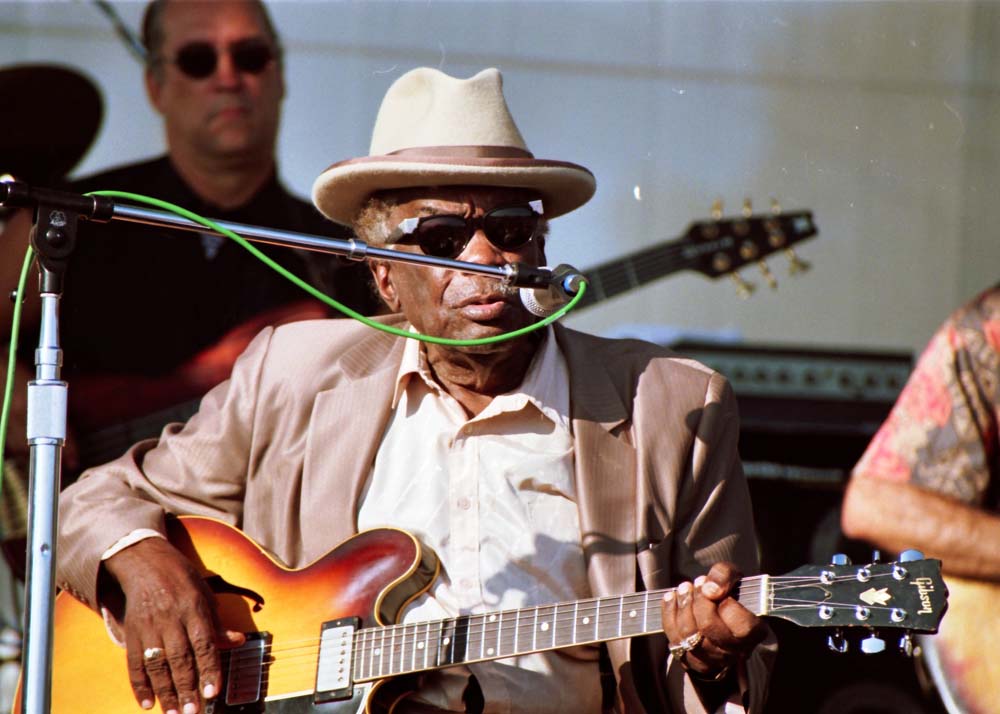
T-Bone Walker gave John Lee Hooker his first electric guitar — an Epiphone — in Detroit, during the wartime factory years when Hooker was working at Ford and playing the Hastings Street clubs at night. “I was already established but not electrified,” Hooker recalled. “I still have that old Epiphone that T-Bone laid on me back in Detroit.” The specificity of the memory — the name of the guitarist who gave it, the city where it happened, the fact that he still had it — speaks to what the first electric guitar meant in the specific context of the Hooker career: the amplified instrument was the transformation, the moment when the acoustic boogie style that the stepfather Will Moore had taught him in Mississippi and that Hooker had been developing on Beale Street in Memphis became the electric boogie that would define a genre. The Epiphone that T-Bone gave him was the beginning of everything subsequent. The Epiphone Sheraton that became his primary electric guitar — the semi-hollow Gibson family instrument whose warm, full archtop character suited the specific Hooker tone — was the continuation of the T-Bone gift’s foundational choice. Epiphone. Detroit. The factory shift during the day. Hastings Street at night. The foot stomping that was as much a part of the sound as the guitar. The thumb on the bass strings. The index finger upstroke on the lead licks. The open G tuning that first appeared on “Crawlin’ Kingsnake” in 1949. The metrically free blues that refused to conform to the standard twelve-bar progression because the music’s emotional content required something more free-form. “Boogie Chillen” in 1948 — the million-selling race record that announced the Hooker boogie to the world and that established the specific rhythmic identity that the Rolling Stones and the Animals and the Doors and Van Morrison and Carlos Santana and generations of subsequent musicians heard as the foundational sound of the electric blues. The King of the Boogie. The T-Bone gift. The Epiphone. The foot stomp. Detroit.
John Lee Hooker was born on August 22, 1917 (the most generally accepted date, though 1912 appears in some accounts), near Clarksdale, Mississippi, to a sharecropper family. He died on June 21, 2001, in Los Altos, California, at the age of eighty-three, having lived the last years of his life in San Francisco where he had licensed a nightclub to use the name “Boom Boom Room,” after one of his most celebrated songs. The biography between the Clarksdale sharecropper’s birth and the Boom Boom Room in San Francisco is one of the more complete available documents of the twentieth-century Black American experience: the Mississippi Delta sharecropper’s son, the Memphis Beale Street musician at fourteen, the wartime Detroit factory worker, the Modern Records artist whose “Boogie Chillen” sold a million copies in 1948, the British Invasion’s most celebrated American influence, the Grammied elder statesman of The Healer in 1989 and Don’t Look Back in 1997, and finally the club owner in San Francisco with the star on the Hollywood Walk of Fame and the induction in the Rock and Roll Hall of Fame and the two songs on the Rock and Roll Hall of Fame’s 500 Songs That Shaped Rock and Roll — “Boogie Chillen” and “Boom Boom.” Two songs. Both from the same source: the foot stomp, the Epiphone, the open tuning, the metrically free blues that moved to its own pulse.
The stepfather Will Moore is the specific biographical connection to the deepest available blues tradition: Moore had played guitar with Charley Patton and Son House — two of the most foundational figures in the Delta blues tradition — and it was Moore who taught the young Hooker the foot-stomping boogie blues that would become his signature. “The first song that John Lee learned was a Patton tune, ‘The Peavine Special.'” The first song: a Charley Patton blues, from the most foundational available Delta blues source, taught by a man who had played with Patton himself. Moore also gave Hooker his second guitar — a mail-order Stella to replace the battered Silvertone — when the first guitar wore out. The guitar lineage: the battered Silvertone, the mail-order Stella from Moore, the Epiphone from T-Bone Walker in Detroit. Three guitars. Three stages of the Hooker musical development, from the Mississippi Delta farm to the Detroit Hastings Street electric blues.
The “metrically free” quality of Hooker’s blues is the specific musical characteristic that most fundamentally distinguishes him from every other blues guitarist in this series and in the broader tradition. Hooker’s blues doesn’t follow the standard twelve-bar progression in the strict metrical sense — the bars may extend or contract, the pulse may shift or sustain, the song may go wherever the emotional content requires rather than where the formal structure demands. “He developed a ‘talking blues’ style that was his trademark. Though similar to the early Delta blues, his music was metrically free.” The metrically free quality is the guitar player’s version of the blues preacher’s call — the specific freedom of someone who learned from Charley Patton through Will Moore, from the deepest pre-commercial layer of the Delta blues tradition where the music served the emotional truth rather than the commercial form. The foot stomp keeping the time that the guitar’s meter didn’t need to follow. The Epiphone saying what needed to be said. The beat: within the guitarist, expressed through the stomp, not required from the metrical structure of the chords.
Background: Clarksdale, Beale Street, Detroit, and the Gift That Started Everything Electric
The Clarksdale, Mississippi origin — the specific Northern Mississippi Delta town that is the geographic center of the Delta blues tradition, that produced Robert Johnson and Muddy Waters and Son House and multiple other foundational blues musicians through the specific combination of the Delta’s cotton-field labor economy and the Saturday night blues culture — placed Hooker at the source of the specific musical tradition that he would spend his career developing and expanding. The sharecropper family background, the childhood in the immediate vicinity of Charley Patton’s and Son House’s music through the stepfather Moore, the specific Delta blues tradition absorbed directly rather than through recordings or secondary transmission: this is the foundational formation of the most foundational available blues guitar voice.
Beale Street in Memphis — where Hooker went at fourteen with guitar in hand — is the specific commercial blues environment that provided the professional context for the Delta blues musician who had the raw material from Clarksdale but needed the professional context for development. The Beale Street clubs, the New Daisy Theatre, the professional musicians environment of the most celebrated blues commercial center of the 1930s and 1940s: this is where Hooker learned the professional context for the blues tradition that Moore had taught him in Mississippi. The sixteen-year gap between leaving Clarksdale and arriving in Detroit — the period covering the Memphis years, some time in Cincinnati, other stops — developed the specific boogie blues approach that Detroit and the electric guitar would electrify.
Detroit in the wartime and postwar period is the specific urban environment that transformed the Mississippi Delta blues into the urban electric blues. The Ford factory job and the Hastings Street clubs: the specific combination of the industrial north’s economic opportunity and the Black urban music scene’s creative energy that produced the Detroit Blues moment of the late 1940s and early 1950s. Hooker was not alone in the Detroit transformation — Detroit also produced the specific blues scene that preceded Chicago’s Chess Records-dominated urban electric blues — but he was the most fully realized individual expression of the Detroit electric blues identity. The Epiphone that T-Bone Walker gave him was the specific instrument through which the Mississippi foot-stomping boogie blues became the Detroit electric boogie that produced “Boogie Chillen.”
“Boogie Chillen” in 1948 — the million-selling race record that “became a hit single” and “selling over a million copies” at the very beginning of his recording career — is the specific commercial breakthrough that established Hooker’s national presence simultaneously with the first available documentation of his electric guitar approach. The guitar on “Boogie Chillen” is the Epiphone through the recording chain at producer Bernie Besman’s Detroit sessions: the specific foot-stomping, single-note-riff, metrically free boogie that the Mississippi Delta had produced through Moore’s teaching and Charley Patton’s tradition, now electrified by T-Bone’s gift and produced by Besman for the Modern Records label. A million copies. The King of the Boogie, established at the first available opportunity.
The British Invasion connection is the specific legacy chapter that established Hooker’s influence on the most commercially significant rock music movement of the 1960s: the Rolling Stones, the Animals, and the Kinks all covered or directly referenced Hooker, and the Animals’ Eric Burdon said that Hooker’s blues was the foundational influence on the entire British blues-rock tradition. The Animals’ version of “Boom Boom” (1964), the Rolling Stones’ sustained relationship with the Hooker boogie identity, and Van Morrison’s extended collaborations across the subsequent decades are the specific commercial and cultural documents of the Hooker influence on the British and European rock tradition. The man who stomped his foot on the Detroit floorboards recording “Boogie Chillen” became the primary influence on the bands that defined 1960s rock culture.
The Rig: John Lee Hooker’s Guitars, Amps, and Effects
Guitars
Hooker remained faithful to Epiphone and Gibson guitars for most of his professional life, with a favorite model being the Epiphone Sheraton — the semi-hollow thinline electric archtop that combines the hollow-body warmth of the full archtop with the feedback-resistance and sustain of the thinline construction. The Epiphone Sheraton’s specific character: the semi-hollow body with the center block that reduces feedback at high volumes while maintaining the acoustic warmth of the hollow chambers on either side; the dual humbucker pickups providing the warm, full, low-noise output appropriate for the Hooker boogie’s specific tonal character; and the Sheraton’s particular scale length and neck feel that suited Hooker’s specific thumb-and-finger playing approach. The Sheraton was the professional-grade Epiphone archtop — positioned as the equivalent of the Gibson ES-335 in the Epiphone line — and Hooker’s consistent return to it across his career confirmed the specific tonal and physical compatibility between the instrument and the approach. Epiphone introduced a signature John Lee Hooker Sheraton and Sheraton II in 2000, the year before his death — the formal institutional acknowledgment of the Sheraton’s central place in the Hooker guitar identity.
The first electric guitar — the Epiphone that T-Bone Walker gave Hooker in Detroit — is the specific founding instrument of the Hooker electric career, held onto for decades after the gift. “I was already established but not electrified. I still have that old Epiphone that T-Bone laid on me back in Detroit.” The fact that T-Bone Walker — one of the most celebrated electric blues guitarists in the tradition, the man who developed the single-string electric blues vocabulary that B.B. King would subsequently develop further — was the specific person who gave Hooker his first electric guitar is the specific biographical connection between the two primary traditions of the electric blues: the Texas single-string electric tradition (T-Bone) and the Mississippi-to-Detroit boogie tradition (Hooker). T-Bone’s gift connected the two. The Epiphone was the instrument of the connection.
The Grammy Museum exhibit on Hooker includes “a rare 1961 Epiphone Zephyr — one of only 13 made that year — identical to the ’61 Zephyr played by John Lee Hooker.” The Epiphone Zephyr is one of the rarest and most historically significant archtop electrics in the Epiphone catalog — a full hollow-body archtop with the specific vintage character of the pre-Gibson-acquisition Epiphone production. Only 45 Zephyrs were produced between 1959 and 1963, making the specific 1961 Hooker Zephyr one of the rarest guitars associated with any artist in the blues tradition. The Zephyr’s full hollow-body construction provided a different acoustic character from the Sheraton’s semi-hollow thinline — more resonant, more acoustically projecting, with the specific warm, full character of the vintage full hollow-body archtop.
Hooker was also a regular player of the similarly-built Gibson ES-335 — the Gibson thinline semi-hollow that the Epiphone Sheraton is modeled after, with the same center-block semi-hollow construction and the same warm humbucker character. The specific relationship between the Sheraton and the ES-335 — effectively the same guitar in different brand contexts — confirms the consistency of the Hooker tonal preference: the semi-hollow thinline with humbuckers, the warm and full acoustic-electric character, whether branded as Epiphone or Gibson.
The Grammy Museum exhibit documents additional instruments: a Hohner HJ5 Jazz, and a custom Washburn HB35, all of which were played by Hooker. The breadth of the collection — from the rare 1961 Epiphone Zephyr to the custom Washburn — reflects the working musician’s accumulation of instruments across a fifty-plus-year professional career while maintaining the consistent preference for the semi-hollow electric archtop family that the Epiphone Sheraton represents.
The early Hooker guitars — the battered Silvertone (original), the mail-order Stella (given by stepfather Moore to replace it) — are the acoustic instruments that preceded the electric career and that defined the specific acoustic approach (open G tuning, foot stomping, metrically free boogie) that the electric guitar subsequently amplified without changing. The acoustic boogie tradition established on the Stella was the complete musical identity before electrification; the electric guitar amplified it rather than transformed it. The foot stomp was always the same. The open tuning was always the same. The metrically free blues was always the same. T-Bone’s Epiphone made it louder.
Amps
Hooker’s specific amplifier choices across the decades of his career are not comprehensively documented in the available sources — consistent with the pattern of the early blues musicians who were not the primary equipment documentarians of their own careers, and who typically used whatever amplification the specific recording session, club, or stage provided. The specific character of the Hooker amplified sound — the “warm and very percussive sound” that Guitar World’s lesson guide describes — is produced primarily by the Epiphone Sheraton’s semi-hollow humbucker character and the fingerstyle technique rather than by a specific amplifier model. The semi-hollow’s acoustic warmth, the humbucker’s full output, and the finger-rather-than-pick technique’s specific soft attack combine to produce the Hooker tone regardless of which specific amplifier is providing the clean amplification.
Effects and Technique
No Pick — Thumb and Index Finger (Primary Technique)
Hooker didn’t use a pick, utilizing his thumb to hit the bass notes and brushing his lead licks with an upstroke of his index finger. This specific fingerstyle approach — thumb for bass, index finger upstroke for lead — is the physical foundation of the Hooker sound. The thumb’s softer attack on the bass strings produces the specific warm, full, sustained bass note that the boogie patterns are built on; the index finger’s upstroke produces a different attack character from the pick’s downstroke — softer, warmer, more rounded — that gives the Hooker lead lines their specific intimate, vocal quality. The no-pick approach is the foundational physical source of the “warm and very percussive sound” — the warmth from the finger attack rather than the pick’s harder contact, the percussion from the specific rhythmic precision of the thumb-and-index alternation.
Foot Stomping (Primary Rhythm — Not Always Following the Bar)
The foot stomp is as much a part of the Hooker “equipment” as the guitar: the specific physical rhythmic foundation that the foot provided on the wooden floor of the clubs and studios was the constant rhythmic pulse against which the metrically free guitar played without being constrained by it. “To me, John Lee sounds the best sitting alone with an acoustic or Sheraton guitar accompanied by the solid foot tapping that was so typical of his sound.” The foot tap was the rhythmic anchor that allowed the guitar to be metrically free without losing the pulse entirely — the foot keeping the essential beat while the guitar explored the space around it. Early recordings of “Boogie Chillen” were famously made with Hooker stomping his foot on the wooden floor of the recording space, the stomp audible on the recording as an integral rhythmic element.
Open G Tuning (Primary Tuning — “Crawlin’ Kingsnake” and Beyond)
Hooker played much of his music in open G, which he first employed for his 1949 recording of “Crawlin’ Kingsnake” (covered by The Doors). Open G tuning — with the strings tuned (low to high) D G D G B D — allows a full G major chord to sound from all open strings, enabling the guitar to be strummed openly for the fundamental chord and slid or fretted for melodic movement without requiring complex chord positions. The open G’s specific resonant quality — all strings contributing to the G major harmonic content — is the specific acoustic character that the Hooker boogie patterns use as their harmonic foundation: the open strings ringing beneath the single-note melodic lines, creating the specific full, resonant boogie texture.
Open A Tuning with Capo (Additional Tuning — Multiple Keys)
Hooker performed and recorded a great many tunes on both acoustic and electric guitar in open A tuning (low to high, E A E A C# E), oftentimes using a capo at the first, second, or third fret to perform in different keys. The open A provides the same self-contained resonant chord character as the open G but in a different key, allowing the specific resonant open-string quality to be maintained across multiple performance contexts. The capo on the first, second, or fourth fret shifts the open tuning to the higher-toned keys (open A at capo 2 becomes open B, etc.), providing the range of tonal options across a single open-tuning approach without requiring different guitar setups for different songs.
Metrically Free Blues (Primary Compositional “Effect”)
The most fundamental “effect” in the Hooker musical approach is not a tuning or a technique but the specific compositional and rhythmic freedom of the metrically free blues — the music that doesn’t follow the standard twelve-bar progression’s strict bar count because the emotional content requires a different kind of time. “His music was metrically free. John Lee Hooker could be said to embody his own unique genre of the blues, often incorporating the boogie-woogie piano style and a driving rhythm into his masterful and idiosyncratic blues guitar and singing.” The metrically free quality comes from the deepest available layer of the blues tradition — the pre-commercial Delta blues that Charley Patton and Son House and Will Moore played before the twelve-bar convention had been commercially standardized. Hooker absorbed the metrically free quality from Moore and retained it through the Detroit electric era and the British Invasion and The Healer and Don’t Look Back, because it was the most authentic available expression of the blues feeling he carried from Clarksdale.
Playing Style & Tone Philosophy
John Lee Hooker plays guitar as the most elemental available expression of the blues — the music in its most distilled form, the feeling before the formal convention, the beat before the bar count. The no-pick approach, the foot stomp, the open tuning, and the metrically free composition combine to produce the specific Hooker sound that Guitar World describes as “warm and very percussive” and that the Udemy blues guitar course describes as “the most ‘blues’ sounding of all the blues guitarists.” The warmth is from the fingerstyle technique; the percussion is from the foot stomp and the thumb’s rhythmic bass pattern; and the “most blues” quality is the specific distillation of the tradition that the Moore-Patton-Son House lineage provided and that the Detroit electrification amplified without diluting.
“I checked out electrified in the ’50s but it wasn’t ’til ‘Boom Boom’… that’s when I really stretched out on the electric.” The stretch that “Boom Boom” represented — the specific development of the electric boogie style that the Epiphone Sheraton’s warm semi-hollow humbucker character through the club amplification enabled — is the specific moment when all the elements of the Hooker electric approach were fully integrated: the T-Bone Epiphone tradition, the open tuning’s resonant harmonic foundation, the foot stomp’s rhythmic anchor, the metrically free compositional freedom, and the Sheraton’s specific warm tonal character all combining in the specific “Boom Boom” sound that Hooker identified as the full realization of the electric approach.
The specific quality of the Hooker blues that made the British musicians — the Rolling Stones, the Animals, the Kinks, Van Morrison — so responsive to it is the specific rawness and emotional directness of the metrically free approach: in the context of the early 1960s British music scene, where the American blues had been filtered through the commercial recording conventions of the standard twelve-bar format, the Hooker blues’ metrically free quality sounded like a liberation — music that served the feeling rather than the form. The British musicians heard the freedom and wanted it. They tried to play it. Most of them succeeded in approximating the form without fully reproducing the freedom. Van Morrison came closest over the long term, through the specific series of collaborations that Hooker and Morrison recorded together — including “Never Get Out of These Blues Alive,” “The Healing Game,” and “I Cover the Waterfront” — where Morrison’s Celtic soul music met the Mississippi sharecropper’s Delta blues in the specific emotional territory that both traditions shared.
How to Sound Like John Lee Hooker
The John Lee Hooker tone requires: an Epiphone Sheraton or equivalent semi-hollow electric archtop with humbuckers (or the Gibson ES-335 in its closest Gibson equivalent); clean tube amplification at low to moderate volume; no pick — thumb for bass, index finger upstroke for lead; open G or open A tuning (with capo for key transposition); the foot stomp as the rhythmic anchor; and the specific metrically free quality of music that serves the emotional content rather than the bar count. The last item is the hardest. The Epiphone can be bought. The freedom from the bar count requires the complete internalization of the blues feeling that the sharecropper’s son from Clarksdale had absorbed from his stepfather and Charley Patton before any formal music education could impose the bar count.
| Control | Setting (0–10) | Notes |
|---|---|---|
| Clean Tube Amplifier (Warm Blues Character) | Volume: 5–6; Treble: 5; Bass: 6; Mid: 6 | Warm, moderately loud tube amplification — the specific character appropriate for the Epiphone Sheraton’s semi-hollow humbucker output in the blues context. Not the high-gain character of the rock amplifier but the warm, clean character of tube amplification at moderate volume that preserves the Sheraton’s acoustic warmth while providing the stage volume required for club performance. |
| Epiphone Sheraton / ES-335 (Humbuckers) | Neck humbucker; Volume: 8; Tone: 6 | The semi-hollow Epiphone or Gibson with the warm neck humbucker output into the clean tube amp. The center-block construction reduces feedback at stage volumes while maintaining the hollow chambers’ acoustic warmth. Tone slightly rolled back for the specific warm, full character of the Hooker tone. The fingerstyle technique’s softer attack is preserved by the warm humbucker’s smooth frequency response. |
| Open G Tuning (D G D G B D) | All six strings tuned to open G chord | “Much of Hooker’s playing was in open G, which he first employed for his 1949 recording of ‘Crawlin’ Kingsnake.'” The open G provides the resonant, full-chord sound from the open strings that the Hooker boogie patterns use as their harmonic foundation. All six strings sounding together produce the G major chord; single notes above the open-string drone create the specific melody-over-drone character of the Delta boogie. Add a capo at the second fret for open A, fourth for open B. |
| No Pick (Thumb and Index Finger) | Thumb: bass strings; index finger upstroke: lead strings | “Hooker didn’t use a pick, utilizing his thumb to hit the bass notes and brushing his lead licks with an upstroke of his index finger.” The thumb’s bass attack and the index finger’s upstroke lead: the specific two-voice technique that produces the “warm and very percussive” Hooker tone. The upstroke of the index finger is softer and warmer than a downstroke pick attack — the specific quality that distinguishes the Hooker lead tone from the pick-using blues guitarists. |
| Foot Stomp (Rhythmic Anchor) | Stomp the beat on the wooden floor | “To me, John Lee sounds the best sitting alone with an acoustic or Sheraton guitar accompanied by the solid foot tapping.” The foot stomp is the rhythmic anchor that allows the guitar to be metrically free without losing the pulse entirely. The foot keeps the essential beat; the guitar explores the space around it. Stomp on 1 and 3. Let the guitar play where the feeling goes. The stomp is audible on the early “Boogie Chillen” recordings. It belongs in the sound. |
| Metrically Free Blues (Emotional Truth Over Bar Count) | Play the feeling; not the form | “Though similar to the early Delta blues, his music was metrically free.” Don’t count bars. Play until the phrase is finished, then start the next. Add a bar if the feeling requires it; take one away if it doesn’t. The twelve-bar is a convention, not a law. The Charley Patton tradition that Will Moore taught Hooker was metrically free. The Hooker boogie carries that freedom. Let the foot stomp keep the underlying pulse; let the guitar say what it needs to say in the time it needs to take. |
Influence & Legacy
John Lee Hooker’s influence on rock, blues, and popular music is the influence of the single-most elemental available electric blues voice — the Mississippi sharecropper’s son who absorbed the deepest available layer of the Delta blues tradition from his stepfather and Charley Patton and Son House, amplified it through T-Bone Walker’s Epiphone gift in Detroit, recorded “Boogie Chillen” in 1948, and spent the next five decades demonstrating to every subsequent generation of rock and blues musicians what the blues actually felt like before the commercial conventions formalized it into the twelve-bar. The Rolling Stones, the Animals, the Kinks, Van Morrison, the Doors (who covered “Crawlin’ Kingsnake”), Carlos Santana, Keith Richards, Bonnie Raitt, Robert Cray, George Thorogood — all of these musicians, across two generations, acknowledged Hooker as the primary available source of the blues feeling that their music most aspired to.
The Healer (1989) — the album that Hooker recorded at seventy-two with Carlos Santana, Keith Richards, Bonnie Raitt, Robert Cray, George Thorogood, Charlie Musselwhite, Los Lobos, and Van Morrison — is the specific commercial document of the Hooker legacy at its most concentrated: every significant rock and blues musician of the era, gathered around the source. The album won a Grammy for Best Traditional Blues Recording (“I’m in the Mood” with Bonnie Raitt, 1990). Don’t Look Back (1997, co-produced by Van Morrison) won a Grammy for Best Traditional Blues Album. The Rock and Roll Hall of Fame inducted him in 1991. Two songs on the Rock and Roll Hall of Fame’s 500 Songs That Shaped Rock and Roll. The Hollywood Walk of Fame star. The Boom Boom Room in San Francisco. The Epiphone signature Sheraton and Sheraton II, released the year before he died. “One of the true superstars of the blues: the ultimate beholder of cool,” as the Grammy Museum describes him. The King of the Boogie. He was already established but not electrified when T-Bone gave him the Epiphone in Detroit. Then he got electrified. Then the world got Boogie Chillen. Then everything followed.
For the Delta blues tradition that Hooker carried into the electric era, see the broader blues roots of this series documented through multiple entries — James “Blood” Ulmer , whose harmolodic avant-funk represents one specific development from the same Delta blues foundation that Hooker’s metrically free boogie embodied more directly. The T-Bone Walker connection that gave Hooker his first electric places the Hooker story in dialogue with the broader Texas-Oklahoma blues guitar tradition documented through Barney Kessel and Herb Ellis — both of whom were working in the same West Coast jazz-blues nexus that T-Bone inhabited when he gave Hooker the Epiphone. And the no-pick fingerstyle technique that defines Hooker’s physical approach connects to Charlie Byrd’s classical fingerstyle — different traditions, the same fundamental commitment to the finger rather than the plectrum as the primary tonal resource.
Born near Clarksdale. Sharecropper’s son. Will Moore taught him the foot-stomping boogie blues and Charley Patton’s “Peavine Special.” Beale Street at fourteen. Detroit and the Ford factory. T-Bone Walker gave him the Epiphone. Hastings Street at night. “Boogie Chillen” in 1948. A million copies. “I was already established but not electrified.” The Epiphone Sheraton. The foot stomp on the wooden floor. The open G tuning. No pick. The metrically free blues. “Boom Boom.” The Rolling Stones. The Animals. Van Morrison. Carlos Santana, Keith Richards, Bonnie Raitt, around the source in 1989. The Boom Boom Room in San Francisco. He died in 2001 at eighty-three. The Epiphone that T-Bone gave him is still there. He still had it. The King of the Boogie. The foot is still stomping.
Frequently Asked Questions: John Lee Hooker Guitars & Gear
What guitar did John Lee Hooker use?
John Lee Hooker’s primary electric guitar was the Epiphone Sheraton — the semi-hollow thinline archtop that he used throughout most of his professional career. He also played the Gibson ES-335 (similarly constructed) and owned a rare 1961 Epiphone Zephyr (one of only 13 made that year), a Hohner HJ5 Jazz, and a custom Washburn HB35. Epiphone introduced signature John Lee Hooker Sheraton and Sheraton II models in 2000, the year before his death. His first electric guitar was an Epiphone given to him by fellow blues guitarist T-Bone Walker in Detroit — an instrument he kept for decades.
How did John Lee Hooker play guitar?
Hooker didn’t use a pick, utilizing his thumb to hit the bass notes and brushing his lead licks with an upstroke of his index finger. He played primarily in open G (first used for 1949’s “Crawlin’ Kingsnake”) and open A tuning (E A E A C# E), often using a capo at the first, second, or third fret to change keys. His foot stomp was an integral rhythmic element — the foot keeping time on the wooden floor while the guitar was metrically free. His music was “metrically free” — not conforming to the strict twelve-bar progression, allowing the emotional content to determine the bar count.
Who gave John Lee Hooker his first electric guitar?
T-Bone Walker — the Texas blues guitarist who pioneered the single-string electric blues vocabulary — gave Hooker his first electric guitar, an Epiphone, in Detroit. “I was already established but not electrified. I still have that old Epiphone that T-Bone laid on me back in Detroit,” Hooker recalled. The gift occurred during the wartime and postwar Detroit years when Hooker was working at Ford Motor Company and playing the Hastings Street clubs. The T-Bone Epiphone was the beginning of the electric Hooker career that would produce “Boogie Chillen” in 1948.
What is the significance of “Boogie Chillen”?
“Boogie Chillen” (1948) was John Lee Hooker’s first major recording — a million-selling race record released on the Modern label that announced his electric boogie style to the world and established him as a significant figure in the electric blues tradition. Recorded in Detroit at producer Bernie Besman’s sessions, the track features Hooker’s foot stomp audibly on the wooden floor alongside the Epiphone guitar in the open tuning boogie pattern. Two Hooker songs — “Boogie Chillen” and “Boom Boom” — are on the Rock and Roll Hall of Fame’s 500 Songs That Shaped Rock and Roll.
What was The Healer and why is it significant?
The Healer (1989) was a late-career Hooker album recorded when he was seventy-two, featuring an extraordinary cast of collaborators: Carlos Santana, Keith Richards, Bonnie Raitt, Robert Cray, George Thorogood, Charlie Musselwhite, Los Lobos, and Van Morrison. The album brought Hooker to a new generation of listeners and documented the breadth of his influence on multiple generations of rock and blues musicians. It won the Grammy Award for Best Traditional Blues Recording (“I’m in the Mood” with Bonnie Raitt, 1990). Don’t Look Back (1997, co-produced by Van Morrison) subsequently won the Grammy for Best Traditional Blues Album.
What is the metrically free quality of Hooker’s blues?
Hooker’s music is “metrically free” — it doesn’t conform to the strict twelve-bar bar count of the standard blues form, allowing bars to extend or contract as the emotional content requires. This quality comes from the pre-commercial Delta blues tradition that Hooker absorbed from his stepfather Will Moore (who played with Charley Patton and Son House) — the deepest available layer of the blues before the twelve-bar was commercially standardized. The foot stomp provides the essential pulse while the guitar is free to play what the emotion requires in whatever time that takes.
Who influenced John Lee Hooker?
Hooker’s primary musical education came from his stepfather Will Moore, who played with Charley Patton and Son House — two of the most foundational figures in the Delta blues tradition. Moore taught Hooker the foot-stomping boogie blues and gave him his first guitar. The first song Hooker learned was a Charley Patton tune. T-Bone Walker’s gift of the first electric Epiphone in Detroit provided the specific transition to the electric blues. Hooker himself then influenced multiple generations: the Rolling Stones, the Animals, the Kinks, Van Morrison, the Doors (who covered “Crawlin’ Kingsnake”), Carlos Santana, Keith Richards, Bonnie Raitt, and essentially every significant blues-rock musician of the subsequent era.
Related stories
Vernon Reid Guitars & Gear: The Complete Guide to Living Colour’s Guitar Genius’s Rig
Vernon Reid's guitars, amps, and effects — the complete guide. Parker MaxxFly, PRS Vela VR, Mesa Dual Rectifiers, Roland VG-99, Eventide H9, Living Colour gear guide.
Warren DeMartini Guitars & Gear: The Complete Guide to Ratt’s Torch Guitarist’s Rig
Warren DeMartini guitars & gear: Ratt's Torch guitarist. Charvel Bomber, snakeskin, Jose-modded Plexi, Fender Super Champ, RTM pickup, slapback echo — the complete rig.
Warren Haynes Guitars & Gear: The Complete Guide to Gov’t Mule’s Guitar Master’s Rig
Warren Haynes' guitars, amps, and effects — the complete guide. Gibson Les Paul Chester, Soldano SLO-100 modified, Klon Centaur, Emma Discombobulator, and how to nail that Gov't Mule blues-rock tone.