Neil Young Guitars & Gear: The Complete Guide to Old Black and the Godfather of Grunge’s Rig
Neil Young's guitars, amps, and effects — the complete guide. Old Black Les Paul, 1959 Fender Deluxe, the Whizzer system, Echoplex, and how to nail that raw, cranked Neil Young tone.
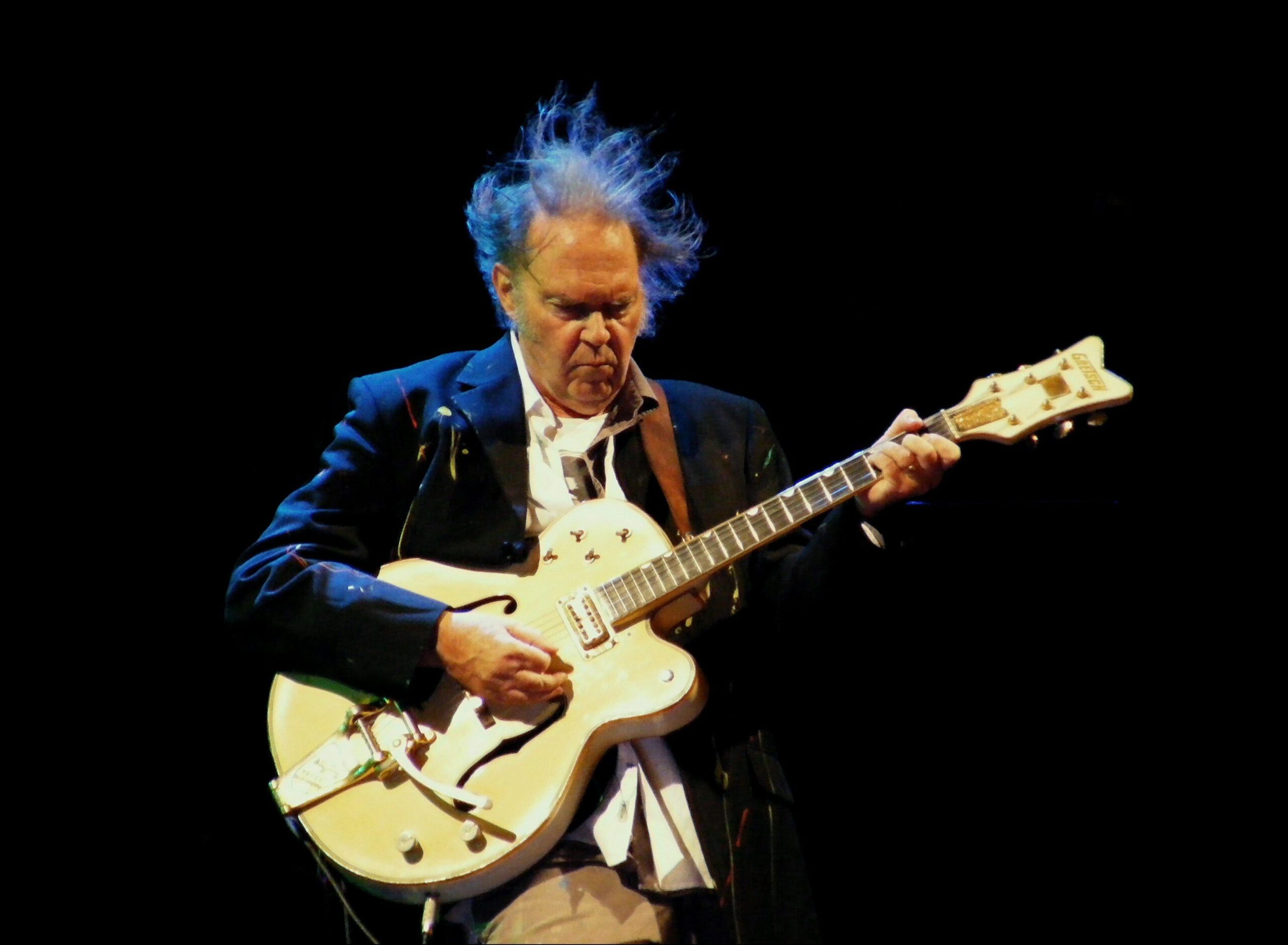
Photo by Man Alive!, licensed under CC BY 2.0. Work: Neil Young 2012.jpg. Licence: https://creativecommons.org/licenses/by/2.0/ Source: https://commons.wikimedia.org/wiki/File:Neil_Young_2012.jpg Site copy resized and re-encoded.
Gear Timeline
There is a guitar, and there is an amplifier, and there is a relationship between those two objects and the man who connects them that defies conventional gear analysis. Neil Young has owned approximately 450 examples of the same 1959 Fender Deluxe amplifier. He has tried almost all of them. He uses one — his original, purchased second-hand in 1967 for $50 — because none of the others sound like it. His guitar tech Larry Cragg has worked for him since 1972 and describes his professional philosophy in four words: “You don’t change anything.” Crazy Horse guitarist Nils Lofgren owns a 1952 Gibson Goldtop specifically so he can cover songs that Neil plays piano on. He has noted, after extensive use, that his guitar sounds nothing like Old Black. “Whether it is the way Neil plays or the guitar or some magical combination of the two,” Cragg has said, “even those who have attempted to replicate Old Black are still unable to nail down the iconic tone the pair produce.”
Neil Young was born on November 12, 1945, in Toronto, Ontario, Canada — a Prairie kid who became a Californian by adoption and a rock legend by accumulated force of will, talent, and a decades-long refusal to be anyone other than exactly who he was. His career trajectory — Buffalo Springfield, Crosby Stills Nash & Young, solo records including Harvest and After the Gold Rush and Tonight’s the Night and Rust Never Sleeps and Ragged Glory, the Crazy Horse partnership, the decades of environmental activism, the LincVolt electric car project, the Pono audio player, the lawsuit battles, the endless archival releases — is one of the most varied and consistently interesting careers in rock music. He has won multiple Grammy Awards, been inducted into the Rock and Roll Hall of Fame twice (as a solo artist and as a member of Buffalo Springfield), and inspired the entire grunge movement while apparently not particularly trying to.
Kurt Cobain quoted him in his suicide note — “It’s better to burn out than to fade away,” from “Hey Hey, My My (Into the Black)” — which gave Young’s observation about rock mythology a permanent, terrible weight that he has spoken about with evident sadness. The phrase was already in the culture. After 1994, it was something else entirely. Young’s response was to keep playing — to continue doing, through the 1990s and 2000s and 2010s, exactly what he had always done: recording when moved to record, touring when the music demanded it, following artistic impulses regardless of commercial logic, and playing Old Black through that specific 1959 Fender Deluxe at volumes that, in the words of his guitar tech Larry Cragg, “sound like thunder when cranked.”
This is the complete guide to the gear that produced all of it — from the battered Les Paul that is worth more than most houses to the Whizzer system that physically turns the amplifier’s knobs from the stage — and to the philosophy behind one of the most uncompromisingly individual sounds in the history of the electric guitar.
Background: From Toronto to the Topanga Canyon and Beyond
Neil Percival Young grew up in Winnipeg, Manitoba, after his parents separated — his father Scott Young was a well-known Canadian sports journalist; his mother Rassy was a quiz show panelist and devoted fan of her son’s music. He contracted polio at twelve, which left him with an arm weakness that would shape his guitar technique for the rest of his career. He has described the accommodation his body made to the polio’s effects — the development of a more arm-based, sweeping picking style that used less fine finger movement than many players employ — as directly responsible for the particular attack character of his playing. The “sloppy” solos, the hammer-like approach to the strings, the primitive power of his lead work: all of this traces at least partly to a childhood illness and the adaptations it required.
He began playing guitar in Winnipeg, picked up the banjo and ukulele first (his mother played ukulele), and gradually transitioned to guitar under the influence of the early rock and roll and folk music he was absorbing. He moved to Toronto and then to California in 1966, connecting with Stephen Stills in Los Angeles and forming Buffalo Springfield — the brief, explosive band that produced “For What It’s Worth” and several other genuinely significant recordings before dissolving in 1968 amid interpersonal friction. Buffalo Springfield gave Young his national profile and his connection to the California music scene that would sustain his solo career through the commercially successful early 1970s period.
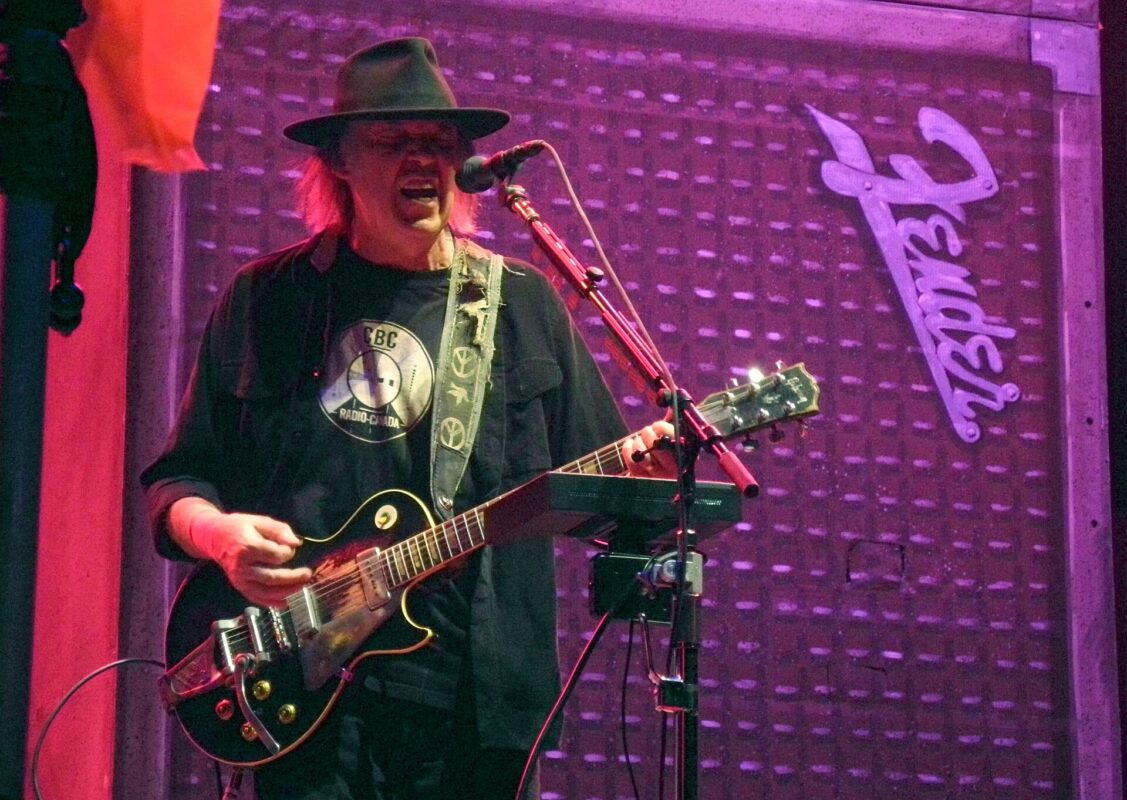
The critical trade that produced Old Black happened in late 1968 or early 1969, when Young traded a Gretsch 6120 Chet Atkins guitar to his Buffalo Springfield bandmate Jim Messina for the battered, already-modified 1953 Gibson Les Paul Goldtop that would become the most famous guitar in his career. The trade value at the time: approximately $350 on Young’s side. The subsequent decades of use and modification transformed a serviceable vintage guitar into an instrument of genuinely mythological status.
The early albums — Neil Young (1968), Everybody Knows This Is Nowhere (1969, with Crazy Horse), After the Gold Rush (1970), Harvest (1972) — established the two poles of his musical identity: the intimate, acoustic, melodically gentle folk-rock side (Harvest, “Heart of Gold,” “The Needle and the Damage Done”) and the distorted, feedback-drenched, primally aggressive electric side (Everybody Knows This Is Nowhere, “Cowgirl in the Sand,” “Down by the River”). The tension between these poles has driven his music for sixty years, and both sides of the guitar approach — the acoustic Martin and the cranked electric Les Paul — are equally fundamental to understanding who he is.
The albums from the mid-to-late 1970s that are sometimes called “the Ditch trilogy” — Time Fades Away (1973), On the Beach (1974), Tonight’s the Night (1975) — represented a deliberate retreat from commercial accessibility that remains artistically stunning and commercially inexplicable: at the height of his commercial success, Young followed up the platinum Harvest with some of the most raw, emotionally difficult, and deliberately uncommercial music of his career. The strategy was eccentric. The music was extraordinary.
Rust Never Sleeps (1979) — the album that gave Cobain his epitaph line — is generally considered his artistic and commercial resurgence of the late 1970s and remains one of the essential documents of his career. The electric side (“Hey Hey, My My (Into the Black),” “Powderfinger,” “Welfare Mothers”) shows the full power of the Old Black/Fender Deluxe combination at its most confrontational. The acoustic side (“My My, Hey Hey (Out of the Blue),” “Comes a Time”) shows the Martin acoustic tradition at its most intimate. The contrast is the argument for Neil Young as a complete guitarist.
He has continued releasing albums at a rate that would exhaust most artists a third of his age, advocating for high-resolution audio through Pono and then through his Xstream project, fighting for environmental causes, and playing concerts with a band called Crazy Horse that has outlasted most of its members’ original expectations by several decades. He is seventy-nine years old in 2026. Old Black is still being played. The 1959 Deluxe is still doing its specific, irreplaceable thing.
The Rig: Neil Young’s Guitars, Amps, and Effects
Neil Young’s gear philosophy, as expressed by his longtime guitar tech Larry Cragg, is one of the most consequential statements in guitar maintenance history: “When it comes to equipment, the idea with Neil is that you don’t change anything. You don’t even think about it.” Everything that follows should be understood in that context.
Guitars
The story of Old Black is the story of one of rock music’s most continuously modified, perpetually controversial, and endlessly analyzed instruments. It began as a standard 1953 Gibson Les Paul Goldtop — part of the first Les Paul production run, featuring the original trapeze tailpiece and two cream P-90 single-coil pickups. The 1953 Les Paul’s construction uses a mahogany body with a one-inch maple cap (to relieve the weight of solid mahogany), a mahogany neck with a rosewood fretboard and trapezoid inlays, and the P-90 pickups that give early Les Pauls their specific combination of warmth and bark. Before Young acquired it, the guitar had been painted black — the goldtop finish obscured under a rough respray that gave the instrument its nickname.
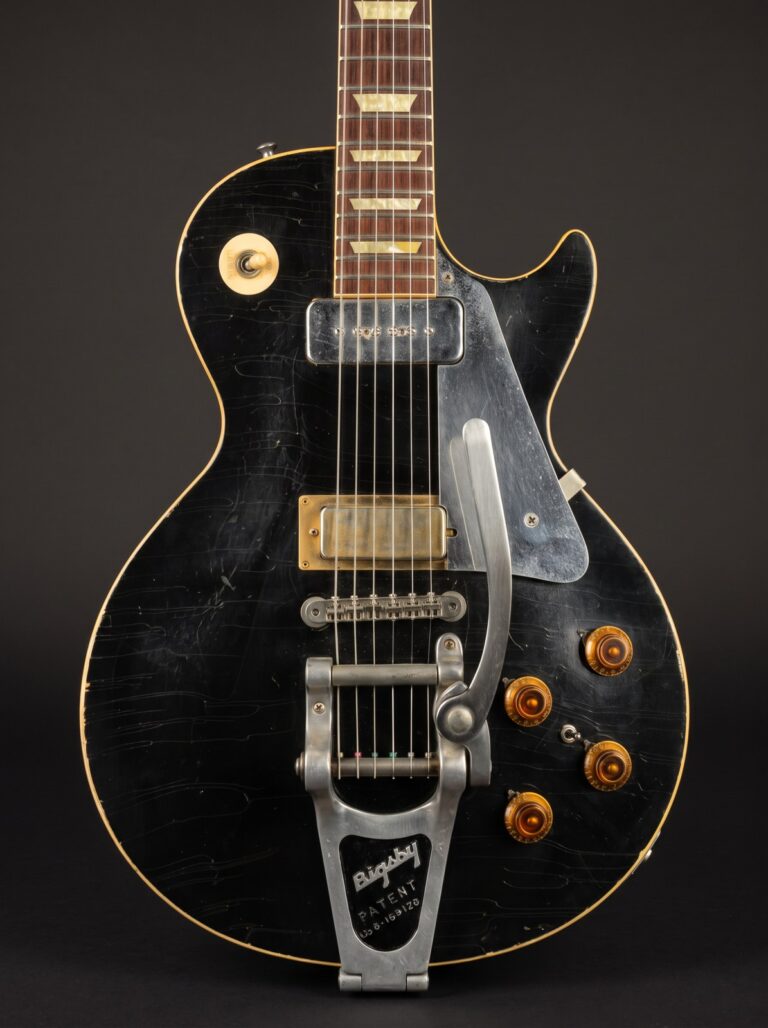
The modifications Young and Cragg made to the guitar constitute a complete transformation from its original configuration. The original bridge pickup — a P-90 that was damaged, sent to a repair shop, and lost when the shop disappeared — was replaced first with a Gretsch Dynasonic single-coil, then with a mini-humbucker from a 1972 Gibson Firebird. This Firebird pickup remains in the bridge position today. It was incredibly microphonic and would create lots of noise and grit, which Young found particularly appropriate for his brand of rock guitar. The neck pickup is the original P-90, now covered by a hand-fitted aluminum cover replacing the original white plastic. The tailpiece was upgraded from the original trapeze to a Bigsby B3 vibrato, then subsequently to a Bigsby B7 (installed around 1973 alongside the Firebird pickup). A Tune-O-Matic bridge (not available as a stock option on 1953 Goldtops) was also added. Schaller M6 tuners replaced the original Grover units.
The most consequential modification — and the one most debated among tone chasers — is the miniature toggle switch installed between the volume and tone knobs. This is actually a switch that allows Neil to bypass the pot and capacitors and allow his signal straight to the amps for max output. When engaged, the guitar signal goes directly from the pickups to the amplifier without passing through the volume pots, tone capacitors, or any of the guitar’s onboard circuitry. This bypass produces a fundamentally different tonal character — the full, unfiltered output of the pickups without the high-frequency attenuation introduced by the tone circuit and the loading effect of the volume potentiometers. The combination of the Firebird pickup’s inherent microphonics and the direct bypass produces the specific raw, somewhat unpredictable, intensely physical tone that distinguishes Old Black from every other guitar.
A chrome-on-brass pickguard and back plates were also added — the brass construction providing electromagnetic shielding and contributing, per some accounts, to the guitar’s resonance characteristics. The metal pickguard adds electromagnetic shielding but also contributes to the guitar’s unique resonance. At nearly nine pounds, the guitar is substantial, particularly given Young’s polio-related arm weakness. The physical demands of playing Old Black at stage volume for three-hour Crazy Horse sets are not trivial.
The tuning instability that results from the Bigsby vibrato — the B7’s spring-loaded arm returning to a slightly different position after each use — is not an accident or a tolerated imperfection. Young appreciates the tuning instability it offers because of his belief that a guitar really shouldn’t always stay perfectly in tune, especially if it’s put through some abuse. He retunes between most songs in live performance. The slight detuning and the interaction between the Bigsby’s tension and the guitar’s natural vibration frequencies contribute to the organic, slightly unstable quality of his tone that no perfectly intonated instrument can match.
For acoustic performance, Neil Young’s most emotionally significant instrument is a Martin D-28 from the early 1940s formerly owned by Hank Williams — acquired at some point in Young’s career through channels that have not been fully documented publicly. This guitar, nicknamed “Hank” in tribute to its former owner, was responsible for much of Harvest (1972), one of Young’s most commercially successful records. Young has been relying on “Hank,” an early Forties D-28 formerly owned by Hank Williams as one of his touring acoustics. The guitar’s connection to Williams — the patron saint of country music’s emotional directness and its tendency to end badly — gives it a mythological weight beyond its physical properties. Cragg fits Hank with stereo FRAP (Flat Audio Response Pickup) transducers for acoustic amplification in live performance.
The 1968 Martin D-45 — one of the most prestigious acoustic guitars in Martin’s production catalog, with its distinctive abalone trim and scalloped bracing — was used for the recording of Harvest and is a primary touring acoustic. The D-45’s construction produces a particularly full, balanced acoustic response: the Indian rosewood back and sides contribute warmth and sustain; the Sitka spruce top provides projection and clarity; the scalloped X-bracing allows the top to vibrate more freely than stiffer non-scalloped alternatives. Cragg fits this guitar with the same stereo FRAP transducer system used on Hank.
One of the more unusual entries in Young’s collection — a 1961 Gretsch White Falcon that his tech Cragg described as “the real deal. Neil’s had it forever. It’s kind of green-looking and really stunning. There’s probably only 10 or 11 of those around.” The White Falcon’s Filter’Tron pickup character and semi-hollow construction produce a distinctive sound quite different from Old Black’s raw Les Paul aggression — used for specific recording and performance applications where the Gretsch’s particular character is appropriate.
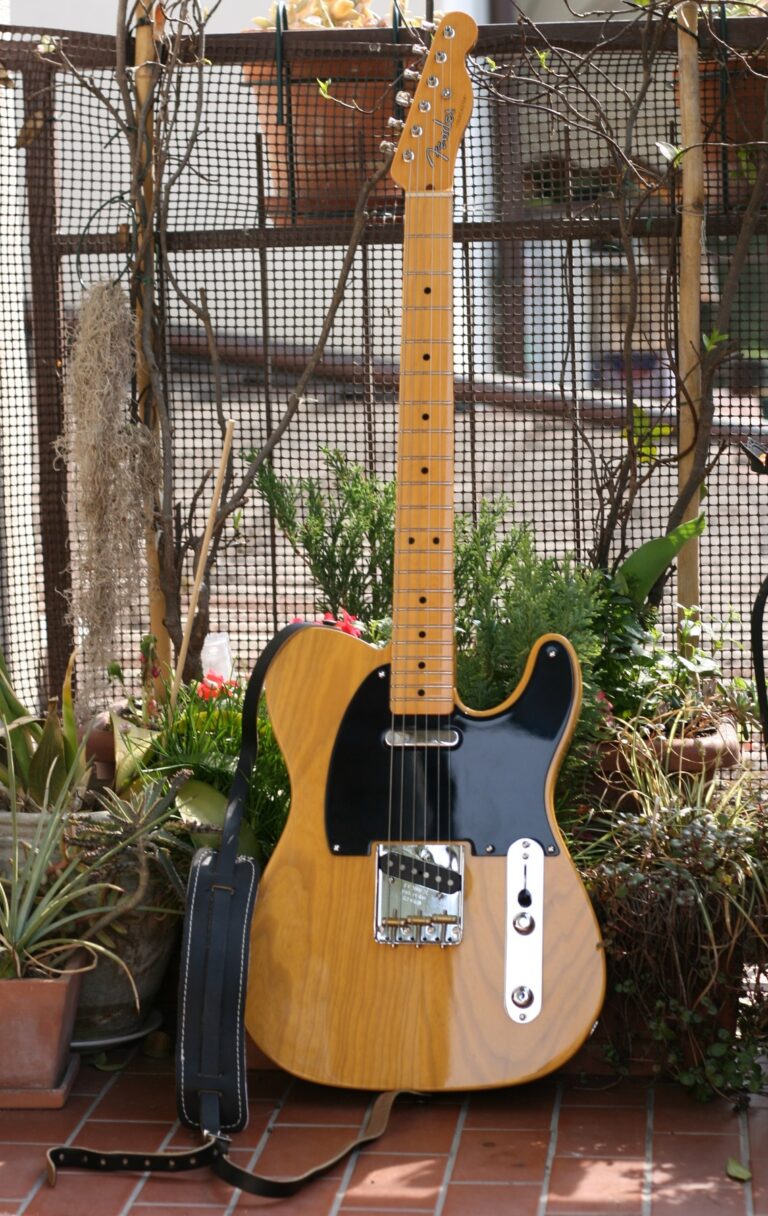
Young has used Telecasters at various points in his career — audible on some Buffalo Springfield recordings and in other specific contexts where the Telecaster’s twangy brightness suited the material. Guild acoustics have appeared for specific recording applications. The collection is extensive, but Old Black and the Martin acoustics are the constants.
Amps
Young bought his primary Fender Deluxe second-hand in 1967 for $50. It has been the core of his electric guitar sound in live performance since the late 1960s. The 5E3 circuit designation identifies a specific version of the Fender Deluxe — a 15-watt combo with a single 12-inch speaker, two 6V6-GT power tubes, and a distinctive two-channel architecture with separate volume knobs for each channel that interact with each other even when only one is in use. This interaction — the fact that raising the volume on the unused channel affects the tone and saturation of the active channel — is the foundation of Young’s Whizzer system and the source of his most characteristic tones.
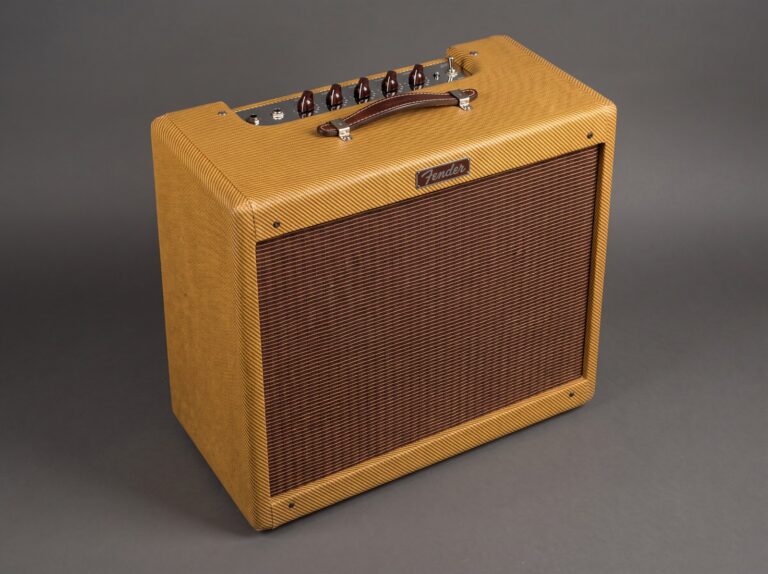
Young’s favorite is a 1959 model, although Young today owns around 450 different Fender Deluxe amps, all of a similar vintage. Young bought the 1959 Deluxe second-hand back in 1967 when it cost him a mere $50. The stock 5E3 used 6V6-GT output tubes, but Young’s has been rebiased to accept 6L6-GT tubes — the substitution slightly increasing the power output from 15 to approximately 19 watts and changing the tonal character: 6L6 tubes produce a different compression and harmonic character from 6V6s, with more headroom and a different saturation curve. The modification is stock otherwise — which is remarkable given how far from stock everything else in Young’s setup tends to be.
Young’s explanation of how he uses the Deluxe is both technical and illuminating: “On a Fender Deluxe, there’s tone and two volumes. The volume on the channel you’re not using will affect the volume of the channel you are using, even when you’re not plugged into it, because of the drain on the power amp. Having the ability to bring up the channel I’m not even using — so the overload thing comes on — or to change the treble here and there, those are the things I couldn’t have done without this technology. Technology hasn’t affected the sound, only the control of the sound.”
The distortion from this amp is entirely natural tube saturation — no pedal contributes the drive. “There is no amp gain. We don’t use a distorted effect at all. Just the Fender Deluxe.” The amp’s ability to produce everything from a clean, slightly compressed tone to full, raucous overdrive purely through volume adjustment — with the Whizzer controlling the specific position of each knob with mechanical precision — gives Young his complete tonal range from a single, stock (except for the tubes) 15-watt combo amplifier.
The stage rig around Young’s primary Deluxe includes additional vintage Fender equipment. The stage rig is rounded out by a 25-watt tweed Fender Tremolux of Cragg’s that the tech rebiased to run at 40 watts, as well as a “high-powered, four-6L6” tweed Fender Twin. The Tremolux — originally a lower-powered tweed combo — rebiased to 40 watts gives the rig an additional amp character for specific tonal requirements. The twin provides the full-power bottom-end reinforcement needed for arena and stadium performances where the Deluxe’s 15-19 watts would otherwise be insufficient without massive PA support.
Cragg pads down the output from the Deluxe and feeds it into a Magnatone 280 with stereo vibrato combo amp, and a Mesa/Boogie Bass 400 head with the highs EQ’d out. The Magnatone 280’s stereo vibrato circuit — a distinctive effect that is closer to true pitch vibrato than the tremolo of most vintage amps — provides a specific modulation character that appears in Young’s recorded and live tone. The Mesa/Boogie Bass 400, with its highs removed via the onboard EQ, provides massive low-frequency support without competing with the tonal character of the Deluxe at the top of the frequency range.
The Whizzer
The Whizzer deserves its own section because it is genuinely one of the more extraordinary pieces of custom gear in rock music history. It is a device that physically turns the knobs of the 1959 Fender Deluxe using servo motors, controlled remotely by foot switches on a red box onstage. This is not a MIDI channel switcher or a relay-based system — it literally rotates the amplifier’s actual physical knobs to pre-programmed positions.
The amp itself is a four-input 1959 tweed Fender Deluxe 5E3, a 15-watter with just two volume knobs and one tone control. Young’s Deluxe is completely stock if you ignore that he’s had to replace its two 6L6 tubes. “Its got four presets that completely control the three knobs on the top of the amp,” Craig told us. “He locks in the preset he wants, and it will always go back to that particular spot. We find that when you have the volume and tone all the way up, by turning that second volume knob up to about 10, it starts to fade away. But right before it starts to fade away, something else happens, and that has to be in exactly the right position. You can’t breathe on it, or it fucks it all up.”
Young has used the Whizzer since Rust Never Sleeps in 1978 — nearly fifty years of a servo motor physically manipulating a vintage amplifier’s controls during live performance. The four presets move between different tonal configurations: clean settings for acoustic-adjacent electric playing; moderate overdrive for standard Crazy Horse rock; the heavily saturated, feedback-adjacent settings for the most extreme moments. The precision required is extraordinary given that the specific knob positions that produce the desired tonal transitions are essentially unique to this specific amplifier — not reproducible on any other unit.
Effects
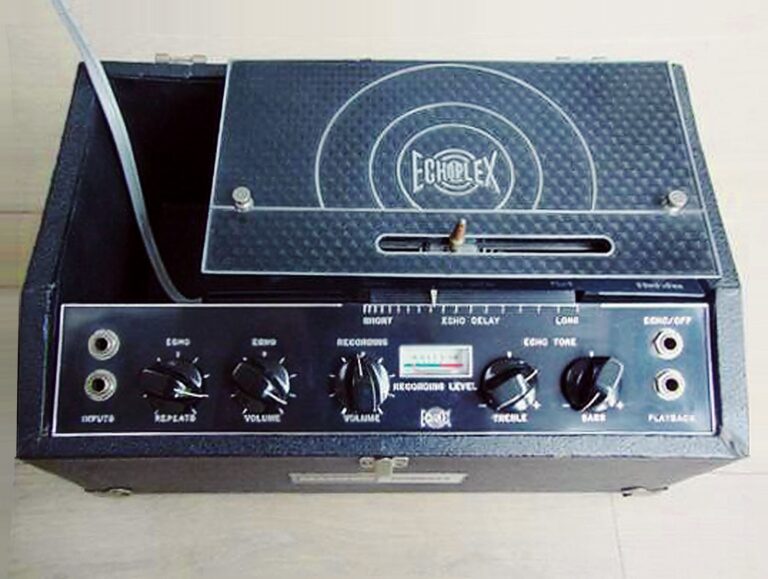
One key element of his signal chain is an original Maestro EP-4 Echoplex unit. Used in tandem with the stock Fender reverb, the Echoplex provides a warbly delay that you can hear Young play against in many of his recordings, creating a thick, ever-shifting tone. The Echoplex is a tape-based delay unit — the actual recording tape loop that stores and plays back the repeated signals giving the delays their specific warm, slightly degrading, organically variable character. The delay times and repeat settings used by Young are not the mathematical, tempo-synced delay of The Edge’s setup; they are shorter, more textural, used as much for thickening and depth as for rhythmic pattern creation.
A standalone 1963 Fender Reverb unit — the outboard spring reverb tank that Fender produced as a separate component for use with amplifiers that lacked built-in reverb — appears in Young’s signal chain. Unlike the built-in spring reverb of many amplifiers, the outboard unit is placed before the amplifier in the signal chain, meaning the reverb signal enters the amp’s preamp stage rather than being applied after amplification. This placement — pre-amp rather than effects loop — produces a different character: the reverb interacts with the amp’s input stage and saturation characteristics in a way that integrated, post-amplification reverb doesn’t. The result is a reverb that feels more part of the guitar tone rather than added to it.
For specific applications — most notably “Hey Hey, My My (Into the Black)” — Young used a MuTron Bass Divider, an octave-down effect that adds a bass-register doubling to the guitar signal. The heavy bass content of that song’s tone, which contributed to its influence on the developing grunge aesthetic, came partly from this device.
The most notable aspect of Young’s effects chain is what’s absent: no overdrive pedals, no distortion boxes, no fuzz units. All drive comes from the amplifier, driven by the guitar’s direct output (enhanced by the bypass switch on Old Black). This is a deliberate and consistent position — that the only legitimate source of electric guitar distortion is a cranked amplifier, and that pedal-based drive is a compromise. Young has maintained this position across his entire career. “There is no amp gain. We don’t use a distorted effect at all. Just the Fender Deluxe.”
Cragg uses D’Angelico 80/20 Brass strings (.012–.054) on Young’s acoustics, and Dean Markley Super V’s (.010–.046) on his electrics. Picks are nylon Herco Gold Flex 50s. “Neil used those when I first started working for him, and he still does today.”
Playing Style & Tone Philosophy
Neil Young’s electric guitar playing is the most instructive example in rock music of the principle that it’s not what you play but how you play it. His technique is, by conventional standards, primitive: limited scale vocabulary, simple chord shapes, single-note solos that often consist of three or four notes repeated with varying emphasis. What makes these solos memorable — what gives them the specific emotional impact that has influenced fifty years of rock guitarists — is not the notes themselves but the weight, attack, and conviction with which those notes are delivered.
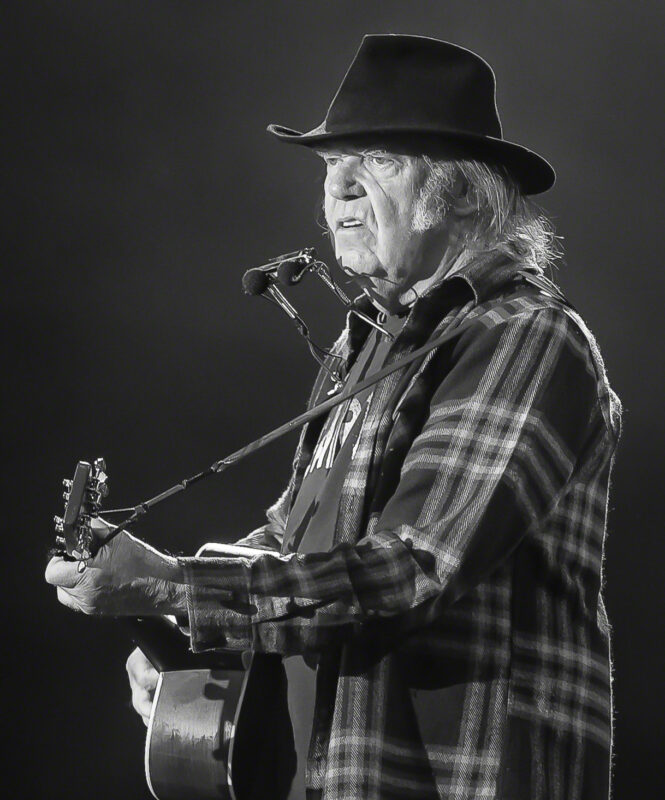
The polio-affected arm and the resulting technique — more arm movement, less finger dexterity — gave his picking a particular physical character. He approaches the strings as if he’s “hitting it with a hammer,” in his own phrase, and the Firebird pickup’s high microphonic sensitivity translates that physical force into the tone with unusual fidelity. A heavily struck note through a microphonic pickup into a saturated tweed amp produces a response that has a tactile quality — you can hear the physical force behind the note in the way the tone blooms and sustains. This physicality is the core of his electric playing.
His approach to feedback is equally characteristic. The combination of the Firebird pickup’s microphonics, the Old Black bypass switch (sending the maximum pickup output directly to the amp), and the 1959 Deluxe operating at or near its saturation threshold creates conditions where sustained notes naturally transition into feedback — the amp’s signal driving the guitar’s pickups sympathetically, creating the self-sustaining loop of acoustic and electronic resonance. Young treats this feedback not as a technical problem to be controlled but as a musical resource to be exploited. The long feedback passages on live recordings from Rust Never Sleeps and Weld are not accidents or indulgences — they are intentional extensions of notes into the territory where the guitar and amp begin to sing independently of the player’s input.
His acoustic playing is its own separate and often underrated tradition. On Martin guitars tuned to his various preferred voicings — including the “A# modal” tuning that his tech Cragg sets on the second D-28, providing a specific droning character — Young has produced some of the most emotionally direct acoustic guitar recordings in American music. “The Needle and the Damage Done,” “Helpless,” “Old Man,” “Heart of Gold” — these are acoustic guitar performances of genuine simplicity and profound emotional impact, demonstrating that the same impulses that drive his electric playing (directness, physical commitment, emotional transparency) also govern his acoustic approach.
His tone philosophy is stated most clearly by what he refuses: he refuses amplifier distortion that doesn’t come from the amp itself; he refuses effects that substitute for technique; he refuses gear changes that might disturb the specific relationship between Old Black and the 1959 Deluxe; he refuses, broadly, any intervention that places technology between his hands and the sound. Young’s tone is as direct as his lyrics — maximum signal, minimum mediation, everything exposed.
How to Sound Like Neil Young
Replicating Neil Young’s tone exactly is expensive (vintage 1953 Les Paul Goldtops run $25,000-$50,000; an original 1959 Fender Deluxe runs $8,000-$12,000; the Whizzer system is custom-built) and, per Nils Lofgren’s experience, possibly impossible regardless of equipment. Approaching it within reach of most guitarists is more practical.
Guitar: A Gibson Les Paul with P-90 pickups (in the neck position) and a mini-humbucker in the bridge is the closest configuration to Old Black’s actual pickup setup. A Les Paul Special with P-90s gets you into the basic tonal territory. The bypass switch concept — going directly from the pickup to the amp output without the guitar’s volume pot — can be replicated by keeping the guitar’s volume at 10 and using the amp volume for dynamics. A Bigsby tremolo on any Les Paul adds the physical vibrato character. The most important thing: dig in. Play harder than you think you should. Young’s tone comes from physical attack, not from settings.
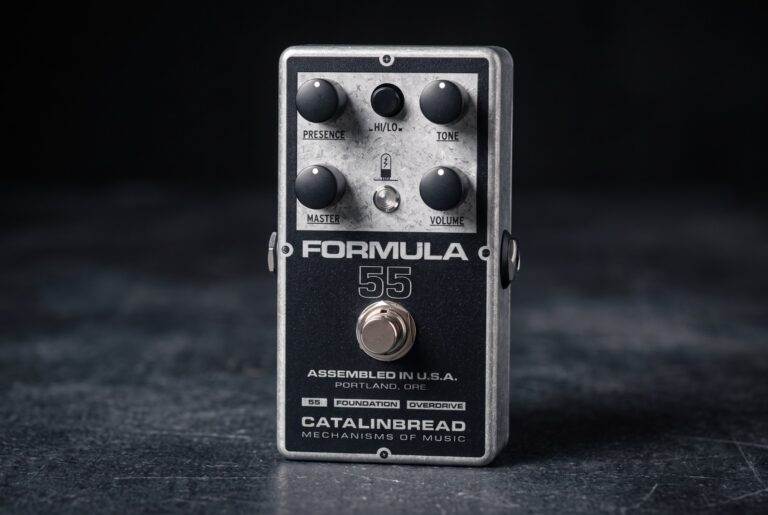
Amp: A tweed Fender Deluxe or a Fender ’57 Custom Deluxe (the hand-wired reissue) is the authentic choice, cranked. For more budget-conscious approaches, a tweed-in-a-box pedal (Catalinbread Formula No. 55, Wampler Tweed 57) into any clean Fender-style combo approximates the character. The key is that the distortion comes from amp saturation, not pedal processing. A small, low-wattage amp driven hard is the correct approach — not a high-gain amp at moderate volume.
Amp Settings (1959 Fender Deluxe equivalent, both channels):
| Control | Setting (0–10) | Notes |
|---|---|---|
| Volume (Primary Channel) | 10–12 (past detent) | Full saturation — the Deluxe is meant to be cranked |
| Volume (Unused Channel) | 7–9 | The Whizzer preset positions — affects primary channel tone |
| Tone | 10–12 | Full treble — the saturation warms it naturally |
| Speaker Size | Single 12-inch | The 5E3 single 12-inch is fundamental to the response character |
Effects: Spring reverb (outboard, placed before the amp if possible). Short Echoplex-style tape delay for thickening (not tempo-synced — textural rather than rhythmic). Nothing else. No overdrive, no chorus, no compression, no EQ. The amp is the effect.
Influence & Legacy
Neil Young’s influence on subsequent rock music divides into two distinct traditions that have operated largely independently and both become enormously significant. The acoustic, melodically direct tradition of his folk-influenced work — Harvest, “Heart of Gold,” “Old Man,” “Helpless” — influenced the entire singer-songwriter movement of the 1970s and the acoustic-guitar-centered indie and alternative folk of the 1990s and 2000s. The electric, feedback-saturated, deliberately raw tradition — Everybody Knows This Is Nowhere, Rust Never Sleeps, Ragged Glory — influenced grunge so directly that Kurt Cobain’s elevation of Young to “godfather of grunge” status was not marketing hyperbole but an accurate description of the sonic and philosophical lineage.
The grunge connection is the most culturally visible part of Young’s influence, but it is not the most musically specific. What Young gave to grunge — beyond the specific sonic template of cranked tube amp through a Les Paul — was a philosophical position about what rock music should prioritize: rawness over polish, emotional directness over technical sophistication, the evidence of human presence over the evidence of studio processing. This position, embedded in his music since Everybody Knows This Is Nowhere (1969), was available to any guitarist who was paying attention for two decades before Nevermind. Cobain was paying attention.
His influence on the specific technique of feedback-as-composition is harder to trace but arguably more musically significant. The extended feedback passages on “Cowgirl in the Sand” and on the live recordings from the Rust Never Sleeps tour and Weld are among the most sustained demonstrations in rock music of how the boundary between controlled playing and amplified acoustic response can be made musically productive. Guitarists who work with feedback and amp saturation as primary tonal resources — Sonic Youth, Dinosaur Jr., and all the bands downstream of those — operate in a tradition that Young helped establish.
The acoustic tradition’s influence runs through the folk revival and the singer-songwriter boom and into the contemporary indie folk scene. Young’s specific guitar style — simple, direct, emotionally transparent — demonstrated that technical simplicity is not a limitation but can be a specific choice that opens emotional possibilities that complexity forecloses. This lesson has been learned and relearned across fifty years of acoustic guitar-based music.
For context on how Young’s approach fits into the broader tradition of Canadian and North American guitar, the comparison with Mark Knopfler’s approach to tone through simplicity and restraint is instructive — two players who both arrived at distinctive, immediately recognizable sounds through deliberate rejection of complexity rather than its pursuit.
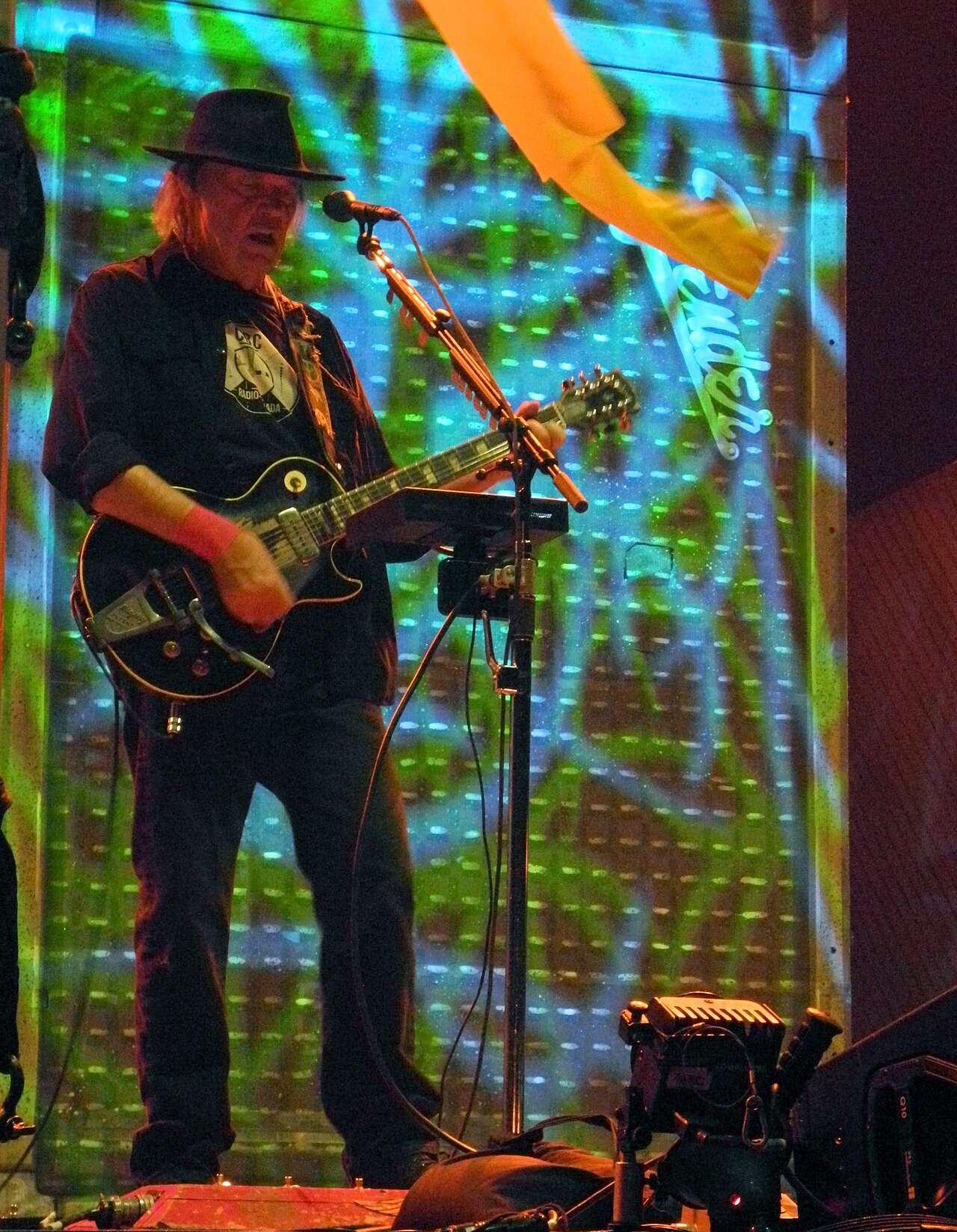
The direct influence on the British post-punk and alternative tradition connects to Johnny Marr’s harmonic approach to guitar composition, which absorbed Young’s principle that the right simple thing, played with conviction, is more powerful than the impressive complicated thing played brilliantly.
And for the fullest picture of how the American folk tradition — the Martin acoustic and the honest, direct song — connects to Young’s acoustic identity, the comparison with Joni Mitchell’s open-tuning guitar approach illuminates how two Canadian folk traditions developed their own approaches to the acoustic guitar’s expressive possibilities simultaneously, and how each influenced the other in the process of defining what folk-influenced popular music could sound like.
Old Black is still being played. The 1959 Deluxe is still doing what 1959 Fender Deluxes do. Larry Cragg is still not changing anything. Neil Young is seventy-nine years old in 2026, has recently recovered from a medical issue that temporarily halted touring, and is still — by every available account — planning to continue making music. The Whizzer servo motors are presumably oiled and ready. The Bigsby spring on Old Black needs lubricating monthly. None of it is changing. None of it is supposed to change. Some things work exactly as they are, and the job of the people around them is to make sure that the conditions that make them work are preserved with the reverence they deserve.
Frequently Asked Questions: Neil Young Guitars & Gear
What guitar does Neil Young play?
Neil Young’s primary electric guitar is “Old Black” — a 1953 Gibson Les Paul Goldtop acquired in a trade with Jim Messina in 1968 or 1969, painted black before Young received it and extensively modified since. Key modifications include: a bridge pickup replaced with a 1972 Gibson Firebird mini-humbucker (replacing the original P-90 that was lost at a repair shop), a Bigsby B7 vibrato replacing the original tailpiece, a Tune-O-Matic bridge, Schaller M6 tuners, a chrome-on-brass pickguard and back plates, and most significantly, a toggle switch that bypasses the guitar’s volume pots and tone capacitors to send the pickup signal directly to the amplifier. The neck pickup is the original P-90, covered with an aluminum cover. Old Black has remained his primary performing guitar for over fifty years. His primary acoustic instruments are a 1940s Martin D-28 formerly owned by Hank Williams (“Hank”) and a 1968 Martin D-45.
What amp does Neil Young use?
Neil Young’s primary and definitive amplifier is a 1959 Fender Tweed Deluxe 5E3, purchased second-hand in 1967 for $50 and used in every live performance since the late 1960s. The amp is stock except for a modification to accept 6L6-GT output tubes instead of the original 6V6-GT units, slightly increasing the power from 15 to approximately 19 watts. Young has collected approximately 450 vintage Fender Deluxe amplifiers of similar vintage; none, in his assessment, sounds as good as his original. He controls the amp remotely via the Whizzer system, a custom device using servo motors to physically rotate the amplifier’s knobs to pre-programmed positions during performance. All of his electric guitar distortion comes from this amp driven hard — no overdrive pedals are used.
What is the Whizzer system?
The Whizzer is a custom-built remote control system that physically rotates the knobs of Neil Young’s 1959 Fender Deluxe amplifier using servo motors, controlled by foot switches on a red box onstage. It has four presets that control the amp’s three knobs (two volumes and one tone) to specific pre-programmed positions. Young has used it since the Rust Never Sleeps tour in 1978. The system allows him to switch between clean, moderately overdriven, and heavily saturated tones during performance without touching the amp. The precision required is extraordinary: the specific knob positions that achieve the desired tonal transitions are unique to this particular amplifier and cannot be reproduced exactly on other units. His tech Larry Cragg has noted that “you can’t breathe on it, or it fucks it all up” regarding the most critical preset settings.
Why is Neil Young called the Godfather of Grunge?
Neil Young is called the Godfather of Grunge primarily because of the direct sonic and philosophical influence his electric guitar work — particularly on albums like Everybody Knows This Is Nowhere (1969), Rust Never Sleeps (1979), and Ragged Glory (1990) — had on the Seattle grunge scene of the early 1990s. The combination of distorted Les Paul through cranked tube amps, feedback-heavy guitar work, and the deliberate prioritization of rawness and emotional directness over technical polish established a sonic template that Nirvana, Pearl Jam, Soundgarden, and their contemporaries drew from. Kurt Cobain explicitly acknowledged Young’s influence, quoting him in the lyric “It’s better to burn out than to fade away” (from “Hey Hey, My My”) in his 1994 suicide note. Young himself subsequently recorded a song titled “Sleeps With Angels” in response to Cobain’s death.
What effects does Neil Young use?
Neil Young uses very few effects. His primary signal chain is guitar (through the bypass switch) into the Whizzer-controlled 1959 Fender Deluxe, with all distortion coming from the cranked amplifier. He uses a 1963 Fender outboard spring reverb unit (placed before the amplifier in the signal chain), a Maestro EP-4 Echoplex for tape delay (providing short, warm repeats rather than tempo-synced rhythmic delay), and occasionally a MuTron Bass Divider for pitch-down effects on specific songs. He deliberately does not use overdrive or distortion pedals, maintaining that all legitimate electric guitar distortion should come from the amplifier itself. The overall chain is: guitar → reverb unit → amp, with the Echoplex in the chain for specific applications.
How did Old Black get its name and modifications?
“Old Black” got its name from the black paint job applied to its original goldtop finish before Neil Young acquired it — the guitar was already painted when he traded for it from Jim Messina in 1968-69 for approximately $350. The major modifications since Young’s ownership include: bridge pickup replaced with a Firebird mini-humbucker after the original P-90 was lost at a repair shop; Bigsby B3 vibrato added (later upgraded to B7); Tune-O-Matic bridge replacing the original tailpiece bridge; chrome-on-brass pickguard; Schaller M6 tuners replacing Grover units; and a toggle switch that bypasses the guitar’s pots and capacitors to send a full, unfiltered signal to the amplifier. The Firebird pickup is notably microphonic, producing the gritty, feedback-prone character that Young considers essential to the guitar’s personality. Young and his tech Larry Cragg performed most of these modifications, with Cragg having maintained the guitar since 1972.
What strings and picks does Neil Young use?
Neil Young’s guitar tech Larry Cragg uses D’Angelico 80/20 Brass strings in .012-.054 gauge on Young’s acoustic guitars, and Dean Markley Super V strings in .010-.046 gauge on his electric guitars. His picks are nylon Herco Gold Flex 50 — a flexible, medium-weight nylon pick that Cragg has supplied since he started working with Young in 1972 and that Young still uses today. The consistency of pick choice over fifty-plus years is characteristic of Young’s general approach to gear: find what works and maintain it without change.
Image credits
- Neil Young: Matthew Harris, Wikimedia Commons, CC BY-SA 2.0.
- Neil Young: Gorupdebesanez, Wikimedia Commons, CC BY-SA 3.0.
- Top image: by Man Alive!, Wikimedia Commons, CC BY 2.0.
- Neil Young: photo by Gorupdebesanez, via Wikimedia Commons, CC BY-SA 3.0.
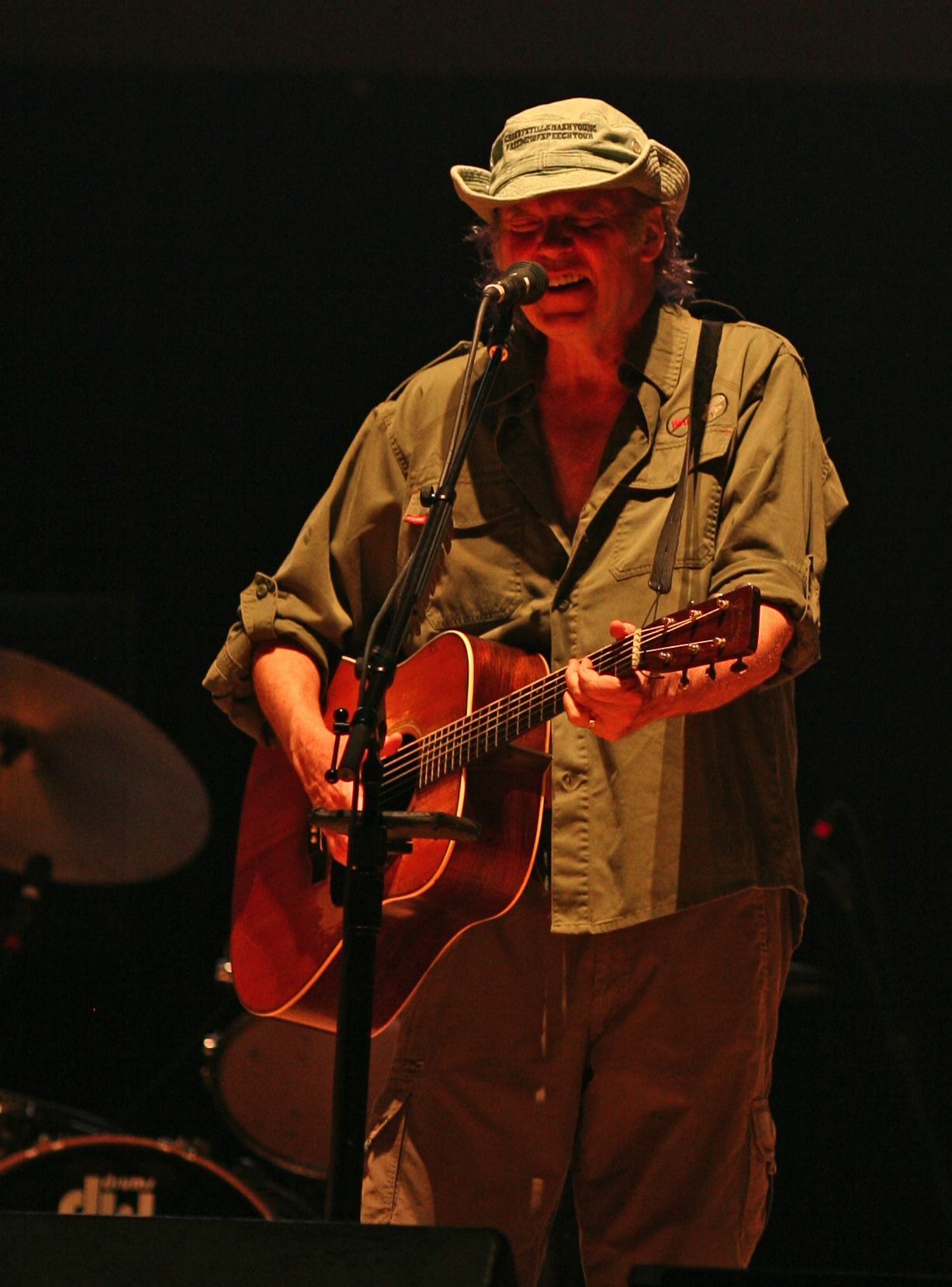
- Neil Young: photo by Tore Sætre, via Wikimedia Commons, CC BY-SA 4.0.
- Fender Telecaster: Massimo Barbieri, Wikimedia Commons, CC BY-SA 3.0.
- Neil Young live: Raph_PH, Wikimedia Commons, CC BY 2.0.
- Neil Young’s ‘Old Black’: GuitarGangsters AI-generated reference illustration, not a photograph.
- Maestro Echoplex EP-4: Drunem2010 (derivative work: Clusternote), Wikimedia Commons, CC BY 3.0.
- Fender Tweed Deluxe 5E3: GuitarGangsters AI-generated reference illustration, not a photograph.