Neal Schon Guitars & Gear: The Complete Guide to Journey’s Guitar Virtuoso’s Gibson, PRS & Marshall Rig
Neal Schon guitars & gear: Journey's founding guitarist. 1977 Les Paul Deluxe, PRS signature, Marshall Plexi, Floyd Rose — the Don't Stop Believin' and Lights tone explained.
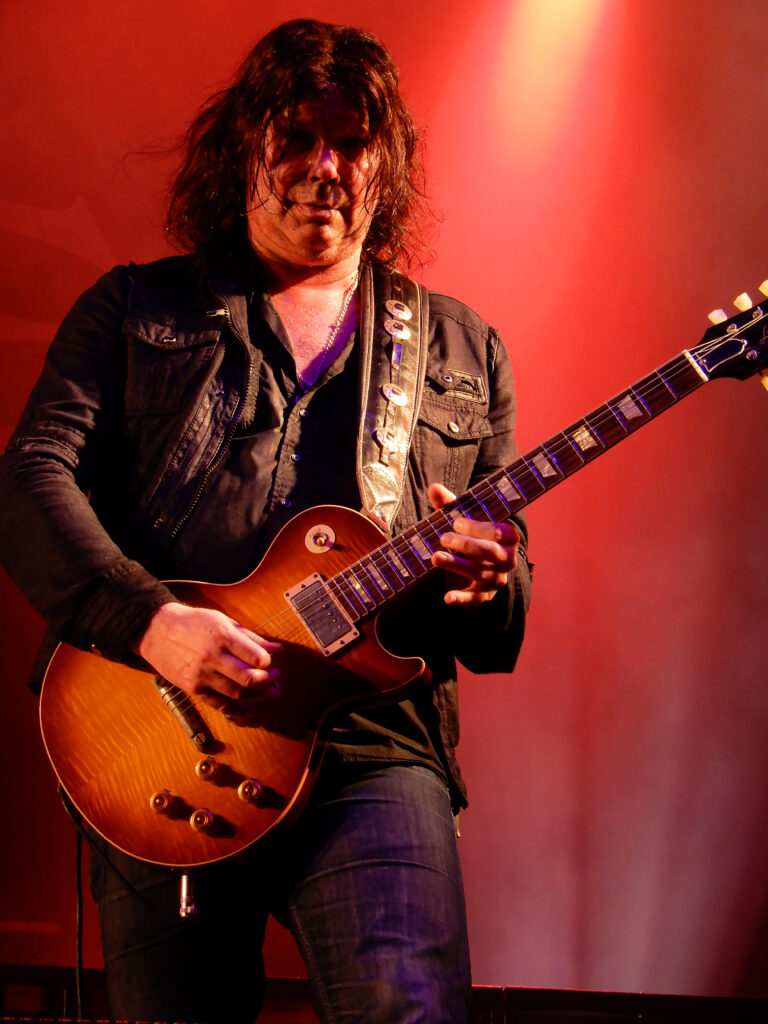
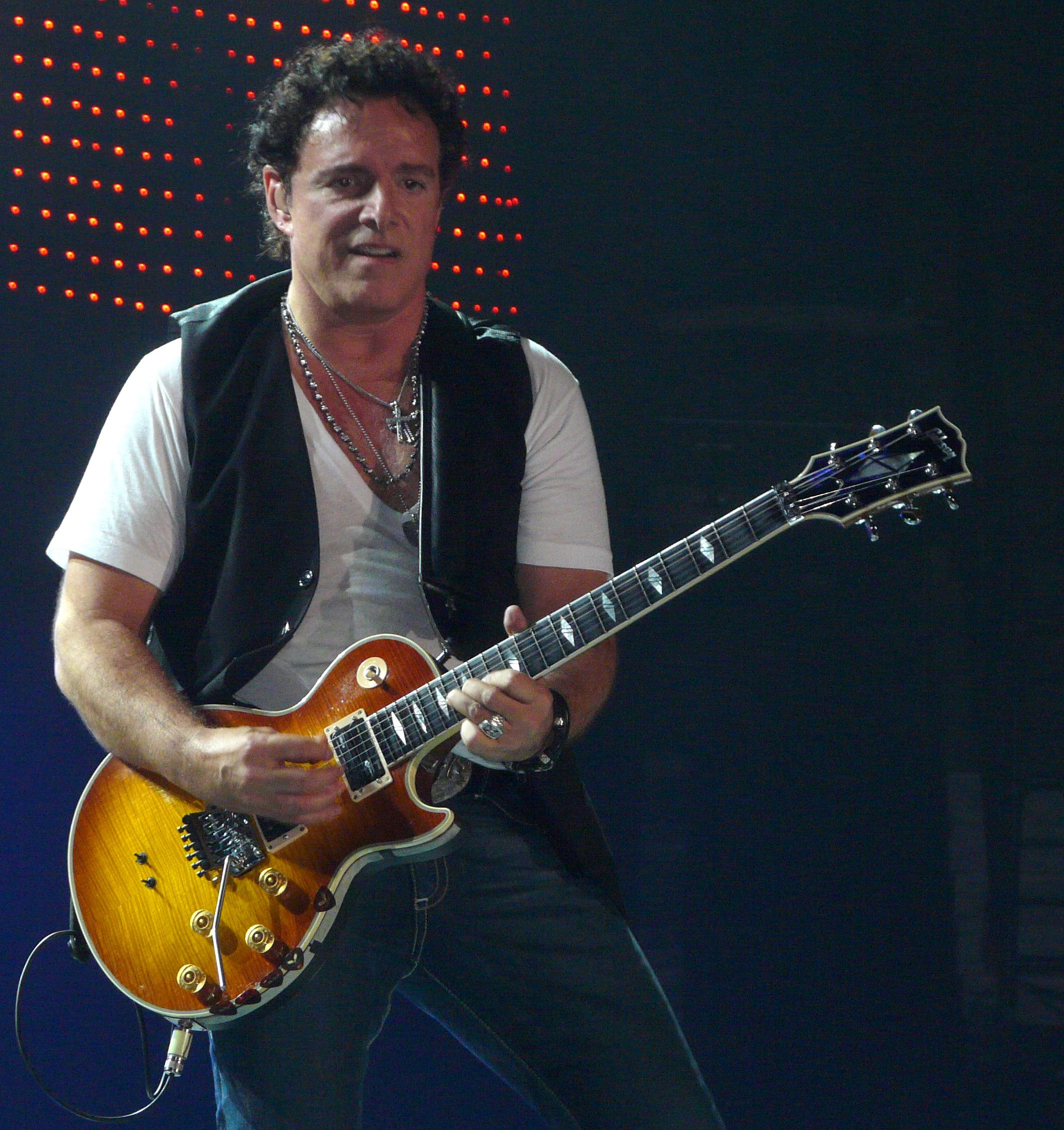
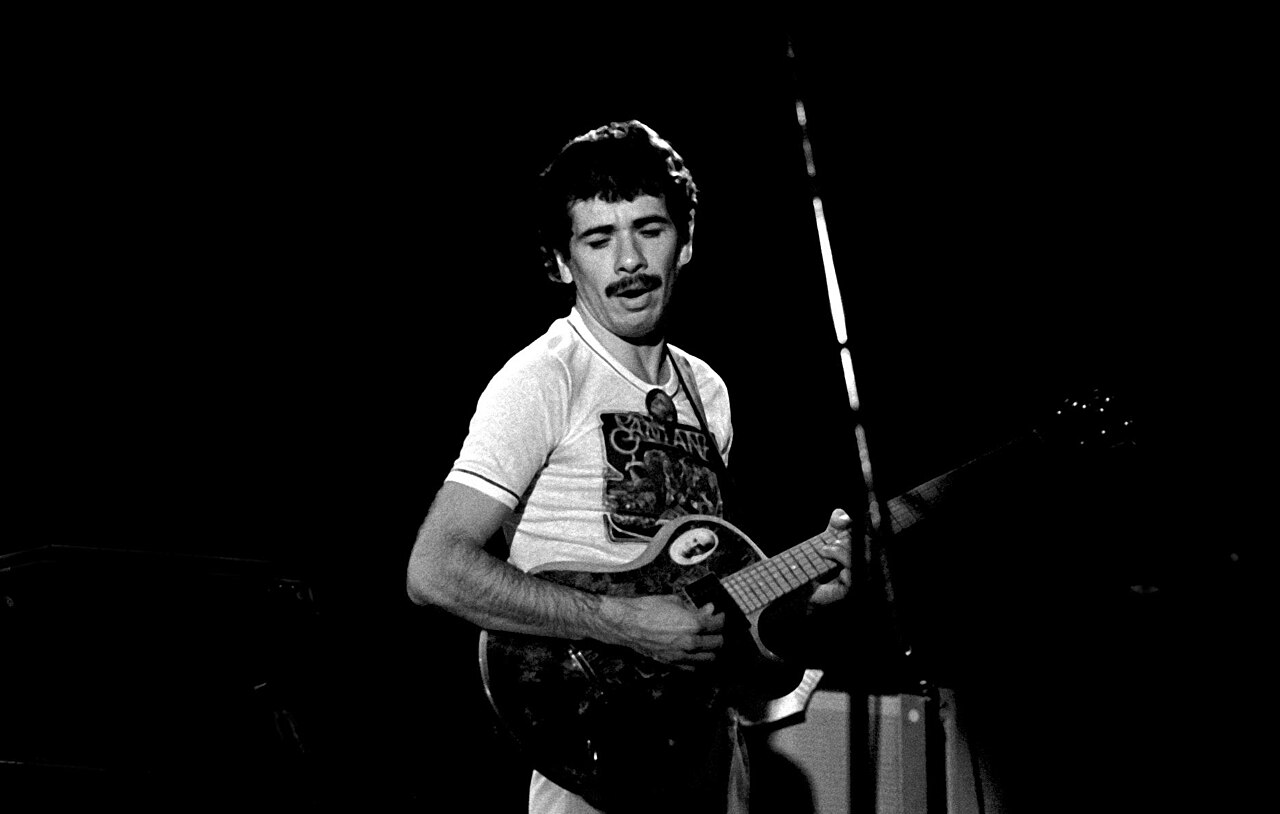
Photo by Matt Becker, licensed under CC BY 3.0 (https://commons.wikimedia.org/wiki/File:Neal_Schon.jpg)
Gear Timeline
Carlos Santana was offered Eric Clapton as a second guitarist in 1971. He turned Clapton down and hired Neal Schon instead, who was seventeen years old. The specific reason for this choice — choosing a seventeen-year-old over Eric Clapton — is not exhaustively documented in available sources, but the outcome suggests Santana heard something specific in Schon that the opportunity to play alongside the most celebrated British blues guitarist of the era didn’t offer: a specific melodic fluency, a specific combination of blues feeling and rock aggression, a specific quality of musical potential that was already fully audible at seventeen and would take Santana III and Caravanserai as its first major public documentation. Schon left Santana at twenty to co-found Journey in 1973, and the subsequent career — the San Francisco hard rock years, the commercial AOR breakthrough with Steve Perry, the “Don’t Stop Believin'” that now has over a billion streams on Spotify and is played at every sporting event in America — is built on the foundational quality that Santana recognized when he chose a teenager over Eric Clapton. The guitar playing on “Lights,” “Don’t Stop Believin’,” “Stone in Love,” “Faithfully,” “Open Arms,” and the rest of the Journey canon has a specific, immediately identifiable quality: soulful, melodic, and tonally warm in a way that studio technique alone cannot produce. It was there at seventeen. It has been there through every subsequent decade.
Neal Joseph Schon was born on February 27, 1954, at Tinker Air Force Base in Oklahoma — the military base origin indicating a father who was a career serviceman, but more relevantly, a father who was also a jazz saxophonist. Growing up with a jazz musician’s relationship to melody, harmony, and improvisation in the household established the specific musical sensibility that Schon has always demonstrated: the jazz musician’s respect for harmonic sophistication and melodic development, applied to the electric guitar in a rock and roll context. He picked up the guitar at ten, developed with speed that was apparently self-evident to anyone who heard him, and at seventeen joined Santana — one of rock’s most rhythmically sophisticated and melodically ambitious bands, whose Latin rock fusion context demanded musical depth that pure rock training couldn’t provide. The two Santana albums he recorded — Santana III (1971) and Caravanserai (1972) — are part of the Santana canon and among the best documents of Schon’s early playing.
The 1977 Gibson Les Paul Pro Deluxe that recorded “Don’t Stop Believin'” is the most consequential single guitar in this series by commercial measure: the guitar used to record the best-selling catalog rock song in iTunes history, the song played at every sporting event, the song in the Sopranos finale, the song with a billion Spotify streams. It was a modified guitar — Floyd Rose double-locking tremolo and locking nut added, making it what Schon claims was the first Gibson to receive a double-locking Floyd Rose installation; active electronics with a battery compartment; Fernandes Sustainer at the neck for the live setup. The guitar weighed 10.8 pounds, toured extensively, and was eventually sold at Heritage Auctions in 2021, where it was presented as “the ‘Don’t Stop Believin” guitar.” It is now in someone’s collection, signed by Schon in silver ink on the headstock, with a yellow Ferrari sticker on the back, still carrying its original JOURNEY / NIGHTMARE INC / SAN FRANCISCO U.S.A. flight case stencil.
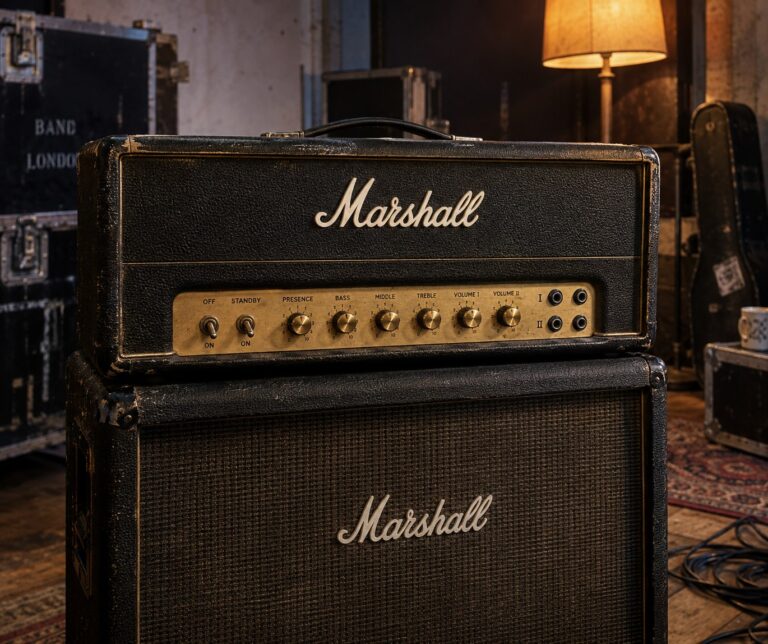
His amplification for the Escape era is specifically noted: around the time of recording “Lights,” Schon is confirmed to have used a Marshall Plexi — the vintage, non-master-volume Marshall head that appears throughout this series as the foundational amplification of British and American hard rock. “Around 45:45 Neal talks about using a Plexi to record Lights,” as the Equipboard community documentation records from a contemporaneous interview. The Plexi’s EL34 character — the warm, natural saturation of the non-master-volume design pushed to its working point — provides the specific sustaining, singing quality of the “Lights” guitar tone, and of the broader Journey AOR guitar sound at its classic peak. The guitar technology was modern (Floyd Rose, active electronics); the amplifier was vintage. The combination produced the sound that a billion people have heard.
His guitar style — described on Journey’s official website as “soulful, melodic, and infamously admired by such fellow legends as Eric Clapton and Prince” — is the specific quality that makes the gear story both important and secondary. The gear enables the sound; the sound is Schon. A Marshall Plexi and a Gibson Les Paul through the hands of a guitarist who was good enough at seventeen that Santana hired him over Clapton produces the specific quality of “Lights” and “Don’t Stop Believin'” and “Stone in Love.” The same equipment through different hands would not produce those recordings. This is always true, and it is more true of Schon than of most players in this series, because the “soulful, melodic” quality of his guitar work is the most immediately personal dimension of the sound — more immediately personal than the specific pickup configuration, the Floyd Rose installation, or the Marshall Plexi model designation.
Background: Santana at 17, Bad English, and the Most-Played Song in American Sports
The Santana chapter is the biographical foundation on which everything else rests. Playing in Santana — a band whose Latin rock fusion required rhythmic sophistication, melodic sensitivity, and tonal warmth rather than the straight-ahead rock aggression of the Sunset Strip or the Bay Area hard rock scene — gave Schon a musical education in the specific qualities that distinguish excellent guitar playing from technically competent guitar playing: the ear for the right note at the right moment, the understanding of how guitar melody relates to rhythm and harmony rather than existing above them, and the specific quality of improvisational listening that jazz-influenced music demands. These qualities are audible in every Journey recording: the solos aren’t just technically accomplished, they’re melodically right for the song. The right note. The right moment. Santana taught him this, or confirmed what his jazz-saxophonist father’s household had already established.
Journey’s founding in 1973 produced a different band from the one that would eventually become commercially dominant. The early Journey — instrumental fusion rock, jazz-influenced, without the AOR commercial orientation of the Steve Perry era — was the direct extension of the Santana context: sophisticated, ambitious, focused on musicianship rather than commercial accessibility. The arrival of Steve Perry in 1977 transformed the band’s commercial context while maintaining the musical quality that Schon’s guitar work provided, and the subsequent albums — Infinity (1978), Evolution (1979), Departure (1980), Escape (1981), Frontiers (1983) — produced the AOR canon that has become Journey’s primary cultural legacy.
Bad English — the supergroup formed with John Waite, bassist Ricky Phillips, and drummer Deen Castronovo, producing Bad English (1989) and Backlash (1991) — was Schon’s most significant commercial project outside the Journey context, demonstrating his ability to contribute at the highest commercial level in a band context where he was not the primary songwriter or frontman. The “When I See You Smile” number-one single confirmed the commercial profile.
His collaboration with Carlos Santana continued intermittently across the subsequent decades — the two guitarists who shared a stage at seventeen and twenty respectively maintaining a musical relationship that the career divergence hadn’t terminated. The Abraxas Pool project (a mid-1990s reunion of former Santana members) and various guest appearances documented the ongoing connection between the two guitarists whose early relationship established Schon’s career trajectory. The Rock & Roll Hall of Fame induction — Journey inducted in 2017 — formally recognized the commercial and cultural significance of the catalog that the 1977 Les Paul Pro Deluxe helped create.
The Rig: Neal Schon’s Guitars, Amps, and Effects
Guitars
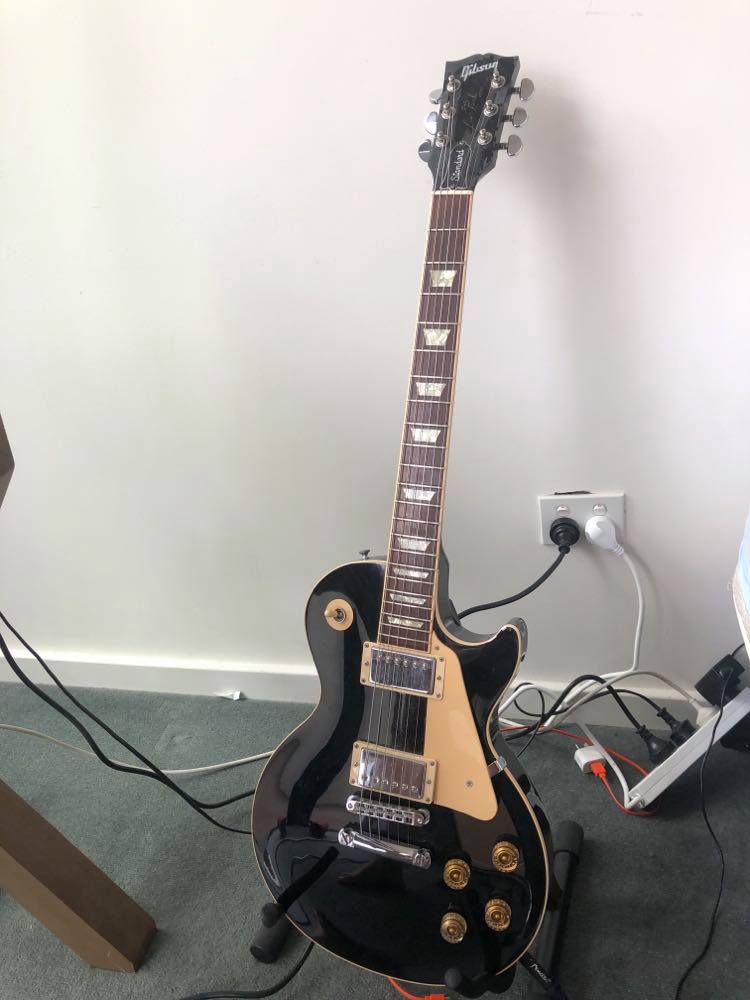
The 1977 Gibson Les Paul Pro Deluxe, serial number 06 115596, in black finish is the foundational instrument in Schon’s career documentation — the guitar confirmed as his primary instrument on Journey’s Escape album (1981) and the Escape Tour. Schon modified the guitar extensively: a Floyd Rose double-locking tremolo and locking nut were installed, making it what he claims was the first Gibson ever fitted with a double-locking Floyd Rose; active electronics with a battery compartment replaced the standard passive circuit; a Fernandes Sustainer was added in the neck position for the live setup, enabling the infinite-sustain technique. The guitar was used on “Don’t Stop Believin’,” “Stone in Love,” “Who’s Crying Now,” and across the Escape album and tour. It was eventually sold at Heritage Auctions in 2021, signed by Schon in silver ink on the headstock and retaining its yellow Ferrari sticker on the back. The Heritage Auctions description called it “the ‘Don’t Stop Believin” guitar” — a designation that captures both its historical significance and the way in which a guitar can become inseparable from the recording it produced. It weighs 10.8 pounds, it has a Floyd Rose where a Les Paul was never designed to have one, and it recorded the song that has been played at more sporting events than any other piece of music in American history.
PRS Guitars produces multiple Neal Schon signature models — the NS-14, NS-15, and the PRS Dragon Double-Neck — as the primary instruments of his modern performing and recording career. The PRS Schon signatures combine PRS’s specific construction quality and playability with the tonal requirements Schon has established: humbucking pickups for warmth and output, tremolo systems for the pitch modulation his playing employs, and the specific neck profile and fretboard radius that suit his technique. PRS’s 25-inch scale length — between the Gibson 24¾-inch and Fender 25½-inch scales — provides a string tension and playing feel that Schon has found optimal for the combination of lead guitar fluency and rhythm guitar precision his performances require. The 2005 PRS Dragon Double-Neck is among the most visually dramatic instruments in his collection — the Dragon inlay (PRS’s most ornate standard inlay) appearing on both necks of the double-neck configuration, which he uses for songs requiring both six-string and twelve-string guitar in live performance.
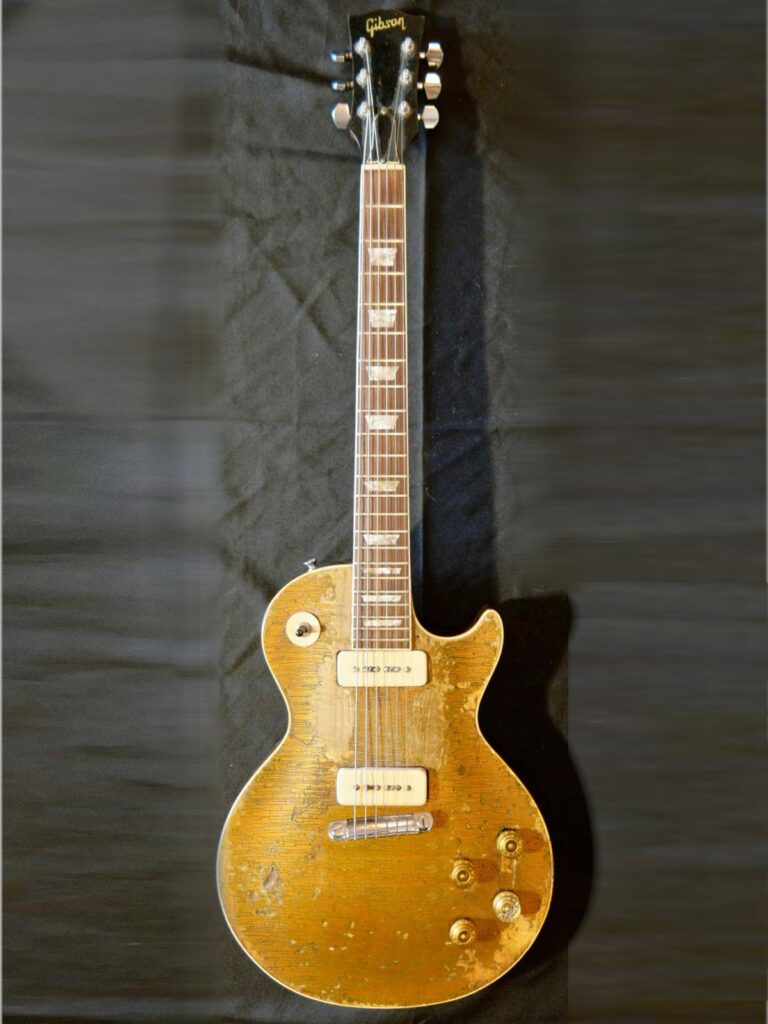
Schon’s guitar collection documented through the Heritage Auctions 2021 sale is among the most significant guitarist’s collections to have been publicly auctioned in recent decades. The collection includes a pair of 1959 Gibson Les Paul Standards, a 1960 Gibson ES-355 (the fully bound ES-335 variant with Varitone circuit), a 1953 Fender Telecaster in Butterscotch Blonde, a 1955 Gibson Goldtop (the P-90-equipped Les Paul from before the PAF humbucker era), and dozens of additional vintage and significant instruments. The breadth and depth of the collection confirms Schon as one of rock’s more serious vintage guitar connoisseurs alongside his touring and performing identity. His statement about the auction — “These are guitars I’ve been collecting for decades and need to make room for new arrivals” — reflects the specific relationship of a working musician who collects instruments for tonal and historical reasons rather than purely as investments.
Schon specifically noted in an interview: “Around 11:00 Neal says he had a ’68 Goldtop reissue with P90s. It was his second ever guitar and his dad bought it for him.” This ’68 Goldtop reissue was the guitar that followed his first instrument — purchased by the jazz-saxophonist father who also bought his first guitar — and the P-90 pickup configuration that gave him the first warm, biting, single-coil-sized humbucker tonal experience that P-90 players recognise as formative. The father-bought guitar and the P-90 tradition it introduced are part of the foundational equipment biography.
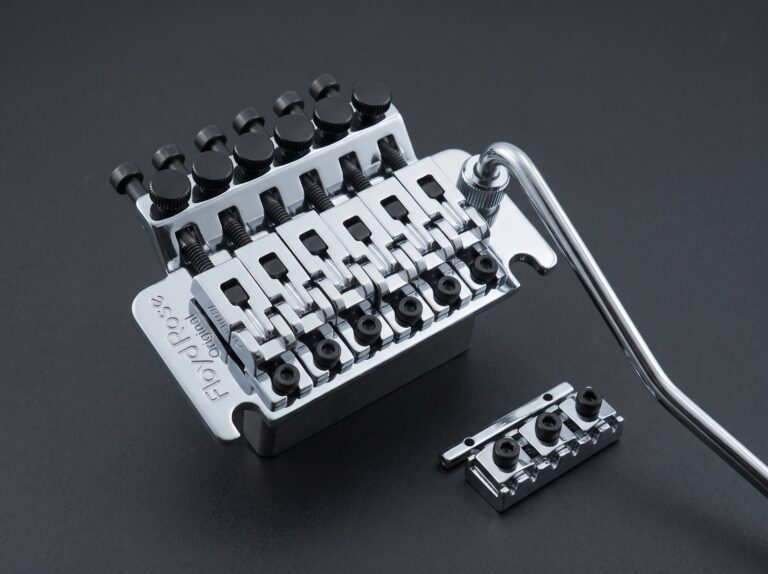
Neal Schon has used a Floyd Rose tremolo system on the majority of his guitars, including his signature models. The Floyd Rose’s double-locking design — locking at both nut and bridge — provides complete tuning stability regardless of tremolo usage, enabling the pitch-bend and dive-bomb techniques that Schon employs without the tuning instability that conventional tremolo systems produce. The installation of a Floyd Rose on the 1977 Les Paul Pro Deluxe was specifically noted as the first such installation on a Gibson — a claim that, if accurate, makes Schon an early adopter of the technology in a non-superstrat context, using it on a traditional Gibson when the Floyd Rose was still primarily associated with the Charvel/Jackson superstrat world that was developing simultaneously. The specific feel of the Floyd Rose’s bridge under the palm is part of Schon’s physical relationship with the guitar — the specific tactile feedback of the double-locking bridge is present in every performance gesture that involves the tremolo arm.
Amps
The Marshall Plexi — the vintage, non-master-volume 100-watt Marshall head from the late 1960s — is confirmed as Schon’s primary recording amplification for the classic Journey era. “Around 45:45 Neal talks about using a Plexi to record Lights,” according to the Equipboard community documentation. The Plexi’s specific character — warm, full, with the natural power-amp saturation of the non-master-volume design pushed to its working point — produces the specific sustaining, singing quality of the classic Journey guitar tone. “Lights” is the most direct demonstration: the guitar sustains through the melody lines with a specific warmth and vocal quality that the Marshall Plexi EL34 output stage provides at working volume. The combination of the 1977 Les Paul Pro Deluxe’s active electronics and Floyd Rose hardware with the vintage Plexi’s natural saturation is the specific equipment combination that produced one of AOR’s most celebrated guitar tones.
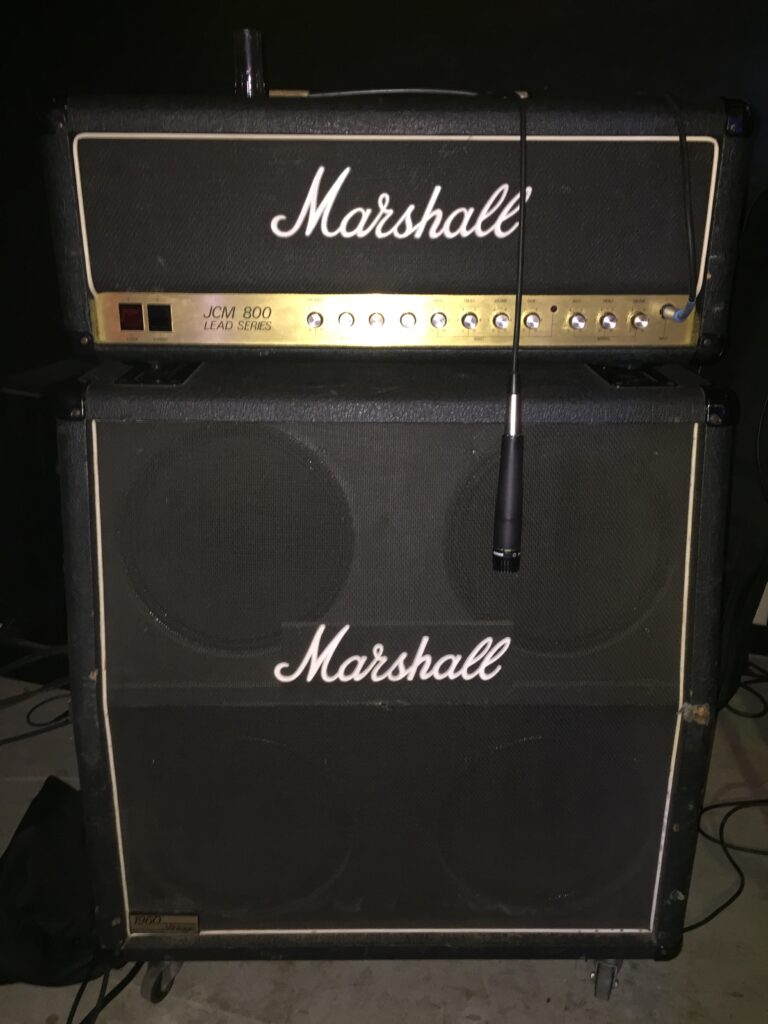
The Marshall JCM800 also appears in Schon’s documented amplification for the commercial peak Journey period. The JCM800’s preamp-gain architecture — higher gain than the vintage Plexi through a dedicated high-gain preamp stage rather than the Plexi’s output-stage saturation — provided a more modern, more immediately available high-gain character that suited the more aggressive AOR rock of the Frontiers era. Both the Plexi and JCM800 are Marshall EL34 designs; the tonal difference is in the gain architecture and in the specific warmth character of the output stage saturation versus the preamp gain.
In a modern interview, Schon is noted as being “plugged into a Vox” while playing “Don’t Stop Believin'” around 17:33. Vox’s British EL84-powered amplification provides a different character from the Marshall EL34 designs of the classic era — brighter, with a more compressed, chiming quality. Schon’s use of Vox in the modern period reflects the mature guitarist’s ongoing exploration of different amplification characters in different contexts, consistent with his identity as a serious guitar connoisseur.
Schon’s modern live rig has evolved beyond the specific Marshall configuration of the classic Journey era, incorporating various boutique amplifiers appropriate for the contemporary professional touring context. The specific combination of amplification, effects, and instruments varies across different Journey tours and recording sessions, reflecting the same ongoing tonal exploration that produced the extensive vintage guitar collection.
Effects
The Fernandes Sustainer installed in the neck position of the 1977 Les Paul Pro Deluxe (and subsequently in other Schon guitars) provides the specific infinite sustain of an electromagnetic driver that continuously excites the guitar string without pick attack. The Sustainer enables the long, singing sustain of specific Journey lead passages where the note is held for extended duration without the pick attack that would normally initiate and define it. This technology — the same Fernandes Sustainer used by multiple guitarists in this series — allows the guitar to produce the sustained, evolving tone of an organist’s drone or a bowed string instrument, with the specific pitch definition of the electric guitar.
As covered in the guitars section, the Floyd Rose tremolo arm is a primary performance technique rather than simply hardware. Schon’s specific use of the tremolo — not the extreme dive-bomb of the metal tradition but a more subtle, expressive use of pitch modulation as an emotional embellishment of melodic lines — reflects the soulful, melodic approach that defines his guitar style. The tremolo adds the blues guitarist’s vibrato and bend quality to a technical guitar that would otherwise require pure left-hand vibrato for pitch modulation. The double-locking design’s tuning stability enables the tremolo’s use throughout a set without the tuning compromises of conventional vibrato systems.
The active electronics added to the 1977 Les Paul Pro Deluxe — replacing the standard passive pickup circuit with an active preamp powered by the battery compartment — changed the guitar’s output characteristics and tonal character. Active pickups and electronics provide a lower impedance, more consistent output than passive pickups, with less tonal character variation depending on cable length or amplifier input impedance. The specific active circuit used in the modified Les Paul is not identified in available sources, but the general character of active electronics — consistent, high-output, with the specific bright, clear character that active circuits add to the pickup’s fundamental voice — is audible in the Escape-era recordings.
Boss stompboxes appear in Schon’s documented modern touring equipment alongside the PRS signature guitars and contemporary amplification. The specific Boss models are not consistently documented across available sources, but Boss’s standard professional stompbox range provides the reliable, consistent effects performance that sustained touring demands.
The Escape album’s specific commercial profile is worth documenting precisely because it places the 1977 Les Paul Pro Deluxe’s contribution in the proper context. The album was certified Diamond by the RIAA in 2021 on its 40th anniversary — Diamond certification denotes more than 10 million equivalent units sold, a threshold that fewer than 50 albums have reached in the history of the record industry. Of those recordings, Escape is the one most specifically defined by the guitar tone of a single instrument: the 1977 Les Paul Pro Deluxe with the Floyd Rose tremolo, the active electronics, the Fernandes Sustainer, and the Marshall Plexi. That guitar is now in private hands. The album has sold more than 10 million units. Every copy includes the guitar solo on “Stone in Love,” the sustaining melody of “Lights,” and the opening figure of “Don’t Stop Believin’.” The instrument that produced these sounds was modified in ways that would horrify a vintage guitar purist — a Floyd Rose on a Les Paul, active electronics replacing the passive circuit, a Sustainer driver in the neck. The music required it. The music is in the Library of Congress. The guitar is in someone’s collection. The song is at every sporting event. This is the correct outcome.
The jazz saxophonist father bought the ’68 Goldtop reissue with P-90s. Santana heard the seventeen-year-old and chose him over Eric Clapton. The Marshall Plexi recorded “Lights.” The Floyd Rose on the Les Paul was the first of its kind. The song has a billion streams. The guitar style is soulful and melodic and admired by Prince and Clapton. Neal Schon has been one of the most commercially significant and musically respected guitarists in American rock for fifty years, and he is still playing Journey, and the song is still playing at every game, and the equipment that made it is properly documented in the Library of Congress registry of American cultural recordings.
Playing Style & Tone Philosophy
Neal Schon plays guitar with the melodic directness that his jazz-saxophonist father’s musical environment established and that the Santana context then confirmed and developed: every note serves a melodic purpose, every phrase builds toward something, every solo has an emotional arc from its beginning to its resolution. This melodic intelligence — the ability to play fast and technically accomplished while always maintaining the sense that the playing is going somewhere rather than simply demonstrating what the hands can do — is the specific quality that distinguished Schon from his contemporaries in the AOR era and that has maintained his reputation across decades in which the AOR genre’s commercial prestige has fluctuated significantly.
The “soulful” dimension of his guitar work — the quality that has earned the admiration of Eric Clapton and Prince, two guitarists who come from very different musical traditions but who share the ability to recognise genuine feeling in guitar playing — comes from the blues-and-jazz foundation that preceded the rock context. Schon hears the blues tradition’s commitment to emotional communication in every note, and this commitment is present even in the most commercially polished Journey recordings. “Lights” is not a virtuoso showcase; it is a sustained meditation on a single melody, played with the complete physical commitment and emotional engagement that the blues tradition demands for sustained, expressive guitar melody.
The warm, vocal tone — the Gibson Les Paul’s mahogany warmth, the Marshall Plexi’s natural EL34 saturation, the Fernandes Sustainer’s infinite sustain — creates the specific tonal environment for this emotional communication. Each note sustains long enough for the melody to breathe; the warmth prevents harshness that would disrupt the emotional flow; the active electronics and Floyd Rose provide the technical consistency that allows the expressive dimensions to function reliably in a demanding performance context.
How to Sound Like Neal Schon
The Neal Schon Journey tone requires: a Gibson Les Paul (modified with Floyd Rose for tremolo capability) or PRS equivalent; a Marshall Plexi or JCM800 pushed to natural EL34 saturation; optional Fernandes Sustainer for extended-sustain passages; and the specific melodic approach — the blues-informed commitment to serving the song’s emotional content with each note rather than demonstrating technique. The tone without the melodic intelligence produces technically competent playing; the melodic intelligence without the tone produces the same quality through worse hardware. Both are required.
| Control | Setting (0–10) | Notes |
|---|---|---|
| Marshall Plexi Volume (Classic Journey — No Master) | 7–8 (for studio natural saturation) | Non-master-volume approach — push the single volume control for natural EL34 output stage saturation. “Lights” tone comes from this point: warm, sustaining, not compressively distorted but naturally broken up in a way that sustains indefinitely. This amp must be played at volume to work. There is no quiet version of the “Lights” tone. |
| Bass | 6 | Moderate bass — the Les Paul’s mahogany provides natural warmth. Amp bass at 6 supports without excessive low-end that would compromise the clarity of the melodic lines. The Journey guitar tone is warm but not heavy in the bass. |
| Mid | 7 | Present midrange — the vocal, soulful quality of Schon’s lead tone lives in the midrange. Active electronics provide flat output to the amp; the amp’s midrange provides the warmth and presence. The specifically melodic character of the lead work depends on midrange presence. |
| Treble | 6–7 | Moderate-to-present treble for note definition. The Les Paul’s inherent warmth combined with active electronics needs treble support for the articulation of fast melodic passages. Warm and defined; not bright and cutting. |
| Presence | 5–6 | Moderate presence — the Schon tone is warm and sustaining rather than aggressively cutting. The AOR radio context requires presence without harshness. Presence at 5–6 provides clarity without the aggressive top-end of a harder rock approach. |
| Fernandes Sustainer (Sustained Lead Passages) | Engage for melody; bypass for rhythm | For “Lights”-style sustained melody passages: engage the Fernandes Sustainer, which will maintain the note indefinitely. The specific application is sustained single-note melody with slight vibrato added by the left hand. Bypass for rhythm playing and for lead passages where the pick attack’s attack transient is part of the phrasing. |
| Melodic Approach | Serve the song; build the arc; resolve | The primary element of the Schon sound. Play in service of the melody — not the scale, not the mode, not the technique, but the specific melodic content that the song’s harmonic context suggests. Santana taught this. The jazz-saxophone father established it. The AOR context required it. The emotional communication is the point; the technical execution is how the communication is delivered. |
Influence & Legacy
Neal Schon’s influence on rock guitar is concentrated in the specific intersection of technical accomplishment and melodic accessibility that the AOR context required at its best and that he delivered more consistently than almost any of his contemporaries. The Journey recordings at their commercial peak — Escape and Frontiers specifically — contain guitar work that combines technical fluency with the specific melodic directness of the singer-songwriter tradition, producing solos and lead lines that are both impressive to guitar players and immediately accessible to listeners who don’t think about guitar playing at all. This accessibility-without-sacrifice-of-quality is the specific achievement that has made the Journey catalog as durable as it has proven across four decades.
His commercial legacy is, by the specific metrics of commercial music, extraordinary: “Don’t Stop Believin'” is the best-selling catalog rock song in iTunes history, has over a billion Spotify streams, is in the Library of Congress National Recording Registry, and is played at every sporting event in America. The 1977 Gibson Les Paul Pro Deluxe that recorded it sold at Heritage Auctions. The song in the Sopranos finale. These are the cultural artifacts of a guitar career that produced more mainstream commercial impact than virtually any other guitarist in this series.
His artistic legacy is the specific quality of melodic guitar playing that inspired Eric Clapton and Prince — two guitarists who are not easily impressed — and that has maintained its vitality across fifty years of professional playing. The Santana chapters connected him to the Latin rock and fusion traditions; the Journey chapters connected him to the AOR tradition; the solo and collaborative work has connected him to the broader landscape of American rock guitar. For the broader AOR guitar tradition, see Peter Frampton’s parallel melodic guitar approach. The Santana connection that established Schon’s early career is part of the broader Carlos Santana legacy . And the “soulful, melodic” quality that Eric Clapton admired connects Schon to the blues-rock melodic tradition that Paul Kossoff and other emotionally direct players all embody in their different ways.
His ongoing collaboration with original Journey members across different lineup configurations — the various legal and musical disputes over the Journey name and legacy, the specific complexity of a band whose founding membership has changed across decades — reflects the specific challenges of maintaining a commercial and artistic identity across fifty years of personnel changes, audience expectations, and the general difficulty of being responsible for one of American rock’s most recognizable and most commercially significant catalogs. Schon has navigated these challenges as both a musician and a businessman, maintaining both the musical quality and the commercial viability of the Journey name through contexts that would have compromised less committed artists. The Rock and Roll Hall of Fame induction in 2017 provided formal institutional recognition. The Diamond certification of Escape in 2021 provided commercial documentation. The billion Spotify streams provide daily evidence. The songs continue to be played because they continue to be good, and they continue to be good because Neal Schon’s guitar work made them good and made them durable. The Plexi helps. The Floyd Rose helps. The Les Paul helps. The billion streams are the proof that none of us needed, but that confirms what we already knew.
Santana chose him over Clapton. He was seventeen. He had the quality then that he has now. The 1977 Les Paul Pro Deluxe is in someone’s collection. The song is in the Library of Congress. “Don’t Stop Believin'” is playing somewhere right now, at a game or a bar or a car radio, and someone who doesn’t know a Floyd Rose from a Bigsby is singing along. This is the Neal Schon legacy. It is considerable.
Frequently Asked Questions: Neal Schon Guitars & Gear
What guitar did Neal Schon use to record “Don’t Stop Believin'”?
“Don’t Stop Believin'” was recorded with a 1977 Gibson Les Paul Pro Deluxe, serial number 06 115596, in black finish. Schon had modified the guitar extensively: a Floyd Rose double-locking tremolo and locking nut were added (making it what he claims was the first Gibson to receive a double-locking Floyd Rose installation), active electronics with a battery compartment replaced the standard passive circuit, and a Fernandes Sustainer was installed in the neck position. The guitar was used on “Don’t Stop Believin’,” “Stone in Love,” “Who’s Crying Now,” and across the Escape album and its supporting tour. It was sold at Heritage Auctions in 2021, signed by Schon in silver ink on the headstock, retaining its yellow Ferrari sticker on the back and the original JOURNEY flight case.
What amplifier did Neal Schon use on “Lights”?
Neal Schon confirmed in an interview (referenced by the Equipboard community at approximately 45:45) that he used a Marshall Plexi to record “Lights” — the vintage, non-master-volume Marshall head from the late 1960s. The Plexi’s EL34 output stage, pushed to natural saturation by the single volume control, produces the specific sustaining, singing warmth of the “Lights” guitar tone — the quality of a note that continues indefinitely with the warmth of natural valve saturation rather than the harder edge of preamp-gain distortion. In a modern interview, Schon was also noted as playing “Don’t Stop Believin'” while plugged into a Vox amplifier, confirming his ongoing exploration of different amplification.
How did Neal Schon come to join Santana at age 17?
Neal Schon’s path to Santana began with a specific choice that Carlos Santana made: he was offered Eric Clapton as a second guitarist but chose the seventeen-year-old Schon instead. The specific qualities that prompted Santana to choose a teenager over one of rock’s most celebrated guitarists are not exhaustively documented, but the result — Schon recording Santana III (1971) and Caravanserai (1972) as a teenage member of one of rock’s most musically sophisticated bands — confirms that whatever Santana heard in the seventeen-year-old was genuine and fully present. Schon left Santana at twenty to co-found Journey in 1973.
What is the Neal Schon PRS signature guitar?
Paul Reed Smith Guitars produces multiple Neal Schon signature models, including the NS-14, NS-15, and the Dragon Double-Neck. The PRS Schon signatures combine PRS’s specific construction quality with the tonal requirements Schon has developed: humbucking pickups for warmth, Floyd Rose tremolo systems, and the specific neck profile and fretboard radius of his playing requirements. The 2005 PRS Dragon Double-Neck — with the Dragon inlay on both necks — is among the most visually dramatic instruments in his collection and one of two Dragon Double-Necks he offered through the 2021 Heritage Auctions sale.
Why is “Don’t Stop Believin'” culturally significant beyond being a hit song?
“Don’t Stop Believin'” has achieved a specific cultural durability that extends well beyond its original 1981 chart performance. It is the best-selling catalog rock song in iTunes history. It has over a billion streams on Spotify. It was featured in the series finale of The Sopranos, in the TV show Glee (prompting a revival of interest in the song for a new generation), and in the film Rock of Ages. It is in the Library of Congress National Recording Registry. It is played at virtually every major sporting event in America. The Library of Congress designation — reserved for recordings of cultural, artistic, or historical significance — is the formal institutional acknowledgment of the song’s place in American culture. Neal Schon co-wrote the song with Steve Perry and Jonathan Cain, and the 1977 Gibson Les Paul Pro Deluxe that recorded the guitar parts is in private hands, having sold at Heritage Auctions in 2021.
What is Neal Schon’s guitar collection like?
Schon is one of rock’s more serious vintage guitar connoisseurs, with a collection documented through the 2021 Heritage Auctions sale that included a pair of 1959 Gibson Les Paul Standards, a 1960 Gibson ES-355, a 1953 Fender Telecaster in Butterscotch Blonde, a 1955 Gibson Goldtop, the “Don’t Stop Believin'” 1977 Les Paul Pro Deluxe, two PRS Dragon Double-Necks, and dozens of additional instruments. Schon’s own statement about the auction — “These are guitars I’ve been collecting for decades and need to make room for new arrivals” — reflects the ongoing collection rather than a clearance sale. The collection spans vintage Gibsons, vintage Fenders, and the PRS signature models that represent his modern performing identity.
When did Neal Schon join the Rock and Roll Hall of Fame?
Journey was inducted into the Rock and Roll Hall of Fame in 2017 — the induction that had been delayed past the point when some observers felt it was overdue given the commercial and cultural significance of the Journey catalog. Schon is also a member of the Oklahoma Music Hall of Fame. Earlier recognition included Journey’s Star on the Hollywood Walk of Fame (2005) and the Billboard Magazine Legend Of Live Award at the 2011 Billboard Touring Conference. The Escape album was certified Diamond by the RIAA in 2021 on the album’s 40th anniversary — Diamond certification denotes more than 10 million equivalent units sold, one of the rarer achievements in the history of the record industry.
Image credits
- Carlos Santana: Heinrich Klaffs, Wikimedia Commons, CC BY-SA 2.0.
- Top image: by Matt Becker, Wikimedia Commons, CC BY 3.0.
- Marshall 1959 Super Lead Plexi: GuitarGangsters AI-generated reference illustration, not a photograph.
- Marshall JCM800: John2112, Wikimedia Commons, CC BY-SA 4.0.
- Gibson Les Paul Goldtop: Kellykma71, derivative by Clusternote, Wikimedia Commons, CC BY-SA 4.0.
- Gibson Les Paul Standard: DonnyBurger1974, Wikimedia Commons, CC BY-SA 4.0.
- Floyd Rose Original tremolo: GuitarGangsters AI-generated reference illustration, not a photograph.