Epiphone Firebird: The Guitar a Car Designer Built, and Four Completely Different Genres Fought Over
Epiphone Firebird history: Johnny Winter's blues fire, Allen Collins' real Free Bird guitar, and Warren Haynes' Firebird fleet — specs and buying guide.
Most guitar shapes get invented by luthiers. The Firebird got invented by a man who designed Cadillacs. In 1963, with Fender’s sleek, futuristic Jazzmaster and Jaguar eating into its market share, Gibson made an unusual move: they hired automotive stylist Ray Dietrich — a man whose résumé included the Lincoln Continental and Packard sedans — to design them a guitar that looked like nothing else on a stage. What Dietrich handed back was a “reverse body” instrument, with the horns flipped so the longer point sat on the treble side, a matching reverse headstock, and Gibson’s first-ever neck-through-body construction. It looked like a chrome tailfin. It sounded like nothing Gibson had made before. And over the following six decades, it would become the signature weapon of four guitarists who couldn’t have less in common musically: a Texas blues-slide madman, a Southern rock tragedy, a jam-band Gibson loyalist, and an English art-rock aesthete who bought his by knocking on a stranger’s door.
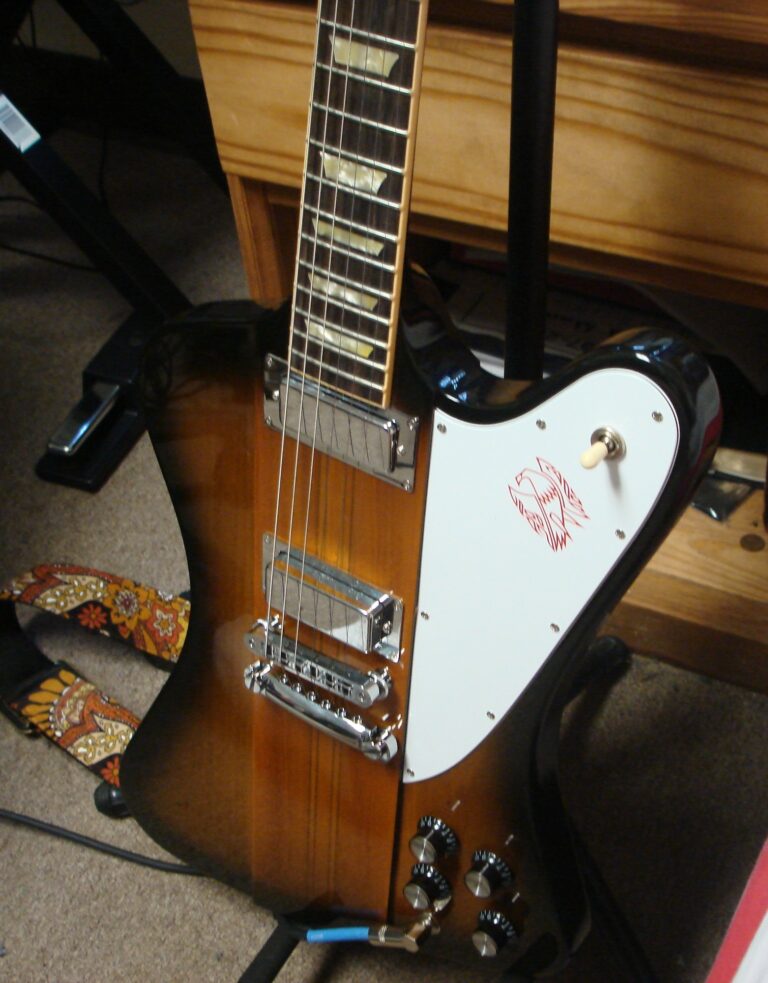
The Epiphone Firebird — currently around $649 to $699 depending on finish, from the Inspired by Gibson Collection — inherits every bit of that neck-through weirdness at a fraction of the Gibson price. And here’s the pleasant surprise this time: all four of the players usually associated with it check out. Johnny Winter, Allen Collins, Warren Haynes, and Phil Manzanera didn’t just play “a Firebird” in some loose family sense — they built entire signature sounds around the shape, on the exact reverse-body silhouette this guitar recreates. Even better: Epiphone’s own marketing copy for its Inspired by Gibson Custom Firebird series name-checks Johnny Winter and Phil Manzanera directly as the players who defined the tone.
1963: Detroit Chrome Meets Kalamazoo Wood
The Firebird arrived at a genuinely strange moment for Gibson. Fender’s offset shapes were selling to a generation that wanted guitars that looked like the future, and Gibson — the company of arch-tops and Les Pauls — needed an answer that didn’t just copy the competition. Dietrich’s solution borrowed more from Detroit than from any luthier’s bench: a body with genuine automotive flair, a headstock that swept backward instead of forward, and — most radically — a neck-through-body build where a nine-ply mahogany-and-walnut spine ran the entire length of the instrument, with mahogany “wings” glued to either side.
This was Gibson’s first neck-through electric, and it wasn’t a cosmetic choice. Because the pickups, bridge, tailpiece, and tuners all mount to the same continuous piece of wood, the Firebird delivers sustain and resonance that a bolt-on or even a standard set-neck guitar can’t quite match — the entire signal path, mechanically speaking, sits on one uninterrupted plank. Early Firebirds also carried genuinely new “mini-humbucker” pickups, smaller than Gibson’s standard PAFs, delivering a sound that split the difference between humbucker warmth and single-coil bite — bright, a little splashy, but never brittle.
The guitar came in four flavors numbered I through VII by pickup and hardware count, with the Firebird VII topping the line with gold hardware, three pickups, and a Maestro Vibrola. Fender, amusingly, sued over the reverse-body’s resemblance to their own offset shapes, and Gibson quietly redesigned the body to a “non-reverse” configuration for a few years in the late ’60s before the beloved original reverse shape returned for good in the ’70s. That legal skirmish is a big part of why vintage Firebird history is such a maze of variants — but the reverse-body 1963-64 format, the one every player below fell in love with, is exactly what today’s Epiphone recreates.
Four Players, Four Genres, One Reverse Body
Johnny Winter: The Blues Thunderstorm
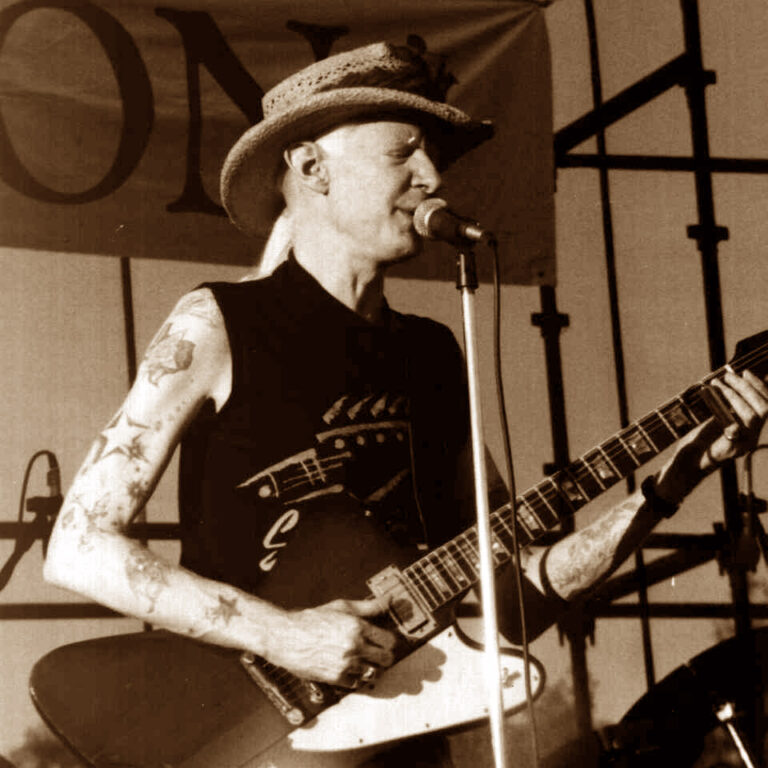
Johnny Winter is arguably the single guitarist most synonymous with this shape. He acquired a 1963 sunburst Firebird V early in his career and it became inseparable from his sound — searing, hyper-fast slide and lead work that made him one of the defining blues-rock guitarists to emerge from Texas. Winter’s most famous Firebird, a heavily worn Polaris White 1964 example nicknamed the “Holy Grail of rock guitars” by collectors, appears on the cover of his landmark live album Captured Live! and racked up so many miles that Winter had its Maestro Vibrola removed entirely, preferring the tone and stability of a straight stop-bar. He played that guitar — chipped paint, faded logo, and all — from the late 1960s until his death in 2014, using it on Grammy-winning albums he produced for his hero Muddy Waters. When Epiphone launched its Inspired by Gibson Custom Firebird series, their own promotional copy cited Winter by name as one of the players who “captivated” audiences with this exact tone — about as direct an official endorsement of the connection as this series gets.

Allen Collins: The Free Bird Firebird
Here’s a detail that reframes one of the most famous guitar recordings in rock history. Allen Collins of Lynyrd Skynyrd is remembered today for his 1958 korina Explorer — the guitar he switched to in 1976 and used for the rest of his career. But during Skynyrd’s earliest, most pivotal years — 1970 through 1975 — Collins’s primary stage and studio guitar was a modified 1964 Gibson Firebird, fitted with a chrome-covered P-90 in the bridge position and a distinctive “teaspoon” vibrato arm. That means the Firebird, not the Explorer, is the guitar underneath the band’s 1973 debut album Pronounced ‘Lĕh-‘nérd ‘Skin-‘nérd — the record containing the original studio version of “Free Bird,” on which Collins doubled every layer of that legendary extended outro solo himself. The Explorer gets the glory in guitar-shop mythology, but the Firebird is arguably the guitar that actually built Lynyrd Skynyrd’s sound.
Warren Haynes: The Modern Multi-Firebird Loyalist
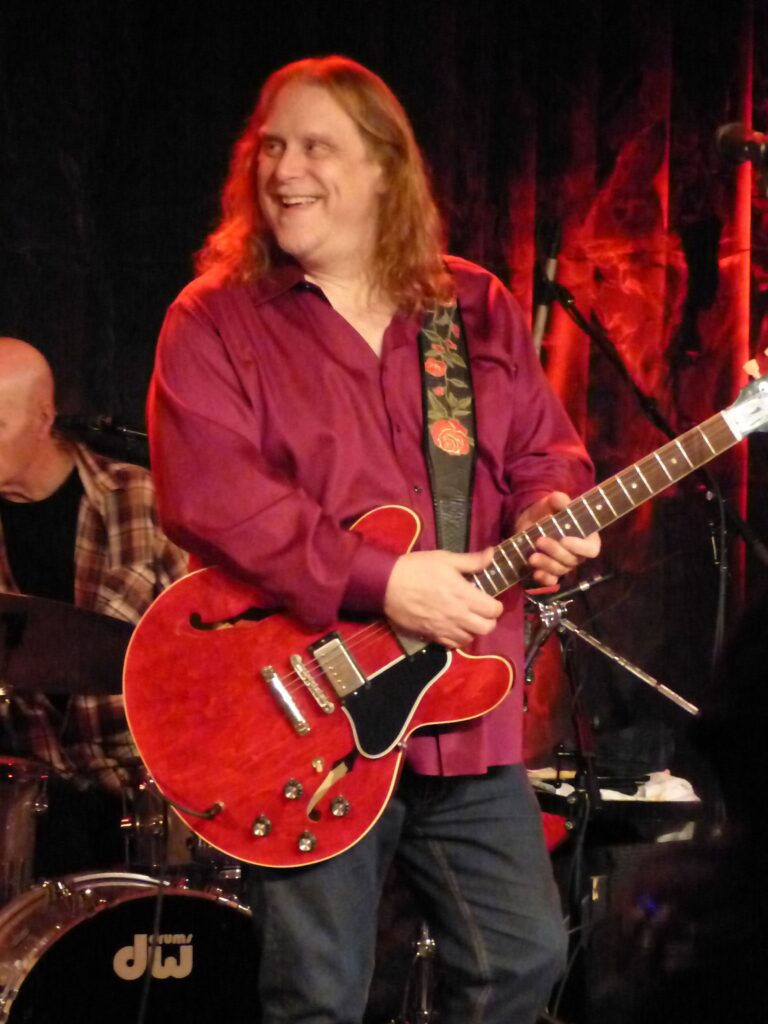
Warren Haynes — the Allman Brothers Band and Gov’t Mule guitarist widely considered one of the great living blues-rock players — doesn’t own just one Firebird; he owns a small fleet of them, each with its own nickname. “Moe Lester,” a brown Firebird tuned down a half step. “Ole Blue,” a dark blue example usually capoed at the second fret. “Paul E Lester” and “Freeway,” both loaded with three P-90 pickups instead of humbuckers for extra tonal texture. Haynes has explained that he started favoring Firebirds for material tuned down a half-step because — unlike his SGs — they held up well to the altered tension. He’s currently working with Gibson on a signature Firebird model loaded with a trio of P-90s, following years of using Custom Shop prototypes in exactly that configuration. For a guitarist as thoroughly identified with Gibson Les Pauls as Haynes, the sheer number of named, road-worn Firebirds in his touring arsenal tells you how central the shape is to his actual working sound, not just his image.

Phil Manzanera: The Art-Rock Accident
And then there’s the strangest acquisition story in this entire article. Phil Manzanera of Roxy Music needed a “flash” guitar in 1973 after his Gibson ES-335 was stolen from a tour van. He spotted a classified ad in Melody Maker — just “Red Gibson for sale,” no further detail — and went to a posh house in London’s Regent’s Park, where a 16-year-old American kid answered the door holding a Cardinal Red 1964 Gibson Firebird VII with gold-plated hardware. Manzanera had never seen one before, didn’t even plug it in, and bought it on the spot for £120. It became, in his words, his musical trademark from that day forward — visible in the iconic inner-gatefold photo of Roxy Music’s 1973 album For Your Pleasure, and present on every one of his solo albums and on Roxy staples including “Love Is the Drug.” Decades later, a chance connection revealed the guitar’s mysterious prior owner, closing a fifty-year mystery about where his signature instrument actually came from. It’s the Firebird’s least “rock and roll” origin story and one of its best.
The Epiphone Firebird Today: Neck-Through at a Fraction of the Price
The current Inspired by Gibson Epiphone Firebird stays faithful to the 1963 format in the way that matters most: it’s a genuine 9-ply mahogany-and-walnut neck-through-body construction, not a set-neck approximation. That’s a real engineering commitment at this price point — neck-through construction is significantly more labor-intensive to build than a bolt-on or glued joint, and it’s the single biggest reason the original commanded such loyalty from players who could otherwise afford anything.
Full Specifications — Epiphone Firebird (Inspired by Gibson)
The Wider Firebird Family
Above the standard model sits Epiphone’s newer Inspired by Gibson Custom 1963 Firebird I and V, which step up to genuine USA-made pickups — the same units found in Gibson Custom Shop Murphy Lab Firebirds — plus CTS potentiometers, Mallory capacitors, and Switchcraft hardware. The Firebird I comes in period colors like Silver Mist and Inverness Green; the Firebird V in Frost Blue and Ember Red. Both ship with a hardshell case. This is the tier that Epiphone explicitly links to Winter, Manzanera, and companions like Keith Richards, Eric Clapton, and PJ Harvey in its own marketing. For players chasing period-correct 1960s tone rather than a modern workhorse, this Custom Collection line is the one to watch.
How It Sounds: Bright, Splashy, Never Brittle
The Firebird’s tonal signature is genuinely distinct from every other Epiphone in this series. Where the mahogany-heavy Les Paul and SG deliver dark, compressed midrange, the Firebird’s neck-through construction and mini-humbucker-derived ProBucker FB720 pickups push a brighter, more open voice — plenty of humbucker warmth underneath, but with a top-end sparkle that borders on single-coil territory without ever getting thin or harsh. It’s the tone Johnny Winter needed for lightning-fast slide runs to cut through a mix without disappearing into mud, and the same brightness that made Manzanera’s angular, treated leads slice through Roxy Music’s dense art-rock arrangements.
The neck-through build also changes how the guitar responds physically. Because the entire body core is one continuous piece of wood, sustain is exceptional — notes bloom and hang rather than decaying quickly — and there’s markedly less of the “neck dive” some players report on other mahogany-heavy Gibson-style guitars, since weight distributes more evenly along that spine. Players moving from a bolt-on Telecaster or Stratocaster often note the Firebird’s longer overall length changes the felt scale, even though it’s the same 24.75″ as a Les Paul.
Tone Recipes
Texas Thunderstorm (Johnny Winter)
Bridge pickup, slide on your pinky, into a cranked tube amp with minimal pedal interference — maybe a Tube Screamer for a touch more push. Winter’s tone lived in raw amp breakup, not effects; keep your signal chain as short as his patience for studio overdubs.
Free Bird Outro (Allen Collins)
Neck pickup for the sustained melodic lines, switching to bridge for the harder-picked runs. Into a Marshall-style amp pushed to edge-of-breakup, no gain pedal — just amp volume and pick attack driving the dynamics, the way Southern rock’s twin-lead tradition always did.
Ole Blue Half-Step (Warren Haynes)
Tune down a half step, bridge pickup, into a warm British-voiced amp with a Klon-style transparent overdrive for a touch of grit. This is Gov’t Mule jam territory — leave room for the notes to breathe and don’t over-pedal the signal.
In Every Dream Home (Phil Manzanera)
Both pickups blended, into an amp with a long analog-style delay or tape echo for that “double-time” rhythmic layering Manzanera favored. A Uni-Vibe or phaser for the more psychedelic passages captures the art-rock texture without losing note definition.
Epiphone Firebird vs. the Alternatives
Vs. Gibson Firebird: Gibson’s current Firebird lineup runs well over $2,000, with the Custom Shop Murphy Lab tribute models — like the actual Johnny Winter reissue — reaching into five figures. The Epiphone shares the neck-through construction philosophy and general spec sheet; the gap is USA-made pickups, nitro finish, and collector value.
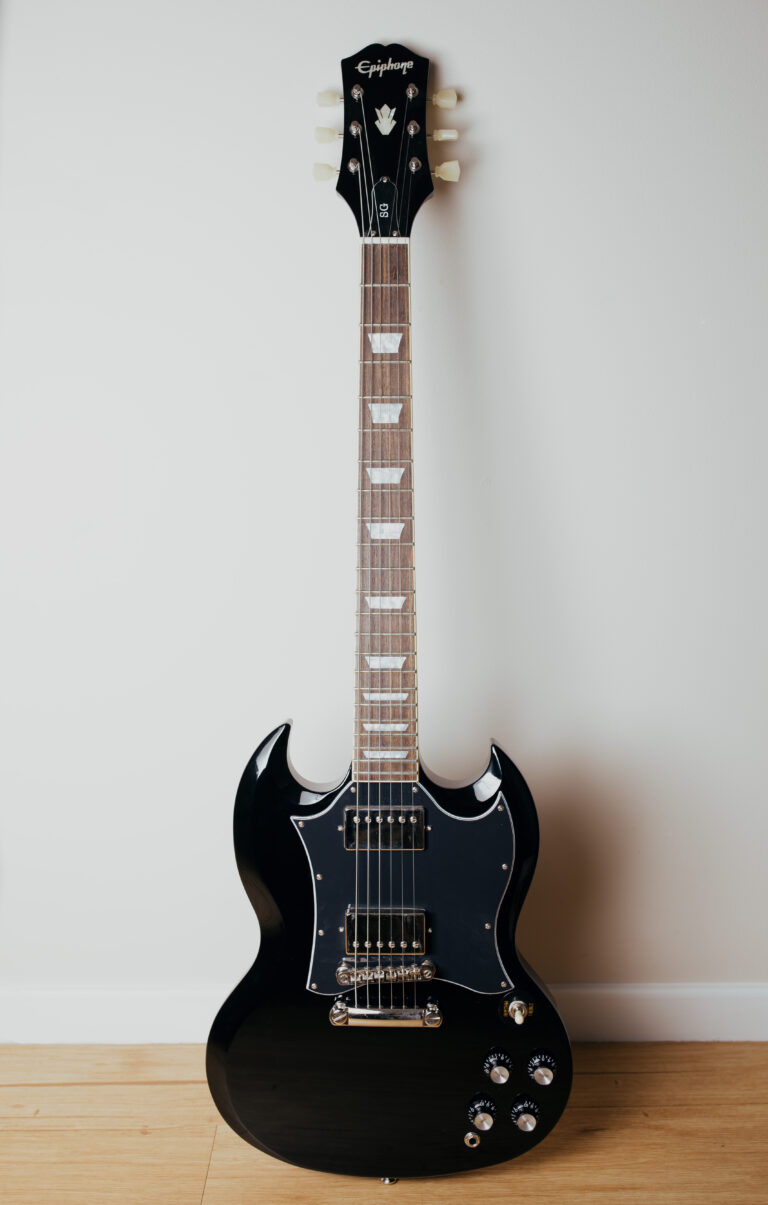
Vs. Epiphone SG Standard: Both are mahogany-based Gibson-family instruments, but the construction philosophy diverges completely — the SG is a set-neck double-cutaway with a darker, more compressed midrange, while the Firebird’s neck-through design and mini-humbucker-derived pickups deliver a brighter, more open voice with exceptional sustain.
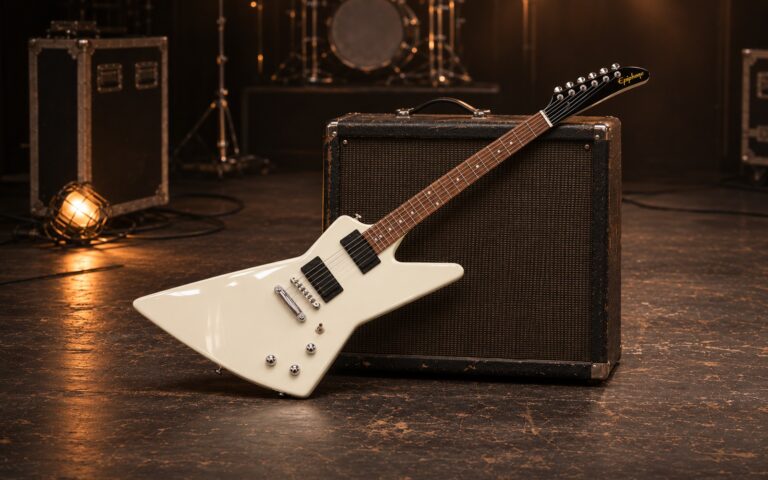
Vs. Epiphone Explorer: Direct siblings from the “Modernistic” design lineage, but the Explorer uses a set-neck mahogany build with a darker, thicker low end, while the Firebird’s neck-through construction and reverse body give it that signature brightness and sustain. Allen Collins, notably, owned both and switched between them at different points in his career.
Vs. a Fender Jaguar/Jazzmaster: The guitars that indirectly provoked the Firebird’s creation. Both chase a “futuristic ’60s” aesthetic, but the construction philosophies are opposites — offset bolt-on versus reverse neck-through. If you love the era but want humbucker warmth over Fender’s single-coil jangle, the Firebird is the answer.
Buying Guide: Which Firebird, and What to Check
The standard Inspired by Gibson Firebird (~$649–$699) is the sensible entry point — genuine neck-through construction, ProBucker FB720 pickups built to 1960s spec, and enough vintage-correct detail to satisfy most players. Step up to the Inspired by Gibson Custom 1963 Firebird I or V if period-correct USA pickups and premium electronics matter more than budget — this is the tier Epiphone associates directly with Winter and Manzanera. Reverse-body Firebirds have a reputation for being slightly harder to source used in good condition than Les Pauls or SGs simply because fewer were made across most production eras; expect prices in decent shape to hold up well on the secondary market.
On any Firebird, new or used, check the neck-through joint carefully at the body/wing seams — this is the guitar’s structural signature and any separation or visible gap is a dealbreaker. Confirm the reverse headstock tuners turn smoothly (the string angle behind the nut is different from a standard headstock and puts unusual stress on cheap tuners), and sight down the neck for straightness, since the longer overall body length means slightly more leverage on any warp.
Living with a Firebird: Practical Ownership
The Firebird’s balance is one of its most underrated practical virtues — because the neck-through spine distributes mass evenly along the guitar’s length, many players report noticeably less neck dive than comparable mahogany-heavy Gibson-style instruments, making it comfortable on a strap for long sets. The reverse headstock does mean restringing takes a moment to get used to; tuners sit in the opposite order from a standard Gibson headstock, so keep that in mind the first few string changes.
Weight varies by finish and era but generally sits in a manageable 7–8 pound range. Because neck-through construction makes neck resets essentially impossible (there’s no separate neck to remove), buy from a reputable source and avoid anything with visible body-wing separation or headstock repairs — issues that are catastrophic rather than fixable on this design. Standard hardshell cases fit the body reasonably well despite the asymmetric reverse shape, unlike the more demanding Flying V or Explorer.
The Verdict: One Shape, No Consensus Genre
Every other guitar in this series eventually gets claimed by a genre — the SG by hard rock, the Explorer by metal, the Flying V split between blues and thrash. The Firebird never fully surrendered to any single scene. It’s simultaneously the guitar on “Free Bird,” the guitar behind Roxy Music’s arch art-rock experiments, the guitar Johnny Winter used to out-blues everyone in Texas, and the guitar Warren Haynes still tours with today, decades into a career built mostly on Les Pauls. Ray Dietrich designed a car-inspired body for a guitar company chasing Fender’s futurism in 1963, and somehow ended up creating the one shape too idiosyncratic for any single genre to fully own.
FAQ
What makes the Firebird’s construction different from a Les Paul or SG?
The Firebird uses genuine neck-through-body construction — a continuous 9-ply mahogany/walnut spine running the full length of the instrument, with mahogany wings glued to either side. Les Pauls and SGs use set-neck construction, where a separate neck is glued into a body joint. Neck-through generally delivers greater sustain and more even weight distribution.
Did Allen Collins really play a Firebird on “Free Bird”?
Yes — Collins’s primary guitar from 1970 to 1975, including on Lynyrd Skynyrd’s 1973 debut album containing the original studio recording of “Free Bird,” was a modified 1964 Gibson Firebird. He switched to his now-more-famous 1958 korina Explorer starting in 1976.
What pickups does the Epiphone Firebird use?
The standard Inspired by Gibson model uses Epiphone ProBucker FB720 humbuckers built with Alnico 2 magnets to 1960s Firebird specifications — designed to recreate the original mini-humbucker’s bright, articulate voice. The Inspired by Gibson Custom 1963 series steps up to genuine USA-made pickups.
Is the Epiphone Firebird comfortable to play seated?
Yes, notably more so than a Flying V or Explorer — the Firebird’s more conventional body contour rests naturally on the leg, and its balanced weight distribution from the neck-through design reduces neck dive compared to many mahogany-heavy alternatives.
Why is the Firebird’s headstock “reverse”?
Automotive designer Ray Dietrich flipped the traditional Gibson headstock and body horn orientation as part of the 1963 original’s futuristic redesign. The reverse configuration also changes the string pull angle and tuner order compared to a standard Gibson headstock — a detail players restringing for the first time should know about.
How does the Epiphone Firebird compare to the Epiphone Explorer?
Both descend from Gibson’s early-60s “Modernistic” design push and share a similar mahogany tonal palette, but the Firebird’s neck-through construction gives it a brighter, more sustained voice compared to the Explorer’s darker, set-neck low end. Allen Collins famously owned and played both at different points in his career.
Image credits
- Johnny Winter: Pelerin, Wikimedia Commons, CC BY-SA 4.0.
- Warren Haynes: Frank Schwichtenberg, Wikimedia Commons, CC BY-SA 3.0.
- Johnny Winter: Masahiro Sumori, Wikimedia Commons, CC BY-SA 3.0.
- Warren Haynes: SaltyBoatr, Wikimedia Commons, CC BY-SA 3.0.
Latest News
Related
On This Day
Tuesday 10 November
From this week: