Epiphone Explorer: The 1958 Flop That Became Metal’s Favorite Shape
The Gibson Explorer bombed in 1958, then Hetfield, The Edge, and Collins made it their own. History, specs, and buying guide inside.
Allen Collins, James Hetfield, The Edge, and Matthias Jabs are all genuinely, verifiably associated with the Explorer . What makes that worth noting is how differently these four players used the exact same angular body. One built Southern rock’s most famous guitar solo on it. One invented thrash metal’s rhythm-guitar vocabulary on it. One used it to make U2’s early, chiming post-punk sound “ginormous.” And one turned it into a Scorpions stage weapon so central to his identity that Gibson eventually built him a scaled-down signature version. Few guitar shapes carry that range of genuine ownership.
A Guitar Ten Years Ahead of Its Own Audience
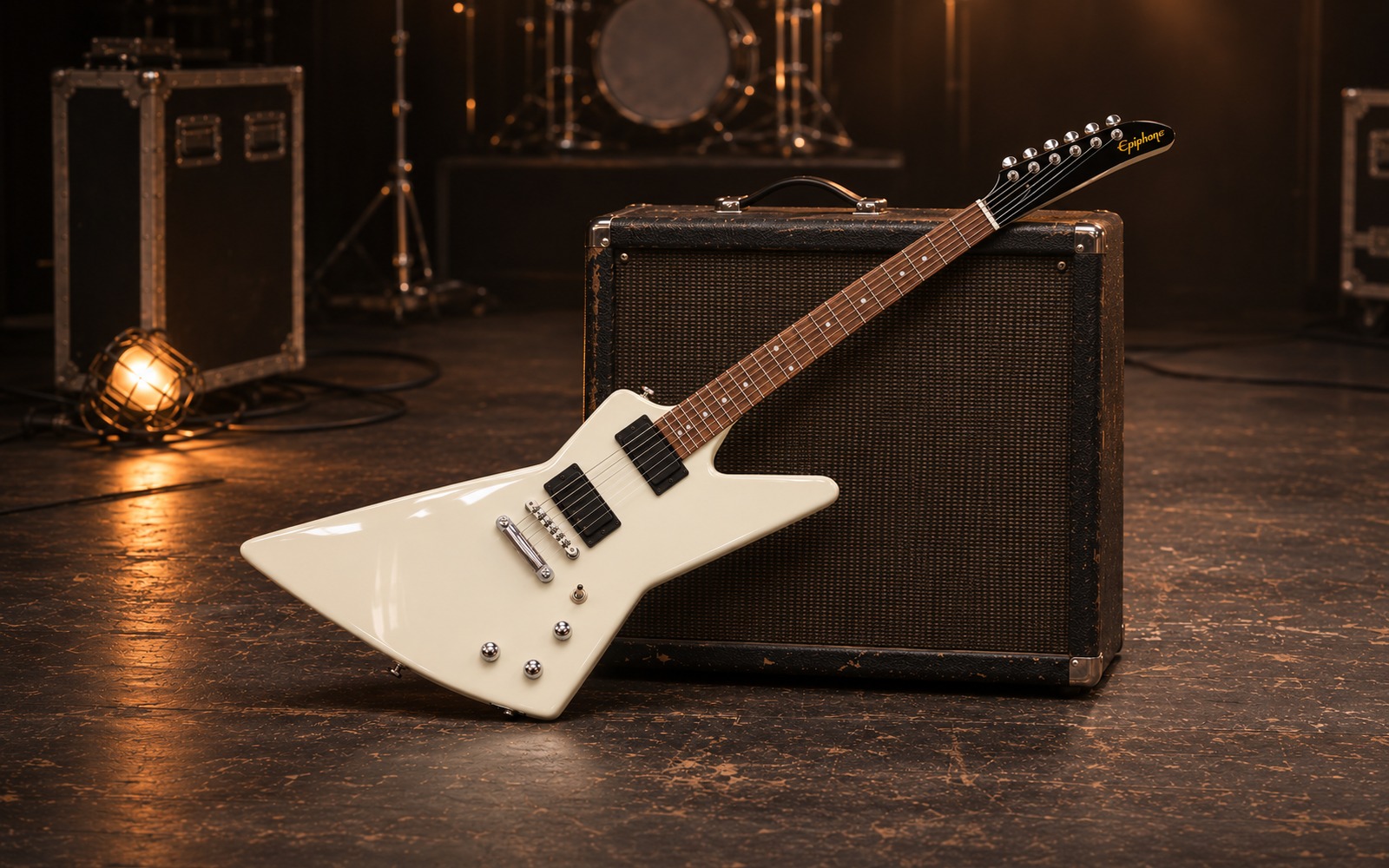
The Gibson Explorer launched in 1958 alongside its equally radical sibling the Flying V, part of what Gibson later marketed as the “Futura” design family, developed by president Ted McCarty as a space-age answer to Fender’s increasingly popular, sleek-bodied Stratocaster. It was, by any commercial measure, a disaster. The original Explorer’s arrowhead body and hockey-stick headstock were simply too futuristic for a guitar market still dominated by conservative, crew-cut sensibilities, and only around 22 units were built in the guitar’s initial 1958-59 run, with fewer than 50 more assembled from leftover parts in the early 1960s before Gibson quietly discontinued the model in 1963. Those handful of surviving originals are now among the most valuable production electric guitars ever made.
The Explorer’s second life didn’t arrive until more than a decade later. Gibson began reissuing the Explorer in 1976, partly in response to competitor Hamer Guitars finding commercial success with similarly shaped instruments, and this time the timing was right — hard rock and the earliest wave of heavy metal were hungry for a guitar shape aggressive enough to match the music. What had been unsellable in the buttoned-up late ’50s became, within a few years, one of rock’s most recognizable silhouettes.
A Shape That Kept Reinventing Itself
Unlike some iconic guitar shapes that stayed frozen in amber after their breakthrough era, the Explorer kept evolving through genuinely different design experiments. Gibson released a 1976 Limited Edition Explorer in mahogany with gold hardware, followed in 1979 by the radically different E2 model — a five-piece walnut and maple laminated construction with a contoured body that stayed in production only until 1983. That E2 design later resurfaced decades later as the basis for a Brendon Small signature model, proof that even the Explorer’s more experimental offshoots found dedicated audiences eventually. Smaller, more compact variants followed too, including the Matthias Jabs-designed Explorer 90 and later the Explorer Pro — each an attempt to adapt the shape’s dramatic silhouette to slightly different ergonomic priorities without losing what made the original distinctive.
Full Specifications
Why the Shape Actually Matters for Tone
It’s tempting to treat the Explorer as purely a visual statement, but the body shape genuinely shapes the sound. The large mahogany body delivers rich midrange character and considerable sustain, a product of having significantly more resonating mass than a Stratocaster-style body despite the angular cutaways. The ProBucker-2 and ProBucker-3 pairing uses Alnico II magnets — the same type found in prized vintage PAF humbuckers — for warm tone with crystalline top end and a tight low end, a combination reviewers consistently describe as well-suited to both aggressive rock and metal tones and surprisingly usable clean and lightly-driven sounds. That versatility is easy to overlook given the guitar’s genre reputation, but it’s exactly what let The Edge coax chiming, atmospheric tones out of the same core electronics that Hetfield used to define thrash rhythm guitar.
The tradeoff is ergonomic rather than tonal. Some players report the guitar’s balance can encourage forward tilt due to strap button placement, and heavier examples can produce noticeable shoulder fatigue over long standing sessions — a real consideration for anyone used to a lighter-bodied guitar.
Famous Players: One Shape, Four Completely Different Sounds
Allen Collins and the Explorer’s Southern Rock Roots
Allen Collins of Lynyrd Skynyrd switched to a natural-finished korina 1958 Gibson Explorer in 1976, an instrument he’d bought for roughly $3,000 — a serious investment at the time for a guitar most of the market still considered a commercial failure. Collins had already recorded the studio version of “Free Bird” — routinely ranked among the greatest guitar solos of all time — playing the entire solo himself, and the Explorer became inseparable from his live identity for the remainder of his career with the band. His well-worn Explorer, complete with a hand-added Maestro Vibrola he fitted himself since Gibson never offered one stock on the model, became so iconic that Gibson later issued a limited-edition Allen Collins signature Explorer in his memory. Find his profile at GuitarGangsters’ Allen Collins page.
James Hetfield: The Guitar That Defined Thrash
James Hetfield switched to a white Gibson Explorer in 1984 after the neck on his previous Flying V-style guitar snapped, and this Explorer — later nicknamed for the “So What” graffiti scrawled across its body — became the primary instrument used to record Metallica’s landmark second album, Ride the Lightning. It’s arguably the single most influential Explorer in the guitar’s entire history, cementing the shape’s association with heavy, downtuned rhythm playing for an entire generation of metal guitarists who followed. Find his profile at GuitarGangsters’ James Hetfield page.

The Edge: Proof the Explorer Isn’t Just a Metal Guitar
The Edge of U2 found his Explorer on a 1978 trip to New York, originally intending to buy a Les Paul before falling for the Explorer instead, paying $248.40 for a guitar he later described as feeling instantly right in his hands. That guitar became central to U2’s earliest studio work, and tracks like “I Will Follow” showed the Explorer could deliver an ethereal, chiming sonic character entirely removed from the aggressive rock and metal contexts the shape is best known for. It’s the clearest evidence in the Explorer’s history that the guitar’s tonal range genuinely exceeds its visual reputation. Find his profile at GuitarGangsters’ The Edge page.

Matthias Jabs: The Explorer Superfan
Matthias Jabs of the Scorpions owns more than twenty different Gibson Explorers, including seven Korina examples, making him arguably the most dedicated Explorer collector among the guitar’s famous players. Gibson eventually built him a signature Explorer 90, so named because its body measured just 90 percent the size of a standard Explorer — a genuine design collaboration that shows how deeply the shape shaped his stage identity over a decades-long career. Find his profile at GuitarGangsters’ Matthias Jabs page.
Tone Recipes
Hetfield-Style Thrash Rhythm
Bridge pickup, volume maxed, tone rolled back slightly for a tighter, more focused low end. Palm-mute heavily and push into a high-gain amp — the mahogany body’s natural sustain and midrange density carry downtuned riffs without needing extreme gain to feel massive.
Collins-Style Southern Rock Lead
Neck pickup for warmth, moderate gain from a cranked tube amp. The Explorer’s long sustain suits extended, melodic solo lines that build slowly rather than relying on speed alone.
The Edge-Style Chiming Atmosphere
Bridge pickup, tone opened up, minimal gain, heavy use of delay and light modulation. The ProBucker’s clarity in the top end translates surprisingly well to clean, effects-driven textures that most players wouldn’t expect from a metal-associated guitar.
Jabs-Style Melodic Rock Leads
Bridge pickup, tone around 6, moderate-to-high gain from a British-voiced stack. Balanced output between clarity and saturation suits soaring, vibrato-heavy lead lines without collapsing into mud at higher gain settings.
How It Compares
Vs. the Epiphone Flying V
Both share the same “Modernistic” 1958 origin story and similarly divided commercial fate — flops on release, icons decades later. The Flying V’s more symmetrical, pointed shape distributes weight differently and tends to sit slightly better balanced on a strap; the Explorer’s asymmetrical body offers a larger resonating surface and generally thicker midrange in exchange.
Vs. the Epiphone Firebird
The Firebird’s slimmer, more contoured body and typically brighter mini-humbucker voicing (depending on model) contrasts with the Explorer’s larger mahogany mass and warmer, more traditional humbucker output. Players chasing Allen Collins’ specific tone should note his Firebird years actually preceded his Explorer years — the two shapes represent different eras of the same player’s evolving sound.
Vs. a Solidbody Les Paul
Compared to a Gibson Les Paul Standard, the Explorer trades the Les Paul’s carved maple top and thicker overall body for a flatter slab construction, resulting in a slightly more direct, less compressed midrange response. Both share genuinely comparable sustain thanks to similar total mahogany mass.
Buying Guide
The current production Epiphone Explorer runs approximately $649, positioning it as an accessible route into a shape that would otherwise require thousands for an original vintage example or a Gibson USA reissue. Buyers chasing more historically accurate specs should look toward the Epiphone 1958 Korina Explorer, which swaps the standard mahogany body for korina wood, adds gold hardware, and steps up to Alnico Classic humbuckers for a genuinely closer match to the original’s tonal and visual character, typically at a higher price point. Metal-focused players should also investigate signature and Goth-collection variants, which frequently swap in higher-output pickups better suited to extreme gain settings than the standard ProBucker set.
Used examples can be found starting around $600, making the secondary market a viable option for budget-conscious buyers, though condition and pickup configuration should be verified carefully given how many variant Explorer models Epiphone has produced over the decades. Check current listings at Reverb’s Epiphone Explorer marketplace.
Practical Ownership Notes
The Explorer’s asymmetrical body shape genuinely changes the seated playing experience compared to a conventional guitar — the deep waist rests comfortably on the knee even without a curved contour, though the upper wing can occasionally get in the way for some players. Standing playability benefits from careful strap button placement; if you notice the guitar tilting forward or diving toward the headstock, repositioning the strap or adding a strap lock at the upper horn typically resolves it. Players consistently praise the guitar’s tuning stability, crediting the combination of Grover tuners and the LockTone Tune-O-Matic bridge for reliable intonation over extended playing sessions — a genuine advantage for gigging musicians who need a guitar that holds pitch through aggressive playing. The larger body mass that gives the Explorer its sustain also makes it noticeably heavier than a stripped-down solidbody like an SG, worth factoring in for players sensitive to instrument weight during long sets.
Case selection deserves special attention with this shape — a standard rectangular case won’t accommodate the Explorer’s angular body, so a dedicated Explorer/Firebird-style case is essential for safe transport. The pointed lower horn is also more vulnerable to impact damage than a rounded body edge, so extra care when setting the guitar down or leaning it against furniture is worthwhile. Fret access above the 15th fret is genuinely excellent thanks to the deep cutaway design, making the Explorer a strong choice for players who spend significant time soloing in the upper register despite its reputation as primarily a rhythm-focused metal instrument.
FAQ
Why did the Gibson Explorer fail commercially when it first launched?
The Explorer’s angular, futuristic design was simply too radical for the conservative guitar market of 1958, leading to extremely limited production before Gibson discontinued the model in 1963 — more than a decade before it found its audience.
Is the Epiphone Explorer only good for metal?
No — while the shape is strongly associated with metal through players like James Hetfield, The Edge of U2 built much of U2’s early, atmospheric sound on an Explorer, proving the guitar’s tonal range extends well beyond aggressive genres.
What’s the difference between the standard Epiphone Explorer and the 1958 Korina Explorer?
The Korina version uses korina wood instead of mahogany, adds gold hardware, and steps up to Alnico Classic pickups for a more historically accurate recreation of the original 1958 instrument, typically at a higher price.
Is the Epiphone Explorer comfortable to play sitting down?
Reasonably so — the deep body waist rests naturally on the knee, though the upper wing shape takes some adjustment for players used to more conventional guitar silhouettes.
Image credits
- Top image: GuitarGangsters AI-generated reference illustration, not a photograph.
- The Edge: by Joe Ahorro, Wikimedia Commons, CC BY-SA 4.0.
- James Hetfield: Ralph Arvesen, Wikimedia Commons, CC BY 2.0.
Latest News
Related
On This Day
Tuesday 10 November
From this week: