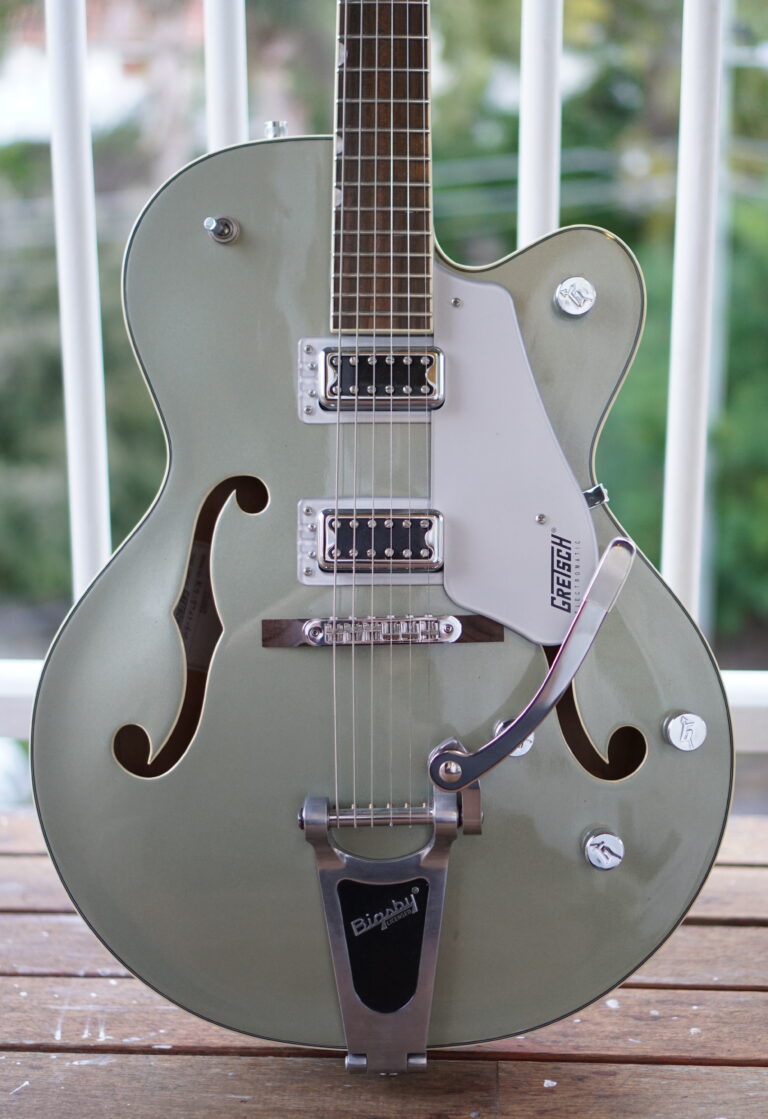
Gretsch G6136T Players Edition Falcon: The Spreadsheet Got This One Half Right
Chet Atkins and Setzer only half-count. Here's who really built the Gretsch White Falcon's legend — and who the spreadsheet got wrong.
Gretsch hollowbodies are listed with the same five players: Chet Atkins, Brian Setzer, George Harrison, Malcolm Young, Eddie Cochran. With the White Falcon, it’s worth taking each name seriously — because some of them genuinely hold up, and the ones that don’t reveal something important about how this guitar actually earned its legend.
The Same Five Names — But This Time, It’s Complicated
Start with the two names that survive scrutiny, if only partially. Chet Atkins is inseparable from Gretsch’s history — the man whose 1954 endorsement deal built the brand’s entire electric guitar identity — but his signature instruments were the 6120 and the Country Gentleman, not the Falcon. He’s genuinely documented among the guitarists who embraced the Falcon at points in his career, but it was never his defining instrument in the way the 6120 was.
Brian Setzer tells a similar story. He’s frequently cited as one of the most visible modern Falcon players, and Gretsch even built him a Falcon-based signature model, the Black Phoenix. But Setzer’s true signature guitar — the one that fueled the entire neo-rockabilly revival of the 1980s — is his orange 6120, not a Falcon. The Falcon connection is real, but secondary.
Malcolm Young is a more interesting case. AC/DC’s rhythm guitar sound was built almost entirely on a heavily modified 1963 Gretsch Jet Firebird — a solidbody, nothing like the cavernous hollow Falcon. But multiple sources document Young occasionally playing a smaller White Falcon Jr during the Back in Black and For Those About to Rock era, meaning there’s a genuine, if minor, Falcon chapter in his story — just not the one most people assume.
Eddie Cochran’s connection is the weakest of the five. He’s occasionally listed among Falcon players in broad “history of the guitar” retrospectives, but his signature sound and image were built entirely around his orange 6120 — the same instrument that launched a thousand rockabilly bands chasing that exact tone. Any Falcon association appears to be incidental at best.
And George Harrison simply doesn’t belong on this list at all. His well-documented Gretsch arsenal — a 1957 Duo Jet, a Tennessean, a Country Gentleman — never included a White Falcon in any meaningfully sourced account. This is the clearest case of the generic “Professional-tier” list being applied without any model-specific verification.
The Real Falcon Legends the List Left Out
Stephen Stills is the Falcon’s most enduring ambassador. He’s used one — usually his beloved 1958 model — across decades of solo work and Crosby, Stills, Nash & Young tours, and Gretsch has periodically reissued a signature model directly based on that guitar. Where Atkins and Setzer treated the Falcon as a secondary instrument, Stills built entire eras of his career around it.

Read our guide to Neil Young’s guitars and gear.
The Neil Young connection produces one of the best stories in the whole Gretsch catalog: Young reportedly talked Stills into buying his White Falcon specifically so the two of them could stage “dueling Falcon” moments on stage together during their Crosby, Stills, Nash & Young years. Young’s own guitar tech has described his vintage example — greenish with age, “the real deal” — as an instrument that’s been with him for decades, occasionally surfacing in the studio even though it’s not his primary stage guitar.
Billy Duffy of The Cult may be the single player most associated with the White Falcon in the modern rock era. He purchased his first in 1981 and built the band’s massive, ringing arena-rock sound around it — a genuinely unusual choice for the era’s harder-edged rock scene, which mostly reached for Les Pauls and Stratocasters. Gretsch eventually built him his own signature Falcon model in recognition of that decades-long association, and it’s hard to imagine a song like “She Sells Sanctuary” on any other guitar.
John Frusciante brought the Falcon into a completely different context, using his vintage example extensively throughout Red Hot Chili Peppers’ commercial peak on Californication. It’s a reminder that the Falcon’s appeal was never limited to rockabilly or classic rock revivalists — its huge, compressed, naturally resonant tone works just as well in alternative rock contexts as it does in the hands of a 1950s session player.
A Guitar That Was Never Supposed to Exist
The White Falcon’s origin story is one of the strangest in electric guitar history. In 1954, Gretsch designer and sales ambassador Jimmie Webster set out to build a one-off showpiece for that year’s NAMM convention — a “Dream Guitar” meant purely to demonstrate the company’s craftsmanship, inspired directly by GM’s rotating “Dream Car” concept displays of the era. Webster borrowed gold-sparkle binding from Gretsch’s drum production line, engraved pearl inlays from its banjo shop, and wrapped it all around a gleaming white hollow body, displaying the finished instrument on a rotating, spotlit pedestal for maximum showroom drama.
It was never meant to be sold. Dealers and players who saw it at NAMM demanded otherwise, and Gretsch rushed the design into production as the model 6136, releasing the first units in 1955. At $600, it was one of the most expensive electric guitars available at the time, trailing only the Gibson Super 400CES — and Gretsch’s own marketing wasted no time calling it “the finest guitar we know how to make.”
The design evolved steadily through the late 1950s and early 1960s: the original single-coil DeArmond DynaSonic pickups gave way to Filter’Tron humbuckers in 1958, the Melita bridge was replaced by the more stable Space Control roller bridge that same year, and a double-cutaway body arrived in the early 1960s to give rock and pop players easier access to the upper frets. A stereo version, the 6137, followed, splitting each pickup’s output to a separate amplifier for dramatic tonal experimentation. The guitar’s fortunes dipped hard during Gretsch’s troubled Baldwin Piano ownership years in the 1970s, when quality control famously declined — but Fred Gretsch III’s 1989 relaunch of the family business restored the Falcon to its former glory, and it’s remained a flagship model ever since.
From Showpiece to Workhorse: What “Players Edition” Actually Changes
The Players Edition designation signals a specific set of modern refinements layered onto the classic Falcon silhouette, built for guitarists who want the vintage look and voice without inheriting every quirk of a 1950s original. The most significant change is the FT-67 Filter’Tron pickup set — Gretsch’s current-generation take on the humbucker Ray Butts designed for the company in the late 1950s, tuned for a more even, well-rounded response across the neck and bridge positions than some vintage-spec reissues.
Equally important are the electronics refinements that don’t show up in a spec sheet at a glance. The Players Edition Falcon uses a no-load master tone pot, meaning the tone control fully bypasses the circuit at its maximum setting rather than subtly rolling off high end even when “wide open” — a detail that matters for a guitar this resonant. It’s paired with a treble-bleed circuit on the volume control, which keeps the top end intact as you roll the volume down rather than letting the tone go muddy, and Gretsch’s own “Squeezebox” paper-in-oil capacitors, chosen specifically to add a smoother, more vintage-voiced character to the tone controls.
Full Specifications
Tone Recipes
Classic rockabilly slap (the Setzer/Atkins approach): Bridge pickup or both together, amp on the edge of breakup, light slapback delay. The Falcon’s huge acoustic chamber does most of the work here.
Arena rock chime (the Duffy approach): Both pickups, moderate gain, generous reverb, Bigsby used for sustained pitch swells rather than sharp dives. The natural compression of the hollow body gives sustain most solidbodies can’t match at this volume.
Alternative rock texture (the Frusciante approach): Neck pickup, clean-to-mild-breakup amp setting, chorus or phaser for movement. The Falcon’s airy resonance adds a shimmer that a solidbody simply doesn’t have available.
Folk-rock strum (the Stills/Young approach): Both pickups, amp clean, tone rolled back slightly. Full, warm chords with none of the honk that smaller-bodied Gretsch models can exhibit at this setting.
The Falcon Family: More Than One Bird
Part of what makes shopping for “a White Falcon” confusing is that Gretsch has never treated it as a single, static model. Beyond the Players Edition covered here, the current and recent lineup includes the G6136T-59 Vintage Select Edition, which swaps the modern FT-67 pickups for period-correct TV Jones Classic units and 1959-style trestle bracing for players chasing an authentically vintage voice over modern refinements. There’s also been a Black Falcon variant finished in black rather than the signature white, prized by players who want the same massive hollow construction with a more understated stage presence. Limited-run anniversary editions — including a 140th “Double Platinum” model finished in a striking two-tone platinum scheme with a solid Adirondack red spruce top — periodically appear to mark Gretsch milestones, typically in small numbers and at a considerable premium over standard production. Smaller-bodied “Falcon Jr” and center-block Falcon variants also exist, aimed at players who want the visual identity and pickup voicing without committing to the full 17-inch hollow body — the same category of instrument, notably, that gave Malcolm Young his occasional Falcon moment without asking him to abandon his beloved solidbody Jet Firebird as his main guitar.
How It Compares
Against the smaller-bodied G6120T-59 Vintage Select — the guitar that actually was Atkins, Setzer, and Cochran’s true signature instrument — the Falcon trades some of that model’s snap and focus for sheer scale, resonance, and stage presence. Against the entry-tier Electromatic and Streamliner semi-hollows covered elsewhere in this series, the difference isn’t subtle: the Falcon is a genuinely full-hollow, Japan-built Professional Collection instrument at roughly six to ten times the price, and it sounds and handles the part. Against its closest era-appropriate rival, the Gibson Super 400CES that inspired Jimmie Webster’s original 1954 design in the first place, the Falcon remains the flashier, more visually maximalist choice — Gibson’s flagship archtop leans toward restrained elegance, where the Falcon leans all the way into spectacle.
Buying Guide
- Know your Falcon variant. “Players Edition” (modern electronics, FT-67 pickups), “Vintage Select” (period-correct TV Jones pickups and trestle bracing), and various anniversary Limited Editions are meaningfully different guitars sharing one silhouette — decide which era of tone and construction you actually want before shopping.
- Check the bridge/tailpiece configuration. Some Players Edition units use a licensed Bigsby, while premium finishes get the String-Thru Bigsby B6GP — the latter offers marginally better sustain and tuning stability but is harder to restring and set up correctly.
- Weight and comfort matter here. At roughly 8 lbs and 17 inches wide, this is a genuinely large instrument. Try one on a strap before committing if you haven’t played a full-hollow guitar of this size before.
- Case included: The Players Edition ships with a dedicated 17″ deluxe hollow body hardshell case — factor that into any used-market price comparison, since replacing a properly fitted case for a guitar this size isn’t cheap.
Ownership Notes
Owners consistently note that a guitar this size and this hollow will feed back more readily at high gain and volume than any center-block or solidbody Gretsch in this series — that’s the trade-off for the Falcon’s massive, resonant clean and edge-of-breakup tones. Managing stage volume and speaker positioning matters more here than with smaller-bodied instruments. The Bigsby setup, particularly on String-Thru equipped units, benefits from a proper professional setup to get string breaks and spring tension dialed in; this isn’t a guitar to restring casually without some care.
Frequently Asked Questions
Did George Harrison ever play a White Falcon?
No well-documented evidence supports this. His known Gretsch guitars were a 1957 Duo Jet, a Tennessean, and a Country Gentleman — none of them Falcons.
What’s the difference between “Players Edition” and “Vintage Select” Falcons?
The Players Edition uses modern FT-67 Filter’Tron pickups and updated electronics (no-load tone, treble bleed) for a more contemporary feel; Vintage Select models use period-correct TV Jones pickups and 1959-style trestle bracing for a more historically accurate voice.
Where is it made?
Japan, as part of Gretsch’s Professional Collection — the top manufacturing tier in the current lineup.
Is the White Falcon good for beginners?
Not typically recommended as a first guitar — its size, weight, price, and feedback-prone full-hollow construction make it better suited to experienced players who specifically want its tonal and visual character.
Who is the most famous White Falcon player?
Stephen Stills and Billy Duffy of The Cult are the two most consistently cited career-defining Falcon players, each having used the guitar across decades and inspired official Gretsch signature models.
Image credits
- Stephen Stills: SolarScott, Wikimedia Commons, CC BY 2.0.
Latest News
Related
On This Day
Tuesday 10 November
From this week: