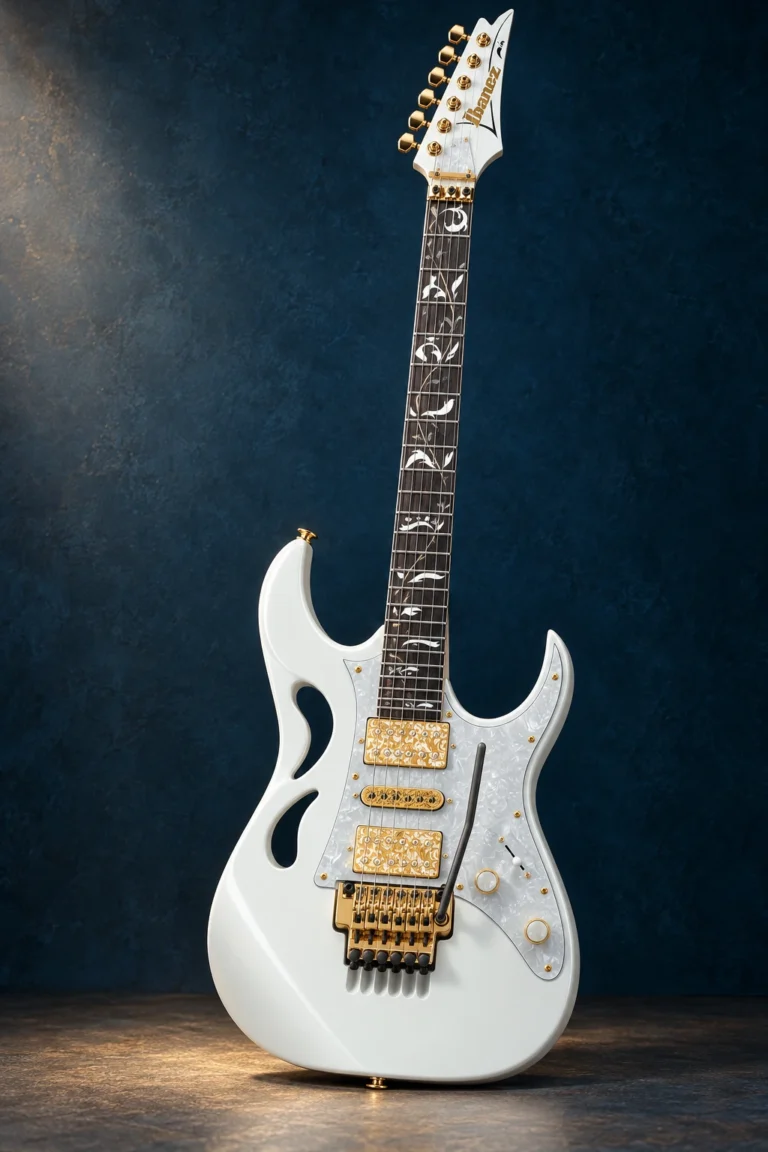
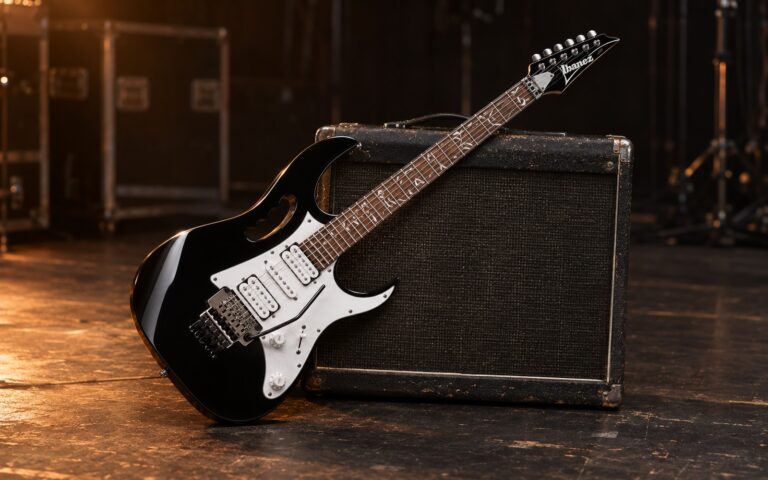
Ibanez RG550 Genesis Collection: The Guitar That Came Before the Signatures
Vai, Satriani, Gilbert, Strauss, Henson all have signature Ibanez guitars now. The RG550 is the guitar that came before — but not all of them played it.
Steve Vai, Joe Satriani, Paul Gilbert, Nita Strauss, and Tim Henson each have their own name on an Ibanez headstock today. That’s exactly why the RG550 is interesting: it’s the guitar that predates all of those deals. Before JEM, before JS, before PGM, before JIVA, before KRYS, there was a $1,000-ish superstrat built to democratize a shape Ibanez had designed for one guitarist and then decided everyone should be able to buy. These are genuinely Ibanez’s five defining shred artists. The catch is that “genuinely Ibanez” doesn’t automatically mean “genuinely this guitar,” and the real story here is sorting out which of the five actually has a documented RG550 connection versus which one just belongs to the same extended family.
1987: The Affordable JEM
By the mid-1980s, Ibanez was losing ground to Charvel/Jackson, Hamer, B.C. Rich, and especially Kramer, despite endorsements from players like Phil Collen, Allan Holdsworth, and Steve Lukather. The company’s answer was to sign a 20-something guitarist fresh off stints with Frank Zappa and Alcatrazz: Steve Vai. Ibanez luthier Mace Bailey built prototypes around Vai’s input, and the result — the JEM777 — debuted at the 1987 Winter NAMM Convention to an enormous reaction. The RG550 arrived the same year as a more affordable, more conventional sibling: same basic body shape and dimensions as the JEM, same basswood body, same thin maple neck and double-locking Floyd Rose-style tremolo, but without the JEM’s monkey grip handle or lion’s claw tremolo rout, and loaded with American-designed Ibanez Vintage pickups instead of Vai’s DiMarzios.
The formula worked. Bright, era-defining finishes — Road Flare Red, Desert Sun Yellow, Purple Neon — became visual shorthand for the entire late-’80s Superstrat boom, and the RG550 quickly became the guitar aspiring shredders actually saved up for, since almost none of them could afford Vai’s own instrument. Controls were stripped down to a simple master volume, master tone, and five-position blade switch — a deliberately no-nonsense layout compared to the JEM’s more elaborate wiring, but one that still delivered a genuinely wide spread of humbucking and single-coil tones. The original run lasted through 1994, and the model has been revived repeatedly since — a 20th-anniversary RG550MXX/RXX reissue in 2007, and finally the Genesis Collection version covered here, which Ibanez brought to market in 2017, built by FujiGen in Japan specifically to recapture the late-’80s original rather than update the RG concept for modern shred demands.
The RG550’s success also solved a real business problem for Ibanez. The company’s mid-’80s Superstrat and Roadstar-derived models hadn’t managed to distinguish it from Charvel/Jackson or Kramer despite respectable endorsers, and a weakening dollar was making Japanese imports less competitive on price. Landing Vai gave Ibanez a genuine rockstar identity to build around — something the company had lacked despite already working with respected names like Lee Ritenour, Joe Pass, and Steve Lukather. The RG550 turned that identity into a mass-market product line, and its six-on-a-side headstock design, borrowed from the Iceman, became a visual signature of Ibanez’s new direction that persists across the RG family today.
Full Specifications
Genesis vs. Original: What Actually Changed
The Genesis Collection reissue is a faithful recreation rather than a reimagining, and Ibanez kept the changes minimal and specific. The original RG550’s neck was a single piece of maple; the Genesis version uses a 5-piece laminated maple/walnut neck, a change most owners describe as adding stability without meaningfully altering the guitar’s famously fast feel. The pickups are Ibanez’s V7/V8 humbuckers flanking an S1 single-coil — actually a faithful match to the RG550’s own later years, since the original line switched from its first V1/V2 pickup set to V7/V8 in 1994, right before the model’s initial discontinuation. Everything else — the basswood body, the tilt neck joint with its stamped metal plate rather than a modern sculpted heel, the original-spec Edge double-locking tremolo, the flat 16.9-inch fretboard radius — is a direct callback to the late-’80s original, deliberately avoiding the more contoured “All Access” neck joints and modern hardware found on current-production RG models.
Famous Players: Sorting the Real Connections From the Adjacent Ones
Given that every one of these players has their own Ibanez signature series, it would be easy to assume they all played the guitar that came before those deals. The actual record is more specific than that — and more interesting.
Paul Gilbert has the strongest, most direct connection of the five. Guitar World’s own history of the RG550 states plainly that Gilbert was one of the first major shredders to play a stock RG550, and that several of his own signature PGM models — introduced starting with the PGM100 in 1989 — were literally based on the RG550’s body and dimensions. Gilbert has said that after touring Ibanez clinics with custom guitars, he found he preferred the stock RGs sitting in the store over his own personalized instruments, which directly shaped how his signature series was eventually built. This isn’t an adjacent-family connection; it’s a documented, direct line from the RG550 to one of Ibanez’s most enduring signature franchises.
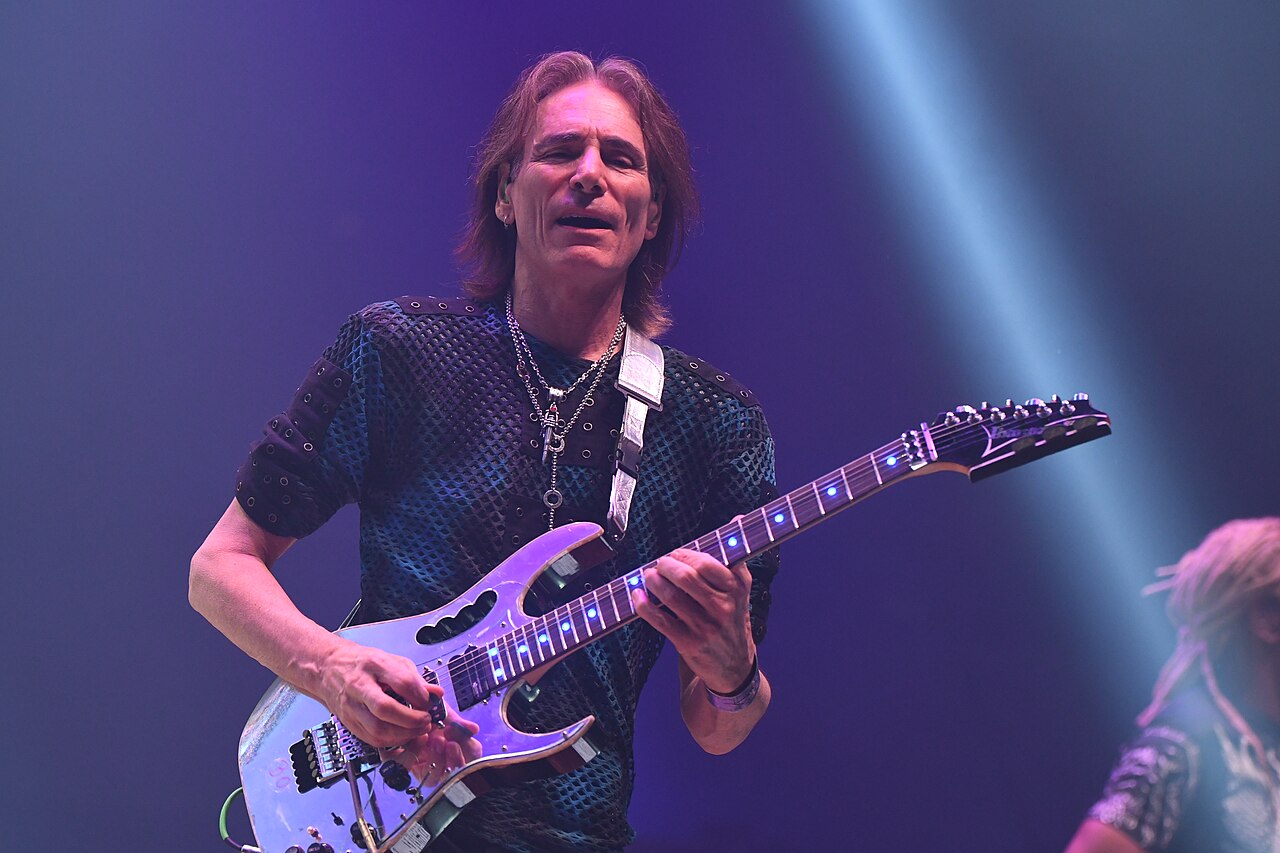
Steve Vai’s connection is real but indirect — his design DNA, not his personal guitar. The RG550’s entire body shape exists because of the JEM777 development process Vai went through with Ibanez. But the RG550 was explicitly built as the accessible, de-featured version of Vai’s own guitar — no monkey grip, no lion’s claw rout, cheaper pickups — precisely so that players who couldn’t get a JEM could get something close. There’s no record of Vai personally playing an RG550 on stage or in the studio; he had the real thing. The RG550 is his design’s legacy, not his instrument.
Joe Satriani’s connection is a close cousin, not a match. When Satriani became an Ibanez endorser in 1987 — the same year the RG550 launched — Ibanez sent him a 540 Radius model to start from, not an RG550. His own JS series, launched in 1990, descends from that Radius body shape rather than the RG line. Both guitars came out of the same 1987 catalog overhaul and share a family resemblance as Superstrat-era Ibanez designs, but they’re genuinely different model lines. Satriani’s history runs parallel to the RG550’s, not through it.
Nita Strauss’s real early Ibanez was a different RG altogether. Before her JIVA signature launched in 2018, Strauss was known for playing an Ibanez RG770DX in Laser Blue during her years with the all-female Iron Maiden tribute act The Iron Maidens, and later an RGT320Z Prestige model during her tenure with Alice Cooper. Both are genuine, well-documented RG-family instruments — just not the RG550 specifically.
Tim Henson’s pre-signature Ibanez was a budget RG, not this one. Photos and video from 2017 — the same year the RG550 Genesis Collection launched — show Henson playing a white Ibanez RG350, a considerably more affordable model than the RG550, before Ibanez built him his AZ-based signature series starting with the THBB10 in 2019. Genuine RG history, wrong specific guitar.
Guitar World’s own RG550 retrospective credits a different set of players with actually being seen on this specific model: Nili Brosh, Larry Mitchell, Blues Saraceno, and Dave Urich. None of the four carries the same headline recognition as the signature-series shredders, but all four have a more literal claim to the RG550 itself.
Tone Recipes
- Classic Shred Lead: Bridge humbucker (V8), high gain, tight noise gate — the tone the RG550 was built around from day one.
- Strat-Adjacent Clean: Middle single-coil (S1) or the 2/4 switch positions, clean amp channel, light chorus — proof the HSH layout does more than just metal.
- Neck Pickup Fusion Lead: Neck humbucker (V7), moderate gain, slight compression — a warmer, rounder voice for legato-heavy playing.
- Full Dive-Bomb Rhythm: Bridge humbucker, palm-muted rhythm, Edge tremolo used for pitch dips on accents — the vibrato system this guitar was designed to showcase.
Comparisons to Related Models
Against the guitars its own player list actually belongs to, the RG550 reads as the shared ancestor rather than a competitor: Vai’s JEM adds the monkey grip and lion’s claw for a more elaborate, personalized instrument; Satriani’s JS series uses the related-but-distinct Radius body shape; Gilbert’s PGM models are RG550-derived but wear his painted f-holes and reversed headstock; Strauss’s JIVA and Henson’s AZ-based signatures represent entirely newer body designs built decades later for very different playing styles. Within this project, the coming Ibanez RG421 and RG470AHM represent the RG550’s modern, budget-tier descendants — guitars that inherit its silhouette and playing philosophy without the vintage-accurate specs or Japanese manufacturing.
Buying Guide
- Genesis Collection vs. vintage original: The Genesis reissue is generally considered the more stable, better-built option thanks to its updated 5-piece neck, while original 1987–1994 examples carry more collector value and a slightly different feel from the one-piece maple neck.
- No case included: Budget separately for a hardshell case or gig bag, as Ibanez sells the Genesis Collection RG550 without one outside Japan.
- Color and headstock matching: Some 1989–1990 vintage finishes shipped with black rather than color-matched headstocks — a detail collectors specifically look for when dating an original-era guitar.
- Neck heel access: Owners consistently note the classic tilt-neck joint restricts upper-fret access more than a modern sculpted heel — a deliberate vintage-accuracy tradeoff, not a flaw.
Practical Ownership Notes
The Super Wizard neck remains the RG550’s signature feature and the reason players return to it decades later — reviewers and forum owners alike consistently describe it as glorious, fast, and thin without feeling flimsy. The Edge double-locking tremolo requires the same setup discipline as any Floyd Rose-style system: restringing takes longer than a standard bridge, and the locking nut needs a hex key on hand for tuning adjustments. Because the guitar ships without a case, factor that into the total cost before buying, and note that some players report waitlists of several months when a particular finish sells out.
FAQ
Did Steve Vai ever actually play an RG550?
Not that’s documented — the RG550 was built as the accessible version of his JEM777, sharing its shape and dimensions, but Vai played his own more elaborate instrument.
Which of the five artists on this list has the strongest real connection to the RG550?
Paul Gilbert, by a clear margin — he was among the first major shredders to play a stock RG550, and his own PGM signature series was directly based on it.
What’s the difference between the RG550 and Joe Satriani’s JS series?
They’re related but distinct: Satriani’s JS line descends from the 540 Radius model Ibanez gave him in 1987, a sibling design from the same era rather than the same guitar.
Is the Genesis Collection a faithful reissue or a modernized update?
Mostly faithful — the main changes are a 5-piece maple/walnut neck instead of one-piece maple, and V7/V8/S1 pickups, which actually matches the original RG550’s own later-production spec after its 1994 pickup change.
Why doesn’t the RG550 come with a case?
Outside Japan, Ibanez sells it without one to help control the price point; a hardshell case or gig bag is available as a separate purchase.
Image credits
- Steve Vai: Wojciech Pędzich, Wikimedia Commons, CC BY 4.0.
Latest News
Related
On This Day
Monday 9 November
From this week: