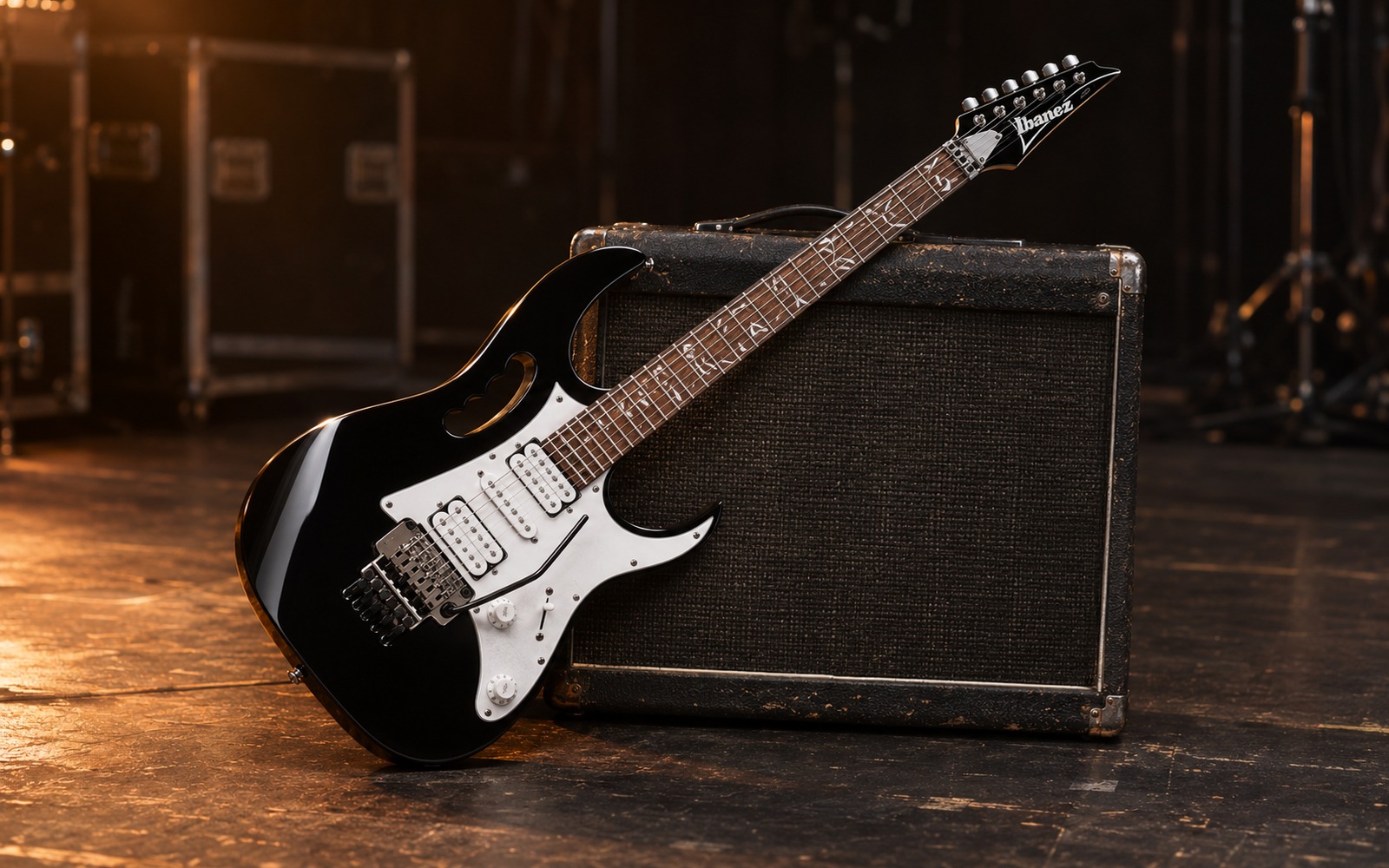
Ibanez JEMJR: The $500 Gateway to Steve Vai’s Wildest Guitar
The JEMJR carries Steve Vai's name and a design born from a Long Island friendship, a Frank Zappa day job, and a guitar bidding war. Full history and specs.
The JEMJR carries Steve Vai’s name because it’s the affordable end of a guitar lineage Vai designed himself, piece by piece, out of pure creative stubbornness — and understanding why that lineage exists at all means going back to a Long Island childhood friendship, a Frank Zappa day job, and a guitar company that was willing to build exactly what one very particular guitarist asked for when every other company just slapped his name on something already sitting in their catalog.
The Kid Who Wouldn’t Compromise
Vai’s guitar education started early and intensely. At thirteen, shortly after buying his first guitar, he began taking lessons from a fellow Long Island native named Joe Satriani, and quickly became obsessed with disciplined practice, maintaining a rigid ten-to-fifteen-hour-a-day schedule throughout his career. That obsessiveness followed him through Berklee College of Music and into his most formative professional job: transcribing and performing Frank Zappa’s rhythmically complex compositions, work that demanded exactly the kind of relentless, start-slow-and-perfect-it discipline Vai had already built into his practice routine.

Learning to Modify from Zappa
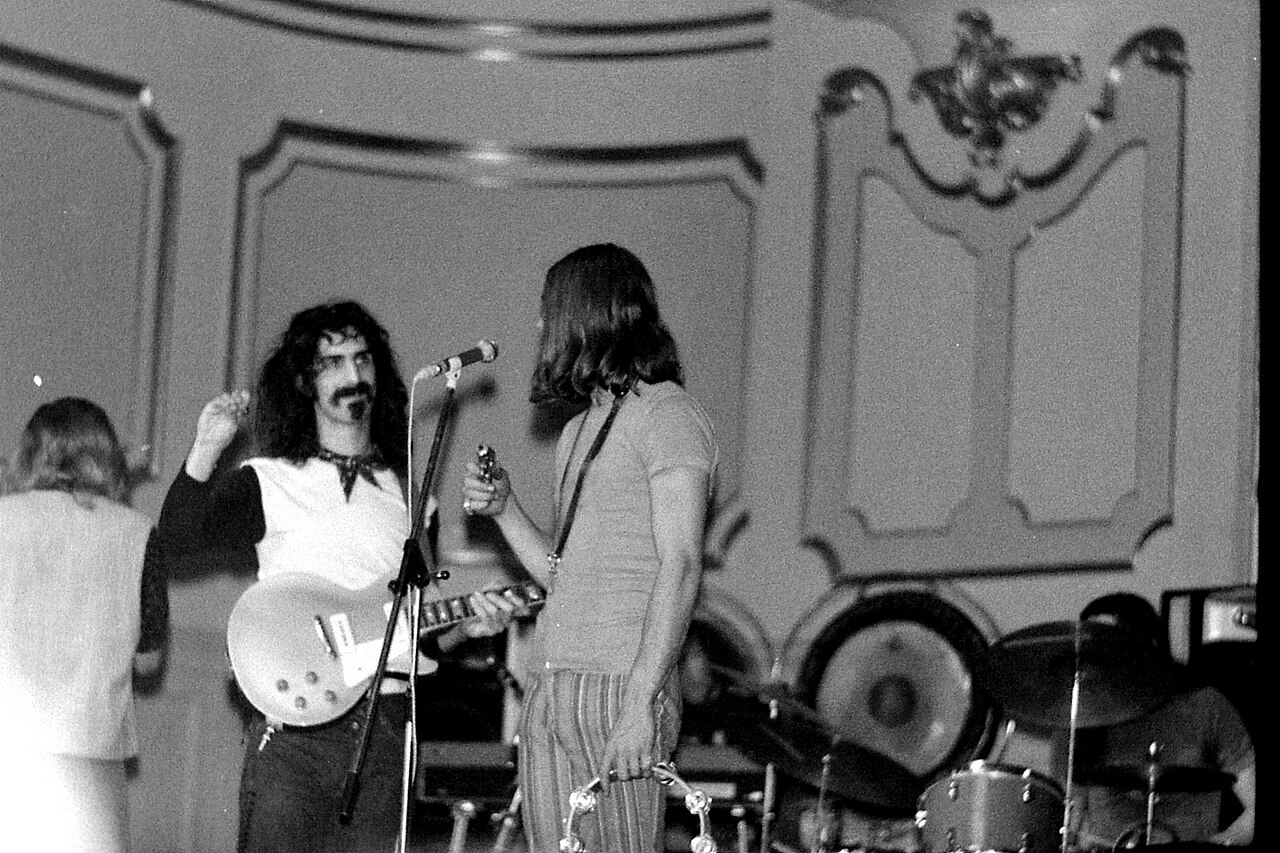
The habit that mattered most for the guitar Vai eventually designed wasn’t musical at all — it was mechanical. Working for Zappa meant watching a bandleader who treated his own instruments as raw material rather than finished products, constantly wiring in frequency modulators and parametric EQs, swapping necks, swapping pickups, chasing a specific sound by physically rebuilding the tool that made it. Vai has said directly that this is where he absorbed the idea that if you want something specific out of a guitar, you don’t wait for someone to build it — you go find it yourself, or build it yourself. That philosophy is the entire reason the JEM exists, and by extension, the entire reason a budget version of it exists today for players who’ll never own an original.
Joe “Jem” Despagni and the Guitar Before the Guitar
Long before Ibanez was involved, Vai already had a source for exactly the wild, custom instruments he wanted: a childhood best friend. Vai had several custom prototypes built — guitars used on the Eat ‘Em and Smile tour — by Joe “Jem” Despagni, a custom guitar luthier and friend of Vai’s since before kindergarten. Despagni described his own builds as “Jems,” which is where the name of Vai’s entire signature line ultimately came from — a naming detail most JEMJR owners never learn, since the letters read as a generic acronym rather than a tribute to a specific person. Vai has also credited Despagni with building the first-ever handle into a guitar body, years before it became the JEM’s signature “Monkey Grip,” and with coining the very word “shred” as it’s used in guitar culture today.
Despagni’s most famous creation for Vai was the “Flame” guitar — a single-humbucker, Floyd Rose-equipped instrument with a bolt-on maple neck that Vai used extensively during his run with David Lee Roth’s band, including a Drop D-tuned spare built specifically for playing “Unchained” live. Vai eventually sold the original Flame guitar in 2017 to help raise funds for Despagni, who was battling the illness that took his life the following year — a quietly emotional footnote behind a guitar most people only know from wild ’80s music videos.
How Ibanez Won a Bidding War It Didn’t Know It Was In
By the mid-1980s, Vai’s profile in Roth’s band made him a hot endorsement target, and he handled the situation unusually for the era. Rather than accept whatever any company offered, Vai sent out the specifications of his own guitar and told every interested manufacturer that whoever returned the best version of it would get the deal — and nearly all of them came back with a stock model bearing his name and a few token tweaks. Ibanez was the exception: the company built him a guitar to his actual specifications and had it back to him within three weeks.
The JEM777 Debuts
It wasn’t a smooth first attempt. Ibanez’s first offering was a prototype called the Maxxas, delivered to Vai at a show in Buffalo, New York at the end of September 1986 — but its semi-hollow body fed back uncontrollably the moment Vai plugged it in at soundcheck, sending the design back to the drawing board. A solidbody version followed by the end of 1986, and Ibanez craftsman Mace Bailey traveled to Japan to personally oversee production of the first samples. Vai’s own scrutiny of that first finished guitar has become part of JEM folklore: according to Ibanez’s Rich Lasner, Vai disassembled the guitar on the spot — neck from body, pickguard off, tremolo out — explaining afterward that he does this with every new guitar to check the craftsmanship underneath.
The JEM777 debuted at Summer NAMM in June 1987 in three colorways: Desert Sun Yellow and Shocking Pink at $1,299, and a limited-run Loch Ness Green at $1,590 — genuinely expensive for the era, comfortably above a Gibson Les Paul Standard or Fender American Standard Stratocaster at the time. All 777 units of the green model sold out almost immediately, and each was individually signed by Vai. The name itself was a gift as much as an acronym — Vai named the line JEM specifically in hopes of drumming up business for Despagni’s own small guitar company of the same name.
What the JEM Was Built to Record
The JEM wasn’t a guitar built in a vacuum — it landed right as Vai’s career was accelerating in several directions at once. Before Ibanez, Vai had already passed through Frank Zappa’s band and a stint with Alcatrazz, and his profile exploded during his run in David Lee Roth’s band, whose 1986 album Eat ‘Em and Smile is still regularly ranked among the best hard rock records of the decade. After leaving Roth’s band in 1989, Vai stepped in for an injured Adrian Vandenberg to record guitar parts on Whitesnake’s Slip of the Tongue, an album that sold more than three million copies and sent Vai out on a thirteen-month world tour. That same stretch of years produced Vai’s own solo breakthrough, Passion and Warfare (1990), which reached number 18 on the Billboard 200 and sold over a million and a half copies worldwide — establishing Vai as a headlining solo artist in his own right rather than simply a hired gun for other bandleaders. The JEM was the guitar underneath all of it, the common thread running through a Whitesnake arena tour and Vai’s own solo ascent in the same handful of years.
What Made the JEM Revolutionary
The specifics Vai insisted on weren’t just cosmetic. A 24-fret neck with the top four frets scalloped gave him upper-register access most guitars of the era couldn’t match. The humbucker-single-humbucker pickup layout paired with 5-way switching let him split the bridge and neck humbuckers in positions 2 and 4, pulling classic single-coil-style quack out of a guitar built for aggressive high-gain tone — the best of both a Strat and a Les Paul in Vai’s own stated logic for wanting the guitar in the first place. The Floyd Rose locking tremolo gave him the dive-bomb and pitch-bend vocabulary he’d built his style around, and the Monkey Grip — inherited straight from Despagni’s own custom builds — turned a practical touring convenience into the single most recognizable visual signature in the whole design.
The JEM’s Lasting Ripple Effect
The JEM didn’t launch alone. Ibanez released a lower-priced derivative alongside it at the same 1987 NAMM show — the RG series — which went on to become the best-selling metal guitar line in history, including the Ibanez RG550 covered elsewhere in this project as the guitar that predated Paul Gilbert, Nita Strauss, and Tim Henson’s own eventual Ibanez signature deals. Vai’s design choices didn’t stay contained to his own signature line; they reshaped what an entire category of guitar was expected to offer. The JEM lineage has also produced its share of genuinely eccentric special editions over the decades — DiMarzio pickup updates through the Evolution and Breed lines, and the JEM2KDNA series, for which Vai famously mixed a small amount of his own blood into the paint at a ratio of roughly one part blood to eight parts paint. None of that carries over to the JEMJR, but it’s the kind of detail that explains why the JEM has stayed a talking point for close to four decades rather than fading into just another ’80s superstrat.
From JEM777 to JEMJR: Democratizing a Legend
The JEMJR covered in this article sits at the accessible end of a family that’s grown steadily more tiered since 1987. The current JEMJR was introduced for 2015 as the most affordable JEM model, produced in Indonesia, and represents a revival of an earlier budget guitar called the JEM-JR (also sold as the JEM333) that ran from 2002 to 2012 in Korea and then Indonesia before being discontinued — two different guitars sharing a near-identical name a decade apart, worth knowing if you’re shopping the used market and want to be sure which one you’re looking at.
Where the JEMJR Sits in Today’s Lineup
Ibanez currently splits the JEM into three tiers. The JEMJR anchors the entry level, in white, black, and special-edition JEMJRSP colorways in yellow or pink. A Premium tier — the JEM77P in a blue floral finish and the JEM7VP in white — sits in the middle, Indonesia-built but upgraded with DiMarzio pickups. At the top sits the JEM7V, built in Japan with direct input from Vai himself, a five-piece Wizard III neck, and a dual humbucker/single-coil Evolution pickup combination, priced at roughly $2,999.99 — six times the JEMJR’s price for genuinely Japanese-tier construction and components.
The Guitar Underneath the Cosmetics
Ibanez’s own RG450DX is essentially the same guitar as the JEMJR minus the Monkey Grip, the Lion’s Claw tremolo routing, the angled output jack, and with different fretboard inlays — proof that a meaningful chunk of the JEMJR’s price and identity is the licensed Vai cosmetic package layered onto a guitar that exists in Ibanez’s regular catalog under a different name. That’s not a knock on the JEMJR; it’s simply useful context for understanding exactly what you’re paying the premium for.
The Modern JEMJR: Full Specifications
Vai’s Actual Rig Today
Steve Vai’s own number-one guitar remains “EVO,” a 1991-built JEM he still tours with today — production versions of the EVO spec use a rosewood fingerboard where Vai’s own guitar has ebony, but the scalloped 21st-through-24th-fret treatment carries over to both. Vai has continued expanding his signature relationship with Ibanez well past the original JEM design, most notably with the newer PIA line — covered in its own article elsewhere in this project — which Vai has described as “a little change” after more than three decades with the JEM as his primary design. The JEMJR doesn’t chase any of that newer engineering; it’s a snapshot of the 1987 concept built to a budget, which is exactly the appeal for players who want the shape and story rather than the latest refinements.
Tone Recipes
Classic Vai Lead Tone
Bridge humbucker, amp pushed into heavy saturation, tight noise gate. This is the JEMJR’s most natural home — aggressive, high-output lead tone that rewards the scalloped-adjacent upper-fret access even though the JEMJR itself isn’t scalloped.
Position 2/4 Quack
The coil-split-style in-between positions on the 5-way switch pull a brighter, more Strat-like texture out of the humbuckers — useful for funk-inflected rhythm parts and a good demonstration of exactly why Vai insisted on this switching scheme in the first place.
Whammy Dive Practice
Neck pickup, moderate gain, and generous use of the double-locking tremolo for dive bombs and pitch swells. The JEMJR’s trem isn’t the same hardware as the Japan-built JEM7V, but it’s functional enough to practice the vocabulary before investing in a higher tier.
How the JEMJR Compares
Against the Japan-built JEM7V, the JEMJR trades DiMarzio Evolution pickups for Ibanez’s own Quantum units, a five-piece neck for a simpler Wizard III, and true Japanese Prestige-tier fit and finish for Indonesian budget-tier construction. It’s a completely honest trade for the price gap, and reviewers have consistently positioned the JEMJR as a values-forward way into Vai’s world rather than a genuine substitute for the flagship. Against the newer Ibanez PIA3761 covered elsewhere in this project, the JEMJR represents the original 1987 concept rather than Vai’s more recent refinements to his own signature platform — two different eras of the same designer’s thinking, decades apart.
Buying Guide
- Don’t confuse JEMJR with JEM-JR. The 2002–2012 JEM-JR (also called JEM333) is a different guitar with dot inlays and a basswood body rather than the current JEMJR’s vine inlay and mahogany construction.
- Check the fingerboard wood if buying used. Rosewood examples predate 2018; jatoba examples came after — not a quality difference so much as a supply-driven material change worth knowing for tone and appearance expectations.
- If the cosmetics don’t matter to you, look at the RG450DX. It’s reported to be essentially the same underlying guitar without the Monkey Grip, Lion’s Claw routing, and angled jack — worth comparing prices directly.
- Decide how much of the JEM legacy you actually want. The JEMJR gets you the shape and the switching scheme; stepping up to a Premium-tier JEM77P/JEM7VP buys real DiMarzio pickups, and only the JEM7V delivers genuine Japanese-built construction.
- White finishes show wear differently than colored ones. Because the JEMJR’s most common finish is all-white — body, pickguard, and knobs included — scuffs and yellowing are more visible on a used example than they’d be on a black or colored guitar, worth factoring into a used-market price comparison.
Practical Ownership Notes
Reviewers are consistent that the JEMJR’s construction quality outperforms its price point — clean neck joints, solidly attached hardware, no corner-cutting that compromises playability — even while noting plainly that the guitar is sold as much on its unmistakable look as on its parts. The Monkey Grip itself draws mixed reactions from reviewers used to conventional guitar shapes; it’s a genuine ergonomic feature for stage-to-stage guitar swaps in Vai’s original touring context, but many JEMJR owners never use it for anything beyond visual identity. As with any double-locking tremolo system at this price point, expect a learning curve around restringing and fine-tuning compared to a simple hardtail bridge, and budget for a proper setup if the guitar doesn’t arrive perfectly intonated. The lighter mahogany typically used at this price point also means slightly less low-end density than a heavier, higher-tier JEM — a fair trade for the JEMJR’s noticeably lower overall weight during long practice sessions.
Frequently Asked Questions
Does Steve Vai actually play the JEMJR?
No — Vai’s own touring and recording guitars are high-end JEM and PIA instruments, most famously his 1991 “EVO” JEM. The JEMJR is a budget-tier guitar built for fans who want the JEM shape and design at an accessible price, not Vai’s personal instrument.
Why is it called “JEM” in the first place?
Vai named the line after his childhood friend Joe Despagni’s own small guitar-building company, which Despagni had called “Jems” — a tribute rather than a pure acronym, even though most players today assume it’s simply an abbreviation.
What’s the difference between the JEMJR and the older JEM-JR?
They’re different guitars despite the near-identical name. The 2002–2012 JEM-JR (also sold as the JEM333) had a basswood body and dot fingerboard inlays; the current JEMJR, introduced in 2015, uses a mahogany body and the more elaborate Tree of Life vine inlay.
Is the Monkey Grip functional or just decorative?
Both. It originated as a genuinely practical touring feature — Vai’s friend Joe Despagni built the first version specifically to make swapping guitars faster and safer on stage — though most JEMJR owners today use it purely as part of the guitar’s visual identity.
Did the JEM come out before or alongside Ibanez’s RG series?
They launched together at the same 1987 NAMM show. The JEM was Vai’s premium signature guitar, while the RG was a more affordable derivative that went on to outsell it many times over as Ibanez’s flagship metal-guitar platform.
Why did the original JEM cost so much more than a Les Paul or Stratocaster in 1987?
The JEM777’s launch price of $1,299–$1,590 reflected genuinely upscale construction and Vai’s insistence on custom-spec hardware — a locking tremolo, scalloped upper frets, and a purpose-built pickup switching scheme — at a time when a Gibson Les Paul Standard listed around $1,000 and a Fender American Standard Stratocaster around $650.
– Guitars > Electric Guitars > Signature Models
– Guitar Styles > Superstrat & Shred
Image credits
- Top image: GuitarGangsters AI-generated reference illustration, not a photograph.
- Frank Zappa: ThomasFHH, Wikimedia Commons, CC BY-SA 4.0.
- Steve Vai: Wojciech Pędzich, Wikimedia Commons, CC BY 4.0.


Latest News
On This Day
Monday 9 November
From this week: