Ibanez PIA3761: The Guitar Steve Vai Named After His Wife
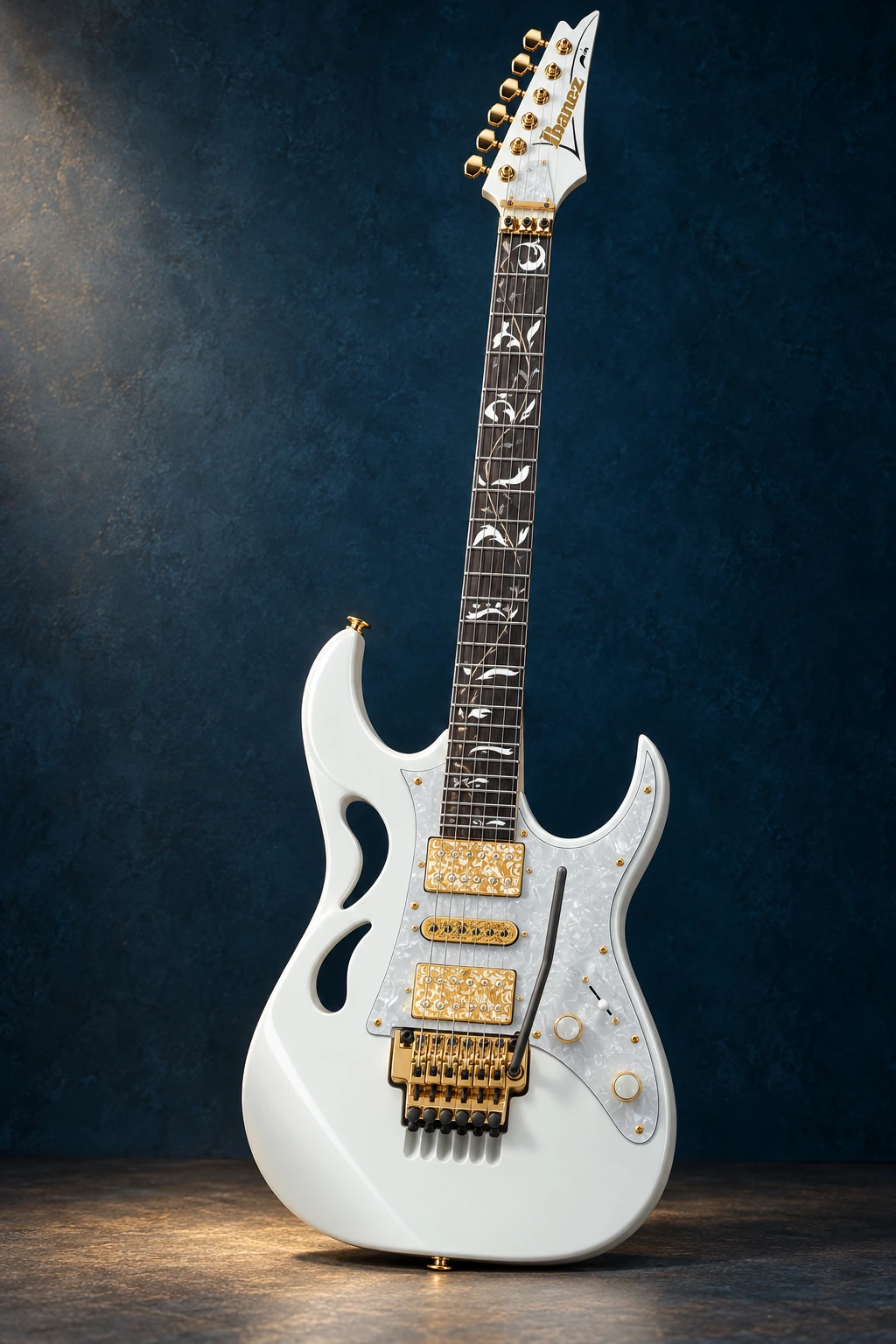
Representative editorial illustration of an Ibanez PIA3761 in Stallion White. Decorative details are stylized; this is not a technical facsimile or a photograph of Steve Vai’s personal instrument.
Vai named his newest signature guitar after his wife and built it as an evolution of the JEM, not a replacement. Full PIA3761 history and specs.
Rather than retell the full 1987 JEM origin story — already covered in depth in the Ibanez JEMJR article — this one focuses on the part of Vai’s story that’s actually unique to the PIA3761: why, after more than three decades of the JEM being one of the best-selling signature guitars ever made, Vai decided to design something new instead of just refining what already worked.
Why Vai Needed a Sequel, Not a Replacement
By 2018, the JEM genuinely didn’t need to change. It had barely shifted its fundamental design in over 30 years beyond finishes and anniversary editions, and it remained enormously successful without any pressure to evolve. That’s precisely why what happened next is interesting — Vai wasn’t chasing a functional problem with his existing guitar. He was chasing something more personal: an instrument that reflected who he’d become as an artist and a person, rather than who he’d been in 1987. The PIA was developed over roughly three years, with Vai describing it as a “more organic, more comfortable” instrument built to take the JEM concept further rather than to replace it.
A Name With Two Meanings
Vai has said directly that he wanted something simple for the new guitar’s name, something that also carried personal meaning for him. PIA stands for “Paradise in Art” — and it’s also his wife’s name. It’s a rare case of a signature guitar’s branding functioning as a genuine personal dedication rather than a marketing acronym invented after the fact, and it sets the PIA apart from every other guitar in this project’s Ibanez coverage, including Vai’s own JEM, which was named for a friend’s guitar company rather than anyone in Vai’s immediate family.
What Changed From JEM to PIA
The PIA keeps the JEM’s fundamental superstrat DNA — it continues to use a super-Strat RG-style body and the Lion’s Claw tremolo rout that has always been part of the JEM design — but nearly every surface detail was reconsidered. The body picked up a deeper rout on the back of the lower horn, more aggressive forearm relief, and a slightly larger radius roundover on all the edges, changes aimed squarely at comfort during the kind of extended, physically demanding performances Vai still gives well into his sixth decade of touring.
The Petal Grip
The single biggest visual departure is also the most symbolically loaded one. The Monkey Grip hole is gone, replaced by two holes shaped like flower petals — a design echoing a yin-and-yang arrangement — and that same petal motif repeats throughout the rest of the guitar, including in the laser-cut pattern on the pickup covers. Ibanez renamed the guitar’s fretboard inlay the “PIA Blossom,” a redesigned evolution of the JEM’s Tree of Life vine pattern that incorporates the same petal shapes found in the body cutout. It’s a coherent design language rather than a single novelty feature — the same visual idea shows up on the body, the inlay, and the pickups, which is a more unified aesthetic statement than the JEM ever attempted. The redesign also introduced a magnetic tremolo cavity plate on the back of the body, a small hardware refinement paired with the guitar’s contoured bolt-on neck construction that makes battery and spring access noticeably quicker than the JEM’s screwed-down cover — the kind of detail a touring tech notices immediately even if most players never think about it.
New Pickups: DiMarzio UtoPIA
Ibanez developed dedicated DiMarzio UtoPIA pickups for the PIA, voiced according to Vai’s own tonal preferences for smoother highs, scooped mids, and a more pronounced low end compared to the JEM’s long-running Evolution pickups. The pickup covers were laser-cut with the same floral pattern as the PIA Blossom inlay and Petal Grip — a visual callback players familiar with Vai’s custom “Woody” guitar will recognize, since Ibanez borrowed a similar laser-cut aesthetic from that one-off instrument for the PIA’s production pickups. The electronics picked up a functional upgrade too: the volume knob was modified with a push-pull high-pass filter capacitor, letting players cut some low end at lower volume settings to keep the tone crisp, activated or bypassed at will.
Launch and Reception
The PIA made its public debut at the 2020 Winter NAMM Show, backed by a live event at the House of Blues where Vai played through the new guitar’s various finishes in front of an audience for the first time. Guitar Interactive’s review called it less a follow-up than a genuine evolution of the Steve Vai signature concept, and framed the timing as deliberate: the JEM hadn’t needed to change through three decades of steady success, but by 2018 and 2019, Vai was ready to build something that reflected who he’d become as a player rather than simply refining the guitar that had made him famous. The reviewer, who received one of the very first production samples in the UK, noted that the guitar he was testing was the same unit used in Ibanez’s own official demo video — a detail underscoring just how limited early PIA supply actually was in the months immediately following the NAMM announcement. The comparison that follows naturally from that framing — JEM as the young shredder’s statement guitar, PIA as the veteran’s refined one — is one the guitar press leaned on heavily at launch, and it holds up reasonably well against the actual spec sheet.

Full Specifications
The Wider PIA Family
The PIA3761 launched in four colorways — Stallion White, Onyx Black, and two more vibrant options, Envy Green and Panther Pink, plus a gold-toned Sun Dew Gold. Several of those brighter launch colors were discontinued relatively quickly, with Stallion White and Onyx Black proving the more durable, ongoing options in the catalog. A chrome-hardware variant, the PIA3761C, offers the same core specification with different metal finish and colorway pairing for players who prefer chrome over gold hardware.
Ibanez marked the 35th anniversary of Vai’s partnership with the brand in 2023 with the PIA77, a limited-edition model restricted to fewer than 200 units worldwide. The PIA77 swaps the standard PIA3761’s opaque, decorative pickup covers for a transparent pickguard and humbuckers without covers, and upgrades the tremolo to a Lo-Pro Edge system with an UltraLite arm — a genuinely collectible variant rather than just a new paint job, aimed squarely at long-time Vai collectors rather than working musicians shopping for a stage guitar.
Vai’s Current Rig: Still Mostly JEM
Here’s the honest wrinkle in the PIA’s story: despite three years of development and Vai’s own description of it as the next evolution of his signature line, his actual day-to-day touring and recording guitars remain JEM-based. His main guitar, nicknamed “EVO,” is an early-production JEM built around 1991, and his second, “Flo,” is a JEM77 repainted from its original floral finish. Both guitars have had parts replaced over decades of hard touring use — tremolos, even necks — but they remain fundamentally JEM instruments rather than PIAs. The PIA is best understood as Vai’s forward-looking artistic and commercial statement about where his signature line is headed, not a wholesale replacement of the guitars he actually reaches for on stage. That’s a genuinely useful piece of context for anyone buying a PIA expecting to sound identical to Vai’s most famous recorded tone — his most iconic performances were captured on JEM, not PIA, hardware.
Most of Vai’s actual stage and studio guitars, whether JEM or PIA-derived, are built from stock production parts rather than fully custom one-offs — a detail that undercuts the assumption that a virtuoso’s rig must be exotic from the ground up. Ibanez has built him genuine custom pieces too, including a pair of heart-shaped triple-neck guitars, a third triple-neck based on the JEM7V, and a double-neck built around the JEM77B, but these are showpieces rather than everyday touring tools.
Amps and Effects
Vai’s amplification history runs through a genuine side project as much as a shopping list: he worked directly with Carvin Guitars to help develop the Carvin Legacy line of guitar amplifiers, wanting something affordable that still matched the sound and versatility of any amp he’d used previously — an echo of the same design-it-yourself instinct that produced the JEM in the first place. His effects chain over the years has included a modified Boss DS-1, an Ibanez Tube Screamer, a Morley Bad Horsie wah, the Ibanez Jemini Twin Distortion pedal he helped design, a TC Electronics G-System, a Morley Little Alligator volume pedal, a Digitech Whammy, and — notably on Passion and Warfare — an MXR Phase 90/Phase 100, often run through rack effects units controlled via MIDI rather than a simple pedalboard. None of that gear is unique to the PIA specifically, but it’s the sonic context any PIA owner chasing “the Vai sound” actually needs alongside the guitar itself.
Tone Recipes
Vai’s Vocal Lead Tone
Bridge UtoPIA humbucker, moderate-to-high gain, high-pass filter engaged via the push-pull volume knob to keep the tone crisp rather than boomy at lower volume settings. This setting leans into the scooped-mid, smooth-high voicing the UtoPIA pickups were specifically designed around.
Clean Ambient Passages
Middle single-coil or the split combination positions, high-pass filter disengaged to let more low end through, light modulation and reverb. The UtoPIA’s Alnico middle pickup was voiced for exactly this kind of clarity.
Whammy-Heavy Technical Runs
Any pickup position, moderate gain, and full use of the Edge tremolo’s UltraLite arm for the dive-bomb and flutter techniques Vai’s playing has always been built around — the redesigned tremolo system was specifically engineered for extreme use without losing tuning stability.
How the PIA3761 Compares
Against the Ibanez JEMJR, the comparison is almost unfair — the PIA3761 is a full Japanese Prestige-tier instrument at roughly nine times the JEMJR’s price, built with genuinely different pickups, hardware, and fretboard radius rather than a cosmetics package layered onto a shared budget platform. Against the JEM7V, the PIA3761 represents Vai’s more recent design thinking — new pickups, a refined body contour, and an electronics upgrade — while the JEM7V preserves the original 1987 concept largely unchanged. Against its own limited-edition sibling, the PIA77, the standard PIA3761 offers the more practical, still very much in-production option, while the PIA77 trades everyday availability for genuine collector-grade scarcity.
Buying Guide
- Check the fretboard radius if buying used. Ibanez changed the PIA3761’s fingerboard radius for the 2021 model year, so pre- and post-2021 examples will feel slightly different under the fretting hand.
- Decide between gold and chrome hardware early. The PIA3761 and PIA3761C share a core spec but differ in hardware finish and available colorways — a purely cosmetic choice, but one that affects resale value and matching-parts availability if you ever need replacement hardware.
- Discontinued launch colors carry a premium. Envy Green, Panther Pink, and Sun Dew Gold examples are scarcer than the ongoing Stallion White and Onyx Black options, and price accordingly if collectibility matters to you.
- The PIA77 is a different purchase decision entirely. With fewer than 200 units built worldwide, it’s priced and positioned as a collector’s piece tied to a specific anniversary rather than a working musician’s everyday stage guitar.
- Try the push-pull volume knob before assuming it’s a gimmick. Some players never touch it and treat the PIA as a standard HSH superstrat; others build it into their live tone-shaping routine — worth actually testing rather than judging from a spec sheet alone.
Practical Ownership Notes
The redesigned forearm relief and edge roundovers are a genuine, noticeable comfort upgrade over the sharper-edged JEM for players who spend hours at a time with the guitar against their body — a small ergonomic refinement that’s easy to underrate on a spec sheet but obvious the moment you actually play one next to an original JEM. The push-pull high-pass filter on the volume knob is a feature worth actually using rather than ignoring; rolling off volume on a humbucker-loaded guitar often turns muddy, and the filter meaningfully preserves clarity at lower stage volumes or during quieter passages. As with any high-end double-locking tremolo system, expect the usual restringing learning curve if you’re coming from a simpler hardtail bridge, though the Edge system’s reputation for tuning stability under heavy dive-bomb use is well earned. Owners moving from a JEM7V to a PIA3761 consistently describe the transition as immediately comfortable rather than requiring real relearning — the changes are refinements to a familiar shape rather than a fundamentally different playing experience, which was clearly the intent behind keeping the core superstrat body and scale length untouched while updating everything around the edges.
Frequently Asked Questions
Is the PIA3761 meant to replace the JEM?
No — Vai and Ibanez have both described it as an evolution alongside the JEM rather than a replacement for it. The JEM7V and other JEM-tier guitars remain in Ibanez’s catalog, and Vai’s own primary touring guitars are still JEM-based instruments.
What does PIA actually stand for?
“Paradise in Art” — and it’s also the name of Vai’s wife, giving the guitar’s name a dual, deliberately personal meaning rather than a purely descriptive acronym.
What’s the biggest functional difference between the PIA and the JEM?
The redesigned body contours (deeper lower-horn rout, more aggressive forearm relief, larger edge roundovers), the new DiMarzio UtoPIA pickups voiced for smoother highs and scooped mids, and the push-pull high-pass filter on the volume control are the most significant practical changes — the Petal Grip replacing the Monkey Grip is the most visible one.
Does Steve Vai actually play the PIA live?
He’s performed on it at launch events and in promotional material, but his day-to-day main touring guitars, nicknamed “EVO” and “Flo,” remain JEM-based instruments he’s used for decades rather than PIA models.
Why does the PIA cost so much more than the JEMJR?
The PIA3761 is a full Japanese Prestige-tier instrument built in FujiGen’s factory with custom-developed DiMarzio pickups, premium hardware, and a Deluxe Ibanez hardshell case included, while the JEMJR is an Indonesia-built budget guitar sharing the JEM’s shape and switching philosophy at a fraction of the cost. Both carry Vai’s name, but they occupy opposite ends of the same signature lineup.
Is the PIA77 the same guitar as the standard PIA3761?
No — the PIA77 is a separate, far more limited 2023 release tied to the 35th anniversary of Vai’s Ibanez partnership, built in a run of fewer than 200 units with a transparent pickguard, uncovered pickups, and an upgraded Lo-Pro Edge tremolo not found on the standard PIA3761.
Closing This Ibanez Chapter
– Guitars > Electric Guitars > Signature Models
– Guitar Styles > Superstrat & Shred
Image credits
- An Ibanez Artcore semihollow guitar in an open case: Scott Cranfill from Lexington, Kentucky, United States, Wikimedia Commons, CC BY 2.0.
- Steve Vai: Wojciech Pędzich, Wikimedia Commons, CC BY 4.0.
- Top image: GuitarGangsters representative editorial illustration, not a photograph of Steve Vai’s personal instrument.
Latest News
Related
On This Day
Monday 9 November
From this week: