The Rarest Amp You’ll Never Own: Inside the Trainwreck Liverpool
Ken Fischer's Trainwreck Liverpool: 30W EL84 tube head specs, Brad Paisley's confirmed rig, tone recipes, Komet and Z-Wreck comparisons, and buying guide.
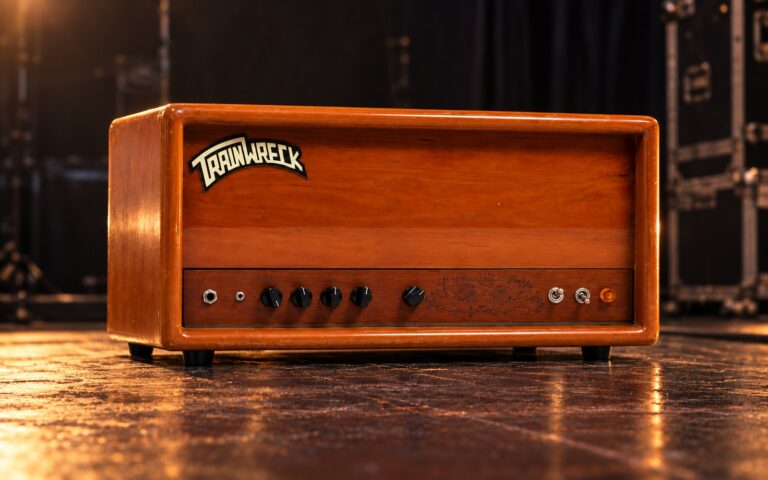
Seventy amplifiers. That’s the most generous estimate of how many Trainwreck circuits Ken Fischer finished before his health finally prevented him from working. Seventy handbuilt, obsessively tuned, named-not-serialised guitar amplifiers — against a waiting list that had topped 1,500 names by the time Fischer died in December 2006. In the entire sweep of the guitar world, there is no amp quite like the Trainwreck Liverpool. Not because the circuit is impossibly complicated — on paper it is almost provocatively spare, five knobs and a power switch — but because Fischer’s method of building was less engineering and more alchemy. He selected every component by hand, laid every wire with a purpose, and then tuned each amplifier until it sat at what he called the edge of instability: the point where the smallest change in a player’s right hand would cascade into a completely different sound. The Liverpool is the model where that philosophy met four EL84 output tubes, a cathode-biased output stage and an unshakeable belief that single-coil guitars deserved something better than the world’s existing amp vocabulary could provide.
Ken Fischer, Colonia, and the First Trainwreck
Ken Fischer was born on May 12, 1945. He started in electronics the way many of his generation did — through the military, followed by repair work on televisions and radios, and then a serious step up into vacuum tubes at Ampeg during the 1960s. By the time he left Ampeg he had absorbed a working understanding of tube amplifier design at a level most technicians never reach. Through the 1970s he built a reputation repairing and modifying amps in New Jersey, becoming the kind of figure that serious players drove hours to see.
In 1982 — three years before Trainwreck Circuits was formally established — Fischer built his first custom amplifier for a customer named Casper McCloud. That first design, running four EL84 power tubes in cathode bias, would eventually become the Liverpool model. Two related designs followed shortly after: the Express, running EL34 tubes in fixed bias for a harder, more muscular character, and the Rocket, Fischer’s attempt to redesign the Vox AC30 from first principles into the ultimate clean amplifier. Together these three models constitute the entire Trainwreck output. There were no production runs, no variants, no limited editions. Every amplifier Fischer built was essentially one-of-a-kind, differing in the specific components selected and the specific voicing performed during build.
Fischer’s output was never enormous — by the late 1980s he was already building slowly — but it collapsed entirely in 1988 when he came down with what appeared initially to be a severe flu. He never fully recovered. The diagnosis that eventually followed was chronic fatigue immune dysfunction syndrome, and it would compromise every subsequent year of his working life. The waiting list for a Trainwreck kept growing regardless. By the late 1990s Fischer had connected with Holger Notzel and Michael Kennedy of Komet Amplification in Louisiana, who became stewards of his design philosophy and mentorship partners in his final years. The Komet 60, developed through that collaboration, is the closest thing to a sanctioned Trainwreck successor in production form. Fischer died on December 23, 2006, with approximately 70 completed amplifiers scattered across private collections and stages around the world.
Liverpool Specifications
The Liverpool Circuit and What It Actually Does
The circuit diagram for a Trainwreck Liverpool looks, if anything, simpler than what you’d find in a Fender Deluxe Reverb. There is no complex switching, no effects send and return, no master attenuation section. Three 12AX7 preamp tubes drive the phase inverter, which in turn drives four EL84s configured in cathode bias rather than the fixed bias you find in the Express. That cathode-biasing decision is central to the Liverpool’s character: the output tubes can set their own operating point, which creates a naturally compressive quality as they approach saturation and gives the amp a bloom and sustain that fixed-bias designs (which tend to feel faster and more aggressive) typically do not have.
The EL84 tubes add their own layer of character on top of the topology. EL84s produce a crystalline, forward top end — think of the chime that defines a cranked Vox AC30, but with Fischer’s wider frequency thinking underneath it. The Liverpool’s low end is full without being flabby, the midrange has a slight upper-mid emphasis that makes every note present in a mix, and the top end is present without sharpness or brittleness. When you back the guitar’s volume knob off, the amp cleans up and the clean tone reveals itself to be genuinely bell-like. Push the guitar volume and picking attack and the overdrive arrives not as a different channel switching in but as a continuation of the same voice — more saturated, more harmonically dense, but recognisably the same amplifier.
Fischer compared his design philosophy to that of an F-16 fighter aircraft: a machine engineered to operate right at the edge of aerodynamic stability, so responsive to pilot input that conventional aircraft would be uncontrollable by the same pilot, but in the right hands an instrument of extraordinary precision. The analogy lands. A Trainwreck Liverpool rewards a player who understands right-hand dynamics and guitar volume as tone controls. It punishes a player who reaches for a boost pedal where the amp itself should be doing the work.
Component selection was not incidental to this philosophy — it was the mechanism by which it was achieved. Fischer sourced every capacitor, every resistor, every potentiometer with deliberate intent. The output transformer is particularly important. Early Liverpool units used Stancor transformers (Standard Transformer Company of Chicago). When Stancor discontinued the relevant unit in the 1980s, Fischer moved to Pacific Transformer in California, making specific engineering changes to an old Stancor design to get what he needed. The result is that “old transformer” and “new transformer” Trainwrecks are genuinely different-sounding amplifiers — the former tending toward sweetness and a rounder top end, the latter more aggressive and mid-forward. Knowing which you’re looking at, when buying on the used market, is not a footnote. It is the purchase decision.
One further point on build details: Fischer refused to use serial numbers. Each amplifier received a female name instead. Three original Trainwrecks documented through the Scruff’s Vintage Guitars dealer as of recent years include a Liverpool named “Lucy”, and an Express named “Sarah” (which has a significant player provenance, discussed below). Brad Paisley’s Liverpool is named “Hattie Mae.” The naming convention is not affectation — Fischer believed each amplifier possessed a distinct personality shaped by the particular components that went into it, and he treated that individuality as worth acknowledging.
Famous Players — Verified, Sourced, and Honest
The mythology around Trainwreck amps tends to expand the roster of famous users far beyond what the evidence supports. When the total production across all three models is approximately 70 amplifiers, the law of large numbers alone should limit the confirmed player list. Here is what the primary and secondary sources actually say.
Brad Paisley — Confirmed on Liverpool
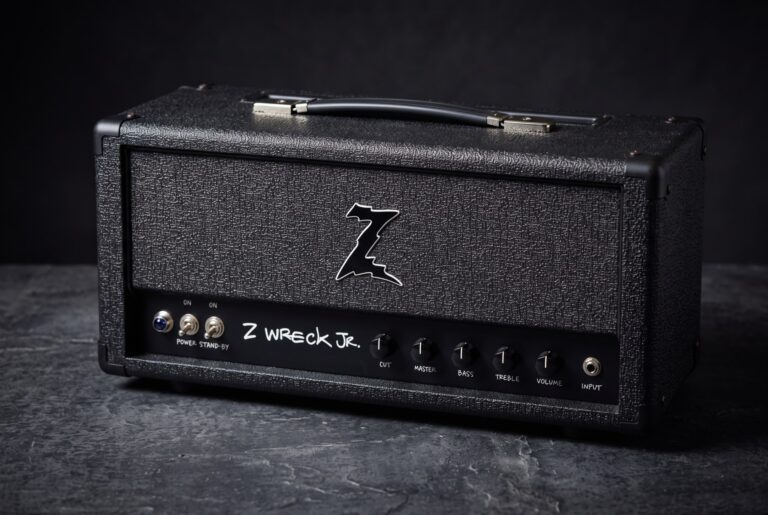
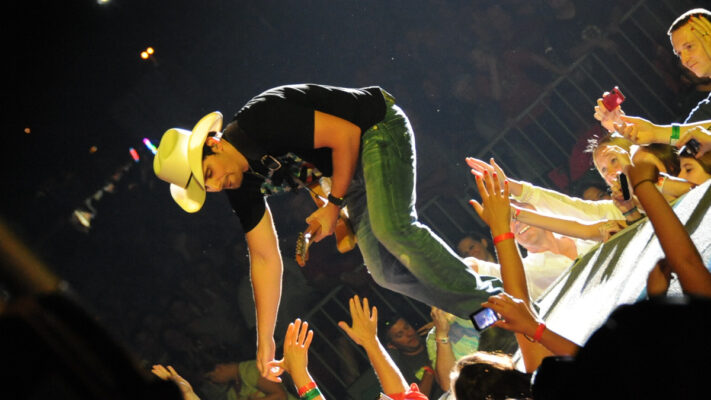
Paisley is the clearest documented Liverpool player among major touring artists. His Liverpool 30 is named “Hattie Mae” and has been a permanent part of his live rig alongside a Dr. Z Stingray, two Z-Wreck combos and two Bruno Underground 30s, all switched in and out during performances. The Trainwreck connection runs deeper than live use: on his landmark 2008 album Play, Paisley used the Liverpool as his primary overdrive source. Any distorted tone on that record came from the natural breakup of the amp rather than any overdrive pedal — a deliberate creative decision that resulted in one of the most dynamically responsive country-rock records of the decade. The influence of the Liverpool on Paisley’s tone thinking also directly generated a commercial product: the Z-Wreck, developed in collaboration with Dr. Z’s Mike Zaite, was conceived as a blend of the Trainwreck Liverpool’s touch response and the clean shimmer of a Vox AC30. The Z-Wreck exists because Paisley spent years playing “Hattie Mae” and wanted something with similar DNA that touring crews could service and that he could obtain more than one of.
Mark Knopfler — Credibly Connected, Source Depth Varies
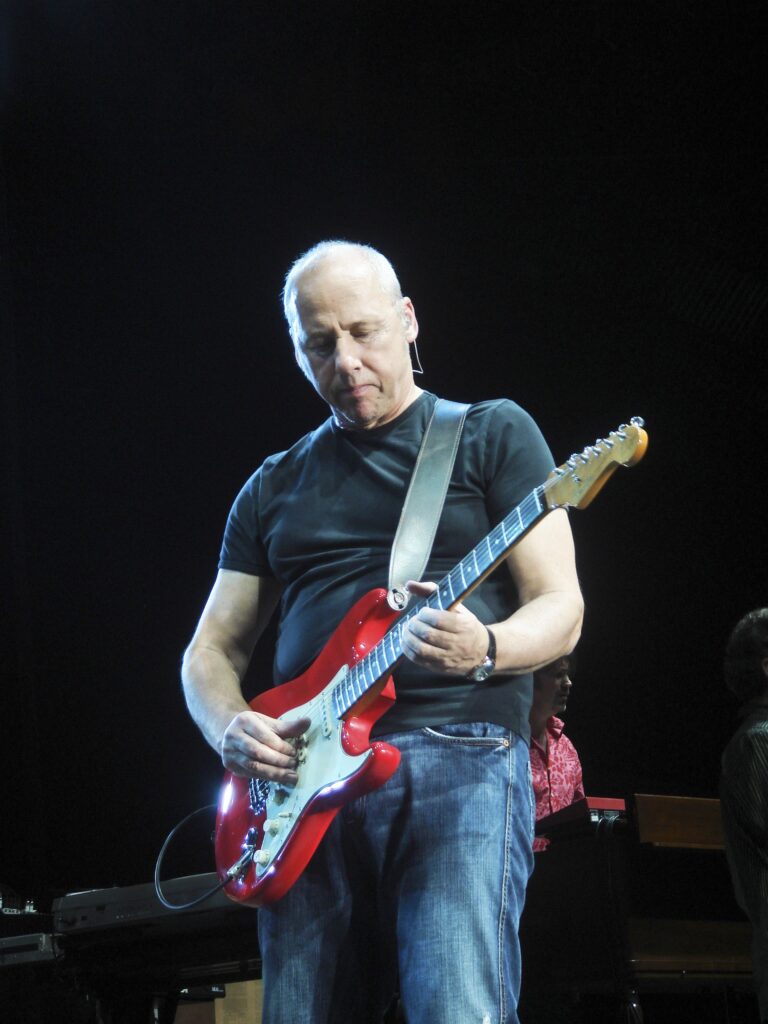
Knopfler is cited as a Trainwreck user across multiple pieces of guitar press and in the Reverb.com history of the brand. His later documented use of Komet amplification — a direct Fischer lineage — is consistent with being an early Trainwreck owner who followed the sound as it evolved through Komet’s collaboration. The connection is credible and widely repeated by sources that typically verify rather than recycle. However, the specific Liverpool model attribution, as opposed to generic Trainwreck use, lacks the documentary precision of the Paisley case. Include Knopfler as a credible Trainwreck user with the honest caveat that model-specific primary documentation is thin.
Warren Haynes — Dealer-Cited
Scruff’s Vintage Guitars, a specialist dealer with on-staff Trainwreck expertise in the person of Komet co-founder Holger Notzel, lists Haynes among recognized Trainwreck players. Dealer citations at this level of specialist expertise carry meaningful weight, but they do not constitute primary-source documentation of which specific model or build was used. Haynes’s broader amp history — particularly his work through the Allman Brothers’ later years and his Gov’t Mule touring rigs — is consistent with the kind of player who would seek out and use a Trainwreck. Flag it as credible but not primary-source verified.
Keith Urban — Dealer-Cited
Urban appears in the same Scruff’s Vintage listing alongside Haynes and Paisley. His country-with-rock-guitar aesthetic maps naturally onto the Liverpool’s strengths with single-coil instruments. No independent primary-source documentation found.
Billy Gibbons — Trainwreck Yes, Liverpool Specifically Debunked
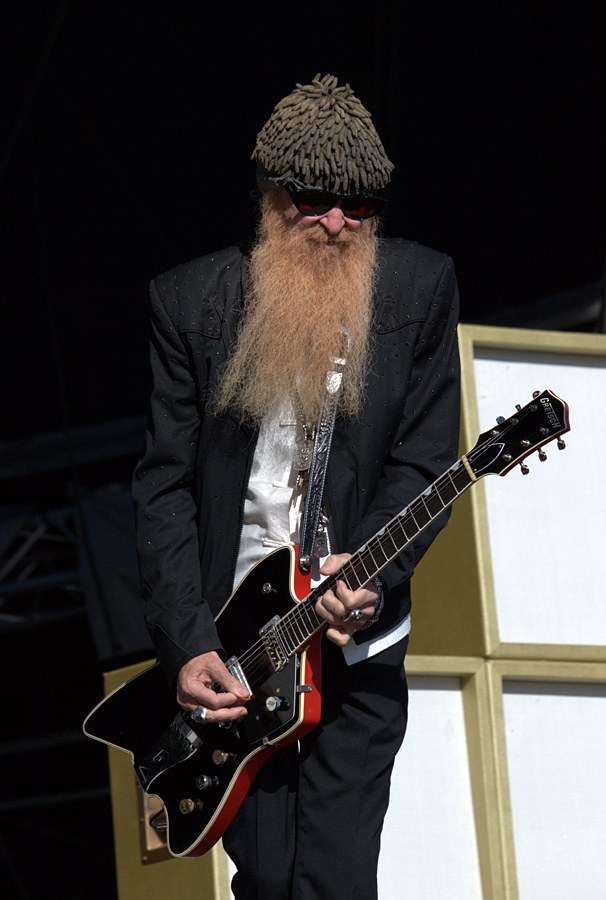
The Trainwreck “Sarah” — a 1987 Express model, serial identity confirmed through dealer documentation — was sold to Billy Gibbons. That instrument is the documented Gibbons-Trainwreck connection, and the Express circuit (EL34, fixed bias, 35–40 watts, harder and more muscular) is categorically different from the Liverpool (EL84, cathode bias, 30 watts, compressed and chiming). Sources that list Gibbons as a Liverpool player are applying a generic “Trainwreck user” label to the wrong model. This article will not repeat that conflation. Gibbons used a Trainwreck Express, and the distinction matters.
Joe Bonamassa — Unverified
The 2013 Premier Guitar rig rundown for Bonamassa’s solo tour documents vintage Marshalls, a Suhr SL68, and a Friedman Dirty Shirley prototype — no Trainwreck. A Joe Bonamassa fan forum thread titled “Trainwreck Liverpool or Express…anyone?” reads as a question about purchasing one, not documentation of ownership. Equipboard’s Bonamassa page (accessed for this article) does not list a Trainwreck Liverpool. No Liverpool claim will be made for Bonamassa in this article.
Tone Recipes and Settings
1. Paisley Country Sparkle (Telecaster bridge, light strings)
Volume 3, Treble 5, Mid 4, Bass 3, Presence 4. At this setting the amp is crystalline and clean with significant top-end presence. Picking attack introduces the barest bloom of compression. This is the Play-era clean tone before the amp is pushed. Guitar volume at 8–9 for this.
2. Natural Drive — Single Coil (Telecaster or Stratocaster bridge, guitar volume 10)
Volume 5–6, Treble 4, Mid 5, Bass 3, Presence 3. Here the EL84s start to compress under sustained notes. There is natural sustain and upper harmonic content with no pedal involved. Presence rolled back from the previous recipe to prevent stridency as the signal gets hairier.
3. Blues Lead — Open Roll (Les Paul neck or P-90, guitar volume 8)
Volume 6, Treble 3, Mid 5, Bass 4, Presence 2. The cathode bias compression becomes the defining feature at this setting. Notes bloom and sustain. Bending into a phrase the amp follows the pitch change with a harmonic richness that no solid-state power section replicates. This is the setting that made the Liverpool the kind of amplifier people write forum posts about years after they’ve sold one.
4. Knopfler Clean — Fingers Only (Strat, neck or middle pickup, no pick)
Volume 2–3, Treble 5, Mid 4, Bass 4, Presence 5. A high Presence setting with low Volume keeps the amp linear and articulate. Fingerstyle playing sits the frequency response right in the area where harmonics are audible but the attack has control. Knopfler’s documented preference for high Presence on whatever amp he used is replicable here.
5. Full-Tilt Open-Air Stage (any guitar, guitar at 10, amp driving hard)
Volume 8–9, Treble 3, Mid 5, Bass 4, Presence 2. The Liverpool at full noise is not a hair-metal amp. The EL84 saturation character keeps it musical rather than chaotic — thick, warm, harmonically complex. The mid emphasis sits around 2–3 kHz, which is where a guitar needs to cut through a loud drummer. Bass and Presence reduced to manage low-end mud and high-frequency hash at high levels.
Settings on a Liverpool are deceptively simple. The entire control set is Volume, Treble, Mid, Bass and Presence. There is no master volume — the Volume control is the only gain stage you have. To access the amp’s overdrive, you increase the Volume until the output tubes begin to saturate, and you manage the level in the room with speaker placement, baffling, or a load box. These are suggested starting points for a Liverpool or a credible clone. Adjust by ear; the amp will tell you when it’s working.
Comparisons and Context
Trainwreck Express vs. Liverpool
The Express runs 2× EL34 in fixed bias for roughly 35–40 watts. Where the Liverpool blooms and compresses under picking attack, the Express responds faster and more aggressively — the feel is punchy, immediate, with more raw power in the bottom end and a mid emphasis that sits lower and thicker. Both share the same preamp topology and the same single-channel, no-master-volume architecture. If the Liverpool is a screaming Les Paul through a cranked AC30 on recording steroids, the Express is that amplifier’s angrier sibling with a Marshall fix. The documented Billy Gibbons “Sarah” Express makes sonic sense: Gibbons’s ZZ Top tone is about attack and low-mid grit, not about EL84 chime. Most Liverpool owners report it works best with single-coil guitars and rewards restrained technique. Express owners tend to pair it with humbuckers and heavier playing.
Komet 60 — Fischer’s Own Succession Plan
The Komet 60 was developed directly from Fischer’s design philosophy through the collaboration with Holger Notzel and Michael Kennedy. It is as close to a manufacturable Trainwreck as the design has ever come — available in actual production, serviceable, and carrying Fischer’s direct intellectual input from the late 1990s through his death. Komet 60s sell used in the $3,000–$5,000 range. If you want Trainwreck DNA in an amp you can actually own, buy and repair without spending six figures, the Komet 60 is the answer the market has arrived at.
Friedman BE-100 Deluxe — Modern High-Gain Boutique
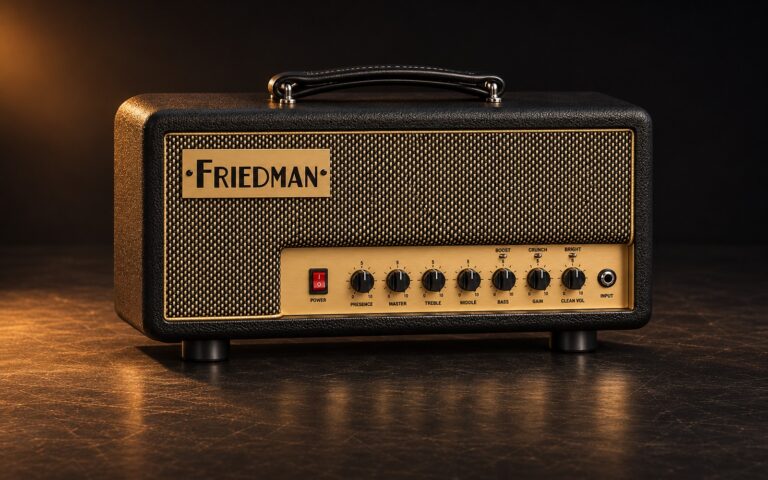
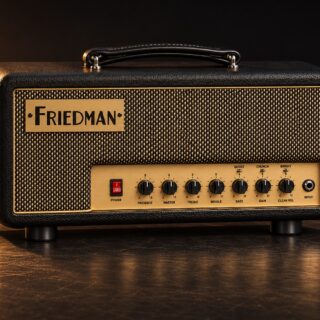
The BE-100 Deluxe is a different philosophy from the ground up — two channels, massive headroom, purpose-built for modern high-gain playing — but it occupies a similar position in the boutique amp market as a hand-built American amplifier that commands premium money and delivers boutique response. Where the Liverpool is a single-coil, touch-sensitive, no-frills British-inflected design, the Friedman is a heavy rock machine with extensive EQ and switching options. Different tool for a different player.
Bogner Helios 100 — British Channelled Boutique
The Helios is Reinhold Bogner’s interpretation of British amp character with modern convenience layered on: multiple channels, effects loop, broader tonal range. It is supremely capable and far easier to use at various volume levels than a Liverpool. It is also, by definition, not a Liverpool — the channelled architecture and master volume remove the direct connection between playing dynamics and amp response that makes Fischer’s design mythic.
Hiwatt Custom 50 DR504 — Vintage British Single-Channel
The Hiwatt DR504 is another single-channel, no-master-volume British amp with a similarly uncompromising approach to the signal path — hand-wired, Partridge transformers, fixed bias EL34s. The Hiwatt character is cleaner, stiffer, with significantly more headroom before it begins to break up. Where the Liverpool’s character is defined by its cathode-biased bloom and cathode follower touch response, the Hiwatt is about linear power and absolute fidelity to the input signal. Both amps demand to be played loud and resist pedal dependency. At approximately $2,500 for a new Custom Shop Hiwatt versus $70,000+ for a Liverpool, the Hiwatt is the accessible comparison rather than the purchase alternative — these are different values at entirely different price points.
Dr. Z Z-Wreck — Liverpool DNA in Production Form
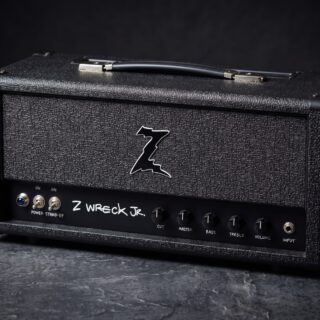
Brad Paisley worked directly with Dr. Z’s Mike Zaite to create the Z-Wreck — explicitly and by his own account a blend of the Trainwreck Liverpool and the Vox AC30. The Z-Wreck captures the touch response, the EL84 cathode-bias bloom and the single-channel simplicity of the Liverpool in a hand-built American amp that can be purchased, serviced and, crucially, ordered from a real amplifier company. Z-Wrecks trade used in the $2,500–$4,500 range. For anyone whose interest in the Liverpool is about tone rather than collector status, the Z-Wreck is where the conversation should start.

Buying Guide
You are not shopping for a Trainwreck Liverpool the way you shop for most amplifiers. You are entering a private collector market where provenance is everything, prices are set by individual negotiation or specialist auction, and the total available pool globally is perhaps 20–30 Liverpools. Here is what you need to know before spending the money.
First, authentication. A genuine Fischer-built Trainwreck can be verified through Holger Notzel at Komet Amplification — he knows these amplifiers intimately, has worked on many of them, and is considered the primary technical authority for authentication and service. Do not buy any Trainwreck presented as genuine without Notzel’s (or an equivalent expert’s) independent verification. The market for fake or misrepresented boutique amplifiers is real, and a misidentified Trainwreck at Liverpool prices is a very costly mistake.
Second, the transformer question. Determine whether the unit has the original Stancor output transformer or the Pacific Transformer replacement. This affects both the sound and the potential collectability. Original Stancor units are rarer and often command a premium. Neither is “wrong,” but you need to know what you are buying.
Third, understand the service situation. Trainwrecks can be serviced, but not by most technicians. The circuit’s deliberate operation at the edge of instability means that substituting components — even to “equivalent” specs — can alter the tuning Fischer achieved. Find a technician with specific Trainwreck or Komet experience before purchasing, not after.
Fourth, pricing expectation. As of 2026, genuine Trainwreck Liverpools have sold at specialist auction and through private sale in the $70,000–$120,000 range, with exceptional examples or those with documented famous player provenance exceeding that. If a Liverpool is offered below $50,000 with no authentication documentation, treat that as a serious red flag.
Ownership Notes
Operating a Liverpool requires accepting its design terms. There is no master volume. Playing at low volume with the amp still in its clean range produces a genuinely beautiful clean tone, but the characteristic overdrive only arrives when the output tubes begin to saturate — and that requires volume. A reactive load box (Two Notes Torpedo, Universal Audio OX, or equivalent) is the sensible solution for anyone who needs the amp’s overdrive character at manageable levels. Running the Liverpool into a load box and taking the cab-simulated output into a recording interface is actually one of the most effective ways to access its sound in a controlled environment.
With no effects loop, time-based effects (delay, reverb) need to go either in front of the amp or, for a wet/dry rig, into a separate power amp and cab running in parallel. Many Liverpool owners run the amp dry and use a parallel wet signal through a simpler channel amp. This is also consistent with what Fischer intended — the Liverpool should be heard clean or overdriven, not swimming in processing.
The EL84 tubes do have a finite life and will need periodic replacement. The cathode-biased output stage means the amp self-biases, so tube swaps do not require a technician to rebias. You can drop in any matched quad of EL84s. Given the value of the amplifier, however, use quality current-production tubes (JJ, Mullard reissue, or Tung-Sol EL84) and keep original tubes as spares if the amp came with tubes believed to be original Fischer installs — those have collector value of their own.
Frequently Asked Questions
How many Trainwreck Liverpools were actually built?
No definitive count exists because Fischer kept meticulous internal records but those records were not fully published or centralized after his death. The consensus across specialist dealers, auction house documentation and the Komet Amplification team is that approximately 70 Trainwreck amplifiers of all three models were completed. The Liverpool is the first and oldest design, so it likely has the highest count of the three models, but individual unit counts per model have not been definitively published.
What makes the Liverpool different from the Express?
Power tubes and bias method. The Liverpool uses four EL84s in cathode bias; the Express uses two EL34s in fixed bias. EL84 cathode bias produces natural compression, a crystalline top end and a bloom character ideal for single-coil guitars. EL34 fixed bias is faster, punchier, with more low-end punch and a thicker mid character. Fischer designed the Liverpool specifically with single-coil guitars in mind. The preamp is shared across both models but voiced differently to complement each power section.
What is the Rocket?
The Rocket is Fischer’s third model — his attempt to “perfect” the Vox AC30 circuit. It uses four EL84s like the Liverpool but adds a rectifier tube, runs higher voltages and uses a larger output transformer than a standard AC30. It is designed for clean tone primarily. Production is the rarest of the three models.
Did Billy Gibbons play a Liverpool?
No — not according to the documentary record. The Trainwreck associated with Gibbons is “Sarah”, a 1987 Express model with EL34 power tubes, documented through dealer records. Sources that describe Gibbons as a Liverpool player are applying a generic “Trainwreck” label without model specificity. The Express and Liverpool are significantly different amplifiers.
What happened with the Stancor vs. Pacific Transformer issue?
Fischer’s preferred output transformer was made by Stancor (Standard Transformer Company, Chicago). When Stancor discontinued the relevant model in the 1980s, Fischer worked with Pacific Transformer in California to produce a replacement, incorporating specific engineering changes to an old Stancor design. “Old transformer” units (Stancor) tend to sound sweeter and more vintage, with a rounder top end. “New transformer” units (Pacific) are typically more aggressive and mid-forward. Both are genuine Fischer builds; the difference is a sonic preference and a provenance point, not a quality distinction.
Are the Komet 60 and Dr. Z Z-Wreck genuine Trainwreck alternatives?
They are the closest alternatives with legitimate design lineage. The Komet 60 was developed with Fischer’s direct involvement through his collaboration with Komet Amplification. The Z-Wreck was designed by Mike Zaite of Dr. Z at Brad Paisley’s request to capture the Liverpool’s touch response alongside Vox AC30 clean character. Both are hand-built American boutique amplifiers. Neither is a Trainwreck — but both were developed from it with more integrity than any generic “Trainwreck-style” clone.
Can a Trainwreck Liverpool be repaired and maintained?
Yes, but it requires the right technician. The cathode-biased output stage means tube swaps do not require rebiasing, which simplifies the most common maintenance task. More involved repairs — replacement of passive components, transformer work, chassis issues — should be handled by someone with specific Trainwreck or Komet experience, ideally in contact with Holger Notzel. Substituting components casually risks disturbing the precise tuning Fischer applied, which is part of what makes the amp sound the way it does.
What is the realistic market price for a Liverpool in 2026?
Documented sales through specialist auction houses and private dealer transactions have placed genuine Fischer-built Liverpools in the $70,000–$120,000 range. Amplifiers with documented famous player provenance — or with an original Stancor output transformer and strong authentication paperwork — can exceed this. If a Liverpool is presented at a significantly lower price without authentication documentation, treat it as requiring extraordinary due diligence before proceeding.
Image credits
- Brad Paisley: U.S. Navy, Toiete Jackson, Wikimedia Commons, Public domain.
- Brad Paisley: by Mass Communication Specialist 1st Class Toiete Jackson, Wikimedia Commons, Public domain.
- Mark Knopfler: Christopher Bowley, Wikimedia Commons, CC BY 2.0.
- Billy Gibbons: Antti Salonen, Wikimedia Commons, CC BY-SA 3.0.
Latest News
Related
On This Day
Tuesday 10 November
From this week: