The Ironheart That Shook Birmingham: Inside the Laney IRT60H’s Bold Claim on Modern Metal
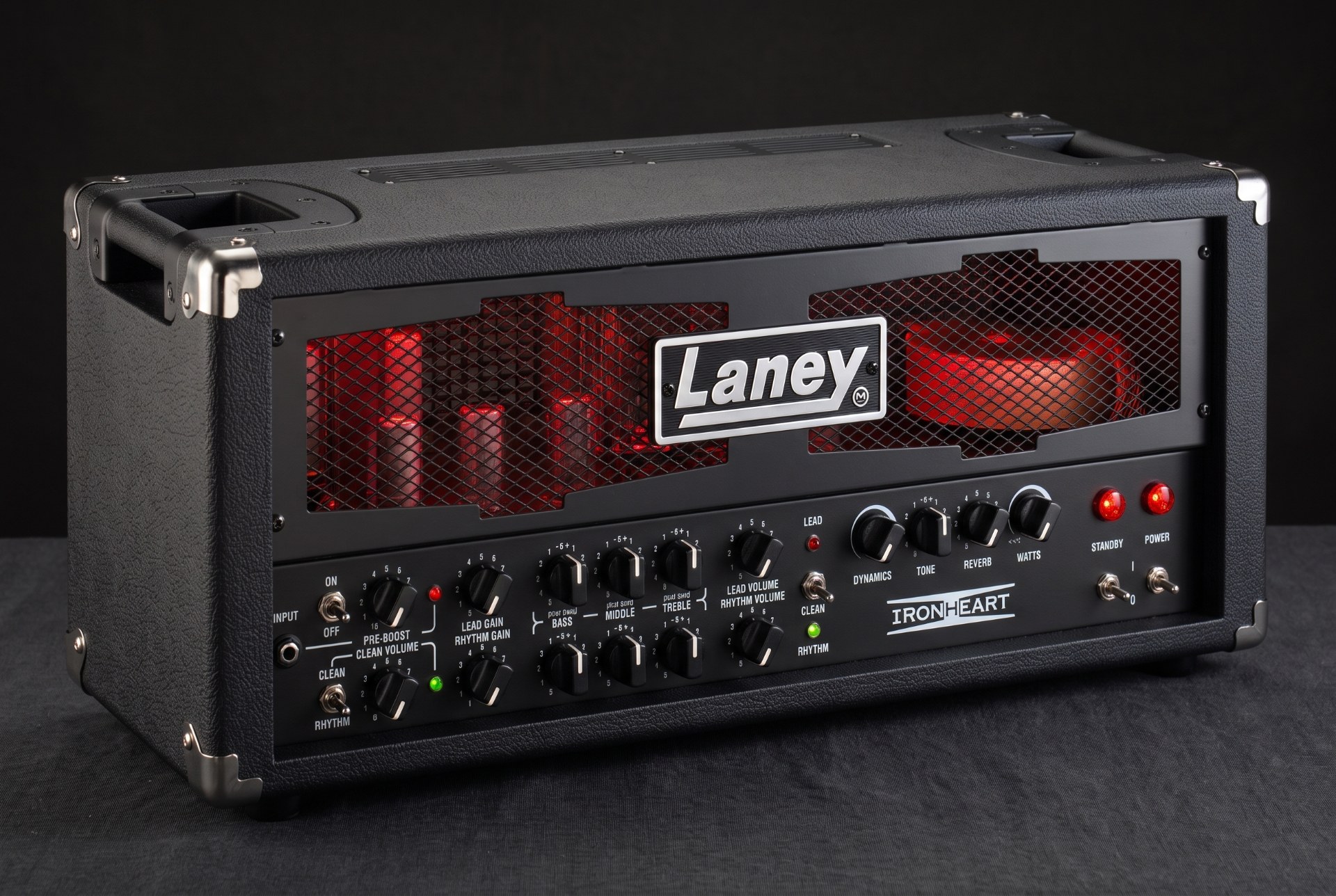
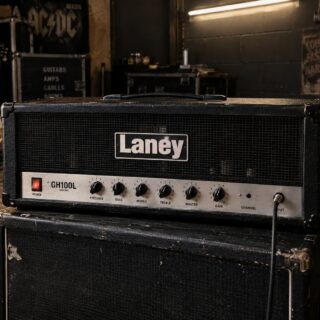
An AI-generated illustration of the Laney Ironheart IRT60H.
The Laney IRT60H: three channels, 6L6 tubes, push/pull EQs, and variable wattage in a discontinued metal head worth hunting used. Full specs and buying guide.
When Laney rolled out the Ironheart series at the dawn of the 2010s, they were making a very specific argument. Not “we can build a boutique amp that sounds like a vintage one.” Not “our reverb is lush and our cleans are warm.” The argument was blunter: we can build the best-value modern metal head on the market, design it in England where we know what heavy sounds like, manufacture it in Asia where the price stays honest, and watch the metalcore touring world adopt it within twelve months. That argument held up. The Laney IRT60H is now discontinued, but its used-market reputation — and the fact that Adam Dutkiewicz was running Ironheart heads through Celestion Vintage 30-loaded 4x12s when Killswitch Engage recorded Disarm the Descent — tells you the argument landed.
This is not a vintage amp. It does not smell of tweed, it will not remind you of a Texas roadhouse, and it has absolutely nothing to say about your country blues. What it does is three channels, push/pull EQ on every knob, a variable wattage control that runs clean down to less than a watt, and a Dynamics knob that lets you dial the sag from surgical to flubby without touching the master volume. At the street prices it reached before discontinuation — consistently under $900 new, now $400–700 used — nothing from any brand at any wattage was offering that feature set. Some things are worth understanding even after the manufacturer stops making them, and the IRT60H is one of them.
Where the Ironheart Comes From
Laney Amplification was founded in Birmingham in 1967 by Lyndon Laney, who had been playing in the same local circuit as Robert Plant and John Bonham before Led Zeppelin consumed their futures. The backstory has been told three times in these pages already — the LA100BL that Tony Iommi used to record Black Sabbath and Paranoid, the GH100L that gave Paul Gilbert his Racer X crunch, the Lionheart L20T-112 that Adam Dutkiewicz and Joel Stroetzel kept in the writing room between tours. Laney has operated continuously from Birmingham for nearly sixty years, relocating from their Custard Factory premises in Digbeth to Halesowen in 2004 with Iommi ceremonially cutting the ribbon.
The Ironheart series arrived around 2011–2012 and represented Laney’s deliberate move into the modern high-gain market. Where the GH100L was an explicit British-voiced JCM800 rival, and the LA100BL was a museum piece reprinted for the faithful, the Ironheart was new. Three channels from the ground up, 6L6 power tubes rather than the EL34s in the GH and LA lines, variable wattage rather than fixed power, and a preamp gain architecture oriented toward the contemporary palate: tight palm muting, clear harmonic content at high gain, enough low-end mass to fill a club without burying the pick attack. It was designed in England and manufactured in Asia — a combination Laney has been transparent about and has consistently made work, at least in this series.
The IRT60H launched alongside the IRT120H (which uses four 6L6s instead of two, delivering 120W) and the IRT-Studio (a low-watt recording variant). The whole range carried the “Black Country Customs” prefix in Laney’s internal product codes — BCC-IRT60H — a nod to the Black Country, the industrial district of the West Midlands that includes Halesowen and has been making things out of metal since the eighteenth century. The amp is now discontinued; Laney’s own website files it under /discontinued/irt60h with the label “all tube 3-channel guitar head – 60W with Reverb.” Buy used.
Specifications
The Circuit in Detail
Three Channels, One Compromise
The IRT60H’s three channels are not equal in their independence. Clean and Rhythm share a single EQ section — Bass, Middle, Treble — while Lead gets its own dedicated three-knob set. In practice this means you can voice Clean and Rhythm differently only with the Gain and Volume knobs and the channel-level Pre-Boost; the tone shaping is identical between them. For players who want a fat rhythm crunch and a scooped lead, this means lead-channel EQ gets the scoop and the rhythm is shaped by the same control set, which limits the degree of difference you can dial in between channels one and two. The Lead channel sounds punchier and slightly more aggressive than Rhythm even with identical EQ settings — the gain staging is genuinely different — but the shared EQ is a real trade-off at this price point.
Push/Pull EQs: The Killer Feature
Every EQ knob on both EQ sections has a push/pull function, and this is where the IRT60H earns its reputation for versatility. On the Bass knob, pulling it up extends the low-frequency range of the control, bringing in more deep bottom end — useful for drop-tuned riffing or for fattening up a 2×12 cabinet that needs more thump. On the Middle knob, pulling shifts the frequency range of the mid control downward, tightening the sound by moving the mid hump into a lower register; Laney calls this “Mid Shift” and the practical effect is a tighter, more modern palm-muted response. On the Treble knob, pulling broadens the treble control’s frequency response, rounding out upper harmonics without simply reducing them — “Treble Shift” in Laney’s terminology, good for softening a fizzy high end without rolling off the air.
These are not parametric EQ controls; you cannot choose any frequency, only the preset bands Laney engineered in. But having six binary frequency options across three EQ knobs — on two independent EQ sections — gives you a grid of voicings that effectively multiplies the number of distinctly useful tones the amp can produce. Players who reviewed the IRT60H consistently cited this system as the single feature they wished other amps in the price range had adopted. It also means a used IRT60H requires time to explore properly: the controls interact, and the “right” settings for a given cabinet-and-guitar combination may not be obvious on first power-up.
Variable Wattage Done Right
The Watts control is a genuine analog power attenuator, not a stepped switch. You turn it clockwise from the minimum and the output climbs continuously from under a watt to the full 60W. Unlike fixed-tap attenuators that offer a handful of preset reductions, the IRT60H’s continuous control means you can find the exact watt-age sweet spot for your room. Players who reviewed the amp found the power section’s character remained consistent all the way down — the feel of the amp does not change into something mushy or compressed in the way some attenuators emulate. This is the correct way to implement power scaling in a tube head; the IRT120H version exists for the same reason, and the logic scales: if you need to gig large venues at full power, the 120H is the choice, knowing its own Watts control handles the rest of the range.
Dynamics: Sag on a Knob
Sag is the compression a power amplifier applies to the signal when its power supply cannot instantaneously deliver the current a hard note demands. In old low-headroom designs with unregulated transformers it was unavoidable and became considered a feature; modern high-headroom designs can be extremely fast and tight, which is right for djent and technically precise metal but wrong for bands who want that yielding, vintage-feeling low end. The Dynamics knob on the IRT60H controls the amount of this sag electronically, from a fast, tight response suited to seven-string palm muting all the way to a big, loose, airy quality that the MusicPlayers.com review diplomatically called “vintage.” Most players in the metal context run it between 9 and 12 o’clock. Going past 12 on the rhythm and lead channels typically adds unwanted looseness without adding useful warmth; where the control earns its keep is at lower settings, where it keeps the low end articulate on a cab that would otherwise sound boomy in a small room.

The 6L6 / EL34 Question
Factory power tubes are 6L6s. The 6L6 is the American tube par excellence: full, warm low end, clean headroom, smooth compression, a slightly rounded top end. It is the tube in a Fender Twin Reverb and in early Mesa/Boogie Marks. Laney’s manual confirms that EL34s can be substituted, and the amp is designed to accommodate this without a bias adjustment. EL34s are the British tube: tighter, more compressed in the midrange, with a harder, glassier top end and more aggressive overdrive character at the same wattage. Swapping to EL34 tightens the low end, sharpens the midrange crunch, and makes the amp feel more immediate — closer to the GH100L in character. Swapping back recovers the 6L6’s rounder, warmer body. Both work. The choice is between an amp that sounds bigger and smoother (6L6) and one that sounds tighter and more aggressive (EL34). Given that the IRT60H is already tight enough for metalcore at the stock settings, many players leave the 6L6s in and use the Bass push/pull to adjust low-end character instead.
Pre-Boost
The Pre-Boost is a footswitchable boost stage that hits the input signal before the EQ sections on all three channels simultaneously. It has one level control and is useful in two scenarios: as a volume boost for solos without adding distortion coloration, and as a light overdrive-ish texture on the clean channel for players who want a mid-point between fully clean and full rhythm gain. The MusicPlayers.com review noted that at low settings the boost is clean and useful; at medium settings it introduces a slightly solid-state-sounding edge that is distinguishable from the amp’s own gain character; at high settings it becomes counterproductive on the distorted channels. It is not a substitute for a good drive pedal in front of the amp, but it is functional and its inclusion means one fewer pedal for players who only need a basic volume jump for solos.
The Global Tone Knob
This is the feature that review after review describes as “genius” and that no one expected at this price. After all the channel EQs have been set and the amp is voiced to taste, the Tone knob provides a single overall frequency trim that applies across all three channels simultaneously. It is intended for use when moving from one room to another: dial in your channels in your rehearsal room, leave them there, and use the Tone knob to compensate for the acoustic differences of each venue. Bright room? Turn it back. Dead room with carpet walls? Turn it up. It works as described, and its taper is useful — there is plenty of sweep on either side of the neutral 12 o’clock position without the extreme positions being unusable. It is the kind of feature that touring bands discover on the second night and never stop using.
Famous Players
Mattias IA Eklundh
Mattias IA Eklundh is the IRT60H’s most consistently cited professional endorser. The Swedish guitarist from Freak Kitchen is among the most technically inventive players in progressive metal, known for right-hand tapping acrobatics, unusual harmonic vocabulary, and an approach to the guitar that treats conventional technique as a starting point to be abandoned. His endorsement of the Laney Ironheart was part of the Ironheart launch campaign, and Laney’s own history credits “the rock and metal world” taking to the Ironheart line during exactly the period when Eklundh was associated with it. He is documented using the IRT60H in video material on the Italian music platform Musicoff.com, and appears on Equipboard’s IRT60H artist roster.
Eklundh’s playing style makes the IRT60H’s feature set a specific match rather than a generic one. The push/pull Mid Shift is the control that lets a seven-string or extended-range player in a complex harmonic context avoid the frequency buildup that makes heavily distorted chords unreadable; Eklundh’s playing sits at the intersection of high gain and clarity in exactly the register where that control earns its pay. His cabinet preference leans toward Laney’s own Ironheart cabs, and his studio use of the related IRT-Studio (also on Equipboard) confirms this is a sustained working relationship rather than a single product placement appearance.
Killswitch Engage
The Killswitch Engage connection to the Ironheart is real and documented — but the specific model within the Ironheart line is where the sources diverge, and the article should tell you that rather than paper over it.
In Premier Guitar’s March 2013 feature on the band’s Disarm the Descent album, journalist Shawn Hammond published both guitarists’ 2013 tour gear lists in full. Adam Dutkiewicz’s list reads: “Laney Ironheart 100-watt heads driving Ironheart 4×12 cabs with Celestion Vintage 30s, Laney Ironheart 2×12 combo (for clean tones).” Joel Stroetzel’s list reads identically for the dirty side: “Laney Ironheart 100-watt heads driving Ironheart 4×12 cabs with Celestion Vintage 30s.” In the same interview, Stroetzel says of the recording: “For the record, it was mainly a mix of a Laney Ironheart and a Fuchs Viper. The Ironhearts have a good, tight, focused sound, and all the notes jump out nice and clear.”
The problem: “100-watt” is not a standard Ironheart rating. The IRT60H is 60W; the IRT120H is 120W. Neither is 100W. The most likely explanation is that the PG journalist approximated the wattage, or relied on band information that was slightly wrong. Separately, the YouTube video title for Joel Stroetzel’s Laney gear interview explicitly reads “Laney Ironheart IRT-120H and Lionheart L20T-112,” confirming that the high-power Ironheart in his live rig was the IRT120H. Equipboard’s IRT60H artist page lists both Dutkiewicz and Stroetzel — with the Stroetzel entry sourced to a YouTube video about the IRT-120H. The honest reading: Killswitch Engage used Laney Ironheart heads during the Disarm the Descent era, both live and in the studio; the specific split between IRT60H and IRT120H in each player’s rig is uncertain from available documentation. Adam Dutkiewicz may have used the IRT60H in the writing context (the Lionheart L20T-112 being his other writing-room amp, which is documented); Stroetzel’s live heavy amp is documented as the IRT120H. The Disarm the Descent guitar tone — tight, punching, clear even in the breakdown — is reasonably credited to the Ironheart circuit regardless of which wattage variant was under the recording microphone.
By the time KSE’s next album cycle arrived, both Dutkiewicz and Stroetzel had transitioned to Laney’s Tony Iommi signature heads, per Laney’s own documentation. The Ironheart era for KSE was real and consequential; it was also finite.
Tim Henson (Polyphia)
Tim Henson — in this series — appears on Equipboard’s IRT60H artist page. He is included here for completeness, but context matters. Polyphia’s current production identity is built on digital rigs, amp modelers, and a production approach that treats guitar tone as something assembled in a DAW rather than captured in a live room. The IRT60H, if it appeared in Henson’s setup, predates Polyphia’s current aesthetic and belongs to an earlier phase of the band’s development. It is not a claimed connection that Laney is currently trading on, and the source trail does not extend to a primary rig rundown, official gear page, or interview. Equipboard-only, early-career only — named for accuracy, not as an endorsement of the amp by the current Polyphia sound.

The Roster: Four Strikes
Four names are listed for the IRT60H: Tony Iommi, Paul Gilbert, Mattias IA Eklundh, and Guthrie Govan. To spare the reader a full-length debunk:
Tony Iommi’s Laney is the LA100BL — the hand-wired 1969 100W head with no master volume, documented across five primary sources including a 1974 Guitar Player interview whose original tape has been posted to YouTube. He had no relationship with a 3-channel 6L6 head that didn’t exist until he was sixty-three years old. His article is Rank 541. Paul Gilbert’s Laney is the GH100L — documented through his Racer X GOOMY tour Equipboard page, confirmed as a ~15-year relationship that ended around 2007 when he moved to Marshall. His article is Rank 542. Guthrie Govan does not use tube heads of any brand as his primary rig; his live and studio rig runs Fractal Audio through Laney LFR-212 FRFR active cabinets, which is documented in his Equipboard profile. He uses the Laney brand, not Laney amplifier circuits.
Mattias IA Eklundh is the only one of the four names that belongs on an IRT60H page. He is discussed above.
How It Sounds
The clean channel is American-voiced — clear, detailed, with little natural warmth — closer to a Fender than to anything British. It takes pedals well, particularly transparent overdrives and delays. The MusicPlayers.com review used the phrase “bell-like tones drenched in delays and reverbs” for this channel, which is accurate. It is not a vintage Vox clean; there is no bloom, and the breakup when pushed is not musically interesting. Use it clean, put your drive character elsewhere.
The Rhythm channel is where the amp’s character becomes clear. The lows are full and present, the highs sparkle without shrieking, and the midrange is adjustable across a genuinely useful range. With the Gain at noon you are in modern metal territory; with a Maxon OD808 or equivalent in front for compression and focus (Adam Dutkiewicz’s documented approach: “gain all the way down, just for a little bit of compression and clarity in the picking”) the tightness reaches djent-adjacent levels. Past noon on the gain the dynamics compress and the sound becomes more aggressive but less specific — the pick attack starts disappearing into the saturation. Most useful range on Rhythm: 9 to 12 o’clock on the Gain.
The Lead channel is meaningfully different from Rhythm, not just a louder copy. It is punchier, richer in the upper mids, and more dimensionally present — harmonics come off the strings more readily. The sweet spot on channel volume is around 11 to 12 o’clock; past that, the amp opens up and becomes airy in an uncontrolled way rather than getting appreciably louder. If you need more volume than the IRT60H’s sweet spot provides, get the IRT120H and run its Watts control appropriately.
What the amp does not do at this price is deliver the harmonic richness of a boutique head. Tones are present, clear, and well-organized; the saturation is smooth and low-noise. But there is a ceiling on overtone complexity that becomes apparent when you play one alongside a Bogner or a Friedman. For touring metalcore bands on a budget, that ceiling is well above what the genre requires. For players chasing the last three percent of harmonic depth in an expensive custom cab, the IRT60H will disappoint. Both things are true.

Tone Recipes
Recipe 1: The “Disarm the Descent” KSE Rhythm Tone
Channel: Rhythm. Gain 10 o’clock. Bass (no pull) 12 o’clock. Mid (pull for Mid Shift) 11 o’clock. Treble (no pull) 12 o’clock. Dynamics 9 o’clock. Watts 3 o’clock (full power). Maxon OD808 in front: Level 3 o’clock, Tone 12 o’clock, Gain 7 o’clock (lowest). Boss NS-2 in front of the chain. This is the documented Dutkiewicz approach: a tight, focused response with the low-mid content pushed by the Mid Shift, palm muting that speaks fast and clearly, no flubby low end. EMG or equivalent active pickups push this further into certainty.
Recipe 2: Modern Prog Clarity
Channel: Lead. Gain 10–11 o’clock. Bass (pull) 1 o’clock. Mid (no pull) 11 o’clock. Treble (pull Treble Shift) 12 o’clock. Dynamics 9 o’clock. Tone (global) 11 o’clock. The Bass pull adds low extension without mud; the Treble Shift rounds the top end. Appropriate for extended-range players in a harmonic context where chord clarity matters more than sheer aggression. Mattias IA Eklundh territory.
Recipe 3: Blues-Rock Crunch
Channel: Rhythm. Gain 12–1 o’clock. Bass 12 o’clock. Mid (pull Mid Shift) 2 o’clock. Treble 11 o’clock. Dynamics 2 o’clock (more sag). Watts 11 o’clock (about 20W). With sag up, the amp yields in a way that rewards a pick attack calibrated to the instrument — dig in harder and the note opens up; ease off and it compresses. Unexpected in a metal head, genuinely useful for any player who wants the Rhythm channel’s tonal character at a more interactive dynamic feel.
Recipe 4: Writing Room Clean
Channel: Clean. Volume at 2 o’clock. Bass 12 o’clock. Mid 12 o’clock. Treble 11 o’clock. Reverb 10 o’clock (on). Watts 8 o’clock (low power). Tone 12 o’clock. The IRT60H’s clean at low power with the digital reverb engaged — which was unusually lush for this price class per the review — gives a useful, neutral platform for writing chord progressions and melody ideas without the amp’s own color imposing itself. Not a studio recording clean; a writing-room reference clean.
Recipe 5: Studio Direct (Amp + Load Box)
Channel: Lead. Gain 11 o’clock. Mid Shift pulled. Treble Shift pulled. Dynamics 8–9 o’clock. Watts 7 o’clock (very low). Into a load box, then an IR loader with a V30 or Greenback IR. The FX loop’s series design with the −10dB switch option allows rack gear insertion cleanly. At the very low wattage settings the output transformer saturation contributes lightly without the speaker volume becoming a tracking issue. Not all players love direct-recorded 6L6 tones, but the IRT60H at this setting — per forum reports from the SevenString.org and Rig-Talk communities — is workable for home recording when the cabinet-mic option is not available.
Comparisons
The Laney GH100L is the IRT60H’s most direct predecessor in the Laney catalog and the most useful tonal reference point. The GH100L is a single-channel EL34 head with no effects loop, no reverb, no variable wattage, and no footswitch convenience — a raw British crunch amp. It sounds angrier and more immediate than the IRT60H in the upper mids, with a top-end character that cuts harder through a mix; the IRT60H is cleaner in its distortion and more organized across the frequency spectrum. If you want controlled rage, the IRT60H is the choice. If you want less control and more attitude, the GH100L — when you can find one — is the better option. Price on the used market is comparable.
The Laney LA100BL shares a factory address but belongs to a completely different tonal world. No preamp gain stages, no master volume, breakup through sheer voltage into the output transformer and speaker — the LA100BL at stage volume with a treble booster in front of it is where Sabbath-era tonal mythology lives. The IRT60H is the correct amp for bands that need to set up in forty-five minutes and sound consistent every night. The LA100BL is the correct amp for musicians who consider tone a philosophical project.
The Laney Lionheart L20T-112 is the instrument Dutkiewicz kept at home when the Ironheart heads were in the touring rig — the parallel single-ended Class A EL84 combo for writing. Where the IRT60H is tight, fast, and controlled, the Lionheart is compressed, warm, and harmonically rich in a way that rewards playing quietly. They are complementary, not competing. If you play in a range of contexts from quiet writing to loud live, both have specific roles. The IRT60H does the loud, loud, loud part.
The Hughes & Kettner GrandMeister Deluxe 40 is the IRT60H’s most direct feature competitor from a rival European manufacturer. Four channels to the IRT60H’s three, MIDI control and 128 presets against the Laney’s analog-only operation, built-in delay/chorus/flanger/phaser against the Laney’s reverb-only. The GrandMeister Deluxe 40 uses EL84 power tubes rather than 6L6 — different character, slightly softer saturation at the same gain level. If you need MIDI recall and an iPad app to manage complex multi-channel live rigs, the H&K wins unambiguously. If you want a simpler, more hands-on amp that sounds slightly bigger in the low end, the IRT60H (used) is the less expensive option.
The Marshall JCM800 2203 is the canonical British metal head that the Ironheart range was implicitly measured against on launch. The JCM800 is single-channel, no master-volume-footswitch convenience (original spec), and requires an overdrive pedal in front for modern gain levels. It sounds more compressed in the mids than the IRT60H, with a more historic quality to the saturation. The JCM800 is more expensive used than the IRT60H; it sounds categorically different rather than categorically better. Both have their place. The IRT60H is newer, more versatile, more consistent from gig to gig, and half the price on the used market. The JCM800 is the JCM800.

Buying Guide
The IRT60H is discontinued. New old stock exists at some dealers — Maxwell’s House of Music and equivalent — at prices approaching the original retail, which makes no sense when the used market offers the same amp for considerably less. Budget $400–600 for a used example in excellent condition. Above $700 for a used unit, look harder — there will be another one.
Tubes: the factory 6L6 set — Laney used TAD 6L6s in production per the MusicPlayers.com review — has a finite life. If you are buying used and the seller cannot document a retube, budget for a fresh quad of ECC83s and a matched pair of 6L6s. The Ruby Tubes branded tube kit for the IRT60H is documented for this exact amp. ECC83 retube (4 tubes) costs $30–60; 6L6 retube (2 tubes) costs $40–80 matched. Budget it into the purchase price.
Cabinet: the IRT60H was voiced with Celestion Vintage 30s, which is the standard documentation from the KSE and review contexts. It also works well with Greenbacks (softer, more compressed, slightly warmer in the mids) or G12T-75s (harder, more extended, brighter). Budget amp, budget cab is the wrong combination; the IRT60H’s circuit benefits from a high-quality speaker doing the final conversion, and a good V30-loaded 4×12 will make it sound considerably better than a budget no-name cab at half the price.
The IRT-Studio (low-watt Ironheart variant with a load and DI output) is an alternative worth considering if you primarily record at home. It gives you the Ironheart preamp circuit with direct output capability in a unit designed for the purpose. Different topology in the power section — do not assume it sounds identical to the IRT60H at the same gain and EQ settings.
Ownership Notes
The shared EQ between Clean and Rhythm channels means any EQ change you make while setting up your rhythm sound also affects your clean sound. The practical solution: set Clean to a position you consider neutral, set the overall character with the Global Tone knob, and use the Rhythm channel’s gain and the Bass/Mid/Treble push/pull options for fine-tuning rather than large EQ swings. The Lead channel’s independent EQ means you can scoop or shape the lead sound without affecting either of the other two.
The Dynamics knob interacts with the Watts control. At low wattage settings, reducing the Dynamics to minimum does not produce the same tight response it would at full power — the power section’s headroom changes at lower wattage, and the sag characteristic shifts. If you use the Watts control for bedroom playing, set the Dynamics knob by ear rather than by a position that worked at stage volume.
The Pre-Boost is footswitchable and its level is set by a front-panel knob that applies to all three channels. If you use it as a solo boost on the Lead channel, it will also add gain on Clean and Rhythm when engaged — fine if you use it only for Lead and always switch back to Lead before engaging the boost, but a potential noise issue if you inadvertently engage it on the Clean channel at high boost settings in a noisy stage environment. The Boss NS-2 in the chain (Dutkiewicz’s documented solution) is the practical noise management strategy for anyone running high boost and high gain simultaneously.
Discontinued means no manufacturer warranty path and no guarantee of parts availability for the long term. The amp uses standard ECC83 and 6L6 or EL34 tubes that are widely available from multiple suppliers, so tube servicing is not a concern for the foreseeable future. PCB-level repairs depend on technician availability and Laney’s own parts supply — research local techs before purchase if you are in a region with limited amplifier service options.
Frequently Asked Questions
Is the Laney IRT60H discontinued?
Yes. Laney’s own website archives it at laney.co.uk/discontinued/irt60h with the full specification intact for reference. It is available used, and new old stock exists at some dealers, but Laney is not manufacturing new units. Plan to buy used.
Can I swap the 6L6 tubes for EL34s?
Yes, and Laney designed the amp to support this substitution without rebias. EL34s tighten the low end, increase midrange compression, and add a more aggressive, harder-edged quality to the distortion. 6L6s are fuller, warmer, and rounder. Both work; the choice depends on how much British tightness versus American body you want from the power section.
What does the Dynamics knob actually do?
It controls the amount of power supply sag in the amplifier — how much the output “yields” when a hard note demands more current than the power supply can instantly deliver. High settings produce a loose, yielding, vintage-feeling low end. Low settings produce a fast, tight response with clear attack. For most metal applications, 9–12 o’clock is the useful range. Turn it up if you want the amp to breathe more; turn it down if you want your drop tunings to speak with maximum definition.
What is “Mid Shift” on the push/pull mid knob?
Pulling the Mid knob activates a preset frequency shift that moves the midrange control’s center frequency downward. In practical terms, this tightens the sound by placing the mid hump in a lower register — useful for extended-range guitars and drop-tuned metal where a mid hump at the standard frequency would add boxiness or mud rather than presence. Most high-gain players leave the Mid Shift engaged and adjust the Mid knob within that shifted range.
How does the Laney IRT60H compare to the IRT120H?
Same preamp circuit, same channel architecture, same EQ system. The IRT120H uses four 6L6 output tubes versus two; it delivers 120W and a slightly larger, more authoritative power section response. The Watts control on both brings the output down to bedroom levels. If you play large venues and need full-power headroom, the IRT120H; if you primarily gig clubs and rehearsal spaces, the IRT60H’s 60W is sufficient and costs less to maintain (two output tubes versus four at retube time). Joel Stroetzel’s documented live amp during the KSE Disarm the Descent tour was the IRT120H.
What cabinet does the IRT60H work best with?
Based on the documented touring use (KSE with Ironheart 4×12 cabs loaded with Celestion Vintage 30s) and the MusicPlayers.com review (tested with a Marshall 1960bx with G12M-25 Greenbacks and an ENGL 2×12 with V30s), the Vintage 30 is the most natural match. The V30’s mid-forward character complements the IRT60H’s extended low-end reach and gives the distortion the definition it needs to cut through a full-band mix. Greenbacks round the tone slightly and add warmth; G12T-75s extend the top end further and add brightness. A sealed, straight-front 4×12 gives more low-end mass than an open-back configuration.
Did Tony Iommi use the Laney IRT60H?
No. Tony Iommi’s Laney is the LA100BL — the 1969 single-channel, no-master-volume 100W head that he used with a Dallas Rangemaster treble booster into the Normal input to record Black Sabbath and Paranoid. He later used the GH100TI and TI100 Iommi signature heads. There is no documented connection between Iommi and a 3-channel 6L6 amp.
What does the Global Tone knob do that individual channel EQ does not?
The Tone knob applies a single broadband frequency trim across all three channels simultaneously, after the individual EQ sections. It does not change the relative voicing between channels — if Lead is brighter than Rhythm, it remains brighter by the same margin regardless of the Tone knob position. What it changes is the overall brightness or warmth of the whole amp in response to the acoustic environment. It is a one-knob room correction tool, not a substitute for individual channel EQ.
Image credits
- Guthrie Govan: ArtBrom, Wikimedia Commons, CC BY-SA 2.0.
- Paul Gilbert: matt barsden, Wikimedia Commons, CC BY-SA 2.0.
- Tony Iommi: Marek Krajcer (Maross), Wikimedia Commons, CC BY-SA 3.0.
- Top image: GuitarGangsters AI-generated reference illustration, not a photograph.
- Tim Henson: by Drew de F Fawkes from Guildford, Wikimedia Commons, CC BY 2.0.
Latest News
Related
On This Day
Tuesday 10 November
From this week: