Five Decades of Studio Magic Shrunk Into a Single Pedal: The Eventide H90 Harmonizer
Everything you need to know about the Eventide H90 Harmonizer: dual-engine architecture, 74 algorithms, verified pro players, and five tone recipes.
In November 2022, Eventide announced a pedal that sent ripples through every serious pedalboard forum on the internet. The H90 Harmonizer wasn’t another me-too multi-effects unit. It was the distillation of fifty years of pitch-shifting science — from the H910’s 1975 debut as the world’s first commercially available digital pitch shifter through the H3000 Ultra-Harmonizer that defined the sound of Steve Vai’s studio rig, all the way to the H9000 flagship rack unit that currently lives in major recording and broadcast facilities worldwide — compressed into a triple-footswitch floor pedal you can power from a standard supply and carry in a gig bag.
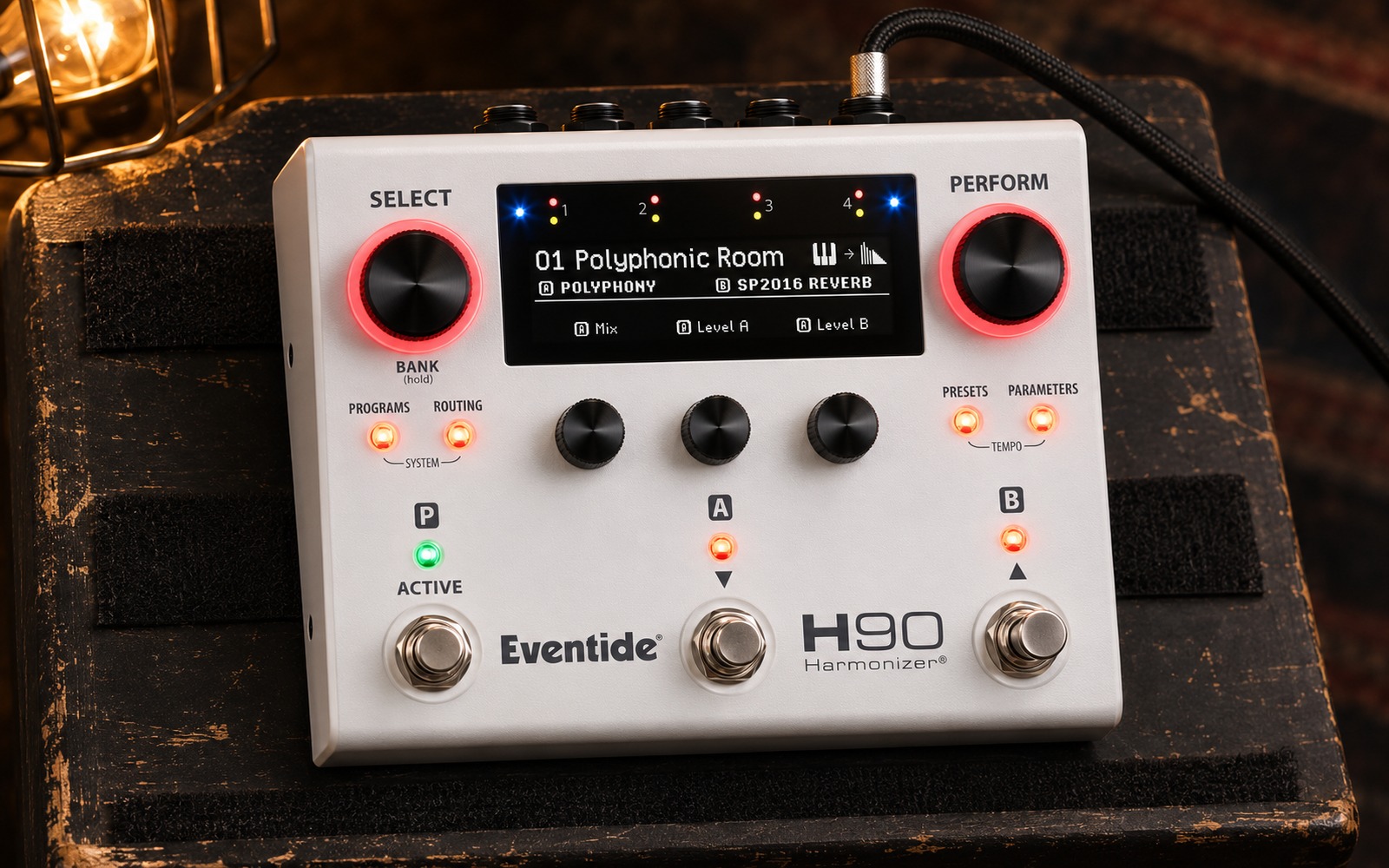
The price tag reflects that heritage: at $899, the H90 sits well above budget multi-effects territory. What justifies that number isn’t the build quality alone (though the enclosure is solid and the OLED display unusually clear for a floor unit). It’s the algorithm library — 74 professional-grade effects at launch (expanded via firmware from the original 62), a dual-engine design that runs two algorithms simultaneously, and routing flexibility that would have required a 19-inch rack and a patchbay a decade ago. This is a guide to what the H90 actually is, what it sounds like, who uses it, and whether it belongs in your rig.
Before we get into specs: this is a feature guide, not a review. GuitarGangsters doesn’t hand out star ratings. We tell you what the gear does, who plays it, what it costs new and used, and what you should know before you pull the trigger or pass.
Eventide: A Brief History of the Harmonizer
Eventide was founded in 1971 by recording engineer Stephen Katz, inventor Richard Factor, and businessman Orville Greene. The company grew out of Sound Exchange, a recording studio in New York City, and is today headquartered in Little Ferry, New Jersey. From the start, the mission was precision digital audio processing for professional applications — not consumer electronics, not guitar boutique, but broadcast and recording infrastructure.
The H910 Harmonizer arrived in 1975 and changed what was possible in the recording studio overnight. It was the world’s first commercially available digital pitch-shifting unit, combining pitch change with delay and feedback and offering a two-octave range with up to 112.5 milliseconds of delay — figures that sound modest today but were genuinely uncharted territory in the mid-1970s. The Audio Engineering Society recognised it with a TECnology Hall of Fame award in 1976 (and again in 2007). AC/DC, David Bowie, and Frank Zappa were early adopters. The H910 didn’t just offer an effect; it invented a category.
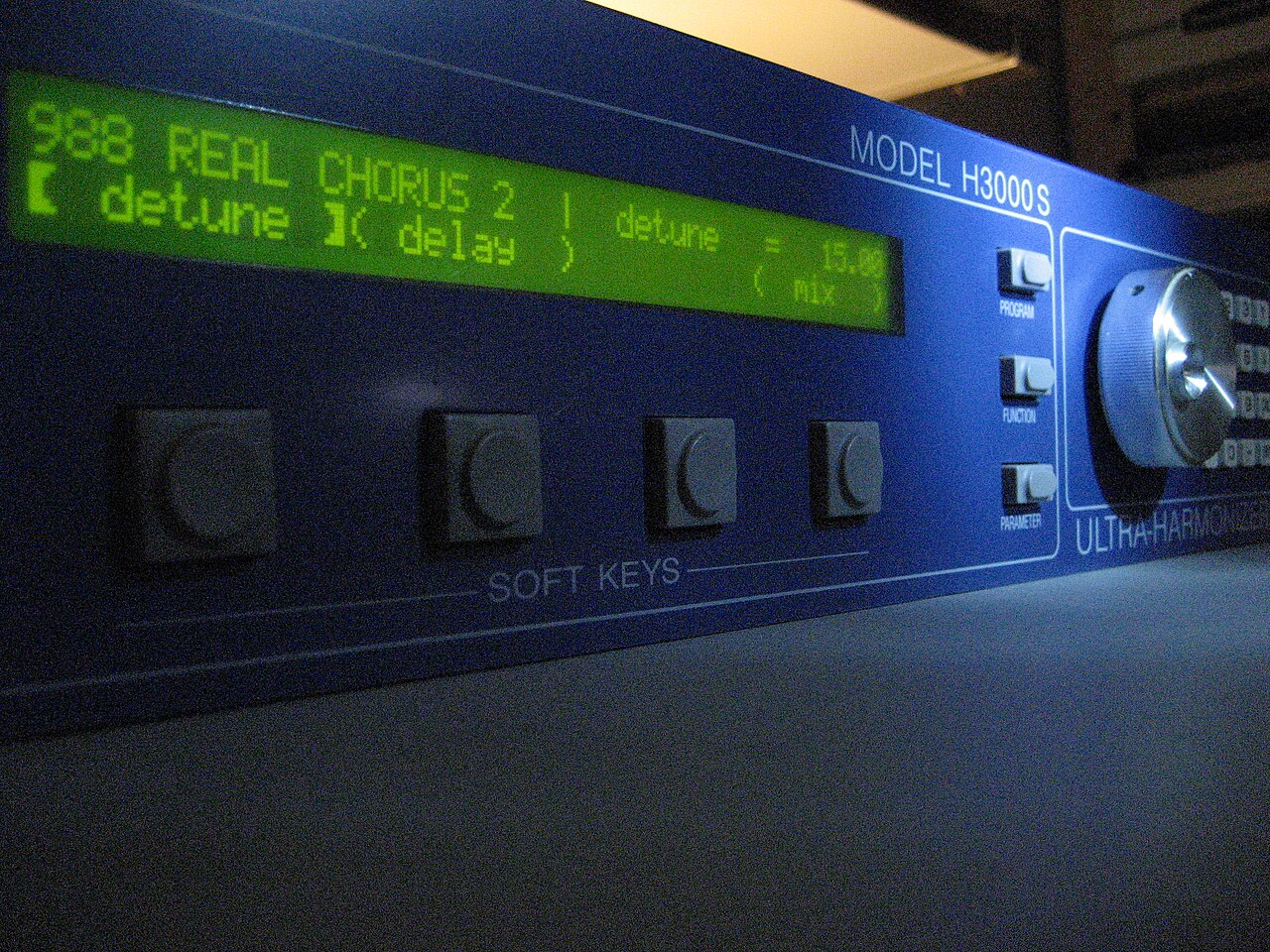
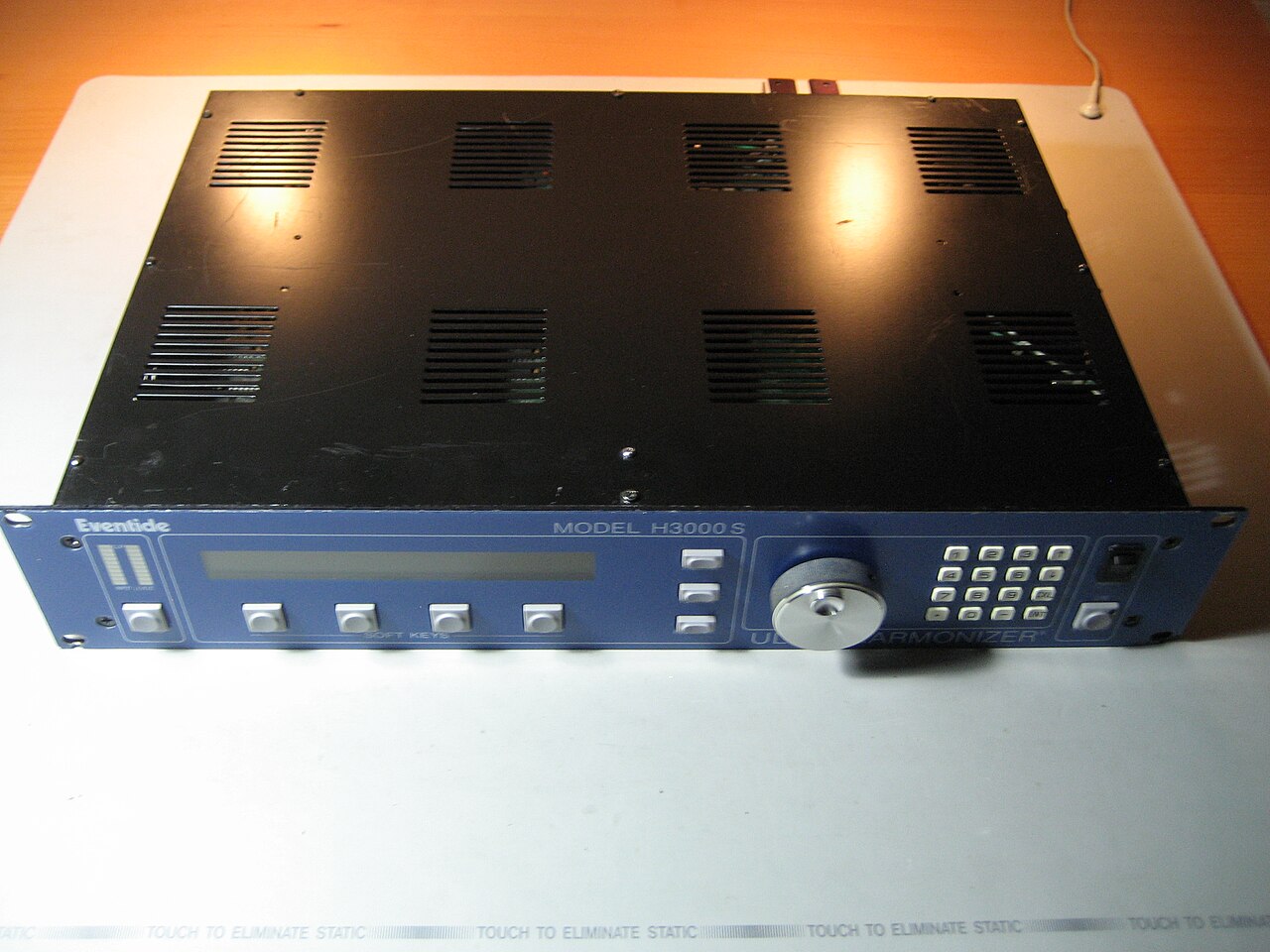
The lineage ran through the H949 (1977, which added smoother flanging and longer delay), the H3000 Ultra-Harmonizer (1986, which became a studio rack standard and found its way into Steve Vai’s studio signal chain), and the H8000 and H9000 rack processors — the latter a 16-DSP, network-ready flagship released in 2017 that remains the most powerful Eventide processor ever built. The H9 pedal (2013) was the first time the Harmonizer platform translated into a pedalboard-friendly footswitch format, and it sold in large numbers precisely because working guitarists could finally carry a pocket-sized version of the studio rack experience.
The H90, announced 10 November 2022, is the H9’s direct successor. Where the H9 ran one algorithm at a time, the H90 runs two simultaneously. Where the H9’s architecture was based on an older DSP platform, the H90 uses ARM-based processing derived from the H9000 itself. The step from H9 to H90 is roughly the step from a single-channel mixing desk to a dual-channel desk with a patchbay — same sonic DNA, fundamentally different flexibility.
Specifications
| Parameter | Specification |
|---|---|
| Price (new) | $899 USD / £999 GBP |
| Origin | China |
| Algorithms | 74 (62 at launch, expanded via firmware) |
| Engines | 2 simultaneous (per Program) |
| Routing | Series, parallel, or dual-instrument (Dual Mode) |
| Inputs | 4 × ¼” TS mono jack (Inputs 1–4) |
| Outputs | 4 × ¼” TS mono jack (Outputs 1–4) |
| Insert points | 2 × mono insert (or 1 × stereo insert), positionable anywhere in chain |
| EXP/CTL | 2 × ¼” TRS (expression pedal, 3-button aux switch, or CV) |
| MIDI | 5-pin DIN In; 5-pin DIN Out/Thru; also via USB-C |
| USB | USB-C (control, firmware updates, MIDI) |
| Footswitches | 3 in standard mode; 6 assignable in PERFORM mode |
| Controls | 5 push-turn knobs, 7 LED buttons, hi-res OLED display |
| Quick Knobs | 3 push-button knobs for assignable performance parameters |
| Bypass | Relay (true) or DSP (user-selectable) |
| Spillover | True spillover between Programs |
| Input impedance (instrument) | >600 kΩ |
| Input impedance (line) | >80 kΩ |
| Output impedance | 220 Ω |
| Max input level (instrument) | +4 dBu |
| Max input level (line) | +14 dBu |
| Power | 12V DC @ 1A, centre positive, 5.5/2.5mm jack (included) |
| Dimensions (product) | 6.5″ W × 5.25″ D × 2.5″ H / 170 × 136 × 68 mm |
| Weight | 1.85 lbs / 0.84 kg |
| Software editor | H90 Control (Mac/Windows/iPad, Bluetooth or USB-C) |
Three things in that table deserve unpacking. First, the power supply is included at this price point — a detail so rare among premium pedals that it’s worth flagging explicitly. No hunting for a 12V centre-positive supply that your existing 9V-dominated board can’t provide. Second, the 12V 1A requirement (12 watts) means the H90 won’t run from the 100mA or 250mA outputs common on budget isolated supplies — plan a dedicated output or an appropriate high-current supply. Third, the instrument-level input impedance of 600 kΩ is high enough to preserve the natural treble response of passive pickups, which matters for vintage single-coils that load down easily.
The Dual-Engine Architecture
The H90’s central design principle is the Program: every preset is two algorithms working together. You can run them in series (Algorithm A feeds into Algorithm B) or in parallel (both receive the same input and their outputs are summed). This isn’t a minor convenience — it’s the difference between a pitch shifter followed by a reverb (series, where the shifted notes bloom in the reverb’s tail) and a pitch shifter plus reverb blended together (parallel, where the dry-pitch signal and the reverb occupy separate sonic space and neither smears the other).
The Two Mono Inserts mode adds a further dimension: you can break the signal chain at any point in the H90’s internal routing and insert external pedals — your favourite overdrive before the pitch shift, for example, or a compressor between the two algorithms. In Dual Mode, the four-cable method connects the H90 in both the amp’s front input and effects loop simultaneously, letting you assign certain algorithms to the preamp chain and others to the power-amp chain. Alternatively, Dual Mode lets you process two entirely independent stereo instruments at once — useful in studio contexts where two guitarists share a recording chain.
PERFORM mode reassigns all three footswitches into six programmable buttons (each switch has both press and hold functions), with tap tempo, preset and insert bypass with momentary states, and performance parameters like reverb freeze, pitch flex, and delay repeat all mappable to any button. The HotKnob adjusts expression mappings by hand in real time. If you want to go deeper without bending down, the H90 Control app (Mac, Windows, and iPad) handles full preset editing, MIDI mapping, and firmware management over Bluetooth or USB-C.
The Algorithm Library
The H90 launched with 62 algorithms — all 52 from the H9 Max in enhanced versions, plus 10 H90 exclusives. Subsequent firmware updates have added 12 more (the four Granular algorithms: Cosmic Web, Glitch, GrainMod, and Stutter; and the four Harmonizer+ Vocal algorithms: VocalTune, VocalShift, VocalShiftMIDI, and Quadravox+), bringing the current total to 74. Eventide’s ongoing firmware support for the H90 tracks the algorithm additions it is making to the H9000 platform, so the count is likely to continue growing.
A few algorithms deserve individual attention because they explain why this pedal appears on serious rigs rather than on budget boards. The Polyphony algorithm uses Eventide’s SIFT (Spectral Instantaneous Frequency Tracking) technology to track and shift individual notes in a chord rather than treating the signal as a single pitch. The result is polyphonic pitch shifting that tracks complex chord voicings without the characteristic warbling that plagues simpler pitch-shifting approaches. It’s the algorithm most comparable to what you’d previously have needed a rack-mounted processor to achieve.
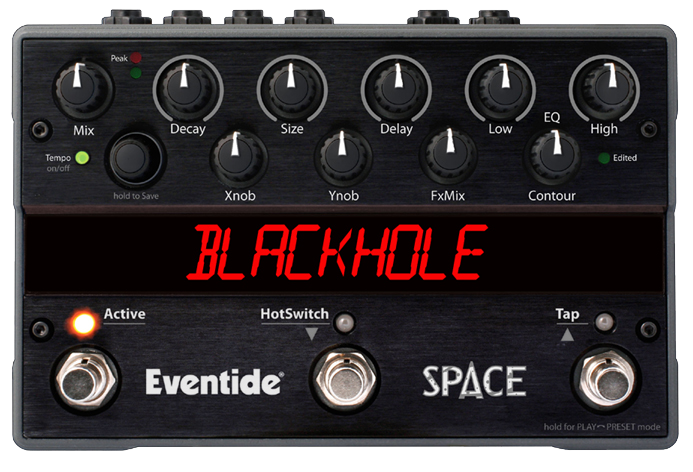
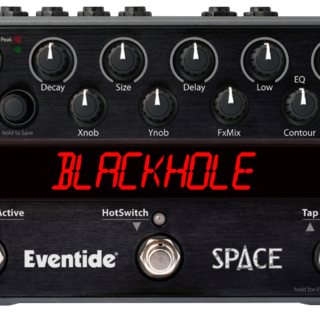
Blackhole (inherited from the H9 with enhancements) is arguably the most famous Eventide reverb: an infinite-sustain, pitch-rising reverb algorithm modelled on the concept of a sound entering a black hole and never returning. At moderate sizes it’s a massive plate reverb; at extreme settings it becomes a self-generating drone pad. WeedWacker is a Tube Screamer-style drive circuit modelled with the same precision Eventide applies to its pitch algorithms — an unusual addition to a harmonizer platform but a genuinely usable, harmonically rich distortion. The four Granular algorithms — Cosmic Web, Glitch, GrainMod, and Stutter — extend the H90 into territory more typically associated with software synthesisers and Eurorack modules, delivering blooming reverse delays, rhythmic stutters, and granular textures that morph between states unpredictably.
The H910 H949 algorithm recreates the original 1975 and 1977 harmonizer units in software, including their characteristic artifacts — the slight pitch instability, the digital roughness, the early-digital delay coloration — that are now considered the defining texture of classic 1970s and 1980s rock and pop production. Running the H910 H949 algorithm on a clean guitar into a clean amp is the fastest route to the sound of a David Bowie or AC/DC record.
Famous Players
Eventide makes a distinction worth understanding upfront: the brand has a long history across rack processors, the H9, and now the H90. When a publication or manufacturer’s website credits a guitarist as an “Eventide artist,” the specific SKU matters. A player credited with H3000 use is not necessarily an H90 user. We’ve verified only H90-specific use below.
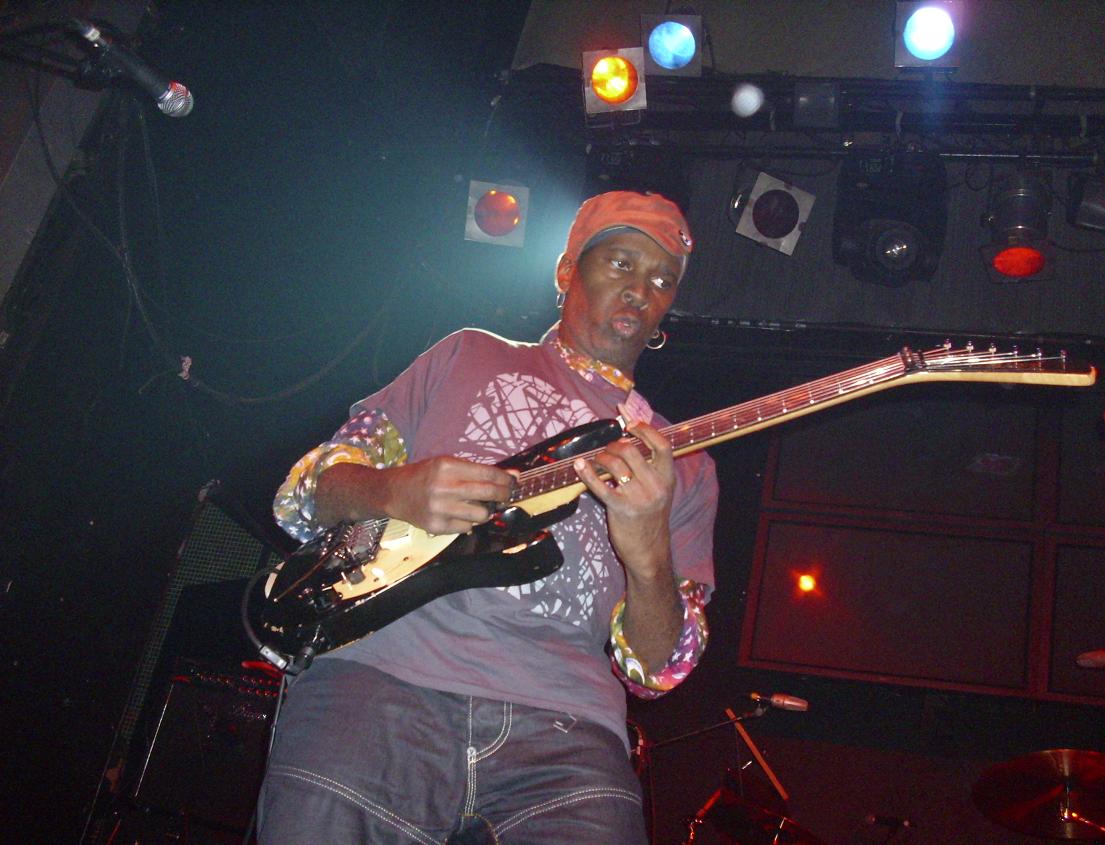
Vernon Reid (Living Colour) is confirmed on the H90 via an Instagram reel posted by user vurnt22, in which the H90 is clearly visible on Reid’s pedalboard, captioned “New Helix Backup.” Reid’s long relationship with Eventide processing — his tone on Living Colour’s recordings is built on dense, polyrhythmic pitch-shifting and harmonic layering — makes the H90 a natural fit. His use of it as a backup to a Line 6 Helix unit is itself instructive: even when the H90 is the redundant processor, it’s trusted with the whole gig if the primary unit fails.
St. Vincent (Annie Clark) runs two H90s simultaneously on her live rig, documented in a Reverb studio tour video and independently confirmed in gear rundown coverage. Two units gives her access to four independent algorithm slots — in effect, four processors routing at once — with synth-like sounds, tremolos, delays, and reverbs all programmed per-song and ready to recall with a footswitch. Clark is exactly the kind of technically precise guitarist for whom the H90’s complexity is a feature rather than a barrier; her live rigs have historically involved extensive signal routing that most guitarists would find dauntingly complex.
Ed O’Brien (Radiohead) uses the H90 on his pedalboard, documented in video footage where the unit is visible at the 23-second mark in a board walkthrough. O’Brien’s Radiohead work involved extensive studio-processed guitar — the diffuse, shimmer-heavy textures of Kid A and Amnesiac were partly created by rack-mounted Eventide processing — so the H90 represents a live-format continuation of a studio relationship the band had with Eventide for decades.
Steve Vai’s documented Eventide unit in his studio rig is the H3000-D/SX UltraHarmonizer, confirmed via Equipboard with studio photography. His long-standing relationship with Eventide harmonizers dates to the Passion and Warfare era (1990), but that relationship is specifically with the H3000 family, not the H90. No rig rundown, pedalboard photo, or verified interview places Vai on an H90 specifically. John Petrucci‘s 2024 rig is Fractal Audio-centric; no primary source places him on an H90. Reeves Gabrels has used Eventide gear — the 3500 Harmonizer for a PBS soundtrack session — but no H90-specific documentation exists. These are all named in the context of brand-level association, not SKU-level confirmation.
Beyond the three confirmed players above, Equipboard documents 34 pro artists using the H90 across genres. The platform is genuinely broad: ambient and experimental guitarists, session players, live touring players who need complex effect combinations in a compact package. It is not a pedal defined by a single genre or a single famous name.
Tone Recipes
1. Classic Detune Chorus (H910 H949 Algorithm)
Load H910 H949 in the first engine slot. Set pitch to -7 cents on voice 1, +7 cents on voice 2, with delay times of 12ms and 18ms respectively. Output blend to 40% wet. Run the second slot empty or with a light plate reverb (SP2016 Reverb, Small Room preset). This recreates the 1970s and 1980s studio wide-guitar technique: not a true chorus (no modulation), but a natural-sounding doubling caused by the subtle pitch variance. Single-coil Strat or Tele, clean Fender amp, medium picking attack.
2. Polyphonic Harmony (Polyphony Algorithm)
Load Polyphony in Engine 1. Set the scale to major, harmony interval to a third above (major third), mix at 60% wet. Run Engine 2 with a Digital Delay at 250ms, 20% feedback, 25% mix, set in series after the Polyphony. The harmoniser tracks chord shapes correctly; the delayed tail creates a sense of space around the harmonised line. Works best with moderate output humbucker, amp breakup rather than pedal distortion — high-gain signals confuse pitch tracking in any harmoniser.
3. Shimmer Cloud (Blackhole + Polyphony, Parallel)
Set routing to parallel. Engine 1: Blackhole reverb, large size (7/10), feedback 60%, gravity at maximum, mix 100% wet. Engine 2: Polyphony, fifth interval above, mix 35% wet. Blend parallel outs 60% Engine 1 / 40% Engine 2. Volume swells into the shimmer — play a chord, kill the attack with your volume knob or a volume pedal, then open the volume and let the Blackhole bloom. The Polyphony underneath adds the “choir of harmonics” quality. This is the sound of Ed O’Brien-era Radiohead ambient passages, achievable live in a single footswitch click.
4. Glitch Texture (Glitch Algorithm + Wormhole)
Engine 1: Glitch. Rate slow (3/10), Depth moderate, Feedback 40%. Engine 2: Wormhole reverb, size large, mix 50% wet. Run in series, Glitch into Wormhole. The Glitch algorithm introduces rhythmic digital stutters whose tempo tracks to the tap tempo button; the Wormhole spreads them into a cavernous, pitch-shifted reverb haze. Most effective for single-note sustaining lines and slow arpeggios — dense chords muddy the Glitch’s rhythmic articulation. St. Vincent territory: experimental, rhythmically precise, texturally dense.
5. Tight Stage Harmonist (Diatonic Pitch + ModEchoVerb, Series)
Engine 1: Diatonic pitch shifter, set to the key and mode of the song, third above, no detune, mix 50% wet. Engine 2: ModEchoVerb — delay 120ms, feedback 25%, modulation depth 15%, reverb size small, mix 25% wet. Series, Diatonic first. This is a working gigging setup, not a textural experiment. The diatonic shift provides clean melodic harmonies that follow the key; the ModEchoVerb adds a sense of space without masking the dry signal or the harmony line. Set the expression pedal to control the diatonic pitch mix — zero for rhythm passages, 50% for lead sections.
Positioning the H90 in Your Signal Chain
The H90’s flexibility is also its main decision point: where does it go? For pitch-shifting and harmoniser algorithms, the traditional position is early in the chain — after tuner and wah, before drive pedals — so that the pitch detector receives a clean, unambiguous signal. Drive pedals add harmonics that interfere with pitch tracking; harmonisers before drive means the shifted signal is then driven, which often sounds better than driving first and shifting the distorted result.
Reverb and delay algorithms, by contrast, traditionally live at the end of the chain or in the effects loop of an amplifier (post-preamp). The H90 addresses this with its insert-loop architecture: you can configure the signal flow so that the H90’s first algorithm slot operates early in the chain (pitch-related), external pedals run through the insert loops in the middle, and the H90’s second algorithm slot acts as an effects-loop unit for reverb and delay. This four-cable-method setup — guitar to H90 Input 1, H90 Output 1 to amp input, amp send to H90 Input 2, H90 Output 2 to amp return — is documented in the manual and is the professional standard for players who want modulation and pitch in the front, reverb and delay in the loop, from a single pedal.
Power supply planning: 12V 1A at the 5.5/2.5mm centre-positive jack. The included supply works reliably, but if you want the H90 on a powered board, ensure your supply has a 12V output rated at 1A minimum. Cioks DC7, Strymon Zuma/Ojai with 12V output, and the Walrus Audio Aetos 12V models all work. Do not run the H90 from a 9V output with a boost cable — the pedal requires 12V for its internal headroom architecture.
Comparisons
H90 vs. Line 6 Helix Floor
The Helix Floor is a complete amp-modelling ecosystem: amps, cabinets, microphones, and effects in one box at $1,499. The H90 is exclusively an effects processor with no amp modelling at $899. They serve different primary functions: the Helix is a amp replacement, the H90 is a best-in-class effects unit designed to work with real amps or other modellers. A significant number of professional players use both — the Helix for amp sounds, the H90 for pitch and modulation quality the Helix can’t match. Vernon Reid’s rig reportedly uses the Helix as primary, H90 as backup; that pairing is a professional workflow statement as much as a gear choice.
H90 vs. Neural DSP Quad Cortex
At $1,599, the Quad Cortex is Neural DSP’s flagship floor processor — amp modelling, capture, and effects in a touchscreen interface. Its built-in effects are competent but optimised for the platform’s amp-capture workflow rather than as standalone studio-grade processing. The H90’s algorithms, particularly Polyphony (SIFT pitch tracking), Blackhole, and the H910/H949 emulations, have no equivalent in the Quad Cortex’s effect library. Players using the Quad Cortex for amp sounds often add an H9 or H90 as a dedicated pitch and modulation processor in the effects loop.
H90 vs. Kemper Profiler Head
The Kemper Profiler captures the character of real amplifiers via analogue profiling and reproduces them with its DSP-based playback engine. Its built-in effects — including pitch, modulation, reverb, and delay — are respectable for a profiling unit. The H90’s pitch-shifting algorithms are in a different class: the Polyphony algorithm’s SIFT technology tracks polyphonic chord voicings without the artifacts that appear in Kemper’s harmoniser, and the Eventide reverb catalogue (Blackhole, SP2016, Shimmer) has decades of studio credibility behind it. The two products coexist naturally — Kemper into H90’s effects loop is a common professional setup.
H90 vs. Fractal Audio Axe-Fx III Mark II
The Axe-Fx III is a rack-mounted flagship at approximately $2,499. Its pitch-shifting algorithms are accurate, its reverbs are excellent, and its modelling is the industry reference standard. For players who already own an Axe-Fx III, the H90 adds relatively little — the Fractal covers most of the same sonic territory. Where the H90 wins is portability and pedalboard integration: the H90 runs standalone on any board without a laptop or MIDI controller infrastructure. For players who want an Axe-Fx-quality effects unit in a floor pedal, the H90 is the closest thing available.
H90 vs. Strymon Iridium
These are complementary, not competing. The Iridium ($399) is an amp modeller — Round (blackface Deluxe), Chime (Vox AC30), Punch (Plexi) — with IR cabinet loading. It has no modulation, no pitch-shifting, no reverb beyond a basic room control. The H90 has no amp modelling. Guitar into H90 for pitch and modulation, H90 into Iridium for amp simulation, Iridium to PA or audio interface: this is a DI touring rig that costs under $1,300 and sounds like a premium professional setup. Ed O’Brien’s evolving towards direct-to-PA setups; St. Vincent has used similar DI configurations with heavy effects processing before the amp stage.
Buying Guide
The H90 retails at $899 / £999 and street pricing has been stable since launch — there is minimal dealer variation on Eventide’s flagship pedal. Sweetwater, Guitar Center, and Musician’s Friend all hold the $899 price. Thomann lists it at approximately €949 in Europe. A limited-edition Dark colourway has appeared at slightly higher pricing but is circuit-identical to the standard white unit.
Used pricing on Reverb runs approximately $680–750 in excellent condition, $600–650 in good condition. The H90 was announced November 2022 and has a one-year Eventide warranty; used units from 2022 or early 2023 are now out of warranty. The firmware update history has been active and meaningful — each update has added algorithms — so confirm before buying used that the unit is on the current firmware. H90 Control software (free, Mac/Windows/iPad) connects via Bluetooth or USB-C and handles the update process cleanly.
The H9 Max (predecessor) can be found used for $280–380. It runs one algorithm at a time and has all 52 original algorithms. If you need dual-engine operation, true spillover, four-cable method with internal routing, or the new Granular and Harmonizer+ Vocal algorithms, the H90 is the only option. If you want Eventide quality for a single pitch or reverb effect and don’t need the dual-engine architecture, the H9 Max used is a more cost-efficient entry point to the same sonic heritage.
If you’re upgrading from an H9, be aware that presets are not directly transferable. The H90 Control software manages export and import but the dual-engine architecture means H9 presets load into one engine slot of an H90 Program, with the second slot empty — a starting point, not a finished sound. Budget time to rebuild your favourite H9 Programs with complementary second algorithms.
Ownership Notes
The H90 is not a plug-and-play pedal. Guitar World’s review (May 2023, Trevor Curwen) explicitly flags this: “there’s a lot to get your head around.” This is not a criticism — it’s a description of what the H90 is. A pedal offering 74 algorithms, dual-engine routing, insert loops, four-cable-method configuration, MIDI mapping, six footswitch modes, and a remote editor app cannot also be simpler than a single-algorithm stompbox. Plan two or three sessions with the manual and the H90 Control app before you commit to using it live.
The physical interface rewards study. The five push-turn knobs are contextual — what each knob does depends on which mode or parameter view is active, displayed on the OLED screen. The workflow is more similar to a hardware synthesiser’s menu navigation than to a traditional effect pedal’s dedicated knob-per-parameter layout. Players with experience on the Kemper or Helix interface will find it familiar; players who have only used single-function stompboxes will need adjustment time.
Bluetooth connectivity for the H90 Control app is convenient for quick edits from a standing position on stage — open the iPad app, select a preset, adjust a parameter, save — but it requires pairing and occasional reconnection. USB-C is more reliable for sustained editing sessions. Keep both options available.
The included power supply works correctly but is bulky relative to the pedal. If you need to fit the H90 on a Pedaltrain or similar board-with-underside-mounting, consider a Cioks or Strymon high-current 12V solution mounted beneath the board and leave the Eventide supply at home as a backup.
FAQ
What is the difference between the H9 Max and the H90?
The H9 Max runs one algorithm at a time with two footswitches. The H90 runs two algorithms simultaneously (a Program) in series or parallel with three footswitches and six in PERFORM mode. The H90 also adds 22 exclusive algorithms not available on the H9 Max, ARM-based processing derived from the H9000 flagship, insert loops, Dual Mode for two independent instruments, true spillover between Programs, and H90 Control software. The H9 Max used runs $280–380; the H90 is $899 new.
Can the H90 replace an amp modeller like the Helix or Quad Cortex?
No. The H90 has no amp modelling or cabinet simulation. It is a pure effects processor. It can work alongside any amp modeller (in its effects loop) or with a real amplifier (front-of-chain or four-cable method). Players who want effects-only quality alongside a preferred modeller will find the H90 the strongest effects-only pedal at its price.
Does the H90 do polyphonic pitch shifting?
Yes. The Polyphony algorithm uses Eventide’s SIFT (Spectral Instantaneous Frequency Tracking) technology to track and shift individual notes within a chord independently. It is significantly more accurate on complex voicings than standard monophonic-detection pitch shifting. Clean input signal improves tracking — heavy distortion before the pitch processor degrades accuracy in all pitch-shifting systems.
What power supply does the H90 need?
12V DC at 1 amp, centre positive, 5.5/2.5mm jack. The supply is included. Ensure any board-mounted supply has a 12V 1A output — the H90 will not run from the 9V outputs that power most standard stompboxes, and a voltage converter cable is not recommended. Total power draw at 12V is 12 watts.
Is the H90 Control app required?
No, but it makes complex programming dramatically faster. All parameters are accessible from the front panel. The app (Mac, Windows, iPad, free) is necessary for preset management across a large library, visual MIDI mapping, and firmware updates. For live players who programme rigs before the gig and don’t edit mid-set, the app is a studio tool rather than a performance dependency.
What is Dual Mode?
Dual Mode repurposes the H90’s four inputs and four outputs to handle two independent stereo signals at once. In a guitar context, the most useful application is the four-cable method: guitar to H90 Input 1, H90 Output 1 to amp input, amp send to H90 Input 2, H90 Output 2 to amp return. This routes pitch and modulation algorithms through the amp’s preamp (Engine 1) and reverb and delay through the effects loop (Engine 2) — all from a single pedal.
How many factory presets does the H90 come with?
Hundreds, organised into curated Playlists. The factory Programs cover conventional combinations (drive plus delay, modulation plus reverb) and more experimental territory (Granular textures, Harmonizer+ vocal processing). Eventide and user communities share additional Playlists through the H90 Control software’s preset-sharing infrastructure. The breadth means most players start by loading a factory Playlist closest to their genre and editing from there rather than building Programs from a blank slate.
Will Eventide continue to add algorithms to the H90?
Eventide’s firmware history for the H90 — the original 62 algorithms at launch expanded to 74 by mid-2026 — strongly suggests ongoing development. The H90 platform is architecturally derived from the H9000, and Eventide has stated that the ARM-based architecture was chosen specifically to allow algorithm development to continue. No end-of-life date has been announced for H90 firmware support.
Image credits
- Top image: GuitarGangsters AI-generated reference illustration, not a photograph.
- An Eventide H3000 SE Ultra-Harmonizer seen from the side: John R. Southern, Wikimedia Commons, CC BY-SA 2.0.
- An Eventide H3000 SE Ultra-Harmonizer: John R. Southern, Wikimedia Commons, CC BY-SA 2.0.
- Vernon Reid: Mario, Wikimedia Commons, CC BY 2.0.
Latest News
Related
On This Day
Monday 9 November
From this week: