Eventide PitchFactor: Fifty Years of Harmonizer Squeezed Into a Cast Metal Box
The Eventide PitchFactor packs ten classic harmonizer algorithms into a pedal. Crystals, MicroPitch, verified players, settings and buying advice.
There is a specific sound that has been haunting rock records since 1975, and almost nobody who loves it could name the machine that made it. It is the sound of a guitar that is somehow two guitars, slightly out of step with itself. It is the sound of a note that falls when you push a pedal and keeps falling past the point where it should have stopped. It is the sound of a clean arpeggio that answers itself backwards, an octave up, from somewhere behind the drum kit.
That machine is the Eventide Harmonizer, and for most of its life it lived in a rack, in a studio, behind a locked door, owned by someone who was not you.
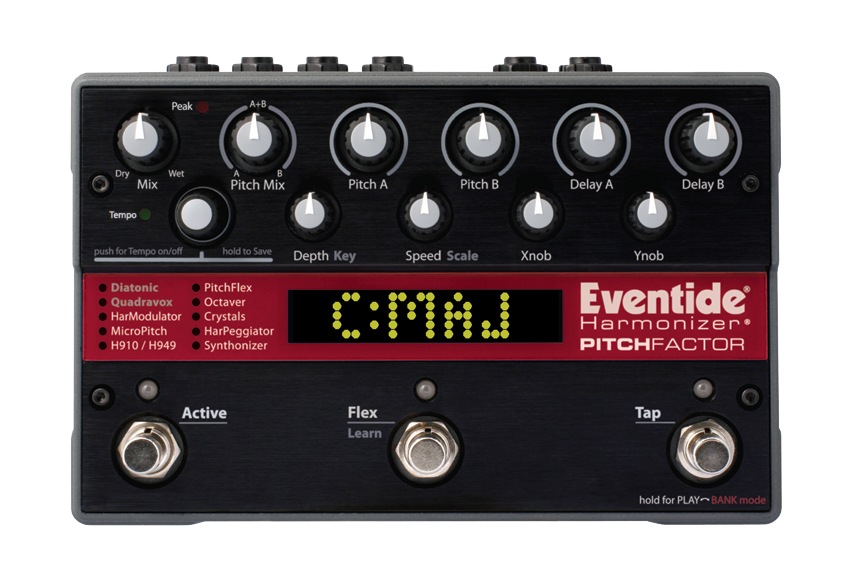
The Eventide PitchFactor is the moment that changed. Released in 2009 as the third pedal in Eventide’s Factor Series, it took ten of the company’s signature pitch and delay algorithms — some of them literal ports of effects that had been running on six-figure rack processors — and put them on the floor, under a boot, for the price of a decent boutique overdrive stack. Seventeen years later it is still in the catalogue at $499, still on professional pedalboards, and still one of the least understood pedals in the format.
This is a feature, not a review. What follows is what the PitchFactor actually is, where its algorithms came from, who has genuinely been documented using one, how to make it do specific jobs, and what you are getting into if you buy one.
The Short Version
Where the PitchFactor Came From
Eventide is not a guitar company. That single fact explains almost everything odd about this pedal.
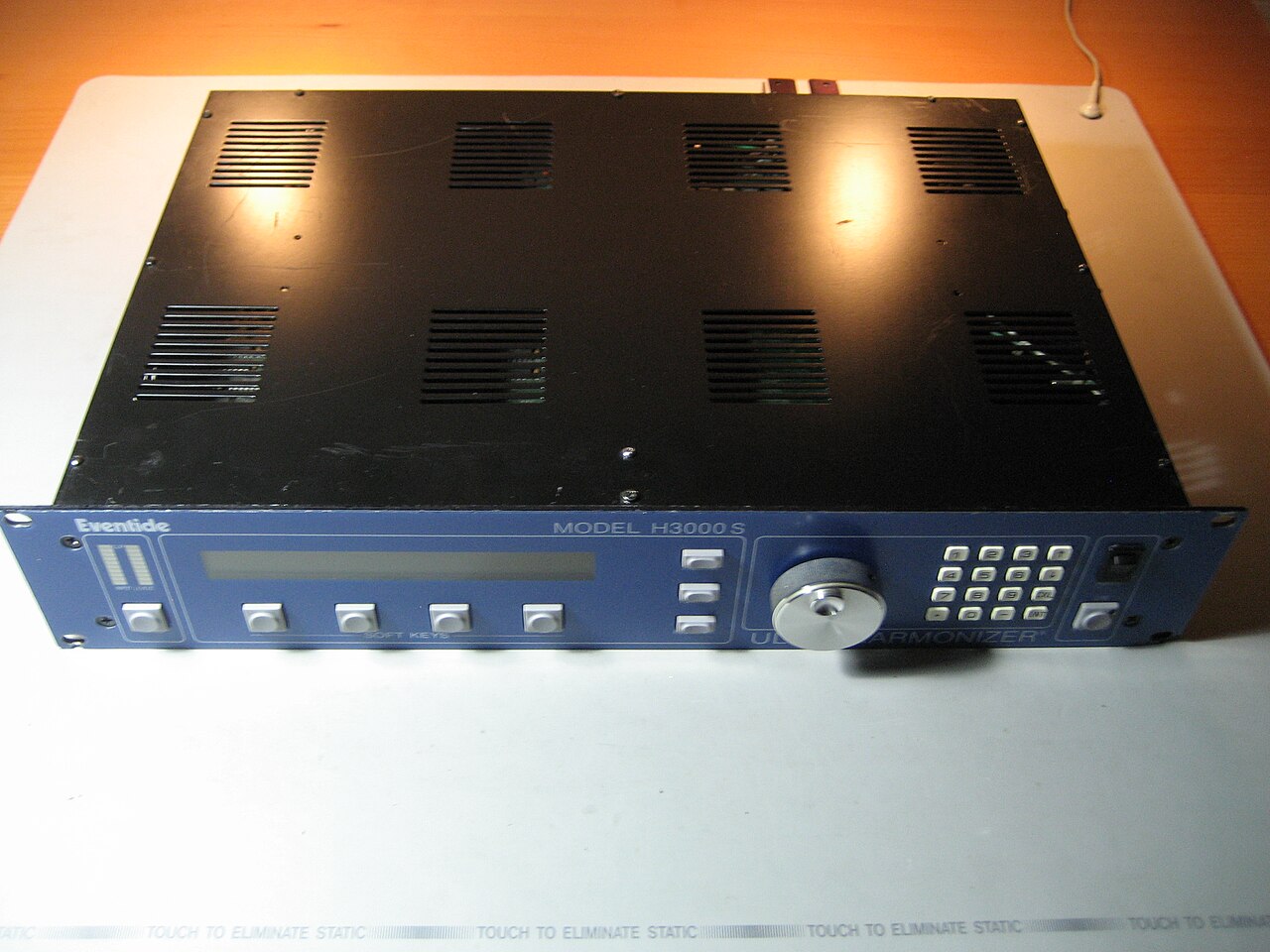
The company was founded in New York in 1971 and made its name in broadcast and studio hardware. In 1975 it shipped the H910 Harmonizer, the first commercially successful digital pitch shifter, and in doing so invented a category. The H949 followed, then the H3000 in 1986, then the DSP4000, the Eclipse and the H8000. These were rack units. They lived in machine rooms. If you heard one on a record in 1988, it was because a producer owned it, not because the guitarist did.
For roughly three decades, that was the entire relationship between Eventide and the guitar-playing public: you loved the sound, you could not have the box.
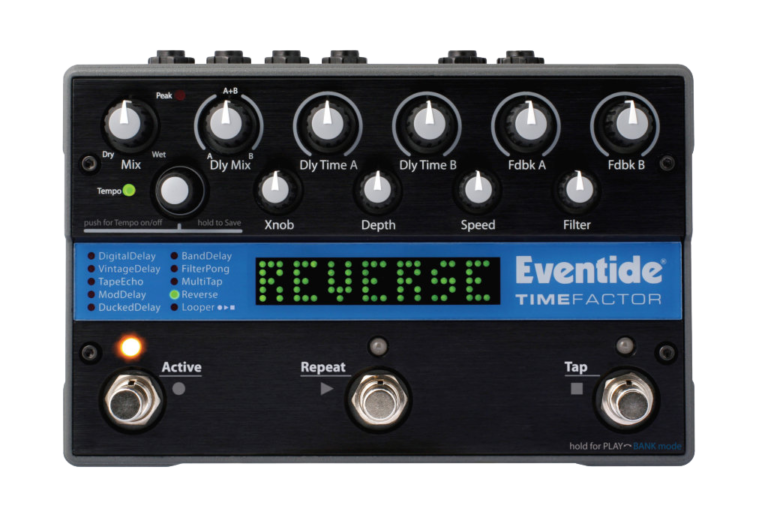
In 2007 Eventide changed strategy and launched the Factor Series — cast metal floor units with three footswitches, eleven knobs and a retro eight-character LED display, each one carving a slice of the company’s rack legacy into a pedalboard-sized package. TimeFactor came first, in 2007, for delay. ModFactor followed with modulation. PitchFactor arrived in 2009 carrying the harmonizer material — the crown jewels, the thing Eventide is actually famous for. Space completed the family in 2011 with reverb.
Sound On Sound’s Paul White reviewed the ModFactor and PitchFactor together in the October 2009 issue and put the situation plainly: “Despite the pedal format, the ‘Factor’ series makes use of algorithms drawn from Eventide’s best effects from their 36 years in the business.” Premier Guitar’s reviewer, writing in September 2009, was blunter still, calling the PitchFactor “an Eventide for the rest of us” and scoring it 4.5 out of 5 at a $499 street price.
That $499 figure is worth sitting with for a second. It has not changed. In 2026 the PitchFactor is still listed on Eventide’s own site at $499, which means that in real terms, adjusted for seventeen years of inflation, the pedal is roughly half the price it was at launch. Almost nothing else on a modern pedalboard can make that claim.
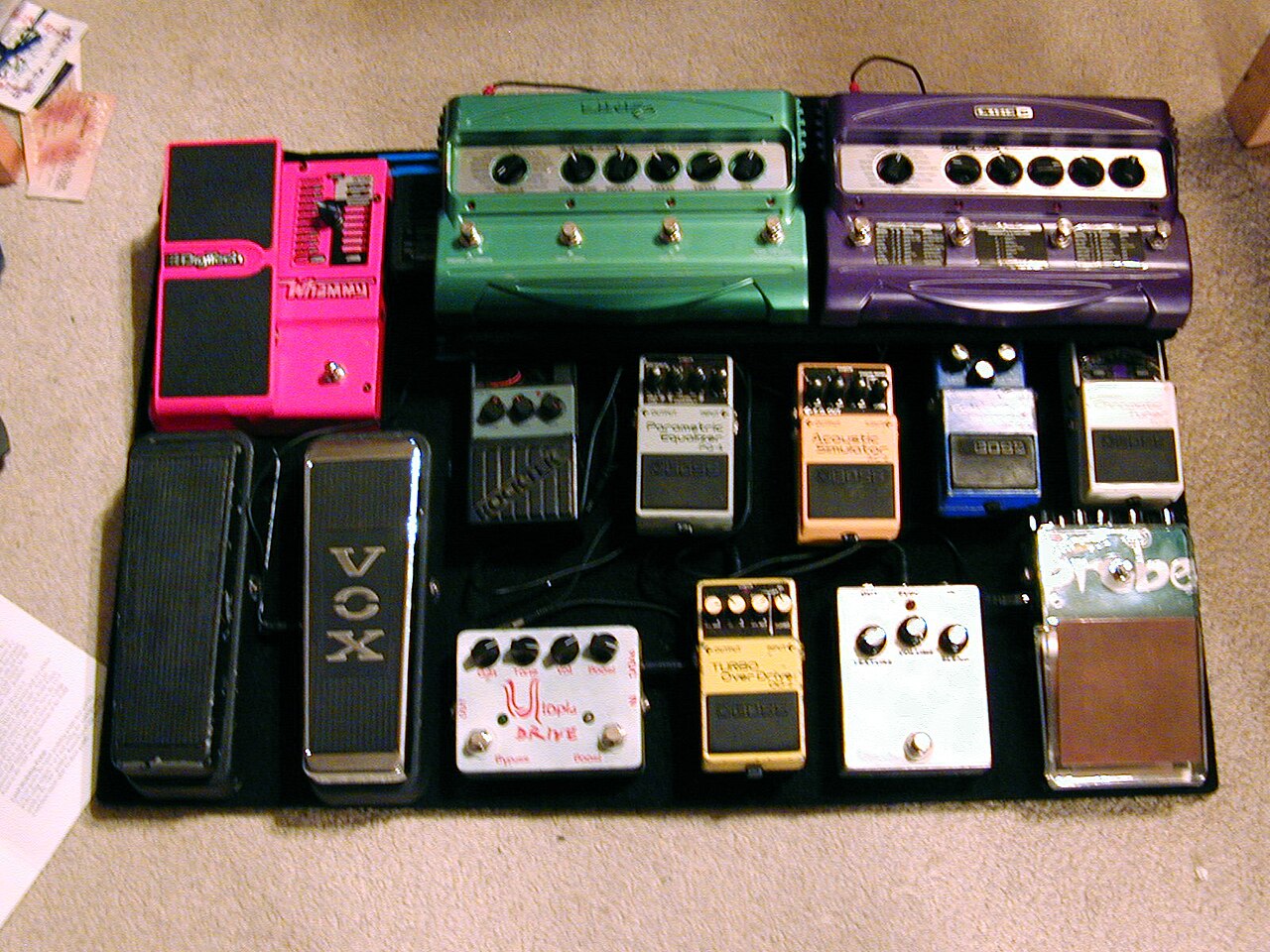
The Ten Algorithms, One at a Time
The PitchFactor is not one pedal. It is ten, and the mistake most people make is buying it for one of them and never finding out about the other nine. Here is what each one actually does.
Diatonic
The classic intelligent harmonizer. You tell the pedal a key and a scale, you tell it what intervals you want, and it generates up to two harmony voices that stay musically correct as you move around the neck. Each harmony voice can have its own delay time, which is the detail that turns “harmonizer” into “arranger” — a third above with 90 ms of delay is a completely different musical event from a third above in perfect unison.
The scale can also be learned from a chord you play, with the chord name appearing in the display. That is a nice piece of design and it works better than you would expect. It does not work perfectly, and Premier Guitar’s reviewer flagged exactly that in 2009: playing a melody in G major, the pedal would occasionally be unsure whether to hand back a major or a minor third, and would sometimes switch its mind mid-note. This is a limitation of monophonic pitch tracking in general rather than a PitchFactor defect, and every intelligent harmonizer ever made has some version of it.
Quadravox
Diatonic with four voices instead of two, plus rhythmic pattern control on one of the delay knobs. This is where the pedal stops sounding like a guitar effect and starts sounding like an arrangement. Four diatonic voices, each with its own delay, played from a single note, is functionally a string section that follows your fingers.
Premier Guitar’s review included an audio example labelled “Harmonizing Brian May style” recorded entirely with Quadravox from a single guitar pass, no overdubs. That is the right reference point — Brian May‘s famous stacked-harmony guitar orchestras were built by multitracking a Red Special through a Deacy amp, one part at a time, over hours. Quadravox does an approximation of it live. It is not the same thing and it does not sound identical, but the fact that the comparison is even in the conversation tells you what this algorithm is for.
Octaver
An octave down and a second voice two octaves down, combined with fuzz and a resonant filter, and the filter can be driven by the envelope of your picking. That last part is the interesting bit. This is not a clean sub-octave in the Nano POG sense — it is an octave effect designed to sound like a synthesiser, and if you want a transparent, invisible octave-down for thickening riffs, this is the wrong tool and a dedicated polyphonic octaver is the right one.
HarModulator
Two chromatic pitch shifters with modulation applied to the shift amount, covering plus or minus three octaves in semitone steps. Modulation sources include the input envelope. Set it subtly and you get seasick detune; set it to extremes and you get sounds that have no business coming out of a guitar amplifier. This is the algorithm most likely to make a guitarist who bought the pedal for harmonies suddenly understand what else it is for.
Crystals
Twin reverse pitch shifters with delay, feedback and reverb. This is the signature. If you have heard one PitchFactor sound in the wild without knowing what it was, it was probably Crystals.
The effect is hard to describe and instantly recognisable: fragments of what you played come back reversed, shifted, blurred into a shimmering cloud that sits behind the dry signal. Sound On Sound’s Paul White — a reviewer who opened his assessment by admitting “I’m not a big fan of pitch-shift effects” — singled out Crystals and MicroPitch as the two he loved.
The historical reference here is Steve Vai‘s Passion and Warfare, which Premier Guitar described as serving “pretty much as a demo CD for the Eventide Harmonizer.” That record was made with rack Eventides, not a PitchFactor — but Crystals is the algorithm that gets you closest to that world from a pedalboard.
MicroPitch
Fine-resolution detuning: two voices, a few cents apart, each with independent short delay times. On paper it is the least exciting thing in the box. In practice it is the most used.
MicroPitch is the tone-fattening trick that made Eventide famous with guitarists in the first place. Premier Guitar’s 2009 description remains the best one: with MicroPitch dialled in you get “Eddie in a box,” very close to Hagar-era Van Halen. Eddie Van Halen was, famously, an early and enthusiastic Harmonizer user, and the reason so many 1980s guitar tones sound impossibly wide is a few cents of detune with a handful of milliseconds of delay on each side of the stereo field.

Eventide has since spun MicroPitch out into its own standalone mini pedal, which tells you exactly how much of the PitchFactor’s real-world use is this one algorithm.
HarPeggiator
A dual 16-step sequencer running pitch, rhythm and effect patterns simultaneously, drawing on a library of pre-programmed sequences with 26 pitch options plus a random setting, syncable to tap tempo or MIDI clock. Sound On Sound’s summary is perfect: “If you want to be transported back to the Tangerine Dream days, but play guitar rather than keyboard, this will get you close.”
It is the most polarising thing in the pedal. It is also the algorithm that has kept the PitchFactor on experimental pedalboards for seventeen years while more conventional pitch pedals have come and gone.
H910/H949
A direct emulation of the 1975 H910 and its successor the H949, with longer delay times than the originals allowed. The H910 was, by modern standards, not a very good pitch shifter — it glitched, it warbled, it did strange things at the edges. That is precisely why it is worth having. Its imperfections are a recognisable musical texture, and a modern, perfectly-tracking pitch shifter cannot produce them.
You can also wrap feedback around the shifter for pitch-spiralling effects that run away up or down into infinity, which is a documented studio trick going back to the original units.
PitchFlex
Foot-controlled pitch glides with one or two voices — whammy-style bends, but with control over the glide time in both directions via the two delay knobs. It needs an expression pedal to work properly, or the Flex footswitch if you want fixed-speed dives rather than continuous control.
This is the algorithm most directly comparable to a DigiTech Whammy, and it is worth being clear that in a straight head-to-head as a whammy, the Whammy is the better dedicated tool. What PitchFlex offers is two independently-timed glide voices and the ability to sit in a preset next to nine other algorithms.
Synthonizer
Tracks a monophonic input and synthesises an entirely new waveform from it, processed additively or subtractively, with a filter, a reverb and an adjustable envelope attack. It produces analog-style synth leads, organ tones and theremin sounds. Sound On Sound’s verdict — “Although Moog geeks may not be fooled, you can produce some great sounds” — is honest and still accurate.
If you want convincing instrument emulation, an EHX MEL9 or B9 does a more literal job. Synthonizer is for sounds that are recognisably synthetic rather than sounds that pretend to be a Mellotron.
Controls and Workflow
Ten knobs plus a rotary encoder, three footswitches, an eight-character LED display. The knob layout is Mix, Pitch Mix, Pitch A, Pitch B, Delay A, Delay B, Depth/Key, Speed/Scale, XKnob and YKnob, with the encoder stepping through the ten algorithms and doubling as a push-button for saving and tempo functions.
The footswitches operate in two modes. In Play mode they handle bypass, the algorithm-specific “flex” function and tap tempo. Hold the tap switch for a couple of seconds and they become bank and preset selectors. Presets are organised in banks of two — 50 banks, 100 presets — but the pedal ships with only the first 20 presets enabled, and enabling the rest requires a trip into the manual. This catches out a great many new owners who conclude the pedal has 20 presets.
Three things are worth knowing before you buy:
- The expression pedal is not optional. Every factory preset already has expression assignments mapped, and a large fraction of what makes this pedal expressive is under your foot rather than under your fingers. Budget for one.
- The tuner requires a two-footswitch press. Middle and right simultaneously. Premier Guitar flagged this in 2009 as awkward on a dark stage, and it still is. If you already run a Boss TU-3 or a PolyTune 3 Mini, keep it.
- The jacks are on the wrong side. The PitchFactor’s inputs are on the left, opposite to almost every other pedal on the market. On a tightly-packed board this means longer, crossing cables. It is a genuine annoyance and there is no way around it.
Later in the pedal’s life Eventide added Eventide Control, a desktop application that connects over the USB port and gives you every parameter, firmware updates, preset management, MIDI configuration and full backup and restore. If you are buying a PitchFactor in 2026, install it on day one. It converts the pedal from a device you programme by holding buttons into a device you programme with a mouse, and it is free.
Who Actually Uses One
This is the section where gear articles usually go wrong, so a note on method: everything below is drawn either from Eventide’s own artist gallery, from published Premier Guitar Rig Rundowns, or from dated interviews. Where a connection is to the Harmonizer lineage rather than this specific pedal, that is stated.
Documented PitchFactor users
Vernon Reid (Living Colour) is the strongest case. Premier Guitar’s 2016 Rig Rundown documents a PitchFactor on his main board alongside an Eventide H9, a modded Line 6 M9, a Roland FC-300 MIDI controller and a Mission Engineering Expressionator. Reid is also listed in Eventide’s own artist materials. If you want to hear what a PitchFactor sounds like in the hands of somebody who treats pitch shifting as a compositional tool rather than a garnish, start there.
St. Vincent appears in Eventide’s official “Artists Using PitchFactor” gallery, and named the pedal herself in a 2012 interview with The Lab Magazine, describing two Eventides on her board — a PitchFactor and a Space. Given how much of her guitar identity is built on sounds that are recognisably processed but not recognisably any standard effect, this is one of the more instructive usages to study.
Nick Zinner (Yeah Yeah Yeahs) runs a PitchFactor on his third pedalboard, documented by Premier Guitar, alongside a second Line 6 DL4, a TimeFactor and a Space — effectively the whole Factor Series plus reverb.
Will Swan (Dance Gavin Dance) has used a PitchFactor since at least 2015’s Instant Gratification, per Premier Guitar’s Rig Rundown, which describes it as one of his most heavily used pedals.
Dave Harrington (Darkside) runs one on a board that also contains an Eventide H90, a Chase Bliss Habit, a Hologram Microcosm and two HexeFX reVOLVERs — which is to say, on a board where the PitchFactor is not even the strangest thing present, it still earns its space.
Bradford Cox (Deerhunter / Atlas Sound) has a documented PitchFactor associated with the Halcyon Digest material.
Eventide’s own gallery additionally lists Dave Weiner (Steve Vai’s band), Chris Carter (Throbbing Gristle, Chris & Cosey), Angel Deradoorian (Dirty Projectors), John Konesky (Tenacious D), Young the Giant, Dan Wiese (Kill Hannah), Joe Andreoli (Giraffes? Giraffes!), Joe Berger, Aaron Janik, Derrick “Hott Soss” Cummings and Brien Brannigan.
The names that belong to the lineage, not the pedal
Be careful here, because a lot of writing about the PitchFactor blurs this line.
Eddie Van Halen, Steve Vai and Brian May are all invoked constantly in PitchFactor discussion — including in Premier Guitar’s own review, which frames the pedal as covering everything “from Van Halen to Brian May.” That framing is about sounds, not about ownership. Van Halen and Vai are documented Eventide rack users from the era of the H910, H949 and H3000; the PitchFactor reproduces effects they helped make famous. May’s harmony-guitar approach predates digital harmonizers entirely and was built with multitracking. None of the three is a documented PitchFactor user, and any article that implies otherwise is selling you something.
The same applies to the broader Eventide artist roster. Eventide has a very large artist list spanning rack units, plug-ins, the H9 and the H90, and names get recycled between product pages with alarming freedom. The list above is limited to what could be tied to this pedal.
Tone Recipes
Eddie in a Box (MicroPitch)
MicroPitch. Pitch A around +9 cents, Pitch B around −9 cents. Delay A about 12 ms, Delay B about 22 ms. Mix around 40 percent. Run it in stereo into two amps if you possibly can — the entire effect depends on the two voices arriving from different places. In mono it is a thickener; in stereo it is a wall.
The Vai Cloud (Crystals)
Crystals. Pitch A +12 semitones, Pitch B −12 semitones. Long delay times on both, feedback around 40 percent, reverb generous, Mix around 30 percent. Play sparse, clean, slow arpeggios and let the pedal answer you. Push feedback higher and it stops being an effect and becomes a drone generator.
Live Harmony Rig (Diatonic)
Diatonic. Set key and scale for the song. Pitch A to a third above, Pitch B off, Delay A at zero, Mix around 45 percent so the harmony sits under the melody rather than fighting it. Assign Mix to the expression pedal so you can pull the harmony in and out by foot rather than committing to it for eight bars.
Guitar Orchestra (Quadravox)
Quadravox. Four diatonic voices at third, fifth, octave and tenth. Stagger the delays — roughly 0, 20, 45 and 70 ms — so the voices enter as an arpeggiated swell rather than a block chord. Mix around 50 percent. Play single-note lines only; this algorithm does not want chords.
Whammy Dive (PitchFlex)
PitchFlex, expression pedal connected. Single voice, range set to −24 semitones. Set the glide-down time short and the glide-up time longer, so dives are violent and returns are lazy. That asymmetry is what makes it sound intentional rather than mechanical.
Broken Machine (H910/H949)
H910/H949 mode. Small shift amounts — a few cents off unison — with feedback around 50 percent and a short delay. Let the glitching happen. This is a texture, not a tuning correction, and the moment it sounds clean you have gone too far.
Synth Bass Riff (Octaver)
Octaver with the fuzz engaged, filter resonance high, filter modulation driven by input envelope. Play low, play hard, palm-mute. Mix around 70 percent so the synthetic voice leads. This one sits beautifully in front of a clean amp and terribly in front of a distorted one.
Tangerine Dream Sequence (HarPeggiator)
HarPeggiator, tempo tapped in or slaved to MIDI clock from whatever else is running the song. Start with just the rhythm sequencer and pitch sequencer off — get the rhythm right first, then bring pitch in. Mix around 60 percent. Hold one chord and let the machine do the playing.
Starting points, not gospel. Every one of these assumes you will move the Mix knob until it sits right in your own rig.
Where It Goes in the Chain
Standard placement is late — after drive, before or in parallel with your time-based effects. Pitch tracking is dramatically more accurate on a signal that has not been through a fuzz first, so if you use Diatonic or Quadravox seriously, keep dirt out of the front end or run the pedal in an amp’s effects loop.
The switchable guitar/line input and amp/line output sensitivity is the feature that makes this practical. A PitchFactor is as happy in a studio insert or in front of a desk as it is on a board, which is unusual and is a direct consequence of Eventide being a studio company that wandered into pedals rather than the other way round.
If you are stacking it with other time-based effects, the PitchFactor sits naturally before reverb — a Strymon BigSky, an EHX Oceans 11 or its own sibling the Space — and either before or after delay depending on whether you want pitch-shifted repeats or repeats of the pitch-shifted signal. Both are valid; they sound completely different. Try both.
Comparisons
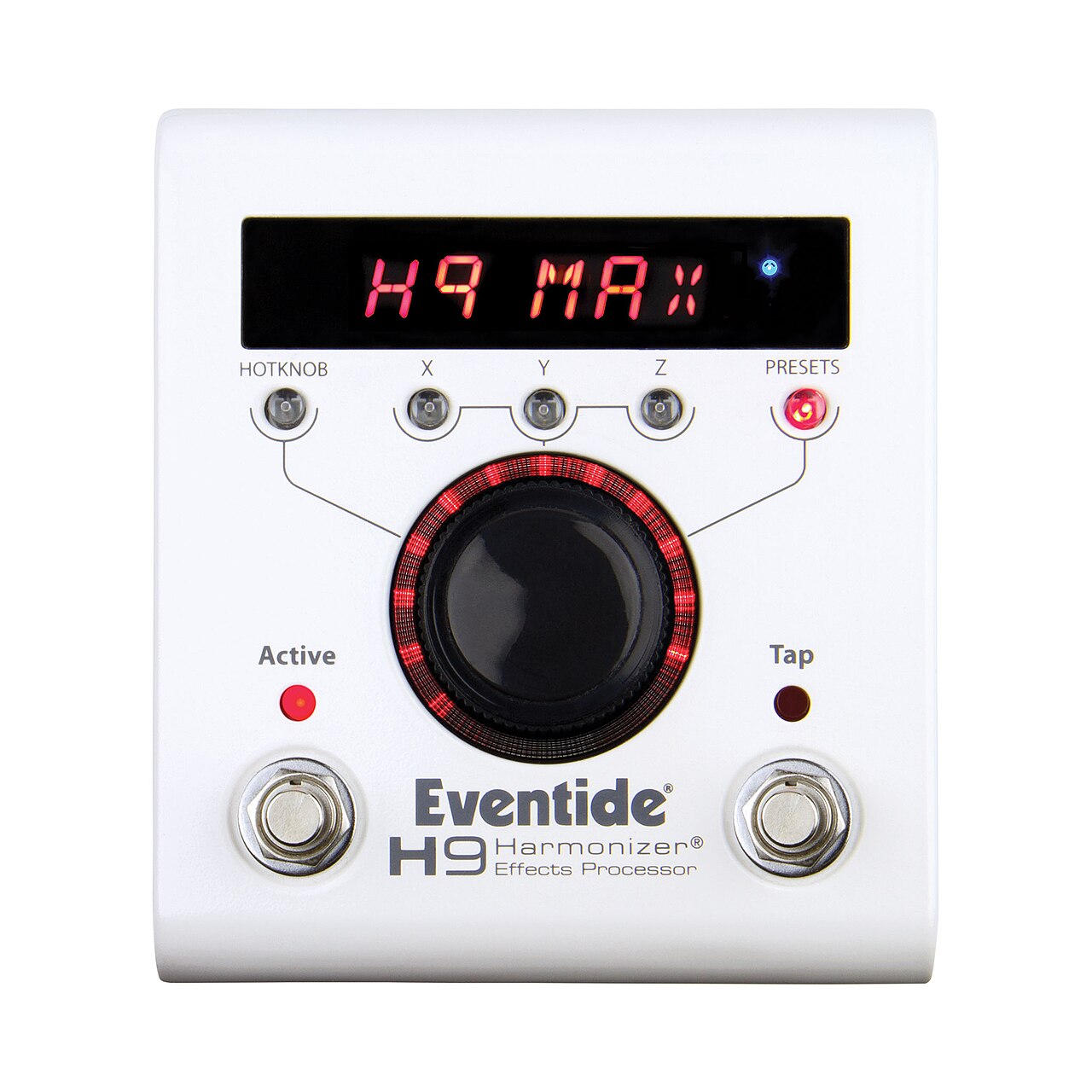
PitchFactor vs. Eventide H9
The H9 can load every PitchFactor algorithm and every algorithm from the rest of the Factor Series besides, in a much smaller box, with app control. On paper it obsoletes the PitchFactor entirely. In practice it does not, for one reason: the H9 runs one algorithm at a time and has a single knob. The PitchFactor gives you ten physical controls, all live, all the time. If you tweak while you play, that difference is the whole ballgame. If you set a preset and leave it, buy the H9.
PitchFactor vs. Eventide H90
The H90 is the modern answer to all of this — two simultaneous algorithms, better converters, far more routing, and a price roughly double the PitchFactor’s. If money is not the constraint, the H90 is the better pedal and it is not close. If money is the constraint, the PitchFactor delivers the same core algorithms at half the price with more knobs.
PitchFactor vs. DigiTech Whammy 5
The Whammy 5 is a better whammy: faster, more immediate, one job done superbly, with a treadle built in. The PitchFactor’s PitchFlex does the same job with more control over glide behaviour but needs an external expression pedal and costs three times as much. Buy the Whammy if whammy is what you want. Buy the PitchFactor if whammy is one of ten things you want.
PitchFactor vs. EHX POG2 / Pitch Fork
Different philosophies. The POG2 and Pitch Fork are polyphonic — they track chords. The PitchFactor’s intelligent harmony algorithms are monophonic and want single notes. For organ-style stacked octaves under full chords, EHX wins outright. For key-aware harmony lines and reverse-shifted clouds, the PitchFactor is in a category the EHX pedals do not enter.
PitchFactor vs. Line 6 HX One
The HX One costs a third as much and contains a very large number of effects including capable pitch algorithms. It is the sensible modern choice for a player who wants pitch shifting as one item on a long list. The PitchFactor is the choice for a player who wants Eventide’s specific pitch algorithms — Crystals and MicroPitch in particular have a character that has not been convincingly cloned.
Buying a PitchFactor in 2026
New: $499 direct from Eventide, with free ground shipping, a one-year warranty and 30-day returns. It remains a current product, which after seventeen years is remarkable and means firmware support and spare parts are not a gamble.
Used: This is where the PitchFactor gets genuinely interesting as a purchase. Because the H9 and H90 absorbed most of Eventide’s marketing attention, second-hand Factor Series pedals have drifted well below their new price, and a used PitchFactor typically trades at a substantial discount to the $499 list. Given that the algorithms are identical and the enclosure is a cast metal brick with no known systemic failure, there is very little argument for buying new unless you specifically want the warranty.
What to check on a used unit:
- Confirm which power supply it came with, and confirm what the unit’s own rear panel says. This matters — see below.
- Cycle through all ten algorithms and confirm the encoder does not skip. It is the most-used moving part on the pedal.
- Confirm both footswitch modes work, including bank scrolling in both directions. Very early units had a firmware bug where the bank selector only incremented; Eventide fixed it long ago, but it is a quick way to find out whether the unit has ever been updated.
- Plug in an expression pedal and confirm the jack reads full sweep.
- Check the display for dead segments. Eight characters is not many, and a dead one is a permanent irritation.
Living With One
The power supply question
This is the single most confused topic surrounding the Factor Series and it deserves a clear answer. Sound On Sound’s 2009 review describes the supplied adaptor as “carrying 12V at 1200mA.” Eventide’s current specification page for the PitchFactor lists 9V DC, 500 mA, centre positive, on a 5.5mm/2.5mm barrel.
Both are correct, for different production eras. The practical implications are the same in every era, though, and they are non-negotiable:
- Centre positive. Not centre negative. Plugging a standard Boss-style centre-negative supply into this pedal is the classic Factor Series mistake.
- 5.5mm/2.5mm barrel. Not the 2.1mm barrel that most pedal supplies use. You need the right plug, not just the right voltage.
- 500 mA minimum on a modern unit. A daisy chain will not do this. An isolated supply with a high-current outlet will.
- No battery operation. There is no compartment and never was.
Read the rear panel of the specific unit in front of you and match it. Do not assume.
The board-layout problem
The left-side input jacks and the 190 x 122 mm footprint mean a PitchFactor eats real estate and forces cable routing across the board. On a Pedaltrain Classic 2 or larger this is a non-issue. On a small board it is the reason many people eventually trade down to an H9.
The preset problem
Twenty presets enabled out of the box, 100 available, and the process to unlock the rest is buried in the manual. Do it on day one via Eventide Control rather than by holding buttons, and then — this is the important part — actually curate them. A hundred presets you have not organised is worse than ten you have. Use the bank-hiding function to expose only the banks you use live.
Reliability
The Factor Series enclosure is cast metal with metal footswitches and has a strong long-term reputation. The failure modes people report are overwhelmingly power-related — wrong supply, insufficient current, flaky barrel connection — rather than component failure. Secure the power cable to the board. The connector is a push-in, fall-out design and Sound On Sound complained about it in 2009 for good reason.
Frequently Asked Questions
Is the Eventide PitchFactor still made?
Yes. As of 2026 it remains a current Eventide product at $499 with a one-year warranty, seventeen years after its 2009 launch. It has not been discontinued, despite the arrival of the H9 and H90 covering similar ground.
What is the difference between the PitchFactor and the H9?
The algorithms are the same. The H9 is smaller, app-controlled, can load algorithms from every Factor pedal, and has one knob. The PitchFactor has ten knobs and an eight-character display, so every parameter is available under your hands in real time without a phone. The H9 is better for preset-based players; the PitchFactor is better for players who tweak live.
Does the PitchFactor need an expression pedal?
PitchFlex effectively requires one to be usable as a whammy. The other nine algorithms work without one, but every factory preset ships with expression assignments already mapped, so you are leaving a large fraction of the pedal’s expressive range unused if you do not connect one. Treat it as a required accessory rather than an optional one.
Can the PitchFactor do polyphonic pitch shifting?
Not in the intelligent-harmony sense. Diatonic and Quadravox track a monophonic input and will get confused by chords. Chromatic algorithms such as HarModulator and MicroPitch handle chords far better because they shift everything by a fixed amount rather than trying to analyse what you played. If you need key-aware harmony under full chords, this is not the pedal for that job.
What power supply does the PitchFactor need?
Modern units: 9V DC, 500 mA, centre positive, 5.5mm/2.5mm barrel. Early units shipped with a 12V, 1200 mA supply. Neither runs on a battery, and neither uses the standard centre-negative 2.1mm barrel that most pedals use. Check the rear panel of your specific unit and use the correct adaptor — this is the number one cause of PitchFactor problems.
Is the PitchFactor good for bass?
Yes, and the switchable input sensitivity helps. The Octaver algorithm’s sub-octave and filter behaviour is well suited to bass, and MicroPitch works on anything with strings. The intelligent harmony algorithms track low notes less reliably than mid-range ones, which is a general limitation of pitch detection rather than a PitchFactor-specific weakness.
Which PitchFactor algorithm is the most used?
MicroPitch, by a wide margin, and it is not the reason most people buy the pedal. Eventide has since released MicroPitch as a standalone mini pedal, which is the clearest possible confirmation of which algorithm earns its keep on the most pedalboards. Crystals runs a close second.
Can I use the PitchFactor in a studio rather than on a pedalboard?
Yes, and this is arguably what it is best at. The input can be switched to line level and the output to line level, the impedances are studio-appropriate (500k in, 470 ohms out), there are full-size MIDI In and Out/Thru ports, and USB connects it directly to Eventide Control for full parameter access. It functions as a rack processor that happens to have footswitches, which is exactly what its designers were used to building.
Image credits
- A pedalboard with wah and effects pedals: John Athayde, Wikimedia Commons, CC BY 2.0.
- An Eventide H3000 SE Ultra-Harmonizer: John R. Southern, Wikimedia Commons, CC BY-SA 2.0.
- An Eventide H9 Max pedal: Nalzatron, Wikimedia Commons, CC BY-SA 4.0.
- Eddie Van Halen: Anirudh Koul, Wikimedia Commons, CC BY 2.0.
- Top image: Eventide PitchFactor. Photo: Nalzatron, Eventide Pitchfactor Pitch + Delay Stompbox, CC BY-SA 3.0. Full original frame retained; displayed at reduced size. No crop or retouch. Adaptations must use the same or a compatible license.
Latest News
Related
On This Day
Monday 9 November
From this week: