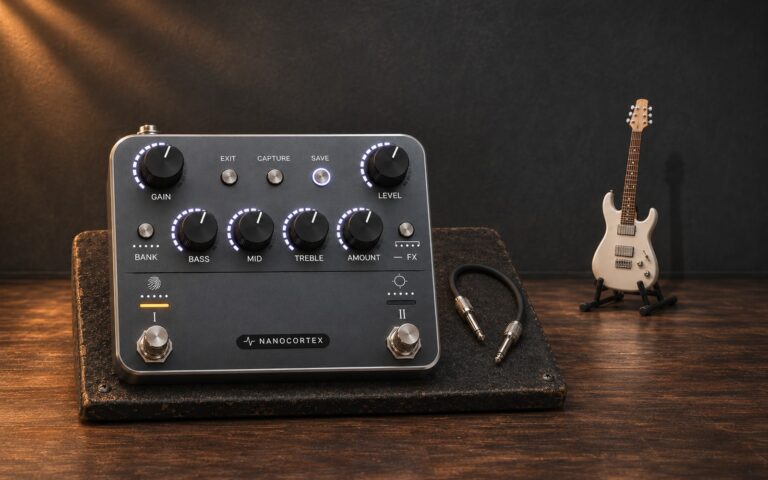
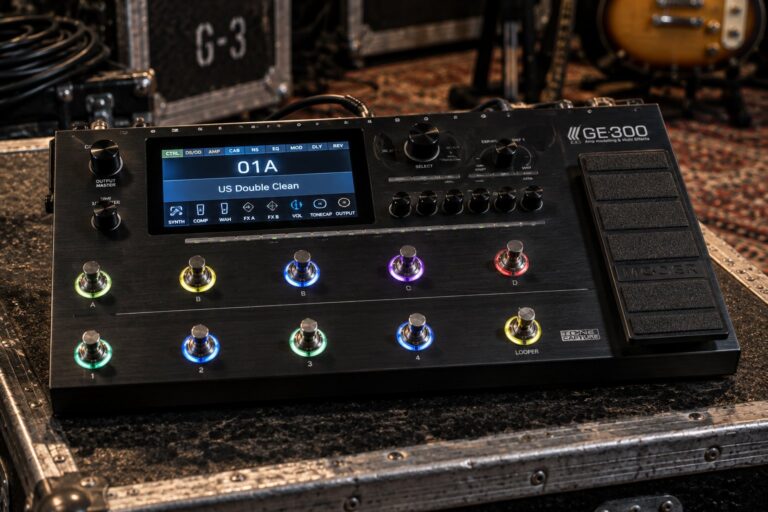
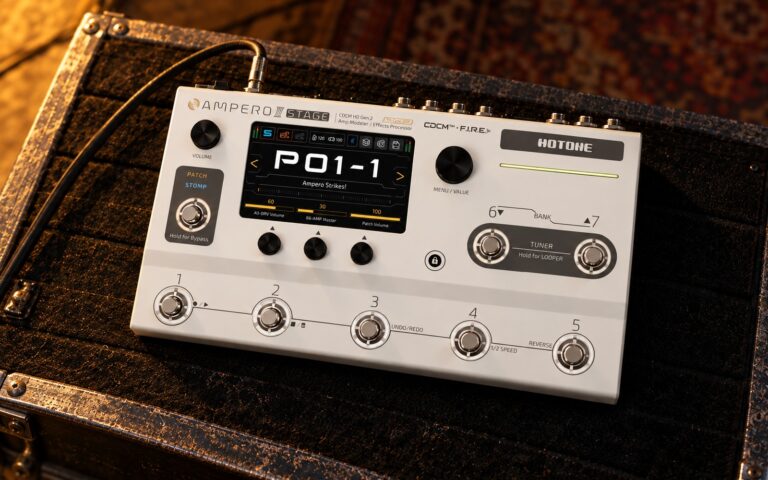
Clone Your Amp, Process Your Voice, and Rule the Stage: The HeadRush Prime Is a Different Animal
HeadRush Prime combines amp cloning, 600+ models, NAM support, and Antares AutoTune in one road-ready floorboard for stage and studio.
Most multi-effects units ask you to accept a deal: here are our models, pick the ones you like, learn to live with the rest. The HeadRush Prime asked a different question entirely. What if the unit could learn your amp? What if instead of chasing a manufacturer’s interpretation of a JTM45 or a Dual Rectifier, you plugged your actual amp into the Prime, ran a twenty-second capture process on a seven-inch touchscreen, and walked away with a clone that nailed the sound, the sag, the feel? That was the pitch when inMusic Brands unveiled the Prime in April 2023, and it changed the conversation around floorboard processors in ways that are still reverberating through rehearsal rooms and green rooms worldwide.
The Prime isn’t a revised Pedalboard. It isn’t an incremental firmware bump on existing hardware. It’s a ground-up flagship that added Amp Cloner technology, full vocal processing with Antares AutoTune, built-in Wi-Fi for cloud connectivity, Bluetooth audio, and — by the time firmware 5.1 landed — native Neural Amp Modeler support and direct TONE3000 access, turning the floor unit into what HeadRush calls an “open tone platform.” At $1,299 street, it sits in a serious bracket: above the workhorse Boss GT-1000 and Line 6 POD Go tier, below the Fractal Axe-FX III in outright price, and squarely competing with the Neural DSP Quad Cortex for the working pro who needs one unit to cover everything.
This is what it is, what it does, and what it sounds like in real life.
HeadRush: From Avid’s Eleven to ReValver
HeadRush is a brand of inMusic Brands, Inc. — the Rhode Island-based holding company that also owns Akai, Alesis, Numark, M-Audio, AIR Music Technology, Rane, and Denon DJ. When the original HeadRush Pedalboard launched in 2017, its centrepiece was Eleven HD Expanded technology from Avid, the makers of Pro Tools. That was a big deal at the time: Eleven was a professional studio-grade amp simulation suite, and putting it in a $1,499 floorboard with a seven-inch touchscreen gave HeadRush an immediate credibility argument against Line 6’s Helix and Fractal’s then-current XT offerings.
The Prime marks a departure. HeadRush’s corporate relationship with Avid wound down, and for the Prime’s modelling engine, inMusic turned to ReValver — the software guitar amp simulation platform originally developed by Peavey, which inMusic acquired as part of broader portfolio moves. ReValver has a legitimate pedigree in software amp modelling, predating many of its current competitors, and the Prime’s 600+ amp, cab, and microphone models are built on ReValver’s physics-based engine rather than Avid’s Eleven framework. This is a documented architectural shift, not a mere refresh, and it’s worth knowing if you owned a HeadRush Pedalboard: the Prime’s tones come from a completely different modelling codebase.
The original HeadRush Pedalboard was followed by the Gigboard (a smaller two-footswitch unit) and the MX5 (five footswitches, compact form factor). The Prime represents the top of the new generation, with the Flex Prime — announced simultaneously — occupying a smaller, four-footswitch format using the same processing architecture and touchscreen workflow.
HeadRush Prime Specifications
| Feature | Specification |
|---|---|
| Display | 7-inch high-resolution touchscreen (exclusive patent-pending technology) |
| Footswitches | 12 assignable, with customizable RGB LEDs and OLED scribble strips |
| Expression Pedal | Built-in with integrated toe switch |
| Amp/Cab/Mic Models | 600+ (via ReValver-based engine) |
| Cabinet IRs | 300+ onboard + virtually unlimited via import |
| Convolution Reverb IRs | 21 onboard C-Verb IRs + unlimited import |
| Amp Modeling Engine | ReValver (inMusic/Peavey) |
| NAM Support | Native (NAM A1 + NAM A2 formats, via firmware 5.1+) |
| TONE3000 Access | Direct, via Wi-Fi and HeadRush Cloud |
| Amp Cloner | Built-in; captures amps, preamps, OD/DS/fuzz pedals and analog gear |
| SuperClones | Multiple captures combined via ReValver (via HeadRush Cloud) |
| Vocal Processing | Full suite; Antares AutoTune, harmony, doubler, distortion, delay, reverb |
| USB Audio | 24-bit / 96kHz (recording and reamping) |
| Wi-Fi | Built-in; remote editing (browser-based, no software), HeadRush Cloud, firmware updates |
| Bluetooth | Audio streaming (practice, backing tracks) |
| Looper | Max loop: 5 minutes; total layered audio: 20 minutes; save/export as WAV; MIDI sync |
| Drum Machine | Built-in; BFD Drums-sourced kits; footswitch-triggered fills and accents |
| Modes | Stomp, Rig, Hybrid, Setlist, Song |
| Preset Switching | Gapless with reverb/delay tail spillover |
| Guitar Input | Combo XLR+¼” with switchable 48V phantom power |
| Outputs | Dual XLR (with switchable ground lift) + Dual TRS (amp or line level) |
| FX Loop | Stereo, with 4-cable method support |
| MIDI | 5-pin DIN In and Out |
| Headphone Out | Yes |
| Amp Control | Dedicated channel-switching output |
| USB-A | File transfer and USB-MIDI controllers |
| Chassis | Road-ready steel |
| Street Price (US) | $1,299 |
Famous Players: A Candid Look at HeadRush’s Artist Roster
HeadRush operates a real, publicly documented artist programme. Unlike some brands whose “artist” section is a marketing fiction populated with names who have no verifiable gear connection, headrushfx.com publishes individual artist pages with downloadable preset packs — so the relationship is at minimum real enough for HeadRush to produce branded content with these players. That said, two important caveats apply.
First: the HeadRush artist page covers the brand’s entire product history. Artists who signed with HeadRush in 2017 or 2019 were using the original Pedalboard, which runs a completely different modelling engine (Avid Eleven HD) from the Prime (ReValver). No artist page explicitly documents which unit a given player is currently using in their live or studio rig. The safe framing is: these artists use HeadRush products; the Prime is the current flagship; which specific unit any individual player has on their stage requires per-tour verification beyond what their brand page provides.
Second: the roster skews toward working professionals and mid-level touring players rather than arena headliners. This is a structural fact about the $1,299 price bracket. The Fractal Axe-FX III, Kemper Profiler, and to some extent the Neural DSP Quad Cortex are the units where touring acts with full production — multiple trucks, IEM rigs, a dedicated guitar tech — are most likely to appear in Premier Guitar Rig Rundowns. At $1,299, the HeadRush Prime serves a different demographic: serious working guitarists who need a professional unit without the Fractal price tag or the Kemper’s separate profiler/player workflow. That player is harder to photograph for a press release, but they’re the heart of the live music economy.
With those caveats noted, the most notable verified names on HeadRush’s current roster include Brian Robertson, the guitarist who co-wrote and recorded the twin-guitar fury of Thin Lizzy’s Jailbreak and Johnny the Fox before fronting his own band and later playing with Motörhead. Robertson’s association with HeadRush is publicly documented through his artist page on headrushfx.com. Also on the roster is Rex Brown, bassist and co-founding member of Pantera — the groove-metal architects behind Vulgar Display of Power and Far Beyond Driven — who has continued recording and touring with Down, Kill Devil Hill, and his own solo work. Tracii Guns of L.A. Guns and Brides of Destruction, Davey Grahs of Pop Evil, Dan Vadim Von of Morbid Angel, Nili Brosh (Cirque du Soleil, Tony MacAlpine’s band, a respected instrumental guitarist in her own right), and session heavyweights including Jason Roller (documented session and touring work with Alabama, Alice Cooper, Deep Purple, Dolly Parton) and Tony “Chicago” Russell and Robert Gueringer (both credited as guitarists in Kendrick Lamar’s live band) round out a roster that covers hard rock, metal, progressive, R&B, and country pop touring contexts.
For comparison: the players who built careers around multi-effects floorboards at this tier — Tom Morello (who built his sound around the Digitech Whammy and a Roland GP-100 rack unit before the current generation of modellers existed), Matt Bellamy of Muse (an early and enthusiastic adopter of complex multi-effects rigs, documented using Line 6 hardware), Guthrie Govan (whose studio flexibility makes him a natural candidate for modeller workflows), and Tim Henson of Polyphia (a documented Quad Cortex user) — represent the tier of player the Prime competes for in terms of sound and functionality, even if none of them are publicly documented as HeadRush Prime users. The point is the category, not the brand: guitarists who want professional-grade direct tone without a truck full of amplifiers.
The Amp Cloner: What It Actually Does
The Amp Cloner is the Prime’s most distinctive feature and the one that most clearly differentiates it from the Boss GT-1000 and Line 6 POD Go tier. The concept is straightforward and the execution is genuinely well-designed. Connect your amp — or your overdrive, fuzz, or preamp — to the Prime using the dedicated capture routing. Follow the on-screen process on the seven-inch touchscreen. The unit plays test signals through your gear, captures its response across the frequency and dynamic range, and produces a clone that you can load into any rig alongside the built-in models, third-party IRs, and NAM captures.
The practical applications are significant. A player who has spent years developing their tone around a specific vintage amp — say, a 1968 Fender Blackface reissue with a particular bias and worn output transformer — can now clone that amp and take it to every gig as a direct rig, leaving the actual vintage piece at home where it won’t be at risk. A session guitarist who owns a boutique fuzz that costs $800 on the used market can capture it, use the clone on sessions that don’t require the original to travel, and share that clone with collaborators via HeadRush Cloud. The Amp Cloner doesn’t capture the cabinet (that’s handled by a separate IR you select or load), but it does capture the amp’s preamp response, power amp character, and the specific colouration of your unit’s output stage — including the inconsistencies and character that make vintage gear interesting.
The ability to remove the cabinet sound from an amp clone — so you can pair it with any IR in your library — is a practical workflow detail that HeadRush documents explicitly. Clone a Vox AC30, strip its speaker character, pair it with a Celestion Blue IR at a different mic position. That flexibility is what makes the Amp Cloner more than a party trick.
The NAM integration added by firmware 5.1 extends the same philosophy to the Neural Amp Modeler ecosystem. NAM captures are community-created digital recreations of amplifiers and signal chains, and TONE3000 is the central library where those captures live. The Prime can now browse, demo, and download NAM captures directly from its touchscreen, without a computer in the chain, pulling from a library that at any given moment contains hundreds of thousands of captures of amps from a 1959 Marshall Super Lead to a Dumble ODS to a Fortin Monstortion. This is the “open tone platform” positioning: instead of accepting only what HeadRush’s engineers modelled, you now have access to everything the global capturing community has created.
Five Tone Recipes for the HeadRush Prime
1. Live Direct-to-FOH Rock: No Amp Required
Load a British Stack model (the Prime’s Marshall-derived options, built on ReValver’s physics engine) or a NAM capture of a specific 100-watt plexi. Select a 4×12 IR mic’d with a Shure SM57 off-axis at 3cm. Add a mild tube screamer OD block pre-amp (drive 40%, tone 55%, level to taste) to push the input. Reverb: a short spring, pre-delay 15ms, mix 20%. Run the dual XLR outputs to the PA. Switch ground lift on if you hear hum. This is the fundamental Prime live rig: two XLRs out, nothing else on stage. Turn off the cab sim only if you’re going into a real amp’s power section — running Line mode into a guitar amp’s instrument input with cab sim on creates doubled cabinet simulation and results in a cloudy, indistinct sound. The Amp/Line output switch on the dual TRS outputs handles this.
2. Four-Cable Method with Your Real Amp
Guitar → Prime input → Prime sends to your amp’s FX loop return (bypassing the amp’s preamp) and your amp’s guitar input (for the preamp stage) → Prime’s FX loop return receives from your amp’s send. Use the Prime’s preamp blocks as the main tone engine, then route through the real amp’s power section and cabinet for the final output character. This preserves the feel of the power amp and speaker while giving you the Prime’s full effects chain, gapless switching, and MIDI control. The Prime’s dedicated amp control output handles footswitch-style channel switching on the amp itself, so you can switch your amp’s channels via the Prime’s footswitches. The FX loop position (pre or post amp model) is selectable per rig — essential for placing time-based effects correctly.
3. Modern High-Gain Metal: Direct, Tight, Mix-Ready
Load a NAM capture of a Mesa/Boogie Mark V or Dual Rectifier, or use the Prime’s onboard Recti-style amp model. Cab: a 4×12 OS IR with a Mesa Vintage 30, SM57 at the cone edge. Pre-amp: gate with threshold set just below pick noise (typically around -65dB to -55dB depending on your pickups) to kill string noise between riffs. Post-amp: a tight parametric EQ — cut 3dB at 300Hz to reduce muddiness in a dense mix, boost 2dB at 5kHz for pick attack definition. No reverb in the main chain; add 12–15ms of pre-delay room reverb at 8% mix just to keep it from sounding like a DI. This is a mix-engineer-friendly direct signal that sits in a band context without fighting the kick and bass. Players like Misha Mansoor and Mark Holcomb of Periphery defined what tight modern metal sounds like in a direct context — the Prime has the processing headroom to get there.
4. Amp Cloner Capture Session Workflow
Plug your target fuzz (or overdrive, or amp head’s direct out) into the Prime’s input using the routing the on-screen Amp Cloner guide specifies. Run the capture process — takes around 20 seconds. When the clone is created, pair it with a neutral studio cab IR (a 1×12 Jensen at 1cm, light mic distance, no proximity effect) for a balanced reference tone, then dial in the character. Strip the cab from the clone if you want to use it with different speakers later. Save the clone to HeadRush Cloud and tag it for sharing. This is genuinely useful for players with irreplaceable or expensive gear: capture once in a controlled studio environment, use the clone everywhere, protect the original.
5. Guitar and Vocal Combined Rig (using Antares AutoTune)
Connect a microphone to the combo XLR input (enable 48V phantom if you’re using a condenser). Build a guitar rig as normal for your instrument chain. In the vocal chain (which runs parallel), set Antares AutoTune to Retune Speed around 20–30 for a natural correction feel, or dial it to zero for the hard “T-Pain” effect when the song calls for it. Add a short hall reverb at 25% mix on the vocal, and run the vocal and guitar chains to the dual XLR outputs at their respective levels. This positions the Prime as a one-unit solution for singer-guitarists playing venues where they’re running direct: no separate vocal processor, no second DI box, no monitor mix complexity. The AutoTune is the actual industry-standard Antares plugin, not a budget approximation — the same software credited on major label records.
How It Compares
The Line 6 POD Go sits about $400 below the Prime at street, delivers excellent Helix-based modelling in a compact five-footswitch format, and is one of the best direct rigs at its price. What it doesn’t have: Amp Cloner, native NAM, vocal processing, Wi-Fi, Bluetooth, or the Prime’s 12-footswitch layout. If you don’t need to clone your own amp and you’re not running vocals, the POD Go gets you most of the way there for considerably less money.
The Line 6 Helix Floor is the Prime’s most direct comparator in format and ambition. The Helix has a longer track record, a larger user community, arguably more documented use at the touring-pro level, and a slightly lower street price than the Prime. What the Helix Floor doesn’t have at its stock price point: built-in Amp Cloner, native NAM without third-party hardware, Antares AutoTune integration, or Bluetooth. The Prime trades some of the Helix’s ecosystem breadth (thousands of community presets developed over a decade) for a more forward-looking open platform that can grow through captures and downloads.
The Neural DSP Quad Cortex is the closest spiritual competitor. The Quad Cortex also does hardware profiling (Capture mode), runs NAM models, has a touchscreen interface, and sits at a similar price point. The Quad Cortex’s strengths: arguably a larger community of high-profile touring endorsers, Neural DSP’s own plugin ecosystem as the backing modelling authority, and a more established NAMM presence as of 2023. The Prime’s strengths: Antares AutoTune integration (the Quad Cortex has no equivalent vocal processing), the Drum Machine (BFD Drums source material), Bluetooth audio for practice, and the Dropbox song-learning integration. These are different tools with different priorities for the same budget.
Against the Boss GT-1000, the Prime offers more at a higher price: Amp Cloner, NAM, vocals, Wi-Fi, Bluetooth, touchscreen workflow. The GT-1000’s strengths are its 96kHz processing, its near-bulletproof build quality from Boss’s manufacturing heritage, and a longer established library of verified user rigs at the touring-pro level. The GT-1000 is a more conservative purchase; the Prime is a more ambitious one.
The Boss ME-90 at $350 is in a different conversation entirely — it uses AIRD from the GT-1000, covers all practical live and recording needs, and has no frills. The Prime costs three and a half times as much and provides roughly three and a half times as many capabilities. Whether those additional capabilities matter to you is the question the buying decision turns on.
Buying Guide
The HeadRush Prime launched at $1,299 US street and has held that price through mid-2026. The Flex Prime — same processing platform, smaller four-footswitch format, no expression pedal — sits at around $799 street and is worth considering if you want the Prime’s tonal capabilities without the full floor footprint. Used Prime units appear regularly on Reverb and Guitar Center’s used inventory starting around $850–$950 depending on condition, which is a meaningful entry point if the Amp Cloner and NAM are your primary draws rather than the extended warranty coverage.
Check firmware before buying used. The Amp Cloner shipped with the original firmware; NAM support and TONE3000 access are post-launch additions that arrived with firmware 5.1. Any unit updated to firmware 5.1 or later has the full platform. HeadRush’s firmware history is well-documented in their support base, and the update process is straightforward via Wi-Fi.
The Prime ships with a universal power supply — no separate power brick needed for international touring. It does not include a carry case; HeadRush sells an optional padded bag, and third-party pedalboard cases in the range of 18″–20″ accommodate it comfortably.
Ownership Notes
The seven-inch touchscreen is the primary interface, and the learning curve for the Prime is steeper than for a conventional multi-effects unit precisely because so much capability is available. Budget time with the screen before your first gig. The remote editing feature — accessible from any tablet or desktop browser over Wi-Fi without software installation — is genuinely useful for pre-show rig building when you’d rather not be on your knees behind the unit.
The Amp/Line switch on the TRS outputs matters more than it appears in the documentation. “Amp” mode disables the cabinet simulation so you can run the Prime’s preamp output into a real amp’s power section without doubling the speaker colouration. “Line” mode keeps the cab sim active for direct-to-desk or PA operation. Running in Line mode into a guitar amp’s instrument input is the single most common source of the “muddy, dark, unusable” complaints in HeadRush forum threads — it’s a settings issue, not a hardware limitation.
The looper’s 20-minute total capacity and WAV export capability make it a legitimate songwriting and arrangement tool, not just a live looper. The Drum Machine — with BFD Drums-sourced kits — is surprisingly complete for practice and demo work. These two features together position the Prime as a standalone creative station for home recording and content creation that doesn’t require a DAW to produce usable output.
For players planning to use the Amp Cloner, do the capture in a controlled acoustic environment. Amp Cloner captures are sensitive to room noise during the test signal phase — capturing a loud amp in a live room can introduce artefacts that aren’t present when the same amp is captured in a dead room or using a load box into the output.
Frequently Asked Questions
Does the HeadRush Prime replace the original HeadRush Pedalboard?
Yes, the Prime is the current flagship in the HeadRush line and replaces the original Pedalboard both in positioning and in underlying architecture. The original Pedalboard used Avid’s Eleven HD modelling engine; the Prime uses ReValver. Presets are not directly transferable between the two platforms.
What does Amp Cloner capture, and what doesn’t it capture?
Amp Cloner captures the tonal response of your amp’s preamp and power amp stages, including any overdrive or distortion characteristics. It does not capture the speaker cabinet — cabinet simulation is handled separately by selecting an IR from the Prime’s 300+ onboard library or importing your own. HeadRush’s implementation allows you to remove the cabinet character from a full amp clone after the fact, giving you a “just the amp” capture you can pair with any IR.
What’s the difference between the Prime and the Flex Prime?
The Flex Prime uses the same processing architecture and touchscreen workflow as the Prime, but in a compact four-footswitch format without a built-in expression pedal. The Flex Prime is designed for players who want the Prime’s tonal capabilities on a smaller pedalboard footprint, or who prefer to use an external expression pedal. Price difference at launch was approximately $500.
Does the HeadRush Prime work as a USB audio interface?
Yes, at 24-bit / 96kHz, which is professional recording quality. It supports both recording (guitar direct into DAW through the Prime’s processing) and reamping (sending a pre-recorded DI track from the DAW back through the Prime to add amp tone to an already-recorded performance). This is a legitimate studio workflow used by engineers to separate tracking from tone decisions.
Can I use the Prime with a real amp instead of running direct?
Yes, via the four-cable method using the stereo FX loop. The Prime’s FX loop integrates the external amp’s preamp into the signal chain, with the Prime handling all effects routing and the real amp’s power section providing the final amplification and speaker interaction. The dedicated amp control output handles footswitch-style channel switching on compatible amplifiers. This is how players run hybrid rigs — the real amp for feel and power, the Prime for effects and switching.
Is the Antares AutoTune integration the actual AutoTune software?
Yes. HeadRush licensed Antares AutoTune for the Prime’s vocal processing suite — not a budget approximation or a generic pitch correction algorithm. The Prime’s vocal chain includes AutoTune alongside harmony, doubler, distortion, delay, and reverb processing, making it a complete vocal signal path that doesn’t require a separate vocal processor for straightforward live applications.
What is TONE3000 and how does it work on the Prime?
TONE3000 is a community-driven library of NAM captures, rigs, and guitar tones created and shared by musicians worldwide. As of firmware 5.1, the Prime can access TONE3000 directly through the HeadRush Cloud interface on the touchscreen, without a computer — browse, demo, and download captures while standing in front of the unit. The library covers everything from common production amp captures to boutique and rare-gear captures created by enthusiasts with access to the original hardware.
What’s the Prime’s looper like in practice?
The looper offers up to five minutes per loop and a total of twenty minutes of layered audio before it hits its capacity ceiling. Loops can be saved as WAV files and exported via USB, and WAV files can be imported to use the looper as a backing track player — meaning you can load a pre-recorded drum loop, chord progression, or click track and practice or perform against it without a separate device. MIDI sync keeps the looper locked to external drum machines or sequencers for live performance use.
Image credits
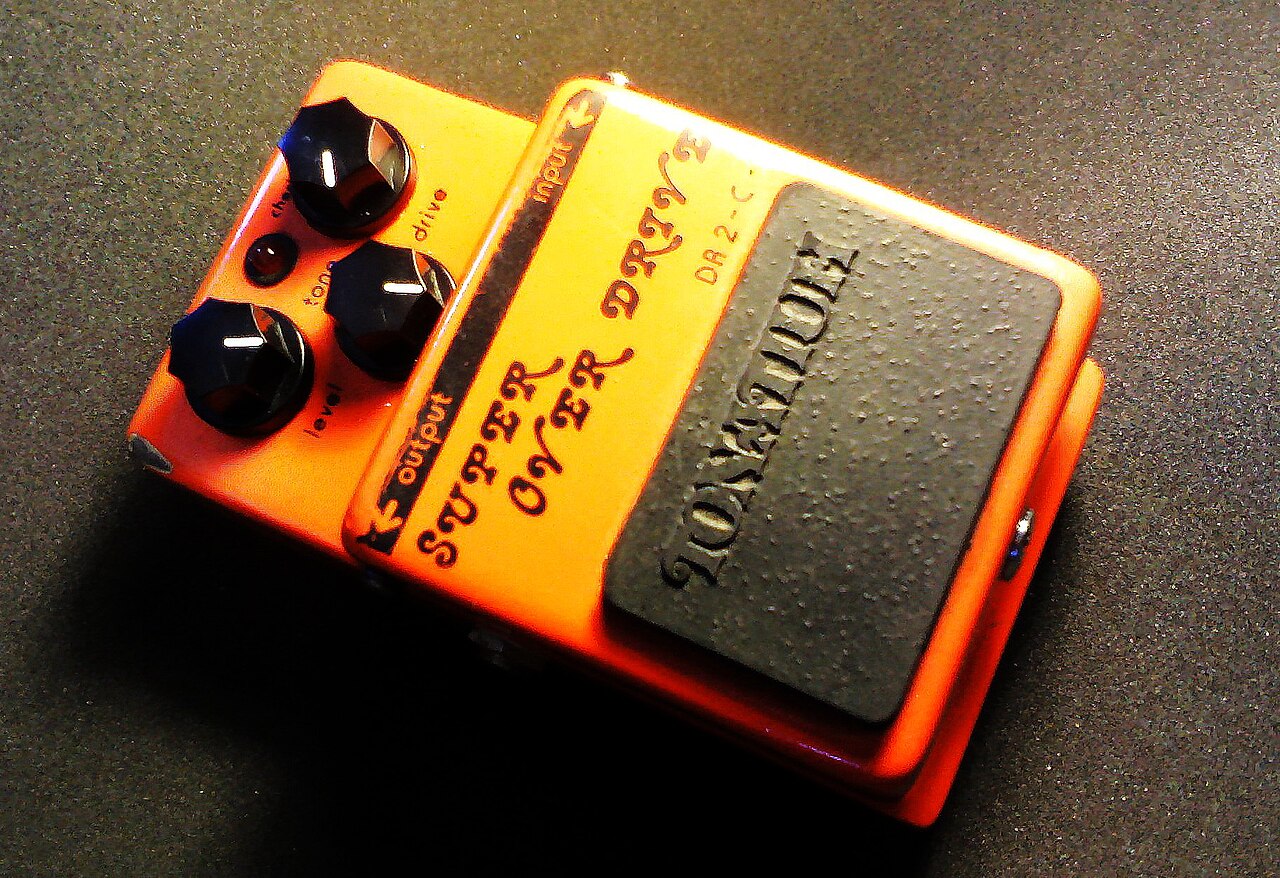
- An orange overdrive pedal: Andrés Galeotti, Wikimedia Commons, CC BY 2.0.
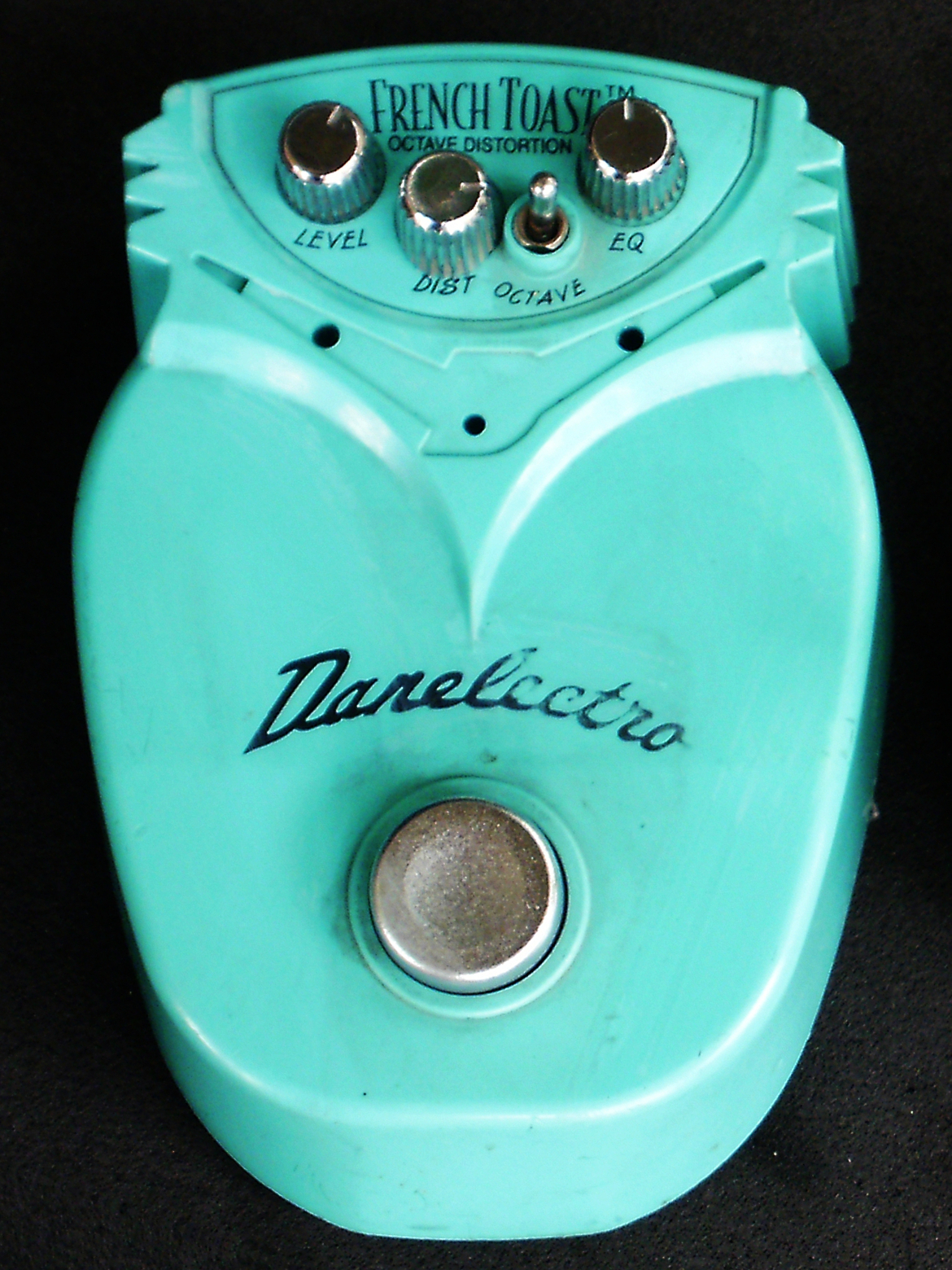
- A mint green distortion pedal: Danelectro French Toast octave distortion rehouse on metal case (2011-10-03 by Andrés Galeotti).jpg: Andrés Galeotti fro, Wikimedia Commons, CC BY 3.0.
Latest News
Related
On This Day
Monday 9 November
From this week: