Thirty-Five Legends in a Box: The NUX MG-30 and the Art of the Compact Rig
The NUX MG-30 packs 35 amp models, 1024-sample IRs, and dual DSP processing into a compact, affordable floor modeler. Here's what you need to know.
The premise behind every floor modeler on the market is the same fantasy: walk into any venue, plug a single box into the PA, and summon decades of tube-amplifier history on demand. The problem is that premise has historically come with an asterisk — you either pay boutique money for a unit that actually delivers (Fractal, Kemper, Line 6 Helix), or you accept compromises at the sub-$500 tier that keep reminding you what you didn’t spend. The NUX MG-30 is a direct argument against that rule. At $329, it packs 35 amp models, dual DSP processing, 1024-sample IR support, and a signal chain flexible enough to run four-cable method — in a unit small enough to drop into a gig bag pocket. That doesn’t make it a Helix. What it makes it is considerably more interesting than its price tag suggests.
From Shenzhen to Your Signal Chain: NUX and the Road to the MG-30
NUX is a guitar and bass effects brand under Cherub Technology Co., Ltd., headquartered in Shenzhen, China. The brand built its name on compact, affordable stompboxes — the nano-sized stomp format that Shenzhen’s electronics manufacturing infrastructure makes peculiarly possible — before pivoting toward more ambitious multi-effects territory. The MG-300 was their credibility moment in the modeler space: a budget floor unit that earned genuine respect among working players looking for a giggable direct rig without the premium price tag. NUX announced the company philosophy plainly when the MG-300 landed: “working musicians don’t need hundreds of mediocre amp models.”
The MG-30, announced in March 2021, is the logical next step. Where the MG-300 proved the concept, the MG-30 sharpened the execution: upgraded NXP RT dual-core processors, 2K-class amp modeling (what NUX calls TS/AC-HD “White-Box” technology, updated in current firmware), a larger 4-inch color LCD, expanded IR capability, and a more sophisticated global settings system. The “30” in the name referenced the original 30 hand-selected amp models the unit launched with — a deliberate curated selection rather than an arms-race number. Firmware updates have since expanded the library; current production ships with 35.
What You’re Actually Getting
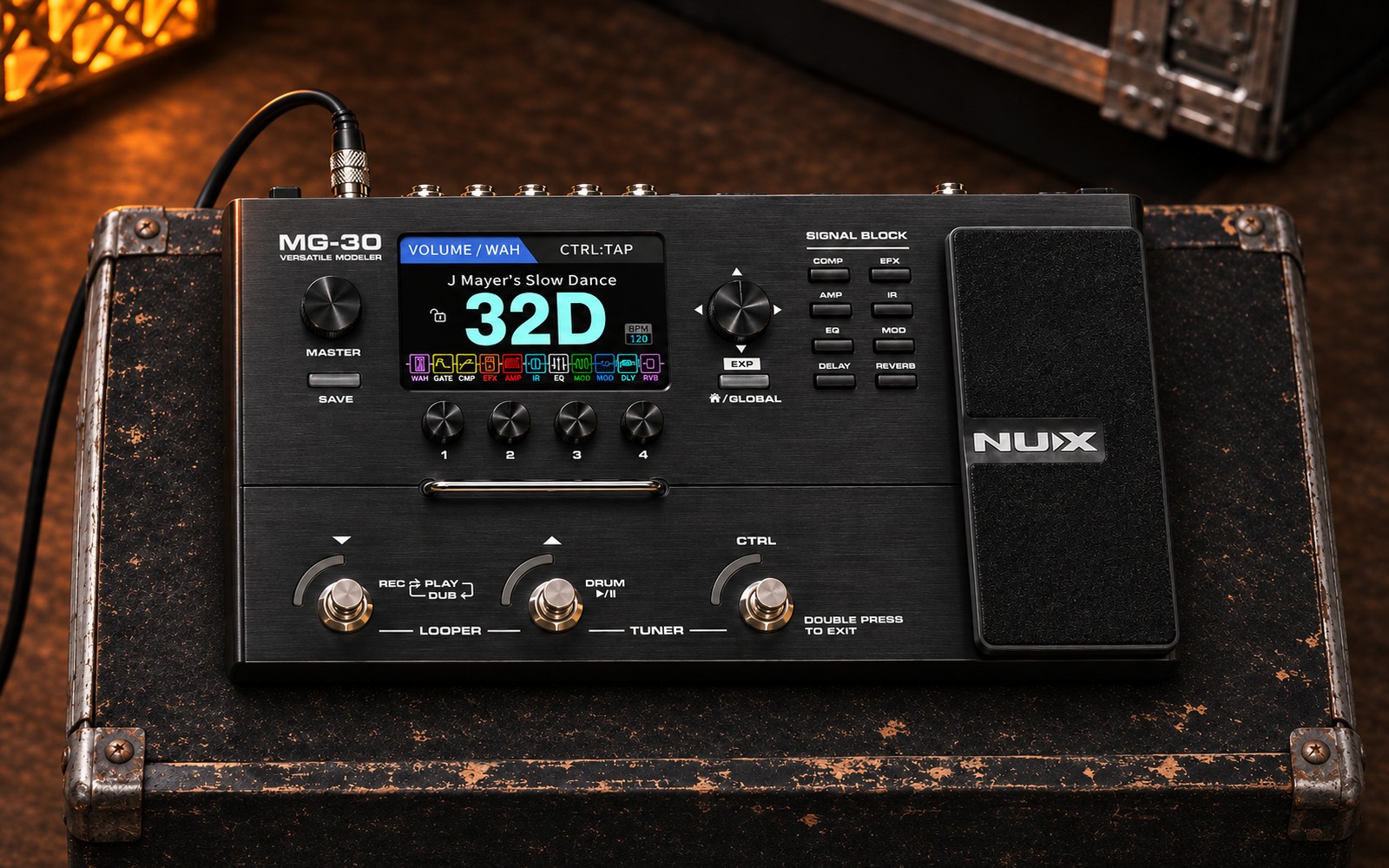
The MG-30 is a compact floor-format amp modeler and multi-effects unit with a built-in expression pedal. In terms of physical footprint it is genuinely small — gig-bag portable — and NUX’s decision to run it on 9V/400mA means it sits comfortably on a standard multi-output pedalboard power supply alongside stompboxes. The included NMP-2 two-button external footswitch attaches via the Expression input using the included patch cable, bringing the total footswitch count from three to five (three main switches, two external, plus toe-down on the expression pedal as a sixth assignable control). That is a meaningful live rig for the price.
Build quality is solid metal — reviewers consistently note it feels more substantial than the price implies. The 4-inch LCD is large enough to read under stage lighting without squinting, and the combination of a rotating/clicking navigation knob plus four parameter knobs that both rotate and click makes editing genuinely hands-on. NUX’s position — edit everything from the floor unit, not just in software — is not marketing. Most parameters are accessible without a laptop anywhere nearby.
Specs at a Glance
| Spec | Value |
|---|---|
| Amp models | 35 (28 electric, 2 acoustic, 5 bass) |
| Factory cabinet IRs | 23 (12 electric, 3 acoustic, 8 bass) |
| Custom IR slots | 128 |
| IR resolution | 1024-sample |
| Mic selections | 8 microphones × 3 positions |
| Signal blocks | 11 independent, moveable |
| Parallel routing | Optional post-FX parallel path |
| Display | 4″ color LCD |
| Looper | 60-second phrase looper |
| Drum machine | 67 patterns / 11 styles |
| System latency | 2ms |
| Converters | 32-bit AKM dual-channel A/D & D/A |
| Dynamic range | ~110 dB |
| Processors | 2× NXP RT DSP (one amp, one effects) |
| Inputs | Guitar In (¼”), AUX In (⅛”), Send (FX loop), Expression In |
| Outputs | Stereo Out L/R (¼”), Return (FX loop), Headphones (⅛”), USB-C |
| USB | USB-C (audio interface + QuickTone editor + firmware) |
| Power | 9V DC / 400mA, center-negative |
| Included accessories | Power adapter, USB-C cable, patch cable, NMP-2 footswitch |
| Street price (new) | $329 USD (NUX USA, 2026) |
| Used market | ~$150–200 |
The Amp Model Library: Curated Over Comprehensive
NUX’s founding principle for the MG-30 was curated quality over inflated quantity. The original launch offered 30 amp models; firmware updates brought the current tally to 35, split across 28 electric guitar amps, 2 acoustic simulator amps, and 5 bass amps. The electric models trace recognizable circuit families without requiring NUX to name their sources. From the unit’s own interface, the lineup includes: a Plexi 45 and Plexi 100 (Marshall 1959/1987 Plexi), a Brit Blues (Marshall Bluesbreaker 1962), a Brit 2000 (Marshall JCM2000), a 1987 X 50 (Marshall JCM800 50W), a Dual Rect (Mesa/Boogie Dual Rectifier), a Cali Crunch (Mesa/Boogie Mark-series voiced gain), a Class A15 and Class A30 (Vox AC15/AC30), a Deluxe Rvb and Princeton (Fender Deluxe Reverb and Princeton Reverb), a Super Rvb (Fender Super Reverb), a Tweedy (Fender 5E3 tweed Deluxe), a Jazz Clean (Roland JC-120), a SLO 100 (Soldano SLO-100), a Diezel VH4, a Fireman HBE (Friedman BE-100), a Bogner Überschall, a Hiwatt DR103, and a Matchless-voiced clean. That is a genuinely well-rounded selection — clean-to-crunch Fenders, British gain ranging from mild to violent, American high-gain metal, a Roland clean machine, and a handful of boutique extremes.
The BIAS tweak parameter is worth understanding before dismissing it as a marketing feature. In a real tube amp, BIAS controls the resting current through the output tubes: too cold and the amp crossover-distorts; too hot and the tubes run toward compression and sag. On the MG-30’s modeled amps, the BIAS parameter shifts the character of the virtual output stage in a way that tracks this behavior. Dialing it cold adds edge and aggression; warming it up adds compression and bloom. For a $329 unit to include a per-amp-model BIAS control is a meaningful design decision.
Factory cabinet IRs follow the same philosophy: 23 curated options capturing 8 microphone types at 3 positions each rather than hundreds of indifferent snapshots. Reviewers consistently note that the factory IRs are functional but that loading third-party IRs from providers like Celestion, Ownhammer, or York Audio reveals the hardware’s full ceiling. With 128 custom IR slots available — each user patch gets its own dedicated IR loader slot in addition to the main bank — there is no shortage of room to build a library.
Effects Architecture: Eleven Blocks, One Chain
The MG-30’s signal chain offers 11 independent blocks that can be reordered in any sequence via the display or the QuickTone desktop editor. The blocks cover: WAH (five models including Clyde Wah, Cry Baby BB, V847, Horse Wah, Octave-Shift), CMP (three compressors: Rose, K Comp, Studio Comp), GATE (noise reduction), EFX (fourteen overdrive and fuzz options including T Scream, Blues Drv, Muff Fuzz, and Red Dirt), EQ (6-Band, 10-Band, Align, Para), MOD (thirteen modulation effects including CE-1, CE-2, Phase 90, Phase 100, U-Vibe, Tremolo, Rotary, and Harmonist), DLY (eight delays: Analog, Digital, Modulation, Tape, Reverse, Pan, Duotime, and Phi), and RVB (five reverbs: Room, Hall, Plate, Spring, Shimmer). The amp and cabinet blocks complete the chain.
Optional parallel post-FX routing allows delay and reverb to run in parallel with the dry signal, which matters for players who want to keep their dry attack intact under large ambient effects. It is not a full parallel wet/dry split with separate physical outputs — that level of routing complexity lives in the Helix tier — but within the price bracket it represents useful flexibility.
Three scenes per preset allow you to toggle blocks or parameter states on and off without changing patches. The CTRL footswitch scrolls through the three scenes. With the NMP-2 plugged in, you have four switches total for scene navigation plus patch up/down, or you can assign each switch to individual block bypass. The system is less flexible than Helix’s per-scene independent parameter control, but it is enough to handle verse-chorus-lead transitions cleanly in a live context — as documented in the isthisgeargood.com review, which used the MG-30 live at a church gig with this exact workflow.
Famous Players: A Structural Honesty Note
No touring professional is documented on a NUX MG-30 in any primary source checked for this article — no Premier Guitar rig rundown, no manufacturer artist page listing, no Equipboard photo- or video-confirmed entry. NUX runs an artist programme, and their nux.us/pages/artists page lists working musicians and online educators, but none of the visible endorsers are names that would appear in a mainstream gear context. This is not a failing of the instrument. It is a structural fact about the $329 price tier: at this level, manufacturers do not write the endorsement cheques that bring touring-level artists into the fold. John Petrucci uses Fractal Audio, an Axe-FX III rig. Guthrie Govan has been documented on Neural DSP. Matt Bellamy built his stage rigs around Manley and custom Diezel configurations. Tim Henson uses Strymon and boutique signal chains. None of them need a $329 modeler. That is exactly the point — the MG-30 is not competing for their pedalboards. It is competing for every working guitarist who cannot spend $1,500 on a floor processor but still needs the show to sound professional.
The nearest analogue on this list is the Mooer GE300 ($489), which also carries no confirmed touring-level endorser in any primary source, and the Boss ME-90 ($350), which relies on Boss’s corporate presence rather than artist association. The MG-30 sits in that same honest bracket. What it offers is not association with famous rigs — it offers the tones those famous rigs run, at a fraction of the access cost.
Five Tone Recipes
1. Classic British Crunch — Live to PA
Start with the Plexi 45 model, set BIAS at roughly 65% (warmer, more saturated), Gain 55, Bass 50, Mid 60, Treble 55, Presence 45. Load a Celestion V30 IR in a 4×12 closed-back cab (or the factory Marshall-voiced cab IR as a starting point), SM57 position. Add a light spring reverb (Spring model, mix at 15%, decay 1.8s) and a touch of analog delay (Analog DLY, 320ms, mix 18%, one repeat). This is the sound of a cranked Marshall with room air around it — British rock, hard classic rock, AC/DC-adjacent rhythms. In a four-piece band mix, cut 200Hz slightly on the amp EQ block to let the bass breathe and push 800Hz by 2dB to cut through a dense drum mix.
2. High-Gain American Metal — Four-Cable Method
Dual Rect model, BIAS cool (35%), Gain 80, Bass 65, Mid 30 (the classic Rectifier mid scoop), Treble 70, Presence 60. No cab IR in the amp block — run the ¼” output without cab simulation directly to your stage amplifier’s return, and use the XLR with cab simulation to FOH simultaneously. Set the GATE threshold carefully (start at –40dB, raise until single-note ring-out survives but open-string noise dies). In the EFX block, place a T Scream (tubescreamer-voiced overdrive, gain at zero, level at 100, tone at 50%) in front of the amp to tighten the low end — this is the same front-of-amp boost that half of modern metal touring players use regardless of their actual amp model. For studio DI use, switch to a cab IR and use USB-C direct into your DAW at 32-bit.
3. Clean Country and Pedal Steel — Fender Territory
Deluxe Rvb model, Gain 20, Bass 55, Mid 45, Treble 60, Presence 50. Spring reverb (MG-30’s Spring model, mix 25%, time 2.0s). Tremolo in the MOD block (rate 4.5Hz, depth 60%). The Princeton model works equally well here for smaller-venue fingerpicking — it voices slightly drier with more midrange push. Add K Comp in the compressor block (attack medium, ratio 4:1, sustain modest) for pick-attack smoothing. This is the sound of chicken-pickin’ lines under a vocal melody — it cuts at 3–5kHz, sits politely in a mix, and reacts dynamically to pick attack in a way the unit handles well at 2ms latency.
4. Post-Rock Shimmer Wall — Ambient Textures
Class A30 model (Vox-voiced, chiming top end), Gain 30, treble rolled back to 40 to prevent ice-pick in a wet mix. In the RVB block, Shimmer reverb with size at maximum, mix 65%, pre-delay 20ms, tone warm. Stack a long modulation delay (Phi model, 900ms, high feedback around 70%, mix 35%) in a parallel post-FX path so the dry attack arrives first and the wash builds behind it. Players in Tim Henson’s orbit use layered shimmer-reverb-into-delay stacks that structurally match this recipe — the MG-30 replicates the architecture at a fraction of the signal chain cost. Volume swell technique or a slow attack EFX setting turns this into a synthetic pad that holds up under film scoring or instrumental post-rock without a single additional pedal.
5. Studio DI Reference — Clean Recording Direct
Jazz Clean model (Roland JC-120-voiced), Gain 10 (essentially clean), Bass 55, Mid 55, Treble 55. Studio Comp in the compressor block (fast attack, gentle ratio, transparent leveling). Load a matched neutral IR — a 1×12 with a ribbon mic capture works well for acoustic realism. USB-C into DAW, USB routing set to Normal (guitar processed signal out). This is a flat, accurate, honest capture of what the modeler is doing — useful as a reference track that you can reamp later if needed (use the Reamp USB routing mode, which sends the dry signal out USB while monitoring the wet signal). Dynamic range of ~110dB means the noise floor is not the problem at this price tier that it once was.
How the MG-30 Compares
vs. Line 6 POD Go (~$499)
The POD Go costs about 50% more than the MG-30 and brings HX modeling — the same engine that drives the Helix series — plus a more robust stereo FX loop and more sophisticated per-block parameter control. If Line 6’s HX amp models and the Helix preset ecosystem matter to you, the POD Go is the obvious step up. Where the MG-30 competes is UX simplicity and physical size: it is a smaller unit, the hands-on control is arguably more intuitive for non-technical players, and its preset-out-of-the-box quality is frequently cited as better than the POD Go’s factory content. Both are legitimate live direct rigs; the MG-30 is the lower-budget, lower-complexity choice.
vs. Mooer GE300 (~$489)
The GE300 and MG-30 occupy the same price tier with different personalities. The GE300 offers a polyphonic synth engine, a 30-minute looper, NAM A2 Lite support via firmware, and Tone Capture — tools for players who want synthesis and machine-learning tone modeling in addition to traditional amp simulation. The MG-30’s advantages are a faster learning curve, better factory presets that work immediately, and a more compact footprint. Factory cab IRs are the known weakness on the GE300 (two independent reviews call them thin and nasal out of the box); the MG-30’s factory cabs are more usable as a starting point, though both units reward investment in third-party IRs.
vs. Hotone Ampero II Stage (~$699)
At more than double the MG-30’s price, the Ampero II Stage is a different class of unit: 460+ effects, 90+ amp models, Bluetooth MIDI, 8×8 USB audio interface at up to 192kHz, a 5-inch touchscreen, and five scenes per patch with seamless switching. It is significantly more capable for complex live rigs and studio use. The MG-30 is the answer when budget is genuinely the constraint — it delivers the core modeler experience (amp models, cab IRs, essential effects, looper, direct recording) without the premium features. If you play small venues and need a dead-simple direct rig, the MG-30’s three-scene system and smaller footprint may actually suit you better than the Ampero II Stage’s fuller feature set.
vs. Line 6 Helix Floor (~$1,499)
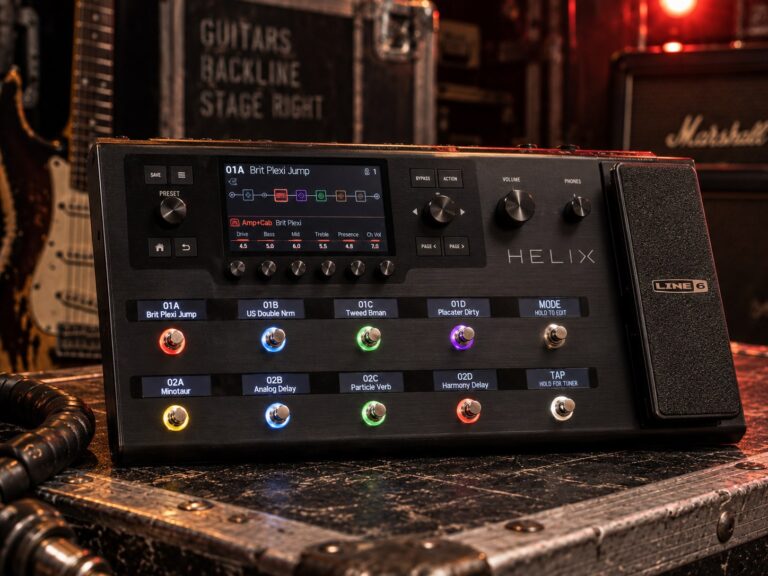
The Helix Floor costs more than four MG-30s and earns every dollar: HX modeling, 32 simultaneous processing blocks, a full stereo parallel signal chain, eight performance footswitches, four-switch scribble strips, and the deepest preset ecosystem in the sub-Fractal tier. John Petrucci-level players use Helix because it handles complex scene changes, full wet/dry/wet rigs, and studio-grade direct recording in ways the MG-30 simply cannot. The comparison here is not competitive — it is architectural. Buy the Helix if your live rig demands 32 blocks and seamless scene switching. Buy the MG-30 if you need a professional-quality direct signal and $329 is your actual budget.
vs. Neural DSP Quad Cortex (~$1,599)
The Quad Cortex is in a different universe: NAM-powered neural amp modeling, 24-block parallel signal processing, a 7-inch touchscreen, amp/pedal capture via the Capture feature, and a library of commercial preset packs from touring professionals. It is the choice for players who want machine-learning-accurate models of specific real amps they own or admire. The MG-30 is the correct choice for players who want a fast, reliable, affordable direct rig using curated models of classic amps. One is a studio tool with live capability; the other is a live rig with studio capability. The price difference is $1,270.
Buying Guide
The MG-30 retails at $329 from NUX USA with free shipping and a 3-year warranty — a meaningful warranty term for the price point. New-in-box pricing has been stable; there is no indication of a significant price drop coming. Used units appear on Reverb in the $150–200 range. When buying used, check three things: screen condition (the LCD is the component most susceptible to knocks on a used floor unit), firmware version (GEN2 firmware is a significant update available free from NUX; confirm the seller’s unit can accept it), and expression pedal calibration (the built-in expression pedal should track smoothly from heel to toe — test it before completing a private sale).
The NMP-2 external footswitch is included in the box; buying used, confirm it is present, since losing it costs roughly $20 to replace but is an irritant if missing from day one. Power: standard 9V center-negative DC, 400mA — compatible with most multi-output power supplies including the standard Strymon Zuma, Truetone 1 Spot Pro, and similar boards. The MG-30 does not require an isolated output; 400mA is a modest draw.
For FRFR speaker pairing, the MG-30 pairs well with the Headrush FRFR-108 or similar compact FRFR systems for live monitoring. For practice and recording, any studio monitor or headphones with the ⅛” output works cleanly. The unit’s ~110dB dynamic range is competitive with units costing three times as much, so the limiting factor in a recording chain at this price is generally the room and the guitar, not the modeler.
Living With the MG-30
QuickTone is NUX’s free desktop editor, available for Windows and Mac. It gives you a visual representation of the full signal chain, drag-and-drop block reordering, preset organization, IR management (upload, label, organize up to 128 custom IRs), and USB-C routing configuration. USB routing modes include: Normal (processed guitar signal out to DAW), USB Loopback (monitor processed signal while routing clean signal to DAW), Reamp (dry signal out USB, processed signal monitored through headphones — for re-amping workflows), and Dry Out (record the dry signal to DAW while performing live). These four modes cover the main studio workflows at no additional software cost.
The global settings page is more comprehensive than most players expect at this price: Pre-EQ lets you sculpt the incoming signal before the signal chain begins, which is useful for balancing between guitars with different output levels or tonal characters. Output mode sets global output levels for your specific routing (direct-to-PA, 4CM, headphones practice). Expression pedal calibration lives here. Display brightness adjusts. And, buried in the settings: a Snake game, which is exactly the kind of practical joke that makes an otherwise dry signal chain manual memorable.
The scene system deserves some patience to configure. Each of the 300 presets (60 banks × 5 patches) has three scenes. A clean verse sound, a driven chorus sound, and a lead sound is the standard three-scene template that covers most gigging situations. The CTRL switch steps between them. Add the external NMP-2 and you gain dedicated patch-up and patch-down controls, freeing the main footswitches for within-patch navigation. Configuring this in QuickTone rather than on the floor unit saves considerable setup time.
Third-party IRs are the single most impactful upgrade you can make to the MG-30’s sound. The factory IRs are usable — unlike some competitors at this tier where factory content is actively thin — but they do not demonstrate the hardware’s ceiling. Celestion’s licensed IRs, Ownhammer’s impulse response libraries, or free collections from ML Sound Lab show what the 1024-sample resolution and NXP DSP processing are actually capable of. Load the best IRs you can find into the 128 user slots early; treat the factory cabs as a fallback, not a destination.
FAQ
How many amp models does the NUX MG-30 have?
Current production and the latest firmware ship with 35 amp models: 28 electric guitar amps, 2 acoustic simulator amps, and 5 bass amps. The original 2021 launch spec was 30 models (25 electric, 2 acoustic, 3 bass); firmware updates have expanded the library. Always update to the latest GEN2 firmware to access the full current model count.
Does the MG-30 support third-party impulse responses?
Yes. Each user patch includes a dedicated third-party IR loader slot, and the unit supports up to 128 custom IRs in the main IR bank, at 1024-sample resolution in standard WAV format. Loading third-party IRs from commercial or free sources is one of the most impactful improvements you can make to the unit’s sound.
Can I use the NUX MG-30 as a USB audio interface?
Yes. The USB-C port functions as a class-compliant audio interface for recording. QuickTone offers four USB routing modes — Normal, USB Loopback, Reamp, and Dry Out — covering the main studio workflows. On Mac the unit is driver-free; Windows users should install the NUX USB driver for lowest-latency performance.
What is the BIAS parameter on the MG-30?
BIAS adjusts the simulated output-stage operating point of each amp model, mirroring what happens when you bias the output tubes in a real valve amplifier. Running cooler (lower BIAS value) adds edge, crossover character, and aggression. Running hotter (higher BIAS value) adds compression, sag, and a more vintage saturated feel. It is a per-model parameter, so you can dial it differently for a tight metal Rectifier setting versus a warm vintage Plexi crunch.
How do the scenes on the MG-30 work in a live context?
Each preset has three scenes. A scene is a stored snapshot of which blocks are active and what parameter values they are set to. The CTRL footswitch (or the NMP-2’s two buttons, depending on how you assign them) steps between the three scenes. Common template: Scene 1 = clean, Scene 2 = rhythm overdrive, Scene 3 = lead boost. Scene changes are not seamless in the same way as on a Helix or Kemper — there is a brief transition — but for most live situations (verse, chorus, lead) the system works effectively.
What is the difference between the NUX MG-300 and the MG-30?
The MG-300 was NUX’s earlier budget modeler and established the brand’s credibility in the floor-modeler space. The MG-30 (March 2021) is the step-up replacement: upgraded NXP RT dual DSP processors for faster processing and lower latency, updated TS/AC-HD 2K amp modeling, a larger 4-inch LCD, 128 custom IR slots versus the MG-300’s more limited IR capability, and a more comprehensive global settings system. The MG-30 is the current flagship compact modeler in the NUX range.
Is the NUX MG-30 suitable for live performance?
Yes. The isthisgeargood.com review documents the MG-30 used in a live church gig context with strong results. The 2ms system latency is transparent in a live mix. The stereo output with balanced XLR and unbalanced ¼” allows simultaneous FOH and amp monitoring (with and without cab simulation, respectively). Five assignable footswitches (three on-unit plus the included NMP-2) plus toe-switch on the expression pedal handle most live switching requirements. For complex multi-bank rigs requiring more than five independent switches, units in the Helix tier are more appropriate — but for a two-to-three-sound live direct rig, the MG-30 is a professional-quality solution.
What power supply does the NUX MG-30 require?
Standard 9V DC center-negative, 400mA maximum draw. The included power adapter covers this. The modest current draw means the MG-30 is compatible with most multi-output pedalboard power supplies without requiring an isolated or high-current output. It does not run on batteries.
Image credits
- Top image: GuitarGangsters AI-generated reference illustration, not a photograph.
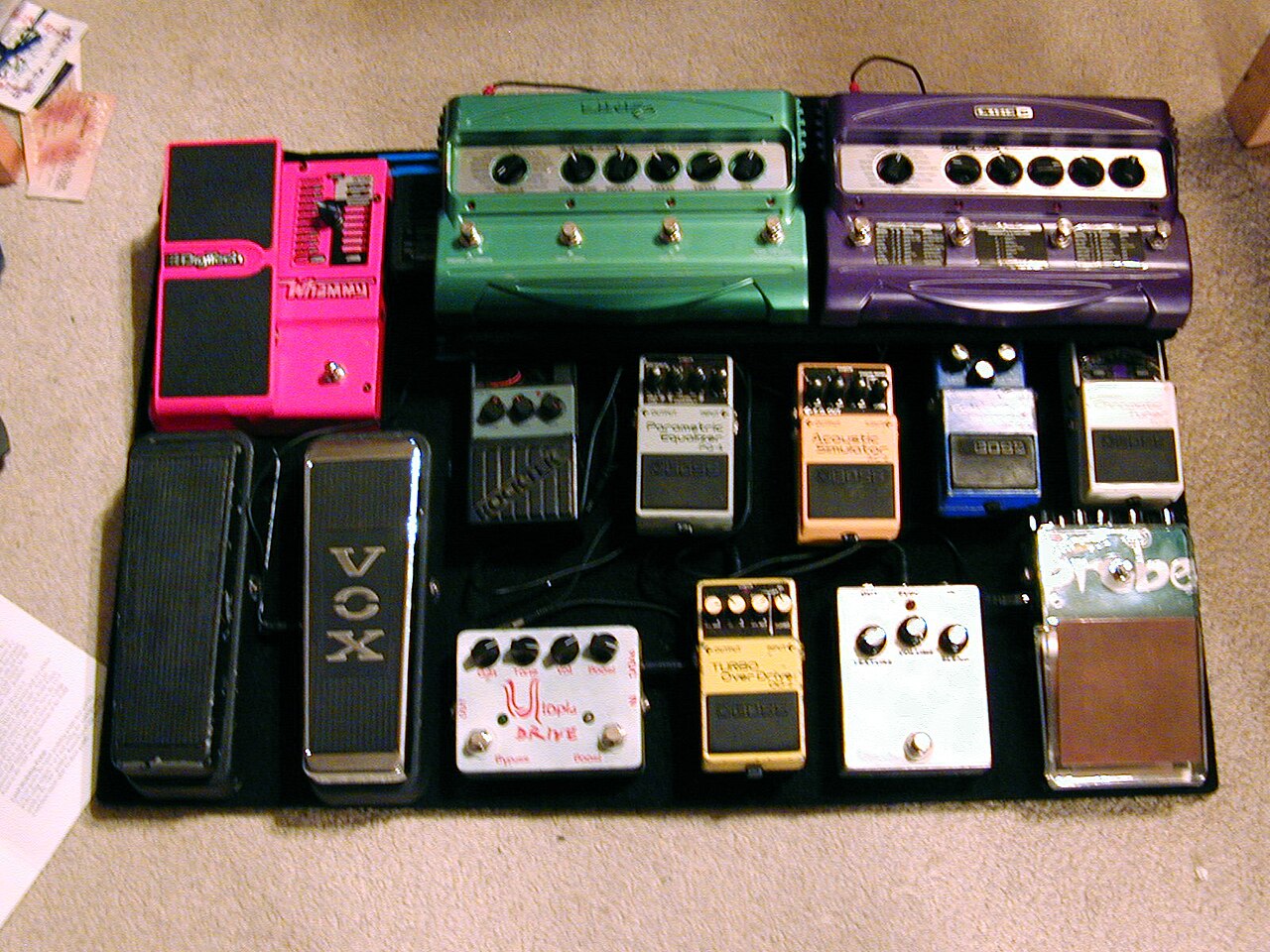
- A pedalboard with wah and effects pedals: John Athayde, Wikimedia Commons, CC BY 2.0.
- A pedalboard with a mix of effects pedals: ArtBrom, Wikimedia Commons, CC BY-SA 2.0.
- Line 6 Helix Floor: GuitarGangsters AI-generated reference illustration, not a photograph.
Latest News
Related
On This Day
Monday 9 November
From this week: