Nuno Bettencourt – The Funk Metal Architect of Fire and Precision
GuitarGangsters Editorial 23 min read Updated 21 October 2026
There are guitarists who can shred.
And then there’s Nuno Bettencourt — the guy who turned shred into swagger.
Born in the Azores, raised in Boston, and forged in the chaos of the late-’80s guitar explosion, Nuno didn’t just play fast — he played with intent. While most were chasing Eddie Van Halen’s brown sound, Nuno was busy rewriting the rulebook: RAT distortion always on, funk groove under the hood, and tone sharp enough to cut glass.
His band Extreme wasn’t a one-hit wonder — it was a revolution hiding behind harmonies. From the platinum anthem “More Than Words” to the electrifying “Get the Funk Out,” Bettencourt proved that soul, speed, and syncopation could coexist. He was the shredder who could swing, the pop star who could solo like a god, and the session gun who somehow ended up backing Rihanna in front of billions at the Super Bowl.
“Tone is honesty. You can’t fake that.”
— Nuno Bettencourt
Nuno’s sound is paradoxical — clean but filthy, disciplined yet dangerous. It’s what happens when Portuguese precision meets Boston grit and Hollywood polish. Every note he plays feels like a middle finger to the predictable, every solo like a conversation with his heroes — Eddie, Brian May, Prince — but told entirely in his own voice.
This is the story of a man who made funk metal dangerous again.
This is the anatomy of his rig, his tone, and his fearless philosophy.
Background / The Artist’s Journey
When Nuno Duarte Gil Mendes Bettencourt arrived in the U.S. from the Azores as a child, no one could’ve guessed he’d grow into one of the most respected guitarists of his generation. The youngest of ten siblings, Nuno’s early life in Hudson, Massachusetts, wasn’t about fame or endorsements — it was about obsession. Hockey, soccer, drums — all got sidelined the moment he picked up a six-string.
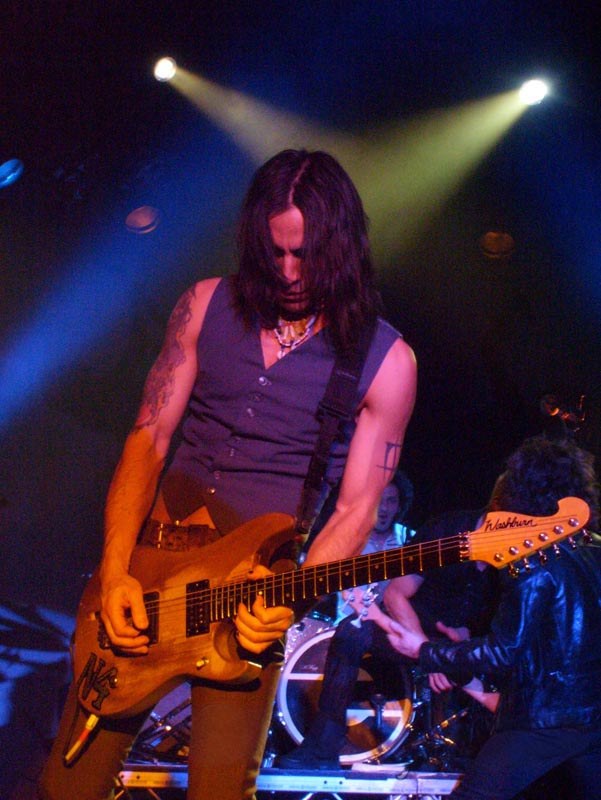
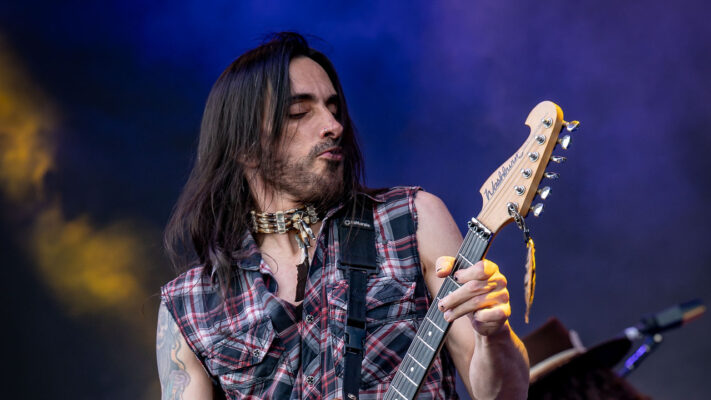
He practiced up to seven hours a day, chasing the feel of Eddie Van Halen, Brian May, and Al Di Meola, but adding something no one else had: groove. By 1985, he’d joined a local Boston act called The Dream, which soon evolved into Extreme — a name that perfectly fit the band’s sound and his style.
Their self-titled debut (1989) dropped just as hair metal was reaching peak saturation — but this was different. Extreme’s funk-metal hybrid was tighter, punchier, more musical. Then came 1990’s Pornograffitti — and everything changed.
The Breakthrough: Pornograffitti and Beyond
Extreme II: Pornograffitti was a masterclass in contrasts.
From the acoustic tenderness of “More Than Words” to the acrobatic riff-fest “He-Man Woman Hater,” it cemented Nuno as a new kind of virtuoso — one who could out-play and out-feel anyone in the room. Produced by Michael Wagener and powered by ADA MP-1 preset 45, the record gave us the holy trinity of tone, technique, and taste.
“Get the Funk Out” wasn’t just a song — it was a manifesto.
— Brian May called it ‘a landmark in rock history’.
By 1992’s III Sides to Every Story, Nuno was stretching far beyond shredding. Conceptual arrangements, orchestral textures, vocal layering — he’d evolved from guitarist to composer. Even when grunge hit and the guitar heroes of the ’80s fell from fashion, Bettencourt adapted rather than disappeared. Waiting for the Punchline (1995) stripped things down — raw, grungy, honest — with tones that were closer to garage than glam.
When Extreme split in 1996, he launched Schizophonic (1997), a solo record that blended alternative rock and pop experimentalism. It didn’t hit mainstream charts — but it showcased the restless creativity of a player who refused to live inside any genre box.
Reinvention: From Mourning Widows to Rihanna
Between the late ’90s and 2000s, Nuno fronted several projects: Mourning Widows, Population 1, and later DramaGods. Each era had new tones, new textures — funk met alternative, pop met aggression. But perhaps the wildest chapter came in 2009, when he joined Rihanna’s live band.
For over a decade — including the 2023 Super Bowl Halftime Show — Bettencourt was the stealth weapon behind one of pop’s biggest icons. Instead of abandoning his rock roots, he fused them into modern pop production. The same precision that once cut through Pornograffitti now powered “Umbrella” and “Diamonds” in front of global stadium audiences.
“People think I had to change my tone for pop.
I didn’t. They had to make room for it.”
— Nuno Bettencourt, Guitar World 2023
Then came the full-circle moment: Extreme’s 2023 comeback album Six — their most explosive since the ’90s. Songs like “Rise” and “Other Side of the Rainbow” showed Nuno hadn’t mellowed with age; he’d sharpened. His solos were melodic yet mechanical, soulful yet surgical — proof that funk-infused hard rock still had plenty to say in a world of digital sterility.
Legacy of a Relentless Innovator
From his early days jamming to Queen and Led Zeppelin in a small Massachusetts basement to commanding arenas alongside Rihanna, Nuno’s journey mirrors the evolution of the electric guitar itself — analog roots, digital reach, but human at the core.
He’s inspired guitarists as diverse as Synyster Gates, Tom Quayle, Tosin Abasi, and John 5, all citing his hybrid of rhythmic precision, tone minimalism, and fearless feel as the next-generation blueprint.
For the modern player, Bettencourt represents balance — technical brilliance fused with authenticity. He reminds us that gear is a tool, but conviction is tone.
Nuno’s rig is the paradox that makes perfect sense: a minimalist toolkit weaponized by ridiculous right-hand control. No 40-pedal spaceship, no boutique voodoo—just the right guitar into the right front end, with a RAT snarling quietly underneath everything. If you’re here for chrome and blinking lights, keep walking. If you’re here for attack, articulation, and attitude, welcome home.
“I’m not an ‘effects’ guy. I’m a ‘play it like you mean it’ guy.”
— Nuno Bettencourt
Guitars (signature & primary, specs, mods, trivia)
Washburn N4 (the lifer) — alder, speed, and steel.
The N4 isn’t just Nuno’s signature—it’s a statement. Alder body for snap; maple bolt-on neck with Stephen’s Extended Cutaway so you can freight-train past the 17th fret without contorting your wrist. Floyd Rose on deck for surgical vibrato and dive-bombs that return to pitch like a boomerang.
- Pickups:
• Bridge: Bill Lawrence L500-XL (the high-output, razor-edged one). This is the “pop out of the mix” secret—fast transient, tight lows, bright upper mids that never smear.
• Neck: Seymour Duncan ’59—warm, honest PAF-style for cleans and the rare neck-lead. - Electronics & controls:
One Volume, One Tone. That’s it. Nuno has famously kept the signal path short—less copper, more truth. Modern N4s often use a push-pull on the tone for coil tricks; the core recipe is still bridge > volume > jack. - Hardware & setup highlights:
Floyd Rose (often with EVH D-Tuna for instant E↔D), Graph Tech or brass sustain pieces depending on era, medium-low action for speed but enough resistance to dig in. Radiused to facilitate those wide muting fields his right hand lives on. - Finish & feel:
Nuno has long favored the unfinished/oiled neck and “de-glossed” feel—no sticky lacquer, no fight. If it looks relic’d, it’s because he sweated the finish off on tour, not because a factory took a belt sander to it. - Other N-series & oddballs:
You’ll spot N5/N6/N8 and the carved-top P4 in various eras, plus acoustics for “More Than Words”/“Hole Hearted.” In recent seasons, he’s teased Nuno-branded models (think stripped-down, road-honest rock tools) without abandoning the N4 DNA.
Tone takeaway: the L500-XL into a floating Floyd, a simple control scheme, and a neck that begs you to play past your comfort zone. If you swap the pickup or overcomplicate the wiring, you’ll miss the point: transient speed and clarity first, everything else second.
Amps & Cabinets
Nuno’s amp history reads like a working guitarist’s survival guide: use what cuts, don’t fear bright, and make the front end your throne room.
Studio cornerstone (peak-era studio tones):
- ADA MP-1 programmable tube preamp → Furman parametric EQ (for that surgical mid trim/boost) → Macintosh hi-fi power amp → Marshall 4×12.
- Why it works: the MP-1 delivers saturated but highly articulate gain; the rack EQ sculpts the pick attack “window”; the hi-fi power section keeps the low end unflubby while the Marshall cab gives classic rock bark.
Live workhorses (1990s → present):
- Marshall JCM2000 DSL/TSL heads into Marshall 4×12 (Celestion G12T-75 in many modern rigs).
- Typical starting lane for the Lead/Crunch channel: Gain ~7, Treble ~7, Mids ~4, Bass ~3, Presence ~2, Master ~3. Use your ears and the room; Nuno’s secret is letting the RAT set the input feel rather than drowning the amp in preamp gain.
Signature muscle (2008 →):
- Randall NB King 100 head + NB412 cabs. The idea: bake the RAT-like bite into the amp’s front end so the “always-on” philosophy translates even if the pedalboard doesn’t make the flight.
Cab & speaker reality check:
Greenbacks give chewy mids and friendly top; G12T-75 adds the modern, scooped sheen and tight bottom that keeps percussive rhythms from turning to sludge. Nuno has lived in both neighborhoods; choose based on how loud you can push the cab and how much cut you need beside your drummer.
Room recipe: treble forward, controlled presence, don’t fear the scoop if your right hand is articulate. The percussive right hand is the missing mids.
Pedals & Signal Chain
If you remember nothing else, remember this: the RAT is not a “lead pedal.” It’s the floor the house stands on.
Core chain (front of amp):
- Pro Co RAT (classic or tasteful clone), always on.
- Starting point: Distortion 8–8.5, Filter ~1 o’clock, Volume to taste.
- Job: add a hint of compression and a taut, harmonically rich edge that makes syncopated palm-mutes explode and tapped lines separate.
Loop & ambience (tasteful, never swampy):
- Boss DD-3 (often two units) for dotted-eighth and slap—the dual-delay thing lets the solo sit in air without blurring transients.
- Occasional MXR Phase 90 for motion, Boss OC-3/PS-3 for specific moments, and the rare talkbox cameo. Historic chorus tones often came from the ADA era; live, he leans dry and lets the rhythm hand do the modulation.
Signal order (live-practical):
Guitar → RAT → Amp input // Loop: Send → DD-3 #1 → DD-3 #2 → Return.
Keep leads short, buffers sensible, and ground the pedalboard like your gig depends on it—because it does.
“The pedalboard is not the show. Your right hand is the show.”
— Shop talk you’ll hear at soundcheck
Strings, Picks & Setup
- Strings: Often .009–.052 (a custom-feeling “hybrid” set) tuned Eb. The light top keeps speed and bending effortless; the heavy low end keeps Drop-D riffs from flapping out when the Floyd floats.
- Picks: Historically Fender Heavy; modern tours have seen custom Grover Allman cells. The important part is rigid attack—thin picks won’t give you Nuno’s consonants.
- Action & relief: Medium-low with a floating Floyd. Low enough to flash; high enough to bite back if you’re lazy.
- Intonation & stability: Locking nut dialed, studs lubricated, springs balanced to the string gauge. Don’t be precious—be precise.
Practical translation: if your Eb-tuned hybrid set, floating trem, and rigid pick aren’t giving you an audible “tick” on the front of every note, you’re not there yet.
Tunings & Tone Philosophy
- Standard E and Eb (half-step down) dominate; Drop D (and the quick EVH D-Tuna flip) appears when the riff demands it.
- Philosophy in one line: more rhythm hand, less knob turning. The RAT adds a controlled “push”; the amp provides headroom and treble authority; the bridge pickup makes the statement.
Why it works live:
Bright, scooped-ish rigs can sound thin in the bedroom—but with a drummer and bass, they create space. Nuno’s percussive playing supplies the missing midrange in the time domain (the attack), so the audience hears clarity, not honk.
Bedroom fix:
If you’re practicing alone, add a touch more mids (5–5.5) and back the presence down a hair. When you step onstage, restore the treble-forward balance and let the mix do its job.
Quick-Reference “Era Map”
- 1989–1992 (Peak studio articulation): Washburn N4, L500-XL/’59; ADA MP-1 → EQ → hi-fi power → Marshall 4×12; RAT always on; dual DD-3 for air.
- 1993–2006 (Touring modern): N4 into Marshall JCM2000 stacks; RAT floor; Phase 90 for color.
- 2008–present (Signature muscle): N4 + Randall NB King 100/JCM2000; G12T-75 authority; same RAT philosophy, same delay discipline; internal D-Tuna tricks for quick drops.
Starter Settings (pin these, then tune by ear)
- RAT: Dist 8.5 / Filter 1:00 / Level unity or +1 dB
- Marshall-style head (lead channel): Gain 7 / Treble 7–7.5 / Mids 4 / Bass 3 / Presence 2–3 / Master 3 (or venue headroom)
- DD-3 #1: 380–420 ms, mix ~30–35%, repeats 2–3 (lead space)
- DD-3 #2: 110–130 ms, mix ~15%, repeats 1–2 (thickness)
- Guitar: Bridge pickup, volume wide open; tone full unless a part calls for a subtle roll-off
Playing Style & Tone Philosophy
There are fast players.
And then there’s Nuno Bettencourt — a guitarist who plays like he’s trying to outrun gravity. His right hand isn’t just rhythm — it’s percussion, it’s punctuation, it’s punctuation marks made of steel. Every riff, every muted strike, every syncopated burst is calculated chaos wrapped in groove.
“If it doesn’t move, it doesn’t matter.”
— Nuno Bettencourt
While most of his late-’80s peers were busy chasing clean sweeps and lightning-fast arpeggios, Nuno was building a new language — funk meets metal meets Brazilian pulse. His technique was never about showmanship alone. It was about feel precision — that sweet spot where attitude, groove, and melody collide.
The Right Hand: The Engine Room
Nuno’s right hand is pure violence with purpose. He attacks the strings like a drummer smacking a snare — sharp, fast, and just a millisecond ahead of the beat.
He plays into the strings, not across them, using a near-horizontal wrist angle for maximum bite and control.
- Palm Muted Hammer-Ons: His signature. You can hear it in He-Man Woman Hater and Cupid’s Dead. Those machine-gun bursts aren’t pedals — they’re right-hand muscle memory and economy of motion.
- String-Skipping Funk: “Get the Funk Out” is practically a textbook on how to use the pick as a rhythm instrument.
- Dynamic Control: Nuno can go from razor-pick attack to featherlight ghost strokes without changing his gain. The RAT stays on; his hand is the volume knob.
When he locks into a groove, you feel the air move. It’s not shredding — it’s percussion disguised as melody.
The Left Hand: Control Meets Chaos
On the fretting side, Nuno’s game is about agility and expression, not brute force. He keeps his thumb low and his vibrato wide — somewhere between Eddie Van Halen’s elasticity and Brian May’s vocal precision.
- Fretting approach:
He plays light but fast. Minimal pressure, maximum clarity. You won’t see him muscle frets; he glides. - Vibrato:
Big, confident, and deliberate. Every sustained note sings because he controls the pitch — not the amp. - Tapping:
Fast and rhythmic, often combined with string skipping. Listen to Flight of the Wounded Bumblebee — that’s not a studio trick. That’s a right-left hand duel at 180 bpm.
“Technique is useless unless it makes the groove feel better.”
— Nuno Bettencourt
Rhythm as a Weapon
Nuno treats rhythm like melody’s evil twin.
His riffs don’t sit on the grid; they dance around it. He’ll accent off-beats, flip patterns mid-bar, or syncopate chord punches so the groove breathes like a funk drummer on Red Bull.
This approach separates him from the typical shredder: he thinks like a rhythm guitarist, even in solos.
Songs like “Decadence Dance” and “Warheads” groove harder than most bands’ entire rhythm sections — because Nuno’s guitar is the rhythm section.
If you listen close, you’ll hear parallels to players like [John Frusciante – The Soul of the Red Hot Sound] and [Prince – The Purple Architect of Groove and Tone]. Both built entire worlds around syncopation and feel rather than speed.
Melodic Construction: Between Eddie and Prince
Nuno once described his approach as “Van Halen meets James Brown.”
That’s not hyperbole.
He fuses the harmonic daring of the former with the rhythmic control of the latter. His solos are rarely linear — they’re conversations.
He uses melodic repetition and rhythmic phrasing as hooks — a songwriting trick most “lead” players never learn.
The “Get the Funk Out” solo, for instance, doesn’t just show off chops — it sings. Every motif builds on the last, like a voice arguing with itself in perfect pitch.
In Rise (from Extreme’s Six), he channels that same melodic logic into a more modern frame — cinematic, wide, with cleaner phrasing but the same swagger. It’s the sound of a veteran who’s mastered not just playing, but storytelling through tone.
Live Energy and Philosophy
Watch Nuno live and you’ll see what separates him from 99% of modern guitarists:
He plays like it could all collapse at any second — and that’s the point. He doesn’t aim for perfection; he aims for impact. The pick attack, the feedback, the swing — it’s all part of the show.
“Mistakes are cool. They’re human. They make the solo feel alive.”
— Nuno Bettencourt
Even in polished settings — like onstage with Rihanna — he kept that edge. Same rig, same tone, same energy. Pop production around him, yes — but when his solo drops in “Umbrella,” it’s unmistakably him: high gain, sharp articulation, rhythmic phrasing that sounds like it was pulled out of Pornograffitti and dropped into the halftime show.
Tone Philosophy: Hands First, Gear Second
At its core, Nuno’s tone philosophy is brutally simple:
- RAT on, always.
It’s the compression, not the distortion. - Bright pickups, low gain.
If your attack’s good, brightness is your friend. - Less EQ, more intent.
Most of the EQ lives in the hands. - Play with motion.
The right hand is the modulator — delay just expands it. - Every note must groove.
Even when soloing, there’s rhythm in the air.
It’s the antithesis of modern modeling culture — less about presets, more about personality. Nuno’s setup could fit in a backpack, but his tone fills arenas because his intent fills every note.
If you’re chasing that tone, you’ll find that no plugin, pedal, or patch can fake his percussive feel. You either have it in your right hand, or you don’t. And that’s why his sound has outlived every gear trend of the last 30 years.
There’s no shortcut to sounding like Nuno Bettencourt — but there is a roadmap.
You don’t need a boutique amp wall, you need discipline, touch, and control. The man could plug into a $200 combo and still sound like a thunderstorm wrapped in funk. Why? Because the gear only shapes the edges — his hands made the music.
But for those who want to chase that razor-sharp Pornograffitti tone, here’s how to build the modern Bettencourt sound, from bedroom setups to full-stage rigs.
“If your tone doesn’t make people move, it’s not tone — it’s noise.”
— Nuno Bettencourt
The Core Signal Chain (Classic Setup)
Guitar → Pro Co RAT → ADA MP-1 → Furman EQ → Macintosh Power Amp → Marshall 4×12
That’s the original Pornograffitti signal flow, built for surgical articulation and funky punch. It’s compact, logical, and — most importantly — alive. Every piece adds texture, not clutter.
- Pro Co RAT: Always on. Think of it as the glue — a compressor disguised as distortion.
- ADA MP-1: Dual 12AX7 preamp, programmable. Use Preset 45 as your baseline.
- Furman PQ-3 EQ: Optional, but that mid sculpt (around 800 Hz) is key.
- Macintosh Power Amp: Pure headroom, zero coloring.
- Marshall 4×12 (Greenbacks): Adds bark and bite — the roar that defined 1990.
Quick Bedroom Translation:
Guitar → RAT (Dist 8 | Filter 1 o’clock | Level 3) → Marshall DSL → Celestion cab sim.
You’ll get 80 % of the DNA right there.
Digital Modeler Preset (Helix / Kemper / AmpliTube)
Chain:Guitar → RAT block (Dist 8.5, Filter 1.0) → ADA MP-1 model (Gain 7 / Bass 6 / Mid 5 / Treble 7.5 / Presence 3) → 4×12 IR (Celestion G12T-75) → Dual Delay
Delay 1: 380 ms @ 30 % mix
Delay 2: 120 ms @ 15 % mix
Reverb: Light plate (20 % mix)
EQ Curve: Low cut 80 Hz | Mid dip 750 Hz | High shelf +2 dB at 6 kHz
“The dotted-eighth thing isn’t an effect — it’s a rhythm section.”
— Nuno Bettencourt
Starter Amp Settings (Marshall Style)
| Control | Setting | Why it Works |
|---|---|---|
| Gain | 7 | Enough saturation to react to touch |
| Bass | 3 | Keeps bottom tight for funk rhythms |
| Middle | 4 | Scooped just enough for clarity |
| Treble | 7 | Essential for cutting through |
| Presence | 2 – 3 | Adds bite without ice-pick highs |
| Master | 3 | Cranked power-amp feel without mush |
Budget Rig Recommendations
Under $1 000 Setup (2025 Market):
- Guitar: Harley Benton ST-62 or Charvel So-Cal Style 1 HH FR
- Pickup Swap: Bill Lawrence L-500XL (bridge)
- Pedal: Pro Co RAT 2 or JHS Pack Rat
- Amp: Marshall DSL 20 Combo or Boss Katana Artist MkII (headroom + FX loop)
- Delay: Boss DD-3 (x2 if possible)
- Strings: GHS Boomers .009 – .052 (Eb tuning)
For digital rigs, use a Helix LT or Quad Cortex preset with those parameters and load a Greenback or G12T-75 IR for the cab.
Technique Settings – The Human EQ
Pick Attack:
- Angle ~30°; down-stroke dominant. Think snare drum.
- The attack creates mids — don’t fix with knobs.
Vibrato & Bends:
- Wide, controlled, vocal.
- Always return to pitch; Nuno’s bends are in tune even at chaos speed.
Rhythmic Feel:
- Practice funk strumming with no distortion, full clean tone.
- Then kick on the RAT — if it suddenly sounds messy, it’s not the pedal; it’s you.
Delay Discipline:
- Never let repeats crowd the groove.
- Each delay hit should feel like a second snare behind your riff.
The “Extreme Starter Preset” (For Modelers)
| Block | Setting | Notes |
|---|---|---|
| Drive | RAT, Dist 8.5 / Filter 1 / Vol 3 | Always On |
| Preamp | ADA MP-1 Crunch, Gain 7 / Mid 5 / Tre 7.5 | Core tone |
| EQ | Scoop 750 Hz – 4 dB | Clarity |
| Cab | 4×12 Greenback IR | Warmth |
| Delay | Dotted-8th 380 ms @ 30 % mix | Depth |
| Reverb | Plate Light 20 % mix | Space |
Save that, crank your monitors, and you’re in the ballpark.
Common Mistakes (and How to Fix Them)
❌ Too much gain: Kills articulation. The RAT is compression, not chaos.
❌ Over-EQing mids: Your right hand is the mids.
❌ Ignoring delay timing: Bettencourt’s phrasing locks to delay — not over it.
❌ Using the wrong pickup: The L-500XL’s bite defines the mix. A generic humbucker will blur.
❌ Forgetting the groove: If your head isn’t bobbing, it’s not Nuno.
Practice Rituals for Nuno-Level Precision
- Metronome Groove Drills: Play 16th-note funk patterns @ 100 bpm with muted strings. Focus on dynamics, not speed.
- Palm-Muted Hammer-Ons: Alternate between muted and open notes in groups of 7 – 9.
- Delay Sync Exercise: Set a DD-3 to 380 ms; play rhythms so your repeats land on the backbeat.
- “Rise” Solo Breakdown: Record it at half speed. Learn phrasing first, speed second.
- Dynamic Volume Control: Practice solos with volume knob at 6, then 8, then 10 — feel how the amp breathes.
The “Secret Sauce” – Philosophy in Action
Nuno’s tone = technique × touch × transients.
He never chased perfection; he chased feel.
His setup gives you room to fail gloriously — every nuance, every slip becomes part of the performance.
“It’s about attitude, not amplitude.”
— Nuno Bettencourt
If Eddie Van Halen built the highway, Nuno Bettencourt burned rubber across it in sixteenth notes. He wasn’t just another fast player in the neon glow of the late ’80s—he was the guy who gave shred a heartbeat again. Where others turned technique into gymnastics, Nuno turned it into conversation. His solos talked, his rhythms grooved, and his tone still slices through time like a straight razor through velvet.
“You can teach speed. You can’t teach feel.”
— Nuno Bettencourt
A Bridge Between Worlds
When Extreme dropped Pornograffitti in 1990, the guitar world split in two: metalheads called it “funky,” funk players called it “metal,” and Nuno didn’t care what you called it as long as it moved. That record didn’t just give us “More Than Words” — it gave us a new kind of player: one who could quote Prince, channel Eddie, and outgroove everyone else on MTV.
From there, Bettencourt became the connective tissue between genres that rarely spoke to each other:
- Metal: For the aggression and right-hand discipline.
- Funk: For the syncopation and groove.
- Pop: For melody and precision.
- Fusion: For the harmonic daring few noticed until III Sides to Every Story.
He essentially taught a generation that you didn’t need to choose between feel and flash — you could have both if you earned them.
Influence on the Next Generation
The fingerprints are everywhere.
- Synyster Gates (Avenged Sevenfold): cites Nuno as a rhythm inspiration — not just a lead god.
- Tosin Abasi (Animals as Leaders): borrowed the concept of percussive phrasing through minimal gain.
- Tom Quayle: points to Nuno’s phrasing as a “masterclass in timing and economy.”
- John 5: once called Nuno “a player who grooves harder than drummers.”
And it’s not just the virtuosos — you’ll find echoes of Bettencourt in players as different as Bruno Mars’ live guitarists, Paramore’s Taylor York, and even modern R&B players chasing hybrid clean tones that still punch through.
“If you removed Nuno from history, every modern rhythm soloist would lose half their vocabulary.”
— Guitar World, 2024 retrospective
Legacy on Stage and in Studios
When Nuno joined Rihanna’s live band in 2009, it raised eyebrows across the rock press. What was a funk-metal demigod doing in pop? The answer: redefining pop guitar credibility.
He didn’t change his tone — the world changed around it. His razor-edged right-hand groove cut through massive pop arrangements like a secret weapon, proving that organic, human guitar still had a place in the digital era.
And then came the return — Six (2023).
If “Rise” doesn’t make your jaw drop, check your pulse. It’s every era of Bettencourt distilled: the rhythm of Pornograffitti, the harmonic sophistication of III Sides, the punch of Waiting for the Punchline. Critics called it “proof that guitar heroes never die—they just reload.”
Teaching the Gospel of Groove
Nuno’s latest venture, the Six String Sanctuary guitar camp (launching January 2026), is more than a clinic — it’s a philosophy summit. Attendees won’t just learn sweep picking; they’ll learn why notes matter. Expect lessons on tone control, dynamics, and that elusive percussive right-hand that made him a legend.
In true Bettencourt style, he’s building the next generation not by spoon-feeding licks, but by teaching the mindset behind them.
The Paradox of Permanence
Every decade produces its innovators. Most burn bright and fade. But Nuno’s legacy keeps evolving because it was never about fashion — it was about fundamentals.
He understood that tone isn’t in the amp, it’s in the attack; groove isn’t in the click track, it’s in the conviction.
His playing lives in a weird, wonderful intersection of danger and grace.
He can headline with Extreme, rip with Rihanna, and still sound unmistakably himself.
“Tone is honesty. You can’t fake that.”
— Nuno Bettencourt
That’s why he matters more than ever — in an age of perfect quantization and AI guitar lines, Bettencourt remains the human algorithm that no machine can replicate.
Before we close the lid on the funk-metal lab, here’s a rundown of the most-searched questions fans ask about Nuno Bettencourt, answered the GuitarGangsters way — raw, real, and without marketing fluff.
Q: What pickups does Nuno Bettencourt actually use?
A: His bridge pickup is the legendary Bill Lawrence L500-XL — not the modern Wilde version, but an early original from before Lawrence left the company. The neck pickup is a Seymour Duncan ’59. That combo gives him the glassy articulation and mid-punch needed for percussive rhythm and vocal leads.
Q: What’s his main guitar?
A: The Washburn N4 — his personal signature since the early ’90s. Alder body, maple neck, Stephen’s Extended Cutaway, and an oiled finish so raw it feels like a vintage surfboard. He’s also launching his own Nuno Guitars line (Dark Horse & White Stallion models) that continue his “no paint, no pretense” design philosophy.
Q: What amp does he use live today?
A: The Randall NB King 100 — his signature head built to replicate the ADA MP-1 + RAT + Marshall stack chain from his Pornograffitti era. On tour, he still keeps Marshall JCM 2000 DSL/TSL heads as backups.
Q: What are Nuno’s go-to pedals?
A: He keeps it brutally simple:
- Pro Co RAT (always on) – compression + tight punch
- Boss DD-3 (x2) – dual delay setup (380 ms + 120 ms)
- MXR Phase 90 – occasional swirl
- Boss PS-3 Pitch Shifter – studio harmonizer moments
No fancy racks, no reamp trickery. Just precision and sweat.
Q: What’s Nuno’s tuning and string gauge?
A: 95 % of his catalog is half-step down (Eb). For heavier riffs or live Drop D moments, he uses an EVH D-Tuna on his Floyd Rose. Strings: GHS Boomers .009–.052 or Dean Markley Signature .010–.052.
Q: What’s the secret to his tone?
A: It’s not a secret — it’s physics and philosophy.
- Bright pickup into low-gain amp = transients for days
- RAT pedal = compression, not distortion
- Dynamic right hand = midrange in motion
- Tone discipline = play less, mean more
You can copy the gear. You can’t copy the conviction.
Q: Which songs best showcase his tone?
A:
- “Get the Funk Out” – quintessential Nuno; percussive rhythm, blistering solo, Brian May-approved.
- “He-Man Woman Hater” – hammer-on tapping intro that redefined shred.
- “Rise” (Six, 2023) – modern clarity meets classic aggression.
- “More Than Words” – proof that tone is touch, not distortion.
Q: Did Nuno really tour with Rihanna?
A: Yes. From 2009 through the 2023 Super Bowl Halftime Show, he was her live guitarist. He used the same rig philosophy — minimal pedals, massive tone. The pop world got its first taste of funk-metal tone under stadium lights.
Q: What advice does he give young players?
A: Focus on groove and honesty before speed.
He’s said countless times that “feel trumps flash.” Learn rhythm guitar like a drummer, learn leads like a singer.
“I don’t care how fast you can play.
Can you make me move?”
— Nuno Bettencourt
Links
Nuno Bettencourt remains the rare guitarist who made funk swing hard enough to melt metal. His tone still stands as a monument to honesty over hype, groove over gimmicks. In a world obsessed with modeling and presets, Nuno’s sound is a reminder: tone doesn’t live in silicon — it lives in sweat.
“Play every note like it’s the last one you’ll ever get to mean.”
— Nuno Bettencourt
Image credits
- Nuno Bettencourt, Oslo 2024: Birgit Fostervold, Wikimedia Commons, CC BY-SA 4.0.
- Nuno Bettencourt: sezzles (credited as GMG Creative), Wikimedia Commons, CC BY-SA 2.0.