Joe Satriani – The Alien Who Gave the Guitar a Human Voice
GuitarGangsters Editorial 26 min read Updated 21 October 2026
There are guitar heroes, and then there’s Joe Satriani — the man who taught the world that a guitar doesn’t need a voice to speak. With over ten million albums sold, fifteen Grammy nominations, and a career stretching across four decades, Satriani didn’t just define instrumental rock — he made it mainstream.
His tone is as recognizable as his shaved head and silver Ibanez: rich, singing sustain that sounds less like circuitry and more like a living, breathing entity. Every note bends like it’s gasping for air, every phrase feels like a confession. In an era obsessed with volume and velocity, Satriani found something rarer — clarity.
“I wanted the guitar to sound like a singer trying to tell a story,” he once said. “Every solo should have a voice, a soul, and a reason.”
From Surfing with the Alien to The Extremist, Crystal Planet, and his modern epic The Elephants of Mars, Joe’s journey is a living evolution of tone — one that forever changed how the electric guitar communicates emotion.
If you’ve already explored [Steve Vai – The Alchemist of Sound and Sorcery] or [Eric Johnson – The Perfectionist of Tone], then buckle up — this is the sound of the cosmos speaking in 6 strings.
Background / The Artist’s Journey
Joe Satriani’s story begins not in the limelight but in the suburbs of Westbury, New York, where a 14-year-old kid dropped his football helmet on September 18, 1970 — the day Jimi Hendrix died — and decided that the guitar would become his life’s work. “I was devastated,” he later recalled. “I picked up the guitar that day, and I never put it down again.”
That single act set the trajectory for one of the most disciplined, curious, and expressive guitarists the world has ever known. Unlike most rock prodigies, Satriani’s foundation was built not in chaos but in structure: he studied under jazz luminaries Billy Bauer and Lennie Tristano, absorbing theory, phrasing, and harmony from musicians who thought in chords and modes rather than riffs.
By the late 1970s, Satriani wasn’t just a guitarist — he was a teacher. Among his students? Steve Vai, Kirk Hammett of Metallica, Alex Skolnick of Testament — players who would go on to define entire genres. His influence was already echoing through arenas before he’d even released a record.
In 1986, that changed. Armed with nothing but a Kramer Pacer, a homemade Strat copy, and a maxed-out credit card, Satriani self-funded his debut, Not of This Earth. Recorded on a shoestring and released through Relativity Records, the album was an alien statement in a guitar world dominated by flash and hair spray — clean, melodic, strange, and deeply human.
Then came the explosion.
Surfing with the Alien (1987) — recorded for just $13,000 — rewrote every rule in instrumental rock. Where other virtuosos played for speed, Satriani played for feel. Tracks like Satch Boogie and Always With Me, Always With You didn’t just showcase chops — they sang. His tone was born from limitations: a malfunctioning Eventide H949, a Chandler Tube Driver, and a restless obsession with phrasing.
“It wasn’t about distortion or flash,” he told Guitar World. “It was about emotion. I wanted every note to mean something.”
By 1989, Flying in a Blue Dream had elevated him from cult hero to mainstream icon. Suddenly, MTV was airing instrumental guitar music, and record executives were scrambling to understand how a player without a singer could top the charts. Satriani became the face of the impossible: a virtuoso who sold millions without sacrificing musicality.
Throughout the ’90s and 2000s, Satriani’s path became a journey of evolution rather than repetition. He joined Deep Purple as a touring guitarist (replacing his idol Ritchie Blackmore temporarily in 1993), founded the legendary G3 Tour alongside Vai and Eric Johnson in 1996, and later formed the supergroup Chickenfoot in 2008 with Sammy Hagar, Michael Anthony, and Chad Smith.
Yet, through all of it, the heart of Satriani’s artistry remained unchanged: a relentless pursuit of tone that could speak. Every album felt like a new experiment in how far he could stretch the instrument without losing its soul.
From the glassy, ethereal leads of Crystal Planet (1998) to the modern production of Shockwave Supernova and the cinematic vastness of The Elephants of Mars (2022), his sound kept evolving — proof that innovation doesn’t have to mean losing touch with emotion.
“The biggest compliment I get is when someone says, ‘Your guitar made me feel something,’” Satriani said. “That’s the goal — not to impress, but to connect.”
Even today, Satriani’s influence extends beyond his recordings. His Ibanez JS Series guitars and DiMarzio pickups have become staples in studios and stages worldwide, and his tone philosophy — guitar as voice — continues to guide a generation of tone chasers.
And while many guitarists chase tone through gear, Satriani chases it through meaning.
He’s not just playing notes — he’s translating thoughts.
The Rig / Gear
Joe Satriani’s rig is a temple of tone. Every screw, every solder joint, every mod tells a story about his lifelong obsession with clarity, sustain, and control. His setup is not about showing off — it’s about giving emotion a mechanical body. From his early Kramer days to his modern Ibanez JS2400 and beyond, Satriani’s gear has evolved like a language that he alone speaks fluently.
Guitars – The Ibanez JS Legacy
When Joe Satriani signed with Ibanez in 1988, it wasn’t just an endorsement — it was a revolution in ergonomics and design philosophy. The Ibanez JS Series, based on his personal modifications to an old Kramer Pacer and a homemade Strat, became one of the most successful signature lines in history.
His first production model, the JS1 (1989), introduced what would become his trademark design language: a sleek, rounded body for comfort, a 22-fret maple neck with a 250mm radius, and an Edge double-locking tremolo system that could dive-bomb into oblivion and still return perfectly in tune.
Later came the JS1000, JS1200, JS1600, JS2400, JS2410, and JS2450, each refining the formula while staying true to Joe’s minimalist philosophy — no frills, just tone.
“A guitar should disappear when you play it,” Satriani told Guitar Player. “It shouldn’t fight you. It should let you feel.”
At the heart of every JS model is the partnership with DiMarzio, one of the longest artist-pickup relationships in history.
- 1980s–early ’90s: DiMarzio PAF Pro and FRED defined the “Surfing” and “Blue Dream” tones — mid-rich, articulate, slightly compressed.
- 2000s: introduction of PAF Joe (neck) and Mo’Joe (bridge) brought modern warmth and harmonic punch.
- 2014–present: Satch Track single-coil-sized humbucker — a marvel designed for the 24-fret JS2400 to maintain neck clarity without hum.
Each pickup was tailored to Satriani’s tone principle: retain articulation under massive gain, never lose vocal quality, and always sing.
His finishes are as iconic as his tones — the Chrome Boy (JS2PRM) mirrored guitar is a showpiece in itself, while the JSBDG (Black Dog) remains a cult favorite among collectors.
Even his prototypes — like the JS6, the only JS with a mahogany body — are worshipped among gearheads for their raw, organic response.
Whether in the studio or on stage, Joe’s primary guitars are always tuned for emotional accuracy, not cosmetic flash.
As he once put it:
“If you close your eyes, the guitar should sound like it’s breathing.”
Read our guide to the Ibanez JS2410 Joe Satriani Signature.
See also: [Steve Vai – The Alchemist of Sound and Sorcery]
Amps & Cabinets – Marshall Power with Surgical Precision
While many guitarists rely on amp distortion to define their sound, Satriani does the opposite. His philosophy: start clean, then sculpt.
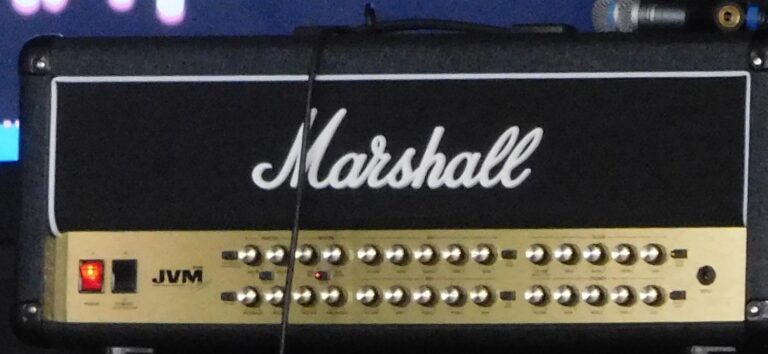
In his early years, he relied on Marshall Plexi and Jubilee heads, sometimes paired with Peavey JSX models he helped design in the ’90s. But his defining tone came with the Marshall JVM410H, the amp that became synonymous with the “modern Satch sound.”
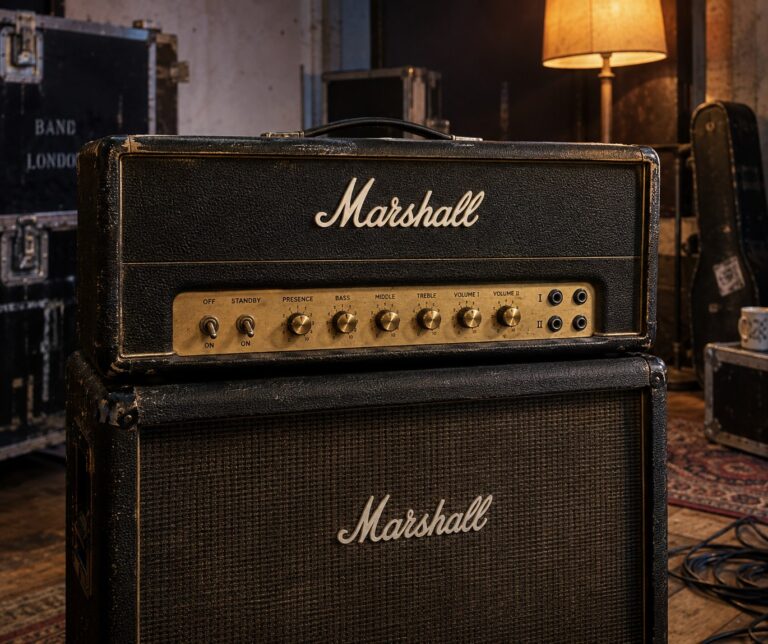
Unlike most players, Joe doesn’t run the JVM hot for saturation — he uses the clean channel, pushing it with pedals for a precise overdrive. This keeps his tone dynamic, transparent, and incredibly expressive. The result is what engineers call “piano clarity”: every note defined, even under extreme sustain.
His modern rig usually features:
- Three Marshall JVM410 heads (custom prototypes, live switching)
- Marshall 4×12 cabinets with Celestion Vintage 30 speakers
- A 3rd Power Dream Series amplifier as auxiliary support for stereo width
- Parallel delay routing to keep effects pristine and separated from the dry tone
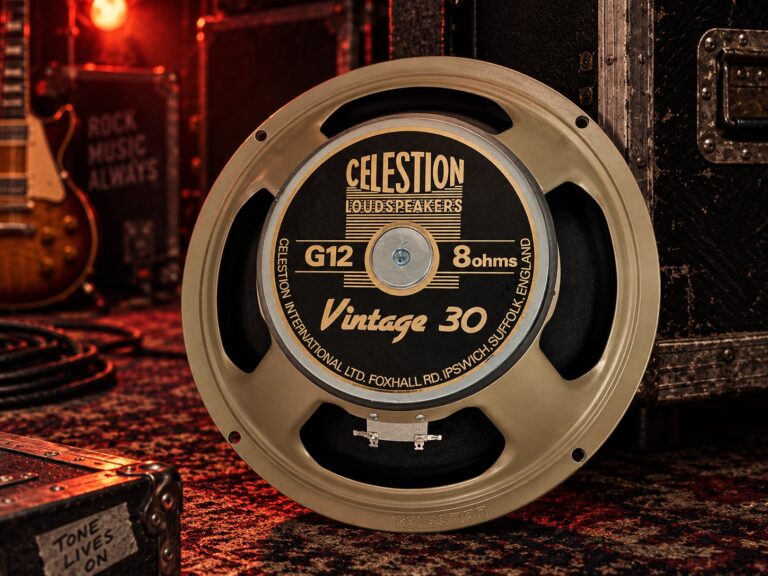
“The amp should be honest,” Joe said in a Premier Guitar rig rundown. “If it lies, you’ll play worse.”
Satriani’s setup is designed for headroom, not crunch — a bold choice for a high-gain world. The clarity lets his legato phrasing breathe, and his picking dynamics translate flawlessly from the softest whisper to full-on cosmic roar.
Related: [Marshall JVM410 – The Clean Beast of Modern Rock]
Pedals & Signal Chain – The Satch Way
Joe’s pedalboard is deceptively simple — but every pedal has a purpose, and every millisecond of delay is measured.
His live signal chain (simplified) typically looks like this:
Guitar → VOX Big Bad Wah → VOX Ice 9 Overdrive → Noise Gate → Dual Delay Loop (290ms / 600ms) → Marshall JVM410 → Cabinets
Additional inserts include:
- VOX Time Machine Delay (dual mode, analog + digital)
- VOX Satchurator Distortion for added harmonic bite
- Digitech Whammy for pitch-shift theatrics (Cool #9)
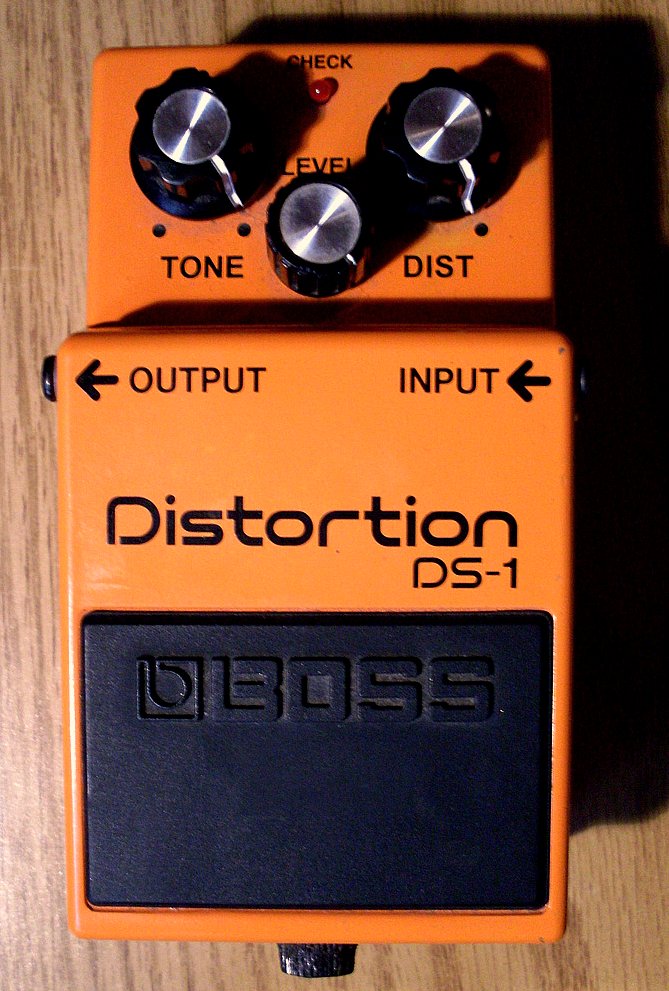
- Boss OC-3 Octave and Voodoo Lab Micro Vibe for texture
- Reverb and EQ loops set behind the main chain for subtle space control
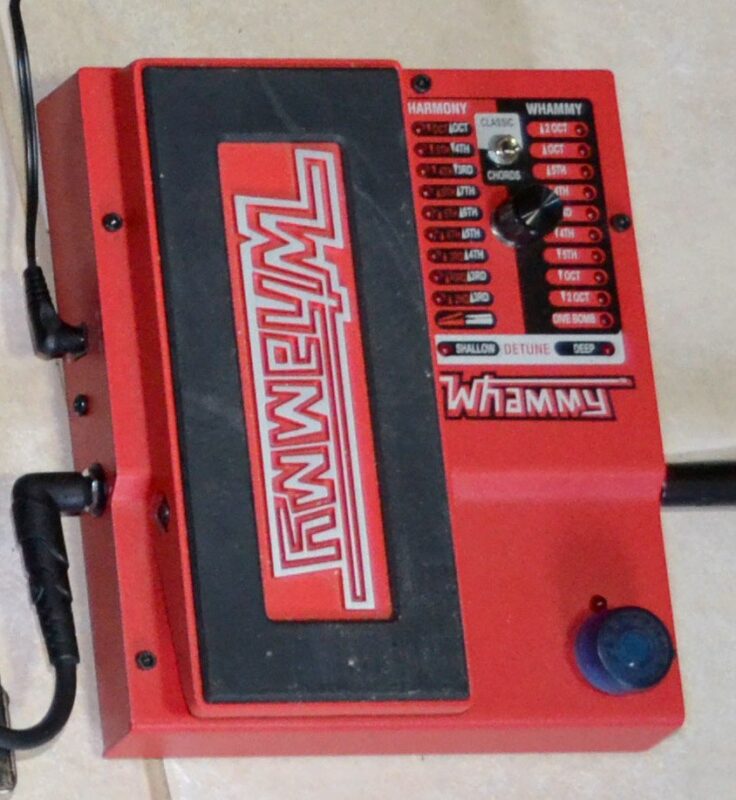
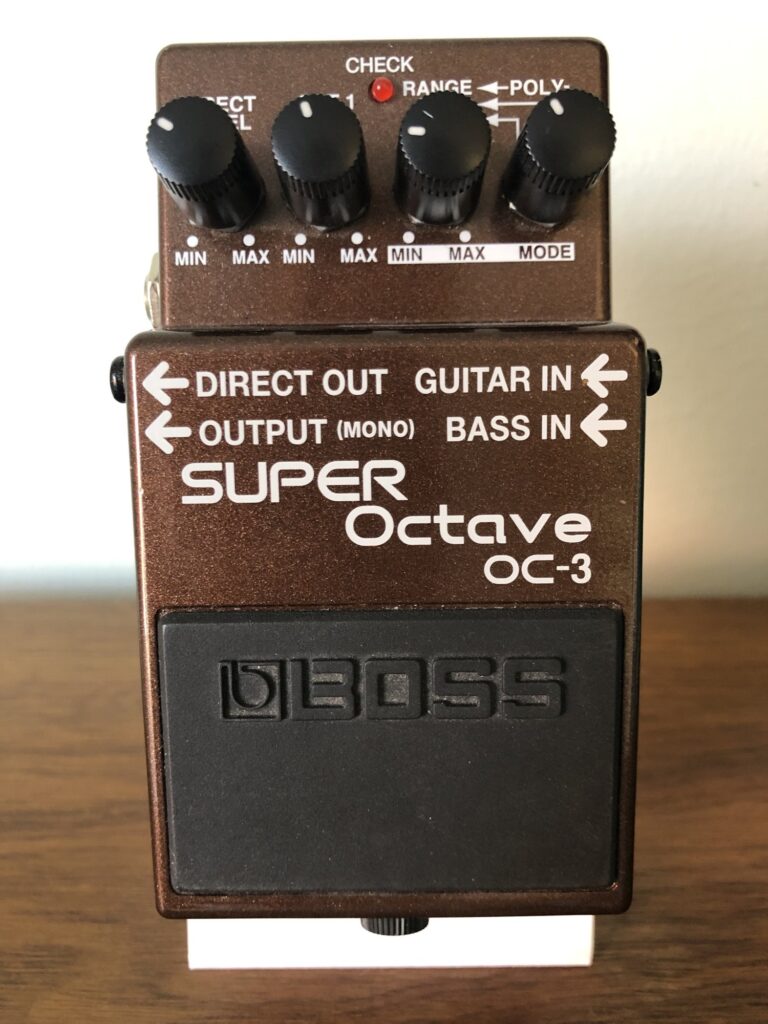
This rig evolved over decades of refinement — but the philosophy never changed: every effect must serve the melody, not overshadow it.
“Effects are spices,” he told Onstage Magazine. “You use them to enhance the flavor, not to cook the whole meal.”
His VOX signature line — developed between 2008 and 2014 — represents his exact taste:
- Big Bad Wah: dual inductor for vocal-style sweeps.
- Ice 9 Overdrive: named after his 1987 track, featuring a “More” button for added heat.
- Time Machine Delay: split-channel timing for live ambience control.
- Satchurator: distortion with mid-boost transparency — built for articulation under pressure.
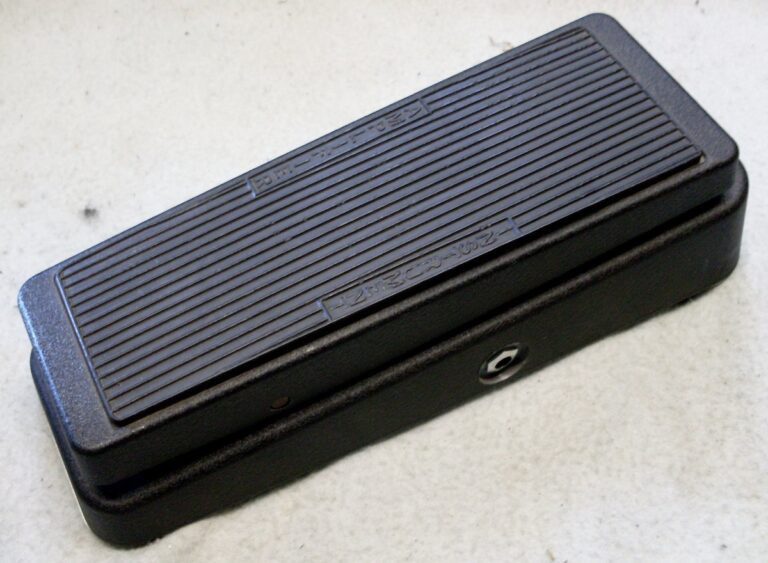
Read our guide to the Dunlop GCB95 Cry Baby wah.
Strings, Picks & Setup – The Science of Comfort and Attack
Joe’s string and setup preferences reveal his engineering mindset. He typically runs .010–.046 D’Addario strings, balancing bendability with sustain. Earlier in his career, he alternated between .009s and .010s depending on tour demands.
His action is moderate — high enough for clarity, low enough for legato smoothness. He prefers floating tremolos set to neutral pitch, allowing upward bends and flutter vibrato.
His picks? Dunlop 1.0mm or custom Planet Waves Delrin, always rounded for smooth attack.
He polishes frets with surgical precision and maintains an ultra-clean fingerboard — no grime, no residue.
“Your strings are your voice,” he’s said. “If they’re dead, you’re not speaking clearly.”
Tunings & Tone Philosophy – Guitar as Voice
Satriani’s tuning approach is deceptively traditional: standard E tuning for 95% of his catalogue, occasionally dipping into drop D or Eb for texture. But the real magic isn’t in the tuning — it’s in his touch.
Every tone decision he makes ties back to one philosophy:
“The guitar should sing like a human.”
He builds his tone through what he calls the three-tier system:
- Foundation: Clean amp + transparent pickups = vocal clarity.
- Character: Controlled overdrive adds grit and emotion.
- Dimension: Stereo delays and reverb give breath and space.
This method creates the illusion that his guitar “inhales” between phrases — a phenomenon few guitarists can replicate. It’s why even his high-gain solos feel alive instead of synthetic.
“When I hit a note, I imagine someone’s voice breaking mid-sentence — that’s the kind of emotion I want,” he once said.
The Signal Chain Blueprint (Live 2024)
Ibanez JS2400 → VOX Big Bad Wah → VOX Ice 9 → Noise Gate → Delay A (290ms) + Delay B (600ms, parallel) → Marshall JVM410 Clean Channel → 4×12 V30 Cab
Auxiliary FX:
- Whammy, Octave, Chorus, Phaser (optional chain)
- Reverb and EQ loop (rack processed)
- Stereo split via 3rd Power amplifier
Each link is tuned for fidelity, minimal coloration, and surgical control — a blueprint that defines the “Satch sound” for a generation of guitarists chasing tone perfection.
Playing Style & Tone Philosophy
Joe Satriani doesn’t just play the guitar — he converses with it. His phrasing feels less like a scale and more like speech, his bends like syllables, his vibrato like punctuation. Every note he plays is built on the idea that the guitar should sound like a human voice — capable of whispering, screaming, sighing, or laughing.
Satriani once described his tone as “a conversation between the fingers and the heart,” and that’s not poetic exaggeration — it’s engineering philosophy. Everything he does, from the way he phrases legato lines to how he sets his amp’s clean channel, serves one central goal: clarity in emotion.
“I’m not trying to impress you with speed,” he once said. “I’m trying to move you with melody.”
Legato – The Fluid Architecture of Sound
In the guitar world, legato is often associated with speed — but for Satriani, it’s about flow. His trademark technique involves three-note-per-string runs, executed so smoothly that the pick seems almost irrelevant.
Unlike Allan Holdsworth’s metrically perfect legato, Satriani’s is deliberately human — loose, slightly behind the beat, and full of micro-dynamics. Listen to Flying in a Blue Dream or Crushing Day and you’ll hear that elasticity; notes breathe, stretch, and slide into each other like liquid mercury.
He uses minimal pick strokes — just enough to define attack — then lets his fretting hand carry the melody. This gives his solos their signature “floating” feel, as if the notes are defying gravity.
“Legato is like talking without consonants,” he once explained. “It’s all vowels — all voice.”
Modal Interchange & Pitch Axis Theory
Satriani isn’t just a player; he’s a theorist in disguise. His Pitch Axis Theory — a concept he popularized in the ’90s — became a cornerstone of modern rock composition.
The idea is deceptively simple: anchor one tonal center while shifting modes around it.
In practice, it means he can play an A Lydian line one moment, then pivot to A Mixolydian or A Dorian without ever changing the root.
Songs like Lords of Karma and Crystal Planet demonstrate this beautifully — harmonic movement without losing grounding, exotic but never disorienting.
This modal exploration, paired with his lyrical phrasing, makes Satriani’s solos feel cinematic — they travel. It’s not just scale practice; it’s storytelling in real time.
Two-Handed Tapping – Melodic, Not Flashy
Satriani’s approach to tapping is the polar opposite of Eddie Van Halen’s explosive showmanship. For Joe, it’s not a stunt — it’s an extension of melody.
On tracks like Midnight, his two-handed tapping technique transforms the guitar into a self-contained orchestra. Both hands play independent arpeggios that interlock like gears in motion, creating a harp-like shimmer that few players have replicated convincingly.
What’s striking is how restrained he is with it. Satriani uses tapping only when the composition demands it — never as filler. That discipline is part of his DNA.
“Tapping isn’t about showing off,” he told Guitar Player. “It’s about expanding what the guitar can sing.”
Vibrato & Bending – The Human Voice Factor
If you stripped away the gear, the lights, the million-dollar tone, and handed Satriani a $100 guitar — he’d still sound like Satriani. Why? Because of his touch.
His vibrato is a study in control through imperfection. Wide, slow, and deliberate — never sterile. He bends into notes like a vocalist reaching for emotion, often sliding up into pitch rather than attacking it head-on.
That’s Hendrix’s ghost right there — but tamed, disciplined, and aimed at melody rather than chaos.
In slow ballads like Always With Me, Always With You, every bend feels like a heartbeat; in The Extremist, it’s rebellion turned into electricity.
“Bends are emotion in motion,” Joe once said. “They’re the difference between talking and crying.”
Rhythmic Control & Dynamics
Satriani is one of the few instrumentalists who can groove without a vocalist to lean on. His sense of rhythm is deeply percussive — likely inherited from his time teaching younger players how to lock in with drums and bass.
He uses muted ghost notes, subtle palm mutes, and rhythmic rakes to create phrasing that feels sung even when it’s purely instrumental.
Listen to Satch Boogie: it’s basically funk disguised as shred.
Even in high-speed passages, his timing breathes — he’s not locked to a metronome, he’s locked to feeling.
It’s this rhythmic intuition that allows his solos to feel conversational rather than mathematical. Every accent, every syncopation is intentional — as if he’s emphasizing emotional words in a sentence.
The Tone Philosophy – Guitar as a Vocal Instrument
Everything about Satriani’s tone philosophy circles back to one idea: the guitar should mimic the human voice.
He builds this sound on a three-tier structure — a method so elegant it’s become gospel for tone chasers:
- Foundational Clarity – clean Marshall JVM410 channel + DiMarzio pickups tuned for articulation.
- Character Layer – overdrive pedals (like the VOX Ice 9) adding bite without compression.
- Spatial Dimension – stereo delays (290ms / 600ms) for depth and harmonic space.
This structure ensures his tone is alive. It reacts to touch, pick angle, and dynamics. When he digs in, it growls. When he eases up, it whispers.
Unlike metal players who rely on saturation, Satriani’s rig breathes. The clean foundation gives him a tonal vocabulary — from crystalline cleans to violin-like leads — all within a single amp channel.
“Distortion hides things,” he once said. “Clarity exposes them — that’s where the truth lives.”
The Mindset of a Tone Architect
Satriani’s artistry sits at the intersection of emotion and engineering. He doesn’t just chase sound — he reverse-engineers it.
Every pedalboard tweak, every pickup swap, every amp mod is born from a what if?
What if the note could linger longer? What if delay could feel like memory, not echo? What if tone could carry empathy?
That curiosity turned him into one of the most influential tone architects of all time.
His methods influenced not just players but gear manufacturers — from Ibanez’s JS design language to VOX’s pedal circuits and DiMarzio’s modern pickup line.
He built an empire on experimentation — and yet, his tone never lost humanity. That’s the paradox of Satriani: technical perfection in service of emotional imperfection.
Related: [Eric Johnson – The Perfectionist of Tone]
Related: [Ritchie Blackmore – Shadows, Fire and Precision]
How to Sound Like Joe Satriani
If you’ve ever wondered how to make your guitar sing like a UFO wrapped in velvet, this is where the journey begins. Getting Joe Satriani’s tone isn’t about buying every pedal with his name on it — it’s about understanding why each element is there and what emotional job it performs.
Satriani’s rig is science and soul in equal measure. The magic lies in the balance between headroom and heat, clarity and chaos, and that unteachable ingredient — touch.
“You can have my gear, but not my hands,” he once told a fan backstage. “The tone lives in the fingertips.”
🎸 Guitar Setup – Build the Voice, Not the Weapon
Start with what matters most — the guitar that translates emotion into electricity.
Essentials:
- A 24-fret Ibanez JS-series or similar sleek-bodied guitar. The 24 frets give room for Satriani’s melodic phrasing and those wide, expressive bends.
- Pickups: a DiMarzio PAF Joe (neck) and Mo’Joe (bridge) combo, or if you want the modern edge, swap the neck for a Satch Track.
- Tremolo: a floating Edge bridge set neutral, allowing up-bends and flutter vibrato without detuning.
- Tone controls: keep them alive — roll back mids for glassy cleans, crank slightly for singing leads.
If you can’t afford the signature model, a well-set-up Strat-style guitar with humbuckers and a stable trem will still get you close. The key is response: it must react instantly to your dynamics.
“The guitar should be invisible between you and the music.”
⚙️ Amp Settings – Clean Gain and Control
Satriani’s tone lives in the Marshall JVM410H clean channel, pushed to the brink of breakup by pedals rather than preamp gain.
Starting point:
- Channel: Clean (orange mode)
- Gain: 9
- Bass: 4
- Middle: 3–4
- Treble: 4
- Presence: 5
- Volume: 6–7
Keep it loud enough that your pick attack drives the amp naturally. Too much preamp gain, and you lose that vocal articulation.
If you’re using a modeler (Helix, Kemper, AmpliTube, ToneX), pick the Marshall JVM410 or JCM800 clean model. Insert your pedals as below, and you’ll be in the right galaxy.
🎛️ Pedal Chain – The Satch Signal Flow
Signal chain (2024 Tour configuration):
Guitar → VOX Big Bad Wah → VOX Ice 9 Overdrive → Noise Gate → Dual Delay (290 ms / 600 ms parallel) → Marshall JVM410 Clean Channel → 4×12 V30 Cab
Auxiliary FX loop (rack or modeler):
- Reverb: Light plate, Mix 15-20 %
- EQ: Gentle mid boost around 800 Hz (+2 dB)
- Stereo Spread: Slight pan for spatial breathing
Optional Extras:
- Digitech Whammy for octave sweeps (Cool #9).
- Voodoo Lab Micro Vibe or Boss CH-1 for liquid modulation (Crystal Planet).
- Electro-Harmonix POG for the lush textures of Super Colossal.
“Effects are accents — you should hear the story, not the studio.”
🎚 Modeler Preset Template
If you’re running digital gear, use this as a foundation:
Helix / Kemper / AmpliTube chain:
Amp: Marshall JVM410 Clean
Cab: 4×12 V30 Mic 57 + 121 Blend 30/70
This setup replicates the dual-delay stereo space that defines Satriani’s “surfing” tone — one short, one long, both tucked behind the dry signal for width without mud.
🧩 Playing Techniques to Nail the Tone
Gear will get you halfway. The rest is in the hands, timing, and phrasing.
1. Legato Flow
Play three-notes-per-string scales but let the hammer-ons breathe. Don’t rush — think fluid, not frantic. Try muting lightly with the picking hand to control sustain.
2. Bending with Purpose
Always approach the target note from below. Bend a whole step, vibrato at the top, then release like a sigh.
3. Volume Dynamics
Use your guitar’s volume knob like a vocal mic. Roll back to 7 for cleans, crank to 10 for chorus lines.
4. Modal Thinking
Practice switching between A Lydian and A Mixolydian without moving root position. That’s the Lords of Karma trick — tension and release without leaving home base.
5. Wah as Voice
Don’t use it for “wah-wah.” Use it to shift formants like a singer changing vowel sounds. Rock it slowly for phrasing, not rhythm.
6. Muting and Groove
In songs like Satch Boogie, notice how his right hand ghosts the strings between notes. That creates the percussive pulse that keeps the instrumental groove alive.
🎯 EQ & Feel Tips for “Surfing with the Alien” Tone
| Parameter | Setting | Function |
|---|---|---|
| Amp Gain | 9 | Sustain without saturation |
| Bass | 4 | Tight low end for clarity |
| Mid | 3–4 | Keeps vocal focus |
| Treble | 4 | Sweet highs without ice |
| Delay Mix | 35 % / 25 % | Dual delay width |
| Reverb Mix | 15 % | Space without wash |
Tone note: The magic isn’t in compression — it’s in touch. Pick softer, and the tone glows; hit hard, and it bites.
🧠 Mindset – Play Like a Storyteller
Satriani’s most powerful lesson isn’t about scales or switches — it’s about intent.
He plays like every phrase is a sentence, every note a word that matters.
Practice improvising over a single chord for minutes, forcing yourself to express emotion without changing harmony. That’s the Satriani discipline: finding infinite color in one canvas.
“You don’t need more notes. You need more meaning.”
Related: [Steve Vai – The Alchemist of Sound and Sorcery]
Related: [Eric Johnson – The Perfectionist of Tone]
Influence & Legacy
Joe Satriani didn’t just change the way people play guitar — he changed the way they think about it.
Before Surfing with the Alien, the idea of an instrumental guitarist topping the charts was laughable. After it, every label in America wanted “the next Satriani.”
He single-handedly made melody fashionable again in a world drowning in distortion. And in doing so, he built a bridge between the technical precision of shred and the emotional storytelling of blues and jazz.
“Joe reminded the world that you can be both a scientist and a poet on the guitar,” said Steve Vai.
The Teacher Who Changed Generations
Before he became a global icon, Satriani was already shaping the future from a small teaching studio in California. His roster of students reads like a Hall of Fame lineup:
- Steve Vai (Whitesnake, David Lee Roth)
- Kirk Hammett (Metallica)
- Alex Skolnick (Testament)
- Larry LaLonde (Primus)
These weren’t just random pupils — they were the next wave of guitar evolution. Satriani’s teaching blended jazz theory with rock aggression, forcing players to think in modes, not boxes.
Even decades later, you can trace his fingerprints through their playing: Vai’s phrasing discipline, Hammett’s modal sense, Skolnick’s harmonic fluency. They’re all extensions of Satriani’s musical DNA.
Related: [Steve Vai – The Alchemist of Sound and Sorcery]
Related: [Kirk Hammett – The Architect of Metal Melodies]
The G3 Revolution – Brotherhood of the Six Strings
In 1996, Satriani founded G3, a touring concept that could’ve easily been an ego war but instead became a masterclass in unity. The lineup — usually featuring Satriani, Vai, and a rotating third virtuoso (Eric Johnson, John Petrucci, Yngwie Malmsteen, Paul Gilbert, etc.) — redefined what guitar performance could be.
Each show felt like a conversation between gods: three completely different philosophies, one shared language.
Satriani’s melodic focus grounded Vai’s experimentation and balanced Johnson’s crystalline tone. Together, they proved that instrumental music could fill arenas — no singer required.
“It wasn’t competition,” Joe said of G3. “It was communion.”
The tour became a proving ground for tone chasers and a cultural reset for rock guitar. And as the years rolled on — through the 2000s, the 2010s, and even the 2024 reunion — G3’s message remained clear: the guitar is not dead; it just evolved.
Chickenfoot & Collaboration – The Supergroup Spirit
In 2008, Satriani flipped expectations again by joining forces with Sammy Hagar (Van Halen), Michael Anthony, and Chad Smith (Red Hot Chili Peppers) to form Chickenfoot — a band that was part jam, part experiment, and all fire.
Where most virtuosos retreat to the studio, Joe dove into collaboration. His role in Chickenfoot was almost humble — playing for the song, not the solo. The self-titled album (2009) proved he could channel his technical brilliance into classic rock grooves and still sound unmistakably Satch.
That project bridged his instrumental universe with mainstream rock — showing that his tone could live anywhere.
Related: [Eddie Van Halen – The Architect of the Brown Sound]
A Lifelong Pursuit of Tone and Emotion
Even after 40+ years, Satriani’s drive for evolution hasn’t slowed down.
With 19 studio albums and countless live recordings, each era unveils a new experiment — from the analog warmth of The Extremist to the digital horizons of The Elephants of Mars (2022).
His sound keeps expanding without ever losing identity. Few artists can say that.
Where Jeff Beck chased abstract textures and Eric Johnson pursued perfection, Satriani built a vocabulary of feeling — one that guitarists still study like scripture.
“Joe is the melody we all wish we could write,” said John Petrucci.
The Enduring Legacy – Emotion Over Excess
Joe Satriani’s greatest legacy isn’t a riff, a record, or even a piece of gear — it’s an idea: that technical mastery means nothing without emotional honesty.
He proved that shred could have soul, that precision could have purpose, and that melody could still win hearts in an era of chaos.
His DNA runs through generations of modern players — from instrumentalists like Plini and Andy Timmons, to mainstream rockers who grew up on Surfing with the Alien. Even the metal scene owes him — his teachings gave birth to Kirk Hammett’s solos, to Vai’s theatricality, to the entire idea that guitar can still be storytelling.
Every time a note sustains longer than physics should allow, Satriani’s influence is there.
And that’s the thing — his music isn’t about perfection. It’s about possibility.
“The guitar is infinite,” Joe said. “You’ll never run out of things to say — if you’ve got something to feel.”
Related: [Eric Johnson – The Perfectionist of Tone]
Related: [Jeff Beck – The Silent Virtuoso]
Modern Context – The Alien Among Mortals
In 2024, as Satriani reunited with Vai and Johnson for the G3 revival, the crowd wasn’t just nostalgic — they were witnessing endurance.
While many of his peers slowed down or disappeared into legend, Joe remained present, recording, touring, teaching, refining.
He’s not chasing relevance — he’s embodying it.
In a world of amp sims, plugins, and digital tone chasing, Satriani still sounds human. His tone breathes, sweats, and bleeds.
That’s why his legacy endures — because every new generation finds him not in history, but in sound.
Satriani’s career is proof that when you combine science and soul, the guitar stops being an instrument — and becomes a language of truth.
FAQ – Joe Satriani: Gear, Tone & Legacy
What gear does Joe Satriani use?
Joe Satriani’s current rig centers around his Ibanez JS Series guitars, powered by DiMarzio pickups (PAF Joe, Mo’Joe, and Satch Track), running into Marshall JVM410H amps through a clean channel setup. His pedals are all VOX-designed — including the Big Bad Wah, Ice 9 Overdrive, Satchurator, and Time Machine Delay.
His signature signal chain:JS2400 → Big Bad Wah → Ice 9 → Delay (290/600ms) → JVM410 Clean → 4x12 V30 Cab
Tone note: it’s not about distortion — it’s about definition.
How does Joe Satriani get his tone?
By using clean headroom and emotional control. Joe’s secret is to let the amp stay clean and shape tone through pedals and touch. His tone philosophy is threefold:
- Foundation: Clear amp + articulate pickups.
- Character: Gentle overdrive for expression, not distortion.
- Dimension: Dual delay/reverb layers for spatial breathing.
He doesn’t rely on gain — he relies on feel. Every pick angle, every fingertip nuance alters the sound.
What pickups are in Joe Satriani’s guitars?
His main Ibanez JS guitars feature a DiMarzio PAF Joe (neck) and Mo’Joe (bridge). Newer models like the JS2400 add the Satch Track, a single-coil-sized humbucker that delivers warmth without hum.
Earlier models used DiMarzio FRED pickups — the classic “Surfing with the Alien” tone — known for harmonic overtones and vocal midrange.
Read our guide to P-90, humbucker and single-coil pickups.
What tuning does Joe Satriani use?
Mostly Standard E tuning. Occasionally, he plays in Drop D or Eb Standard for depth and character, but he’s not a detuning player. His expressiveness comes from hands, not tunings.
“You can tune down all you want — it won’t make you feel more.”
What strings and picks does Joe Satriani use?
He typically uses D’Addario .010–.046 strings, sometimes lighter (.009s) early in his career. His picks are Dunlop or Planet Waves 1.0mm Delrin, rounded for smooth attack. The moderate gauge gives him sustain and control over dynamic phrasing.
How do I sound like Joe Satriani on a budget?
You don’t need the full JS signature rig to sound like Satch. Start simple:
- Use any HSS or HH guitar with a floating trem.
- Set your amp clean and loud.
- Add a transparent overdrive (like a Tube Screamer).
- Use dual delays (one short, one long) with light reverb.
Most importantly — practice phrasing. Play fewer notes with more meaning.
“The cheapest gear with the right hands will still sound like the truth.”
Did Joe Satriani teach other famous guitarists?
Absolutely. Satriani’s students include Steve Vai, Kirk Hammett, Alex Skolnick, and Larry LaLonde — all of whom became genre-defining players. His teaching style focused on modes, phrasing, and tone control over speed, shaping entire generations of guitarists.
Related: [Steve Vai – The Alchemist of Sound and Sorcery]
Related: [Kirk Hammett – The Architect of Metal Melodies]
What is Joe Satriani’s philosophy on music?
Satriani’s entire career rests on one belief: “The guitar should sound like a voice.”
He doesn’t play to show technique — he plays to communicate emotion. His tone philosophy blends discipline with freedom: the structure of theory meets the chaos of feeling. That’s what makes his music timeless.
What’s Joe Satriani’s most iconic song?
Surfing with the Alien remains the anthem — the moment the instrumental guitar became mainstream. But songs like Always With Me, Always With You, Flying in a Blue Dream, and Crystal Planet showcase the full scope of his voice: melody, motion, and meaning.
Has Joe Satriani ever won a Grammy?
No — and that’s one of music’s great ironies. Satriani has been nominated 15 times but has never won. Still, he’s the world’s best-selling instrumental rock guitarist, which is the kind of validation that lasts longer than a trophy.
Why is Joe Satriani still relevant today?
Because tone doesn’t age — and honesty doesn’t go out of style.
In a digital world obsessed with plugins and presets, Satriani remains analog: raw, human, and real. His tone is a reminder that technology is a tool — not the source.
“The guitar is infinite,” Joe said. “You just have to listen to what it’s trying to tell you.”
When Joe Satriani bends a note, it doesn’t sound like a machine — it sounds like a memory.
That’s his secret. He doesn’t just play — he remembers, he imagines, he feels. His tone is the sound of a lifetime spent chasing connection through circuitry and soul.
He proved that an instrumentalist could sell millions without singing a word — that melody can still change lives in a world that’s forgotten how to listen.
He’s a scientist of sound, a poet of phrasing, and a bridge between logic and lightning.
Every era — from the Surfing with the Alien explosion to the cinematic scope of The Elephants of Mars — tells the same story: music without limits.
And that’s Joe’s real legacy — the idea that tone is eternal when it speaks the truth.
“I’m still learning how to make the guitar sing,” he said recently.
And maybe that’s why he’ll never stop sounding new.
Because as long as there’s feeling left to express, Joe Satriani will keep showing us what the guitar can still say.
Links
- [Steve Vai – The Alchemist of Sound and Sorcery] – How Satriani’s star student turned theory into theatre.
- [Eric Johnson – The Perfectionist of Tone] – Precision, purity and the eternal chase for clean tone.
- [Marshall JVM410 – The Clean Beast of Modern Rock] – Inside the amp that defines Satriani’s headroom philosophy.
- Read our guide to P-90, humbucker and single-coil pickups.
- Read our guide to the Dunlop GCB95 Cry Baby wah.
Image credits
- Top image: 20080612-220324 Joe Satriani Rijnhal Arnhem, Wikimedia Commons, CC BY-SA 3.0.
- Marshall 1959 Super Lead Plexi: GuitarGangsters AI-generated reference illustration, not a photograph.
- Celestion Vintage 30 12-inch Guitar Speaker: GuitarGangsters AI-generated reference illustration, not a photograph.
- DigiTech Whammy: marcelodonati, Wikimedia Commons, CC BY 2.0.
- Dunlop Cry Baby: Roadside Guitars, Flickr, CC BY-SA 2.0.
- Marshall JVM410H: Cjp24, Wikimedia Commons, CC BY-SA 4.0.
- Boss OC-3 Super Octave: Kuriosatempel, Wikimedia Commons, CC BY-SA 4.0.