The Pedalboard Standard That Sees All Six Strings at Once: TC Electronic PolyTune 3 Mini
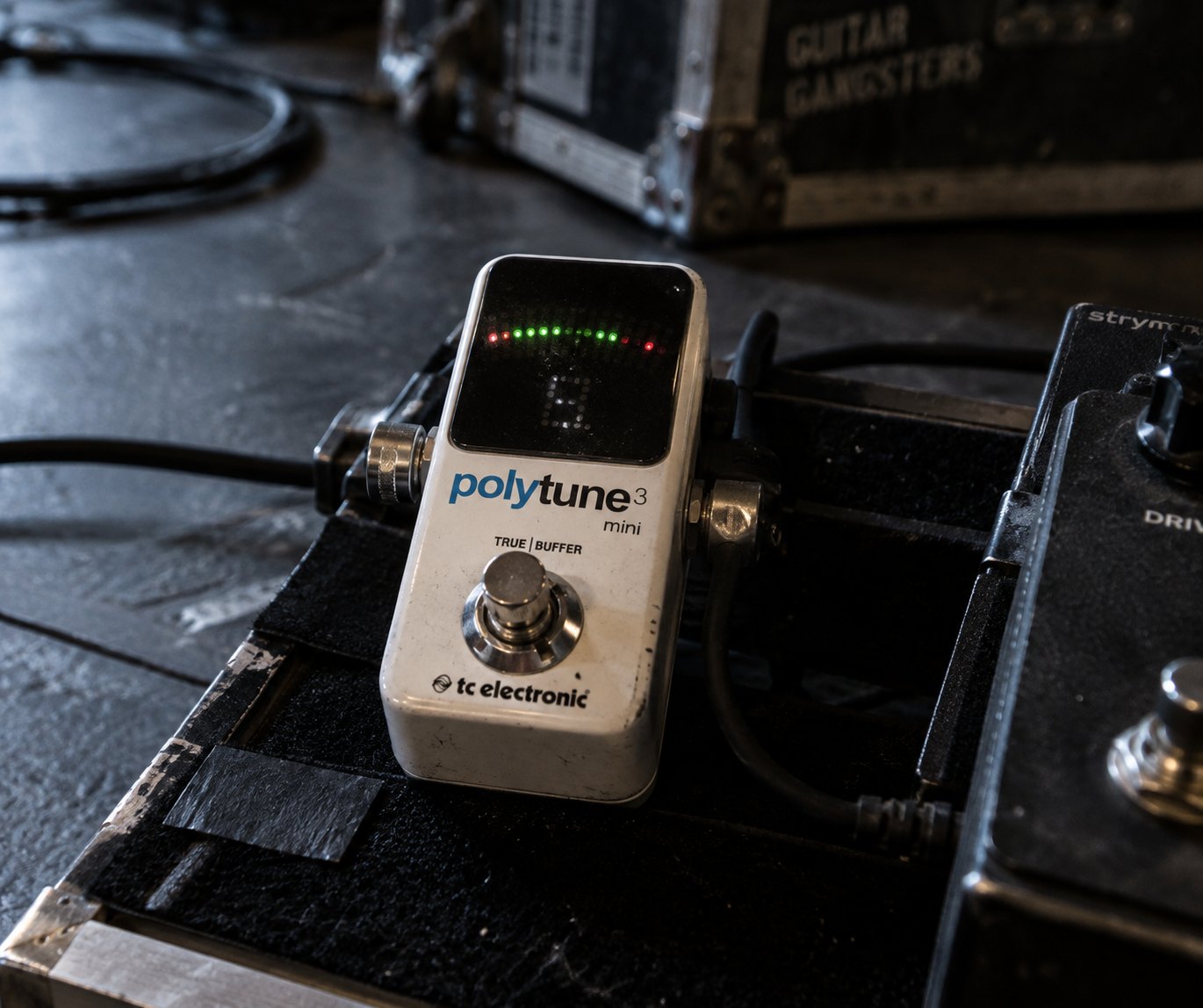
TC Electronic PolyTune 3 Mini Tuner Pedal. AI-generated reference illustration, not a photograph.
The TC Electronic PolyTune 3 Mini packs polyphonic, chromatic, and strobe tuning plus a BonaFide Buffer into a mini footprint. The modern pedalboard standard.
The moment before the set. The soundcheck countdown. The guitarist reaches down and hits a single pedal—strums once across all six strings open—and in two seconds knows exactly which string drifted sharp overnight. No individual plucking, no squinting at a strip, no waiting while the crowd shuffles their drinks. That’s the TC Electronic PolyTune 3 Mini doing what it was built to do: making tuning fast, accurate, and invisible in a footprint so compact it barely registers on the board layout sketch. Since TC Electronic introduced polyphonic tuning to the guitar pedal market in 2010, the PolyTune line has become the most common tuner on professional pedalboards worldwide. The PolyTune 3 Mini takes that trusted circuitry, adds a high-quality analog buffer and three distinct tuning modes to a mini enclosure, and delivers it at a price point that makes the old strip-tuner approach look genuinely primitive. This is the definitive guide to what makes the PolyTune 3 Mini the modern pedalboard standard—and whether it belongs on yours.
Before Polyphonic Tuning, Tuning Was Slow
Before January 2010, tuning a guitar onstage meant one of two things: a clip-on that the crowd could see, or a pedal tuner that required tuning one string at a time. The best chromatic units of the era—the Boss TU-2, the Peterson StroboStomp—were accurate and reliable, but tuning six strings sequentially while a few hundred people waited had a way of killing momentum faster than a broken amp fuse. Guitar technicians and bandleaders treated the tuning break as an unavoidable ritual. The assumption was that it simply had to be slow.
Engineers at TC Electronic, the Danish effects company founded in Risskov in 1976 by Kim and John Rishøj, had a different idea: what if you could scan all six strings simultaneously, the way a trained piano technician hears multiple strings at once? The answer was the original PolyTune, announced at the Winter NAMM show on January 16, 2010—the world’s first polyphonic guitar tuner pedal. Strum once. Six readouts appear. Adjust only the offending strings. Done.
The guitar world reacted with something between disbelief and immediate adoption. Premier Guitar ran the announcement. Sweetwater sold through its allocation. The concept was so clearly correct—strum, glance, fix—that competitors began developing polyphonic designs of their own. But TC Electronic had the head start, the brand credibility already established by products like the Flashback 2 Delay and Hall of Fame 2 Reverb, and the market momentum that comes with being first to solve a problem nobody had solved before.
The PolyTune 2 followed, refining the LED display and improving strobe accuracy. Then in April 2017, TC Electronic unveiled the PolyTune 3 with an addition that had nothing to do with tuning accuracy: the BonaFide Buffer. The full-size PolyTune 3 and PolyTune 3 Mini launched together that year, the Mini bringing an identical circuit to a smaller enclosure for players who need every square centimeter of their pedalboard space occupied by something that actually makes noise. The PolyTune 3 Noir and PolyTune 3 Noir Mini arrived as black-anodized variants—same internals, different aesthetic. Today the PolyTune 3 Mini sits at the front of professional boards in genres from country to death metal, quietly doing its job before every note the guitarist plays.
What the PolyTune 3 Mini Actually Does
The PolyTune 3 Mini is a tuner pedal with three operating modes, each suited to a different context. It lives at the front of the signal chain, mutes output when engaged, and shows tuning information on an auto-dimming 109-LED display that reads clearly under stage wash, harsh outdoor daylight, or near-darkness. The enclosure is solid metal—same construction spec as every TC Electronic compact pedal—and the side-mounted button cycles through standard, dropped, and capo tuning references.
Polyphonic Mode
This is the headline feature. Strum all six strings with a single open-chord strum, and the display segments the signal into individual string readings, flagging each one that’s out of pitch. On a well-maintained guitar after a day of playing, two or three strings will have drifted. Polyphonic mode shows exactly which ones in a single glance. Once the problem strings are identified, you pluck them individually and tune to the target. The entire process runs under fifteen seconds, often closer to five. Polyphonic mode doesn’t achieve the per-string accuracy of chromatic mode—it’s designed for triage, not surgical refinement—but as a speed tool it changes the relationship between a guitarist and the tuning ritual entirely.
Chromatic Mode
The precision instrument of the three. In chromatic mode, the PolyTune 3 Mini tunes one string at a time against all twelve semitones, accurate to within 0.5 cents. For context: the human ear typically detects pitch discrepancies at around 5 cents in melodic contexts and around 2 cents when hearing intervals against other instruments. Half a cent is audiophile precision—no guitarist playing through a valve amp in a live environment will hear the difference between 0.5 cents and perfect. For studio recording, where the mix can expose tuning artifacts in exposed passages, that precision becomes more meaningful. This is the mode most players use for final single-string adjustments after polyphonic mode flags the offenders.
Strobe Mode
The gold standard. At 0.02 cents accuracy, strobe mode operates at the same precision level used by professional luthiers for intonation setup work. The display shows rotating bands indicating whether the string is sharp (bands move forward) or flat (bands move backward) relative to the target pitch; a stationary, locked display means the string is in tune. Reading the strobe display requires a moment’s orientation compared to the bar-graph of chromatic mode, but for intonation setting on a Floyd Rose-equipped guitar, for tuning to a specific historical temperament, or for matching pitch precisely against a keyboard part in a fixed-pitch studio environment, 0.02 cents delivers results that no basic chromatic unit can approach. Most guitarists will use strobe mode rarely—but when they need it, nothing else does what it does for the price.
The BonaFide Buffer: The Feature That Changed the Conversation
When TC Electronic announced the PolyTune 3 in April 2017, the key addition was not a new tuning mode or a brighter display. It was a buffer. The BonaFide Buffer is a high-quality, all-analog preamp circuit built into the pedal’s signal path, selectable via internal DIP switches alongside three bypass configurations: True Bypass, True Buffer, and True Buffer with the display remaining active at all times.
Understanding why this matters requires a brief visit to signal chain physics. A passive guitar pickup outputs a high-impedance signal. High-impedance signals are vulnerable to cable capacitance: the longer the cable run, the more high-frequency content bleeds to ground, leaving the signal darker and more rolled-off than what the pickup actually generated. Buffer circuits—simple, transparent preamp stages that convert high-impedance input to low-impedance output—solve this. On a pedalboard with eight, ten, or twelve pedals connected by patch cables, a well-placed buffer at the beginning of the chain is not optional equipment. It’s signal preservation infrastructure.
The BonaFide Buffer achieves a signal-to-noise ratio exceeding 112 dB—quieter than the noise floor of most guitar amplifiers in any typical room. In True Buffer mode, it sits permanently in circuit from the moment the pedal is powered, delivering a stable low-impedance signal to everything downstream. In True Bypass mode, the buffer is completely removed from the circuit and the PolyTune 3 Mini behaves like a traditional hardwired-bypass tuner—correct for short rigs or for players who already have a buffer elsewhere in their chain. The third option, “Always On” buffered display, leaves the readout tracking pitch even when the pedal isn’t muted—you can glance down between songs during a break, see that the low E has drifted flat from a set of aggressive bends, and correct it before the next number begins.
One specific caveat: germanium fuzz circuits are sensitive to the impedance they see at their input. Placing a buffered tuner immediately before a germanium fuzz—a Fuzz Face-style circuit, for instance—can alter its character. For those specific rigs, run the germanium fuzz before the PolyTune 3 Mini, or set the Mini to True Bypass mode. Silicon fuzz circuits, including the majority of modern high-gain pedals, have no such interaction with buffers and can be placed anywhere after the PolyTune 3 Mini without concern.
Signal Chain Placement
The PolyTune 3 Mini belongs at the very front of the signal chain—before overdrive, before compression, before any effect that processes the signal. The logic is simple: first, the tuner mutes output when engaged, and a mute at position one silences everything downstream cleanly; second, a buffer placed first delivers the most benefit to the entire chain. Everything after it sees the low-impedance output, and high-frequency content is preserved from instrument to amp without loss.
The standard professional chain runs: guitar → tuner/buffer → compressor → overdrive/fuzz/distortion → modulation → delay → reverb → amp. The PolyTune 3 Mini handles both tuning and buffering duty simultaneously at position one. An Ibanez TS9 Tube Screamer or overdrive sits downstream in the gain section; time-based effects occupy the rear of the chain. The Fender Stratocaster‘s single-coil pickups—high-impedance, capacitance-sensitive—benefit most from buffering at position one. Humbuckers are somewhat less sensitive, but still benefit from the low-impedance conversion over long cable runs.
The PolyTune 3 Mini can also run in an effects loop. Some players use a tuner in the FX loop’s return path to mute the power amp section without interrupting the preamp—useful for silent tuning on a cranked valve amp between songs without cooling the output tubes. In this placement, the buffer function matters less than the mute and accuracy, and both remain fully operational.
Who Uses a PolyTune? The Honest Answer
The PolyTune is standard on professional pedalboards, which makes it not meaningful to link to a single guitarist. That is not a hedge. It’s an accurate description of where the PolyTune line sits in the market. Walk any backstage at any major festival and count PolyTune Mini enclosures on monitor wedges and pedalboard cases. The number will be high enough to stop counting.
For specific confirmed users: Rob Harris, guitarist for Jamiroquai, runs a PolyTune 3 Mini specifically, documented via pedalboard photography from Tone Design. Steve Lukather (Toto) uses the full-size PolyTune 3 on his current live touring board—same circuit, larger enclosure. Ray Toro of My Chemical Romance and Patrick Stump of Fall Out Boy have both been photographed with PolyTune 3 units (full-size variants) on their touring boards. Yvette Young of Covet runs one on her pedalboard as confirmed through live photography.
For the earlier-generation PolyTune Mini: Brent Hinds (Mastodon) and Guthrie Govan have both been documented using the original PolyTune Mini—Govan specifically on his compact travel pedalboard, where the small format is essential. The original PolyTune Mini predates the PolyTune 3 generation and does not include the BonaFide Buffer. Neither Hinds nor Govan has been specifically confirmed on the PolyTune 3 Mini as of this writing. The distinction matters for honest reporting: the confirmed hardware is the earlier-generation Mini, not the PolyTune 3 Mini specifically. Any player in their position would find the PolyTune 3 Mini a direct functional upgrade.
The framing that matters: the PolyTune 3 Mini is not associated with a specific player’s signature sound, because tuners don’t make sound. It’s associated with the professional standard of never playing out of tune. Every serious pedalboard requires a tuner, and this is the one most serious players have chosen.
Specs at a Glance
| Feature | PolyTune 3 Mini | PolyTune 3 (Full Size) | PolyTune 3 Noir Mini |
|---|---|---|---|
| Chromatic Accuracy | 0.5 cents | 0.5 cents | 0.5 cents |
| Strobe Accuracy | 0.02 cents | 0.02 cents | 0.02 cents |
| Tuning Modes | Polyphonic / Chromatic / Strobe | Polyphonic / Chromatic / Strobe | Polyphonic / Chromatic / Strobe |
| Display | 109-LED auto-dimming | 109-LED auto-dimming | 109-LED auto-dimming |
| BonaFide Buffer | Yes (switchable) | Yes (switchable) | Yes (switchable) |
| Bypass Options | True Bypass / True Buffer / Always-On | True Bypass / True Buffer / Always-On | True Bypass / True Buffer / Always-On |
| Power | 9VDC, 100mA | 9VDC, 100mA | 9VDC, 100mA |
| Form Factor | Mini (compact) | Full-size | Mini (black anodized) |
| Price (New) | ~$69–89 USD | ~$89–109 USD | ~$79–99 USD |
| Price (Used, Excellent) | ~$40–65 USD | ~$50–75 USD | ~$45–70 USD |
PolyTune 3 Mini vs Boss TU-3: The Definitive Comparison
No tuner pedal comparison is complete without the Boss TU-3. The TU-3 has been on professional boards since 2009, predating the original PolyTune by a year, and it remains the most recognizable tuner pedal in the world. Understanding where it wins and where it doesn’t explains exactly why the PolyTune 3 Mini has overtaken it as the default choice on new board builds.
The Boss TU-3 wins on several fronts. Its reputation for near-indestructible build quality—reinforced jacks, military-grade Boss footswitch—has made it the default choice for touring players who prioritize mechanical reliability above all else. The TU-3’s buffered bypass provides inherent signal preservation, and a dedicated output jack allows it to double as a power source for daisy-chain setups using certain power supplies—a function the PolyTune 3 Mini does not replicate. For players whose power supply runs off the TU-3’s output, the Boss unit is not easily swapped.
The PolyTune 3 Mini wins on three fronts that matter most in practice. First, polyphonic tuning—the TU-3 offers no poly mode whatsoever, requiring sequential single-string tuning every time. Second, precision—the TU-3’s chromatic accuracy is rated at ±1 cent compared to the Mini’s ±0.5 cents, and the Mini’s 0.02-cent strobe mode runs fifty times more precise than the TU-3 allows. Third, pedalboard real estate—the Mini’s footprint is roughly a third of the TU-3’s full-size enclosure, and in modern board design where every square centimeter counts, that difference is significant.
The buffer quality comparison is more nuanced. Both units provide buffered output in their default mode. The BonaFide Buffer’s specified signal-to-noise ratio exceeds 112 dB; Boss does not publish an equivalent figure for the TU-3’s buffer stage. Audible differences between well-implemented buffers at this quality level are minimal and unlikely to be perceived in a live context, but the PolyTune 3 Mini also offers True Bypass as a switchable option—the TU-3 does not. For players building a board with a deliberate bypass strategy, that flexibility matters.
The honest verdict: both are excellent. If you’re building a new board from scratch, the PolyTune 3 Mini is the more capable tuner at a similar price. If you’re running a TU-3 that works reliably and your power supply depends on its output, there’s no urgent reason to change.
Beyond the TU-3: Other Options Worth Knowing
The Korg Pitchblack Advance is the most common budget alternative to the PolyTune 3 Mini, offering solid chromatic accuracy and a compact form factor at a lower price. It lacks polyphonic mode and any strobe function, but tunes reliably and runs quietly. For players who specifically don’t want to pay for polyphonic functionality they don’t plan to use, it’s a legitimate choice—though the PolyTune 3 Mini’s used market pricing puts both units in a similar range when shopping secondhand.
The Peterson StroboStomp HD occupies the premium end of the tuner pedal category. Peterson’s strobe technology is the reference standard for professional luthiers, with accuracy specs and sweetened temperament presets that go beyond what the PolyTune 3 Mini offers in strobe mode. For players who set intonation frequently, use non-equal temperaments, or work in environments where absolute pitch precision against fixed-pitch instruments is critical, the StroboStomp HD delivers. The significant price premium over the PolyTune 3 Mini is justified only for players who will actually use that extra precision.
The TC Electronic PolyTune Clip is the polyphonic concept in clip-on format, aimed at acoustic guitarists or players without a pedalboard. It shares the PolyTune 3 Mini’s polyphonic and strobe modes in a different physical format, and rounds out TC Electronic’s tuner family for players who need both approaches across different instrument setups.
Buying Guide
The PolyTune 3 Mini is available new at approximately $69–89 USD, with regional price variation. The Noir Mini adds a black anodized finish for a small premium—typically $79–99 new—with functionally identical internals. The full-size PolyTune 3 runs $89–109 new, reflecting the larger enclosure rather than any added circuitry or capability.
The used market for the PolyTune 3 Mini is liquid and well-supplied. Units in excellent condition trade at $40–65. There are no production run variations affecting performance—every PolyTune 3 Mini unit shares the same circuit, and a clean used example functions identically to a new one. If cosmetic condition is not important to you, the used market is the obvious choice.
The core decision is Mini vs full-size, not Mini vs any competitor. The full-size PolyTune 3 puts the display higher off the ground on a pedalboard, which some players find more readable from standing height. It does not offer any additional circuitry, modes, or accuracy. The Mini is the better choice for most players on space-conscious boards; the full-size is the better choice only if readability from a standing position is a genuine issue with your specific pedalboard setup.
For players upgrading from the original PolyTune Mini (the first-generation compact): the BonaFide Buffer addition in the PolyTune 3 Mini is the compelling reason to upgrade. If you’re running more than five pedals with standard patch cables, or if your cable run from guitar to pedalboard exceeds fifteen feet, the buffer’s impact on high-frequency preservation is audible on careful comparison. If your rig is compact and your cables are short, the upgrade is optional.
One practical note on power: the PolyTune 3 Mini draws 100mA at 9VDC. That’s relatively high for a tuner—most basic chromatic units draw 30–50mA—owing to the LED display’s brightness and the buffer circuit’s current requirements. Confirm your pedalboard power supply has a 100mA-capable output available before purchase, or plan to use the included adapter.
Ownership Notes
The DIP switches that control bypass mode are small and recessed inside the enclosure. You’ll need a toothpick, a straightened paper clip, or a jeweler’s screwdriver to toggle them. Set the buffer configuration before the pedal goes onto the board and patch cables go in—it’s not a setting you’ll want to adjust mid-session. Once configured correctly for your rig, there’s no reason to revisit it.
The auto-dimming display is more useful than it sounds. Under harsh outdoor sun, the display reads at full brightness. In a dark stage environment, it dims automatically to a level that’s still perfectly readable without being distracting to the performer or the audience. First-time users sometimes mistake the dimmed indoor brightness for a fault—it isn’t. The dimming is working as designed.
The hold-footswitch-for-drop-D function is one of those features that sounds minor until you need it. If you regularly toggle between standard E tuning and drop D within a set, holding the PolyTune 3 Mini’s footswitch for two seconds changes the reference from E to D on the low string. No side button required, no menu to navigate—it’s immediate.
The PolyTune 3 Mini handles bass guitar as well as it handles six-string guitar. Polyphonic mode processes four strings with the same accuracy as six. Bass players who want a compact, dual-purpose tuner that won’t occupy a separate large-format slot on their board—and who want the speed advantage of polyphonic tuning—will find the PolyTune 3 Mini entirely capable.
Polyphonic mode works best with light, even pick attack across all strings. Heavy, aggressive strumming where some strings decay much faster than others can confuse the poly algorithm’s string-detection. If the poly readout looks inconsistent, the issue is almost always pick attack—try a lighter strum. For the most reliable poly tuning, develop a consistent, even open-chord strum that you use specifically for the tuning check: same note velocity on all six strings, same duration.
Frequently Asked Questions
Does the PolyTune 3 Mini work with seven-string and eight-string guitars?
Yes. The PolyTune 3 Mini’s chromatic and strobe modes cover all standard and extended-range pitches. Polyphonic mode was designed around six-string detection—its accuracy with seven or more strings in polyphonic mode is less reliable, and most extended-range players use chromatic mode for individual string tuning anyway. For drop-tuned extended-range instruments, chromatic mode is the appropriate choice.
What’s the actual difference between the PolyTune 3 Mini and the original PolyTune Mini?
The core tuning function is similar, but the PolyTune 3 Mini adds the BonaFide Buffer (the original Mini had no buffer option), an updated 109-LED display with auto-dimming, the “Always On” monitoring mode in buffered bypass, and DIP switch bypass selection. The accuracy specs (0.5 cents chromatic, 0.02 cents strobe) are consistent across generations. The buffer is the meaningful hardware addition.
Can I use the PolyTune 3 Mini in an effects loop?
Yes. In an FX loop, the tuner mutes the return path when engaged—effectively silencing the power amp section on valve amplifiers while the preamp remains powered and warmed up. This is a legitimate use case for players who want silent tuning on stage without disrupting the amp’s operating state. The buffer function is less relevant in an FX loop context.
Is True Bypass or True Buffer the better setting for most pedalboards?
True Buffer is the better choice for most modern pedalboards with more than four or five pedals and multiple patch cables. True Bypass is appropriate only if you already have a quality buffer elsewhere in the chain, or if your board is small enough that signal degradation from cable capacitance is not audible. When in doubt, True Buffer is the lower-risk default.
Does polyphonic mode work when the guitar is already close to in tune?
Yes, but the readout is most useful when at least one or two strings are more than 5 cents off. If the guitar is already nearly in tune, polyphonic mode confirms that fact just as reliably. Players sometimes dismiss polyphonic mode as only useful for dramatic detuning—it’s equally useful for the quick confirmation that the guitar is still holding well after a thirty-minute set.
How does the side button work, and can I accidentally trigger it mid-performance?
The side button cycles through tuning references: standard, dropped (compensated for drop D on the low string), and capo modes that adjust the reference pitch for a capo placed at various frets. The button is recessed on the side panel of the enclosure, not the top—it cannot be triggered by a footswitch press or by normal pedalboard operation. Accidental activation is not a practical concern.
Is there any sonic difference between the Noir Mini and the standard PolyTune 3 Mini?
None. The Noir Mini is the PolyTune 3 Mini circuit in a black anodized enclosure. The tuning electronics, buffer circuit, display, DIP switches, and accuracy specifications are identical. Buy the Noir Mini if you want a black pedalboard aesthetic; buy the standard if you want to save a few dollars. The tone, if a tuner’s bypass path can be said to have tone, is exactly the same.
My guitar has a Floyd Rose tremolo. Is strobe mode necessary for intonation setting?
Strobe mode is highly recommended for Floyd Rose intonation. The saddle adjustment sensitivity on a Floyd Rose is fine enough that a 1-cent error in the reference tuning produces a clearly audible result across the octave. The PolyTune 3 Mini’s 0.02-cent strobe accuracy puts the reference pitch precisely where a luthier would set it. Chromatic mode at 0.5 cents is adequate for standard intonation work, but strobe mode—especially when combined with tuning the open string and the 12th-fret harmonic simultaneously with the display—makes Floyd Rose intonation as precise as it can practically be.
Image credits
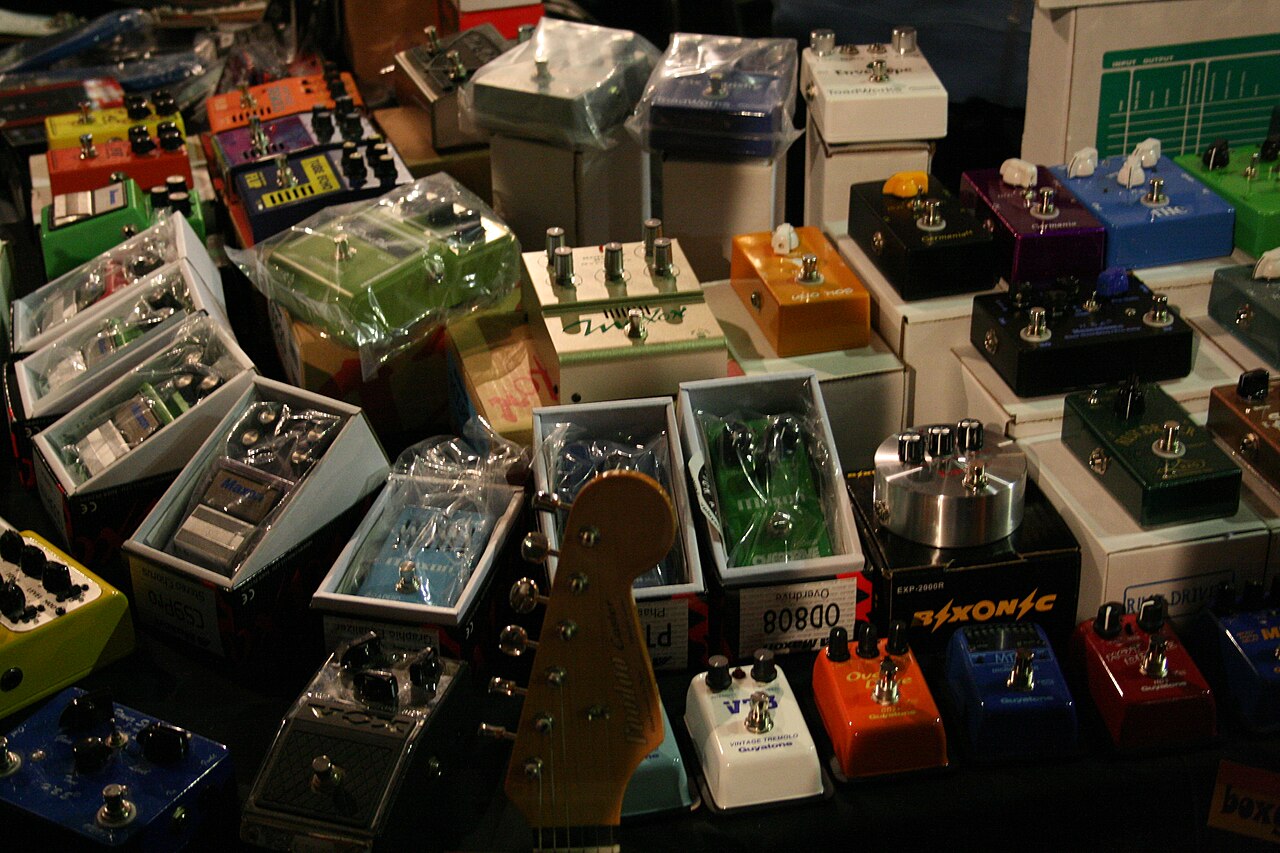
- Effects pedals piled together with a guitar behind them: Alessio Bragadini from Milan, Italy, Wikimedia Commons, CC BY-SA 2.0.
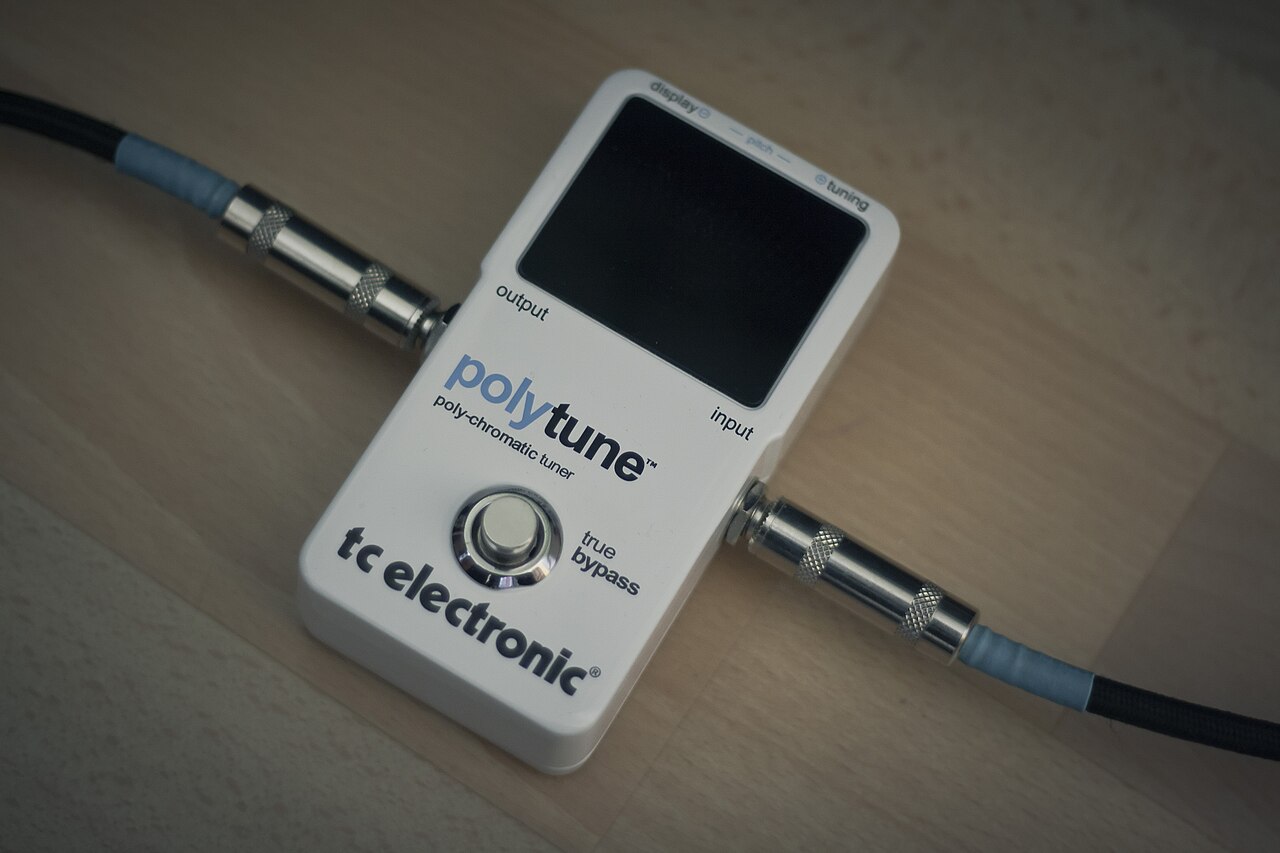
- A TC Electronic PolyTune pedal: Antti Simonen, Wikimedia Commons, CC BY 2.0.
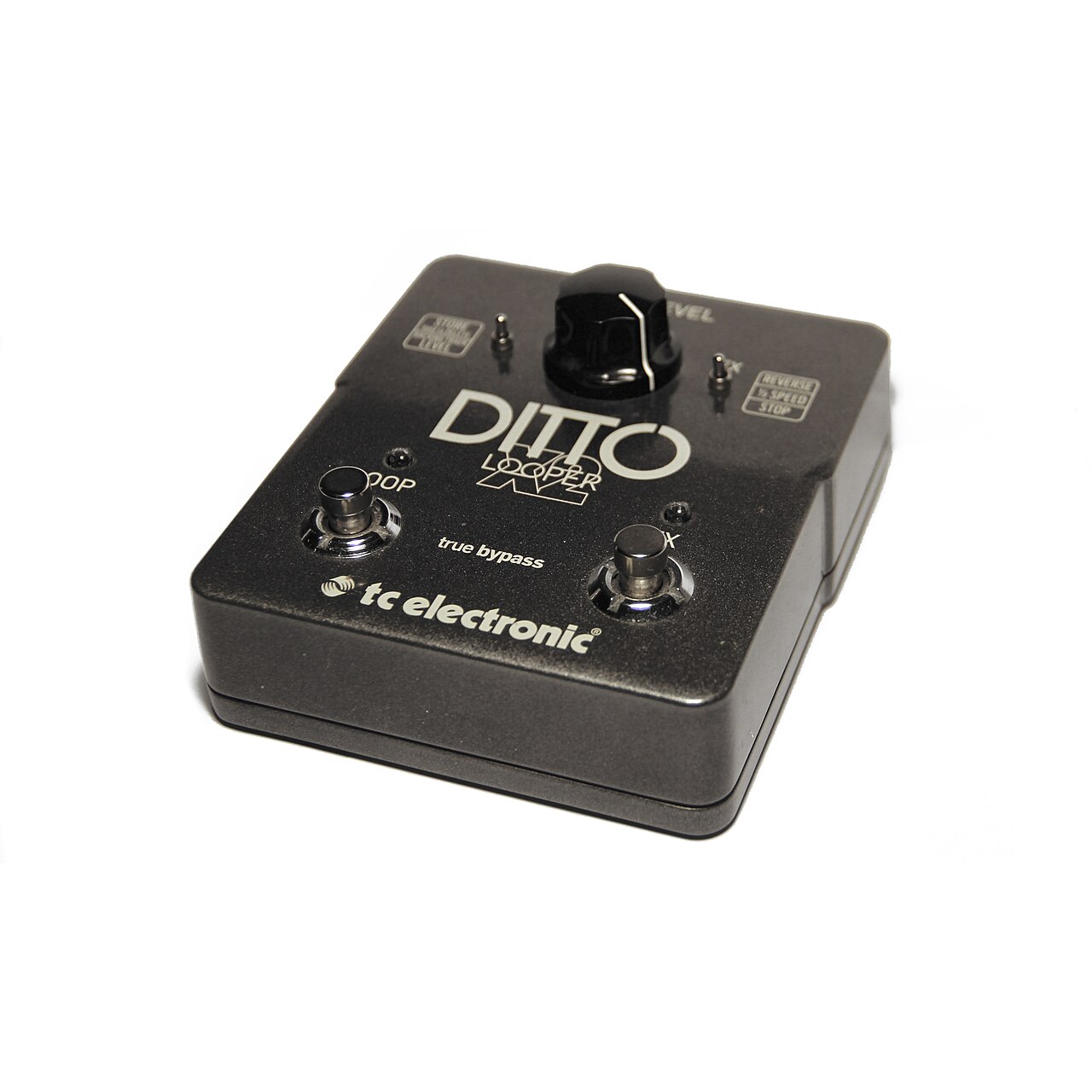
- A TC Electronic Ditto Looper X2 pedal: Potasmic, Wikimedia Commons, CC0.
- Top image: GuitarGangsters AI-generated reference illustration, not a photograph.
Latest News
Related
On This Day
Monday 9 November
From this week: