Boss DD-8 Digital Delay: The One Pedal That Does Everything Your Pedalboard Needs
Boss DD-8: 11 delay modes, 40-second looper, tap tempo, and stereo I/O in one compact pedal. Full specs, tone recipes, and buying guide.
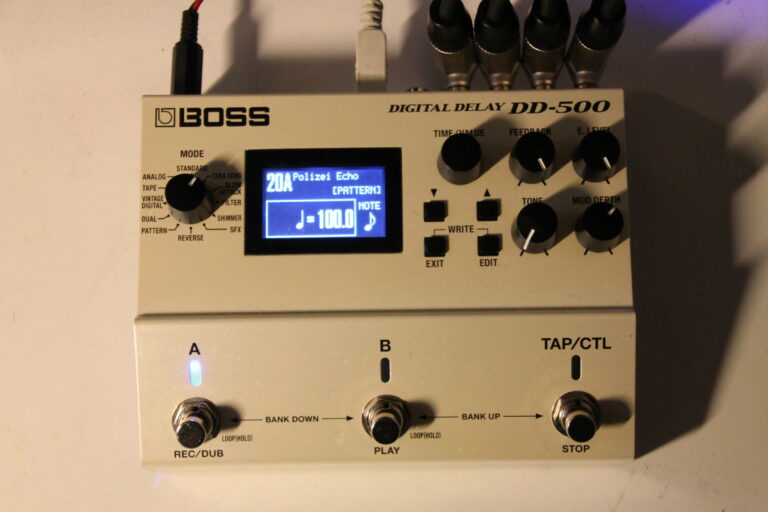
There’s a moment that happens in every guitarist’s life: you’re staring at your pedalboard, trying to cram in a tap-tempo delay, a reverse delay for that one song, a shimmer effect for ambient passages, and a looper for practice, and you realize you’ve run out of space. Boss built the DD-8 Digital Delay specifically for that moment. Released in September 2019 as the successor to the long-running DD-7, the DD-8 is the most feature-rich compact delay Boss has ever produced — eleven delay modes, a 40-second looper, full stereo I/O, tap tempo, carryover trails, expression control, and smart wet-only routing, all inside the same familiar 73×129×59mm enclosure that Boss has used since the 1970s. It is, in the most literal sense, a lot of pedal for the space it occupies.
What separates the DD-8 from a list of features, though, is how usable those features actually are. This is not a menu-diving nightmare — it is a Boss compact pedal, which means four knobs and a mode selector handle most of what you’ll ever need. The exotic stuff (GLT glitch mode, Warp mode, the Twist function via external footswitch) is there when you want it and completely out of the way when you don’t. That balance between depth and simplicity is the reason the DD-8 sits on pedalboards from bluegrass prodigies to shoegaze experimentalists, from bedroom players to working touring musicians.
From DD-1 to DD-8: The Boss Digital Delay Lineage
The Boss compact delay story begins in 1984 with the DD-2, the first mass-market digital delay in a compact pedal format — the technology had previously lived only in expensive rack units. The DD-2 was quickly superseded by the DD-3 in 1986, which went on to become one of the most successful effect pedals in history, staying in production until 2019 (when it was updated as the DD-3T with tap tempo). The DD-5 and DD-6 added stereo and more modes through the 1990s and 2000s. The DD-7 arrived in 2008, staying current for over a decade with its analog mode, modulation delay, and reverse.
The DD-8 arrived September 26, 2019, announced alongside the DD-3T (which preserved the classic DD-3 circuit with added tap tempo). The DD-8 took over where the DD-7 left off and then went considerably further: three completely new delay types (Warm, +RV, and GLT), a looper upgraded to 40 seconds, expression pedal support for simultaneous control of level, feedback, and delay time, three stereo output modes rather than one, and the Carryover switch that addressed one of the most common complaints about digital delay pedals — the abrupt cutoff of repeats when you bypass the effect. Forty years of compact delay experience went into that enclosure.
Eleven Modes: What Each One Actually Does
The DD-8’s MODE knob steps through eleven positions. Understanding what each one is for — not just what it’s called — is what turns a versatile pedal into a creative tool rather than an overwhelming one.
Analog models the character of a BBD (bucket-brigade device) analog delay: the repeats are warmer and darker than the dry signal, rolling off high frequencies progressively with each repeat. This is the sound of classic rock and country slapback, of vintage tape-delay warmth without tape-delay fragility.
Standard is the clean digital delay — repeats that are tonally identical to the dry signal. This is the foundation for Edge-style dotted-eighth rhythmic delays, for crystalline ambient pads, for anything where you want the echoes to be as clear as the original note.
Tape models the sonic character of vintage tape echo machines — not the mechanics of tape, but the tonal signature: slightly compressed, with a pleasantly smeared quality on the repeats that analog and standard modes don’t reproduce. It sits somewhere between Analog and Standard in character, with its own distinct texture.
Warm is a newly developed mode for the DD-8 — a digital delay with a softer, rounded character on the repeats. It’s subtler than Analog mode but warmer than Standard, designed to blend into a mix without the obvious BBD-emulation coloring of Analog mode. Useful when you want delay to support a guitar part rather than define it.
Reverse plays back your delayed signal in reverse — incoming signal goes into a buffer, gets flipped, and plays backward. The result is that familiar atmospheric swell effect, the kind of thing that made countless shoegaze records strange and beautiful. It’s a specialty effect but one that has genuine musical applications far beyond the obvious.
+RV blends delay and reverb simultaneously from a single pedal. This is not just delay running into a simulated reverb — it’s a custom algorithm designed so the two effects integrate naturally. For guitarists who want spatial depth without carrying a separate reverb pedal, this mode alone might justify the purchase.
Shimmer adds pitch-shifted repeats — typically an octave up — that blend with the delayed signal. The result is the soaring, cathedral-like texture that has appeared on everything from post-rock records to contemporary worship music. The FEEDBACK and E.LEVEL controls determine how present and dense the shimmer effect becomes.
Mod adds subtle pitch modulation to the delay repeats, creating a slight chorus-like movement. This is the classic “modulated delay” sound — thickening the repeats slightly so they sit differently from the dry signal in a mix, avoiding the sensation that the delay is fighting with the dry guitar.
Warp is the DD-8’s most interactive mode. Holding the pedal switch (or an external footswitch) increases the feedback and level of the delay to create swelling ambient textures and self-oscillation-adjacent effects. Release the switch and the effect returns to normal. It’s a performance tool, not a set-and-forget mode.
GLT (Glitch) is the genuinely experimental one — pressing the footswitch in this mode creates glitchy, stuttering, machine-gun rhythmic effects. The TIME and FEEDBACK knobs interact with GLT mode to produce a wide variety of glitch textures. This mode sounds like circuit-bent delay, analog sequencer gone haywire, or rhythmic noise — depending on settings, any of these can be true.
Loop puts the DD-8 into looper mode: up to 40 seconds of recording time with mono input (20 seconds in stereo), with unlimited overdub capability. A single footswitch handles record, play, and overdub. Add an external footswitch via the TEMPO/EXP jack to control stop and clear functions independently. For players who don’t want to dedicate real estate to a standalone looper, this is a practical solution built into a delay pedal they’d carry anyway.
Specifications
Famous Players: Who Actually Uses the DD-8
The Boss DD-8 was released in 2019, which creates an important constraint for any honest artist-connection discussion: legendary players whose most famous sounds were created before 2019 did not use this specific pedal. The Edge built his dotted-eighth delay identity with Korg SDD-3000s and Boss DD-3s. David Gilmour’s delay textures on Dark Side of the Moon and The Wall came from Binson Echorec, Maestro Echoplex, and Boss DD-2. John Frusciante’s documented delays include Boss DD-2, DigiTech PDS-1002, and the Boss DM-2W. Andy Summers’ rack-based rig has been documented extensively without any Boss DD-8 appearing. Steve Vai’s technically sophisticated multi-delay setup has no confirmed DD-8 component per any primary-source documentation. These are not DD-8 players — they are delay giants, and the association is a genre-level attribution, not a pedal-specific one.
Who actually uses the DD-8? The Equipboard community database identifies 32 professional users with documented evidence. Among the most credibly sourced:
Billy Strings is confirmed as a DD-8 user via a Premier Guitar interview mention — the Kentucky flatpicking prodigy who has redefined what acoustic-electric bluegrass guitar can do in a modern live context. His use of the DD-8 fits the pedal’s practical strengths: a working musician’s delay that covers everything from subtle echo to ambient experimentation without requiring a second or third dedicated delay pedal.
Tony Esposito of White Reaper is confirmed via the band’s Premier Guitar Rig Rundown (2021), where the DD-8 is visible on his full touring pedalboard at the 7:59 mark of the video. White Reaper’s arena-ready power-pop context — big riffs, clean tones with aggressive picking — is exactly the kind of situation where the DD-8’s Standard mode and tap tempo do their best work.
Elijah Hewson — guitarist and son of Bono, playing in his own right with Inhaler — uses a DD-8 documented via a pedalboard photograph, with the pedal visible on the far left of the top row. Further video documentation shows Hewson primarily using it as a tap-tempo delay, adjusting the tempo live, consistent with the DD-8’s strengths in a live band context.
Bradley Will Simpson of The Vamps has the DD-8 clearly visible in a pedalboard photograph, confirming its role in a mainstream pop-rock live rig.
The honest picture: the DD-8 is not primarily a pedal associated with guitar legends whose tones you grew up hearing. It is a workhorse tool that working musicians across multiple genres chose after 2019 because it is practical, versatile, and reliable. That’s not a lesser reputation — it is exactly the reputation that has made the Boss compact series endure for over forty years.
Tone Recipes and Settings
Recipe 1: Clean Tap-Tempo Stage Delay (Standard Mode)
This is the Swiss Army knife setting — the one you use at every gig where you need delay synced to the song tempo. Set MODE to Standard. Set TIME to roughly 350-450ms and use tap tempo to lock it precisely to your song. Set FEEDBACK around 9 o’clock (two to three repeats maximum). Set E.LEVEL to around 10-11 o’clock (delay about 30-40% of dry signal level). CARRYOVER switch ON — trails continue when you bypass, which is essential for smooth musical transitions. Expression pedal on E.LEVEL lets you fade delay in and out smoothly. This is the setting that was on countless pedalboards before the DD-8 existed, but now it lives in one mode of a pedal that does ten other things.
Recipe 2: Analog Slapback (Analog Mode)
Slapback delay is the sound of early rock and roll, country twang, and Scotty Moore’s guitar on Elvis records. Set MODE to Analog. TIME to 60-120ms — shorter for tight slap, longer for a more spacious echo. FEEDBACK to minimum (7-8 o’clock) for a single clean slap with no repeats. E.LEVEL around 12 o’clock — you want the delay to be heard, not hidden. CARRYOVER OFF for this one. The Analog mode’s inherent high-frequency rolloff on repeats means the slapback sits slightly behind the dry signal in the mix, exactly as a real tape slapback would.
Recipe 3: Ambient Shimmer Wash (Shimmer Mode)
This is for the post-rock swell, the cinematic passage, the moment where the guitar needs to fill a room rather than cut through it. Set MODE to Shimmer. TIME to 700ms–1.5 seconds. FEEDBACK to 2-3 o’clock — high, to let the shimmer accumulate. E.LEVEL to 1-2 o’clock. Roll your guitar’s volume back to about 5-6, play slowly, and let the shimmer build. For maximum effect, connect a volume pedal before the DD-8 and use it for silent guitar swells while the shimmer sustains. This pairing of shimmer mode with volume-swell technique creates the signature sound of contemporary instrumental guitar.
Recipe 4: GLT Rhythmic Stutter (GLT Mode)
The GLT mode is most musical when set up to interact with the tempo of the song. Set MODE to GLT. TIME to a subdivision of your song tempo — quarter note, eighth note, or dotted eighth. FEEDBACK around 10-11 o’clock. E.LEVEL around 11 o’clock. In GLT mode, pressing the pedal switch activates the glitch effect — you can time your footswitch presses to the beat for deliberate rhythmic stutter effects, or press it on non-beat positions for more disorienting results. This is most effective as an accent in specific song moments rather than a continuous effect.
Recipe 5: Wet-Only for Parallel Loop (+RV Mode)
If your amp or mixer has a parallel effects loop, the DD-8’s smart I/O enables a wet-only configuration: plug into INPUT-A, connect OUTPUT-B to your wet return, and leave OUTPUT-A disconnected. Only the processed signal comes from OUTPUT-B, while the dry signal returns through your amp’s direct path. In this configuration, +RV mode becomes a genuine spatial enhancer — delay and reverb together from the effects loop, seamlessly blended with the amp’s natural dry tone. This is a sophisticated routing option that was previously difficult to achieve with a compact pedal, and the DD-8 handles it via cable configuration alone, no internal menus required.
Recipe 6: Warp Ambient Feedback (Warp Mode)
Warp mode turns the DD-8 into an interactive ambient generator. Set MODE to Warp. TIME around 600ms. FEEDBACK around 11 o’clock. E.LEVEL around 12 o’clock. Play a chord, then hold the footswitch down — the feedback and level increase, creating a building ambient wash. Release the switch and the effect returns to the baseline setting. For best results, connect an external FS-5U or FS-6 footswitch to the TEMPO/EXP jack for dedicated Warp control, freeing the main footswitch for tap tempo duties. The Warp mode rewards experimentation: different TIME settings dramatically change the character of the feedback swell.

How the DD-8 Compares
The DD-8’s most direct competition comes from a handful of multi-mode compact delays at similar price points. The MXR Carbon Copy (M169) does one thing — analog delay — with beautiful warmth and simplicity. It costs similar money but offers zero versatility beyond its one mode. For players who need only analog delay, the Carbon Copy’s focused excellence is a better choice; for players who need more than one sound, the DD-8’s eleven modes win on pure utility.
The Electro-Harmonix Deluxe Memory Man is the gold standard for analog delay with integrated chorus/vibrato modulation — it’s a legendary pedal with a larger footprint, higher price, and a specific character that no digital pedal replicates. The DD-8’s Analog mode approximates the sonic philosophy (warm, high-frequency-rolled repeats) but does not claim to be a Deluxe Memory Man. These are complementary rather than competing pedals.
The TC Electronic Flashback 2 offers similar versatility at a comparable price with the addition of TonePrint programmability and true bypass. The DD-8’s advantage is Boss build quality and the brand’s 40-year track record — the five-year warranty and virtually indestructible compact chassis are part of what you’re paying for. The Flashback 2’s true bypass is an advantage for players running germanium fuzz pedals before their delay; the DD-8’s buffered bypass is a non-issue for most other signal chain configurations.
The Boss DD-200 is the natural upgrade from the DD-8 in the Boss ecosystem — it adds more sophisticated parameter control, additional modes, effects loop integration, MIDI capability, and a larger display, at roughly twice the price and twice the footprint. The DD-8 is better than the DD-200 in exactly one dimension: size. For players whose pedalboard space is genuinely limited, the DD-8’s compact form factor is a real advantage.
The Boss DD-3T is worth mentioning as a direct sibling: same compact chassis, tap tempo, but just the one Standard digital delay mode. The DD-3T at roughly $99 versus the DD-8 at $125-190 is the classic trade-off between focus and versatility. If you know you’ll only ever use clean digital delay, the DD-3T saves money. If you want the option to use Shimmer, Reverse, Mod, and Looper — even if you don’t use them all the time — the DD-8’s cost premium is justified.
Signal Chain Placement and Power Considerations
The DD-8 belongs after drive pedals, modulation, and wah in the standard signal chain, and before reverb. This placement ensures that the delay is processing a consistent, shaped tone, and that reverb adds space to the already-delayed signal rather than the delay echoing a reverb tail.
The DD-8’s buffered bypass is not an issue for most signal chains. The buffer functions as a low-output-impedance driver, which actually benefits long cable runs. The only scenario where buffered bypass requires attention is if you run a vintage germanium fuzz before the DD-8 and that fuzz is sensitive to input impedance — in that case, the germanium fuzz should be placed before any buffer in the chain, which means before the DD-8.
Power is the DD-8’s most significant practical constraint: it draws 100mA at 9V DC. This is double or triple what most analog compact pedals draw. A standard daisy-chain power supply — typically rated for 500mA total across multiple outputs — can power a DD-8 alongside other pedals numerically, but noise interference is common in daisy-chain configurations with digital pedals. The recommended approach is an isolated power supply with at least one output rated for 100mA or more dedicated to the DD-8. Voodoo Lab Pedal Power 2 Plus, Strymon Ojai, and similar isolated supplies handle the DD-8 without issue. Powering the DD-8 from a 9V battery is technically possible but produces only about 3.5 hours of runtime — not practical for most gigging situations.
The Carryover Switch: An Underrated Feature
The CARRYOVER switch deserves more attention than it typically receives in DD-8 discussions. When set to ON, delay trails continue naturally after you bypass the pedal — the echoes fade out as they would in real time rather than cutting abruptly. When set to OFF, bypass cuts the delay immediately.
Why does this matter? The abrupt cutoff of digital delay bypassing is one of the reasons many players switched to analog delays or true-bypass designs. It sounds unnatural — notes that were echoing simply disappear. The CARRYOVER switch gives the DD-8 natural trail behavior without requiring true bypass circuitry. In practice, CARRYOVER ON is the musical choice for most situations; CARRYOVER OFF is useful when you need the delay to stop completely and immediately, such as in rhythmically demanding passages where trailing echoes would blur the beat.
Buying Guide
The DD-8 has been in continuous production since 2019 with no manufacturing variants affecting tone — all units are sonically identical. There are no “MIJ vs MIT” or “analog vs digital” version distinctions to navigate, unlike older Boss pedals. A used DD-8 in excellent condition sounds identical to a new one.
When inspecting a used DD-8, test all eleven MODE positions — switching through every mode confirms the MODE selector is fully functional. Test the TEMPO/EXP jack with both a tap tempo footswitch (or simulate by shorting the ring connector) and verify the tap tempo indicator responds. Test the CARRYOVER switch in both positions. Test both stereo inputs and outputs with cables in all positions to verify the smart I/O functionality. Check the Warp mode by holding the footswitch in the engaged position — the feedback should increase smoothly. Listen for any noise floor issues, which can indicate power supply problems or an internal fault.
New DD-8 prices typically run $125–190 USD depending on retailer. Used excellent-condition units sell for $90–130 USD. The price differential between new and used is modest enough that either choice is reasonable — the Boss five-year warranty is transferable but only from the original purchase date, so a used unit may have remaining warranty coverage depending on when it was bought.
The DD-8 pairs naturally with a Fender Stratocaster or Fender Telecaster — the single-coil clarity of either guitar reveals the nuances of each delay mode most transparently, particularly the Analog mode’s high-frequency rolloff and the Shimmer mode’s pitch-shift shimmer. Running a DD-8 through a Vox AC30 Top Boost‘s natural top-end brightness with the DD-8’s Analog mode provides a natural high-frequency balance — the Analog mode’s rolloff on repeats complements the AC30’s chime rather than competing with it.
Ownership Notes
The DD-8 rewards learning its smart I/O routing options beyond the basic mono connection. Boss’s documentation describes five connection configurations: mono in / mono out, stereo in / stereo out (independent mode), mono in / stereo out (panning or wide stereo mode), mono in / wet out only (for parallel loops), and mono in / separate wet and dry outputs. Understanding these configurations unlocks the DD-8’s full utility in different rig contexts.
The Twist function is easy to overlook because it requires an external footswitch. Connecting an FS-5U or FS-6 to the TEMPO/EXP jack (when not used for an expression pedal) enables the Twist effect: holding the external footswitch in any delay mode creates a soaring, feedback-rising effect that’s different from Warp mode. It’s a performance tool that adds a dramatic dynamic to an otherwise set-and-forget delay setting.
The DD-8’s looper is limited by the absence of dedicated undo/redo and stop controls on the main footswitch — to stop a loop, you must hold the footswitch for a moment, and to clear it, hold longer. Adding even a single external FS-5U footswitch to the TEMPO/EXP jack dramatically improves the looper’s live usability by separating stop and clear functions. For players who use the looper regularly, this $20–30 accessory investment transforms the workflow.
Frequently Asked Questions
What replaced the Boss DD-7, and how is the DD-8 different?
The DD-8 replaced the DD-7 in September 2019. The key additions are three new delay modes (Warm, +RV, and GLT), an upgraded looper (40 seconds versus 40 seconds on DD-7 but with improved controls), three stereo output modes versus one, the Carryover switch, and true expression pedal support for simultaneous control of multiple parameters. The DD-7 remains capable, but the DD-8 is unambiguously more versatile.
Does the DD-8 have true bypass?
No. The DD-8 uses buffered bypass, as do virtually all Boss compact pedals. The CARRYOVER switch compensates for the most significant issue of digital bypass (abrupt trail cutoff) by allowing trails to continue naturally when set to ON. Buffered bypass is not a sonic liability for most signal chains; only vintage germanium fuzz pedals before the DD-8 require any special attention.
Can I use an expression pedal with the DD-8?
Yes. The TEMPO/EXP TRS jack accepts either a tap tempo footswitch or a compatible expression pedal (Roland EV-5, Boss EV-30, Boss FV-500H/L). With an expression pedal connected, you can control delay level, feedback, delay time, or all three simultaneously — the last option creates sweeping, multidimensional delay changes with a single foot movement. Note that the same jack also accepts tap tempo footswitches and functions for Warp/Twist control; it cannot simultaneously serve both an expression pedal and a tap tempo footswitch.
How does the DD-8’s 100mA current draw affect my power supply?
The 100mA draw is high for a compact pedal — most analog compacts draw 5–30mA. You need either an isolated power supply output rated for 100mA or more, or a high-capacity daisy-chain supply with sufficient headroom. Running the DD-8 from a standard 100mA isolated output is fine. Running it from a cheap daisy-chain power supply shared with multiple other digital pedals often produces noise or instability. Budget accordingly: an isolated supply like the Voodoo Lab Pedal Power 2 Plus or Strymon Ojai is the practical solution.
What’s the difference between the three stereo output modes?
Independent mode (default) provides linked parallel delays on left and right channels, maintaining the stereo balance of your input in the effect sound. Panning mode creates ping-pong delay where echoes alternate between left and right outputs. Wide stereo mode enhances spatial depth beyond standard stereo. To select between modes, the OUTPUT-B jack’s connection state and input configuration determine which mode is active — Boss’s documentation covers the specific cable configurations for each mode.
Does the DD-8 work well as a standalone looper?
For practice, song-checking, and simple live looping in a single-layered context, yes. The 40-second limit and the single-footswitch operation are practical constraints, but they’re appropriate for a delay pedal with an integrated looper. For complex, multilayer looping as a primary performance technique, a dedicated looper (Boss RC-5, RC-10R, or similar) provides better control and more features. The DD-8’s looper is a genuine bonus capability, not a dedicated looper’s replacement.
The GLT mode sounds chaotic — how do I use it musically?
GLT mode is most musical when used as a deliberate accent rather than a continuous effect. Set a TIME and FEEDBACK combination that interacts with your song’s tempo, engage it for a specific number of beats or bars, then disengage. Shorter TIME settings (under 300ms) with higher FEEDBACK produce tighter machine-gun stutter effects; longer TIME with lower FEEDBACK creates more spaced, granular glitch. The FEEDBACK control significantly affects character in GLT mode — running it above 1 o’clock risks runaway feedback that requires power-cycling to reset, so treat high FEEDBACK in GLT mode with appropriate caution.
How does the DD-8 compare to the Boss DD-200?
The DD-200 offers more sophisticated parameter control via additional knobs, MIDI capability, a larger display showing exact delay time values, more delay modes, and an effects loop. It costs roughly twice as much and takes up roughly twice the pedalboard space. The DD-8 wins on size and simplicity — eleven modes, four knobs, zero menus. For players who need the depth and programmability of the DD-200, it’s the better tool. For players who need a versatile delay in a compact chassis without programming complexity, the DD-8 does more than enough.
Image credits
- A pedalboard with a mix of effects pedals: ArtBrom, Wikimedia Commons, CC BY-SA 2.0.
- A Boss ODB-3 bass overdrive pedal seen from the rear: Roadside guitars, Wikimedia Commons, CC BY-SA 2.0.
- Boss OD-2 Turbo Overdrive and OD-2R pedals side by side: Kuriosatempel, Wikimedia Commons, CC BY-SA 4.0.
Latest News
Related
On This Day
Tuesday 10 November
From this week: