Warm Echoes, No Apologies: How the MXR Carbon Copy Became the World’s Best-Selling Analog Delay
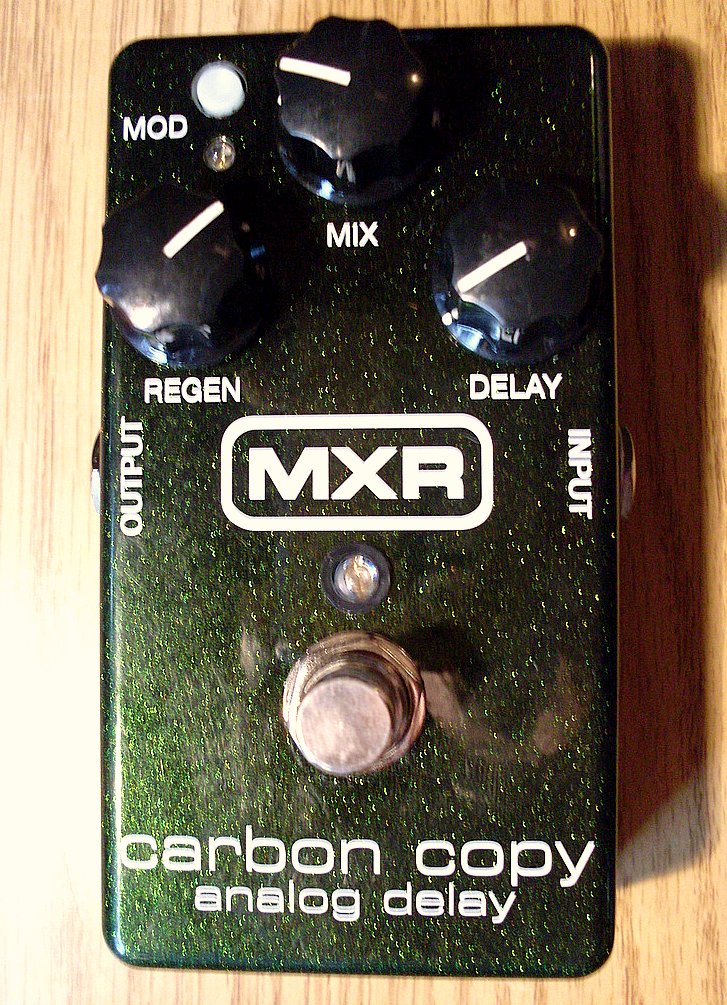
MXR Carbon Copy analog delay pedal. Photo: MXR Carbon Copy by Roadside Guitars, CC BY-SA 2.0 (https://creativecommons.org/licenses/by-sa/2.0/). Source image unchanged by GuitarGangsters. Source: https://www.flickr.com/photos/roadsideguitars/3103574467/
The MXR M169 Carbon Copy is the world's best-selling analog delay. Here's how it works, who plays it, and how to get the best from its BBD circuit.
In 2008, MXR released a compact green pedal with three knobs, one switch, and a bucket brigade chip inside. Nobody threw a parade. The Carbon Copy Analog Delay landed quietly, aimed at players who wanted a no-fuss analog echo in a format that wouldn’t eat half their pedalboard. Sixteen years later, it has sold more units than any other analog delay pedal in history, with 406 confirmed professional users on Equipboard — a list that spans everything from arena-rock guitar heroes to jazz fusion experimentalists to doom metal riff-mongers. That’s not the result of marketing. That’s the result of a pedal that does exactly what it promises, every single time, in a package that players actually want to use.
This is a gear guide to the MXR M169 Carbon Copy Analog Delay — what it is, how it works, who plays it, and why it has quietly dominated the analog delay category for nearly two decades.
Where the Carbon Copy Came From: MXR, Bucket Brigade, and the Analog Revival
To understand the Carbon Copy, you need to understand MXR’s history with delay. The company — founded in 1972 by Keith Barr and Terry Sherwood in Rochester, New York — was among the first to put analog delay in a stompbox format. Their M108 and M113 units from the late 1970s were among the most sophisticated delay pedals available at the time, and players like Andy Summers of The Police built entire rigs around MXR’s analog delay circuits. The Pete Cornish custom board Summers used from 1979 included an MXR Analog Delay at its heart, working in combination with an Echoplex tape unit for the layered rhythmic echoes that defined songs like “Message in a Bottle” and “Can’t Stand Losing You.”
But MXR went bankrupt in 1984. Dunlop Manufacturing acquired the brand and revived it, eventually building MXR into one of the strongest pedal sub-brands in the world. When Dunlop looked at the 2007–2008 analog delay market, they saw a gap: players wanted analog warmth and simplicity, but the best-regarded analog delays — the vintage Electro-Harmonix Deluxe Memory Man, the Boss DM-2 — were either long discontinued or priced out of reach. The Carbon Copy was the answer: modern bucket brigade technology, three knobs, true bypass, $149 street price. Done.
The M169 launched in 2008. Within its first year it was the best-selling analog delay pedal in the US market. It has remained there ever since.
The Circuit: Bucket Brigade in the Modern Era
The Carbon Copy’s defining characteristic is its analog signal path, driven by a Panasonic MN3208 bucket brigade device (BBD) chip. A bucket brigade chip works by passing audio samples along a series of capacitors — like a bucket chain passing water — with each stage introducing a tiny time delay. Enough stages, and you get echo. The MN3208 is a high-clock-frequency BBD that allows the Carbon Copy to reach up to 600 milliseconds of delay time while maintaining relatively good fidelity in the repeats.
This is the fundamental difference between analog delay and digital delay: in a digital pedal, the dry signal is converted to digital, stored, and replayed with near-perfect accuracy. In the Carbon Copy, the delay repeats are genuinely processed through the analog BBD chain, which introduces a slight high-frequency roll-off and a subtle warmth in each repeat. The repeats don’t sound like a perfect copy of what you played — they degrade slightly with each generation, darkening and smoothing in a way that most players find musical. When the repeats eventually wash away, they do so organically, not with a clean digital cutoff.
The modulation circuit adds another layer. Engage the modulation switch (top-mounted on the M169) and the delay time is subtly varied by a low-frequency oscillator, giving the repeats a slight pitch wobble that mimics the speed variations inherent in vintage tape echo units. Two internal trim pots — accessible via small holes in the top panel — allow the player to adjust the width (depth) and rate of the modulation independently of the main controls. The factory settings are conservative, producing a gentle, barely perceptible shimmer. Players who prefer a more pronounced chorus-like modulation can open up the trim pots considerably.
The pedal is true bypass, which means the signal path is completely disconnected when the pedal is off — no buffer, no coloration, no bypass tone alteration. This is the correct choice for a delay that lives after drives and before reverbs in a typical signal chain, where a buffer in the off state is generally unwanted.
Controls and Specs
| Specification | Details |
|---|---|
| Model | MXR M169 Carbon Copy Analog Delay |
| Delay Technology | Analog BBD (Panasonic MN3208 chip) |
| Maximum Delay Time | 600ms |
| Controls | Delay (time), Mix (wet/dry blend), Regen (feedback/repeats), Mod switch |
| Internal Trim Pots | Mod Width, Mod Rate (via top-panel access holes) |
| Signal Path | 100% analog |
| Bypass | True bypass |
| Input | 1 × ¼” instrument |
| Output | 1 × ¼” instrument |
| Power | 9V battery or DC 9V center-negative adapter |
| Dimensions | 4.75″ × 2.75″ × 1.25″ (120.7 × 69.9 × 31.8 mm) |
| Weight | 0.84 lbs (381g) |
| Price (new, M169) | ~$159.99 USD |
| Price (used, excellent) | ~$75–110 USD |
| Equipboard Pro Users | 406 |
| Launch Year | 2008 |
What the Three Knobs Actually Do
The Delay knob sets the time between input signal and first repeat. At minimum, this is short enough for slap-back (approximately 30–50ms); at maximum it reaches 600ms, which is enough for rhythmic subdivisions at most tempos or long wash-out ambient delays. The Mix knob blends the wet delay signal with the dry guitar signal — at minimum it’s nearly inaudible; at maximum the delay sits level with or above the dry signal. The Regen (Regeneration) knob controls how much of the delay output is fed back into the input to create additional repeats. At low settings you get one or two soft echoes; turned up it creates extended decay trails; pushed near maximum it produces near-infinite self-oscillation that eventually runs away into wash.
The interaction of Mix and Regen is where most of the Carbon Copy’s character lives. Higher Mix with lower Regen produces a single prominent echo that competes with the dry signal — classic slap-back. Lower Mix with higher Regen produces a long, gradually decaying trail of quieter repeats that sits under the dry signal — ambient wash. The analog warmth of the BBD circuit means that high-Regen settings become darker and more diffuse with each repeat rather than staying bright and defined, which is why long trails on the Carbon Copy feel musical rather than cluttered.
Famous Players: Verified, Honest, No Mythology
The Carbon Copy’s marketing materials reference “Gilmouresque delays” in their official product description — and that single phrase has been repeated uncritically across gear forums for fifteen years, creating the impression that David Gilmour uses a Carbon Copy. He does not, at least not in any documented or confirmed sense. Gilmour’s iconic delays were built primarily around the Binson Echorec tape echo (early Pink Floyd), the TC Electronic 2290 digital delay (Momentary Lapse era through present), and the Boss DD-2/DD-3. The Carbon Copy can produce Gilmour-adjacent textures, which is exactly what Dunlop’s copy means. It’s an aspiration, not an endorsement.
Similarly, The Edge of U2 — whose name is attached to the Carbon Copy in virtually every gear forum thread about analog delay — is not a confirmed regular user. He was photographed with a Carbon Copy during a Fender product development session, which was almost certainly a loaner pedal for the shoot. His documented live and studio delays are the TC Electronic 2290, the Korg SDD-3000 (his signature digital delay), and Fractal Audio for more recent rigs. Attributing the Carbon Copy to The Edge is like attributing a session-rental Les Paul to a Strat player: plausible in the moment, not part of his actual toolbox.
Andy Summers of The Police is another commonly cited name. Summers absolutely used MXR analog delay — but the vintage M108 and M113 units that formed part of his classic 1979–1983 rig predate the Carbon Copy by nearly three decades. The Police had already broken up twenty-five years before the M169 was released.
The actually confirmed Carbon Copy users are a more diverse and interesting group.
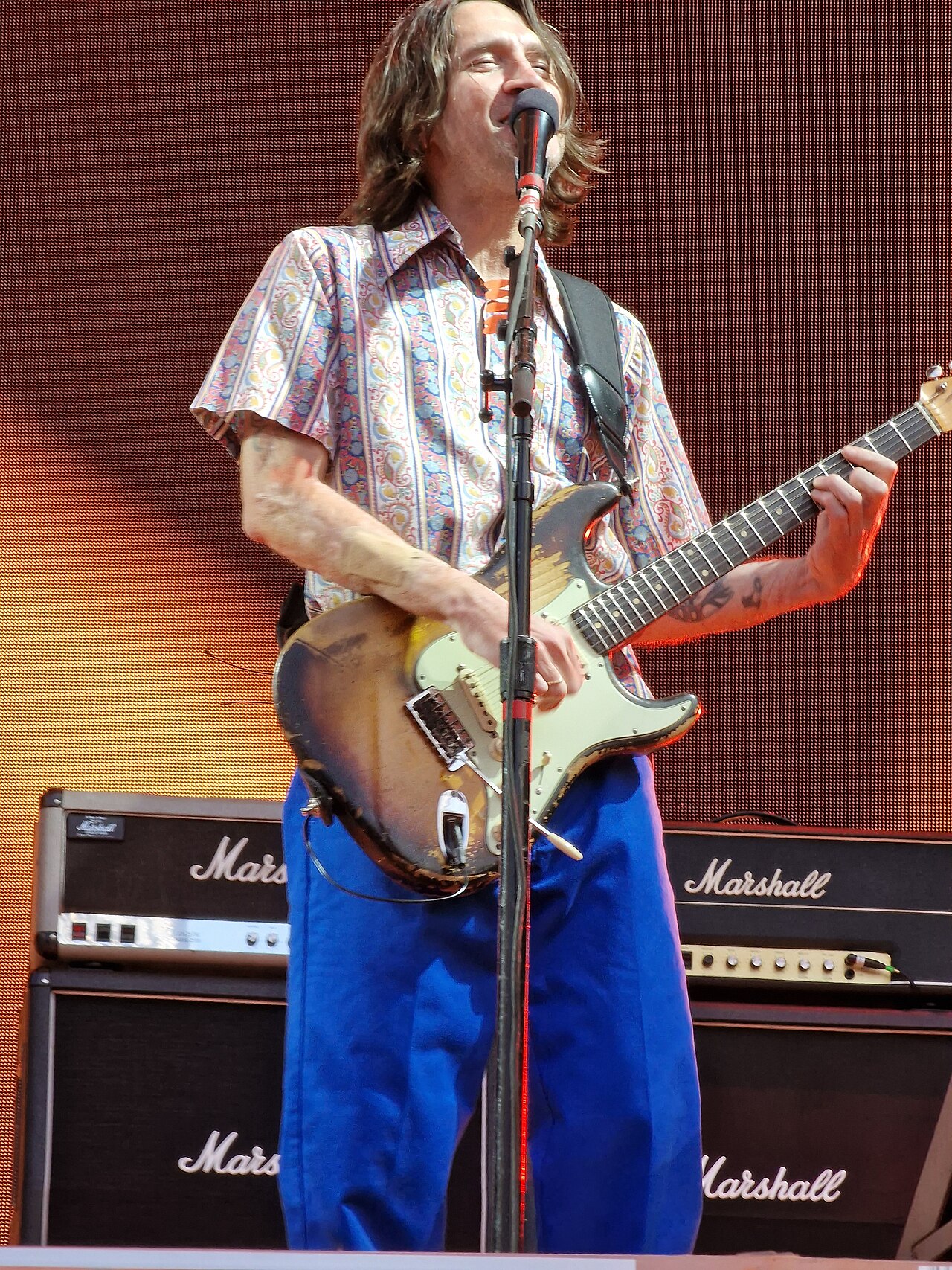
John Frusciante
Frusciante is the article’s most definitively confirmed high-profile user, with primary source photographic evidence. When the Red Hot Chili Peppers performed at the Fonda Theatre in Los Angeles in April 2022 for the Unlimited Love album cycle, bassist Michael Goldman of opening act Irontom posted Instagram footage that revealed Frusciante’s full pedalboard during soundcheck. The MXR M299 Carbon Copy Mini was clearly visible and labeled on his board — alongside the MXR Echoplex, MXR Phase 90, MXR Flanger, MXR Dyna Comp, MXR Micro Amp, and MXR Reverb units, reflecting Frusciante’s strong preference for MXR effects during this era.
Frusciante’s MXR Carbon Copy (in the M299 Mini format) served as one of his primary delay sources during the Unlimited Love and Dream Canteen touring cycle, replacing the Line 6 DL-4 he had previously used. His application is classic rock delay: medium times, moderate regeneration, the Carbon Copy creating the warm ambient trails that sit beneath his leads rather than overwhelming them. His board at the Apollo Theater in New York in September 2022 confirmed the same setup, with the Carbon Copy maintaining its position in his delay chain alongside the Digitech PDS1002 and Boss DD-500.
Frusciante’s chain from that era: Frusciante ran drives including the Boss DS-2, Boss SD-1, and EHX Big Muff Pi — with the Carbon Copy providing delay after the drive stack, before his MXR Reverb units at the end of the chain. The M299 Mini format gave him the same BBD circuit as the M169 in a smaller footprint — useful on a board already packed with MXR pedals.
Zakk Wylde
Zakk Wylde has confirmed the MXR Carbon Copy as his primary delay for Black Label Society touring work, specifically noting that his settings are configured to approximate Randy Rhoads’s guitar solo echo tones. Wylde’s approach is a medium delay — not a fast slap-back, not a long ambient wash — with enough regeneration to produce two or three clear repeats before washing out. His comment that it’s “not going to muddle any of the playing” captures exactly what the Carbon Copy is designed to do: produce present, articulate repeats rather than the diffuse blur that maximum settings produce. Wylde’s delay position comes after his overdrive stack — a chain built around his MXR ZW44 Berserker Overdrive (which replaced the Boss SD-1 he used during the Ozzy era) — and before his Marshall cabinets. The Carbon Copy in this context functions as a signature element of his solo sound.

Joe Perry
Joe Perry of Aerosmith has been confirmed as a Carbon Copy user via Premier Guitar Rig Rundown documentation and Equipboard, with the pedal appearing in his rack effects setup. Perry’s approach differs from Wylde’s — rather than a precision solo-boost delay, Perry uses the Carbon Copy as a rack element for atmospheric textures in a more complex effects routing system. His Aerosmith rig was always built around a core of vintage tonality (his primary amps being vintage Marshalls and Fenders), with the Carbon Copy providing the analog warmth he preferred over digital alternatives. The Carbon Copy’s BBD character — with its natural treble roll-off on repeats — integrates more naturally with the vintage amplifier character Perry builds his sound around than a bright digital delay would.
Additional Confirmed Users
Beyond those three primary players, the Carbon Copy’s Equipboard list of 406 pro users includes documented confirmation of Billy Gibbons (ZZ Top), Brad Paisley, Matt Pike (High on Fire, Sleep), and Billie Joe Armstrong — confirmed across various rig rundowns and gear documentation. The breadth of genres is notable: country (Paisley), classic rock (Perry, Gibbons), metal (Wylde, Pike), alternative rock (Armstrong), and progressive psychedelia (Frusciante) all point to the same pedal for the same reason — analog warmth, simple controls, reliable performance.
Signal Chain Placement and Practical Notes
The standard signal chain position for any delay pedal — and the Carbon Copy is no exception — is after drives and modulation effects, before reverb. Drives before delay means that the delay repeats are clean echoes of the distorted guitar sound, which is musically natural (like an amp with delay at the output stage). Delay before drives would distort the repeats along with the guitar signal, compressing and smearing them in a way that typically obscures clarity. Reverb after delay means the decaying delay trails are then given spatial depth, which generally sounds more open and natural than delay processing a reverberated signal.
True bypass on the Carbon Copy means that when it’s disengaged, the signal path is completely broken and the guitar signal passes through the bypass relay directly. This is the recommended configuration for most setups. The caveat applies in the same way as any true bypass delay: if you switch the Carbon Copy off mid-phrase, the existing delay trails are cut immediately. Players who want delay trails to continue (spillover) after bypassing will need to use the M292 Carbon Copy Deluxe, which includes a trails option, or a buffered switching system that holds the delay in a wet-only send path after bypass.
Power: the Carbon Copy draws approximately 10mA from a standard 9V center-negative power supply — minimal current demand that causes no issues on any standard pedalboard power supply. It can also run on a 9V battery; given the relatively low current draw, a fresh battery will give several hours of play time. The internal trim pots for modulation are accessed through small holes in the top panel with a flat-head or Phillips screwdriver — no case-opening required.
Tone Recipes and Settings
Classic Slap-Back: Rockabilly/Country
Delay at approximately 9 o’clock (100–150ms), Mix at 9–10 o’clock (just audible, not prominent), Regen near minimum (one or two clean repeats). Modulation off. This setting produces the single short echo that characterizes vintage rockabilly, classic country, and the “bathroom reverb” quality MXR’s marketing correctly identifies. Works best into clean amps — a Fender Twin or Vox AC30 with the Carbon Copy at this setting replicates the Sun Records recording chain aesthetic. The analog BBD darkening effect is subtle at short delay times, making this setting closer to a bright slap-back than a warm one.
Wylde Solo Setting: Medium Delay, Clear Repeats
Delay at noon (300–350ms), Mix at 10–11 o’clock (repeats audible but not competing with dry), Regen at 9–10 o’clock (two to three decaying repeats). Modulation off. This is the configuration Zakk Wylde uses for his Randy Rhoads-inspired solo tones — clear, articulate echoes that enhance sustain and add dimension without blurring notes together. Works with any high-gain setup. The Carbon Copy’s BBD character means the repeats are already somewhat smoothed and de-brightened compared to the dry signal, which prevents the fizzy repeat problem that plagues digital delays at high gain.
Ambient Wash: Long Trails
Delay between 3 o’clock and maximum (450–600ms), Mix at noon or above, Regen at 2–3 o’clock (extended decay without self-oscillation). Modulation switch on, trim pots at conservative factory settings. This produces the “Gilmouresque” long-delay ambient texture that MXR’s marketing references. With a clean amp, this setting creates a musical wash under chord pads or slow lead lines. The BBD darkening effect is most pronounced at maximum delay time — the repeats at 600ms are noticeably warmer and duller than the dry signal, which creates a pleasant sense of depth and distance.
Modulated Shimmer: Subtle Chorus Character
Delay at 10–11 o’clock (180–250ms), Mix at 10 o’clock, Regen low, modulation on, trim pots opened up to taste. With the width and rate trim pots turned up from factory settings, the modulation becomes more pronounced — the repeats develop a chorus-like wobble that can simulate the irregularity of vintage tape echo machines. This is most effective at medium delay times where the modulation pitch variation is audible as shimmer rather than as obvious warble.
Rhythmic Delay: Sync to Tempo
For rhythmic applications, set the Delay knob by ear to match the song tempo. A useful starting point for dotted-eighth-note delay (the “U2 edge” interval) at 120 BPM: a dotted eighth note at 120 BPM is approximately 375ms. At 100 BPM it’s approximately 450ms. The Carbon Copy has no tap tempo, so this requires setting by ear or pre-measuring with a calculator. Set Regen at 2–3 o’clock for two rhythmically in-time repeats, Mix at 11 o’clock to keep repeats audible. Chords played on the downbeat will cascade into the next beat rhythmically rather than clashing with it.
Comparing the Carbon Copy to Its Competitors
MXR M299 Carbon Copy Mini
The M299 is the same BBD circuit as the M169 in a smaller format — this is the version John Frusciante uses. It costs more ($179.99 new vs $159.99 for the M169), which is counterintuitive for a smaller pedal, but the premium is for the pedalboard real estate savings rather than any sonic difference. The M299 does not have the top-panel modulation switch or the internal trim pot access in the same configuration as the M169 — the modulation is always available but harder to precisely adjust. If board space is the priority, the M299 is the rational choice. If tweakability matters, the M169.
MXR M292 Carbon Copy Deluxe
The M292 (released 2017, $245.99 new) is the expanded version with external knobs for Mod Width and Rate, tap tempo, switchable trails (spillover), +/– an octave pitch-shifted delay, and stereo output. It’s a fundamentally different proposition — more a boutique delay workstation than a simple stompbox. Players who need tap tempo or spillover should strongly consider the M292 over the M169. The core BBD character is the same.
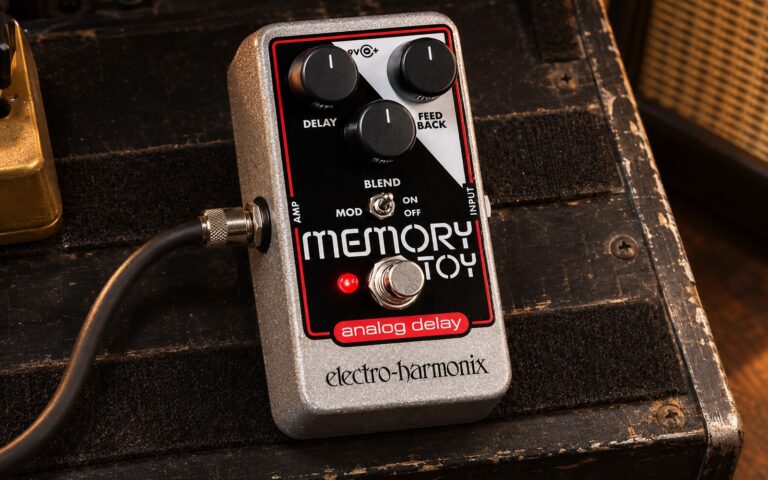
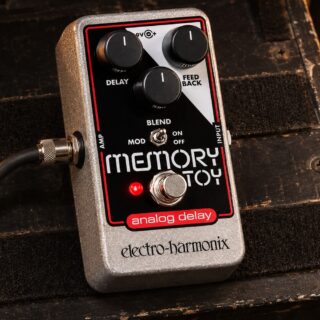
Electro-Harmonix Deluxe Memory Man
The vintage Deluxe Memory Man (1970s–1980s) is the historical analog delay benchmark. Its BBD circuit (MN3005 or similar chips) has a distinctly richer and more complex character than the Carbon Copy — the Memory Man produces a warmer, more saturated repeat with more pronounced high-frequency roll-off. The tradeoff is that original vintage Memory Man units sell for $300–600+ used depending on condition and era, with no consistent quality guarantee given age-related capacitor degradation. The modern EHX Deluxe Memory Man reissue ($299–379 new) is a capable alternative but is significantly larger than the Carbon Copy. The Memory Man is the choice for players who want vintage warmth above all else; the Carbon Copy is the choice for players who want reliable modern performance with analog character.
Boss DM-2W Waza Craft
Boss’s DM-2W Waza Craft ($249 new) is another serious analog delay comparison. The original DM-2 (1981–1984) used MN3205 chips and is highly regarded; the Waza Craft version replicates this circuit in Standard mode and offers a Custom mode with extended delay time. The DM-2W has the Boss advantage of buffered bypass (useful for preserving high-end over long cable runs) and the Boss build quality legacy, but costs $90 more than the Carbon Copy for a comparable analog feature set.
Strymon El Capistan / Brigadier
The Strymon El Capistan ($319) is a tape echo emulator using DSP, not analog circuitry. The Brigadier ($229) is a digital BBD emulator. Both are more complex and more expensive than the Carbon Copy, with capabilities (multi-head tape echo, tape saturation simulation, tempo sync) that the Carbon Copy doesn’t match. For players who want authentic analog simplicity, the Carbon Copy wins. For players who want the broadest possible delay palette in one pedal, Strymon is the answer.
The Carbon Copy Family: Which Version Is Right for You?
MXR has expanded the Carbon Copy line into a family of related products across the full price spectrum.
The M169 ($159.99 new, ~$75–110 used excellent) is the original and still the most popular. Three knobs, modulation switch, internal trim pots, true bypass. This is the right choice for 90% of players asking about the Carbon Copy.
The M299 Carbon Copy Mini ($179.99 new) trades the M169’s interface accessibility for a smaller footprint. Same core circuit. Recommended for players with compact boards.
The M292 Carbon Copy Deluxe ($245.99 new) adds tap tempo, external modulation controls, trails/spillover, pitch-shifted delay (an octave up or down added to the signal path), and stereo output. This is the most fully-featured of the family. If you need tap tempo — and for players who work with specific tempos, tap tempo changes everything — the M292 is the correct version.
The M269SE Carbon Copy Bright (released 2015) is a variant that uses a different filter configuration to produce brighter, less filtered repeats than the standard M169. The standard Carbon Copy’s BBD circuit naturally rolls off high frequencies in the repeats; the Bright variant maintains more of the original signal’s high-frequency content through the delay chain, making it better for applications where you want the repeats to stay present and defined rather than warm and recessed. It’s less suited for lush analog ambience and better suited for bright rhythmic echo work.
The M169A 10th Anniversary Edition (2018) was a collector variant with silver finish. Same circuit as the M169 — no sonic difference, collectible value only.
Buying Guide: New vs Used, What to Look For
The M169 Carbon Copy has been in continuous production since 2008. There are no known significant circuit revisions that affect tone — all production runs sound the same. The MN3208 BBD chip is the heart of the circuit; so long as the chip is functioning correctly, all units are equivalent. Unlike vintage pedals where component age and circuit evolution create meaningful variation between years, the Carbon Copy’s engineering consistency means the primary buying variable is price and condition, not provenance.
New at $159.99, the M169 is priced competitively within the analog delay market. Used units in excellent condition typically sell for $75–110, representing significant savings. Because there is no “preferred era” for the Carbon Copy, buying used is a straightforwardly rational choice — check that the BBD is healthy (listen for unusual noise in the repeats that might indicate chip degradation), that the modulation functions correctly, and that the trim pots haven’t been adjusted beyond sensible positions.
The M299 Mini sells for slightly more used than the M169 in equivalent condition, reflecting its smaller footprint premium. The M292 Deluxe sells for $140–180 used, and for players who would otherwise buy the M169 and a separate tap-tempo solution, the M292 is often the better value by the time all costs are tallied.
Ownership Notes: Practical Considerations
True bypass means trails cut when bypassed. This is the correct behavior for most applications — but if your style involves switching the delay off in the middle of long sustained notes, and you want the trails to continue fading naturally, the M169 will cut them abruptly. The M292 Deluxe solves this with its trails mode. Players using a switcher system can also address this by routing the Carbon Copy in a parallel loop that manages bypass independently of the main signal path.

The internal trim pots are set conservatively from the factory. The factory modulation setting is subtle — almost inaudible on casual inspection. Players who bought the Carbon Copy expecting pronounced chorus-style modulation and were disappointed should investigate the trim pots before deciding the modulation doesn’t suit them. With the Width and Rate trim pots turned up, the modulation becomes a prominent feature rather than a faint coloration. Access requires a small screwdriver through the top-panel holes; no case-opening is required.
Self-oscillation at maximum Regen is a feature, not a bug. With the Regen knob turned past approximately 4 o’clock toward maximum, the Carbon Copy will begin to self-oscillate — the repeats regenerate faster than they decay, building into an escalating, pitch-shifting wash. This can be a musical tool (ambient noise sculpture, controlled feedback section during improvised passages) or an unintended disaster depending on how it’s engaged. Players who want to use self-oscillation deliberately should experiment with Mix and Delay settings to control the character of the runaway wash. An expression pedal routing into the Regen control (via the M292 Deluxe’s expression input) allows real-time management.
FAQ
Does David Gilmour use the MXR Carbon Copy?
Not to any confirmed documentation. MXR’s official product description uses the phrase “Gilmouresque delays” as a tonal descriptor — meaning the Carbon Copy can produce ambient delay textures in the style of Gilmour’s iconic Pink Floyd tones. Gilmour’s actual documented delay tools are the Binson Echorec (early Floyd era), TC Electronic 2290 digital delay (Momentary Lapse era through later), Boss DD-2, and most recently a combination of rack digital delays and rack equipment. The Carbon Copy’s claim to Gilmour-style tones is a textural reference, not a user endorsement.
Does The Edge use the MXR Carbon Copy?
Not as a regular confirmed rig item. The Edge was photographed with a Carbon Copy during a Fender product development session, but this appears to have been a loaner pedal for the shoot rather than part of his actual touring or studio rig. His documented delay tools are primarily digital — the TC Electronic 2290, the Korg SDD-3000 (his signature vintage digital delay), and Fractal Audio processors for modern rigs. The Carbon Copy is not an analog delay; The Edge’s delays are generally digital for reasons of precise timing control.
What is the difference between the M169 and the M299 Carbon Copy Mini?
Same core BBD circuit (MN3208 chip), same 600ms maximum delay time, same Mix/Delay/Regen control structure, same modulation capability. The M299 is physically smaller — better for compact boards — and costs slightly more. The M169 has more accessible modulation controls (external switch, top-panel trim pot access). If board space is not a constraint, the M169 is the better value and more tweakable option.
Does the Carbon Copy have tap tempo?
The M169 does not. The M292 Carbon Copy Deluxe does. If precise rhythmic delay synchronization is important to your playing, the M292 is the right choice in the Carbon Copy family. The M169 requires setting the Delay knob by ear, which works well for ambient applications where exact timing isn’t critical but is less convenient for rhythmically precise work.
What is the BBD chip in the Carbon Copy?
Panasonic MN3208, a high-clock-frequency bucket brigade device that allows up to 600ms of delay time. The MN3208 is a widely available chip (as of writing) and not subject to the supply scarcity that affects some older BBD chips used in vintage pedals. No significant noise or fidelity issues are associated with the MN3208 in the Carbon Copy’s circuit.
Can the Carbon Copy do self-oscillation?
Yes. With the Regen knob turned to maximum (or near it), the delay will self-oscillate — repeats accumulate faster than they decay, producing an escalating, pitch-unstable wash. This is a known and documented characteristic of the circuit, intentional in design. The character of the oscillation is controllable via the Delay and Mix knobs. Use deliberately in performance; avoid unintentional triggering by keeping the Regen below 4 o’clock unless intentional runaway is the goal.
How does the Carbon Copy compare to a digital delay?
Digital delays reproduce the original signal with near-perfect accuracy in each repeat — the repeats stay bright, clear, and spectrally identical to the dry signal across multiple generations. The Carbon Copy’s BBD analog processing introduces a natural high-frequency roll-off and slight saturation in each repeat — the repeats become progressively darker and softer. This is what most players mean by “analog warmth.” At moderate to long delay times, the Carbon Copy’s repeats feel more organic and less clinical than a clean digital delay. At short slap-back times, the difference is less pronounced. Neither is better in absolute terms; they serve different aesthetic preferences.
Is there a no-vintage-premium risk with used Carbon Copy units?
No — unlike vintage pedals where specific production years command premiums for circuit variations or chip availability, all Carbon Copy M169 production runs are equivalent. The primary risk with used units is BBD chip degradation over time, which can manifest as increased noise in the repeats or reduced maximum delay time. Listen carefully to the repeats of any used unit before purchasing. A healthy unit should produce clean, warm repeats with minimal self-noise until Regen approaches maximum.
Image credits
- Andy Summers: Drussel1, Wikimedia Commons, CC BY-SA 4.0.
- John Frusciante: Hel Davies from United Kingdom, Wikimedia Commons, CC BY-SA 2.0.
- Zakk Wylde: Joanna Corwin (jmcorwin AT verizon DOT net), Wikimedia Commons, CC BY-SA 3.0.
- Top image: MXR Carbon Copy. Photo: MXR Carbon Copy by Roadside Guitars, CC BY-SA 2.0. Source image unchanged by GuitarGangsters.
Latest News
Related
On This Day
Monday 9 November
From this week: