Boss DD-500 Digital Delay: When Boss Stopped Playing It Safe and Built the Monster
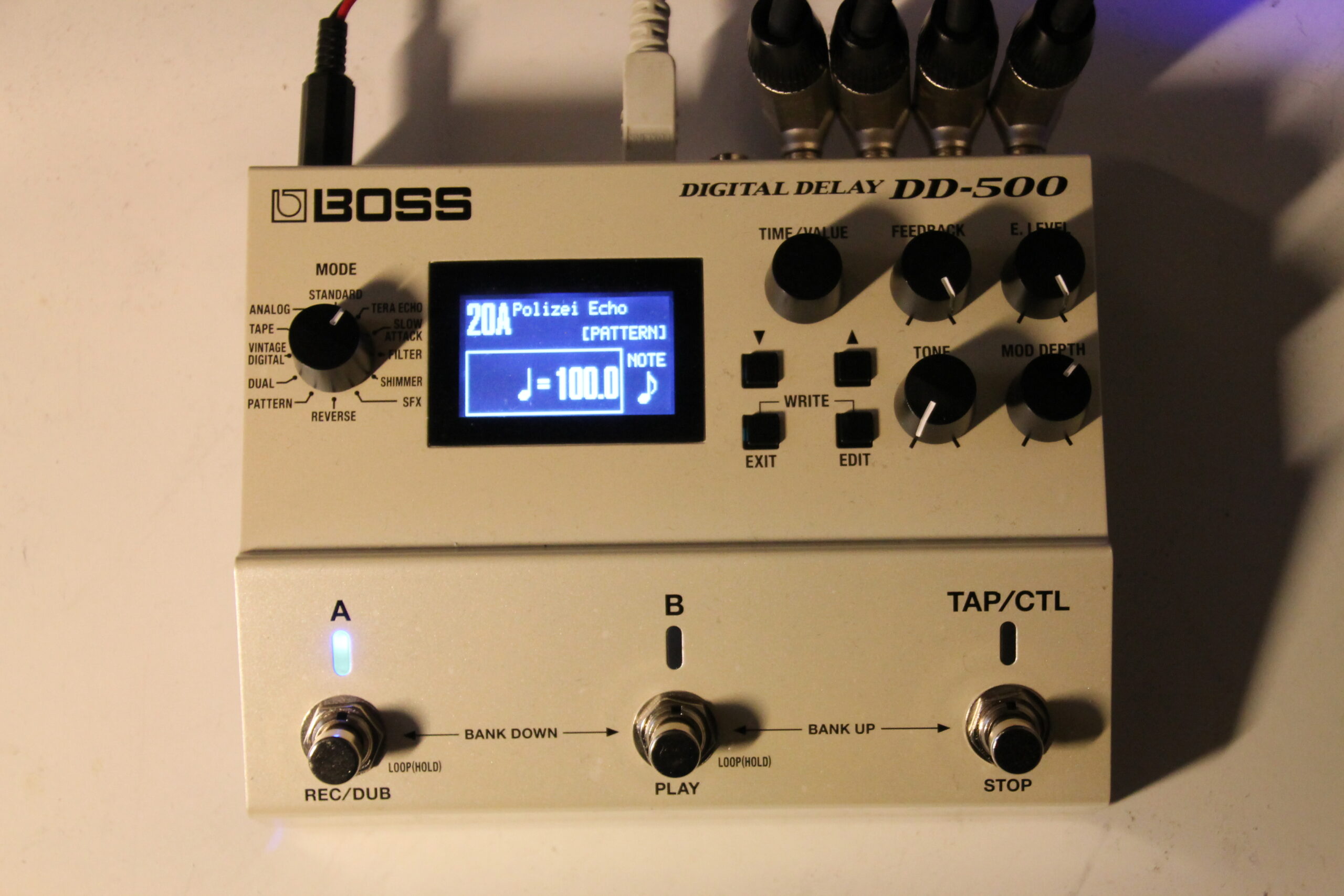
Boss DD-500, photographed 23 December 2016. Photo: Styroks. CC BY-SA 4.0 (https://creativecommons.org/licenses/by-sa/4.0/). Full source frame resized for web without cropping or retouching. Web version licensed under CC BY-SA 4.0. Source: https://commons.wikimedia.org/wiki/File:BOSS_DD-500.jpg
The Boss DD-500 is BOSS's most powerful delay pedal ever: 12 modes, LCD display, full MIDI, and true bypass. Complete guide for guitarists.
In 2015, Boss did something it almost never does: it built a delay pedal that makes no compromises. The Boss DD-500 Digital Delay is not a compact. It’s not a quick-grab solution. It’s a rack-grade delay engine crammed into a stompbox chassis — 12 carefully engineered delay modes, a graphic LCD you can actually read on a dark stage, 198 storable patches, full DIN-5 MIDI, selectable true bypass, and 32-bit/96kHz processing that would be impressive in a studio processor. This is the pedal Boss built to shut up everyone who said they couldn’t compete with Strymon and TC Electronic at the top end. It worked.
The DD-500 sits at the summit of Boss’s delay lineup, the parent unit from which the more compact Boss DD-200 was later derived in 2019. Where the DD-8 gives you a versatile collection of delay voices in a familiar Boss compact, the DD-500 gives you the full studio toolkit — every mode with deep EQ, modulation, and ducking parameters, plus a visual interface that removes the knob-twisting uncertainty of compact pedals entirely. Jerry Cantrell runs one in his touring rack. Russell Lissack of Bloc Party uses it to build the textured, cinematic delays that define his guitar voice. This is the delay pedal for players who want to know exactly what they’re dialing in.
The Road to the DD-500: Boss and the Delay Legacy
Boss’s relationship with digital delay begins in 1983 with the DD-2, the world’s first stompbox digital delay — a pedal that put a then-revolutionary 800ms of clean digital delay into a Boss compact for the first time. The DD-2 begat the DD-3, which has been in continuous production since 1986 and remains one of the bestselling guitar pedals in history. As the DD-3 became an institution, Boss continued developing delay technology: the DD-5, DD-6, and DD-7 each added features while staying within the compact format’s constraints.
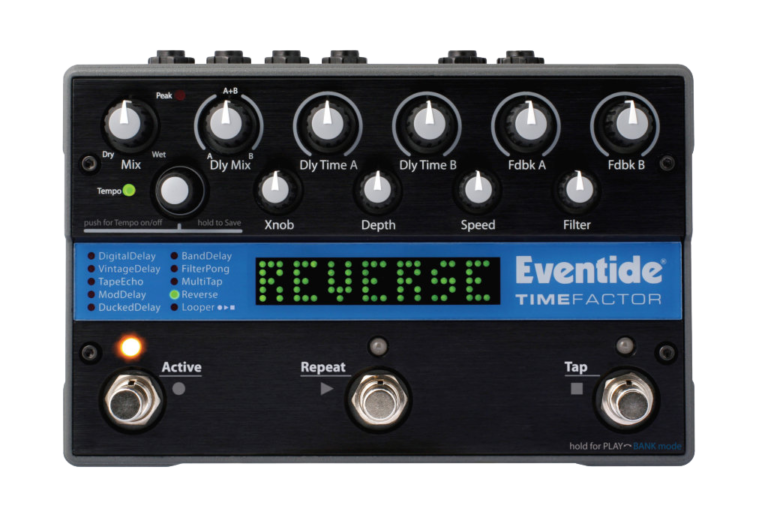
But by 2010, a new tier of boutique delay had emerged. Strymon’s Timeline (2011), TC Electronic’s ND-1 Nova Delay, and Eventide’s TimeFactor demonstrated that guitarists would pay $400-500 for a delay pedal if it delivered deep editing, excellent sound quality, MIDI integration, and preset recall. These weren’t compact pedals in the Boss tradition — they were essentially multi-thousand-dollar rack units in stompbox form. Boss watched this market develop for several years before responding.
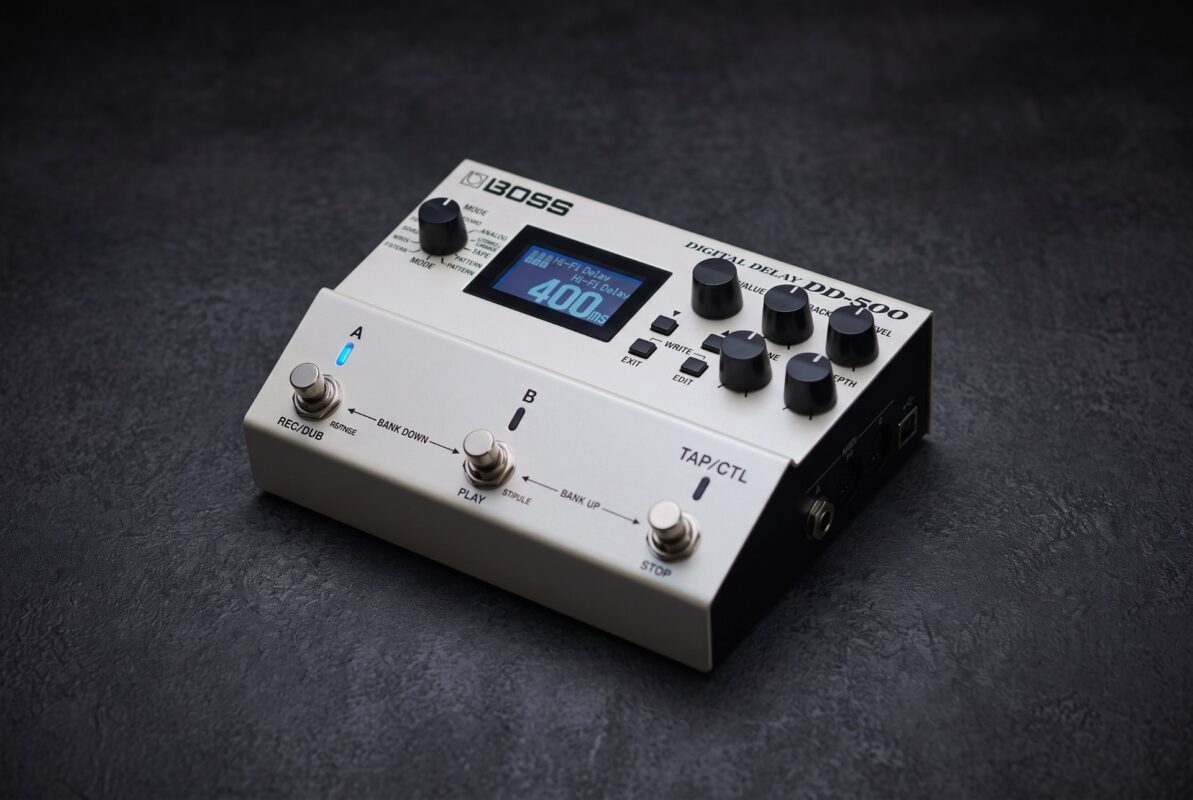
The DD-500, unveiled at Summer NAMM in Nashville on July 8, 2015, was that response. Boss described it as “the most powerful and versatile stompbox delay ever created” — strong language from a company that generally lets the gear speak. But the specs backed it up: 12 delay modes with per-mode four-band EQ and modulation, 198 patches recallable via footswitch, full MIDI in/out with standard DIN-5 connectors, a backlit 128×64 graphic LCD, and a 100% analog dry signal path. It was a new level of ambition for Boss, and it established the 500-series as the company’s premium stompbox platform — a line that later expanded to include the MD-500 Modulation and RV-500 Reverb.
What Makes the DD-500 Different: Specifications Deep Dive
The DD-500 processes audio at 32-bit/96kHz throughout — the same standard you find in professional DAW interfaces. Its AD/DA conversion is 32-bit, and the DSP runs 32-bit floating point arithmetic. The practical result is that the DD-500’s digital delay repeats are cleaner and more transparent than any previous Boss delay, and the noise floor is essentially inaudible in real-world use. Maximum delay time is 10 seconds, though the available range varies by mode. The onboard phrase looper offers 60 seconds of stereo recording (or 120 seconds in mono), and delay effects can be applied to the looper’s signal.
The DD-500’s 12 delay modes are not just preset voicings — each is a distinct algorithm optimized for a specific sonic character:
- Standard — Clean, transparent digital delay. No character coloration; the purest echo of your guitar signal.
- Analog — An emulation of classic BBD (bucket brigade device) analog delays like the Boss DM-2W. Warm, dark repeats with subtle high-frequency rolloff and gentle degradation on each repeat.
- Tape — Emulations of tape-based delay units, including the Roland RE-201 Space Echo and the Maestro Echoplex. Version 2 firmware adds the Binson Echorec 2, a rotary-head Italian tape echo unit beloved by David Gilmour and Syd Barrett.
- Vintage Digital — The DD-500’s most historically significant mode: emulations of Roland’s SDE-2000 and SDE-3000 rack delays from the early 1980s, plus the Boss DD-2 itself. The SDE-3000 is the unit that defined The Edge’s delay sound on “Where the Streets Have No Name” and “The Unforgettable Fire.” Hearing an SDE-3000 emulation at pedalboard price is not a trivial thing.
- Dual — Two independent delay lines that can be routed in series, parallel, or one of three A/B independent configurations. Enables ping-pong delays, complex multi-tap rhythmic patterns, or two entirely different delay characters layered simultaneously.
- Pattern — Sixteen independently configurable delay lines for rhythmic pattern effects. Gate mode creates slicer-like chopped patterns. This is where the DD-500 becomes a compositional tool rather than just a delay pedal.
- Reverse — Backwards delay for psychedelic effects and studio-style reverse tape sounds.
- SFX — Special effects delays with extreme, unconventional character — designed for experimental and noise-adjacent applications.
- Shimmer — Pitch-shifted delay with stereo pitch-shifting and overtone modes for the ambient textures pioneered by Brian Eno and Daniel Lanois. The DD-500’s Shimmer is significantly more controllable than most boutique implementations.
- Filter — Delay with sweeping or touch-responsive dynamic filter (added in Version 2 firmware). The touch-responsive variant responds to pick attack, giving filtered delay a wah-like expressiveness.
- Slow Attack — Ethereal delays that fade in with playing dynamics, creating volume-swell-like attack characteristics without a volume pedal.
- Tera Echo — Spacious, animated ambience derived from the Boss TE-2 pedal — a sprawling, living reverb-delay hybrid that creates the impression of an enormous acoustic space.
Beyond the modes, each patch in the DD-500 stores an independent four-band semi-parametric EQ, modulation settings (rate, depth, waveform, type), ducking settings (ducking causes delay to momentarily drop in level when you play, then swell back in), and comprehensive routing parameters. The DD-500 is not a pedal you dial in at the venue — it’s a pedal you program at home for every song in your set, then recall instantly with a footswitch press.
DD-500 Technical Specifications
| Specification | DD-500 |
|---|---|
| Announced | July 8, 2015 (Summer NAMM, Nashville) |
| Delay Modes | 12 (Standard, Analog, Tape, Vintage Digital, Dual, Pattern, Reverse, SFX, Shimmer, Filter, Slow Attack, Tera Echo) |
| AD/DA Conversion | 32-bit |
| Processing | 32-bit floating point |
| Sampling Rate | 96 kHz |
| Max Delay Time | 10 seconds (mode dependent) |
| Phrase Looper | 60 sec stereo / 120 sec mono (delay can be applied) |
| Patches | 198 (99 banks × 2) or 297 (99 banks × 3) |
| Display | Graphic LCD, 128×64 dots, backlit |
| Footswitches | 3 — A, B, TAP/CTL (all assignable) |
| Knobs | MODE, TIME/VALUE, FEEDBACK, E.LEVEL, TONE, MOD DEPTH |
| Inputs | INPUT A/MONO, B (1/4″ phone) |
| Outputs | OUTPUT A/MONO, B (1/4″ phone) |
| EXP/CTL | 1/4″ TRS (CTL 1,2 or expression pedal) |
| MIDI | Full IN/OUT, standard DIN-5 connectors |
| USB | Type B (MIDI; connects to DD-500 Editor software) |
| Analog Dry Path | Yes — 100% analog dry signal pass-through |
| Bypass | Buffered bypass OR True bypass (relay-switched, selectable) |
| Current Draw | 200 mA at 9V DC (isolated supply required) |
| Battery | 4×AA alkaline (~7 hours) |
| Nominal Input Level | -10 dBu (max +8 dBu) |
| Input Impedance | 1 MΩ |
| Output Impedance | 2 kΩ |
| Dimensions | 170mm W × 138mm D × 62mm H |
| Weight | 1.0 kg (with batteries) |
| Warranty | Boss 5-year |
| Price New | ~$300–400 USD |
| Price Used (Excellent) | ~$180–270 USD |
Two specifications deserve particular emphasis. First: the DD-500’s analog dry path means your clean guitar signal bypasses the DSP entirely and travels through an analog circuit. Even in buffered-bypass mode, the dry signal never enters the digital domain. This matters for players who are sensitive to the slight change in feel that comes from converting a guitar signal to digital before it hits the amp. Second: the true bypass option uses relays rather than the optical circuit found in most Boss compacts — actual relay switching that completely removes the pedal from the signal path when disengaged. That both options are available and switchable in the menu is, frankly, remarkable for a Boss pedal at any price point.
Famous Players: Who Actually Uses the DD-500
The Edge, David Gilmour, John Frusciante, Andy Summers, and Steve Vai are sometimes cited as DD-500 players, but none of these associations are confirmed by primary sources for the DD-500 specifically. The Edge’s documented delays are the Korg SDD-3000 and various rack units. Gilmour’s delays are the Binson Echorec, Roland RE-201, and TC 2290. Frusciante used the Boss DD-2 and DM-2 on the recordings for which he is famous. None of these artists have been documented using the DD-500 in a Rig Rundown, interview, or manufacturer-confirmed rig. They are excluded from this section accordingly.
The DD-500’s confirmed user roster is, however, genuinely impressive:
Jerry Cantrell (Alice in Chains) — CONFIRMED
Jerry Cantrell is the DD-500’s most significant confirmed user, documented by Premier Guitar’s Rig Rundown published October 2, 2024, covering his I Want Blood solo tour. Cantrell’s touring rig is rack-mounted — a Fryette Two/Ninety/Two Stereo Power Amp, Fryette LX II Stereo Power Amp, and Bogner Fish All Tube Preamp drive the foundation, and his effects chain (aside from his signature Dunlop Firefly Cry Baby and MXR Firefly Talk Box at his feet) runs entirely in the rack: MXR Smart Gates, MXR Timmy, Strymon Ola, MXR Six Band EQ, MXR Ten Band EQ, Barber Electronics Direct Drive, Boss DD-500, MXR EVH Flanger, Boss CE-5, MXR Poly Blue Octave, Ibanez TS808HW, MXR Reverb, and Line 6 MM4 Modulation Modeler.
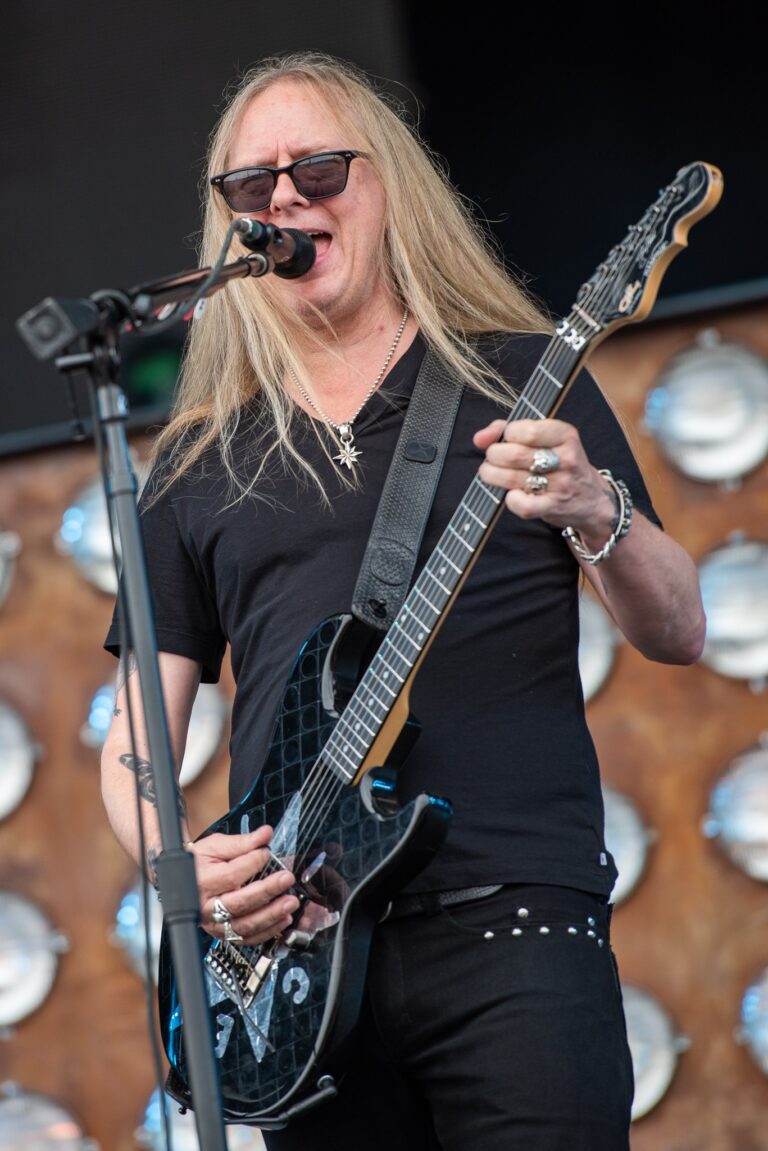
The choice of the DD-500 over boutique alternatives is telling. Cantrell’s tech uses a Custom Audio Electronics RS-T MIDI Foot Controller for all switching — the DD-500’s full DIN-5 MIDI integration fits perfectly into a MIDI-controlled rack system in a way that the DD-200 (with its mini TRS MIDI adaptor requirement) or the DD-8 (no MIDI) cannot. Cantrell’s guitar work has always prized controlled, measured delay — the chromatic half-step slides of “Rooster,” the measured echo of “Would?” — and the DD-500’s precision patch recall ensures those time-locked sounds reproduce identically every night.
Russell Lissack (Bloc Party) — CONFIRMED
Russell Lissack, guitarist for Bloc Party, is a confirmed DD-500 user, documented in a pedalboard rundown by Hemstock Guitars following a 2023 show at the Paramount. Lissack’s guitar approach — complex, textured, effects-heavy, with delays that are as compositional as they are technical — makes the DD-500’s depth of editing a natural fit. Bloc Party’s music demands that delay be musical rather than functional, and the DD-500’s Pattern and Dual modes particularly suit the kind of rhythmically active delay work that characterizes songs like “Helicopter” and “Banquet.”
Misha Mansoor (Periphery) — Equipboard-Documented
Misha Mansoor of Periphery is documented as a DD-500 user on Equipboard, where he can be seen using the DD-500 alongside other Boss 500-series pedals. This is community documentation rather than a primary-source Rig Rundown or manufacturer interview, so it is noted here as an Equipboard-documented association rather than a fully verified primary-source confirmation. His djent-adjacent production aesthetic — tight, precise, modern — aligns with the DD-500’s clean Standard and Dual modes.

Tone Recipes: Six Settings Worth Dialing In
1. Jerry Cantrell’s Controlled Stage Echo (Standard Mode)
Mode: STANDARD. TIME: 380ms (or tap tempo to track tempo). FEEDBACK: 9 o’clock (2-3 repeats). E.LEVEL: 11 o’clock. TONE: neutral. MOD DEPTH: 0. Assign the A footswitch to this patch, TAP/CTL for tap tempo. This is the foundation of most Cantrell-style single-coil-into-high-gain-preamp delay: enough repeat to define the space, not enough to cloud the next chord.
2. Roland RE-201 Space Echo (Tape Mode — RE-201 Algorithm)
Mode: TAPE. Select RE-201 sub-type. TIME: 350ms. FEEDBACK: 10 o’clock. TONE: slight treble cut (the RE-201 was famously warm). MOD DEPTH: 3-4 for wow/flutter. E.LEVEL: 12 o’clock. The RE-201 Tape mode in the DD-500 captures the wandering pitch instability that made the original unit magical. Engage the looper and it becomes a complete ambient writing tool.
3. Roland SDE-3000 Rack Echo (Vintage Digital Mode)
Mode: VINTAGE DIGITAL. Select SDE-3000 sub-type. TIME: 446ms (the famous U2 “Where the Streets Have No Name” approximate setting — exact time depends on song tempo). FEEDBACK: 9 o’clock. TONE: flat. E.LEVEL: 11 o’clock. Modulation: slight (SDE-3000 had gentle pitch modulation on repeats). This is the closest most guitarists will ever get to The Edge’s early-80s rack sound at pedalboard cost — the SDE-3000 currently trades for $600-1200+ used.
4. Shimmer Ambient Wash (Shimmer Mode)
Mode: SHIMMER. TIME: 600ms. FEEDBACK: 1-2 o’clock (long decay). E.LEVEL: 12 o’clock. Pitch: +1 octave (the classic Eno/Lanois shimmer). Stereo pitch active. MOD DEPTH: low for stability. Volume swells into this mode create the cathedral-reverb textures associated with Brian Eno’s U2 production and Daniel Lanois’s work with Emmy Lou Harris. Pair with an expression pedal controlling E.LEVEL for real-time control over how much shimmer enters the mix.
5. Touch-Responsive Filtered Delay (Filter Mode)
Mode: FILTER. Select touch-responsive (dynamic) filter type. TIME: 330ms. FEEDBACK: 9 o’clock. Filter attack: medium. Filter sensitivity: 2 o’clock (reacts strongly to pick attack). Hard playing produces brighter, more pronounced filtered repeats; softer playing produces darker, more subdued echoes. This mode has no equivalent in the DD-8 or DD-200 — it’s a DD-500-exclusive capability added in Version 2 firmware.
6. Dual Mode Ping-Pong (Dual Mode)
Mode: DUAL. Route: Parallel. Delay A TIME: 375ms (left channel). Delay B TIME: 562ms (right channel) — a dotted-eighth to quarter-note cross-rhythm. FEEDBACK A/B: 9-10 o’clock each. Output: stereo (OUTPUT A to left amp, OUTPUT B to right amp). This produces the rhythmically active ping-pong delay that works beautifully behind arpeggiated chord parts — each channel creates its own repeat pattern, and the two interlock into a complex polyrhythmic texture. With an expression pedal controlling Delay A’s time, the whole texture shifts in real time.
The DD-500 has a dedicated editor app and storable patches, so the most useful approach is treating settings as starting points rather than final destinations. These six configurations are starting points for the modes that matter most:
How the DD-500 Compares
The DD-500 exists in a genuinely competitive tier. Here’s how it stacks up against its primary competitors:
Boss DD-500 vs. Boss DD-200: The DD-200 (2019) uses the same DSP core and 12-mode architecture as the DD-500, in a compact Boss chassis. The DD-200 costs roughly half as much, takes up a third of the pedalboard space, and covers 80% of the DD-500’s sonic territory. What it lacks: the LCD display, the depth of per-mode editing, the DIN-5 MIDI (DD-200 uses mini TRS with an adaptor), the 198-patch memory system, the USB computer editor, the Dual mode’s independent A/B routing options, and the selectable true bypass. For the working guitarist who needs DD-500-grade delay in a touring rack with full MIDI control, the DD-200 is not a substitute. For the player who wants most of the DD-500’s sounds in a smaller package, the DD-200 is a genuinely excellent alternative.
Boss DD-500 vs. Strymon Timeline: These two pedals defined the premium stompbox delay category together in the 2015-2020 era. The Timeline has a slight edge in certain vintage emulation quality — particularly its Tape and Oil Can modes — and its expression pedal feel has been tuned obsessively over multiple firmware versions. The DD-500 counters with its LCD (clearer than Timeline’s switch-based navigation in live conditions), its lower noise floor, and its Pattern mode’s 16 configurable delay lines, which exceed anything the Timeline offers for rhythmic complexity. The DD-500 also wins on battery compatibility — four AAs vs. Timeline’s DC-only power requirement. Price-wise they are comparable used.
Boss DD-500 vs. EHX Deluxe Memory Man: The Memory Man is an analog BBD delay with a famously musical, slightly unpredictable character. There is no digital emulation of the Memory Man’s sound — analog BBD physics simply behave differently. If analog warmth and gentle instability are the point, the Memory Man wins by not competing. If MIDI recall, preset storage, true bypass, and 12 distinct modes are the point, the DD-500 is in a different category entirely.
Boss DD-500 vs. MXR Carbon Copy: The Carbon Copy is a single-mode analog delay costing roughly one-fifth the DD-500’s price. This isn’t really a comparison — they address completely different needs. The Carbon Copy for simplicity and analog warmth; the DD-500 for everything else. Many professional guitarists own both.
Buying Guide: New vs. Used, Version 1 vs. Version 2
The DD-500 is a current production pedal available new from authorized Boss dealers at approximately $300-400 USD. The used market, where excellent-condition units appear regularly at $180-270 USD, is worth watching — the DD-500 is built to Boss’s usual tank-grade standard and holds up to sustained professional use without issues.
The most important buying consideration is firmware version. The DD-500 launched with 11 delay modes; Version 2 firmware added Filter mode, the Binson Echorec 2 emulation within Tape mode, the touch-responsive filter, improved A/B Simul mode routing, the Insert Loop function (for routing external effects into the feedback path), and numerous additional parameters. Version 2 is a free update that all DD-500 units can receive via USB connection to the Boss DD-500 Editor software. Any used DD-500 purchased should be updated to Version 2 firmware before serious use — the current system software is Version 2.03, available from Boss’s support page.
When evaluating a used DD-500:
- Test all three footswitches for positive actuation and no sticking
- Navigate through all 12 delay modes and confirm they respond as expected
- Test both INPUT A/MONO and INPUT B, and both OUTPUT A/MONO and OUTPUT B
- Test the CTL/EXP jack with an expression pedal to confirm the TRS jack is intact
- Test MIDI in/out if your setup uses it
- Check the LCD for dead pixels — the backlit display can develop issues in older units
- Confirm which firmware version is installed (visible in system settings) and plan to update
Owning the DD-500: Power, Editor, and Daily Use
The DD-500’s 200mA current draw at 9V DC is the single most important practical specification for players coming from compact pedals. This is not a pedal that can be safely daisy-chained with standard 100mA-output power supplies. An isolated power supply with at least one 200mA or higher isolated output is required — the same constraint applies to the DD-200 at 225mA. Factor this into your power supply budget when purchasing.
The DD-500 Editor software (available free from Boss for Windows and macOS) is worth installing even if you don’t use it regularly. It provides a full-screen view of every parameter in every delay mode, makes patch naming and organization dramatically faster than using the LCD navigation, and enables batch backup of your patch library. After spending hours programming perfect patches, having a backup on your computer is not optional.
The graphic LCD deserves praise beyond its spec sheet. At 128×64 dots with backlighting, it’s legible from six feet away in dark stage conditions — something that cannot be said of the LED arrays on compact pedals or the small displays on some competing boutique units. In a MIDI-controlled rack system like Cantrell’s, being able to glance at the DD-500 and confirm which patch is loaded is genuinely useful. The display also shows delay time in milliseconds during performance, which is invaluable for tap tempo verification.
The assignable footswitch architecture deserves its own attention. By default, the A and B footswitches select between two patches and the TAP/CTL switch handles tap tempo. But all three can be reconfigured: you can set all three to recall three different patches, use TAP/CTL for Warp (feedback surge), Twist (wild real-time parameter changes), Hold, Fade, or any of eight user-defined Assign parameters that control up to eight delay parameters simultaneously from a single footswitch press. This is programming depth that the vast majority of DD-500 owners never fully explore — but the players who do discover a performance flexibility that genuinely separates the DD-500 from conventional delay stomps.
FAQ
What is the difference between the Boss DD-500 and the Boss DD-200?
Both share the same DSP core and 12-mode architecture. The DD-200 is physically much smaller and costs roughly half as much. The DD-500 adds a graphic LCD, 198+ patch memories, full DIN-5 MIDI (vs DD-200’s mini TRS MIDI), USB computer editor connectivity, deeper per-mode parameter editing, the Insert Loop function, Dual mode with independent A/B routing, and selectable true bypass. For rack mounting with MIDI control, the DD-500 is the appropriate choice. For compact pedalboard use, the DD-200 covers most of the DD-500’s sonic territory.
Does the Boss DD-500 have true bypass?
Yes — this is selectable in the system settings. The DD-500 can operate in either buffered bypass or true bypass mode. True bypass is accomplished via relay switching rather than optical circuit. Buffered bypass provides carryover (delay trails continue when the pedal is bypassed), which many players prefer in live use. True bypass removes the pedal completely from the signal path when disengaged, which benefits players running germanium fuzz pedals or others sensitive to buffering upstream.
Does the DD-500 need an isolated power supply?
Yes. At 200mA, the DD-500 requires an isolated power supply output rated for at least 200mA. Standard daisy-chain power supplies typically max out at 100mA per output, which is insufficient and will cause noise or instability. A quality isolated power supply with a dedicated high-current output — Strymon Zuma, Cioks DC10, Truetone 1 SPOT Pro, or similar — is required. Budget approximately $100-200 for power if not already equipped.
What is Version 2 firmware and do I need it?
Version 2 (current: v2.03) is a major free firmware update that adds Filter mode, Binson Echorec 2 emulation in Tape mode, touch-responsive filter delay, improved A/B Simul mode, Insert Loop function, additional MIDI controls, adjustable input/output levels, selectable EQ position, and many other enhancements. If you own a DD-500 without Version 2, updating it is not optional — it substantially expands the pedal’s capability. Update via USB connection to the DD-500 Editor software, available free from Boss’s support page.
What does the Vintage Digital mode emulate?
The DD-500’s Vintage Digital mode includes emulations of the Roland SDE-2000 and SDE-3000 rack delay units (both from the early 1980s), plus the Boss DD-2 (the original stompbox digital delay from 1983). The SDE-3000 is particularly notable — it is the unit documented in The Edge’s early U2 rack setup, responsible for the bright, clean, rhythmically active delay sound of records like “The Unforgettable Fire” and “The Joshua Tree.” Used SDE-3000 units currently trade for $600-1200+.
Can the DD-500 be used in a wet-only parallel effects loop?
Yes. The DD-500 supports wet-only output configurations using its dual output jacks. With the true bypass option active, the insert loop function (Version 2) also enables routing external effects into the delay’s feedback path — a studio technique that places a reverb or modulation pedal inside the delay loop so each repeat passes through the inserted effect. This is a professional-grade routing capability with no equivalent in compact delay pedals.
How does MIDI work on the DD-500 compared to the DD-200?
The DD-500 uses full-size DIN-5 MIDI connectors (standard MIDI cables, no adaptor required), with both MIDI IN and MIDI OUT. The DD-200 uses 3.5mm mini TRS Type A connectors that require the BMIDI-5-35 adaptor to connect standard DIN-5 MIDI cables. The DD-500 can receive program change messages for patch recall, control change messages for parameter control, and clock messages for tempo sync. It can also transmit MIDI, which is useful in more complex rigs where the DD-500’s tap tempo should sync other devices. Jerry Cantrell’s MIDI-controlled rack setup uses the DD-500’s full MIDI capability for seamless song-by-song patch switching.
Is the Boss DD-500 suitable for bass guitar?
Yes. The DD-500’s frequency response and noise floor are appropriate for bass, and the Analog and Standard modes in particular translate well to bass applications. Tony Levin — the legendary session bassist and King Crimson member known for his work with Peter Gabriel — is documented as a DD-500 user, running it in his bass and Chapman Stick rig. The pedal’s wide dynamic range (nominal input -10 dBu, max +8 dBu) handles bass-level signals without issue.
Image credits
- Top image: Boss DD-500, photographed 23 December 2016. Photo: Styroks. Source photograph · CC BY-SA 4.0. Full source frame resized for web without cropping or retouching. Web version licensed under CC BY-SA 4.0.
- Boss DD-500 Digital Delay: AI-generated illustration by GuitarGangsters, based on the manufacturer’s product design (not a photograph).
- Jerry Cantrell: Stefan Brending (2eight), Wikimedia Commons, CC BY-SA 4.0.
- Misha Mansoor: Markus Felix, Wikimedia Commons, CC BY-SA 3.0.
Latest News
Related
On This Day
Monday 9 November
From this week: