Source Audio Nemesis Delay: The 26-Engine Echo Machine That Outsmarted Everyone
Source Audio Nemesis Delay guide: all 26 engines, verified players like Billy Strings, tone recipes, ADT comparison, full specs and buying advice.
In August 2019, Premier Guitar‘s Perry Bean walked onto the stage of the Ryman Auditorium in Nashville to film a Rig Rundown with a flatpicker named Billy Strings. Bluegrass Night at the Mother Church. Doc Watson and Bill Monroe in the rafters. And there, bolted to a pedalboard next to a Chase Bliss Wombtone MkII and an Eventide H9, sat a matte-black stompbox with a rotary engine selector and seven knobs: a Source Audio Nemesis Delay.
That is the whole argument for this pedal in one image. A delay designed by a company from Woburn, Massachusetts whose previous claim to fame was a motion-sensing ring controller, sitting in front of a hand-built Preston Thompson dreadnought at the most conservative gig in American acoustic music. The Nemesis is a pedal that turns up in places nobody predicted, because it does something very few delays manage: it is genuinely easy to use on the surface and genuinely bottomless underneath, and it never asks you to pick one of those two personalities and live with it.
It also won a Premier Guitar Gear Award in 2016 with a review whose “Cons” field simply read: None. That does not happen often.
Origins: Three Years, One Rotary Knob, and a Kurzweil Engineer
Source Audio has an unusual pedigree for a pedal company. Founded in Woburn, Massachusetts, it spent its early years building the Hot Hand — a motion-sensing ring that let you wave your picking hand to control effects parameters — and the Soundblox line, a family of digital boxes that were sonically ambitious and, by common consent, not especially inviting. The word that followed Source Audio around in the late 2000s was “menu-diving.”
The One Series was the correction. Launched in the mid-2010s, it was an explicit attempt to put the company’s DSP horsepower behind a control surface that a guitar player could understand in thirty seconds. The Nemesis Delay was the pedal that made the strategy work commercially. Source Audio’s own copy describes it as “the culmination of three years of intense research, listening, and engineering,” and the company’s later marketing is blunt about what happened next: this is “the award-winning delay pedal that catapulted Source Audio into the hearts and pedalboards of the guitar effects pedal universe.”
The sound design credit belongs to Bob Chidlaw, Source Audio’s chief scientist, who earned his reputation as head engineer at Kurzweil Music in the 1980s and ’90s. That lineage matters. Kurzweil built its name on sampling and modelling real instruments with obsessive fidelity, and the Nemesis engine list reads like a Kurzweil engineer let loose on a rack of vintage echo boxes: the team spent, by the company’s account, over a year studying tape and bucket-brigade units “with a staunch dedication to identifying their every nuance and idiosyncrasy.”
The pedal was previewed at NAMM in January 2015 and formally introduced in January 2016. Premier Guitar‘s Charles Saufley reviewed it that August at a $299 street price. It has since been superseded — sort of — by the Nemesis Delay ADT, which is a story we will get to, because it is one of the more interesting “successor” cases in modern pedal history.
Source Audio Nemesis Delay: Specifications
The Twelve on the Face of the Pedal
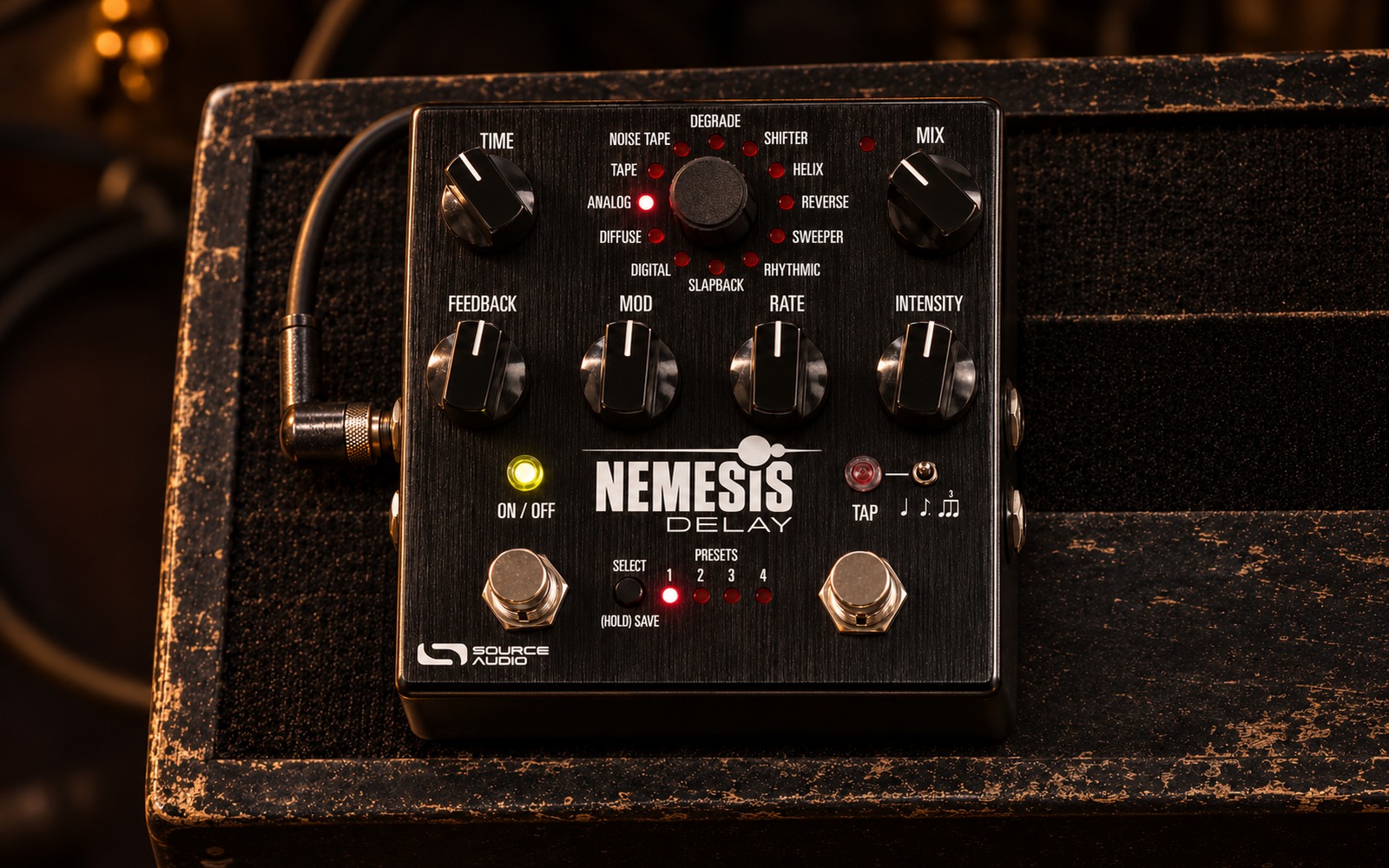
The rotary selector in the middle of the Nemesis is the pedal’s centre of gravity. Twelve positions, each a fully realised delay voice rather than a tweak of the one before it. What separates the Nemesis from the average multi-delay is that the seven knobs do not mean the same thing in every position — most notably the Intensity control, which Saufley called “the real wild card,” a knob that “changes roles depending on the delay type.”
The vintage half
Slapback — a short single-repeat echo modelled on early tape machines. Rockabilly’s default setting, and the reason a Nemesis can sit convincingly in a country or roots rig without anyone knowing there is a 56-bit DSP in the room.
Tape — a detailed recreation of moving-head tape delay, aimed squarely at the Echoplex and Roland Space Echo. Flutter, warmth, and progressive colouration on each repeat. If you already own a Boss RE-2 Space Echo or a Strymon El Capistan, this is the engine you will A/B first.
Noise Tape — the same idea applied to fixed-head machines, grittier and darker, explicitly voiced as old or damaged tape. This is where the Nemesis gets genuinely ugly in the good way.
Analog — bucket-brigade emulation, with the resonant peak and the rolled-off top and bottom that make a Carbon Copy or a Deluxe Memory Man sound like themselves. Repeats get warmer and more lo-fi as they decay.
Digital — pristine, high-definition repeats with optional time modulation. The Intensity knob here becomes a filter: turn left for high-pass (thinner repeats), right for low-pass (warmer repeats), and 12 o’clock for 100% unfiltered digital. This is the rack-delay sound, and it is where that 24-bit delay line earns its keep.
Diffuse — a delay line with a diffusion stage that smears the attack of each repeat so it melts into the dry signal. Source Audio’s own description calls it “reminiscent of classic oil can delay systems,” which is a fair way to describe an effect that sits somewhere between a delay and a very short, very dark reverb.
The strange half
Degrade — a primitive lo-fi digital delay with bit-crushing and sample-rate reduction. Distortion, noise and aliasing in adjustable quantities. Saufley singled out the aliased sounds this engine produces as an example of the Intensity knob’s range.
Shifter — polyphonic pitch-shifting on the delayed signal only. Octave up or down, minor or major third, fourth, or fifth. It is a delay that harmonises, not a harmoniser with a delay bolted on, and the distinction matters in practice: the dry note stays clean and the intervals arrive behind it.
Helix — reverse delay stacked with an octave up. Source Audio calls it “angelic,” which is marketing language that happens to be accurate: notes climb and dissolve into the top of the frequency range. This is the engine that sells the pedal in demos.
Reverse — the psychedelic-era backwards-tape sound, implemented as several overlapping reversed delays that fade in and out to produce a pulsing tremolo character at higher feedback settings.
Sweeper — a resonant low-pass filter sweeping across the frequency range on the repeats. A delay/wah hybrid at low settings, an undulating synth pad at high ones.
Rhythmic — the Nemesis delay line contains six taps; the Rhythmic engine uses four of them to build non-standard multi-tap patterns. This is the closest thing the pedal has to a sequencer.
The Other Fourteen: Neuro
Every One Series pedal ships with a second personality accessible through Neuro, Source Audio’s free editor for iOS, Android, macOS and Windows. On the Nemesis this is not a token extra. It unlocks fourteen more engines, and several of them are the ones enthusiasts actually talk about: Oil Can (modelled on a 1950s Tel-Ray Electronics Sound Chamber, the rotating can of electrolytic oil that produced those ghostly, chorused echoes), Binson Echorec drum delay, Resonant Analog, Dub, Chorus/Flanger, Tremolo, Lo-Fi Retro, Sequenced Filters, Complex Rhythmic and Warped Record.
Any of them can be burned to any position on the rotary encoder, permanently, so the twelve engines on the face of your Nemesis need not be the twelve that shipped on it. That is the single most under-appreciated feature of this pedal. You are not choosing between the onboard sounds and the app sounds; you are curating a personal twelve out of twenty-six.
Neuro also opens up deep parameter editing — Saufley mentions “wow modulation noise” and pan settings among “dozens” of adjustments — plus a preset library and a sharing system. The sharing function is more useful than it sounds. Being able to hand a collaborator or a producer the exact settings, rather than a photograph of knob positions, is a real studio advantage.
One documentation wrinkle worth flagging: Source Audio’s own product page is internally inconsistent about the Neuro engine count, saying “an additional 12 free effect engines” in one tab and “an additional 14 delays” in another, against a stated total of 26. Twelve onboard plus fourteen is 26, so 14 is the figure that reconciles. Marketing materials from the launch era also cite 24 engines. Treat 26 as the current number and do not be surprised by the older one.
Controls and Workflow: Why It Feels Simple
Time, Feedback and Mix behave exactly as they would on a two-knob delay, which is the point. Mod and Rate set the depth and speed of whatever modulation texture is native to the selected engine. Output trims the overall level. Intensity is the shape-shifter.
The tap footswitch does double duty as the Hold, or freeze, control. Saufley’s description of what he did with it is the best single illustration of the pedal’s character in the whole review: with Sweeper selected, he played cyclical arpeggios while holding the switch down with his foot and improvised, seemingly endlessly, on variations of Pete Townshend’s spiralling synth interlude from “Won’t Get Fooled Again.” A freeze function that turns a filter delay into a playable drone instrument is not a spec-sheet feature; it is a songwriting tool.
The division switch moves the tap tempo between quarter notes, dotted eighths and triplets — the dotted eighth being, of course, the setting that launched a thousand arena choruses.
Famous Players: What Actually Holds Up
The Nemesis has a real, documented user base, and it is a stranger one than you would guess.
Billy Strings — verified, and the most surprising
Confirmed on camera in Premier Guitar‘s August 2019 Rig Rundown, filmed before Strings headlined a Bluegrass Night at the Ryman. The Nemesis sits on a board with a Chase Bliss Wombtone MkII, an Eventide H9, a Strymon Lex, an Electro-Harmonix Freeze and an EHX Pitch Fork, all switched by a Boss ES-8, feeding a blend of a Grace Design BiX DI and a Fender Deluxe Reverb. The guitar is a Preston Thompson dreadnought with Brazilian rosewood back and sides, an Audio-Technica ATM350 taped under the soundhole and a K&K Pure Pickup under the saddle.

What makes this the strongest case in the list is not just the photographic evidence but the context: an acoustic flatpicker running a stereo digital multi-delay into a DI feed, deliberately, to push bluegrass toward San Francisco psychedelia. The Nemesis has to be transparent enough not to wreck a hand-built dreadnought’s voice and wild enough to justify its own board space. It passed both tests in the most demanding possible room.
Steven Drozd, The Flaming Lips — verified
Confirmed in Premier Guitar‘s June 2023 Rig Rundown, filmed at the Ryman during the delayed twentieth-anniversary tour for Yoshimi Battles the Pink Robots. Drozd’s board is famously small for a band this psychedelic — nine stomps and a volume pedal — and the Nemesis is one of the nine, alongside a Boss GT-1000CORE doing much of the heavy lifting, a Subdecay Liquid Sunshine, Universal Audio Starlight and Golden Reverberator units, a TC Electronic Spark, a ZVEX Fuzz Factory, a Keeley 30ms Automatic Double Tracker and a Boss EQ-200. It runs into a pair of Roland JC-40s in stereo, reverb and chorus circuits switched off, clean only, everything coloured by pedals.
Note what that means. On a board where nothing is carried without justification, next to a modeller that could produce a delay for free, Drozd carries a dedicated Nemesis. That is a meaningful vote.
Pete Thorn, Daniel Fisher, Nathan Navarro — demos, not endorsements
Source Audio’s own page hosts Nemesis demos by Pete Thorn, by Sweetwater’s synth specialist Daniel Fisher (who ran a Moog Matriarch through it and called it “simultaneously a very simple pedal to use and quite possibly the most complex delay I’ve ever used”), and by Source Audio’s own Nathan Navarro on bass. These are commissioned demonstrations. They are evidence that the pedal sounds good in expert hands, not evidence that any of these players tours with one, and this article will not pretend otherwise.
The roster that does not hold up — and where it actually comes from
Nemesis listings and gear databases routinely attach the names The Edge, David Gilmour, John Frusciante, Andy Summers and Steve Vai to this pedal. None of it survives contact with a calendar.

The Nemesis was introduced in 2016. The Edge’s signature delay identity was fixed by 1983 on a Memory Man and later a TC 2290. Andy Summers built the sound of “Walking on the Moon” on a Deluxe Memory Man in 1979. Gilmour’s canonical repeats came from a Binson Echorec, a machine from the 1950s. These players’ delay tones were finished artefacts three decades before this pedal existed. That is not an absence of evidence — it is a positive disproof, and it is the fastest one available for any modern digital pedal carrying a legacy roster.
But here is the genuinely interesting part, and the reason those five names cling to the Nemesis at all. When Source Audio shipped the Nemesis Delay ADT with 100 curated factory presets, it named several of them after exactly these sounds. The list includes “The Edge” at slot 3, “Run Like Hell” at 6, “Gilmour Bin Sin” at 23, “Edge Multi” at 35, “Comfortably Numb” at 38, “Timmons Dual Tap” at 26, “Shadows Apache” at 87 and “Nile Rodgers: Let’s Dance” at 70.

So the roster is real — as a preset index, not a user list. Source Audio built approximations of these players’ delay sounds and labelled them honestly as approximations. Somewhere between the factory preset sheet and the internet, “the Nemesis can do The Edge” became “The Edge uses a Nemesis.” Frusciante and Vai do not even have that much: no preset carries their names, and no photographic or interview evidence connects either player to this pedal. If you want The Edge’s dotted-eighth cascade, the Nemesis will absolutely give it to you. It will not give you The Edge.
Tone Recipes
1. Ryman Bluegrass Halo
Engine: Digital. Time ~400 ms. Feedback 9 o’clock. Mix 8–9 o’clock. Mod 8 o’clock, Rate 9 o’clock. Intensity ~2 o’clock for a gentle low-pass. The Billy Strings move: enough repeat to widen a flatpicked line into a room, not enough to blur the attack. Keep Mix genuinely low — on an acoustic the dry transient has to win.
2. Yoshimi Stereo Bloom
Engine: Diffuse. Time ~550 ms. Feedback 12 o’clock. Mix 11 o’clock. Mod 11 o’clock, Rate 8 o’clock. Intensity 1 o’clock. Run stereo into two clean amps. The smeared attack removes the “delay” cue entirely and leaves a wash that sits behind a clean Jazzmaster like a second guitarist who is not quite there.
3. Beer-Soaked Slapback
Engine: Slapback. Time 90–120 ms. Feedback fully counter-clockwise. Mix 10 o’clock. Mod off. Intensity 11 o’clock. Saufley’s “grimiest, most beer-soaked punkabilly gig” setting. Add a touch of Mod if the amp is very clean and you want the slap to breathe.
4. Damaged Cassette
Engine: Noise Tape. Time ~380 ms. Feedback 1 o’clock. Mix 11 o’clock. Mod 1 o’clock, Rate 9 o’clock. Intensity 3 o’clock. The repeats should audibly deteriorate. Play sparse single notes and let the tail rot.
5. Townshend Drone Engine
Engine: Sweeper. Time ~600 ms. Feedback 3 o’clock. Mix 1 o’clock. Mod 12 o’clock, Rate 11 o’clock. Intensity 2 o’clock. Play a cyclical arpeggio, then hold the tap footswitch. The freeze captures the loop and the filter keeps moving underneath it. Play over the top.
6. Helix Ascension
Engine: Helix. Time ~500 ms. Feedback 2 o’clock. Mix 12 o’clock. Mod 10 o’clock. Intensity 12 o’clock. Volume-swell into single sustained notes. The octave-up reverse repeats climb and vanish. Works better with the guitar tone rolled back than you expect.
7. Third-Interval Counterpoint
Engine: Shifter, set to a major third. Time ~330 ms, dotted-eighth division. Feedback 10 o’clock. Mix 11 o’clock. Intensity sets the interval — check it against a tuner before the gig. Play a slow melody and let the pedal write the harmony line a beat behind.
8. Bit-Crushed Rhythm Bed
Engine: Degrade. Time ~250 ms, triplet division. Feedback 2 o’clock. Mix 12 o’clock. Intensity 3 o’clock for maximum aliasing. Mute-picked eighth notes turn into a broken drum machine. Pull Mix back to 10 o’clock and it becomes a usable dirty ambience under a chord progression.
Start every recipe with Output at unity and the division switch at quarter notes unless stated. Times are approximate; use the tap switch.
How It Compares
vs. Source Audio Collider Delay+Reverb
The Collider is a greatest-hits compilation drawn from the Nemesis and the Ventris: five delay engines and seven reverbs in one box. If you need both effects and have one slot, the Collider wins easily. If delay is the point and reverb is handled elsewhere, the Nemesis has more than twice the delay engines and a control surface that is not shared between two effects.
vs. Strymon TimeLine
The TimeLine is the other reference-class multi-delay of the era and the more overtly professional-feeling machine — bigger footprint, brighter display, more immediate preset navigation, and a house voicing that is smoother and more polished. The Nemesis counters with a wider and weirder engine list, a lower price, and the Neuro engine-swapping trick. TimeLine for the player who wants a finished instrument; Nemesis for the player who wants a laboratory.
vs. Boss DD-500
The DD-500 gives you an onboard screen and Boss’s build reputation, and does not need a phone to reach its depths. The Nemesis is cheaper, smaller, and better at the strange end of the spectrum. The Boss is the safer live pedal; the Nemesis is the more inspiring one. The DD-200 splits the difference for less money than either.
vs. Eventide TimeFactor
The TimeFactor is the elder statesman — dual independent delays, studio lineage running back to the H3000, and a still-startling price stability. It is also the older interface, with jacks on the wrong side and a tuner that needs a two-switch press. The Nemesis is friendlier in every operational sense and gives up dual-engine flexibility to get there. Its stablemate, the PitchFactor, is the better buy if pitched repeats are your priority.
vs. Empress Echosystem and Meris LVX
The Empress Echosystem offers dual engines and superb ergonomics; the Meris LVX is effectively a modular delay operating system with a routing matrix. Both cost substantially more and both demand more from the user. The Nemesis is the one you can hand to a player who has never read a manual and still get a great sound out of in a minute.
vs. single-purpose delays
Against a Carbon Copy, an El Capistan, a Volante or a Boss DD-3, the Nemesis loses on immediacy and on the specific magic that comes from a circuit designed to do exactly one thing. It wins on almost everything else. If you know precisely which delay sound you want for the rest of your life, buy the specialist. Most people do not. For a cheaper multi-delay compromise, the TC Electronic Flashback 2 and the Walrus Audio Arp-87 both cover the essentials for far less.
Buying Guide: Original or ADT?
This is the decision that matters, because Source Audio did something unusual — it brought the Nemesis back rather than replacing it. The Nemesis Delay ADT is marketed, with no irony whatsoever, as “The Return of the King.”
What the ADT adds: a fully analog dry-through signal path, meaning your dry signal stays 100% unprocessed with zero latency running parallel to the wet path — a long-requested feature the original does not have. It also ships with 100 curated factory presets rather than a blank slate, and it promotes three former Neuro-only engines onto the rotary selector: Drum Echo (Binson Echorec), Oil Can (Tel-Ray) and Resonant Analog (voiced after darker BBD chips, and explicitly inspired by the Carbon Copy). To make room, Degrade, Sweeper and Rhythmic move off the face of the pedal — they remain available through Neuro.
What is identical: enclosure, dimensions, weight, 200 mA draw, 56-bit path, 26 total engines, 8 onboard presets, 128 MIDI presets, stereo I/O, built-in 5-pin MIDI In and Thru, expression control, Universal Bypass. And the ADT is compatible with the thousands of Neuro presets created for the original.
Price, as of 2026: the ADT is current at $299 street. Original Nemesis units are widely listed around $199, and used prices go lower.
The honest recommendation. If you run a mostly-analog board where the dry signal passes through the pedal at all times, the ADT’s analog dry through is worth the difference and it is not close. If the Nemesis is going into a loop switcher, into a parallel send, or at the end of a chain that is already digital — or if you were going to build your own twelve out of the twenty-six anyway — the original is one of the great bargains in used multi-delays right now. You can even install the ADT’s 100-preset package onto an original Nemesis: Source Audio publishes it as a free Neuro backup file.
One more thing Source Audio quietly did right: it kept the original in the catalogue and kept it supported, rather than orphaning it. That is worth something when you are buying a digital pedal that depends on an editor app.
Living With It
Power. 200 mA at 9V DC, centre-negative. That is a serious draw — more than a Boss compact, less than the 300 mA the Collider needs. Do not run it off a daisy chain. A Strymon Zuma, a Truetone CS-series or a Cioks unit with a suitably rated isolated output is the right answer. There is no battery option.
MIDI without accessories. The Nemesis has 5-pin MIDI In and Thru built in. Most One Series pedals need the separate MIDI Adapter or a Neuro Hub to get there. If you are building a MIDI-controlled board, this is one of the few Source Audio boxes that just plugs in.
The Neuro connection quirk. On the original, the mobile app connects through your phone’s headphone jack into stereo Input 2 using the supplied 1/8″ to 1/4″ cable — an audio-data connection, not a data port. Modern phones without headphone jacks need a dongle. The USB mini Type B port supports two-way communication with the app and is the more reliable modern route: a Lightning-to-mini-B cable for iPhone, USB-C-to-mini-B for Android. Mini Type B, not micro, not C — buy the right cable before the gig, not at it.
Bypass. Universal Bypass lets you choose relay-based true bypass or an analog buffer. On a long board the buffer is usually the better choice; the trailing-repeat behaviour is worth testing with your own rig before you commit.
Presets. Eight from the front panel is enough for most gigs and considerably more generous than the four you get on many rivals. Beyond that you need MIDI, and the pedal is fully equipped for it.
Used-buying checks. Confirm the unit is on current firmware via the Neuro desktop editor — Source Audio has updated these pedals for the better part of a decade. Confirm the 1/8″ to 1/4″ Neuro cable is included, since it is easy to lose and annoying to replace. Check that the rotary encoder steps cleanly through all twelve positions without skipping. And verify whether the previous owner burned custom Neuro engines onto the selector, because if so the labels printed on the enclosure will be lying to you.
Frequently Asked Questions
How many delay engines does the Source Audio Nemesis actually have?
Twenty-six in total: twelve accessible from the rotary selector on the pedal itself, and fourteen more downloadable free through the Neuro app or desktop editor. Any of the fourteen can be burned onto any of the twelve rotary positions, so the pedal’s front panel is user-configurable. Older marketing from the 2015–2016 launch cites 24 engines, and one tab of Source Audio’s own product page says 12 extras rather than 14. Twenty-six is the current figure.
Does the Nemesis Delay need the Neuro app to be useful?
No. Premier Guitar‘s review made a point of this: the pedal is sonically flexible before you touch the app at all, and the twelve onboard engines cover more ground than most dedicated delays. Neuro is where the depth lives, but it is genuinely optional. Plenty of owners never open it.
What is the difference between the Nemesis Delay and the Nemesis Delay ADT?
The ADT adds a fully analog dry-through signal path so your dry tone is never converted, ships with 100 factory presets, and promotes Drum Echo, Oil Can and Resonant Analog onto the rotary selector in place of Degrade, Sweeper and Rhythmic. Everything else — enclosure, power draw, engine count, MIDI, preset capacity, I/O — is the same. Both are compatible with the same Neuro preset library.
How much power does the Nemesis Delay draw?
200 mA at 9V DC, centre-negative. It needs an isolated supply output; a standard daisy chain will not do. There is no battery compartment.
Can the Nemesis do The Edge’s delay sound?
Yes — the dotted-eighth division switch and the Digital engine will get you there, and Source Audio thought so too, since the ADT’s factory preset list includes both “The Edge” and “Edge Multi.” That is a compliment to the pedal’s modelling, not evidence that The Edge owns one. His signature repeats were established on a Memory Man and a TC 2290 more than thirty years before this pedal existed.
Is the Nemesis good for bass or synth?
Yes, and unusually so. Source Audio’s Nathan Navarro built an entire demo around bass applications, and Sweetwater’s Daniel Fisher ran a Moog Matriarch through it and called it the one pedal he would take to any gig regardless of instrument. The stereo I/O and the clean 24-bit delay line help, and so does the fact that Diffuse and Digital keep low frequencies intact.
Does the Nemesis have true bypass?
It offers both. Universal Bypass lets you select relay-based true bypass or an analog buffered bypass, so you can match it to the rest of your board rather than living with someone else’s decision.
Is the Nemesis Delay worth buying used in 2026?
It is one of the better value propositions in multi-delay right now. Original units sit around $199 against the ADT’s $299, the pedal remains supported by current Neuro software, and the ADT’s 100-preset package can be installed onto an original as a free backup file. The only feature you cannot recover is the analog dry through. If that does not matter to your signal chain, the original is very nearly the same pedal for two-thirds of the money.
Image credits
- Top image: GuitarGangsters AI-generated reference illustration, not a photograph.
- Andy Summers: Drussel1, Wikimedia Commons, CC BY-SA 4.0.
- Andy Summers: Acroterion, Wikimedia Commons, CC BY-SA 4.0.
- Billy Strings: Forrest L. Smith III, Wikimedia Commons, CC BY-SA 4.0.
Latest News
Related
On This Day
Monday 9 November
From this week: