Eighty Bucks and a Legend: The Electro-Harmonix East River Drive Is What Happens When Analog Man Meets New York City
The EHX East River Drive puts authentic TS-808 tone in an $80 box. JRC4558D chip, Analog Man collaboration, true bypass. Here's what you need to know.
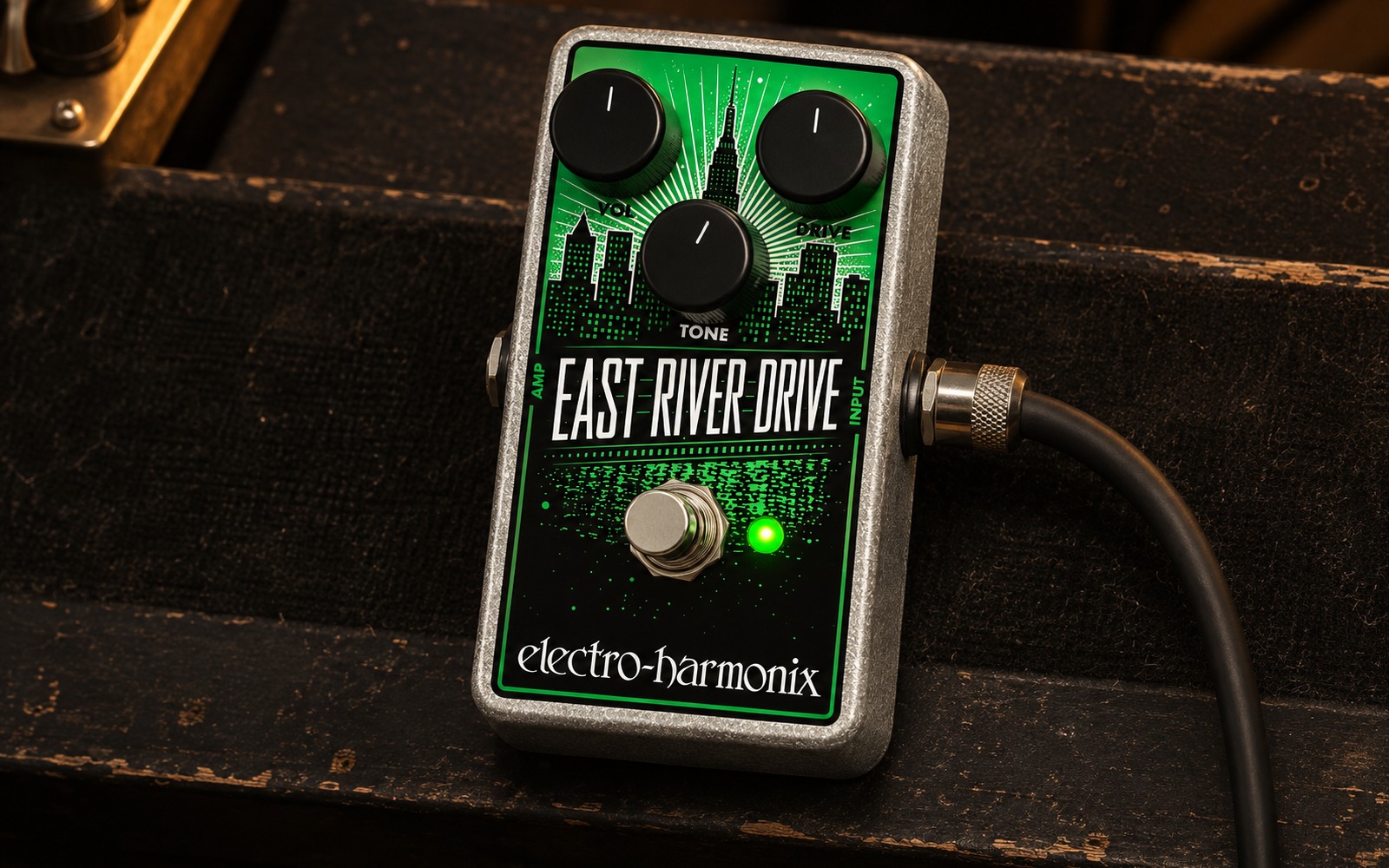
Every few years, someone figures out how to democratize a tone that used to cost real money. It happened with the Big Muff, which put fuzz within reach of every kid who couldn’t afford a stacked Marshall. It happened with the Soul Food, which brought Klon-adjacent dynamics to the $89 bracket. And in 2013, it happened again when Electro-Harmonix released the East River Drive — a Tube Screamer-inspired overdrive built around the same JRC4558D chip that defined the sound of the original TS-808, and priced so low you could leave a music store with two of them.
What makes the story better is who helped build it. Mike Piera of Analog Man — the Connecticut-based modifier who spent more time with TS circuits than arguably anyone outside Maxon itself — lent EHX his expertise, his curated parts list, and his schematic. The result was a pedal that doesn’t just approximate Tube Screamer tone; it aims at the specific warmth and low-mid body of the original 808, not the brighter, crunchier voice of the later TS-9. That distinction matters, and this article is going to explain exactly why.
From Maxon to Manhattan: The TS Circuit’s Long Journey to the East River Drive
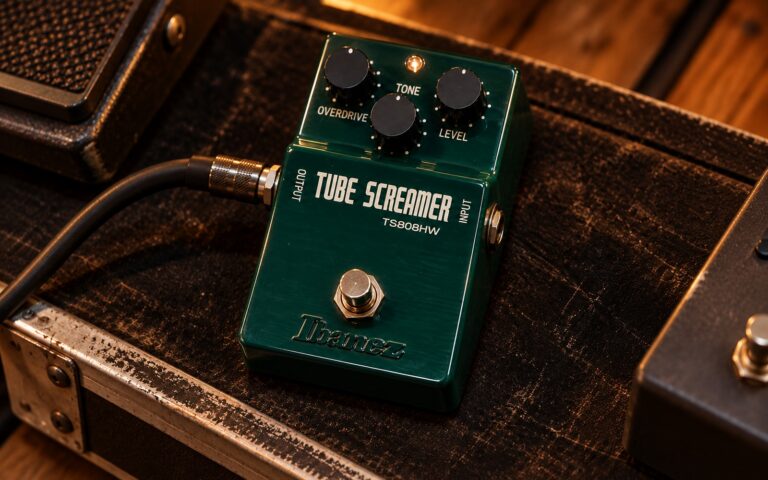
To understand what the East River Drive is, you have to understand what it’s derived from. The Tube Screamer story begins in Japan in the late 1970s at Maxon, where engineer Susumu Tamura designed a soft-clipping overdrive for Ibanez. The TS-808 entered production around 1979 and became one of the most influential pedals ever built — not because it was the loudest or the most saturated, but because of what it did with midrange frequencies and how gently it compressed the signal.
The heart of the original TS-808 circuit is the JRC4558 dual op-amp — specifically the JRC4558D, a bipolar-input chip made by Nippon Radio Corporation. Unlike JFET-input op-amps (like the TL072 used in the Electro-Harmonix Soul Food), the JRC4558D has a particular midrange character that interacts with the clipping stage in a way that became the defining sonic fingerprint of the TS circuit. Pair that with symmetrical clipping diodes and a specific low-pass filter topology, and you get the characteristic Tube Screamer sound: compressed, mid-forward, warm in the lows, and perfectly suited to cutting through a band mix without ice-picking the audience’s ears.
The TS-9, which replaced the TS-808 in 1982, used the same basic architecture but with manufacturing variations over the years — different chips in different production runs, slightly different component values — that shifted the character toward a brighter, more present, sometimes harsher sound in the upper mids. Whether the TS-9 or TS-808 is “better” is one of those arguments that will outlast most of us. The point is that they are genuinely different voices, and the East River Drive was specifically designed to chase the 808 side of the family tree.
Enter Mike Piera. Analog Man had been modifying and restoring Tube Screamers for decades, developing deep expertise in exactly which components produce which sonic character. His Silver Mod TS-808 — a modified version of the original circuit — became a benchmark for what the TS architecture could sound like when optimized by someone who truly understood it. When EHX decided to expand its overdrive lineup in 2013, they called Piera. “When EHX wanted to make a classic overdrive pedal, they asked Analog Man to help them out,” Piera explained in a 2023 Instagram post, “as we have been working on Tube Screamers longer than anyone else. We worked with the EHX management and engineers, and they built this excellent pedal, to our exact specs, with the JRC4558D chip which we have used for so long. A winner at any price, it’s a no-brainer at (way!) under $100.”
The East River Drive was part of a trio of EHX overdrives launched around the same time: the Soul Food (Klon-inspired), the OD Glove (MOSFET-driven British character), and the East River Drive (TS-808-inspired). Three different flavors of overdrive, three different circuit philosophies, all priced for working musicians who don’t want to spend vintage-pedal money on a stage workhorse.
Specifications
Honest Famous Players Section: A Pedal Built on Tone, Not Celebrity
Unlike the Ibanez TS-9, which has been documented on the boards of Stevie Ray Vaughan, Gary Moore, and John Mayer, or the Soul Food which has a confirmed Tash Sultana connection, the East River Drive doesn’t have a roster of household-name endorsers. No Premier Guitar Rig Rundowns have turned it up. No Guitar World features have pinned it to a famous pedalboard.
That’s not a slight against the pedal — it’s an honest accounting. The East River Drive earned its reputation the old-fashioned way: by sounding genuinely good at a price that let players evaluate it on sonic merit rather than celebrity proximity. On Equipboard, hundreds of working musicians list it. In forum discussions and gear blogs, it consistently appears as the answer to “what’s the best sub-$100 TS-style pedal?” The community consensus is real and earned, even if it doesn’t come attached to a famous last name.
For players who want to run a circuit with the same JRC4558D DNA as the original TS-808 without spending $150+ on a vintage or boutique option, the East River Drive is the honest path. It was designed by people who worked on Tube Screamers longer than almost anyone, to specs that prioritize that original 808 character. That’s a meaningful lineage even without a celebrity endorser on the box.
How It Sounds: The TS-808 Character Explained
The East River Drive’s character is inseparable from three design choices: the JRC4558D op-amp, the symmetrical clipping architecture, and the mid-hump EQ curve that’s inherent to the TS circuit topology.
The JRC4558D is a bipolar-input dual op-amp with a particular frequency response that contributes to the warm, compressed character people associate with the original TS-808. It’s not magic — it’s a specific interaction between the chip’s gain characteristics and the filter network around it. When Analog Man insisted on this chip for the East River Drive, he was preserving the lineage that players had been chasing in mods and boutique builds for years.
Symmetrical clipping means both the positive and negative halves of the audio waveform get clipped equally by the diodes. The result is a harmonically even distortion character — predominantly second-order harmonics, which are perceived as warm and musical. Compare this to asymmetrical clipping (where one side clips harder than the other, generating more odd-order harmonics), and the difference is audible: symmetrical has a creamier, more compressed quality; asymmetrical has more bite and harmonic edge. The East River Drive stays firmly in symmetrical territory.
The mid-hump is perhaps the most discussed characteristic of TS-style circuits. The frequency response is not flat — there’s a boost centered roughly around 500-800Hz that gives the pedal its characteristic “honk” in a mix. This is why TS-style pedals became staples in blues and rock contexts: that midrange emphasis helps the guitar cut through bass, drums, and second guitar without adding high-frequency harshness. It’s also why some players dislike them — a Stratocaster with an East River Drive and a bright amp can get nasal and congested if the Tone control isn’t managed carefully.
Premier Guitar’s Charles Saufley, reviewing the pedal in May 2014, compared it directly to an early TS-9 from the first year of production. His conclusion: “The vintage TS-9 has more dimensionality and excites more of a given guitar’s tone spectrum. But that only underscores that the East River Drive sounds more like a vintage TS-808 should sound — smoother in the low and low-mid spectrum and a little more organically integrated with the tone of your amp.” That’s a meaningful distinction for players who’ve been frustrated by brighter TS-style pedals.
Tone Recipes and Settings
Classic Blues-Rock Lead (Single Coils)
Start with DRIVE at 10 o’clock (roughly one-third up), VOL matched to your bypassed signal level, and TONE at noon. With a Fender Stratocaster into a Fender Deluxe Reverb set to just-breaking-up, this gives you that warm, compressed lead tone with just enough sustain extension to carry notes without muddying rhythm work. Back the guitar volume down to 7-8 and the East River Drive cleans up significantly — responsive enough for switching between rhythm and lead without engaging the bypass.
Boosting a Dirty Amp (Humbuckers)
With a Gibson Les Paul Standard and an amp already set to moderate crunch, use DRIVE at 8 o’clock (near minimum), VOL at around 2-3 o’clock (above unity), and TONE at 9-10 o’clock to counteract the darker nature of humbuckers. The East River Drive acts as a booster that also tightens the low end and focuses the midrange — classic application for pushing an amp’s front end harder on solos while keeping the overall character of the amp’s own preamp saturation dominant.
High-Gain Lead Tone (Careful with Tone)
DRIVE at 2-3 o’clock, VOL adjusted for output level, TONE between noon and 2 o’clock for humbuckers, or between 10 o’clock and noon for single coils. Saufley’s PG review noted that with DRIVE wide open, “classic rock chords sound perfectly rowdy and full of harmonic juice.” At high Tone settings with single coils, you can get a scratchy, dry texture in the upper mids — not a fault exactly, but something to manage. With neck pickup selected and Tone backed off slightly, the East River Drive at high gain can deliver a smooth, compressed lead tone with a quality Saufley described as “the cool blistering quality of a revved-up Marshall plexi.”
The Clean-ish Shimmer Trick
Turn DRIVE fully counter-clockwise (minimum). There’s still discernible dirtiness at minimum gain — that’s the nature of the circuit — but rolling your guitar volume down to around 6-7 scrubs most of it away, leaving a subtle sparkle that adds body without obvious clipping. With a clean amp this can add a nice shimmer to chord work, especially through single coils.
Stacking with a Second Overdrive
The East River Drive responds well to being followed by another drive. Place it before a Boss BD-2 Blues Driver and use the ERD with DRIVE low as a mid-focused boost into the BD-2’s input — the ERD’s mid-hump tightens and focuses what the BD-2 does with the signal. Alternatively, place it after a low-gain boost to saturate the ERD’s input for extra harmonic density.
How It Compares
East River Drive vs. Ibanez TS-9 Tube Screamer
These two share a circuit lineage but occupy different sonic territory. The Ibanez TS-9 is brighter and more present in the upper mids — characteristics that can be traced partly to component variations across production runs and partly to the different op-amp configurations Ibanez used at different times. The East River Drive, with Analog Man’s specs and the JRC4558D, targets the warmer, more organically integrated TS-808 voice. For blues-rock and warm lead applications, the ERD has the edge. For situations where you need more attack and treble presence to cut through a dense mix, the TS-9 may be the better fit. Both come in at a similar price point.
East River Drive vs. Ibanez TS-808 Tube Screamer Overdrive Pro
The TS-808 Overdrive Pro is the modern Ibanez-branded reissue of the original circuit, selling for $150-200 new. The East River Drive gives up some of the refinement and collectability of the official TS-808 reissue but delivers the same JRC4558D chip in a true bypass enclosure at roughly half the price. For a stage pedal or a board workhorse that you’re not worried about losing or damaging, the ERD is the pragmatic choice. For studio use or collection purposes where the Ibanez branding and component-level accuracy matter, the TS-808 reissue justifies its premium.
East River Drive vs. Electro-Harmonix Soul Food
This comparison is instructive because they’re siblings from the same EHX overdrive expansion of 2013-2014. The EHX Soul Food is a Klon Centaur-inspired design using a clean blend architecture and TL072 JFET op-amp — fundamentally different from the TS circuit. The Soul Food preserves bass through the drive stage (clean blend), has no mid-hump coloration, and clips with silicon diodes for a harder, brighter break-up. The East River Drive pushes all the signal through the drive stage (traditional TS architecture), adds the characteristic mid-hump, and clips more softly via its symmetrical diode configuration. They complement each other beautifully on the same board: Soul Food for transparent low-to-medium gain with full-range character; East River Drive for mid-focused warmth and compression. At similar prices, owning both is a legitimate choice.
East River Drive vs. Boss Blues Driver BD-2
The Boss BD-2 uses a JFET-based circuit with asymmetrical clipping and a very different EQ character — brighter, with more treble extension and a less pronounced mid-hump. The BD-2 can cover more sonic territory (it goes from subtle warmth to almost distortion-territory crunch), while the East River Drive is more specifically voiced for the classic TS-808 sweet spot. The BD-2’s Boss enclosure and buffered bypass make it a tougher road warrior. The ERD’s true bypass is preferable for certain signal chain configurations. They’re different tools.
Buying Guide
The East River Drive has been in continuous production since 2013, making it easy to find new and used. At its price point, used examples offer minimal savings — you’re typically looking at $30-50 for a used one versus $65-80 for new, and the premium for a factory warranty and fresh battery may be worth the difference to many players.
One thing to note: the East River Drive does NOT include a 9V adapter. The battery is in the box, but if you’re integrating this into a pedalboard powered supply, you’ll need your own standard 9V center-negative cable. The current draw of 6mA is minimal — even the smallest isolated supplies handle this easily, and a single 9V chain can power several ERDs simultaneously. This is a non-issue in practice but worth knowing before your first gig with a new board.
The Nano enclosure is compact and sturdy, with a die-cast chassis that takes normal stage abuse without trouble. The graphics are characteristically EHX — bold and distinctly New York. The footswitch has a satisfying mechanical feel, and the LED is visible under most stage lighting conditions.
For those building a TS-style rig on a strict budget, the East River Drive competes directly with the Joyo Vintage Overdrive, the Biyang OD-8 X-Drive, and the Donner Morpher. Against those sub-$50 competitors, the East River Drive’s Analog Man-spec’d JRC4558D circuit and EHX build quality represent a meaningful step up — closer in architecture and execution to the vintage TS-808 it’s inspired by than most of its budget competitors.
Ownership Notes
A few practical observations from the circuit design and user experience:
True bypass on the East River Drive means no buffering when the pedal is disengaged. If you run long cable runs or have many true-bypass pedals in series, consider your overall signal chain impedance. For most normal gigging rigs, this is irrelevant. For complex chains with 8+ true-bypass pedals, a dedicated buffer early in the chain is worth considering.
The Tone control on the East River Drive is more sensitive than on many drives. Small adjustments make audible differences. With bright single-coil pickups, a conservative Tone setting (9-11 o’clock) typically sounds better than noon or above. With humbuckers, you have more headroom before the upper-mid congestion becomes a problem. The PG review specifically noted that “high tone settings can excessively color chord harmonics in the upper mids… creating a dry, scratchy texture” — especially with single coils. This is manageable but requires attention.
The responsiveness to guitar volume is a genuine feature of this circuit. Unlike some drive pedals that maintain their gain character regardless of what the guitar’s volume is doing, the East River Drive cleans up significantly as you roll back the guitar volume. This lets you dial in a single pedal setting and use your guitar’s volume knob to transition between cleaner passages and driven sections — a useful technique for players who prefer minimal tap-dancing.
Stacking order matters. The East River Drive produces more useful results before other drives (as a mid-focused boost into a second stage) than it does after a hot drive pedal (where its input can compress early and lose dynamics). Experiment with placement, but in most configurations, ERD before other drive elements is the starting point.
Frequently Asked Questions
Is the Electro-Harmonix East River Drive a Tube Screamer clone?
It’s a Tube Screamer-inspired design, not a straight clone. The circuit was developed with input from Analog Man Mike Piera, who provided exact specs and component selections — specifically the JRC4558D chip used in the original TS-808. The goal was to capture the character of the original 808 rather than the later TS-9, and the result is a distinct pedal that shares the TS lineage without being a copy of any specific existing product.
What’s the difference between the East River Drive and the Soul Food?
They’re both EHX overdrives launched around the same time, but they’re completely different circuits chasing different reference tones. The Soul Food is Klon-inspired: clean blend architecture, JFET op-amp (TL072), silicon clipping diodes, no mid-hump, bass preserved through the drive stage. The East River Drive is TS-inspired: all signal through the drive stage, bipolar op-amp (JRC4558D), symmetrical clipping, characteristic mid-hump EQ. Choose the Soul Food for transparent, full-range drive; choose the East River Drive for warm, mid-focused TS character.
Does the East River Drive include a power adapter?
No. A 9V battery is included, but EHX does not include the 9.6VDC-200mA power adapter. You’ll need to purchase a standard center-negative 9V adapter or use your pedalboard’s power supply. At 6mA current draw, it places virtually no load on any supply and runs essentially forever on a battery.
Why does my East River Drive still have some dirt even with Drive at minimum?
That’s inherent to the TS circuit topology. The clipping network is always in the signal path, and at minimum Drive settings there’s still a small amount of soft clipping. Premier Guitar’s review noted this characteristic. If you need completely clean boosted signal, rolling your guitar volume down to around 6-7 typically cleans up most of the residual dirtiness while the pedal adds mild body and midrange presence. For transparent clean boost applications, the Soul Food or a dedicated boost pedal is a better tool.
Can the East River Drive handle high-output pickups?
Yes, but manage your Drive setting accordingly. High-output humbuckers into a high Drive setting will compress heavily and can get congested — this is the same behavior you’d get from any TS-style circuit driven hard by a hot pickup. Back the Drive down to 9-11 o’clock range and use the VOL to compensate, and the pedal opens up considerably. The mid-hump is also more prominent with humbuckers than with single coils, so Tone control management is particularly important.
How does the symmetrical clipping in the East River Drive affect the sound versus asymmetrical clipping?
Symmetrical clipping means both the positive and negative halves of the audio waveform get clipped equally by the diodes. This produces predominantly even-order harmonics (second harmonic being most prominent), which are generally perceived as warm, musical, and less harsh. Asymmetrical clipping (where one side clips more than the other) generates more odd-order harmonics and creates a brighter, more edgy character. The East River Drive’s symmetrical approach is why it has that smooth, compressed, cream-colored overdrive quality rather than the more aggressive or gritty sound of asymmetrically-clipping designs.
Is the East River Drive better than an Ibanez TS-9?
Better is the wrong question — they’re different. The TS-9 is brighter with more upper-mid presence; the East River Drive is warmer and more organically integrated with amp tone, closer to the TS-808 character. For clean amp/warm lead applications, many players prefer the ERD. For cutting through a loud band with a dense arrangement, the TS-9’s extra brightness can be an advantage. At similar street prices, choosing between them is about which character serves your context.
What amps pair best with the East River Drive?
The East River Drive follows the same TS-style wisdom: it sounds best into amp circuits that are already working. A Fender Deluxe Reverb set just below breakup is the classic pairing — the pedal’s mid-hump fills in the frequency range where Fender amps are naturally scooped, and the amp’s natural voice gives the result dimension and air. Marshall-voiced amps on the edge of breakup are also excellent; the ERD’s compression and mid-forward character complements the amp’s own harmonic content. Into a completely clean, HiFi-flat amp, the mid-hump is more pronounced and can feel boxy — manage with the Tone control or consider a different pedal type.
Image credits
- Top image: GuitarGangsters AI-generated reference illustration, not a photograph.
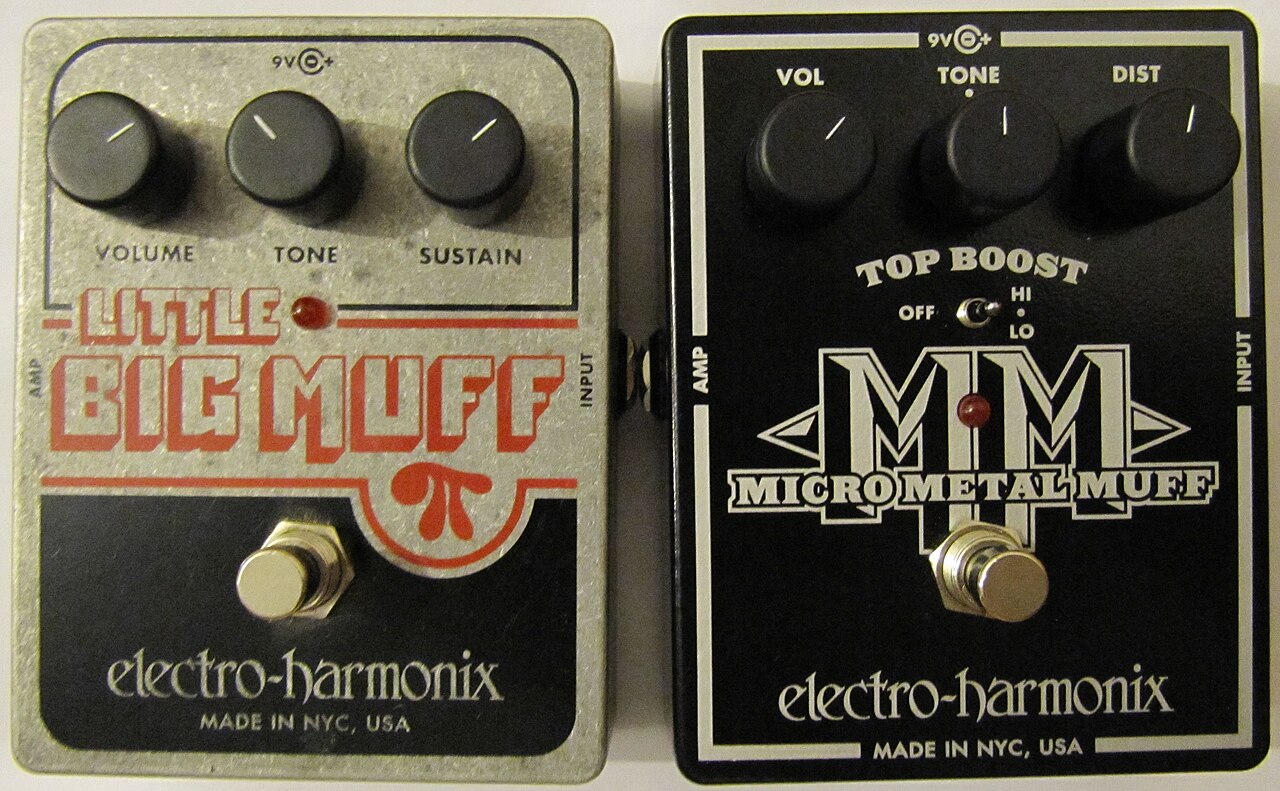
- An Electro-Harmonix Little Big Muff and a Micro Metal Muff pedal: Sky99, Wikimedia Commons, CC BY-SA 3.0.
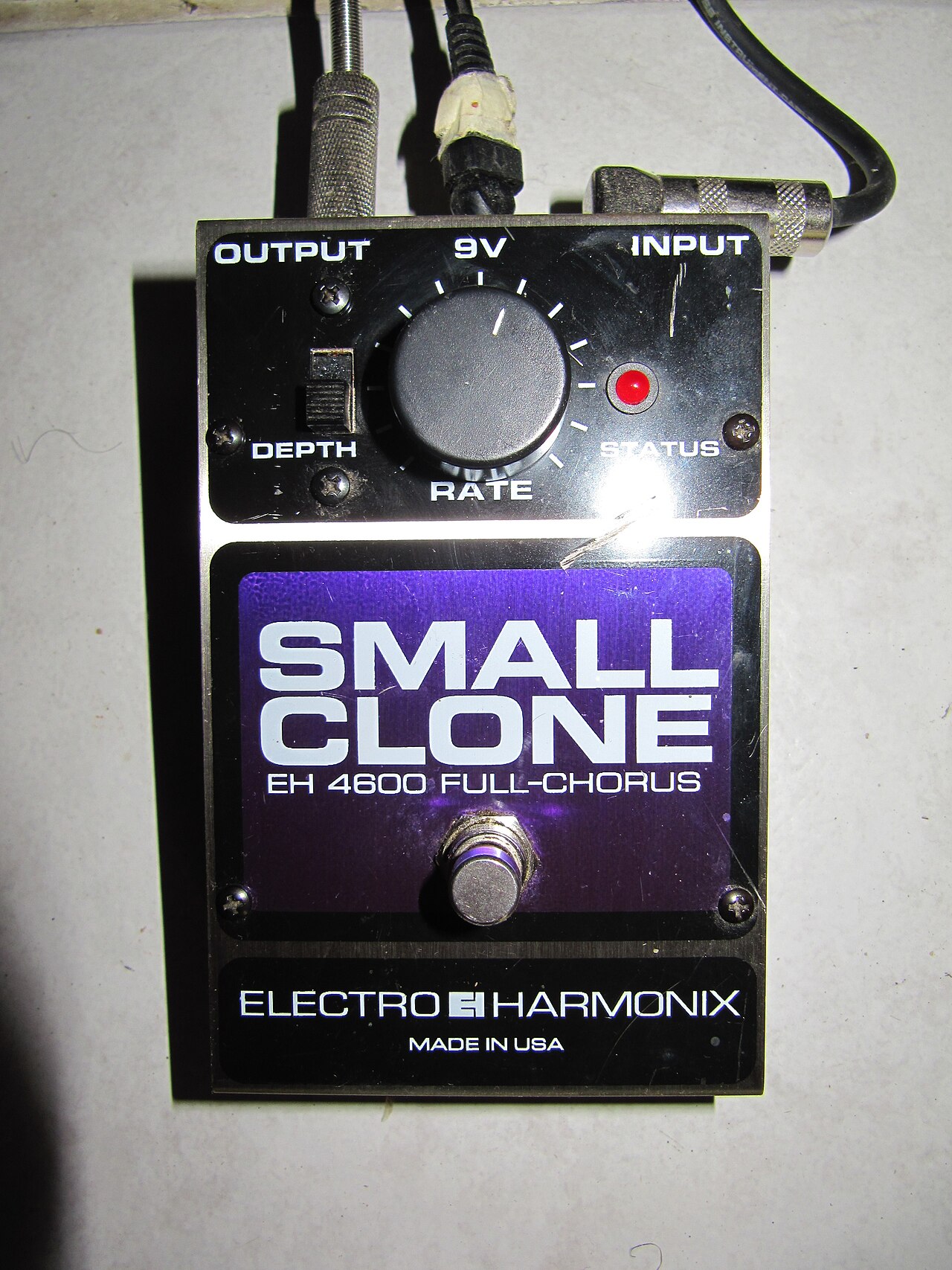
- An Electro-Harmonix Small Clone chorus pedal: Sky99, Wikimedia Commons, CC BY-SA 3.0.
Latest News
Related
On This Day
Tuesday 10 November
From this week: