The Fuzz That Defined Generations, Now in a Nano Package
The EHX Nano Big Muff Pi packs the legendary fuzz circuit into a pedalboard-friendly nano enclosure. Specs, tones, settings, and who really uses it.
There are very few guitar pedals that can claim to have helped define the sound of multiple decades of rock music. The Electro-Harmonix Big Muff Pi is one of them. From the soaring Pink Floyd leads of the mid-1970s to the crushing shoegaze walls of the late 1980s, from the grunge explosions of the early 1990s to the garage rock revival of the 2000s, the Big Muff Pi’s distinctive silicon fuzz has been the weapon of choice for guitarists who wanted something bigger, dirtier, and more sustained than a conventional overdrive could deliver.
The Electro-Harmonix Nano Big Muff Pi, introduced in 2013, takes the current production NYC Big Muff Pi circuit — the same four-stage silicon transistor topology that has been the backbone of the design for decades — and fits it into the brand’s compact nano enclosure. Same circuit, same controls, same crushing sustain and violin-like fuzz character: just a smaller footprint, a lower price, and a 3mA current draw so minimal it barely registers on your power supply.
This is not a budget approximation of the Big Muff. It is the Big Muff — or more precisely, a version of the current production Big Muff circuit — in a format that works on modern gigging pedalboards where space is real estate. If you want to understand what the Nano Big Muff Pi is, you need to understand where it came from. And that story starts in lower Manhattan in 1969.
The Big Muff Pi: A Brief History of the Most Copied Fuzz Circuit in the World
Bob Mayer and Mike Matthews created the first Big Muff Pi in 1969 under the Electro-Harmonix banner, which Matthews had founded in New York City in 1968. The original design — known today as the Triangle Big Muff for the triangular arrangement of its control knobs — used four silicon NPN transistors in a cascaded gain structure unlike anything else on the market. Where most fuzz pedals of the era used two transistors for a relatively simple clipping effect, the Big Muff ran the signal through two clipping stages with a passive tone stack sandwiched between them. The result was enormous sustain, a distinctive mid-scooped frequency response, and a harmonic richness that made it sound less like a distortion effect and more like an instrument in its own right.
The first major revision came between 1973 and 1977 with the Ram’s Head version, named for the goat’s-head graphic on the enclosure face. The Ram’s Head darkened the tone profile, deepened the mid scoop, and extended the sustain envelope — characteristics that made it the preferred Big Muff of David Gilmour, who used a 1974 Ram’s Head model (later modified by Pete Cornish) for the sustained, singing lead work that defined Pink Floyd’s most celebrated recordings. The Ram’s Head remains the most sought-after vintage Big Muff variant and the basis for several EHX reissues, including the J Mascis Ram’s Head signature model.

The late 1970s brought the Op-Amp versions — circuit revisions four through six that replaced the transistor gain stages with operational amplifier designs. These had a distinct voicing: tighter, more compressed, with a different harmonic character. Billy Corgan of Smashing Pumpkins built the wall-of-guitar sound of Siamese Dream on an Op-Amp Big Muff running through a stack of Mesa/Boogie amplifiers, creating what many consider the definitive alternative rock guitar sound of 1993. EHX eventually reissued the Op-Amp version as a standalone product.
Production of the NYC Big Muff collapsed in the early 1980s as Electro-Harmonix hit financial difficulties. During the late 1980s and through most of the 1990s, the brand was represented primarily by its Russian subsidiary producing the Sovtek Big Muff variants: the Civil War (1993), the Green Russian (1994), and the Black Russian (1998). These Sovtek models had a different voicing again — warmer, woollier, with a smoother sustain curve — and developed their own cult following. Jack White’s Big Muff use during the White Stripes era drew heavily from these Russian variants.
When Mike Matthews revived Electro-Harmonix in the late 1990s, production of an NYC-made Big Muff Pi resumed with silicon transistors. The current production NYC Big Muff Pi uses 2N5089 silicon transistors (or close equivalents), restoring the four-stage transistor architecture that made the original design legendary. The Nano Big Muff Pi, released in 2013, puts this same current-production circuit into the brand’s compact nano housing: the same circuit that has been refined and iterated over fifty-plus years of manufacturing, now in the smallest practical enclosure EHX has ever built for it.
What the Nano Actually Is — and One Honest Nuance
EHX markets the Nano Big Muff Pi as sounding “identical in every way to our classic NYC Big Muff Pi,” and for practical purposes this is essentially true. However, a notable comment exists in the community: some players who contacted EHX directly were told that the Nano has slightly more prominent high-frequency content than the full-sized NYC version. The explanation is physics: the smaller printed circuit board has lower parasitic capacitance values across the board, which shifts the frequency response marginally toward the upper end of the spectrum. For most players in most contexts, this difference is imperceptible. In direct A/B comparisons at high volume in a studio setting, some engineers can detect it. The practical consequence, if anything, is that the Nano’s slightly higher treble content can actually balance out the mid scoop somewhat — a modest improvement in mix presence without any circuit modification required.
Specifications
| Parameter | Specification |
|---|---|
| Circuit type | Analog, silicon transistor (4-stage gain, passive tone stack) |
| Controls | Volume, Sustain, Tone |
| Bypass | True bypass |
| Audio | Mono (1/4″ input + 1/4″ output) |
| Power supply | 9V battery included; optional 9.6VDC-200mA center-negative adapter (not included) |
| Current draw | 3mA |
| Dimensions | 4.5″ × 2.75″ × 2.1″ (nano enclosure) |
| Year released | 2013 |
| MSRP (2026) | ~$87 USD |
| Street price new (2026) | ~$60–75 USD |
| Street price used excellent (2026) | ~$35–55 USD |
The Big Muff Pi Circuit: How It Actually Works
Understanding what makes the Big Muff Pi sound the way it does requires a quick look under the hood. The circuit is built around four silicon NPN transistors arranged in a specific architecture. The first transistor is a clean input buffer that drives the signal to appropriate levels. Transistors two and three form the heart of the design: two identical clipping stages, each consisting of a gain stage followed by a diode clipping network that hard-clips the signal. The clipped signal then passes through the passive tone stack — a filter network that creates the famous mid scoop — before reaching the fourth transistor, which handles the output buffer and the Volume control interaction.
The passive tone stack is the defining element of the Big Muff’s character. Set at noon, it creates an attenuation of approximately 13 dB at around 1kHz — the frequency range where guitar sits most prominently in a band mix. This is the Big Muff’s mid scoop: a deep valley in the frequency response that gives the pedal its characteristic “wall of sound” quality. When every instrument is playing, the mid-scooped Big Muff carves out space by removing the frequencies that cause midrange buildup. Rolling the Tone control counterclockwise fills in some of the bass frequencies; rolling it clockwise pushes the treble. But neither extreme eliminates the fundamental mid-scoop architecture — it simply shifts where the center of the scoop sits.
The result is a pedal that sounds enormous when playing alone but can disappear into a dense mix if not carefully managed. The traditional solution — used by studio engineers from the 1970s onwards — is to push the Tone control slightly above noon, accept the mid scoop, and trust that the harmonic complexity of the fuzz fills the spectral space in ways that a conventional EQ measurement doesn’t capture. The alternative solution, used by a generation of shoegaze and noise rock guitarists, is to accept the disappearance into the mix as the point: a wall of fuzz texture that blurs into drums and bass for an effect that is less about lead presence and more about sonic mass.
Famous Players — The Big Muff Family, Honestly
Any discussion of famous Big Muff Pi users requires an honest distinction that the marketing often blurs: the legendary players associated with the Big Muff Pi used specific vintage variants, not the current Nano. The Nano reproduces the current NYC production circuit, which has its own character distinct from the Ram’s Head, the Op-Amp, and the Russian Sovtek variants. Here is what the record actually shows.
David Gilmour is the most documented Big Muff user in rock history, and his preferred version was a 1974 Ram’s Head Big Muff Pi, later modified by Pete Cornish. The Ram’s Head’s darker tone, deeper mid scoop, and extended sustain are audible on “Comfortably Numb,” “Dogs,” and the entirety of Animals. Gilmour’s tone is a template that countless players have tried to replicate, but the specific circuit he used is the Ram’s Head — not the current production silicon circuit that the Nano reproduces. The David Gilmour gear guide covers his complete rig in detail. Players who want Gilmour’s specific character should investigate the EHX Ram’s Head reissue rather than the Nano.
Billy Corgan built Siamese Dream on an Op-Amp Big Muff Pi — the late-1970s circuit revision that uses operational amplifiers instead of transistors throughout the gain stages. The Op-Amp version has a tighter, more compressed character than the current transistor circuit, and Corgan has stated publicly that he stopped using the Big Muff after 1993 when the version he loved became unavailable. EHX eventually reissued the Op-Amp Big Muff Pi as a dedicated product. The Billy Corgan gear guide documents his complete approach to the Smashing Pumpkins guitar sound. He is emphatically not a Nano Big Muff user.
Jack White is documented using various Sovtek Russian Big Muff variants during the White Stripes era — the Civil War (1993) and the Violet Ram’s Head among them — pedals that have a distinctly different character from the NYC circuit. The Russian Sovtek Big Muffs are warmer and woollier, with a different clipping character that comes from component tolerances specific to their Soviet-era production. The Jack White gear guide covers the full context of his White Stripes and post-Stripes rig. His Big Muff use is real and well-documented; his use of the Nano specifically is not confirmed.
J Mascis of Dinosaur Jr. owns more than fifty vintage Big Muffs and has his own signature model — the EHX J Mascis Ram’s Head Big Muff Pi — based on his personal 1973 Ram’s Head that he has used since the earliest Dinosaur Jr. recordings. Mascis’s crushing, amplifier-destroying fuzz tone is the product of specific vintage transistors, component drift, and a playing style developed over decades. The J Mascis gear guide goes deep on his setup. He is a Big Muff family legend; he is not a Nano user.
Dan Auerbach of the Black Keys uses various Big Muff variants as part of a deliberately lo-fi, vintage-leaning guitar setup. His recorded tones draw from multiple fuzz sources including Big Muff variants, but no primary source confirms Nano Big Muff Pi use specifically. The Dan Auerbach gear guide covers his gear in detail.
For confirmed Nano Big Muff Pi users, the Equipboard-documented roster includes Nick Hamm of the indie rock band Citizen, whose Premier Guitar Rig Rundown in both 2017 and 2021 confirmed the EHX Nano Big Muff Pi as a consistent part of his pedalboard — paired with an Ibanez TS9 Tube Screamer, an EHX Micro POG, and an EHX Holy Grail reverb. That TS9-before-Big-Muff configuration (overdrive feeding the fuzz) is one of the classic approaches for adding midrange body back into the mid-scooped Big Muff signal. Matthew Caws of Nada Surf, Nick Steinhardt of noise rock act METZ, Greg Gonzalez of Cigarettes After Sex, and John Baldwin Gourley of Portugal. The Man are also documented Nano users. Gonzalez’s application — slow chord progressions swimming in reverb and fuzz — represents the shoegaze use case that the Nano Big Muff serves particularly well.
Tone Recipes and Settings
Classic Shoegaze Wall
Volume at unity (around noon), Sustain at 2 o’clock, Tone at 11 o’clock. Full saturation, dark and thick, with enough bass body to blur into the rhythm section. Add a digital reverb with long decay to complete the My Bloody Valentine aesthetic. This is the foundational Big Muff setting that has appeared on hundreds of shoegaze recordings.
Grunge Lead Tone
Volume slightly above noon, Sustain at 3 o’clock, Tone at noon to 1 o’clock. Heavy saturation with the Tone control pushed toward the treble side to compensate for the mid scoop and improve cut. Place an overdrive or clean boost immediately before the Nano to push the input and smooth the clipping. Works particularly well with a Fender Stratocaster into a clean-to-edge-of-breakup amp.
Singing Lead Sustain (Gilmour-Adjacent)
Volume at noon, Sustain at 1 o’clock, Tone at 1-2 o’clock. Back off the Sustain from maximum to preserve some pick attack and dynamic response. Higher Tone setting compensates for reduced gain. Use a compressor before the Nano to even out pick dynamics, and a clean boost after to recover volume lost to the mid scoop in the mix. A Marshall JCM800 at low gain volume is the classic amp pairing for this application.
Gated Sputtery Fuzz
Volume at noon to 1 o’clock, Sustain at 8-9 o’clock, Tone at noon. Minimum Sustain produces a gated, compressed fuzz that cuts off abruptly rather than sustaining. The sputtry character works well for single-note staccato riffs and garage rock applications. Rolling back the guitar’s volume knob by 20-30% exaggerates the gate effect and cleans up the attack slightly.
Fuzz as Texture (Rhythm Bed)
Volume at 9-10 o’clock (low), Sustain at 2-3 o’clock, Tone at 10 o’clock. Heavy fuzz, rolled off treble, and a low output volume creates a fuzz texture that sits underneath other elements without competing. Layer over clean chords from a second guitarist or a pad. This is the Cigarettes After Sex application: dreamy, atmospheric, present but not dominant.
Mid-Boosted Fuzz (Fix the Scoop)
Place a Tube Screamer-style overdrive — the East River Drive, TS9, or similar — immediately before the Nano Big Muff Pi. Set the overdrive at low gain (9 o’clock), high tone (2 o’clock), and moderate output. The overdrive pushes the mids into the fuzz input, partially compensating for the passive tone stack’s scoop. The resulting sound has more midrange presence and cuts better in a band mix without any EQ pedal required. This is one of the most practical and widely used Big Muff modifications and costs nothing extra if you already own a Tube Screamer-style pedal.
The Nano Big Muff Pi’s three controls interact in specific ways worth understanding before dialing. Volume is straightforward output level. Sustain controls the gain feeding the two clipping stages: counterclockwise yields a gritty, sputtery fuzz with more dynamic response; clockwise adds compression, sustain, and ultimately hard saturation. Tone shifts the passive filter’s center point between bass-heavy darkness and treble-forward brightness, but the mid scoop is present throughout.
Understanding and Surviving the Mid Scoop
The mid scoop is simultaneously the Big Muff’s most loved characteristic and its most frustrating practical limitation. Players who discover the Big Muff at home — alone, into an amp, at bedroom volumes — hear something enormous. Those same players at band practice often find the Big Muff disappears into the mix the moment drums and bass enter the room. The physics are straightforward: the ~1kHz attenuation of the passive tone stack removes exactly the frequency range where guitars normally cut through a dense ensemble.
There are four practical solutions. First, run a midrange-boosting overdrive before the Nano (the TS-style pedal approach described above). Second, use an EQ pedal — in the effects loop if available, or after the Nano in the signal chain — to add back 3-5dB at 800Hz-1kHz. Third, accept the mid scoop and raise the overall volume to compensate for lost presence, trusting that the harmonic complexity fills the spectral space indirectly. Fourth, choose amplifiers with naturally pronounced midrange character — a Vox AC30, a small Marshall combo, or a Fender Deluxe Reverb with the midrange dials pushed — which add back what the pedal removes. All four approaches are legitimate; the right choice depends on the musical context and what other pedals are on the board.
The Big Muff Family: Which Version Is Right for You?
The EHX Big Muff Pi in its full-sized NYC format uses the same current-production circuit as the Nano but with a larger enclosure, different power options, and the traditional three-knob layout on a larger footprint. For pedalboard-conscious players, the Nano wins on space without meaningful tone sacrifice. For players who prefer larger enclosures with more robust hardware feel, the full-sized version is the choice.
The EHX Ram’s Head Big Muff Pi reissue targets players specifically chasing the Gilmour/Dinosaur Jr. vintage dark character. The circuit differences are real and audible: the Ram’s Head is darker, with a deeper and lower-frequency-centered scoop. The Nano’s current-production circuit is brighter and has slightly more upper-mid presence — which, for mix context, is often an advantage over the vintage darker voicing.
The EHX Op-Amp Big Muff Pi reissue is the choice for players chasing Smashing Pumpkins and Mudhoney tones. The op-amp circuit compresses differently, has a more aggressive attack transient, and is voiced more toward the upper midrange. It is a fundamentally different-sounding pedal that happens to share a name and a legacy.
Boutique alternatives to the Nano include the ZVEX Fuzz Factory (highly adjustable, more complex, four times the price), the Wren and Cuff Creations series of vintage Big Muff recreations, and the Black Arts Toneworks LSTR (darker, asymmetrical clipping, handwired). For players who just want to add fuzz to a pedalboard without spending a week reading forum threads, the Nano Big Muff Pi at ~$60-75 street is the practical answer.
Chain Placement and Pairing Recommendations
Position the Nano Big Muff Pi after tuners and wah pedals, and before time-based effects (delay, reverb, chorus). The traditional placement is after overdrive pedals, but many experienced players reverse this — putting the overdrive after the Big Muff to add midrange body to the already-fuzzed signal. Both approaches produce usable results; they sound different enough to warrant experimenting with your specific gear.
The Nano is true bypass, which means it presents a low input impedance that could affect germanium fuzz pedals placed before it in the chain. If you use a vintage-style germanium fuzz (like an old Fuzz Face variant), place it before the Nano or use a buffer between them to prevent the Nano’s input from loading the germanium circuit. The 3mA current draw is completely unproblematic for any power supply and imposes no meaningful constraints on power brick capacity planning.
With a Fender Telecaster, the Nano’s slightly boosted high-end character relative to the full-sized NYC version becomes an asset: the single-coil treble and the Nano’s upper frequency presence produce a brighter, more cutting fuzz that works particularly well for lead lines. With humbuckers, roll the Tone control back to 9-10 o’clock to prevent the upper midrange from becoming harsh at high Sustain settings.
The classic pairing with an EHX Deluxe Memory Man analog delay is one of the most documented Big Muff combinations in rock history. The Memory Man’s warm, slightly compressed repeats smooth out the hard clipping edges of the Big Muff’s sustain, creating a cascade of harmonically complex delayed fuzz that is the core of a certain style of psychedelic rock lead tone. Place the Memory Man after the Nano in the chain.
Buying Guide: New, Used, and What to Expect
The Nano Big Muff Pi is available new at major retailers for approximately $60-75 USD (MSRP $87, street price typically discounted). Used units in excellent condition — the Nano’s all-metal enclosure is extremely durable, so used units in excellent condition are common — run between $35-55 USD. At these price points, the Nano is one of the most accessible entry points into the Big Muff circuit, and the construction quality means a used Nano in good physical condition performs identically to new.
What to check when buying used: test the Sustain control through its full range for dead spots (uncommon, but the pot can wear); verify the footswitch engages cleanly (true bypass switches can develop travel slop with heavy use but rarely fail); confirm the output is clean in bypass mode (the true bypass circuit is simple and reliable). The 9V battery compartment requires a coin or small screwdriver to open — verify the battery contacts are clean if you plan to use battery power.
One practical note: EHX does not include the 9.6VDC power adapter with the Nano Big Muff Pi, though a 9V battery is included. Budget for a standard center-negative 9V power supply or pedalboard brick if you plan to power the Nano from a power supply, as most players do. The 3mA current draw means even the smallest isolated output on a pedalboard power supply will handle it without issue.
Who Should Buy the Nano Big Muff Pi?
The Nano Big Muff Pi makes sense for players who want the Big Muff Pi sound in the smallest possible format at the lowest possible cost. Shoegaze players, grunge players, noise rock players, and anyone drawn to the vocabulary of slow-chord fuzz atmospherics will find it immediately natural. Players who want the specific vintage sound associated with Gilmour (Ram’s Head), Corgan (Op-Amp), or White/Mascis (various vintage variants) should investigate those specific reissue versions instead — the Nano’s current-production circuit is a different voice from those vintage originals.
For bedroom players, practice-room fuzz exploration, and smaller gigging pedalboards where space matters, the Nano Big Muff Pi is the rational choice. It costs less, takes up less space, draws less current, and sounds nearly identical to its larger sibling. Its construction is road-worthy, its circuit is proven, and its place in rock music history — as a branch of a family that has appeared on some of the most important guitar recordings ever made — is secure.
Frequently Asked Questions
Is the Nano Big Muff Pi the same as the full-sized NYC Big Muff Pi?
Nearly identical. EHX markets it as sounding the same, and for all practical purposes this is accurate. There is a community-documented observation, confirmed by EHX via direct correspondence, that the Nano has slightly more prominent high-frequency content due to lower parasitic capacitance on its smaller PCB. In practice, this difference is subtle and some players consider it an improvement in mix presence.
Did David Gilmour use a Nano Big Muff Pi?
No. Gilmour’s Big Muff of choice was a 1974 Ram’s Head variant — a vintage circuit that predates the Nano by nearly forty years. The Ram’s Head has a darker character than the current production circuit the Nano reproduces. The Nano is inspired by the same family legacy, but it is not the specific pedal Gilmour used.
Can I fix the Big Muff’s mid scoop?
You can compensate for it. Running a Tube Screamer-style overdrive before the Nano pushes midrange into the fuzz input, partially filling the scoop. Using an EQ pedal to add 3-5dB at 800Hz-1kHz in the effects loop also works. Or you can choose an amp with naturally strong midrange and let the amp’s character compensate. You cannot change the fundamental mid-scoop architecture of the circuit without modifying the components, but you can address it with signal chain choices.
Does the Nano Big Muff Pi need an adapter or does it come with one?
A 9V battery is included. A power adapter is not included. You will need a standard center-negative 9V power supply or pedalboard power brick to run the Nano from mains power. The current draw is only 3mA, so any standard power supply output will handle it easily.
What is the difference between the Nano Big Muff Pi and the Ram’s Head Big Muff Pi reissue?
The Ram’s Head reissue uses a different circuit topology based on the 1973-1977 production variants — darker, with a deeper mid scoop, and a more compressed, woollier sustain character. The Nano uses the current production NYC circuit, which is brighter and has slightly more upper-mid presence. The Ram’s Head is specifically for players chasing vintage Gilmour or Dinosaur Jr. territory; the Nano is the modern all-purpose Big Muff Pi in compact format.
What genres is the Nano Big Muff Pi best suited for?
Shoegaze, grunge, noise rock, alternative rock, and fuzz-heavy indie are the native habitats. It also works for psychedelic rock lead tones, doom/stoner riffs with the Tone control rolled back dark, and any context where sustained, harmonically complex fuzz is the objective. It is not naturally suited to metal (too much mid-scoop loss in dense mixes), country, or jazz, though individual players have made it work in almost any context by managing the mid-scoop issue.
Should I place the Big Muff before or after an overdrive pedal?
Both approaches produce usable, valid results. Overdrive before Big Muff pushes more midrange into the fuzz input, filling the scoop and tightening the attack — this is the Nick Hamm configuration (TS9 into Nano Big Muff). Big Muff before overdrive produces a different character where the overdrive shapes the post-fuzz signal, adding its own compression and midrange emphasis to an already-saturated tone. Experiment with both; the right order depends on the specific pedals involved and the tone you’re after.
Is the Nano Big Muff Pi good for bass?
The standard Nano Big Muff Pi works on bass but the passive tone stack’s mid scoop can thin out the low-end presence in a bass context. EHX makes a dedicated Nano Bass Big Muff Pi with a modified frequency response tailored for bass — wider low-end preservation through the gain stages and a tone stack voiced for bass frequencies. For serious bass fuzz use, the Nano Bass Big Muff Pi is the better choice; the guitar version will work in a pinch but is not optimized for the bass frequency range.
Image credits
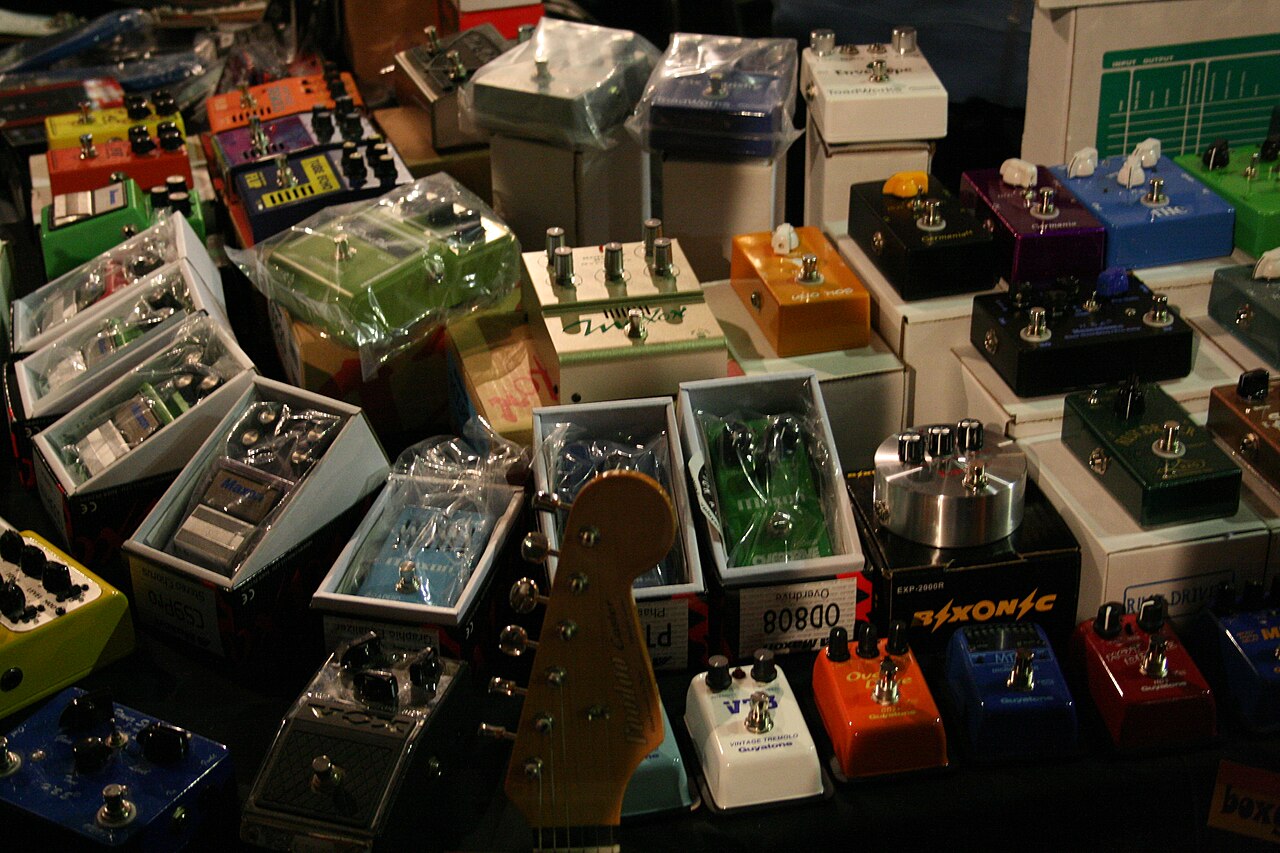
- Effects pedals piled together with a guitar behind them: Alessio Bragadini from Milan, Italy, Wikimedia Commons, CC BY-SA 2.0.
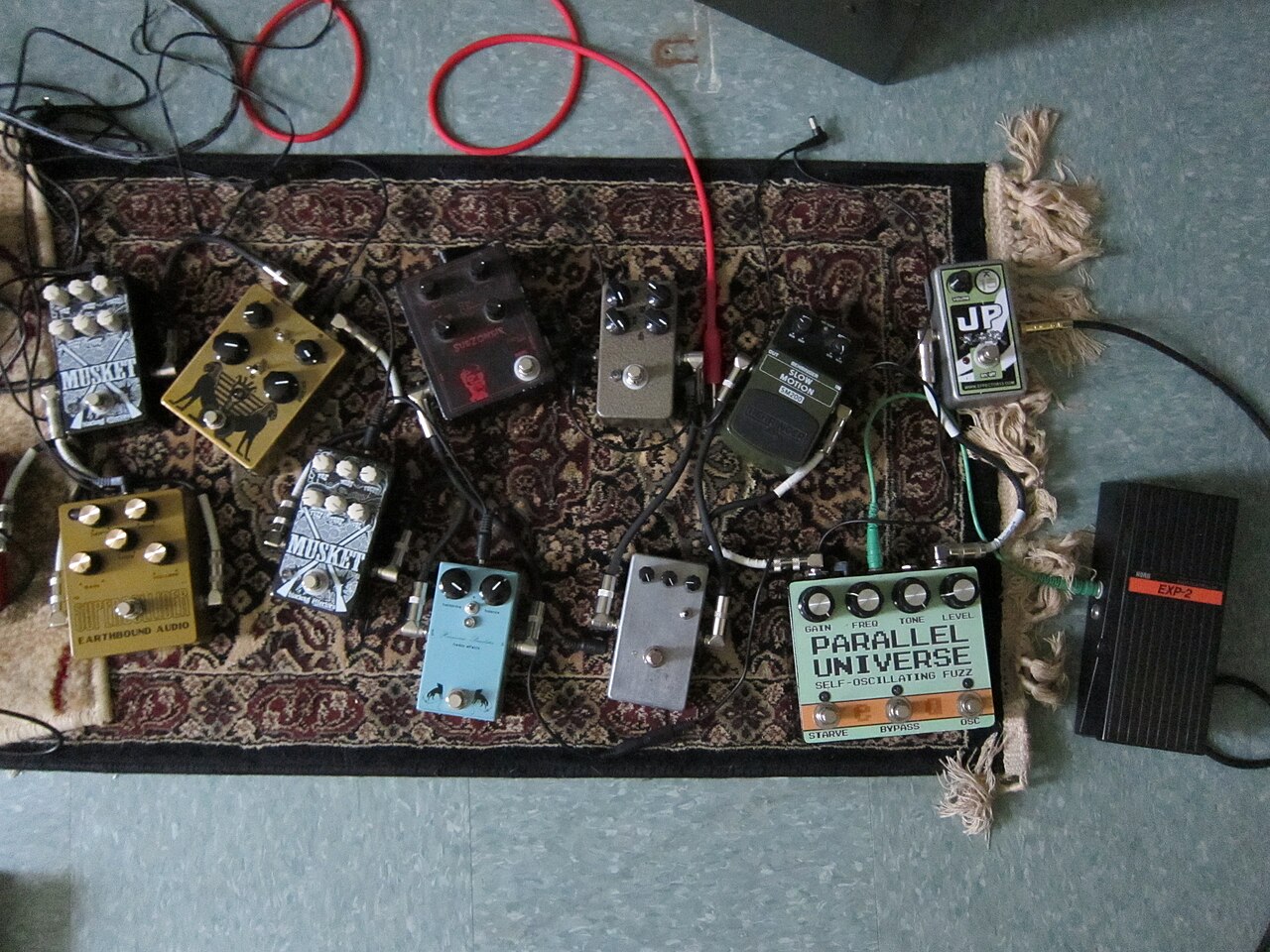
- Guitar pedals on a rug: Oldangelmidnight from Northampton, MA, Wikimedia Commons, CC BY-SA 2.0.
- J Mascis: Bene Riobó, Wikimedia Commons, CC BY-SA 3.0.
Latest News
Related


On This Day
Monday 9 November
From this week: