The $89 Pedal That Cracked the Klon Code: Electro-Harmonix Soul Food
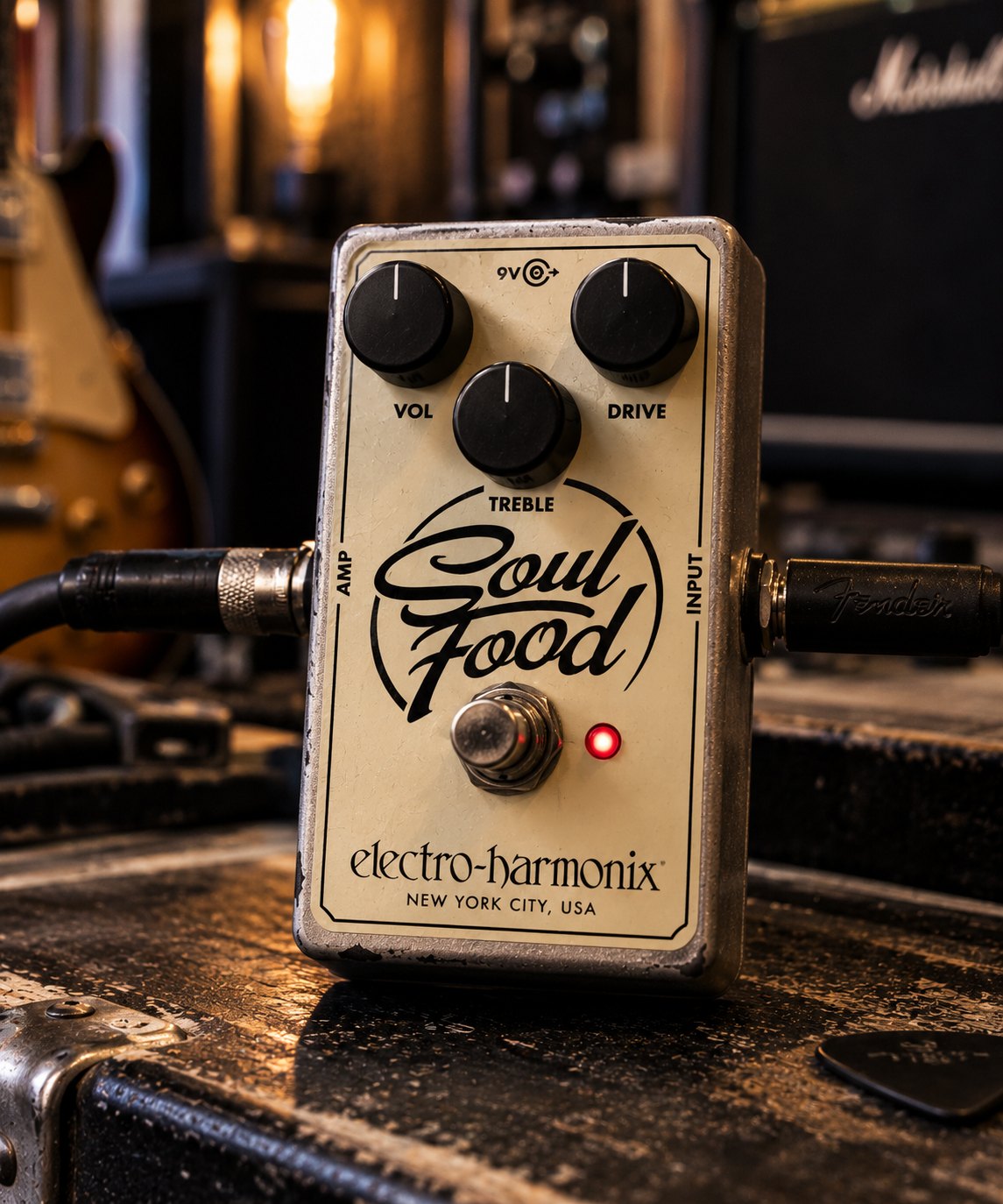
Electro-Harmonix Soul Food. AI-generated reference illustration, not a photograph.
The EHX Soul Food delivers Klon Centaur-inspired transparent overdrive at a fraction of the price. Specs, tone recipes, player profiles, and buying guide.
There is a special kind of madness that grips the guitar world every few years—a collective obsession with a pedal that most players will never touch, that costs more than some guitars, and that has spawned an entire subculture of clones, mods, and arguments. The Klon Centaur is the apex specimen of that madness. Built by hand in a Boston apartment from 1994 to 2008, roughly 8,000 units ever made, original examples now trading for north of two thousand dollars a pop. It became the most hyped overdrive pedal in history—not through advertising or endorsement deals, but through word of mouth among players who heard something genuinely different in it.
When Electro-Harmonix founder Mike Matthews tasked his engineering team to build an affordable version of that sound, the result was the Soul Food Transparent Overdrive, introduced in 2013 at a street price of sixty-six dollars. That proposition—Klon character for the price of sneakers, as Premier Guitar put it in their 2014 review—was either the most audacious act of democratization in pedal history or the most cynical piece of hype-surfing, depending on who you asked.
A decade later, the Soul Food has outsold the original Klon many times over. It sits on pedalboards from Melbourne to Manchester, from bedroom rigs to professional touring setups. It has spawned its own mods, its own debates, its own devoted community. And it retails today at $89, making it one of the most accessible transparent overdrives on the market. Whether it truly captures the Klon’s magic is a question every player has to answer for themselves—but what the Soul Food does with its particular analog circuit is genuinely worth understanding.
The Myth That Built a Market: Klon Centaur Origin Story
To understand the Soul Food, you need to understand what it is chasing, because the Klon Centaur is not just a pedal—it is a creation myth for the boutique effects industry. In the late 1980s, Bill Finnegan played guitar in Boston-area bands, plugging his Telecaster straight into a Fender Twin Reverb. On big stages where he could push the amp to volume six or seven, the thing sang. In smaller clubs at volume three or four, it sounded good but lacked the harmonic richness of a working amp. He tried a Tube Screamer TS9 and a TS808. Neither satisfied him. Both compressed too much, added midrange he did not like, and robbed the low end of its natural weight.
Between 1990 and 1994, Finnegan worked with MIT engineer Fred Fenning to design something completely different—an overdrive that would add the warmth and dynamics of a cranked amp without imposing its own character on the signal. Fenning, who died in a plane crash in the mid-1990s, received much of the credit for the technical execution. The key innovation was a clean blend circuit: rather than running the entire guitar signal through a clipping stage, the Centaur split the signal into a clean path and a distorted path, then recombined them. At low gain settings, the clean signal dominated, preserving the natural voice of the guitar and pickup. As gain increased, more of the overdriven signal was blended in. The result was an overdrive that added saturation without smothering dynamics or homogenizing the guitar’s character.
The op-amp was a TL072—a JFET-input dual op-amp with wide bandwidth and low noise. The clipping was handled by a pair of 1N34A germanium diodes, chosen specifically for their soft compression characteristic, which contributed to the Centaur’s warmth and touch sensitivity. An internal charge pump boosted the 9V supply to a higher internal operating voltage, providing headroom that most 9V pedals of the era could not match. Finnegan covered the entire circuit board in black epoxy, making the circuit impossible to clone without reverse-engineering—which eventually happened in 2008, the same year he discontinued the Centaur, having built approximately 8,000 units over fourteen years.
The used market went predictably insane. By 2013, when EHX introduced the Soul Food, original Centaurs were regularly trading for $1,500 to $2,000. Finnegan reissued the circuit as the Klon KTR in 2014—a surface-mount version of the same design in a smaller enclosure, street-priced around $269. But by then, the clone economy was already in full swing, and EHX had made its move.
EHX’s Answer: How the Soul Food Came to Be
Mike Matthews at Electro-Harmonix has always positioned the company as a democratizer—a builder of great tools for working musicians who cannot afford boutique prices. The Big Muff Pi brought fuzz to the masses in 1969. The Micro Synthesizer, the POG, the Memory Man—all landmark designs at prices that working musicians could actually reach. The Soul Food was a natural extension of that philosophy applied to the Klon phenomenon.
The EHX engineering team did not simply copy the Centaur. They studied it, understood its design principles, and built their own version with some deliberate differences. The TL072 op-amp is the same—a sound choice, given its JFET input stage, high slew rate, and wide bandwidth that contribute to the transparent character. The dual-gang Gain control is the same—a pot that simultaneously adjusts both the gain and the output level, making the two controls interactive in a way that single-gang pots cannot replicate. The internal boosted power rails are there, providing headroom well above what a simple 9V supply would allow.
The key difference is the clipping diodes. Where the Centaur used 1N34A germanium diodes—known for their soft, gradual compression and warmth—the Soul Food uses 1N914 silicon diodes. Silicon diodes clip harder and more abruptly than germanium, which gives the Soul Food a slightly brighter, more defined character at the top of its gain range. It is not a dramatic difference, and at low gain settings—where most players actually run transparent overdrives—the distinction is largely academic. But it is real, and it partly explains why the Soul Food sounds slightly brighter and a touch more forward in the upper midrange than original Centaur examples.
One addition that makes the Soul Food more practical than the original Klon is selectable bypass mode. A small switch on the enclosure allows you to choose between true bypass and buffered bypass. Buffered bypass means the pedal’s output buffer remains active even when the effect is disengaged, which can be genuinely useful in long signal chains where cable capacitance rolls off high frequencies. True bypass means the pedal is completely out of the signal path when off—which is what fuzz users generally want, since fuzz pedals depend on seeing the guitar pickup’s natural high impedance rather than a buffer’s low-impedance output. The Soul Food’s switchable bypass means you can have it both ways depending on your rig.
What Is Actually Inside: Circuit Anatomy
The clean blend architecture is the Soul Food’s defining technical feature, and understanding it explains most of what makes the pedal sound the way it does. When you plug your guitar into the input, the signal is split immediately into two parallel paths. One path goes to the clipping stage—the TL072 op-amp configured as an amplifier, with the 1N914 diodes in the feedback loop providing soft-clip limiting. The other path remains clean, preserving your guitar’s natural transient and frequency response. The Gain control mixes these two paths as it turns. At minimum gain, the clean path dominates and the pedal functions essentially as a clean boost. As you advance the Gain control, more of the clipped signal enters the blend until, at maximum, you have a fully saturated overdrive tone.
This is categorically different from how a Tube Screamer or a Blues Driver works. In those designs, the entire signal passes through the clipping stage. The TS rolls off bass before the clipping stage specifically to reduce intermodulation distortion, but this also reduces the weight and authority of the low end in the output. The Soul Food’s clean signal path preserves the full frequency response of your guitar through the clipping process—including the low end, which remains tight and defined even at high gain settings. This is why players describe it as sitting under the signal rather than on top of it.
The boosted power rails deserve a mention. Electro-Harmonix includes an internal voltage doubling or charge pump circuit that raises the internal operating voltage above the 9V supply. Higher internal voltage means more headroom before the op-amp clips in an uncontrolled way, which contributes to the open, uncompressed feel of the Soul Food’s clean and low-gain sounds. The effect is not dramatic, but it is audible—the pedal stays clear and defined under hard picking where a standard 9V circuit might start to sound strangled.
The Treble control is a simple high-frequency shelving filter at the output stage. It cuts brightness rather than boosting it, which means it can tame the slight brightness that the 1N914 silicon diodes add. Rolling the Treble back from noon is a common technique for players seeking a warmer, more Klon-like response, particularly when using the Soul Food with single-coil pickups that already have plenty of top-end character.
Specifications
Famous Players: Who Actually Uses the Soul Food
The Soul Food is a popular pedal at the grassroots level, which means it appears on a lot of pedalboards without always making it into formal Rig Rundown documentation. Here is what the primary sources actually confirm.
Tash Sultana — CONFIRMED (Primary Source: Premier Guitar, June 2017)
The most cleanly documented professional user of the Soul Food is Tash Sultana, the Australian multi-instrumentalist and loop-based one-person-band phenomenon. Premier Guitar’s gear list for Sultana, published in June 2017 and sourced directly from her setup, explicitly includes the Electro-Harmonix Soul Food Distortion/Fuzz/Overdrive Pedal. At that time, Sultana’s pedalboard was a sprawling setup of 39 pedals, including Boss loopers, TC Electronic reverbs, a Dunlop Cry Baby Mini Wah, and a Boss GE-7 EQ alongside the Soul Food. The function of the Soul Food in that rig was as a transparent gain stage—adding harmonic density and presence to the guitar signal in a context where the loop-based performance demanded that each guitar part retain maximum clarity and definition rather than getting buried in the mix.

The confirmation is solid: Premier Guitar’s direct gear documentation is primary-source evidence of the Soul Food’s use in a professional live context at serious scale.
Albert Hammond Jr. — Secondary Source (Equipboard / Social Media)
Albert Hammond Jr. of The Strokes has been connected to the Soul Food via social media posts and Equipboard documentation, though there is no Premier Guitar Rig Rundown or equivalent primary source confirming the specific pedal. His early-era Strokes pedalboard—the one that defined the sound of Is This It and Room on Fire—was famously minimal: a Visual Sound Jekyll & Hyde and an MXR Micro Amp were the core tools. The Soul Food, introduced in 2013, would represent a later addition to his setup, consistent with his continued refinement of his overdrive approach. This connection is plausible and documented at secondary-source level, but GuitarGangsters’ standard of primary-source verification is not met here, so Hammond is mentioned in this context with appropriate honesty rather than as a confirmed endorsement.

The Grassroots Reality
The Soul Food’s player roster is better understood at a categorical than individual level. It has been embraced by indie and alternative guitarists, singer-songwriters using loop-based performance rigs, worship guitarists seeking transparent boost/drive in a mix-friendly context, country players using it as a clean-boost alternative to a dedicated boost pedal, and progressive rock guitarists who want harmonic density without midrange coloring. Luke Reynolds of Guster and Dave Depper (Death Cab for Cutie) are documented via Equipboard, though without PG primary-source confirmation. The common thread across all these players is the same: they want an overdrive that amplifies their existing tone rather than replacing it, and they are working at price points where the original Klon is simply not a viable option.
Tone Recipes and Settings
Clean Boost / Signal Enhancer (Always-On Application)
DRIVE: 7 o’clock (minimum). VOL: 3 o’clock (boosted). TREBLE: noon. This setting pushes more signal into your amp’s input stage while adding a hair of harmonic complexity from the clean blend circuit. The result is an always-on tone enhancer that makes your base guitar sound bigger and more three-dimensional without adding audible distortion. Works especially well into tube amp clean channels to push them toward natural break-up. This is the setting Premier Guitar’s reviewer Jason Shadrick specifically highlighted: “the kind of tone shaping tool you can keep on all the time.”
Touch-Sensitive Edge-of-Breakup
DRIVE: 10 o’clock. VOL: 1 o’clock. TREBLE: 11 o’clock (slightly backed off). At this setting, the Soul Food sits right at the boundary between clean and broken, responding directly to pick attack. Light picking stays clean; dig in and the clipped signal rises in the blend, producing harmonic saturation that cleans up immediately when you ease off. Ideal for single-coil guitars into Fender-style amps where the natural amp compression is already working in your favor. Treble dialed back slightly tames single-coil brightness.
Mid-Gain Rock Lead
DRIVE: 1 o’clock. VOL: noon to 1 o’clock. TREBLE: noon. The PG review noted that at this setting, single-coil pickups produce “rich, harmonic overdrive tones… that evoked thoughts of Eric Johnson and vintage Larry Carlton.” The clean blend keeps the low end present and the pick attack articulate while the clipped signal adds upper-harmonic density. Use this setting for classic rock and blues lead work where you want to sound like a pushed amp rather than a high-gain pedal.
P-90 and Humbucker Drive
DRIVE: noon. VOL: 11 o’clock. TREBLE: 10 o’clock (backed off noticeably). Hotter pickups—P-90s and humbuckers—push the clipping stage harder at any given Drive setting, requiring a VOL reduction to maintain unity. The PG review specifically tested a Gibson SG Reissue with P-90s and found the Soul Food “a great match,” with the Treble backed off to tame the P-90’s sizzling top-end. This combination produces a “very big and robust” clean-to-crunch sound that works well for classic rock, garage, and blues-rock contexts.
High-Gain Lead for Hard Rock
DRIVE: 3 o’clock to maximum. VOL: 10 o’clock. TREBLE: 1 o’clock. At maximum Drive, the PG reviewer described the output as “both saturated and full of blossoming harmonics—a perfect tone for hot hard rock lead tones.” Note that the interactive dual-gang Gain control means the output level drops as Drive rises, requiring a VOL compensation. The Silicon 1N914 diodes give this setting a slightly harder, more defined character than the Klon’s germanium clipping—arguably more aggressive, which suits heavy rock applications.
Buffer-Mode Tone Preservation (Signal Chain Utility)
DRIVE: 7 o’clock (minimum). VOL: noon (unity). TREBLE: noon. Bypass switch set to buffered. With effect disengaged and bypass set to buffered, the Soul Food acts as a transparent buffer for long cable runs or complex switching systems. Switch it on to add the clean boost above. This dual-function use—passive buffer in bypass, transparent boost when engaged—makes the Soul Food a particularly efficient pedalboard tool.
The Soul Food responds differently at different gain levels, and understanding those zones makes the pedal dramatically more useful than simply setting all controls at noon and hoping for the best.
Soul Food vs. The Competition: Where It Fits
The Soul Food exists in a specific segment of the overdrive market defined by the pursuit of transparency—the quality of enhancing your tone without imposing a strong character of its own. Understanding how it compares to its natural competitors clarifies when it is the right choice and when something else might serve you better.
Against the Ibanez TS9 Tube Screamer, the Soul Food represents a fundamentally different design philosophy. The TS9 colors aggressively—bass rolled off before the clipping stage, JRC4558 or RC4558 op-amp imparting a characteristic mid-forward voice, 1N914 silicon diodes clipping the entire signal. The result is warm, focused, and famously useful for pushing tube amps into compression. But it is not transparent. The Soul Food’s clean blend means your guitar’s fundamental character—the weight of its bass, the sparkle of its treble, the pick attack of its strings—comes through the drive stage intact. If you want your tone enhanced, not transformed, the Soul Food wins. If you want the Tube Screamer’s specific midrange push and compression, it does not.
Against the Boss BD-2 Blues Driver, the Soul Food is quieter, more polished, and more predictable but less harmonically complex. The BD-2’s asymmetrical clipping produces a bluesy, slightly ragged character that many players find more organic and three-dimensional. The Soul Food is cleaner and more refined—better for players who need pristine clean boost with optional saturation, not necessarily better for players who want the BD-2’s specific raw character. These are different tools making different sonic choices.
Against the Klon KTR—Bill Finnegan’s own modern reissue at around $269 street—the Soul Food is approximately three times cheaper and uses silicon rather than germanium diodes. In blind tests, the differences are subtle enough that trained ears regularly disagree about which is which at low gain settings. At higher gain settings, the silicon diodes’ harder clipping becomes more audible, and the KTR’s germanium compression is noticeable. For most players running the pedal as a clean boost or light overdrive, the $180 price difference is very difficult to justify on sonic grounds alone. The KTR is a legitimate piece of history and a precision instrument; the Soul Food is the democratized version of the same idea.
Within the EHX lineup, the Hot Wax pedal combines a Soul Food and a Hot Tubes overdrive in a single enclosure with individual bypass switching and an interaction switch, at around $149. If you want the Soul Food as one stage of a two-stage drive system, the Hot Wax is more efficient. The Bass Soul Food is the low-frequency-optimized version, with modified frequency response for four-string applications.
Buying Guide: New, Used, and What to Look For
The Soul Food is a current production EHX model and widely available from authorized dealers. The “New Low Price!” branding on the EHX website reflects a price reduction to $89 MSRP from earlier pricing. Street price in 2026 runs from approximately $79 to $89 new. Used examples in excellent condition typically trade between $40 and $60—making the Soul Food one of the better-value used-market pickups in the transparent overdrive category.
There are no significant variant or revision considerations to worry about. The Soul Food has been consistent in its design since 2013, and the current production version is the same circuit with the same controls. The “Meat & 3” JHS Pedals modification—which adds a germanium diode option and other voicings—is a popular aftermarket mod that brings the pedal closer to Klon Centaur character. Monte Allums’ “Son of Klon” mod similarly replaces the silicon 1N914 diodes with germanium types. If you buy used, verify that the bypass switch (true/buffered selector) moves cleanly between positions, that all three pots turn smoothly with no crackling, and that the LED illuminates cleanly on engagement. The enclosure is sturdy die-cast construction and can absorb significant road wear.
For power, the included 9.6VDC-200mA adapter is recommended. A 9V battery is optional and not included. Any standard center-negative 9V isolated supply at minimum 22mA will power the Soul Food correctly on a multi-pedal power unit.
Ownership Notes: Living With the Soul Food
The most important thing to understand about the Soul Food’s place on a pedalboard is that it rewards placement and always-on use. Run it as a clean boost that is rarely switched off, and it becomes part of your base tone rather than an effect you reach for. Run it at minimum Drive with Volume pushed, and you get the best of what transparent overdrive design can do: your guitar sounds like itself, only more. This is the application that Premier Guitar’s reviewer flagged as the pedal’s “real magic.”
The dual-gang Gain control’s interactive nature takes some acclimatization. Because Volume and Drive are mechanically linked on the same pot shaft, turning Drive down also reduces output level. This means the Drive knob is not just a gain control—it sets the character of the drive while simultaneously adjusting output, requiring a VOL readjustment whenever Drive is changed. Once you understand this, the control makes sense as a blend ratio between clean and driven signals. Before you understand it, the seemingly unpredictable relationship between Drive and output level can be confusing.
The Treble control is subtle in the low-to-mid range and more audible near its maximum. Most players find the useful range between 9 o’clock and 2 o’clock. The PG review noted that the Treble can become “a bit shrill near the higher end of the spectrum,” which is consistent with the 1N914 silicon diodes’ inherent brightness. If you are using single-coil pickups, keep Treble at or slightly below noon. Humbucker users may push it slightly higher to compensate for the darker pickup character.
Buffer mode is genuinely useful and underutilized. If you are running the Soul Food at the start of a long pedalboard chain—before delays, reverbs, and modulation—engaging buffered bypass means the Soul Food’s output buffer drives the rest of the chain even when the overdrive itself is off. This reduces the tonal degradation that long cable runs and multiple buffered/true bypass transitions can cause. If you run a vintage germanium fuzz pedal, however, put the fuzz before the Soul Food or set the bypass to true—a fuzz pedal needs to see the pickup’s high impedance source, not a buffer’s low-impedance output.
Frequently Asked Questions
Is the Soul Food actually a Klon Centaur clone?
Not exactly. EHX designed their own circuit inspired by the Klon’s architecture rather than copying the Klon’s schematic. Both use a TL072 op-amp and a clean blend circuit, but the Soul Food uses 1N914 silicon diodes where the Klon used 1N34A germanium diodes. The design philosophy is the same; the components make subtle but real sonic differences. EHX describes it as “inspired by” rather than a copy.
Is the Soul Food good for metal and high-gain styles?
It can generate high-gain tones at maximum Drive, but it is not a metal overdrive. The clean blend circuit preserves dynamics and note definition in ways that high-gain metal typically wants compressed and tight. For metal applications, a dedicated high-gain overdrive or distortion—BOSS DS-1, ProCo RAT, or a drive pedal designed for that purpose—will serve better. The Soul Food’s strength is at low-to-mid gain.
What is the difference between the Soul Food and the Klon KTR?
The KTR is Bill Finnegan’s own current production reissue of the Klon Centaur circuit in a smaller surface-mount enclosure, priced around $269. It uses the same TL072 op-amp but with germanium 1N34A diodes—the component that contributes the Klon’s characteristic warmth and soft compression at the clipping stage. The Soul Food uses 1N914 silicon diodes, giving slightly harder, brighter clipping at high gain. At low gain, the difference is subtle in blind tests. At high gain, the KTR is warmer; the Soul Food is brighter and more defined.
Can the Soul Food work as a clean boost?
Yes, and this is arguably its best application. With Drive at minimum, the VOL control lets you push more signal into your amp without adding any visible clipping, while the boosted power rails provide clean headroom well above 9V operation. The result is a clean boost that preserves your guitar’s full frequency response and natural character—no mid-hump, no bass rolloff, no coloring. Premier Guitar’s review described it as producing “more volume with less breakup” at minimum Drive, making it useful for solo level boosts and always-on enhancement simultaneously.
True bypass or buffered—which should I use?
Use buffered bypass if you have a long cable run between guitar and pedals, or a complex switching rig where signal degradation is a concern. The Soul Food’s buffer is transparent and musically beneficial in those contexts. Use true bypass if you run vintage germanium fuzz pedals before or after the Soul Food, or if you already have a dedicated buffer elsewhere in your chain. The switchable design means you never have to choose permanently.
Does the Soul Food stack well with other overdrives?
Very well. Because it preserves rather than colors, it functions effectively both before and after other overdrives. Running the Soul Food before a Tube Screamer pushes the TS’s drive stage harder while maintaining low-end weight. Running the TS before the Soul Food and using the Soul Food as a final boost preserves the TS’s character while adding level and presence. Experimenters have found useful combinations of the Soul Food with the Boss BD-2 Blues Driver, the TS9, and higher-gain pedals where the Soul Food functions as a pre-drive tone shaper.
Why does the output change when I adjust the Drive knob?
The Soul Food uses a dual-gang Gain control—a single potentiometer with two separate wiper tracks that simultaneously adjusts both the amount of signal going into the clipping stage and the output level. This is the same design as the Klon Centaur’s original control, and it is deliberate: it creates a more interactive, organic response between gain and output that single-gang pots cannot replicate. The trade-off is that changing Drive always requires a VOL readjustment. Once you understand this relationship, it becomes intuitive—but it is initially confusing for players expecting independent controls.
How does the Soul Food compare to other EHX overdrives?
EHX makes several overdrives with distinct characters. The OD Glove is a MOSFET-based overdrive with a harder clipping character—more like a classic British overdrive. The East River Drive is EHX’s take on the Tube Screamer topology—midrange-forward and amp-pushing. The Hot Wax combines a Soul Food with a Hot Tubes overdrive for a two-stage drive option. The Soul Food is the most transparent of the current EHX lineup—the one to choose when you want your guitar to sound like itself, only pushed.
Image credits
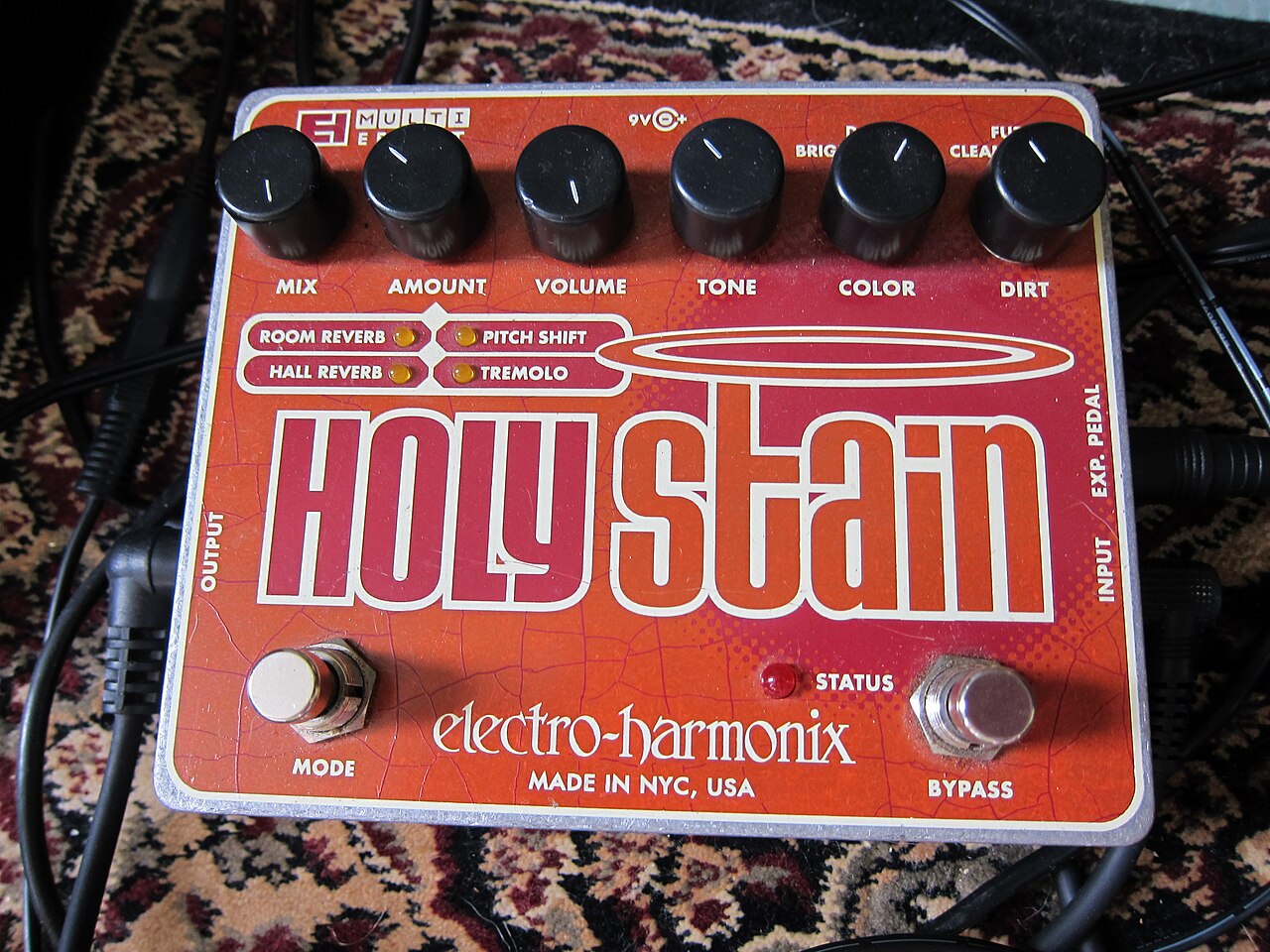
- An Electro-Harmonix Holy Stain pedal: Oldangelmidnight from Northampton, MA, Wikimedia Commons, CC BY-SA 2.0.
- Top image: GuitarGangsters AI-generated reference illustration, not a photograph.
- Tash Sultana: Ben McFadyen, Wikimedia Commons, CC BY-SA 4.0.
- Albert Hammond Jr.: Eric Farias, Wikimedia Commons, CC BY 2.0.
Latest News
Related
On This Day
Monday 9 November
From this week: