Stevie Ray Vaughan Gear and Tone: Number One, Vibroverbs, Tube Screamers and Texas Fire
Complete gear guide to Stevie Ray Vaughan — Number One from Christopher Cross trade-in, .013 strings, Dumble amp, Tube Screamer boost, Hendrix's V846 wah, and the guitarist who saved the blues.
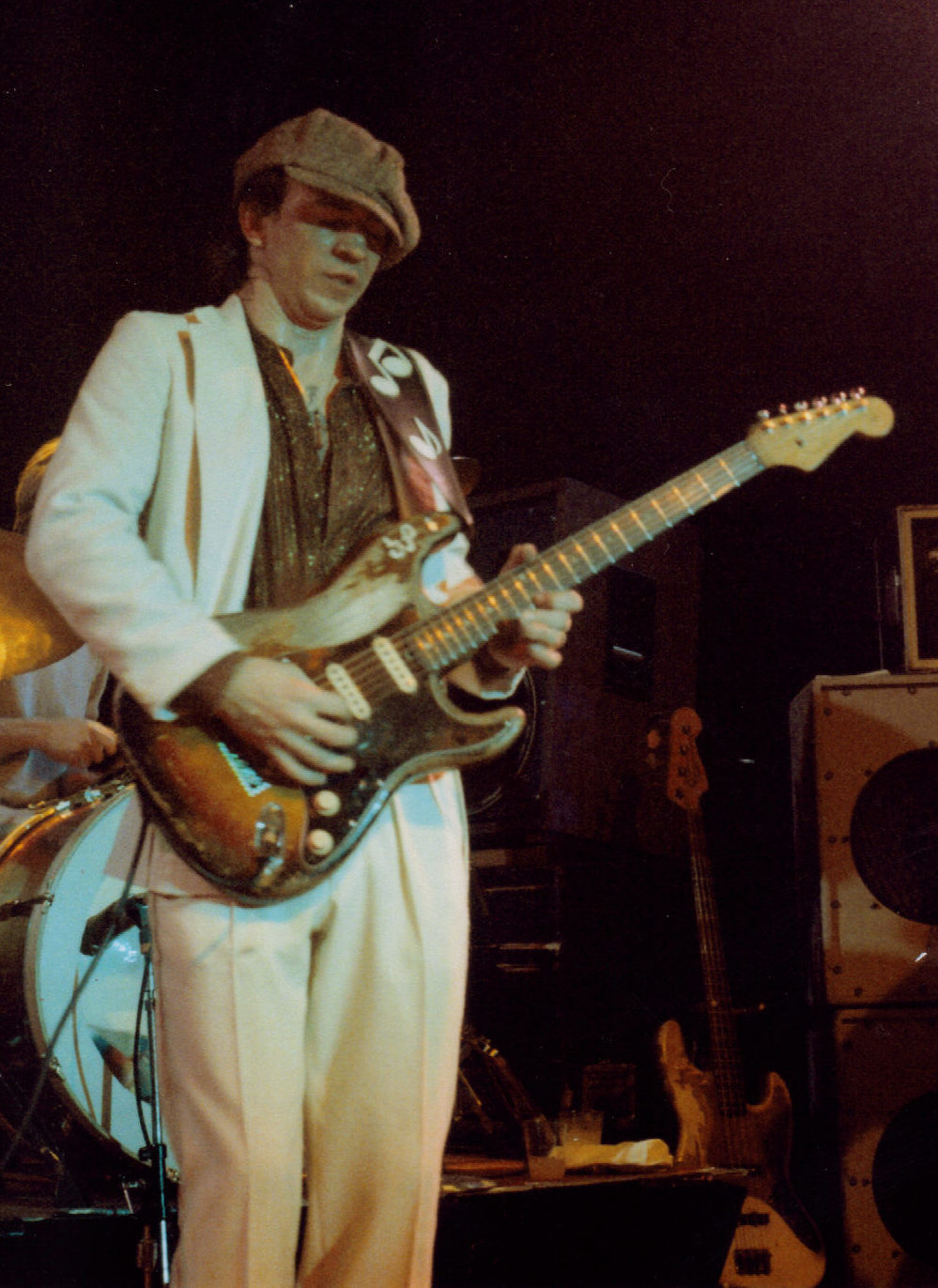
Bob Bissett / Wikimedia Commons / CC BY-SA 4.0
Christopher Cross traded it in. He called it a piece of junk.
Ray Hennig — the owner of Heart of Texas Music on South Lamar in Austin — received the battered sunburst Stratocaster from the soft-rock singer who would later win five Grammys for “Sailing” and “Arthur’s Theme.” Cross didn’t want it. In 1973, Hennig gave it to the seventeen-year-old Stevie Vaughan, who walked into the store. “That’s how he got it,” Hennig confirmed.
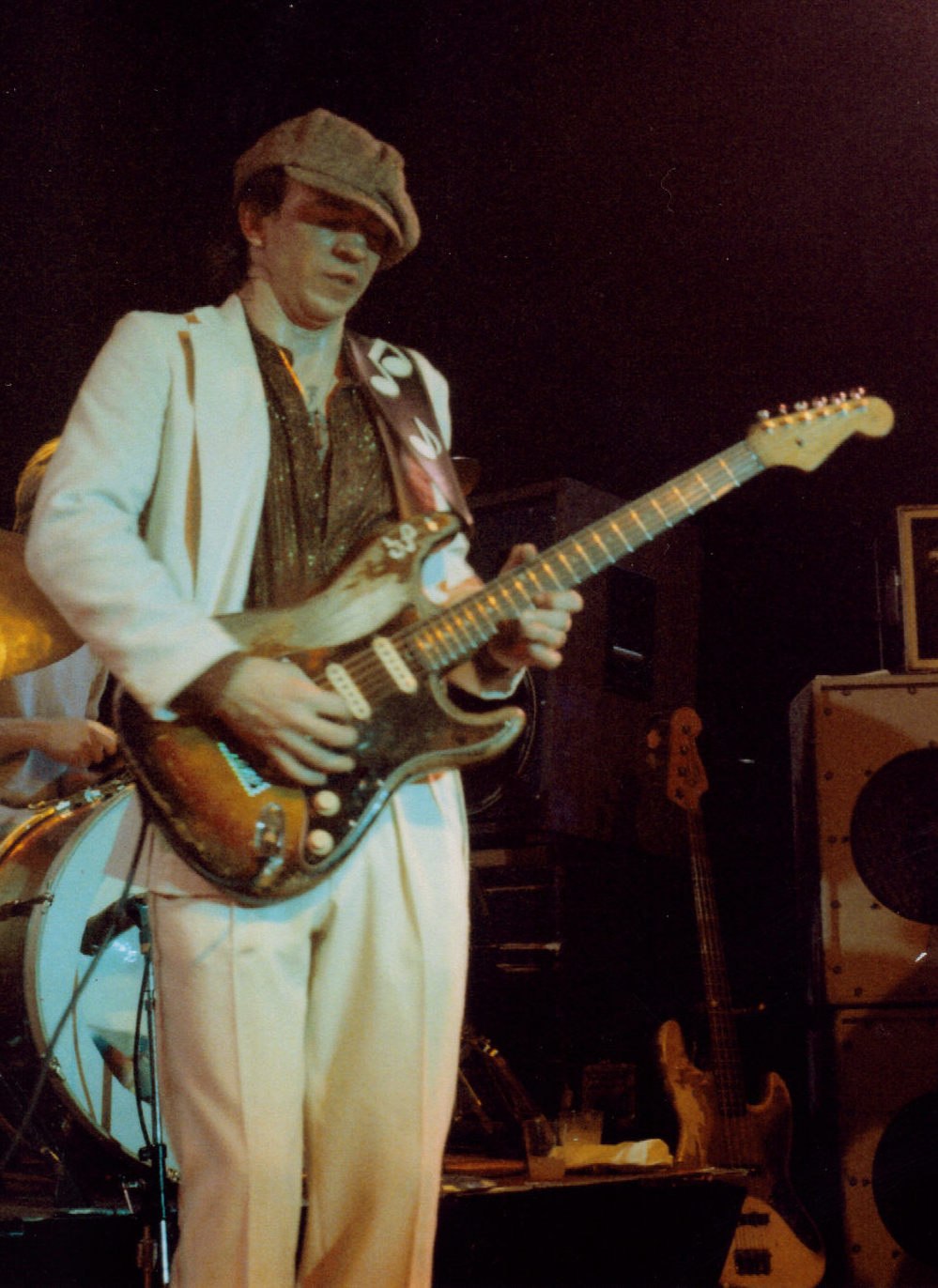
That guitar — eventually identified as having a 1963 body and a 1962 neck — would become Number One. Also known as “First Wife.” The most famous battered Stratocaster in rock history. Rebuilt more times than a custom Chevy. The guitar that Stevie Ray Vaughan played on all five of his studio albums, at Montreux and the Fillmore and Austin City Limits, and that he described as feeling like a part of himself.
The cigarette burn on the headstock came from leaving a burning cigarette tucked under the sixth string for too long while playing. The guitar has a left-handed bridge assembly mounted for right-handed use, so the tremolo arm sat above the strings. The frets are Gibson jumbo bass frets — Vaughan replaced Fender’s stock frets because he said he couldn’t grab onto the strings without them. The pickups are 1959 originals.
He strung it with GHS Nickel Rockers .013-.058. In standard tuning, tuned down a half step to Eb. The same tuning as Hendrix — whose playing was the primary influence — but with strings so heavy that most players can’t bend them at all, let alone the extreme bends SRV performed nightly.
He died August 27, 1990, at age thirty-five, in a helicopter crash following a concert at Alpine Valley Music Theatre in Wisconsin. He had been sober for nearly three years. He had just played a set in which he shared the stage with Eric Clapton, Robert Cray, Buddy Guy, and Jimmie Vaughan. By common consent, he had played the best set of the night.
Christopher Cross called it a piece of junk. Number One is now in the possession of his brother Jimmie Vaughan. It is one of the most precious objects in the history of American music.
Background: Dallas, Austin, Montreux, and the Blues Revival
Stephen Ray Vaughan was born October 3, 1954, in Dallas, Texas. His older brother Jimmie — who would become a celebrated blues guitarist in his own right, with the Fabulous Thunderbirds — was the first musician in the family, and it was Jimmie’s guitar playing and record collection that gave Stevie his initial musical education. His first electric guitar was inherited from Jimmie.
He began playing professionally in Dallas clubs in his early teens, dropped out of high school, and moved to Austin in 1972 — where the Texas club scene provided constant work and an environment that nurtured his development. Austin in the 1970s was a specific musical ecosystem: Albert King, B.B. King, Buddy Guy, and Muddy Waters all played regularly, and the young SRV absorbed directly from them in club settings.
His early influences: Jimi Hendrix above all, then Albert King (the specific left-hand technique, the wide string bends, the emotional directness), Buddy Guy, B.B. King, Freddie King, and T-Bone Walker. The specific synthesis — Hendrix’s psychedelic aggression, Albert King’s bending vocabulary, the Texas shuffle tradition — produced something that was simultaneously rooted in tradition and completely original.
The breakthrough came at the Montreux Jazz Festival in July 1982. Double Trouble (Vaughan, bassist Tommy Shannon, drummer Chris Layton) played on a stage where they weren’t expected and weren’t welcomed. The conservative Montreux audience booed. Vaughan played anyway — harder and better, if anything, for the adversity. David Bowie saw the performance and hired him to play on Let’s Dance. Jackson Browne offered him free studio time. John Hammond signed him to Epic Records. Texas Flood followed in 1983. The blues revival that SRV catalyzed — bringing the blues back to mainstream commercial radio and arena stages — is one of the most significant cultural events in American music of the 1980s.
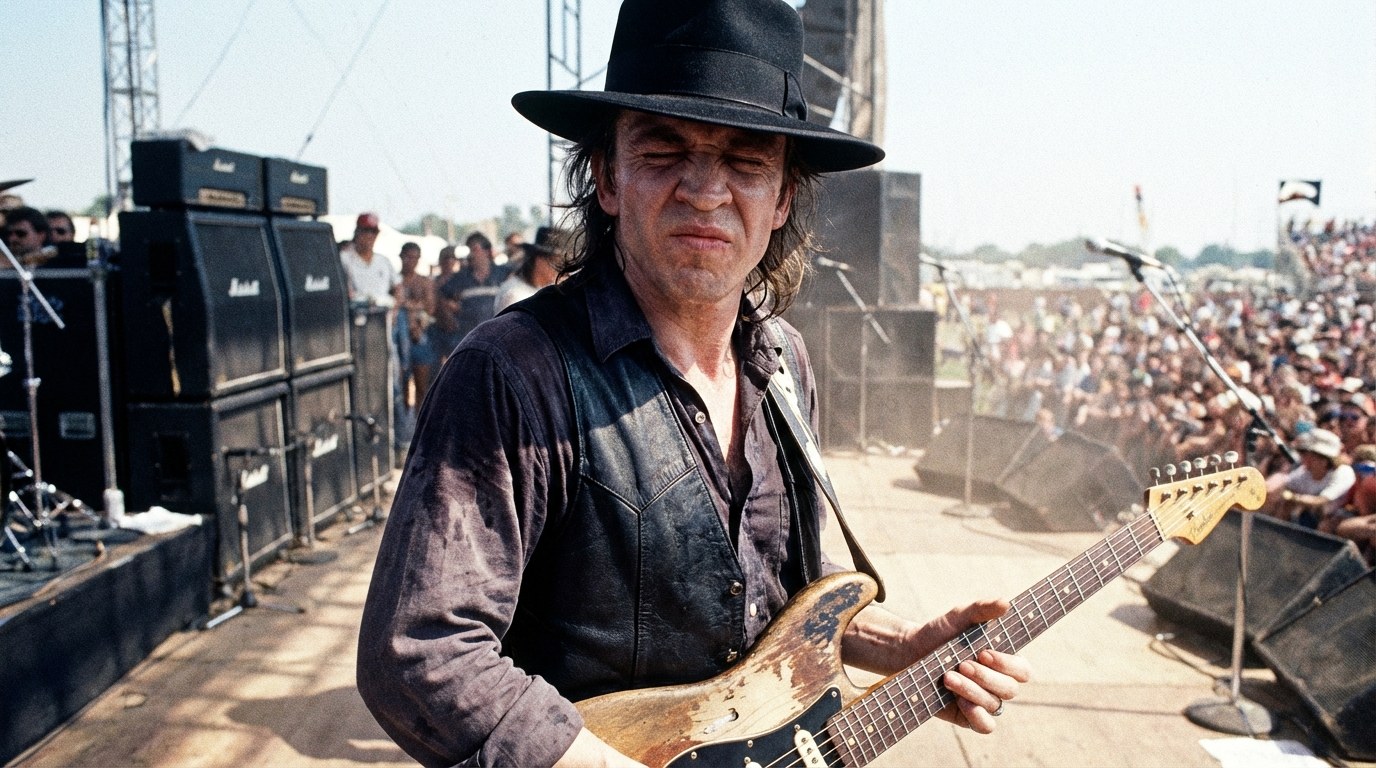
Tone note: “The Stratocaster can handle anything I manage to throw at it.” This is SRV’s complete guitar philosophy in one sentence. He threw everything he had at those guitars — .013 strings, Gibson jumbo bass frets, left-handed bridge assemblies, massive bends, extreme vibrato, maximum volume — and the Stratocaster handled it. He treated the guitar as a vehicle for maximum physical expression and expected it to survive. They did, though barely. Number One was rebuilt more times than a custom Chevy. The guitar endured because it was exactly right for what he needed to do.
The Rig: Stevie Ray Vaughan’s Guitars, Amps & Gear
Guitars: A Family of Stratocasters
Number One (“First Wife”) — The Primary
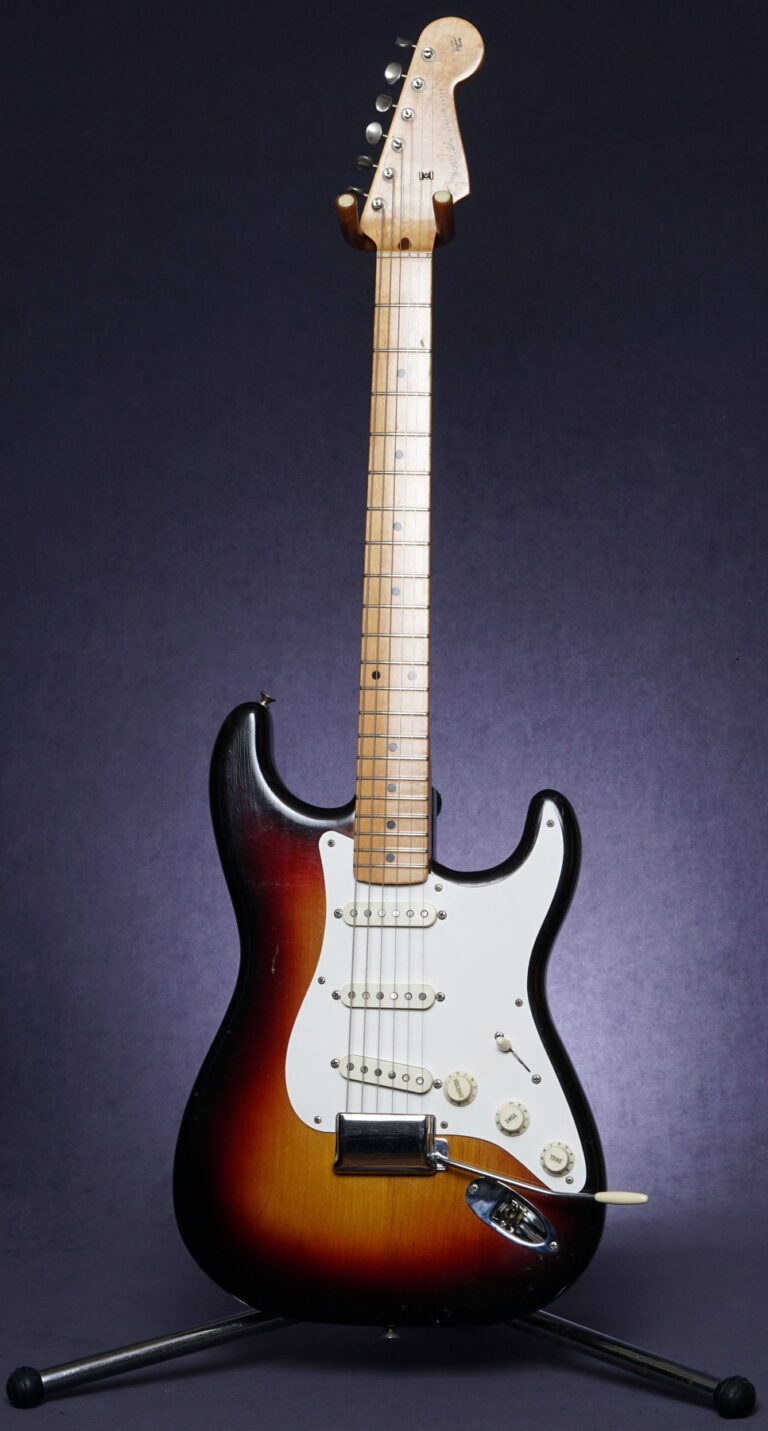
Number One is a hybrid Stratocaster: the body dates to 1963, the neck to 1962, assembled from mismatched parts into the instrument that Rene Martinez — his guitar tech from 1980 until his death — would maintain, modify, and rebuild repeatedly over seventeen years. Vaughan always claimed it was a 1959 model, because that year was written on the back of the original pickups. Ray Hennig gave it to him in 1973 from his Austin music store after receiving it in trade from Christopher Cross.

The key modifications that made Number One specifically SRV’s guitar:
- Left-handed bridge assembly: A left-handed Stratocaster tremolo bridge mounted for right-handed use. Vaughan made this modification after seeing Jimi Hendrix use the same configuration. “I like it better, it just makes more sense to me. You don’t have to really hold on to it. It’s right there.” The left-handed bridge placed the tremolo arm above the strings in a more accessible position for his specific playing approach
- Gibson jumbo bass frets: Vaughan replaced Fender’s stock frets with Gibson jumbo bass frets — much larger than any standard guitar fret. “I don’t like Fender frets. I just can’t grab onto the strings. The frets just aren’t big enough for me to be able to get into it at all, so I use Gibson Jumbo Bass frets. If I didn’t, I’d wear ’em out in no time.” The larger frets allowed the extreme string bending his technique required without the strings falling off the fretboard
- 1959 original pickups: The original 1959 pickups that were dated on the back were the specific component Vaughan protected most fiercely. When the neck was replaced during touring, he preserved these pickups. The specific character of the late-1950s Stratocaster single-coil — wound to the original specifications, with A5 magnets — is distinctly different from later production pickups
- SRV sticker on the pickguard
- Cigarette burn on the headstock: Left accidentally from a cigarette tucked under the sixth string during playing. Not a modification but a documented feature
- Schaller Elite Gold tuning pegs
The neck’s history is particularly dramatic. The original neck’s fingerboard radius was originally 7.25 inches — the standard vintage Stratocaster radius — which gradually flattened to 10 inches over countless refret jobs done by Rene Martinez using Dunlop 6100 fretwire. By 1989, the neck could no longer sustain more refret jobs and was replaced by the neck from his red Stratocaster. Then, at a show in Holmdel, New Jersey, a stanchion fell onto Vaughan’s rack of guitars and split that replacement neck. After his death, the original Number One neck was reinstalled. Number One is currently in the possession of his brother Jimmie Vaughan.
Lenny — The Birthday Guitar
The story of Lenny is one of the great guitar gift stories in rock history. In 1980, Vaughan came across a 1965 Stratocaster in a Texas pawnshop. Though the pickups had been damaged by time and the guitar had been sloppily refinished, something about it resonated with the struggling artist. Vaughan’s wife Lenora pooled together $50 from seven of Vaughan’s friends to meet the $350 asking price, and presented the guitar to him on his birthday. Vaughan was so moved by the gift that he played the guitar all night and wrote a song for his wife, playing it for her when she woke up the next morning. The song and the guitar were both named “Lenny” — Lenora’s nickname.
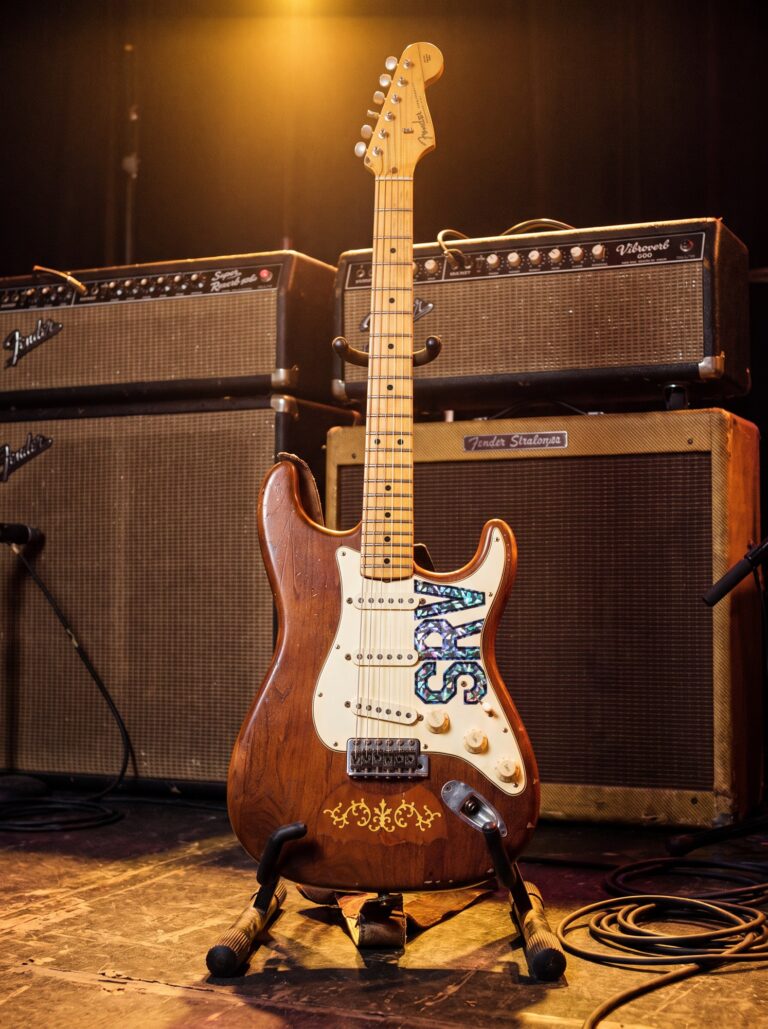
Originally 3-tone sunburst with a rosewood neck, Lenny was later stripped to a dark natural finish and refitted with a mid-1950s maple neck reportedly given to Vaughan by Billy Gibbons. Behind the bridge, on the lower bout of the body, is a unique inlay thought to be originally from an early 1900s mandolin. Vaughan used Lenny for softer, more lyrical tones — “Riviera Paradise” and the song “Lenny” itself. Lenny was auctioned after his death for over $600,000.
Scotch — The Butterscotch Stratocaster (Last Five Years)
Scotch is a 1961 Fender Stratocaster that Vaughan acquired in the fall of 1985 — originally intended as a prize at one of his shows, but Stevie liked it so much that he kept it and gave away a different guitar instead. The butterscotch-colored Strat had a non-original tiger-striped pickguard made by Rene Martinez (resembling Buddy Guy’s pickguard on his butter-colored guitar), and the distinctive SRV prismatic stickers. Vaughan used Scotch for the last five years of his life, often for “Leave My Girl Alone” and “Superstition,” and it appears on the Live Alive album cover with its original white pickguard.
Charley — The Custom Stratocaster
Charley was a custom Stratocaster-style “hardtail” (non-tremolo, fixed bridge) guitar built by Charley Wirz — the owner of Charley’s Guitar Shop in Dallas and a close friend of Vaughan’s. Wirz built it in late 1983 and placed a neck plate engraved “To Stevie Ray Vaughan, more in ’84.” It had a white body, rosewood neck, two controls (volume and tone), and three Danelectro lipstick pickups — an unusual choice that gave the guitar a specific bright, cutting character different from the Stratocaster pickups. On the back of the body was a hula girl sticker. Vaughan often used Charley during “Life Without You,” which was itself said to be written as a tribute to Charley Wirz. Wirz is the person for whom the song was ultimately named.
Hamiltone (“The Main” / “Couldn’t Stand the Weather Guitar”)
The Hamiltone was a custom Stratocaster-style guitar made for Vaughan by James Hamilton in Buffalo, NY, and presented to him on April 29, 1984, as a gift from ZZ Top’s Billy Gibbons. It features a neck-through-body design (unique among Vaughan’s guitars), a two-piece maple body, and an ebony fretboard inlaid with “Stevie Ray Vaughan” in mother-of-pearl. Originally equipped with EMG preamped pickups, Vaughan didn’t like the sound and had them replaced. It was used for the “Couldn’t Stand the Weather” music video — Vaughan didn’t want to risk getting Number One wet during filming.
Other Key Guitars
- “Yellow” — 1958/1959 Stratocaster (stolen 1985) — Stolen at Albany International Airport in 1985; never recovered
- “Red” — 1962 Stratocaster (repainted fiesta red) — Purchased from Charley’s Guitar Shop in late 1983; repainted by Fender in fiesta red; its neck later replaced Number One’s damaged original neck
- Epiphone Riviera (1963) — Semi-hollow for warmer, jazzier tones on specific passages
- Gibson ES-335 — Occasional use for specific tonal applications
- Tokai Stratocasters (×5, 1985 endorsement) — Stevie signed an endorsement deal with Tokai in 1985
- National Duolian resonator (1930s) — Acoustic slide and specific blues passages
- Guild JF65-12 12-string acoustic — Acoustic work
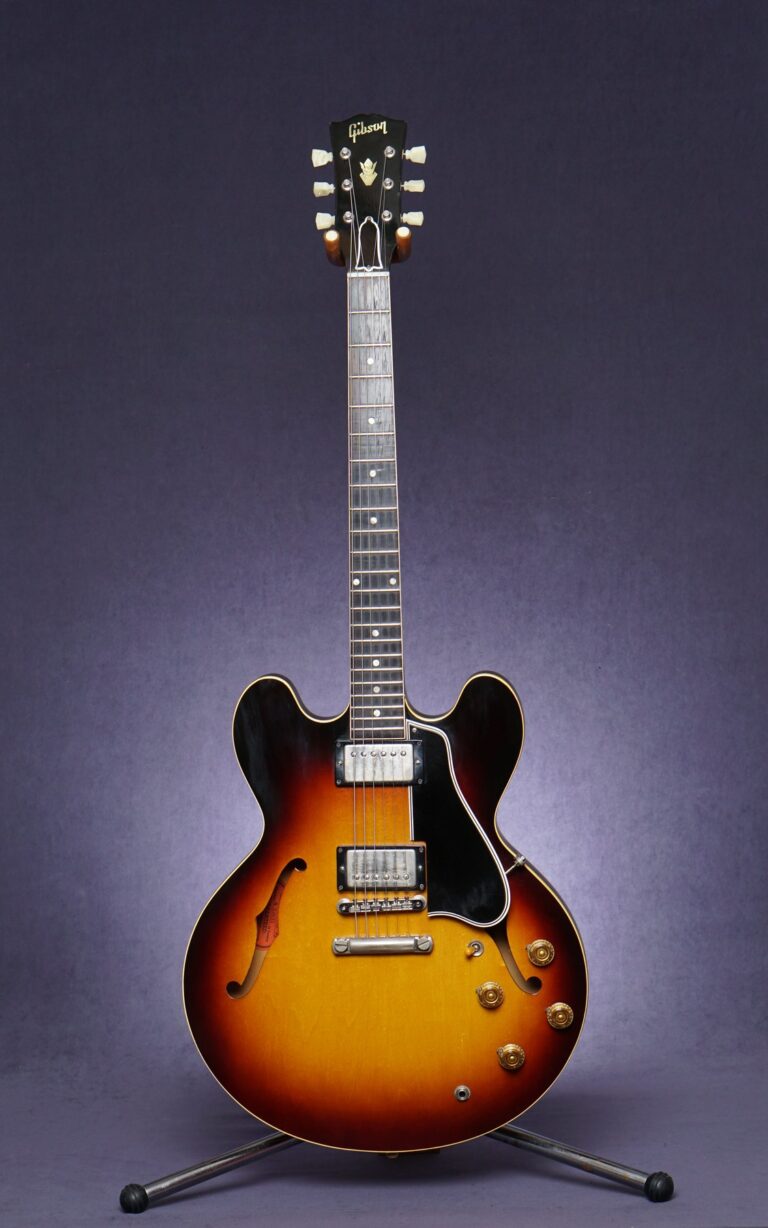
Complete Guitar List (Key Instruments)
- Number One (“First Wife,” 1962-63 Strat hybrid) — Primary; ex-Christopher Cross trade-in; left-handed bridge; Gibson jumbo bass frets; 1959 pickups; cigarette burn; currently with Jimmie Vaughan
- Lenny (1965 Strat, natural finish, Billy Gibbons maple neck) — Birthday gift from wife; “Lenny” song; “Riviera Paradise”; auctioned $600,000+
- Scotch (1961 Strat, butterscotch) — Last five years; Rene Martinez tiger-striped pickguard; “Leave My Girl Alone,” “Superstition”
- Charley (custom hardtail, Danelectro lipstick pickups) — Charley Wirz build; hula girl sticker; “Life Without You”
- Hamiltone (“The Main,” neck-through, EMG replaced) — Gift from Billy Gibbons; ebony board; “Couldn’t Stand the Weather” video
- Yellow (1958/59 Strat, stolen 1985) — Never recovered
- Red (1962 Strat, fiesta red) — Neck later went into Number One
Amps: Fenders for Distortion, Marshall for Clarity
Vaughan’s amplifier philosophy was uniquely stated: “I use the Fenders for distortion and the Marshall for clarity.” This is the complete reversal of conventional wisdom — usually Fenders are clean and Marshalls drive. He used his vintage Fenders pushed hard into natural saturation while relying on the Marshall’s higher headroom for more articulate, present clean tones.
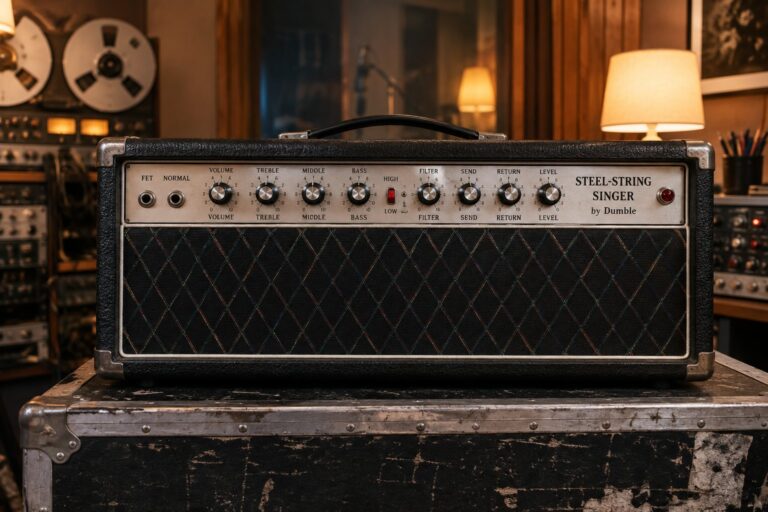
Dumble Steel String Singer — The Late-Career Primary
The Dumble Steel String Singer — the same amplifier that Lowell George had championed — became SRV’s primary amplifier in his later career. Howard Dumble built only a handful of these amplifiers, and they became synonymous with the “best clean tone possible” — transparent, extended, responsive to every nuance of the player’s touch. Vaughan’s Dumble head became the centerpiece of his studio and touring rig, particularly from Texas Flood onward.
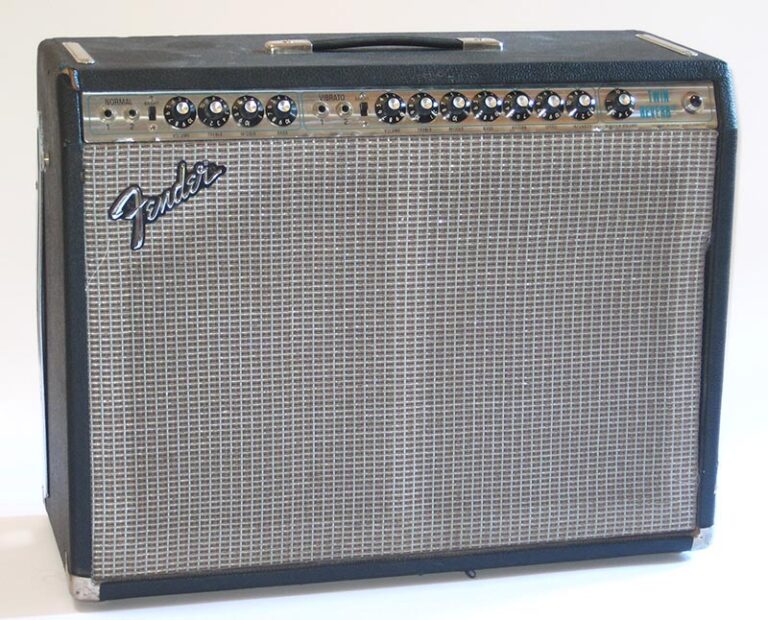
For his 1985 Japan tour, Vaughan used a pair of Fender Twin Reverbs in place of his Dumble Steel String Singer head — a mid-1960s 85-watt blackface model and a late-1970s 100-watt silverface with master volume. The Twins disappeared from his rig after that tour and briefly returned in 1987.
Fender Super Reverb (4×10, Blackface) — The Club/Studio Primary
Before and alongside the Dumble, Vaughan’s working amp was the Fender Super Reverb — the 4×10 combo that had also served Lowell George, producing a wide, punchy sound with the natural tube saturation that Vaughan described as “distortion.” He favored 1960s blackface Super Reverbs, and used them throughout his career for both studio recording and live performance.
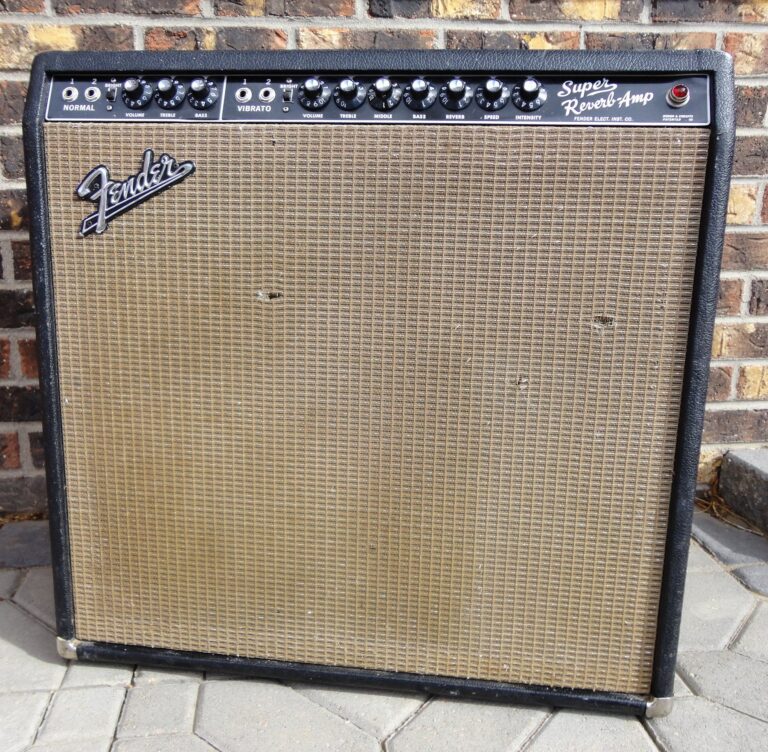
The Super Reverb’s four 10-inch speakers produce a specific distributed sound quality — each speaker handling slightly different frequency content — that is warmer and richer than a single 12-inch or 15-inch speaker. His tech Cesar Diaz tuned and serviced his amplifiers, maintaining their vintage character while ensuring reliability on tour.
Marshall 4140 Club and Country Combo — The “Clarity” Amp
The Marshall 4140 Club and Country amplifier — a clean, high-headroom Marshall combo designed primarily for country music applications — was Vaughan’s Marshall of choice. He used it specifically for its clarity and presence rather than the saturated character of typical rock Marshall setups. Combined with the Fender Super Reverbs pushed into saturation, the Marshall’s clarity provided definition and cut.
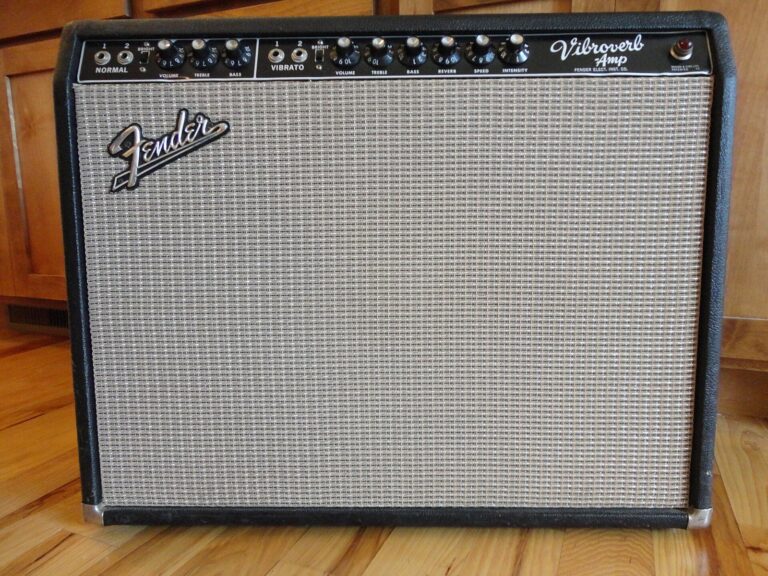
Fender Vibroverb (1×15, Brownface) — The Signature Amp
The Fender Vibroverb — a brownface-era 1×15 combo with the original vibrato and reverb circuits — became one of SRV’s most associated amplifiers. The Vibroverb’s 15-inch speaker produces a deeper, more bass-extended sound than 10-inch or 12-inch configurations, contributing to the specific warmth and fullness of his Texas blues tone. He ran multiple Vibroverbs simultaneously with his Super Reverbs and Marshall in live performance.
Complete Amp Setup (Peak Touring)
The peak SRV live rig could feature: one Dumble Steel String Singer head (into a Marshall cabinet), one Fender Super Reverb combo, one Fender Vibroverb combo, and one Marshall 4140 Club and Country combo — all running simultaneously. In the studio for In Step (1989), it was reported that Vaughan could hear even the slightest malfunction even when running 32 amplifiers into the mixing console.
Pedals: Minimal, Specific, Effective
Ibanez Tube Screamer (TS-808 and TS-9) — The Essential Boost
The Ibanez Tube Screamer is the most associated pedal with Stevie Ray Vaughan’s sound — and the pedal that has become most famous for his use of it. His specific approach: he used the Tube Screamer not as a primary distortion device but as a boost/mid-enhancer to push his amplifiers harder. The Tube Screamer’s specific mid-frequency hump — the characteristic “honk” that many modern players try to reduce — was specifically what Vaughan exploited. Running his TS-808 or TS-9 with the drive relatively low and the level high gave his signal the mid-boost that pushed the Fender amp’s preamp into greater saturation while maintaining the amp’s natural character.
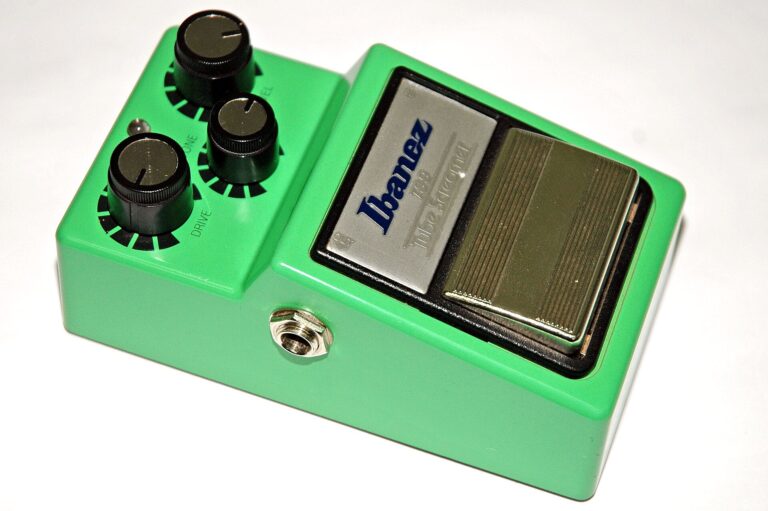
He used both the TS-808 (the original, with the JRC4558D chip, considered the superior version) and the TS-9 (the later, cheaper version). The Tube Screamer’s role in his signal chain became so well-documented that it launched the entire “TS-style pedal” category of overdrive — one of the most reproduced pedal circuits in history.
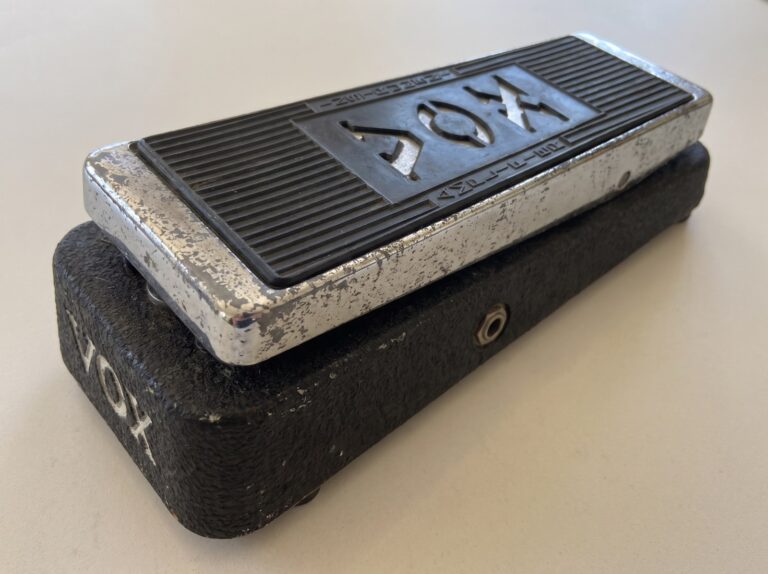
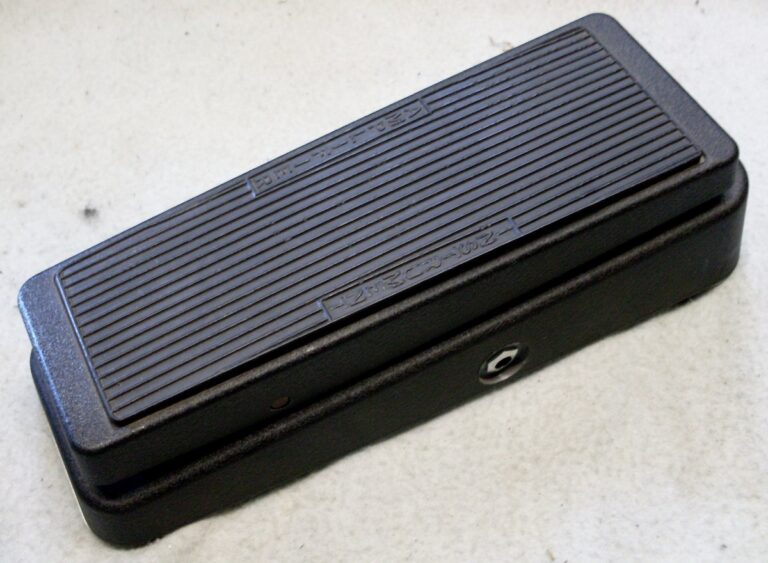
Vaughan eventually acquired Jimi Hendrix’s V846 Vox Wah from his brother Jimmie. “Stevie eventually acquired Hendrix’s V846 from Jimmie.” The symbolic weight of this acquisition — the guitarist whose work was most formative to SRV playing through Hendrix’s actual wah pedal — is hard to overstate. He used it when performing “Voodoo Child (Slight Return),” among other songs. Earlier, he had used Crybaby wahs before switching to Vox models.
Tycobrahe Octavia — The Hendrix Effect
Vaughan used octave-up fuzz pedals to emulate Hendrix tones — initially Roger Mayer Octavia pedals (housed in distinctive “spaceship” metal boxes), then switching to Tycobrahe Octavia pedals when his tech Cesar Diaz located three New Old Stock units. The Octavia’s effect — guitar signal combined with its octave-up harmonic — appeared in specific songs where he wanted the high, ringing quality associated with Hendrix’s “Purple Haze” solo.
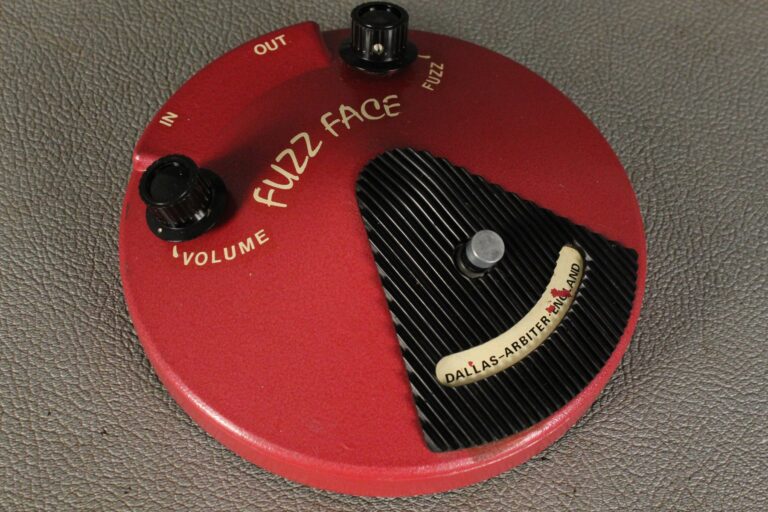
Vaughan experimented with a Dallas Arbiter Fuzz Face in the late 1980s, completing the Hendrix tribute that was already present in his tuning (Eb), his tremolo arm placement (left-handed), and his Octavia use. The Fuzz Face’s germanium transistor character — the same circuit Hendrix used — provided specific tonal colors for specific songs.
Complete Pedal List
- Ibanez Tube Screamer TS-808 — Primary boost; medium drive, high level; the mid-forward push into Fender amp saturation
- Ibanez Tube Screamer TS-9 — Alternative; same function
- Vox V846 Wah (ex-Jimi Hendrix, via Jimmie Vaughan) — Primary wah; “Voodoo Child”; acquired from Jimmie
- Tycobrahe Octavia (×3 NOS units) — Octave-up for Hendrix-influenced passages; located by Cesar Diaz
- Roger Mayer Octavia — Before Tycobrahe; spaceship metal box
- Dallas Arbiter Fuzz Face — Late-career experimentation
- MXR Loop Selector — Signal routing
- Dunlop Cry Baby (custom SRV edition) — Jim Dunlop designed a limited edition specifically for Vaughan in 1987
Strings, Picks & Setup
Strings: GHS Nickel Rockers, .013-.058 gauge, in the key of Eb (tuned down a half step). This gauge — considerably heavier than the .009-.010 most rock guitarists use — requires significantly more finger strength to play, especially for the extreme bending Vaughan performed. Playing with .013s means that a standard full-step bend requires approximately twice the force of the same bend with .010s.
The rationale: heavier strings produce more sustain, more magnetic signal from the pickups (more mass moving through the magnetic field), and a fuller, larger tone. The trade-off is physical demand. SRV’s hands — specifically built for playing these strings — were a physical tool as much as a musical one. Most players who attempt his string gauge last days or weeks before moving back to lighter strings.
He tuned down a half step to Eb — the same tuning as Hendrix. The half-step down reduces string tension enough to make the .013s somewhat more playable while maintaining the heavier-string tone benefits. The Eb tuning also gives his voice a slightly darker, warmer character that suits the blues vocabulary.
Picks: Dunlop heavy picks — typically .88mm or heavier. The heavy pick suited the attack his heavy strings required. Light picks flex too much against .013 gauge strings; a heavier pick provides more consistent attack and better control.
Setup — the guitar: Action somewhat higher than modern shred-oriented setups, which supports sustain and reduces unwanted fret buzz when digging in hard. The combination of high action, heavy strings, Gibson jumbo bass frets, and the left-handed bridge assembly created a setup that was physically demanding but tonally unique. Rene Martinez maintained this setup to Vaughan’s exact specifications throughout their seventeen-year working relationship.
Playing Style & Tone Philosophy: The Blues at Maximum Force
Stevie Ray Vaughan’s guitar philosophy is the most physically committed in the blues tradition. He approached the guitar not as a delicate instrument requiring careful handling but as a physical vehicle for maximum emotional expression — and he built his setup to survive that approach. The heavy strings, the jumbo frets, the left-handed bridge, the multiple amplifiers — all were in service of the single goal: getting the most powerful and most expressive blues tone physically possible.
The Hendrix Foundation
Vaughan’s relationship to Jimi Hendrix was the most total of any guitarist in this series. He tuned to Eb like Hendrix. He used the left-handed bridge assembly like Hendrix. He used the Vox V846 Wah that Hendrix had used (literally — he eventually owned Hendrix’s actual wah). He covered “Voodoo Child (Slight Return)” regularly in live performance. He absorbed the Hendrix vocabulary completely and then filtered it through the Texas blues tradition.
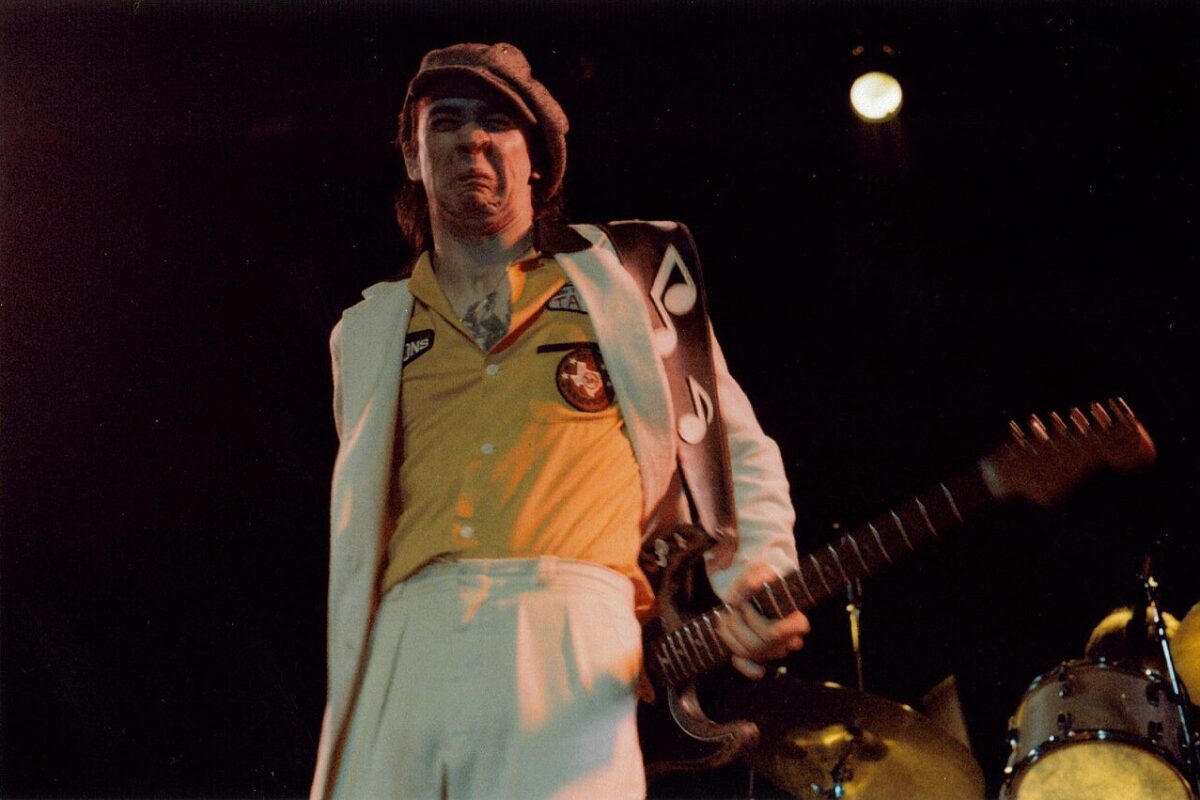
But Vaughan was not an imitator. The Hendrix influence was the starting point for his own complete vocabulary — the Albert King string bending, the T-Bone Walker rhythm sophistication, the Texas shuffle rhythmic approach all combined with the Hendrix psychedelic aggression to produce something that was simultaneously tradition and innovation.
The Physical Technique
SRV’s playing was physically extreme in a way that few guitarists’ playing is. The heavy strings demanded strength. The wide bends — full two-step bends on a .013 high E string — required extraordinary hand strength and control. The aggressive picking attack — he picked hard, much harder than most guitarists — gave his notes a percussive, almost violent initial impact that then sustained into the warmth of the overdriven amplifiers.
The Volume Philosophy
He was loud. Not because loudness was a goal in itself, but because the specific tone of his setup — Fender amplifiers pushed into natural saturation, heavy strings producing maximum pickup signal — required working volume to achieve the natural compression and sustain that defined his sound. His multiple amplifiers weren’t for show; they were for the specific complex of tones that only emerged when the system was running at its intended volume.
How to Sound Like Stevie Ray Vaughan
The Guitar
A Fender Stratocaster — ideally with Texas Special or similar hot single-coil pickups. The left-handed bridge assembly is optional but contributes to the tremolo arm position.
- Fender SRV Signature Stratocaster — Thick oval neck, Texas Special pickups, left-handed vintage tremolo, SRV engraved pickguard. The most direct authentic approach
- Any vintage or vintage-spec Stratocaster with hot single-coil pickups
- Fender Custom Shop SRV Number One Tribute — Limited edition replica (100 made, masterbuilt by John Cruz)
The Amp
Fender Super Reverb (4×10) or Fender Vibroverb (1×15) pushed hard. The Tube Screamer before the amp pushes the Fender into natural saturation. The Marshall adds clarity alongside.
| Control | Setting | Notes |
|---|---|---|
| Volume | 6–8 (natural saturation) | “I use the Fenders for distortion” — the amp saturation is the primary drive |
| Treble | 6–7 | Present; the heavy strings and hot pickups need treble to cut through |
| Middle | 5–6 | The Tube Screamer adds midrange; amp middle stays moderate |
| Bass | 4–5 | Controlled; the heavy strings produce significant low end naturally |
| Reverb | Light to moderate spring | Vintage Fender spring reverb present but not dominant |
The Essential Pedals
- Ibanez Tube Screamer TS-808 or TS-9 — Drive medium-low, Level high; pushing the Fender amp into saturation
- Vox Wah (or equivalent) — For the “Voodoo Child” and wah-forward passages
- Octavia (Tycobrahe or Roger Mayer equivalent) — For specific Hendrix-influenced passages
Budget vs Authentic
Budget:
- Guitar: Fender Player Stratocaster; upgrade to Texas Special pickups
- Strings: Start with .010-.046 and work up toward .011 or .012 before attempting .013
- Amp: Fender Blues Junior or Fender Deluxe Reverb (reissue)
- Pedals: Ibanez TS-9 Tube Screamer + Dunlop Cry Baby Wah
Authentic:
- Guitar: Fender SRV Signature Stratocaster or Custom Shop tribute; GHS Nickel Rockers .013-.058; tuned to Eb
- Amps: Vintage Fender Super Reverb (1960s blackface) + Fender Vibroverb (brownface) + Marshall 4140
- Pedals: Ibanez TS-808 + Vox V846 Wah + Tycobrahe Octavia
The String Warning
Do not start with .013 strings unless you have significant playing experience with heavy gauges. The physical demand is substantial — most players who attempt his gauge give up within weeks. Start with .010s, graduate to .011s, then .012s. The .013s provide approximately 90% of his tone at significantly less physical cost. His strength was built over years of playing; it cannot be shortcut with equipment.
Influence & Legacy: The Blues Revival
Stevie Ray Vaughan’s influence on guitar playing and on American music is the influence of the revivalist — someone who took a tradition that had been pushed to the margins of commercial music and restored it to the center through the force of his playing and personality. The blues revival of the 1980s that he catalyzed produced Gary Clark Jr., Joe Bonamassa, John Mayer’s blues work, Susan Tedeschi, Kenny Wayne Shepherd, and every blues-influenced rock guitarist of the last forty years.
The documented connections:
- Jeff Beck — Beck toured with Vaughan in 1989; mutual admiration between two of the greatest Stratocaster players of the century
- Eric Clapton — Vaughan shared the Alpine Valley stage with Clapton the night he died; Clapton called Vaughan’s playing that night the best of the evening
- Jimi Hendrix — The foundational influence; Vaughan owned Hendrix’s wah pedal, used Hendrix’s tuning and bridge approach, and performed Hendrix’s songs throughout his career
- The Texas blues tradition — He carried forward the lineage from Blind Lemon Jefferson through T-Bone Walker and Freddie King into the 1980s, demonstrating that Texas blues was not a period artifact but a living tradition
- Buddy Guy — One of Vaughan’s heroes; Buddy Guy played at Alpine Valley the night Vaughan died; the mutual connection between the Chicago blues tradition and the Texas tradition that SRV embodied
- The Tube Screamer’s legacy — SRV’s specific use of the TS-808 as a mid-boost into Fender amplifiers became the most documented and most widely replicated “this is how this pedal is supposed to be used” example in guitar history. The TS-style pedal category exists partly because of his specific approach
Christopher Cross called Number One a piece of junk. Ray Hennig gave it to a seventeen-year-old Stevie Vaughan. He played it on every studio album, at Montreux when the audience booed, at the Fillmore and Austin City Limits and Live Aid. He strung it with .013s tuned to Eb and bent those strings further than most players can bend .009s. He pushed his Fenders into natural saturation and called it distortion. He played through Hendrix’s own wah pedal.
He died at thirty-five. He had just played the best set of the night. The helicopter took off in the fog and crashed into a hillside four miles away.
Number One is with Jimmie. The blues is still alive because Stevie Ray Vaughan refused to let it die.
Tone note: Rene Martinez maintained his guitars from 1980 until his death in 1990 — ten years. Cesar Diaz maintained his amplifiers. Both men — guitar tech and amp tech, working in concert — were part of the reason his gear performed at the highest level night after night despite the physical abuse it received. The best guitar tone in the world requires the best maintenance. The crew behind the musician is as much part of the sound as the instruments themselves. SRV could hear the slightest malfunction in a rig of 32 amplifiers. His ears were as precise as his hands. Neither was casual about anything.
Christopher Cross traded it in. He called it a piece of junk. Ray Hennig gave it to a seventeen-year-old. The guitar had a 1963 body and a 1962 neck and 1959 pickups and a left-handed bridge mounted for right-handed use and Gibson jumbo bass frets and a cigarette burn on the headstock.
He strung it with .013-.058. He tuned it to Eb. He pushed Fender amplifiers into saturation and called it distortion. He kept a Marshall for clarity. He put a Tube Screamer in front of everything. He played Hendrix’s wah pedal.
“Texas Flood.” “Pride and Joy.” “Couldn’t Stand the Weather.” “Riviera Paradise.” Alpine Valley, August 27, 1990.
The blues is still alive. He made sure of it.
For the guitarist whose Stratocaster work in a very different tradition he deeply admired and was musically connected to, check our complete guide to Jeff Beck’s guitars and gear, who toured with SRV in 1989 and whose Stratocaster approach represents a parallel, utterly different peak of the same instrument.
And for the guitarist whose tuning, bridge assembly, and wah pedal SRV literally used — check our complete guide to Jimi Hendrix’s guitars and gear, the foundational influence on everything SRV played.
For the guitarist who shared the Alpine Valley stage with Vaughan the night he died — don’t miss our complete guide to Eric Clapton’s gear.
FAQ: Stevie Ray Vaughan Guitars & Gear
What is the story behind Number One?
Number One is a hybrid Stratocaster with a 1963 body and 1962 neck that Ray Hennig — owner of Heart of Texas Music in Austin — gave to seventeen-year-old Stevie Vaughan in 1973. The guitar had been traded in by soft-rock singer Christopher Cross, who reportedly considered it a piece of junk. Vaughan always claimed it was a 1959 model because that year was written on the back of the original pickups. He played it on all five of his studio albums and at virtually every major performance of his career. Number One features a left-handed bridge assembly mounted for right-handed use, Gibson jumbo bass frets, the original 1959 pickups, a distinctive cigarette burn on the headstock, and Schaller Elite Gold tuning pegs. It was “rebuilt more times than a custom Chevy” by guitar tech Rene Martinez. Number One is currently in the possession of Jimmie Vaughan.
Why did SRV use such heavy strings?
GHS Nickel Rockers .013-.058 in Eb tuning — considerably heavier than the .009-.010 gauge most rock guitarists use. Heavier strings produce more sustain, more magnetic signal from the pickups (more string mass moving through the magnetic field), a fuller tone, and the specific “feel” of greater string resistance that allows for more expressive bends and vibrato. The trade-off is significant physical demand: bending a .013 string requires approximately twice the finger strength of bending a .010, and performing the wide bends SRV played nightly required extraordinary hand strength built over years of playing. He tuned down a half step to Eb, which reduces string tension somewhat while maintaining the tone advantages of the heavier gauge.
How did SRV use the Tube Screamer?
Not primarily as a distortion device but as a boost and mid-enhancer to push his Fender amplifiers into greater natural saturation. He ran the Tube Screamer (TS-808 or TS-9) with drive relatively low and the level high, using its specific mid-frequency hump — the characteristic “honk” of the Tube Screamer circuit — to push the Fender amp’s preamp harder while maintaining the amp’s natural character. This approach — using the TS as a signal booster into an amp rather than as the primary distortion source — became one of the most widely documented and widely imitated guitar techniques in blues rock. His specific TS-808 use is credited with launching the entire genre of “transparent mid-boost overdrive” pedals.
What amplifiers did Stevie Ray Vaughan use?
Primarily vintage Fender amplifiers pushed into natural saturation (which he called “distortion”) alongside a Marshall for clarity. His core amp setup: a Dumble Steel String Singer head (his late-career primary), Fender Super Reverb 4×10 combos (1960s blackface), Fender Vibroverb 1×15 combos (brownface), and a Marshall 4140 Club and Country combo for clarity. His stated philosophy: “I use the Fenders for distortion and the Marshall for clarity” — the complete reversal of conventional amp wisdom. His amplifiers were maintained by Cesar Diaz. For recording In Step (1989), he was reportedly running 32 amplifiers simultaneously into the mixing console and could hear even the slightest malfunction in the rig.
What is the connection between SRV and Jimi Hendrix?
Hendrix was Vaughan’s most foundational influence — absorbed from his brother Jimmie’s record collection and developed into a complete musical philosophy. The specific Hendrix elements in Vaughan’s approach: Eb tuning (both players tuned down a half step), left-handed bridge assembly on right-handed guitar (both used this for tremolo arm accessibility), consistent coverage of “Voodoo Child (Slight Return)” in live performance, the Vox V846 Wah (Vaughan eventually acquired Hendrix’s actual V846 from his brother Jimmie), and the Octavia pedal (both used octave-up fuzz for specific tonal effects). The Hendrix influence was total — Vaughan absorbed the vocabulary completely and filtered it through the Texas blues tradition to produce something simultaneously derivative and completely original.
What happened to Stevie Ray Vaughan’s guitars after his death?
Number One — his primary guitar — is currently in the possession of his brother Jimmie Vaughan. Lenny (the birthday gift Stratocaster) was auctioned for over $600,000. Other guitars went to various collectors and family members. Fender produced a signature model SRV Stratocaster (introduced 1992, still in production) and a limited Custom Shop tribute to Number One (100 examples masterbuilt by John Cruz in 2004). The Fender Custom Shop obtained Number One from Jimmie Vaughan to document every detail — every ding, dent, scratch, burn, sticker, and modification — for the tribute recreation.
How do I get Stevie Ray Vaughan’s guitar tone?
Fender SRV Signature Stratocaster (Texas Special pickups, thick oval neck, left-handed vintage tremolo) or any hot-pickup Stratocaster. Ibanez TS-808 or TS-9 Tube Screamer (Drive medium-low, Level high) into a Fender Super Reverb or Fender Deluxe Reverb pushed to moderate volume for natural tube saturation. Vox wah for “Voodoo Child”-style passages. Strings: start with .010-.046 and work up — do not start with .013 without months of preparation. Tune down a half step to Eb. The critical insight: the Tube Screamer is a boost into the amp, not the primary distortion source. Set the amp volume high enough to produce natural Fender saturation, then use the TS to push it further. The heavy strings and the Texas Special pickups provide the signal strength that makes this system work.
Image credits
- Top image: Bob Bissett / Wikimedia Commons / CC BY-SA 4.0
- Fender Stratocaster: Lightburst, Wikimedia Commons, CC BY-SA 4.0.
- Gibson ES-335: Lightburst, Wikimedia Commons, CC BY-SA 4.0.
- Fender Twin Reverb: Micahmedia, Wikimedia Commons, CC BY 3.0.
- Fender Super Reverb: GabeMc, Wikimedia Commons, CC BY-SA 3.0.
- Ibanez TS9 Tube Screamer: Mataresephotos, Wikimedia Commons, CC BY 3.0 US.
- Dallas Arbiter Fuzz Face: sploshette, Wikimedia Commons, CC BY 2.0.
- Dunlop Cry Baby: Roadside Guitars, Flickr, CC BY-SA 2.0.
- Stevie Ray Vaughan’s Number One: LBJ Library, Wikimedia Commons, Public domain.
- Stevie Ray Vaughan live: Bob Bissett, Wikimedia Commons, CC BY-SA 4.0.
- Stevie Ray Vaughan live: Bob Bissett, Wikimedia Commons, CC BY-SA 4.0.
- Fender Vibroverb: GabeMc, Wikimedia Commons, CC BY-SA 3.0.
- Stevie Ray Vaughan’s Lenny: GuitarGangsters AI-generated reference illustration, not a photograph.
- Vox V846 Wah-Wah: GuitarGangsters AI-generated reference illustration, not a photograph.
- Stevie Ray Vaughan (illustration 1): GuitarGangsters AI-generated reference illustration, not a photograph.
- Dumble Steel String Singer: GuitarGangsters AI-generated reference illustration, not a photograph.


