Badi Assad’s Guitars & Gear: Beyond Six Strings
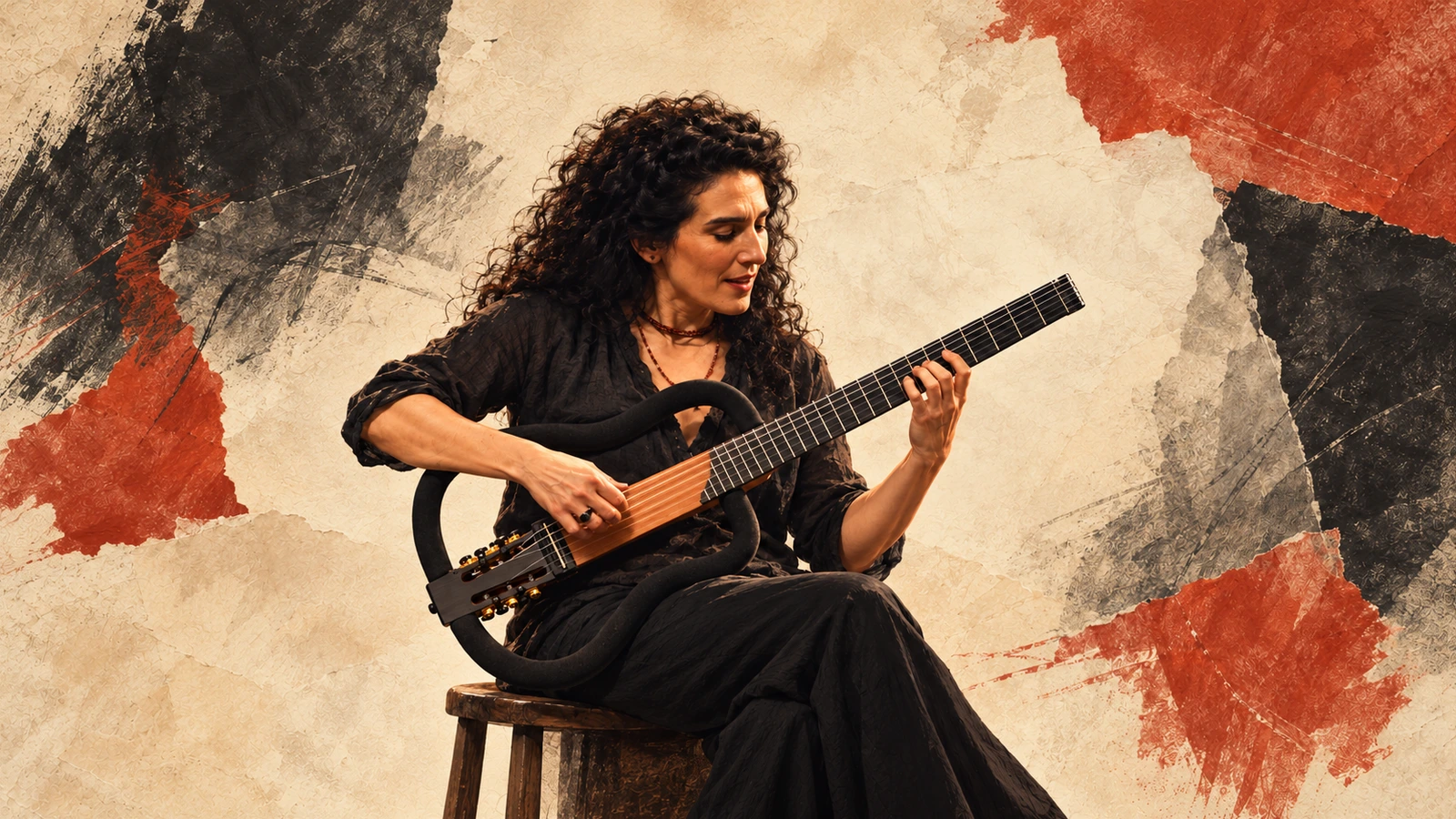
Original editorial illustration of Badi Assad playing a Frameworks nylon-string guitar; not a documentary photograph of a specific performance.
Images in this guide are original editorial illustrations, not documentary photographs.
A guitar can carry the harmony, the bass and the pulse. Add a voice and the arrangement acquires another melody. The difficult part is not finding enough sounds. It is deciding which sounds deserve to happen together—and having enough control to leave the others out.
That is a useful way into Badi Assad’s world. Her guitar story is not a procession of increasingly elaborate pedalboards. It is a study in how a player can expand a nylon-string instrument’s musical role without confusing a bigger arrangement with a busier one. The equipment matters, but so does the division of labour between the hands, the mouth and the space around a phrase.
Background
In the interview published in January 2025 with Joe Barth for Jazz Guitar Today, Assad describes growing up around brothers Sérgio and Odair’s guitar practice and her father’s choro gatherings. She began with classical guitar but increasingly wanted to cross stylistic boundaries. University helped her articulate musical ideas she already understood by ear; touring took precedence over completing the course. Singing and theatre classes also fed the performing artist she became.
The GHA Records biography places Dança dos Tons, Assad’s first album, in 1989. The individual Chesky-linked album catalogues cited below date Solo to 1994, Rhythms to 1995 and Echoes of Brazil to 1997. Chesky’s Three Guitars page dates the collaboration with John Abercrombie and Larry Coryell to July 2003. That sequence gives the story a wider frame than the familiar image of one performer making several sounds at once: recorded solo work and interaction with other guitarists belong to the same career.
A Cal Performances press release dated December 20, 2007 identifies a 1984 young-instrumentalist competition win and a professional debut with the Guitar Orchestra of Rio de Janeiro in 1986. It also credits Assad as co-writer of nine of the twelve tracks on Chameleon.
How the Missing Ensemble Became a Voice
Assad’s own account on the GHA page explains the practical beginning of her mouth-percussion approach. When the musicians from her debut recording were unavailable for a concert, she began reproducing their sounds vocally. The same note describes revisiting eight pieces from that first album and adding four new voice-and-guitar recordings fourteen years later. She names Leo Brouwer, Roland Dyens and Sérgio Assad among the composers whose folk-inflected works had invited her to add percussion and sound effects.
This origin changes the meaning of the familiar “one-person band” description. The goal was not initially to accumulate as many spectacular techniques as possible. There were musical parts she wanted to retain when their original players were absent. Voice became one way to preserve the arrangement’s character without recreating the personnel. That is a more precise creative problem than simply asking how many simultaneous sounds a guitarist can make.
Nowhere: Why the Guitar Credits Matter
A January 30, 2003 interview with Maércio Santamarina for Folha de S.Paulo offers a useful distinction. Discussing Nowhere, Assad said she played relatively little guitar on the record while collaborator and co-producer Jeff Young played extensively. She traced some of its ideas back to their work around Chameleon. She also explained the title’s intended double reading as “nowhere” and “now here.”
The interview includes a striking stage solution: on “Flowing… Into Formlessness,” she and Young divided one guitar between them, with him handling the left-hand part and her the right. This is a reported performance arrangement, not a playing instruction. She described this as a practical adaptation during a tour when she could not play normally. In the same conversation, she rejected an earlier proposed career direction that would have presented her only as a singer, at the expense of her instrumental experimentation.
For a guitar guide, the distinction is between the title artist and the players responsible for individual parts. Model identification should follow the documented musician and session, not simply the name on the cover. An album credit is a starting point for listening, not a substitute for identifying what each person actually played.
Three Early Records, Three Useful Reference Points
The Chesky-linked Solo catalogue gives February 14, 1994 as the release date and credits David Chesky as producer and Bob Katz as recording engineer. Its fourteen tracks include “Valseana,” “Fuoco (Libra Sonatine),” “Palhaço,” “Drume Negrita” and the paired “Estudo #1/Assum Preto.” That repertoire is worth keeping in view beside the later pop reinterpretations: Assad did not arrive at nylon strings simply as an unusual substitute for a rock-band arrangement. The catalogue establishes titles and production credits, not a complete account of how every part was recorded.
For Rhythms, released October 17, 1995, the label lists “Pulo do Gato,” “Bate-Coxa,” “Song for Badi,” the title track and “Moods” among the programme. There is a concrete composer connection behind “Song for Badi”: its individual label credit names Kevin Callahan. In his ClassicalGuitar.org interview, Callahan recalls Assad hearing him improvise and asking him to develop a ballad for Rhythms. Sérgio subsequently encouraged him to build a suite around it. That is a specific account of a performer prompting new repertoire—not merely a general claim that she inspires other musicians.
Echoes of Brazil, dated April 22, 1997 by the label, credits Assad on guitar and vocals, David Finck on acoustic bass, and Jamey Haddad and Valtinho on percussion. Sérgio, Badi and David Chesky share production credits; Bob Katz recorded it, and Nicholas Prout edited and mastered it. The label presents the repertoire as an acknowledgement of influential Brazilian guitarists, including Isaías Sávio, Luiz Bonfá, Baden Powell and Sérgio. That personnel list is a useful reminder not to attribute every low note or percussion sound on an Assad album to her guitar. A solo performer’s capabilities and an ensemble recording’s actual credits are different things.
Three Guitars: A Precisely Documented Meeting
Chesky’s release credits date the recording to December 19–20, 2002, at St. Peter’s Church in Chelsea, New York, and the album’s release to July 22, 2003. Larry Coryell and David Chesky produced it; Barry Wolifson recorded it, and Nicholas Prout edited and mastered it. Assad’s credits extend beyond guitar and voice to flute, kalimba, mouth percussion and percussion. The label identifies steel-string acoustics for Coryell and Abercrombie against her nylon-string classical guitar. Its notes single out “Exercise in Fourths” as a Coryell–Assad duet and “After the Rain” as an Assad composition.
For a gear reader, the useful distinction is between the performers’ contrasting instruments and their additional musical roles. Three credited guitarists do not necessarily mean three uninterrupted guitar parts on every track. Nor does an album recorded in a church identify the microphone used for each performer. These credits give a real session map without inventing a rig diagram.
A Career That Keeps Changing Shape
The Assad family’s official discography provides a useful recent listening route. Ilha (2022) brought collaborations with Chico César, Lucina, Alzira E, Dani Black and Lívia Mattos. The 2023 live single “Waves” credits percussionist Décio 7 and bassist Meno Del Picchia alongside Assad. Bentu (2024), with Sérgio Pererê, was created and recorded live in the studio over five days. The family catalogue also documents 2024’s Olho de Peixe – 30 Anos, a collaboration with Orquestra Mundana Refugi revisiting Lenine and Marcos Suzano’s album. For Acústico (2025), it identifies bassist Gustavo Tenes as the sole guest, on Caetano Veloso’s “Araçá Azul.”
Those credits offer concrete alternatives to treating her entire career as an unchanging solo-guitar act. They identify different collaborators and formats, not undocumented guitar models for each recording.
The Rig: Badi Assad’s Guitars, Amps & Gear
Guitars: Different Jobs, Different Instruments
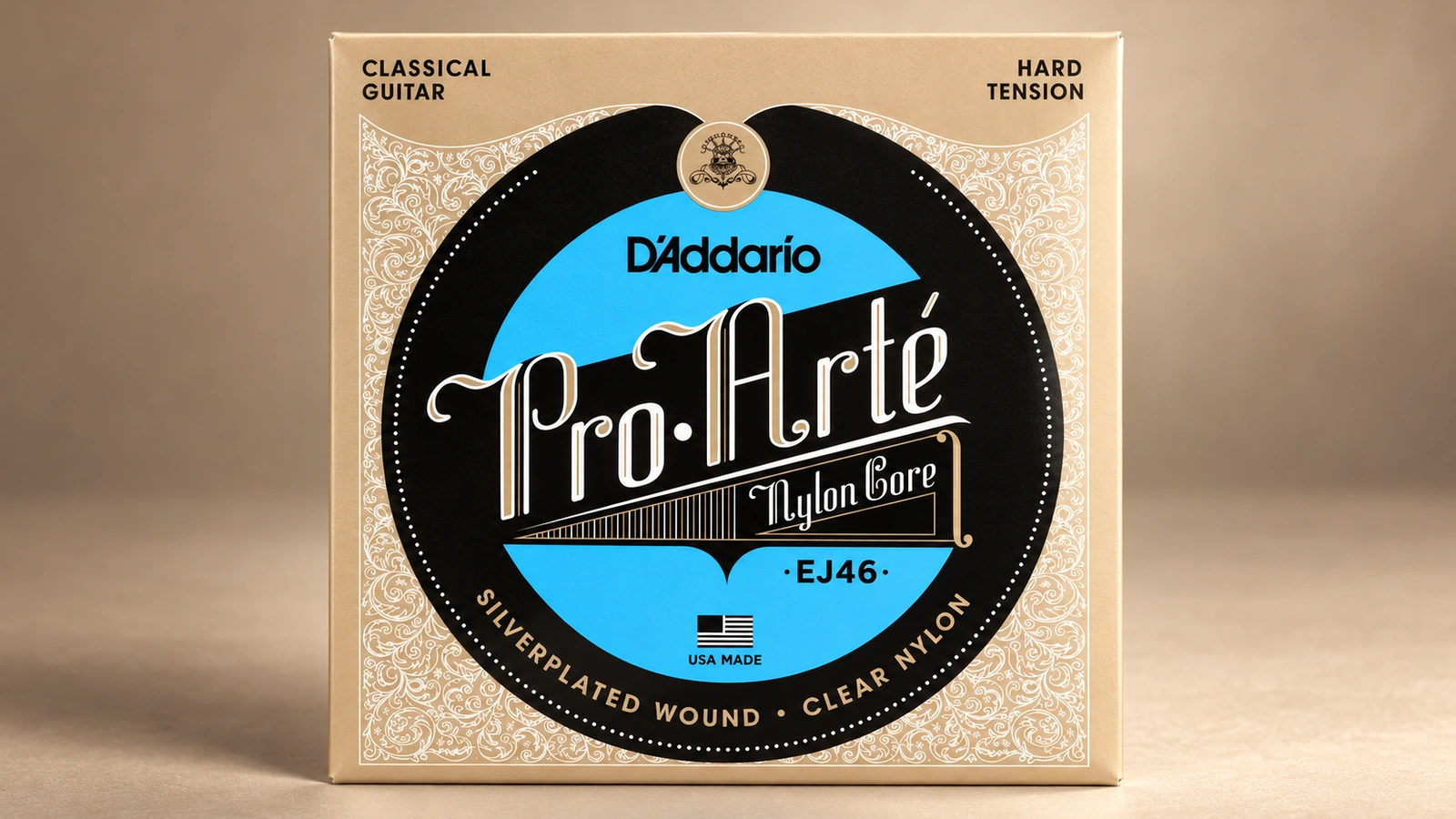
Premier Guitar’s November 2015 interview identifies Fischer for recording, Frameworks for touring and Takamine for body percussion. Its gear box lists D’Addario EJ46 hard-tension strings; Assad describes playing fingerstyle, without a pick.
That division is more useful than a ranking. A recording instrument can be selected for the response a microphone captures. A travel instrument has to solve a transport problem as well as a musical one. A guitar used for body percussion must be considered in terms of both sound and physical interaction. There is no reason to expect one design to win every comparison.
Paul Fischer: The Recording Reference
The Fischer originally belonged to Odair, who lent it to her. Assad described roughly thirty years with it in 2015. A steel-string considered for Hatched did not fit the project. The Fischer’s build year, woods and model remain unidentified.
Frameworks: A Practical Alternative to the Conventional Body
The Frameworks artist roster confirms the association. Its current Frame model page describes a detachable, rubber-covered frame, a mahogany neck, ebony fingerboard and an RMC pickup system with the maker’s preamp. The nylon-string Classical and Modern Classic listings share a 650 mm scale but specify different nut widths: 52 mm and 48 mm respectively. Those current specifications describe the listed products; they do not identify Assad’s exact touring configuration in 2015.
Both current six-string nylon listings specify 22 frets, adjustable RMC bridge saddles, Schaller tuners and three-band EQ. Importantly, Frameworks lists the same string spacing for both: 8.5 mm between adjacent strings and 42.5 mm overall at the nut, and 11.5 mm and 57.5 mm respectively at the bridge. The four-millimetre difference is neck width, not wider string spacing. These are current model comparisons, not measurements of Assad’s touring guitar.
When trying a frame design, check whether its support points suit your seated and standing playing positions. Portability alone cannot answer that question.
The Acoustic Guitar session published in May 2014 provides an earlier performance context: Assad discusses using the lightweight, compact Frame Works design on tour and performs an original from Between Love and Luck. This corroborates a practical touring role without assigning an unverified model suffix or current specification to that older instrument.
Understanding the Electronics Without Inventing a Synth Rig
An RMC pickup credit should not be translated automatically into a guitar-synth credit. As a technology comparison, RMC’s Acoustic Gold documentation describes individual sensor saddles and separates ordinary mono operation from systems equipped for polyphonic processing or MIDI conversion. Those additional capabilities depend on the associated electronics. The manufacturer page does not identify Acoustic Gold or a Poly-Drive unit inside Assad’s particular instrument. It therefore helps explain a distinction, not fill a gap in her equipment list: a pickup maker’s name alone cannot establish a synth, converter, processor or external sound source in a performance.
That distinction is especially useful with a performer who can create unusual sounds acoustically. Before explaining a striking sound as an electronic effect, establish whether the performance credits or demonstration actually identify one. An unfamiliar timbre and an unfamiliar-looking guitar are not, together, proof of MIDI.
Takamine Hirade: A Documented Session Instrument
Acoustic Guitar’s December 25, 2021 session article identifies a Takamine Hirade in Assad’s home-session presentation. The publication date should not be confused with an independently established performance date, and the available text does not justify assigning an exact Hirade model number.
The same report identifies “Zoar” and gives its tuning as E A G B D E♭. It also points to an acoustic version on Around the World. That makes “Zoar” a concrete starting point for studying her alternate-tuning work rather than assuming all of the nylon-string repertoire uses standard tuning. The article does not supply octave designations or a full tablature, so its six-note sequence should not be expanded into an invented arrangement or a prescription to raise strings by unsafe intervals.
Other Documented Instruments
Siccas Guitars’ own artist page identifies a Siccas Luthiers “Creation” Triptych classical guitar for Assad’s May 2026 online concert at its Karlsruhe studio. That is a specific session-instrument attribution from the host. It does not establish that she bought the guitar, replaced her touring instrument, or used that model on earlier albums. The linked performance is an additional listening reference; this guide does not claim a hands-on comparison with her Fischer, Takamine or Frameworks instruments.
Complete Guitar List (Key Instruments)
The dated evidence identifies Paul Fischer for recording, Frameworks for touring, a Takamine for percussion, a Hirade in a later home session, and a Siccas Luthiers Creation Triptych in the maker’s studio concert report. These are distinct working contexts, not five proven current possessions.
Amps
No sufficiently specific amplifier model is established by the evidence used for this guide. That is not proof that Assad has never used an amplifier. It means there is no responsible basis here for naming one as part of her documented setup.
Cabinet Configuration
No specific cabinet is documented in the sources used here.
Studio Amplifiers
No named recording amplifier is established. The dated instrument choices above should not be mistaken for a complete studio signal chain.
Pedals
Complete Pedalboard (Documented)
The available evidence does not identify a model-by-model board or signal order.
Strings, Picks & Setup
That dated gear box also lists a pink capo of unidentified make; it does not establish her current accessories.
Playing Style & Tone Philosophy
In Sue Foley’s February 2023 Guitar Player interview, Assad discusses the move from classical solo playing towards coordinating guitar, voice and percussion, while also valuing simplicity. That is a useful corrective to the assumption that her musical identity can be reduced to doing as many things as possible simultaneously.
Simplicity Is Part of the Technique
In the Foley interview, Assad explicitly distances herself from the idea that everything must be technically complicated. She describes having practised largely alone in her classical period, then developing the ability to combine roles herself. But by the time of that conversation, she no longer felt that difficult playing was necessary to prove her worth as a guitarist. That puts a limit on the familiar “one-woman band” description: it explains a capability, not a requirement that every bar must contain every available sound.
Hatched: The Guitar Part Came First
On “Royals,” Assad explained to Premier Guitar, the vocal was recorded after the guitar; learning to perform them together became a separate task. That distinction matters: the layered arrangement does not imply multiple guitar overdubs, nor does a later live rendition prove that the record was captured as one simultaneous vocal-and-guitar take.
One Performer, Not a Hidden Overdub
In the Jazz Guitar Today interview, Assad recalls recording Solo for Chesky at St. Peter’s Church with one microphone, performing the guitar, singing and percussion live rather than assembling the effect through edits. That is her recollection of that session—not a claim about every subsequent album. It makes the practical distinction clear: coordination is part of the performance, not merely an after-the-fact production effect.
The Voice Changes the Guitar’s Job
Adding a vocal line is not merely adding another instrument to a fixed accompaniment. It can change where the guitar should breathe. A lyric or a sustained vowel may need a clear entrance; a consonant may already provide a sharp rhythmic event. The guitar does not necessarily need to reinforce every one of those events.
Rhythm Lives in Note Length as Well as Attack
Percussive playing is often discussed as a collection of extra sounds. Muting and duration deserve equal attention. Two versions of the same notes can create different rhythmic impressions when one allows them to ring and the other releases them quickly. You do not need an additional strike to make that contrast audible.
How to Sound Like Badi Assad
This section offers original practice and arrangement applications. It does not present Assad’s private exercises, undocumented tunings, exact settings or a shortcut to her musicianship. Choose one problem at a time and use the equipment you already understand before turning the exercise into a shopping project.
Inside the “Zoar” Tuning: A Pitch-Class Study
Here is an original GuitarGangsters analysis of the published note collection—not a transcription of “Zoar,” an account of Assad’s intentions, or a claim that the following examples occur in her performance. Because the report does not give octave numbers, we can examine the pitch classes without prescribing how far to tighten or loosen any string. A keyboard or a notation program is sufficient for this first investigation. There is no need to experiment with potentially unsuitable string tension.
Taking E as a temporary reference, the six named pitches sit at these distances within an octave:
| Pitch | Semitones above E, modulo 12 | Interval relationship to E |
|---|---|---|
| E | 0 | Root reference |
| A | 5 | Perfect fourth |
| G | 3 | Minor third |
| B | 7 | Perfect fifth |
| D | 10 | Minor seventh |
| E♭ | 11 | Major-seventh distance, enharmonically D♯ |
E is a convenient analytical reference because it appears in the collection; that does not establish the song’s key. Without the melody, bass movement, register and rhythmic context, a list of open-string names is not a complete harmonic analysis. Even a collection that resembles a familiar chord can serve another purpose once a performer chooses which notes to sound and which to mute.
The immediate landmark is E–G–B: the pitch classes of an E-minor triad. Add D and the collection also contains an E-minor-seventh framework. Add the pitch written E♭ instead and the distance from E becomes a major seventh. That last relationship is easy to miss if you read the spelling as a command to think in E-flat major. Here the comparison is mathematical: E♭ and D♯ describe the same pitch class in equal temperament, while their spelling can communicate different harmonic functions in a written score.
Having both D and E♭ available is the especially interesting feature. They are a semitone apart. Played together in a close register, adjacent semitones make a different kind of tension from either note played alone against E–G–B. Separated across octaves, their interaction changes again. Since the published tuning omits register, it would be premature to promise one particular beating, roughness or acoustic effect. What we can establish is the available chromatic contrast.
Try an original keyboard comparison. Hold E, G and B in a comfortable register, then add D. Remove D before adding E♭. Finally, compare the two upper notes in succession while the triad stays unchanged. You are testing the effect of moving one pitch by a semitone, not learning Assad’s recorded voicing. Notice whether you hear the added note as a colour that can remain or as a tension that seems to ask for movement. Neither reaction is an objective answer about the song; it is information about your chosen register and phrasing.
A supplies another choice. Against the E reference it is a fourth; voiced above the octave it can be described as an eleventh. With E and B alone, it gives a suspended collection without a third. Bring G back and you restore the minor-third information alongside that fourth. This shows why sounding every available string is not the only—or necessarily the most revealing—way to investigate an alternate tuning. A smaller subset can make the musical question easier to hear.
There is also a simple common-tone exercise. Begin with E–G–B, move to E–A–B, then return. E and B remain while one inner pitch moves. Compare that with a version where G remains and A is added instead. One operation replaces a note; the other increases the number of simultaneous voices. Those are different arranging decisions even though they use the same small pitch collection. Listen for the distinction before making either version faster or more elaborate.
Now investigate the seventh-note contrast without the triad. Alternate D and E♭ over a sustained E, using equal note lengths and a quiet dynamic. Then leave a rest before returning to E. The exercise isolates a chromatic approach to the reference pitch. It does not establish a bass line, melody or cadence from “Zoar.” Keeping that boundary clear makes the experiment more useful: you can hear a relationship without mistaking an analytical possibility for something the artist actually played.
Harmonics introduce a second layer. An octave harmonic preserves a string’s pitch class while changing register and attack. A harmonic corresponding approximately to a fifth introduces a different pitch relationship. Thus a tuning study and a harmonics study are related but not identical: the ringing result depends on which partial you select, not just which open note is written in a tuning chart. Natural harmonics also need not reproduce the exact equal-tempered pitch of a fretted note. Avoid treating the interview’s brief mention of harmonics as a complete recipe for their locations or intonation.
For a safe listening experiment, compare ordinary notes and their octaves on the keyboard first. Keep the rhythm unchanged and move only one voice upward. Does the accompaniment leave more room around the middle register? Does a top note become more exposed? These are practical orchestration questions. They connect the tuning’s possibilities with the broader task of fitting a guitar part around a voice, without pretending to reproduce Assad’s fingering or the sound of her Hirade.
The most productive outcome is not a complicated chord label for all six pitches. It is an understanding of several distinct choices: minor-triad stability, suspended colour, minor-versus-major-seventh tension, close chromatic movement and register. When you later work from a reliable performance demonstration or authorised transcription, those distinctions give you something specific to recognise. They also help explain why buying a similar guitar cannot substitute for understanding which strings the arrangement actually uses.
The Guitar
Begin with a nylon-string instrument that is comfortable, stable and suitable for the way you intend to play. It need not duplicate a named guitar in the historical list. You are trying to develop a relationship between touch, articulation and arrangement; an unfamiliar instrument can make that relationship harder to assess before it makes it more interesting.
The Amp
There is no verified Assad amp setting to copy here. Use the available amplification as a listening tool. Start with a restrained level, play the same passage several times and identify the first point at which the sound stops serving the arrangement. Avoid changing several controls in response to one vague impression.
The Essential Pedals
There is no evidence-based compulsory pedal purchase for this approximation. Keep optional processing out of the first practice pass. That lets you hear whether the articulation and note lengths are doing the musical work you intended.
Budget vs Authentic
Spend first on solving a real limitation. A basic setup issue that prevents clean articulation deserves attention before an optional effect. An unreliable monitoring situation deserves attention before a second guitar chosen for a subtle difference you cannot yet hear consistently. A comfortable instrument that you practise regularly may do more for this approach than a theoretically perfect instrument that makes ordinary playing awkward.
Practice: Build a Small Arrangement That Actually Breathes
First Pass: Establish the Floor
Choose a short progression you already know, using a tempo at which you can keep your shoulders and hands relaxed. Play only the bass movement. Do not add a clever fill when the line feels exposed. The exposure is the point: it lets you hear whether the pulse is stable and whether the notes end where you intend.
Second Pass: Add Harmony Without Taking Over
Add a small chord fragment above the bass. A full six-string grip is not required. Choose a voicing that leaves the bass line intelligible and lets the fretting hand move economically. The goal is to add harmonic information, not to fill every available string.
Third Pass: Introduce the Voice
Use a comfortable vowel or a simple original line rather than borrowing a difficult song immediately. Sing the phrase alone first, then accompany it with the smallest guitar part that supports it. Preserve an easy breathing pattern and stop if the exercise causes discomfort. This is coordination practice, not a test of vocal range or endurance.
Fourth Pass: Add One Rhythmic Colour
Begin with muted strings or a controlled change in articulation rather than striking an expensive instrument’s body. Do not assume that a guitar designed for ordinary playing welcomes repeated impacts, and do not experiment with force to imitate a performance gesture. Protect the instrument and your hands.
For another dated performance reference, WNYC’s Soundcheck archive preserves a January 22, 2014 studio appearance titled “Badi Assad: Guitar-Driven Brazilian Pop.” It includes programme audio and a Michael Katzif/WNYC studio photograph. The archive provides a real broadcast context; it does not, by itself, identify the guitar model.
Repertoire Route: Around the World
The artist’s Ropeadope-linked Bandcamp release dates Around the World to October 2, 2020. Its sequence includes “Zoar,” “Acredite ou não,” “Bachelorette,” “O barco daqui de dentro,” “Hunger of the Pine,” “Lamma Bada,” “Millones,” “Royals,” “Sedated” and “Ondas.” That creates a useful cross-check when moving between an online session and a released album: a familiar title alone does not establish that the same recording, guitar or arrangement is being used.
For an attentive listening session, choose one title that appears in more than one setting and keep a short record of the format—solo video, album track or ensemble performance. Compare the musical jobs rather than attempting to identify equipment by tone alone. Is the bass role supplied by the guitar or another credited player? Is the vocal supported by a repeated figure or freer accompaniment? These are questions to investigate, not a claim that we have audited each recording’s multitracks.
Influence & Legacy
Assad names her brothers and the Gismonti–Naná Vasconcelos album Dança das Cabeças among her important influences in the same Jazz Guitar Today conversation. She also describes voice and kalimba as ways to contribute textures alongside Abercrombie and Coryell, rather than claiming their improvisational vocabulary as her own.
Stringshot: Nylon Strings Meet Slide and Harp
Roy Rogers’ official Stringshot announcement documents the collaboration with Assad and Carlos Reyes. Rogers brings his slide-guitar background; Reyes plays violin and Paraguayan harp. The project is presented as a meeting of blues and Latin music, not as another edition of the Coryell–Abercrombie trio. That matters when tracing Assad’s collaborations: replacing one set of names with another changes the instrumental possibilities, even when the word “strings” remains central.
A harp, violin, slide guitar and nylon-string guitar do not offer the same articulation or sustain. That observation is a reason to ask different arranging questions of the project, not permission to invent who played a particular phrase. Follow the credited lineup first, then investigate the individual recording. A guitarist’s contribution is easier to understand when the surrounding instruments are not treated as interchangeable accompaniment.
A Family Sound Without a Single Family Role
In Joseph Miller’s April 3, 2014 interview with Sérgio Assad, Badi’s brother described encouraging her to pursue singing as a way to distinguish her path from the established duo. Her subsequent percussion work went beyond what he had suggested, and he explicitly connected that example with its influence on his daughter Clarice. For the family’s A Brazilian Songbook concerts, the lineup combined Sérgio and Odair with Badi, pianist and vocalist Clarice, and singer Carolina. Sérgio described a programme that preserved individual and duo appearances as well as group numbers, with Clarice increasingly taking on arranging responsibilities.
That is a specific account of influence, rather than a list of famous people photographed together. Badi’s contribution was not to turn the Assad Duo into a larger version of itself. Her approach added another way of organizing voice, guitar and percussion inside a family already identified with classical guitar. The programme’s mixture of solo and collective performances also matters: a five-person billing does not imply that all five supplied a continuous backing band throughout the show.
Beyond the Guitar Recital
The Red Orange agency account places several other projects alongside the records. It describes Assad’s reinterpretation of U2’s “One” in a bossa-nova setting and Björk’s “Bachelorette” with a tango character on Verde, followed by material associated with Eurythmics, Vangelis and Tori Amos on Wonderland. These are the agency’s descriptions of the repertoire, not claims of a listening test or a transcription here. The same account documents her live collaboration with the Bahia dance company BTCA at the Venice Biennale in 2012, and her commission to accompany the 1934 silent film The Goddess at New York’s Merkin Hall in January 2014.
Those assignments put the familiar solo-guitar resources in different relationships to time. A song supports a singer’s phrasing; dance and a projected film introduce a visual sequence that the music must address. The historical documentation does not disclose her exact cue sheet or equipment for those events, so neither should be invented. What it does establish is that her arranging experience reaches beyond making a pop song playable by one guitarist. The voice-and-guitar performer was also working with bodies in motion and images on a screen.
An Arranger in Saffron Caravan
Genesis at the Crossroads’ own programme identifies Assad as Saffron Caravan’s vocalist and guitarist. Its Sounds of Healing project brought the professional ensemble together with young musicians who collaborated remotely on original material. One concrete credit places Assad and Carlinhos Antunes as arrangers of “Millions of Hearts,” with lyrics by Victor Angel Araque Rangel. That is an arranging credit, not a claim that Assad wrote the lyrics or performed every instrumental part. The programme places her alongside musicians including oud player Haytham Safia, vocalist Aaron Bensoussan and percussionist Javier Saume Mazzei.
In this setting, the relevant inheritance from her solo work is flexibility of role, not the assumption that she must supply all the percussion herself. Working beside a dedicated percussionist or another plucked-string instrument creates a different set of choices from filling an empty stage alone. The credit gives readers a named piece and a documented contribution to investigate, rather than a vague claim that her music crosses borders.
What to Listen for Next
Start with a contrast rather than a ranking. The early solo albums, the Three Guitars collaboration and the recent credited ensemble releases provide different settings in which to follow her contribution. Ask where the guitar carries an independent line, where the vocal becomes the centre, and where another musician takes over a rhythmic role. These are listening questions, not claims that every track uses the same technique. Identifying the format first helps prevent an impressive solo-performance image from becoming a misleading description of an entire discography.
For the working guitarist, the enduring value of this example is a question rather than a shopping list: how much of an arrangement can you make clear with the resources already in your hands? That question can lead towards more technique, but it can also lead towards subtraction. A performer who can do several things at once still benefits from deciding when not to.
Want to explore another perspective on nylon-string guitar in an ensemble? Read our Ralph Towner gear guide. For a different conversation between Brazilian guitar and voice, our João Gilberto guitars and gear guide offers a separate route into the subject.
FAQ
Is this a complete inventory of Badi Assad’s guitars? No. It identifies supported instrument roles and appearances, with dates and model uncertainty kept intact. An exhaustive ownership history would require more evidence.
Can current specifications identify her exact Frameworks version? No. They do not establish an earlier artist instrument’s configuration.
Are the practice exercises Badi Assad’s own lessons? No. They are original GuitarGangsters applications designed around coordination, arrangement and listening. They should not be quoted as her teaching method or private practice routine.
Should I copy body-percussion gestures directly onto my guitar? Not without considering the instrument and technique. Begin with gentle articulation and muted-string work, avoid force, and seek qualified guidance where needed. A striking performance image is not an instruction manual for treating an instrument.