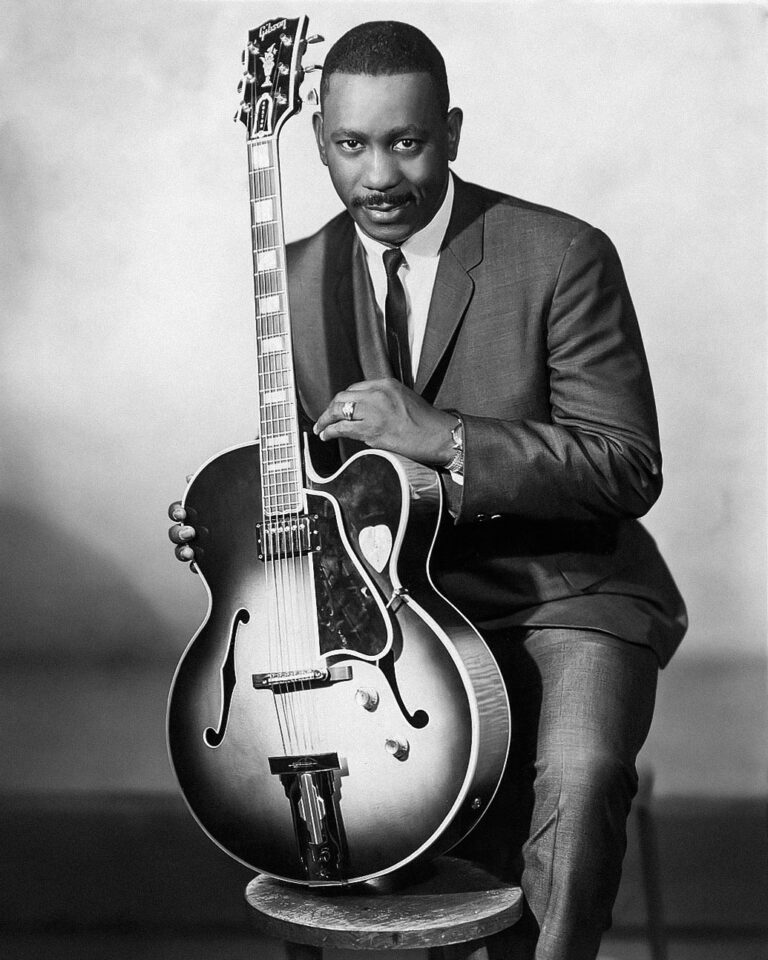
Barney Kessel Guitars & Gear: The Complete Guide to Jazz’s Most Recorded Guitarist’s Gibson ES-350, Kay Signature & Poll Winners Tone
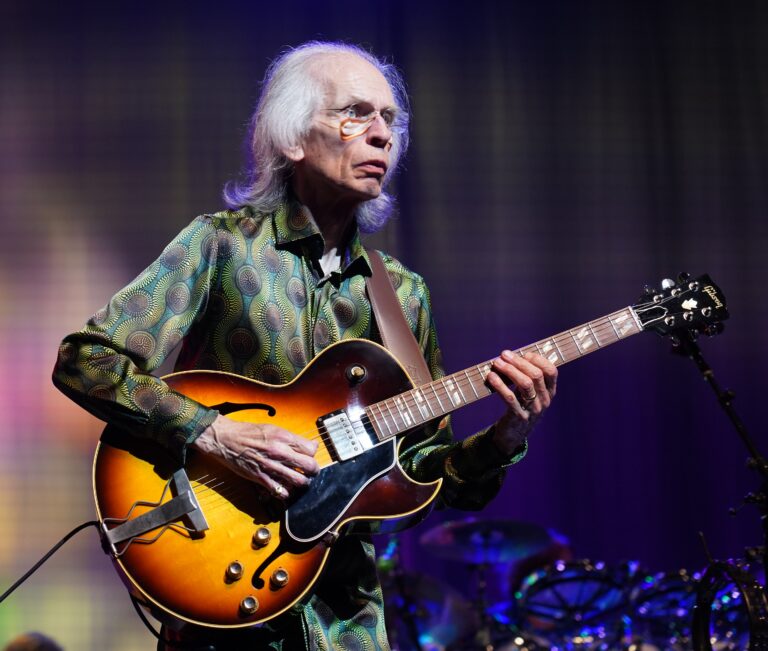
Barney Kessel at a guitar jam session. Photo: “Barney Kessel” by anyjazz65, CC BY-SA 2.0. Cropped and resized. Source: https://www.flickr.com/photos/49024304@N00/306775305/ Licence: https://creativecommons.org/licenses/by-sa/2.0/ This derivative is licensed under CC BY-SA 2.0.
Barney Kessel first encountered the guitar while walking his paper route as a boy in Muskogee, Oklahoma, when he passed a music store and noticed it in the window. What attracted him was “its look and the fact that it came with a booklet, ‘How to Play the Guitar in Five Minutes,’ which he believed.” He believed the booklet. He bought the guitar. He learned in considerably more than five minutes, but the specific quality of the beginner’s confidence — the belief that this instrument and this booklet were the beginning of something — is the specific biographical detail that captures what Barney Kessel brought to every guitar he subsequently played: the directness, the optimism, the willingness to engage with the music completely without irony or complication. Nat Hentoff wrote in the liner notes to The Poll Winners: “Barney absorbed the pulsating beat of jazz the way most of us absorbed the multiplication tables.” The multiplication tables: necessary, foundational, absorbed so completely that they become invisible infrastructure beneath everything that uses them. He absorbed jazz as infrastructure, then built everything else on top. He built the Poll Winners trio with Shelly Manne and Ray Brown — the three musicians who swept the jazz polls for their respective instruments in 1956, an unprecedented achievement. He built the Wrecking Crew session career that put his guitar on more recordings than possibly any other musician in history — Elvis Presley, Frank Sinatra, Sam Cooke, the Beach Boys, the Monkees, Sonny and Cher, Dean Martin, Phil Spector sessions. He built the Contemporary Records catalog of jazz albums that stand as the canonical documents of the West Coast cool-to-hard-bop transition. He did all of it on the Gibson ES-350 modified with a Charlie Christian bar pickup — the guitar that he preferred to his own signature model, the guitar that had the plywood body he liked for the woody, bassy tone it gave through the Gibson amp, the guitar that was his as long as he could play it, which was until the stroke in 1992 ended his performing career. Barney Kessel. Muskogee, Oklahoma. The paper route. The booklet. The guitar. The multiplication tables of jazz, absorbed completely, built into everything.
Barney Kessel was born on October 17, 1923, in Muskogee, Oklahoma, to Russian Jewish immigrant parents (née Kesselman). He died on May 6, 2004, in San Diego, California, at the age of eighty, from brain cancer — having suffered the debilitating stroke in 1992 that ended his performing career while on an Australian tour with the Great Guitars ensemble. The twelve years between the stroke and the death were years in which he could not perform but in which the recordings and the reputation remained fully intact: the Poll Winners albums with Shelly Manne and Ray Brown, the Contemporary Records catalog, the Wrecking Crew sessions, the Oscar Peterson Trio tour, the Charlie Parker recordings, the Julie London “Cry Me a River” million-seller, the Stéphane Grappelli duo album, the Great Guitars recordings with Herb Ellis and Charlie Byrd. Possibly one of the most recorded musicians in the history of recorded music. Born in Muskogee. First guitar from the paper route. Died in San Diego. Between: more recordings than most musicians manage in ten careers, from the jazz poll winner to the Hollywood session invisible hand to the guitar trio to the stroke.
The Charlie Christian connection is the specific biographical event that set Kessel’s jazz trajectory: he met Christian at a jam session when his band was playing in Oklahoma City, and the two jammed together for three days. Christian was Kessel’s idol — “There’s no doubt that I was a fan of his. I idolized his playing, and when I was in high school, I waited for his records to come out. And I think I sounded like him in the early years of my playing.” The three days of jamming with the idol were “life-changing” and led to the development of his own distinctive style by necessity: having met the man he idolized and played alongside him, the only direction was to develop his own voice rather than to continue imitating the source. Christian’s death in 1942 at twenty-five — from tuberculosis, while Kessel was nineteen — removed the idol from the competitive field and left Kessel as the most direct available inheritor of the Christian vocabulary. He is often considered one of the most complete inheritors of Charlie Christian’s pioneer bop guitar style. The inheritor who jammed with the original for three days and then developed his own voice from the foundational inheritance.
The Jammin’ the Blues appearance in 1944 is the specific visual historical document of the early Kessel: the Oscar-nominated short film featuring Lester Young and other jazz greats, in which Kessel was the only white musician in an otherwise all-Black cast, required to dye his hands black and perform in the shadows to maintain the film’s visual consistency. This biographical detail — the white jazz guitarist who had to perform in disguise in the segregated cultural context of 1944 America — is part of the specific historical record of what American music looked like and what the musicians who made it had to navigate in that period. Kessel was twenty years old, his career just beginning, in the shadows of the Jammin’ the Blues frame, already playing at the level that would eventually sweep the jazz polls for thirteen consecutive years.
Background: Muskogee, the Paper Route Guitar, Three Days with Charlie Christian, and the Two Careers in One
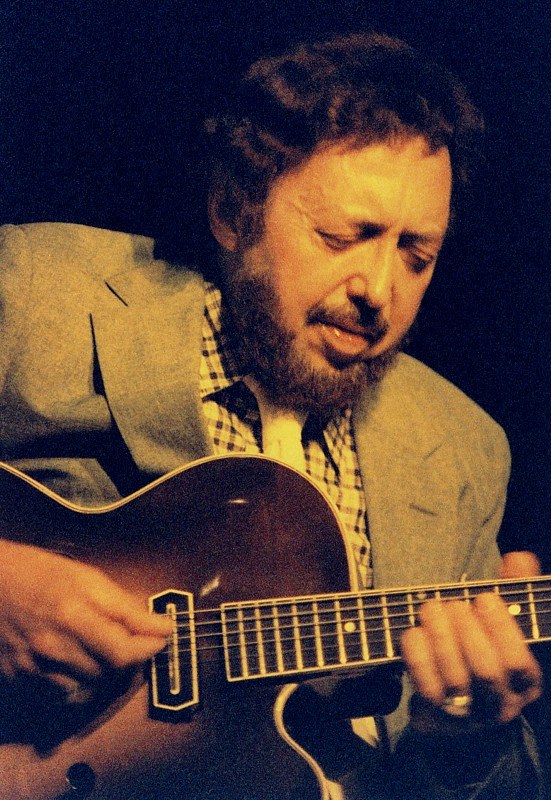
The dual career structure of Kessel’s professional life — the jazz career documented in the Contemporary Records albums, the Poll Winners trio, and the Oscar Peterson Trio tour, running in parallel with the Hollywood session career of the Wrecking Crew — is the specific structural reality of the most accomplished jazz guitarists of the West Coast tradition in the 1950s and 1960s. The geography matters: Los Angeles, not New York, was Kessel’s professional home. And Los Angeles in the 1950s and 1960s was not only the home of the West Coast cool jazz tradition but the home of the Hollywood film, television, and recording industry that employed session musicians as the invisible hands of American popular culture. Kessel’s jazz artistry and his session craft were not separate activities performed by separate versions of the same musician; they were the same musical intelligence applied to different professional contexts with the same dedication and the same level of accomplishment. You heard him whether you knew his name or not. If you listened to popular radio in the 1950s, you heard his guitar. If you saw a movie in the 1950s or 1960s, you probably heard his guitar.
The Poll Winners trio — formed from the specific fact that Kessel, Shelly Manne, and Ray Brown each swept the jazz polls for their respective instruments in 1956 — produced five albums of piano-less jazz trio music that are among the most celebrated recordings in the West Coast jazz tradition. The absence of a piano in the trio is the specific compositional challenge that made the Poll Winners recordings significant: without the piano’s harmonic filling function, the guitar must provide both the melodic improvisation and the harmonic context simultaneously, with the bass and drums providing the rhythmic and structural foundation. This is the “miniature orchestra” quality that Jim Hall also embodied — the jazz guitar as a self-accompanying instrument — applied in the specific context of the piano-less trio, where the guitar’s harmonic and melodic responsibility is maximized. Kessel’s “knowledge of chords and inversions and chord-based melodies” — the specific technical description that the Wikipedia biography identifies as his primary musical characteristic — is the direct consequence of the piano-less trio requirement: in the absence of the pianist’s harmonic filling, the guitarist’s chord vocabulary determines the harmonic richness of the ensemble.

The Wrecking Crew membership — the informal ensemble of Los Angeles session musicians who played on the most commercially successful popular recordings of the 1960s — placed Kessel’s guitar in the most commercially consequential available context: the Beach Boys, Elvis Presley, the Monkees, Sonny and Cher, Frank Sinatra, Dean Martin, Sam Cooke, Phil Spector’s Wall of Sound productions. He is one of the two guitarists heard in the intro of the Beach Boys’ iconic “Wouldn’t It Be Nice.” He played on Julie London’s “Cry Me a River,” the million-seller that is still one of the most celebrated vocal-jazz recordings of the 1950s. The Wrecking Crew session career and the jazz career coexisted for decades without either diminishing the other — the specific professional versatility of the musician who had absorbed jazz “the way most of us absorbed the multiplication tables” and who could therefore apply that foundational knowledge to whatever musical context the next session required.
The Great Guitars formation in 1973 — the trio with Herb Ellis and Charlie Byrd — represents the specific reunion of three significant jazz guitarists in a collaborative touring format that brought the jazz guitar conversation to audiences who might not have heard any of the three individually in the previous decade. The Great Guitars toured internationally, recorded, and continued until Kessel’s stroke ended his participation in 1992. The stroke happened in Australia. The guitar was taken from his hands by the medical event, not by choice. He had planned more. He was eighty years old when he died. Twelve years between the stroke and the death. The recordings remain.
The Rig: Barney Kessel’s Guitars, Amps, and Effects
Guitars
Gibson ES-350 with Charlie Christian Bar Pickup (Primary Career Guitar)
Kessel’s signature guitar was a Gibson ES-350 with a Charlie Christian pickup. The Gibson ES-350 — Gibson’s large-body electric archtop from the late 1940s and early 1950s, with a single pickup, Venetian cutaway, and the specific plywood construction that Kessel specifically valued — was modified with the Charlie Christian bar pickup, the original electric guitar pickup that Christian himself had used on his foundational ES-150 recordings. The Charlie Christian pickup’s specific character: a bar magnet pickup whose tonal character is brighter and more present than the P-90 or humbucker that succeeded it, with the specific vintage electric guitar tone that predates the PAF humbucker era. The ES-350’s plywood body — which was liked by Barney as well as Tal Farlow or other ES-175 players because it gave more woody, bassy tone when amplified, compared to spruce which gave a brighter tone and was sensitive to vibration, meaning more susceptible to feedback — is the specific practical and tonal preference that drove the Kessel choice. The woody, bassy, less feedback-susceptible character of the plywood body through the Charlie Christian bar pickup produced the specific “earthy, organic quality” that Steve Howe identified as Kessel’s most distinctive tonal characteristic. Throughout his career, he had a rocky relationship with Gibson and because of this, the headstock occasionally appears with tape covering the Gibson logo. The irony of taping over the manufacturer’s logo on a guitar that was simultaneously the basis for his own signature model captures the specific complexity of the Kessel-Gibson commercial relationship: he used the ES-350 because he preferred it to his own signature model, which was being manufactured by the same company whose logo he was taping over.
Gibson Barney Kessel Signature Model (1961–1974 — Ironically Rarely Played by Kessel)
While the Gibson Barney Kessel Regular was seen in the hands of guitar greats T-Bone Walker and Sister Rosetta Tharpe, the signature artist himself tended to play other instruments, notably his Gibson ES-350 modified with a Charlie Christian pickup. The Gibson Barney Kessel signature model — produced from 1961 to 1974 — featured a double Florentine cutaway body, twin PAF humbucker pickups, Brazilian rosewood fingerboard, and the specific neck profile that Gibson developed in consultation with Kessel for playability. The irony: Kessel himself preferred his ES-350 to the signature model that bore his name. T-Bone Walker and Sister Rosetta Tharpe — two of the most celebrated electric guitar players in the blues and gospel tradition — played the Gibson Barney Kessel guitar more famously than the man whose name was on the headstock. The signature model’s double-cutaway design and twin humbuckers represented a significant departure from the single-cutaway, single-pickup ES-350 that Kessel actually used, which may explain his preference for the original instrument.
Kay Barney Kessel Artist Model (Early Signature — 1950s-60s)
Before the Gibson signature, Kessel had his name attached to the Kay Barney Kessel Artist guitar. Kay — the Chicago-based manufacturer whose budget-friendly instruments were widely available in the 1950s — produced the Kessel Artist model with a body design that resembled Kessel’s Gibson ES-350, with a large hollow body, f-holes, and Venetian cutaway. The Kay endorsement placed Kessel’s name on an affordable instrument accessible to the beginning jazz guitarist who admired the Poll Winners albums — the same guitar tradition he had started in, the paper route guitar, the accessible instrument that made the music available to someone who didn’t have the budget for a Gibson archtop.
Gibson L-5 (Additional — Career Collection)
The Gibson L-5 — the flagship Gibson archtop that appears in this series across multiple jazz guitar entries — is also part of Kessel’s documented collection. The L-5’s 17-inch body, floating pickup, and traditional jazz archtop construction provide a different tonal character from the ES-350’s plywood construction and Charlie Christian bar pickup. The L-5 represents the opposite end of the Kessel guitar spectrum from the ES-350: traditional, large-body, carved-top archtop versus the practical, plywood, single-pickup modified instrument that was his actual primary guitar.
Amps
Gibson GA-50T (Primary — Poll Winners Era Recording)
For his Poll Winners recordings, Kessel used an early Gibson GA-50T — a 25-watt combo with one 12-inch and one 8-inch speaker. The Gibson GA-50T’s specific character: a tube-powered combo with the warm, mid-focused quality of Gibson’s tube amplifier designs, producing the specific “earthy, organic” amplified character that Steve Howe identified as Kessel’s tonal signature. The 25-watt output through the dual-speaker configuration (12-inch and 8-inch providing a frequency response range between the 12-inch’s extended bass and the 8-inch’s extended high-frequency) produced the specific warm but present character of the Poll Winners recordings. The plywood ES-350’s woody, bassy acoustic character through the GA-50T’s warm tube amplification produced the specific Kessel recording tone that the Contemporary Records catalog documents.
Gibson Model BR-3 (Additional Documented — Combo)
Jazz guitarist Barney Kessel is associated with the Gibson Model BR-3 guitar amplifier, as evidenced by a user-uploaded photo on WordPress. The Gibson BR-3 — another of Gibson’s tube combo amplifiers — appears in photographic documentation of Kessel’s equipment. Gibson amplifiers throughout the career period confirm the specific brand loyalty that connected the ES-350 modification and the GA-50T to the broader Gibson ecosystem of the period.
Effects and Technique
Hybrid Picking (Primary Technique — Pick and Fingers)
Kessel used a hybrid picking technique — combining a pick for the primary melodic lines with the flesh of the fingers for softer accompaniment passages. With the flesh of his right hand fingers, he is able to use a hybrid picking technique to make softer statements in between the sections played with a pick. The specific hybrid picking approach allowed the dynamic range between the pick’s articulate attack on the melodic lines and the fingers’ softer, more rounded tone on the chord-melody accompaniment — producing the specific combination of “single line and chords” that Steve Howe identified as the most distinctive quality of the Kessel approach. The pick for the bebop lines; the fingers for the chord voicings; the combination producing the specific earthy, organic, rhythmically alive Kessel sound that the Telecaster Forum community describes as unlike the “amp-under-a-blanket tone that so many jazz guitar players have.”
Chord Vocabulary (Primary Musical Characteristic)
Known in particular for his knowledge of chords and inversions and chord-based melodies — the specific Wikipedia description that captures Kessel’s primary musical characteristic. The chord vocabulary that made the piano-less Poll Winners trio work as a harmonically complete ensemble, the chord-melody integration that Steve Howe described as “a remarkable mixture of single line and chords,” and the specific approach of “using the musical canvas to the full” are all expressions of the same foundational harmonic knowledge. The multiplication tables of jazz harmony, absorbed so completely that they became the infrastructure of the improvisational vocabulary: this is what the chord knowledge means in practical musical terms. Every bebop line knows where the chord is. Every chord melody contains the melodic line. The combination is the Kessel approach.
No Elaborate Effects (Organic, Direct Approach)
Kessel’s signal chain was direct: the Charlie Christian pickup on the ES-350 into the Gibson tube combo, with no documented effects processing. The “earthy, organic quality” that Steve Howe identified as the Kessel sound is the product of the specific instruments and the specific playing technique rather than of any effects processing. The specific plywood body’s woody resonance, the Charlie Christian pickup’s vintage bar magnet character, the Gibson GA-50T’s warm tube amplification, and the hybrid picking technique’s dynamic range: these are the complete Kessel tone sources, assembled without pedals or effects chain. The directness is part of the “down to earth, bluesy… like I can hear him sweat” quality that the Telecaster Forum community identified as the most specific Kessel characteristic: not polished, not processed, organic and present and rhythmically alive.
The specific historical context of Kessel’s career arc — from the Muskogee paper route to the Jammin’ the Blues Oscar-nominated short to the Poll Winners to the Wrecking Crew — is a concentrated biography of the American music industry’s evolution from the big band era through the bebop revolution through the Hollywood session economy of the 1960s. Each phase required a different professional skill set, and Kessel navigated all of them with the same foundational jazz harmonic intelligence. The Artie Shaw big band context (1945) required the specific rhythm guitar and soloing contribution appropriate to the swing era’s orchestral context. The Charlie Parker recording (1947) required the bebop vocabulary’s harmonic sophistication applied to the specific small-group context of the bebop revolution. The Oscar Peterson Trio tour (1952-53) required the specific supporting and interacting function of the guitar in the piano-trio-without-pianist format. The Poll Winners trio required the complete harmonic responsibility of the piano-less trio. The Wrecking Crew session work required the professional versatility and the sight-reading capability to provide exactly the right musical contribution for whatever chart was placed in front of the guitarist without preparation or rehearsal. All of it: the same multiplication tables of jazz harmony, applied to whatever the specific mathematical problem required.
The Gibson signature model’s ironic biography — produced from 1961 to 1974, more famously played by T-Bone Walker and Sister Rosetta Tharpe than by the man whose name was on the headstock — is the specific story of the endorsement economy of the guitar industry and the specific complexity of the artist-manufacturer relationship that Kessel navigated across multiple labels and across multiple signature models. The headstock taped over because of the rocky relationship with Gibson: this is the specific visual document of an artist who used the instrument company’s guitar (the ES-350) while declining to endorse the company with the headstock logo’s visibility, tape covering the evidence of the commercial relationship. The guitar was chosen for musical reasons (the plywood body’s woody bassy tone, the Charlie Christian pickup’s vintage character); the logo was taped for personal reasons (the rocky relationship). The music and the commerce: separate decisions, in the case of Barney Kessel. The ES-350 stayed. The logo was covered. The multiplication tables of jazz harmony continued. The recordings were made. Julie London sold a million copies of “Cry Me a River.” The Poll Winners swept the polls. The Wrecking Crew recorded the Beach Boys. The guitar played all of it. The booklet had been believed.
Playing Style & Tone Philosophy
Barney Kessel plays guitar as a musician who absorbed jazz “the way most of us absorbed the multiplication tables” and who brings the specific playful, rhythmically irresistible quality of the jazz guitarist who has internalized the harmonic vocabulary so completely that improvising from it is as natural as counting. The “punk vibe to jazz guitar” that the Telecaster Forum community identified — compared to the more polished, slick quality of some contemporaries — is the specific quality of a guitarist who never lost contact with the Muskogee blues on the radio and the paper route guitar and the “How to Play the Guitar in Five Minutes” booklet that he believed. The jazz is sophisticated. The blues is foundational. The combination is the specific organic, earthy, not-too-polished quality that Steve Howe described and the Forum community confirmed: “I can hear him sweat.”
The Steve Howe (Yes) testimony is the most specific available assessment of the Kessel sound and approach from a musician who absorbed it as a formative influence: “Barney Kessel was the first American jazz guitarist I ever related to. I started playing when I was 12 in 1959 and I reckon about two years after that I was aware of Barney Kessel… One of the things I liked about Barney was his sound. Compared to other players, he had a very earthy, organic quality to his sound. And his playing was a remarkable mixture of ‘single line’ and ‘chords’… Barney had his own great, highly individual approach to jazz guitar. The way he combined the chords and that single line. It was a perfect balance, really.” The perfect balance of single line and chords. The earthy, organic quality. Steve Howe, the Yes guitarist who appears in this series in the broader context of progressive rock, is specifically identifying the jazz guitarist who shaped his understanding of what the guitar could be in the most complete available combination of harmonic and melodic function.
The Wrecking Crew career’s specific contribution to the Kessel biography is not merely the commercial scale of the recordings (though the scale is extraordinary: possibly the most recorded musician in history) but the specific professional discipline that the Hollywood session world demanded: the ability to provide exactly the right musical contribution in the minimum necessary time, to read any chart, to serve any musical context with the same standard of professional quality that the jazz career had established. This is the multiplication tables again: the jazz harmony so completely absorbed that it can be applied to Sinatra and to the Beach Boys and to Phil Spector’s Wall of Sound sessions without any of the three requiring a different fundamental understanding. The multiplication tables don’t change. The problems change. The solutions are computed from the same foundational knowledge.
How to Sound Like Barney Kessel
The Barney Kessel tone requires: a Gibson ES-350 or equivalent large-body hollow archtop with a plywood (laminated) top for the specific woody, bassy character; a Charlie Christian bar pickup or equivalent vintage-style single bar magnet pickup; a Gibson tube combo (GA-50T or equivalent) for warm, organic amplification; no effects pedals; and the hybrid picking technique that combines pick attack for melodic lines and finger touch for chord-melody passages. Most importantly: the “knowledge of chords and inversions and chord-based melodies” that the multiplication tables of jazz harmony provide when fully absorbed.
| Control | Setting (0–10) | Notes |
|---|---|---|
| Gibson GA-50T / Gibson Tube Combo | Volume: 5–6; Treble: 5; Bass: 5; Mid: 6 | The warm, organic tube amplification of the Gibson combo tradition. Not the bright, present character of the Fender Twin or the Marshall’s British edge, but the specific warm, slightly mid-forward quality of the Gibson tube amp. The earthy, organic quality that Steve Howe identified lives partly in the amp’s specific character: warm without being muffled, present without being bright. |
| Gibson ES-350 / Laminated Hollow-Body (Charlie Christian Pickup) | Single pickup; Volume: 9; direct into amp | The plywood body’s woody, bassy acoustic resonance through the Charlie Christian bar pickup’s specific vintage character. “Liked by Barney as well as Tal Farlow or other ES-175 players because it gave more woody bassy tone when amplified.” Single pickup, direct signal, no switching. The fundamental tone source: the laminated wood’s specific acoustic character, the bar magnet pickup’s specific frequency response. |
| Hybrid Picking Technique | Pick for melodic lines; fingers for chord-melody passages | “With the flesh of his right hand fingers, he’s able to use a hybrid picking technique to make softer statements in between the sections played with a pick.” The pick for the bebop lines’ articulate attack; the fingers for the chord voicings’ softer, rounder touch. The dynamic range between the two produces the specific “perfect balance of single line and chords” that Steve Howe identified. Practice the technique separately: pick-only runs, then finger-only chords, then combine. |
| Chord Vocabulary (Primary Foundation) | Jazz harmony absorbed as infrastructure | “Barney absorbed the pulsating beat of jazz the way most of us absorbed the multiplication tables.” Nat Hentoff’s specific description: the jazz harmony known as multiplication tables — necessary, foundational, automatic. Every melodic improvisation knows where the chord is. Every chord melody contains the melodic line. This is the foundational musical knowledge that the Kessel approach requires. The ES-350 and the GA-50T serve this knowledge; they do not produce it. |
| Earthy, Not Polished (Tonal Philosophy) | Organic; present; rhythmically alive; “I can hear him sweat” | “He had a very earthy, organic quality to his sound.” “Down to earth, bluesy… like I can hear him sweat. Not too polished.” The Muskogee blues on the radio, the paper route guitar, the booklet that was believed: the specific Oklahoma directness that survived the jazz education and the Hollywood session career without becoming overly polished or overly slick. The jazz is sophisticated. The feeling is earthy. The combination is the Kessel approach. Don’t over-produce. Let the guitar sweat. |
| No Effects (Direct Signal) | Guitar → amp. Organic. Done. | The Charlie Christian pickup into the Gibson GA-50T. No delay. No reverb. No chorus. The earthy, organic quality of the direct signal from the laminated hollow-body through the warm tube amplification, with the hybrid picking technique providing the dynamic range. The multiplication tables don’t need effects processing. The jazz harmony provides all the harmonic complexity the music requires. The guitar provides the tone. The technique provides the music. |
Influence & Legacy
Barney Kessel’s influence on jazz guitar is the influence of the specific individual who was voted the number-one guitarist in DownBeat, Metronome, Melody Maker, and Esquire polls between 1947 and 1960 — thirteen consecutive years of peer and critical recognition at the highest available level — and who was simultaneously the invisible hand on some of the most commercially successful popular recordings in American music history. The Poll Winners trio’s piano-less format and the Wrecking Crew’s Hollywood omnipresence are two completely different expressions of the same musical intelligence: the jazz harmony as multiplication tables, applied wherever the next musical context required it.
Steve Howe’s testimony — cited earlier as the most specific available peer assessment — is particularly significant in this series context because Howe is a progressive rock guitarist rather than a jazz guitarist: the Kessel influence reached across genres into the art-rock tradition through Howe’s specific absorption of the single-line-and-chord-balance approach. The jazz guitar’s harmonic completeness and its melodic improvisational freedom, combined in the Kessel approach, provided a vocabulary for the progressive rock guitarist that the blues-rock tradition’s pentatonic vocabulary didn’t fully provide. Howe heard the Kessel balance and understood it as the correct model for what the guitar could be in the full-spectrum harmonic sense that progressive rock’s classical and jazz influences demanded.
For the jazz guitar tradition that Kessel inhabited, see Kenny Burrell’s entry at #94 — a parallel West Coast jazz guitarist whose Detroit blues heritage and Blue Note recordings represent the hard bop dimension of the same tradition that Kessel’s West Coast cool and bebop approach represents. The Charlie Christian connection that shapes both Kessel’s approach and Jim Hall’s at #93 is the specific foundational lineage that the electric jazz guitar tradition draws from: both Hall (who had his own spiritual awakening from Charlie Christian at thirteen) and Kessel (who jammed with Christian for three days) trace their foundational electric jazz guitar identity to the same Oklahoma source. And the Wrecking Crew dimension of the Kessel career connects to Snowy White’s session musician career at #86 — both musicians inhabiting the session world as the invisible hand that served other artists’ visions while maintaining their own distinct creative identity.
The paper route. The music store window. The booklet “How to Play the Guitar in Five Minutes,” which he believed. Three days jamming with Charlie Christian in Oklahoma City. The dishwasher job in Los Angeles while looking for gigs. The Chico Marx Band. Jammin’ the Blues, dyeing his hands black in 1944 to perform in the shadows. Artie Shaw. Oscar Peterson Trio. The Poll Winners, sweeping the polls. Contemporary Records. Julie London’s “Cry Me a River.” The Wrecking Crew. Beach Boys, Sinatra, Elvis, Sam Cooke. The Gibson ES-350 with the Charlie Christian pickup, the plywood body’s woody bassy tone, the headstock taped over despite the signature model with his name bearing someone else’s hands. The stroke in 1992 in Australia. The guitar taken from his hands by medicine rather than choice. May 6, 2004. The multiplication tables of jazz, absorbed completely, built into everything. Barney Kessel. He believed the booklet. He was right to.
Frequently Asked Questions: Barney Kessel Guitars & Gear
What guitar did Barney Kessel use?
Barney Kessel’s primary guitar was a Gibson ES-350 modified with a Charlie Christian bar pickup. He preferred the ES-350’s plywood body for its “more woody, bassy tone when amplified, compared to spruce which gave brighter tone.” He also had a rocky relationship with Gibson and sometimes taped over the Gibson logo on the headstock. Ironically, his Gibson Barney Kessel signature model (produced 1961-1974) was rarely played by Kessel himself — T-Bone Walker and Sister Rosetta Tharpe were more famously seen with the Gibson Barney Kessel Regular than the man whose name it bore. He also had an earlier Kay Barney Kessel Artist signature model.
What is the Poll Winners and why is it significant?
The Poll Winners was a jazz trio formed by Barney Kessel, drummer Shelly Manne, and bassist Ray Brown — named because all three had swept the jazz polls for their respective instruments in 1956, an unprecedented achievement. The trio recorded five albums for Contemporary Records, most starting with The Poll Winners in 1957. The recordings are celebrated for their piano-less format: without a pianist providing harmonic filling, the guitar bears the complete harmonic responsibility of the ensemble, requiring Kessel’s extensive chord vocabulary and chord-melody integration. “Barney absorbed the pulsating beat of jazz the way most of us absorbed the multiplication tables,” Nat Hentoff wrote in the liner notes.
What was Barney Kessel’s connection to the Wrecking Crew?
Kessel was a member of the Wrecking Crew — the informal ensemble of Los Angeles studio musicians who played on the most commercially successful popular recordings of the 1960s. His session credits include Elvis Presley, Frank Sinatra, Sam Cooke, the Beach Boys (“Wouldn’t It Be Nice”), the Monkees, Sonny and Cher, Dean Martin, and Phil Spector productions. He played on Julie London’s “Cry Me a River” — a million-selling hit. He may have been one of the most recorded musicians in the history of recorded music: “If you listened to the popular radio shows in the 1950s you heard his guitar. When you saw a movie in the 1950s or 1960s you probably heard his guitar.”
What amplifier did Barney Kessel use?
For his Poll Winners recordings, Kessel used an early Gibson GA-50T — a 25-watt combo with one 12-inch and one 8-inch speaker. The Gibson GA-50T’s warm tube amplification with the specific mid-focused character of Gibson’s tube amp designs produced the specific “earthy, organic” quality that Steve Howe identified as Kessel’s primary tonal characteristic. He was also associated with the Gibson Model BR-3 amplifier, as documented in photographs. Gibson tube amplifiers throughout his career — consistent with his preference for the Gibson ES-350 as his primary guitar.
What was Barney Kessel’s connection to Charlie Christian?
Barney Kessel grew up in Muskogee, Oklahoma, and as a teenager idolized Charlie Christian — the foundational electric jazz guitarist who was also from Oklahoma. “There’s no doubt that I was a fan of his. I idolized his playing.” When Kessel’s band played in Oklahoma City, he met Christian and jammed with him for three days — a “life-changing” experience that led Kessel to develop his own distinctive style rather than continuing to imitate his idol. Kessel modified his Gibson ES-350 with a Charlie Christian bar pickup — the original pickup that Christian himself had used — as a direct physical homage to the influence. He is considered one of the most complete inheritors of Charlie Christian’s pioneer bop guitar style.
What was Barney Kessel’s technique?
Kessel was known for his hybrid picking technique — combining a pick for melodic lines with the flesh of his fingers for softer chord-melody accompaniment passages. He was also celebrated for his “knowledge of chords and inversions and chord-based melodies” — the specific jazz harmonic vocabulary that made the piano-less Poll Winners trio harmonically complete. Steve Howe of Yes described his approach as “a remarkable mixture of ‘single line’ and ‘chords’… Barney had his own great, highly individual approach to jazz guitar. The way he combined the chords and that single line. It was a perfect balance, really.” He had a “livelier tone than most contemporaries” — earthy, organic, “not the amp-under-a-blanket tone” of many jazz guitarists.
How and when did Barney Kessel die?
Barney Kessel suffered a major stroke in 1992 while on an Australian tour with the Great Guitars ensemble (which also included Herb Ellis and Charlie Byrd), which ended his performing career permanently. He died on May 6, 2004, in San Diego, California, at the age of eighty, from brain cancer. He was born on October 17, 1923, in Muskogee, Oklahoma, to Russian Jewish immigrant parents. He was a prolific educator in his final years despite the stroke’s limitation on his performing, teaching privately and leading workshops. The twelve years between the stroke and the death were years in which the recordings — the Poll Winners albums, the Contemporary Records catalog, the Wrecking Crew sessions — continued to document a career that had produced more music than most musicians manage in ten careers.
Image credits
- Top image: anyjazz65, Flickr, CC BY-SA 2.0.
- Barney Kessel live: anyjazz65, Wikimedia Commons, CC BY-SA 2.0.
- Barney Kessel: vernon.hyde (Flickr username; real name not disclosed on file page), Wikimedia Commons, CC BY-SA 2.0.