Bob Weir Guitars & Gear: Ibanez Cowboy Fancy, Modulus Blackknife, ES-335 and the D’Angelico Bedford
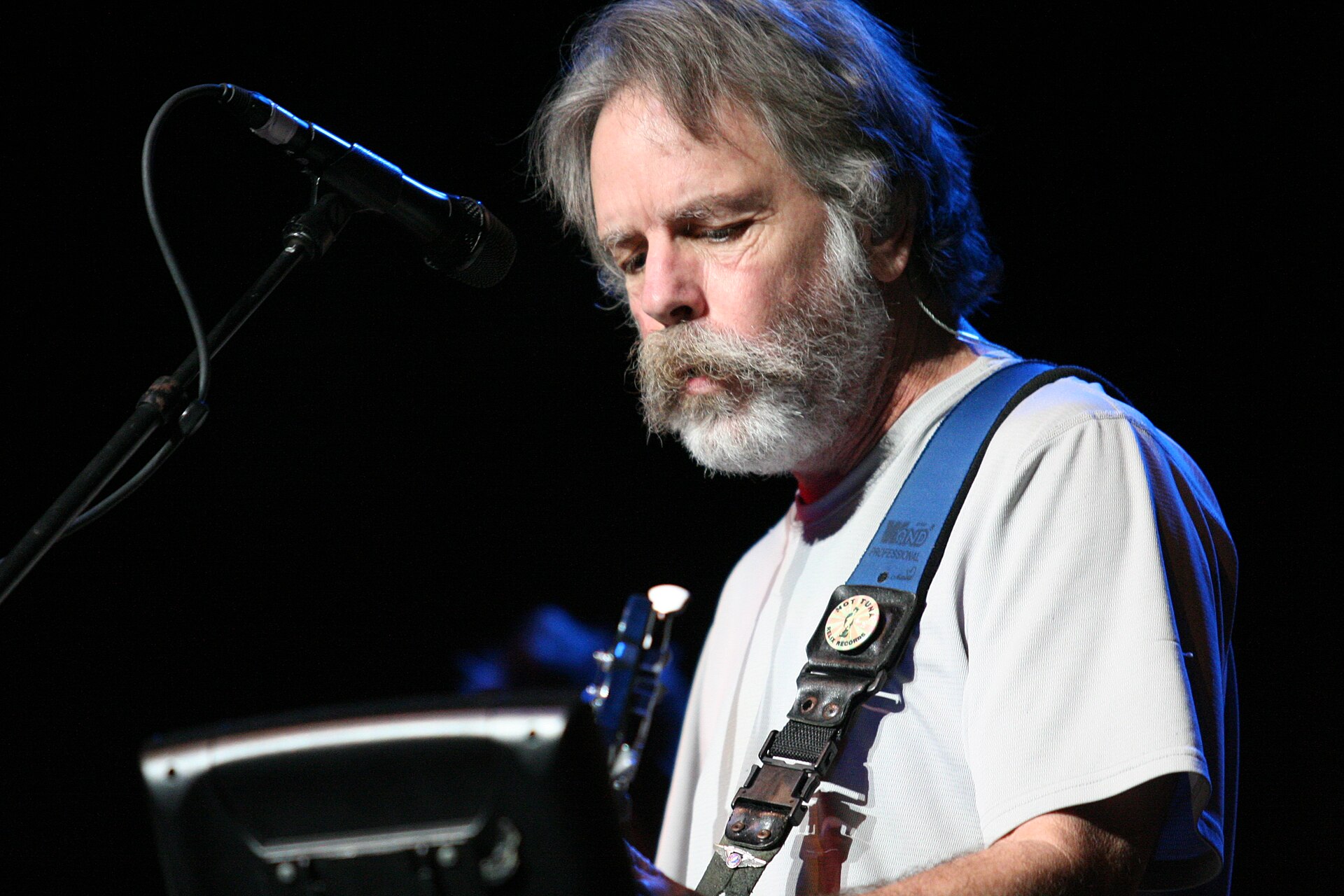
Bob Weir at the microphone in 2007. Photo: minds-eye, CC BY-SA 2.0, via Wikimedia Commons.
Guitar Player reported on 14 January 2026 that Zach Bryan had been given a road-worn Fender Telecaster that once belonged to Bob Weir, a wedding gift from his wife, Samantha Leonard. The story ran days after Weir died on 10 January 2026, and it points at something the record of his gear makes plain: the guitar in his hands changed often, and the paperwork did not always keep up.
Bob Weir, rhythm guitarist and co-founder of the Grateful Dead, left a gear trail that is detailed in some places and thin in others. His signature guitars with D’Angelico, the Ibanez Cowboy Fancy reissue and a Pigtronix acoustic pedal come with maker pages and magazine write-ups. His amps, and much of the rig between the 1960s and the 1990s, rest on auction catalogues, fan lists and reference-site summaries that disagree with each other. Below we keep the two apart, give years only where a source gives them, and say where we could not confirm a claim.
The Rig
Guitars
In a review of the reissue in the November 2016 issue of Vintage Guitar, Pete Prown writes that Ibanez built a custom solidbody for Weir around 1976. The “Ace” inlay at the 20th fret is named, per the same piece, for Weir’s 1972 solo album Ace. Wikipedia’s guitar section and a fan blog add that Weir began developing a custom instrument with Ibanez’s Jeff Hasselberger in 1974, that the sliding-pickup Ibanez 2681 was a testbed during the Blues for Allah sessions, and that he played the Cowboy Fancy from 1976 to the mid-1980s. We treat those details as leads rather than settled history, because neither source points to a primary document we could open.
The reissue, called the BWM1 in the Vintage Guitar review, gives a clear picture of what the original was built to do. It has a swamp ash body with a mother-of-pearl “tree of life” motif, a five-piece maple and walnut neck-through, a 25.5-inch scale and a bound ebony fingerboard with 22 frets. The pickups are two DiMarzio PAF 36th Anniversary humbuckers at the bridge and neck with a DiMarzio Area 61 single-coil in the middle. Four selector switches turn each pickup on or off, and the bridge and neck humbuckers can be coil-tapped. Controls are master volume, tone and an EQ level knob for a battery-powered preamp that adds bass, mid and treble. The review puts the weight at over 9.5 pounds. For background on the humbucker type behind the neck and bridge pickups, see our PAF humbuckers explained guide.
Guitar Player has also run a feature under the headline “Bob Weir on the guitar he stole from George Benson,” which concerns an Ibanez model. The text of the article was not readable to us, so we do not repeat the story here.
Sotheby’s sold a Blackknife as lot 224 in its “From the Vault: Property from the Grateful Dead and Friends” sale, which closed on 14 October 2021. The lot is described as property of Bob Weir and as used on stage by him with the Grateful Dead. Per the catalogue, it is a US-made guitar with no serial number, with graphite neck-through-body construction, a laminate body of maple, ash and walnut, three active EMG single-coil pickups each with an on/off switch, master volume and tone controls, and a Floyd Rose bridge and locking nut. The estimate was 5,000 to 7,000 USD. Those specifications describe this one guitar, not every Blackknife. Wikipedia and the same fan blog say Weir moved to a Blackknife after the Cowboy Fancy years and used a hybrid Modulus and Casio guitar for the “Space” segment; neither gives a year, and we could not trace either claim to a primary source.
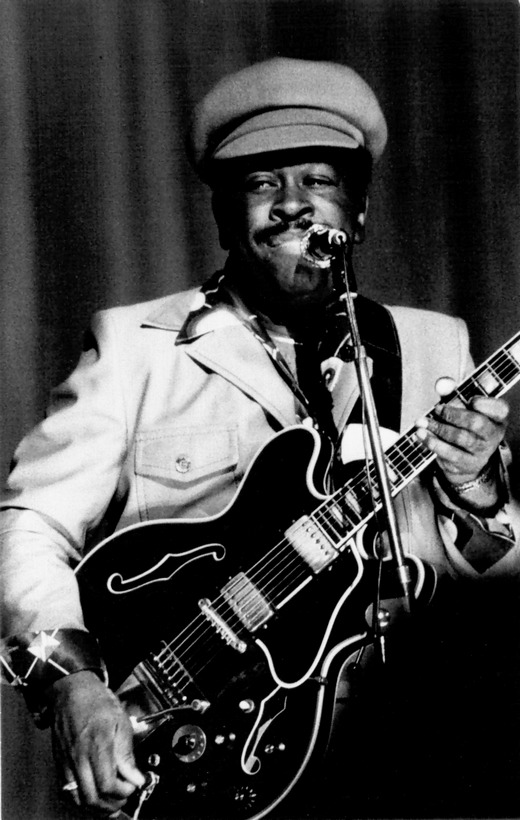
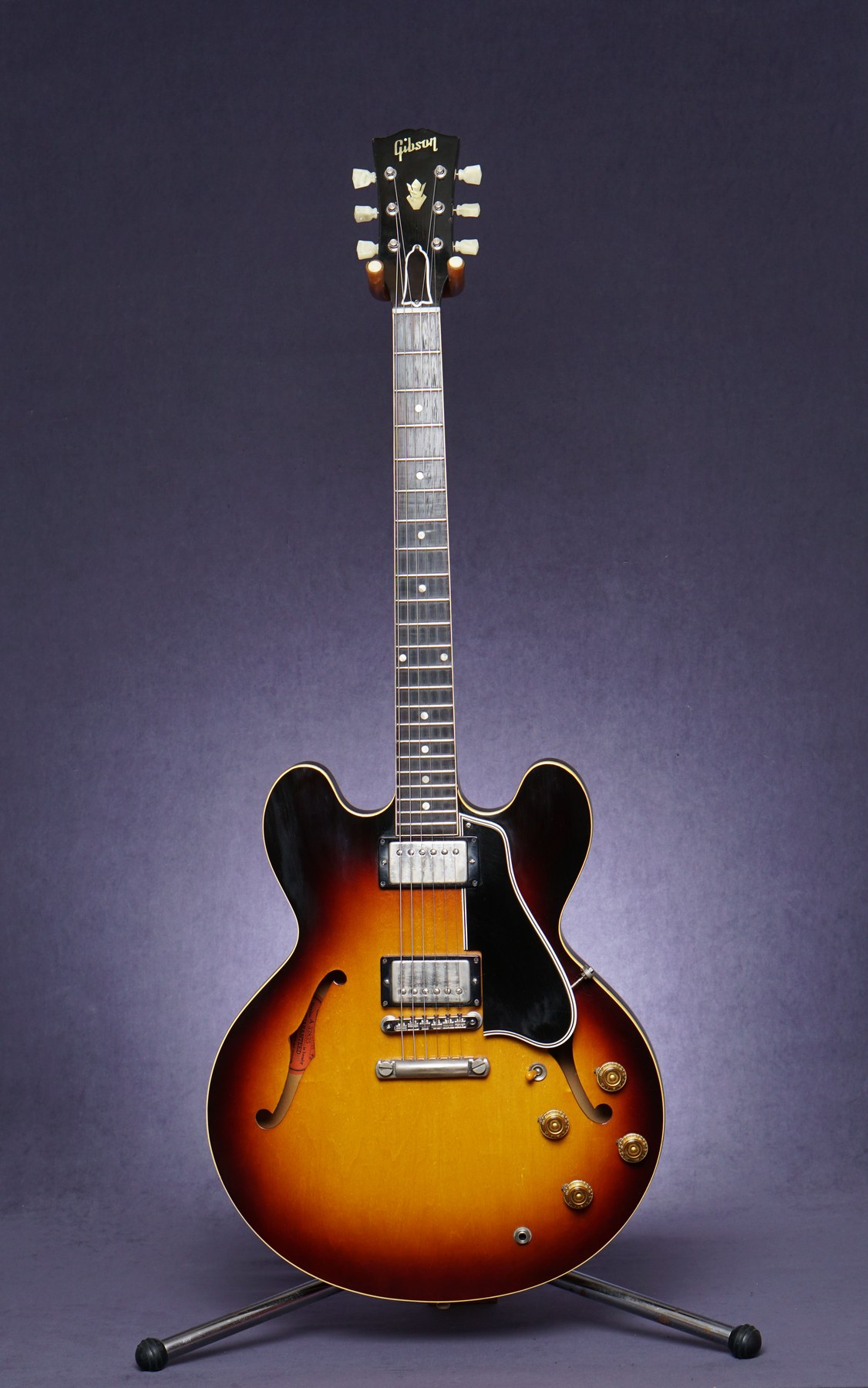
The ES-335 appears in nearly every account of Weir’s guitars, but the sources do not agree on which one. Far Out magazine’s Tom Taylor, writing on 18 July 2022, calls a 1958 ES-335 Weir’s first trusted guitar. The Uber Pro Audio gear list gives a 1959 ES-335 in tobacco sunburst. Wikipedia’s guitar section says he settled on a cherry red 1965 ES-335 as his main guitar for about a decade and played a sunburst ES-335 in The Grateful Dead Movie, filmed in October 1974. Guitar Player’s 2026 retrospective on a 1998 interview is described as having Weir name an early-1970s ES-335 as one of his two favourite guitars; we could not read the article body to check it. We cannot say which of these is right, and they may describe different guitars. Our Gibson ES-335 guide covers the model itself.
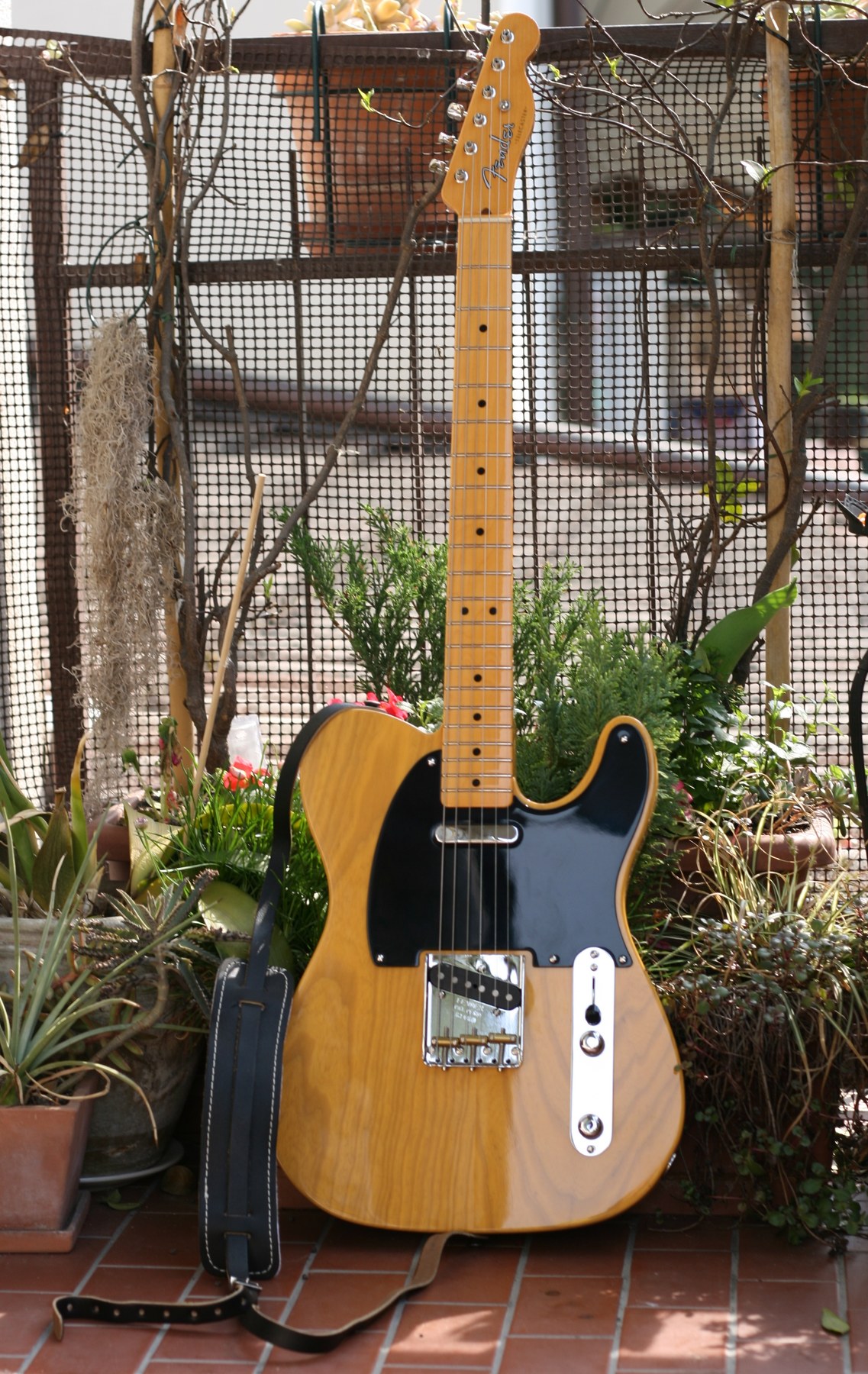
Guitar Player’s January 2026 article is about a Telecaster that Weir owned, and Wikipedia says he played a Telecaster briefly after the band formed; we could not read enough of the article to say more about his early Telecasters. Sotheby’s 2021 sale also listed lot 182, titled “Bob Weir | Fender, 1969, Rosewood Telecaster,” with an estimate of 20,000 to 25,000 USD; the catalogue page gives no further specification. Nothing we read ties the Telecaster given to Bryan to that lot or to any particular year, so we do not match them. If you are comparing the Telecaster with other classic solid-bodies, our solid-body comparison is the place to start.
Guitar.com’s Evigan Xiao reported on 16 January 2020 that D’Angelico had announced this as its first signature solid-body model, at $999 with availability promised for January. The guitar has a basswood body, a maple, walnut and maple set neck, an ovangkol fingerboard, a six-point tremolo, and two Seymour Duncan Designed P-90s at the neck and bridge with an SC-101 single-coil in the middle. A blender knob mixes the neck and bridge pickups, or all three in the in-between positions. D’Angelico’s own page lists a 24.75-inch scale, a 14-inch radius, 22 frets, a five-way blade selector, push/pull volume and tone controls and a made-in-Indonesia build, in Matte Stone only. In a launch statement quoted by JamBands and Guitar.com, Weir said that the more sounds an instrument has, the more colours it gives a player to work with. For how P-90s sit between single-coils and humbuckers, see our P-90 comparison.
D’Angelico’s page for the Deluxe version lists two stacked Seymour Duncan DA-90 P-90 pickups at the neck and bridge, a Lollar Blonde single-coil in the middle, one volume, one tone and one blend control, a pau ferro fingerboard, Grover 509 Super Rotomatic locking tuners, gold hardware and a made-in-Korea build. The page lists it at $1,999.99 as we read it on 16 October 2026. Its text says Weir co-designed the guitar and that the push/pull knobs drop out the dummy coil, which D’Angelico says makes the stacked P-90s quieter and the tone more open. Guitar.com’s 2020 report says the Premier model followed a Bob Weir Deluxe Signature series released in 2019.
This is a single-cutaway semi-hollow with two custom TV Jones DA’Tron humbuckers, a 25-inch scale, 22 frets and a made-in-Korea build, per D’Angelico’s page. The page lists the Satin Trans Wine version at $2,199.99 as we read it on 16 October 2026, and its text says the guitar was road-tested with Dead and Company and with Bobby Weir and Wolf Bros. It gives no release date. Guitar Interactive Magazine’s announcement of this third signature model is dated 8 August 2024, and Guitar World’s headline has Weir saying he plugged it in at a soundcheck, cranked it up and decided it was what he was looking for. We could not read the Guitar World article’s body, so the headline is all we can offer from it.
JamBase’s Scott Bernstein wrote on 5 August 2016 that Weir played a Martin at a New York showcase for the Blue Mountain album and that, according to the article, it was the only instrument he used during the sessions; the piece gives no model. Retailer listings describe the Alvarez-Yairi WY1 as designed with Weir, and Wikipedia lists WY1 Bob Weir signature acoustics among his instruments. We could not open an Alvarez page for the model, so we give no specifications.
Amps
Sotheby’s 14 October 2021 sale listed lot 40 as “Wall of Sound | Bob Weir’s MC 2300,” estimated at 3,000 to 5,000 USD, and lot 44 as “Wall of Sound | Weir’s cab,” estimated at 2,000 to 3,000 USD. The sale introduction says it included amplifiers that powered the guitars of Jerry Garcia and Weir. The catalogue pages we read give no year and no further description. Live for Live Music’s Michael Broerman, reporting on 18 October 2021, wrote that the sale included nearly 40 of Weir’s guitars, many of them used on stage.
Uber Pro Audio’s gear list for Weir gives Mesa Boogie Stereo Rectifier 2:100 power amps driving two single 12-inch cabinets with Tone Tubby speakers, plus Vox cabinets used only for stage sound while his guitar signal goes to a direct box. The list cites no primary source and gives no year for any of the amplifiers, so we treat it as unconfirmed.
Effects
Premier Guitar’s news item of 6 July 2018, a press release dated 5 July, describes an all-analog acoustic preamp that splits the signal into low and high bands, applies separate gain to each and recombines them into a mono output. A single knob sweeps the filter point from 300 Hz to 3 kHz, and the pedal takes one source or two, with a balanced microphone input that has phantom power and an 18V DC supply. Pigtronix’s own page adds 24 dB per octave optical filters, 60 dB of gain on the microphone channel and phase inversion. The release quotes Weir saying that a real acoustic guitar has three-dimensional depth and that the only way to capture it is with a microphone. It also has him saying the design cuts about 90 percent of the feedback a microphone brings; that is a claim from the maker’s side of the table, and we found no independent measurement of it.
Where the Sources Disagree
The clearest conflict is the D’Angelico timeline. Wikipedia and the fan blog list a semi-hollow Premier in 2017 and a solid-body Deluxe Bedford in 2020. Guitar.com’s January 2020 report, though, describes the Premier Bedford as D’Angelico’s first signature solid-body and says a Deluxe signature series came in 2019, and D’Angelico’s own pages show both the Premier Bedford and the Deluxe Bedford as solid-bodies. We follow the manufacturer and Guitar.com for the Bedford models and flag the rest as unresolved.
The ES-335 is the second conflict, covered above: 1958, 1959, 1965 and early 1970s all appear. The third is price. D’Angelico’s Premier Bedford page lists $1,099.99 while its own video captions say $999, which matches the launch price Guitar.com reported in 2020. We give no price for the Premier beyond the 2020 launch figure.
What We Could Not Confirm
We found no maker page or magazine source for a Fender Twin Reverb, a Languedoc custom guitar or Ultra-Sound acoustic amplification in Weir’s rig, so none of them is listed above. We also did not find a primary source for the Mesa/Boogie models, and Mesa’s own artist page for Weir would not load for us. The pickups in his Gibson ES-335 and the exact specification of the Alvarez-Yairi signature acoustic are likewise unconfirmed.
Next to Jerry Garcia and John Mayer
Weir’s rig is often set beside Jerry Garcia’s, and our Jerry Garcia guitars and gear guide covers the other half of the Grateful Dead’s guitar story. For the later Dead and Company years, D’Angelico’s page ties the Deluxe Bobby Weir 3 to road testing with that band, and our John Mayer guitars and gear guide covers the guitarist who shared the stage with Weir in it.
Frequently Asked Questions
What was Bob Weir’s main guitar?
No single guitar fits the whole record. The best-documented custom instrument is the Ibanez Cowboy Fancy from around 1976, per Vintage Guitar. A Gibson ES-335 recurs in the accounts, though sources date it differently. D’Angelico’s own pages present the Bedford and Bobby Weir 3 as his signature models, and the Bobby Weir 3 page says it was tested on stage with Dead and Company and Wolf Bros.
What pickups are in the Bob Weir Bedford?
The Premier has two Seymour Duncan Designed P-90s with an SC-101 single-coil in the middle. The Deluxe has stacked Seymour Duncan DA-90 P-90s with a Lollar Blonde single-coil in the middle, per D’Angelico’s pages.
What acoustic pedal did Bob Weir design?
Pigtronix released Bob Weir’s Real Deal in 2018, an analog acoustic preamp with a 300 Hz to 3 kHz filter sweep and a balanced microphone input with phantom power, according to Premier Guitar’s news item and Pigtronix’s page.
Can you buy a replica of the Cowboy Fancy?
Ibanez made a reissue, reviewed in Vintage Guitar’s November 2016 issue as the BWM1 at a street price of $7,999.99 at that time. We did not check availability or pricing after that review.
Image credits
- Fender Telecaster: Massimo Barbieri, Wikimedia Commons, CC BY-SA 3.0.
- Gibson ES-335: Lightburst, Wikimedia Commons, CC BY-SA 4.0.
- Top image: Bob Weir at the microphone in 2007, minds-eye, Wikimedia Commons, CC BY-SA 2.0.