Bombino Guitars & Gear: The Complete Guide to the Sultan of Shred of the Sahara
Two of his bandmates were executed.
In 2007, the second Tuareg rebellion erupted in Niger. The government, determined to crush it in all its forms, banned guitars — the instrument had become a symbol of Tuareg resistance, a political statement made of wood and wire. Some of Bombino’s musical cohorts were accused of being Tuareg rebels and killed. Bombino fled to Burkina Faso.
He said: “I do not see my guitar as a gun but rather as a hammer with which to help build the house of the Tuareg people.”
He had learned to play guitar from a VHS tape of Jimi Hendrix. He learned while watching his relatives’ sheep in Algeria, a refugee from the first Tuareg rebellion, using a six-string that visiting rebels had left behind. He studied with Tuareg master guitarist Haja Bebe, who gave him the nickname Bombino — a misspelling of the Italian “bambino,” meaning “little child,” given to him because he was the youngest in the band.
From exile in Burkina Faso, filmmaker Ron Wyman tracked him down in 2009 and helped him make a proper record. The album Agadez (2011) launched him internationally. Dan Auerbach of the Black Keys heard it and produced Nomad (2013) in Nashville. The New York Times called him “the Sultan of Shred.” NPR called him one of the world’s best guitarists. He was Grammy-nominated — the first Nigerien artist ever nominated.
He still doesn’t use a pick. He never has. He plays with bare fingers on an electric guitar in the Sahara.
That, and the music of people who have survived what his people have survived, is the complete story.
Background: Agadez, Algeria, Exile, and the Guitar as Political Act
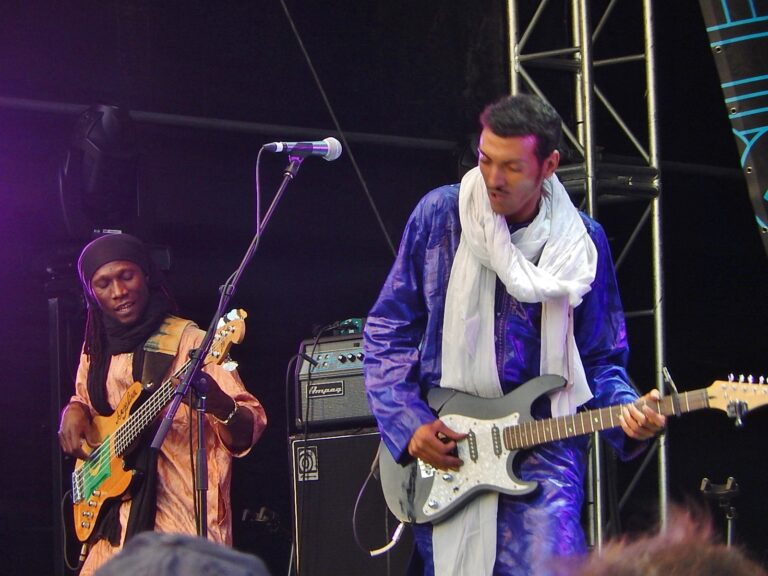
Omara Moctar — known as Bombino, or sometimes Goumour Almoctar — was born January 1, 1980, in Tidene, Niger, a nomadic Tuareg encampment about eighty kilometers northeast of Agadez. He is a member of the Ifoghas tribe, part of the Kel Air Tuareg federation. The Tuareg are a Berber people, nomadic Saharan traders and warriors who have inhabited the desert regions of Niger, Mali, Algeria, Libya, and Burkina Faso for centuries.
His childhood was immediately marked by political crisis. In 1984, a severe drought decimated the region’s livestock and forced mass migration. Then, in 1990, the first Tuareg rebellion began — Tuareg fighters attacked government installations in Niger and Mali; the governments responded by declaring Tuareg people enemies of the state. Bombino’s father, grandmother, and he fled to Algeria.
In Algeria, visiting relatives left two guitars behind for a few months. Bombino learned to play by scrutinizing VHS and cassette tapes of rock guitarists like Mark Knopfler and Jimi Hendrix. He also absorbed the ishoumar style — the guitar music that Tuareg rebels and exiles had developed, influenced by both traditional Tuareg music and the Western rock they’d encountered. He also studied formally with a master Tuareg guitarist, Haja Bebe, who gave him the nickname Bombino, meaning “the kid” — an acknowledgement of his precociousness.
When the first rebellion ended in 1995, Bombino’s family returned to Agadez. His uncle Rissa Ixa, a renowned Tuareg painter, gave him a guitar. He joined Haja Bebe’s band and developed his playing. He performed at political rallies, weddings, and ceremonies. He spent time as a shepherd in Libya between engagements. He recorded early albums known only within Niger in 1998, 2004, and 2007.
In 2006, he traveled to California with the band Tidawt for a tour. During that trip, he recorded a desert blues version of the Rolling Stones’ “Hey Negrita” with Keith Richards and Charlie Watts. He later admitted he had never heard of the Rolling Stones — white rock musicians don’t have a strong following in Africa. He also served as Angelina Jolie’s guide to the Niger desert during a weeklong visit, playing her the music of the Tuareg and telling her stories of nomadic life in the Sahara.
Then came 2007, the second rebellion, the ban on guitars, the executions of his bandmates. Exile in Burkina Faso. Ron Wyman finding him in 2009. Agadez (2011). Dan Auerbach. Nashville. The Grammy nomination. The first Nigerien artist ever nominated for a Grammy. Thousands of Nigeriens attended a parade to welcome him home from the Grammy Awards ceremony.
He continues recording and touring globally, working with producers in Nashville, Woodstock, and Casablanca. He sings in Tamasheq — the Tuareg language. He advocates for Tuareg culture, education, and rights. He plays guitar in a culture where, in recent memory, playing guitar was a political act dangerous enough to get you killed.
Tone note: The government banned guitars because guitars were symbols of rebellion. Two of his bandmates were executed. He said the guitar was a hammer for building, not a gun for fighting. Then he was driven into exile again, waited for a filmmaker to find him, made an album, went to Nashville, got a Grammy nomination, came home to a parade. The guitar survived. The music survived. The political conditions that made it dangerous are still present. He is still playing.
The Rig: Bombino’s Guitars, Amps & Gear
Guitars: Fender Electric as the Voice of the Desert
The First Guitar — Left Behind by Rebels
The guitar that started everything was not purchased, not given as a birthday present, not found in a store. It was left behind by relatives who had come from the front lines of the 1990 Tuareg rebellion to visit family in exile in Algeria. They were carrying guitars — instruments that the rebellion had adopted as symbols of resistance and as vehicles for the ishoumar protest songs. When they left, they left the guitars behind for a few months.
Bombino kept one. He taught himself on it, watching VHS tapes of Jimi Hendrix and Mark Knopfler. The rebel’s guitar became the guitarist’s guitar. The political instrument became the musical instrument. The process was the same: he played notes in imitation of what he heard, first the ishoumar songs of the rebellion, then the Western rock on the tapes.
This origin story — the guitar as literally a weapon of resistance, left by fighters for a child to learn on — is the most politically loaded gear origin in this entire series. The instrument came from a conflict. The music it produced documented and served that conflict. The tradition continues.
Tone note: He learned guitar on an instrument left behind by fighters from the Tuareg rebellion. Not a gift from his parents, not a purchase from a music store — a weapon left by soldiers for a child who happened to be in the same house. The guitar arrived from conflict and was turned toward music. This is the complete origin story of the Tuareg guitar tradition: the instrument came from the rebellion, and the music that came from the instrument served the rebellion. Everything that followed was the continuation of this initial moment.
Fender Stratocaster — The Primary Electric Guitar
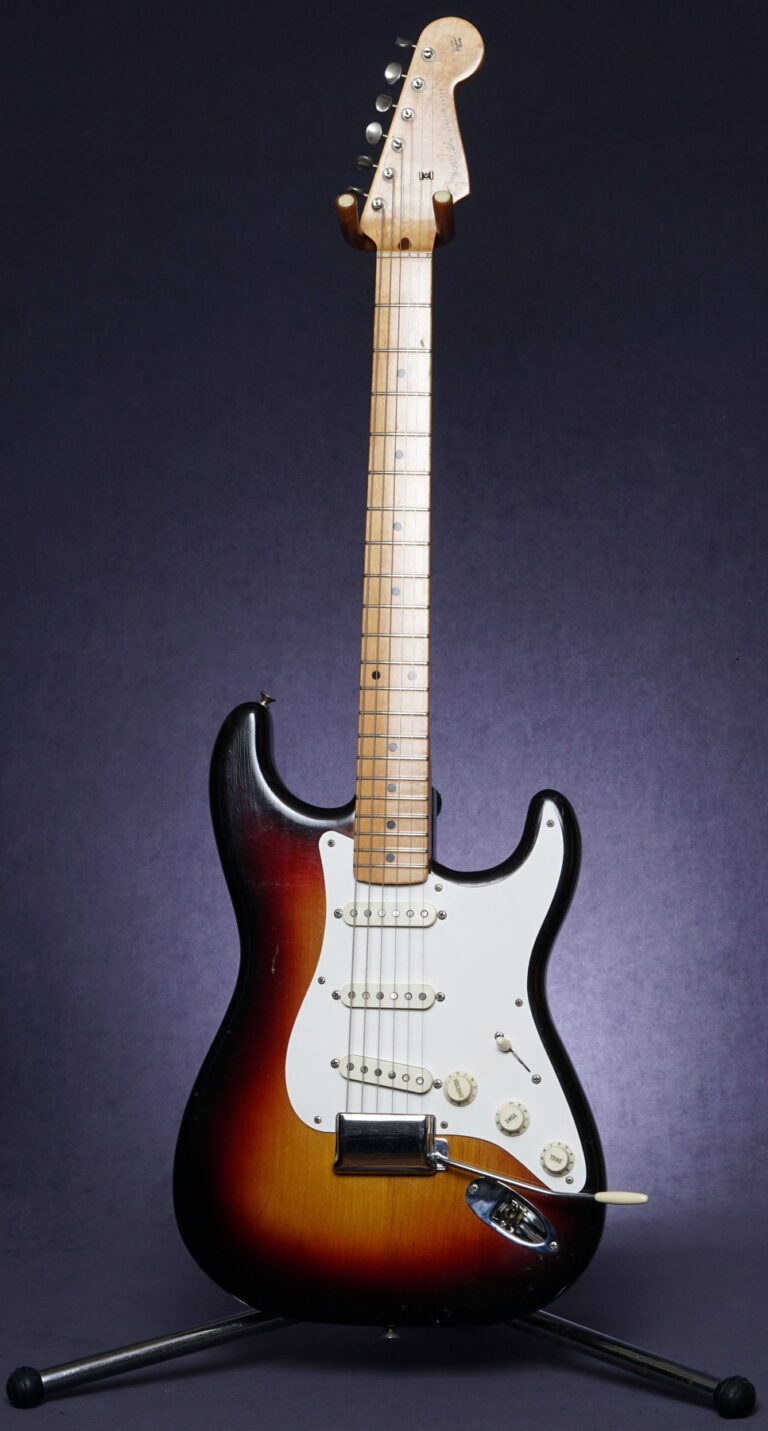
Bombino plays Fender Stratocasters as his primary electric guitar — the instrument most consistently documented across his recording and touring career. Bombino synthesized his own style from traditional Tuareg and Western blues and rock, and the Stratocaster is the Western instrument through which this synthesis flows. Its single-coil pickups produce the specific bright, present tone that suits the desert blues character — clear, cutting, with the clean-to-slightly-overdriven response that Bombino’s playing style requires.
The Stratocaster’s three pickups provide the tonal range he needs: the bridge pickup for the aggressive, trebly attack of fast runs; the middle pickup for a balanced, warm tone in the midrange; the neck pickup for the warmer, more vocal character of slower melodic passages. His playing moves between these tonal positions as the music requires — not through deliberate switching but through the natural evolution of performance.
The specific Stratocasters he uses across different performance and recording contexts vary — he is not documented as maintaining one specific iconic guitar in the way that Roy Buchanan’s Nancy or Tony Rice’s D-28 define those players. His instruments are working tools, chosen for their playability and sound in the specific context rather than for their vintage provenance or collector value.
Acoustic Guitars — The “Dry Guitar” Style
Alongside his primary electric work, Bombino also plays acoustic guitar in the traditional “dry guitar” style — the acoustic, unplugged Tuareg guitar approach that predates amplification and continues alongside it. The A-side contains acoustic performances, in the ‘dry guitar’ style on his Group Bombino – Guitars from Agadez album, confirming the acoustic tradition as a distinct and maintained part of his musical practice.
The “dry guitar” style — acoustic, without amplification — is the most direct connection to the guitar’s origins in the Tuareg resistance movement. It is the sound of the instrument in its most essential form, without the electric amplification that performing for large international audiences requires.
Complete Guitar Notes
- Guitar left by Tuareg rebels (Algeria, 1990) — First guitar; self-taught from VHS tapes of Jimi Hendrix and Mark Knopfler; ishoumar protest songs learned before Western rock
- Guitar from Uncle Rissa Ixa (after 1995 return to Agadez) — Gift from renowned Tuareg painter uncle; instrument for study with Haja Bebe; professional starting point
- Fender Stratocaster (primary electric) — Contemporary touring and recording primary; single-coil pickups; three pickup positions; the electric voice of the desert blues synthesis
- Various acoustic guitars — “Dry guitar” style tradition maintained alongside electric work
Amps: Electric Performance Setup
Bombino’s amplification for electric performance reflects his Stratocaster-based approach — clean to lightly driven tube amplification that preserves the Stratocaster’s natural single-coil character while providing the volume necessary for festival and concert performance.
His recorded work with Dan Auerbach in Nashville used Auerbach’s studio — a professional recording environment with access to a wide range of vintage and boutique amplifiers. The specific amplifiers used on Nomad reflect Auerbach’s production aesthetic: vintage-voiced, warm, with the characteristic Southern grit that Auerbach brings to his production work.
For live performance, standard professional touring amplification — consistent with the Fender or Marshall clean-to-driven platforms appropriate to Stratocaster-based playing — provides the foundation. Specific amp models are not consistently documented in primary sources with the precision found for Western artists.
Pedals & Signal Chain: Minimal
Bombino’s effects use in his primary style is minimal — the specific hypnotic, groove-based character of his playing comes from the music itself rather than from signal chain processing. When effects appear in his recordings, they reflect production choices made in collaboration with his producers rather than personal signal chain elements he carries from show to show.
The Dan Auerbach production on Nomad added “Southern grit” to the proceedings — vintage reverb and room character consistent with Auerbach’s production style. David Longstreth’s production on Azel introduced “subtly experimental aspects.” These are studio production choices rather than Bombino’s own effects vocabulary.
Strings, Picks & Setup
No Picks — The Critical Setup Detail:
Bombino told us about how he’s reconciled the worlds of traditional Tuareg music and rock, how his pieces are born as improvisations, and why he’ll never use a pick.
This is the single most important documented technical fact about Bombino’s playing: he has never used a pick and has stated he never will. He plays electric guitar with bare fingers — the same approach as Hubert Sumlin, Grant Green, Wes Montgomery, and others in this series who discovered that bare fingers provided more nuanced control than a pick.
For Bombino, the no-pick approach is not a choice made in relation to Western guitar tradition — it is the natural continuation of how Tuareg guitar was played from its origins. The ishoumar and traditional Tuareg music he learned on didn’t use picks; the technique he developed with Haja Bebe didn’t involve picks; the VHS tapes of Hendrix he studied may have shown pick technique, but his own playing developed without it.
Playing electric guitar with bare fingers on single-coil pickups produces a specific tonal quality: warmer, less bright than pick playing, with more dynamic nuance — the fingers naturally vary attack force in ways that a flatpick doesn’t. The Stratocaster’s naturally bright single coils are somewhat softened by the bare-finger attack, producing a tone that has warmth alongside clarity. This character is appropriate to both the traditional Tuareg music and the rock/blues synthesis that Bombino has developed.
The Ishoumar Influence on Technique:
The ishoumar — the guitar music developed by Tuareg exiles in Algeria and Libya during the 1970s and 1980s — is the specific tradition that formed Bombino’s fundamental guitar vocabulary before he encountered Western rock through VHS tapes. The ishoumar style uses repetitive, hypnotic patterns, drone-based melodies, and the specific pentatonic vocabulary of Tuareg music. These characteristics predate the Western rock influence and remain the foundation beneath the rock-influenced surface.
Tuning: Standard guitar tuning for most of his recorded and live work — unlike Ali Farka Touré’s G tuning, Bombino works primarily in standard EADGBE tuning, applying the Tuareg musical vocabulary within the Western guitar’s standard pitch configuration.
Tone note: He plays an electric Stratocaster with bare fingers and never will use a pick. The specific warmth that bare fingers produce on Fender single-coil pickups — less brightness than a flatpick, more dynamic nuance, more of the finger’s flesh in the attack — is exactly what the synthesis of Tuareg tradition and Western rock requires. The traditional instruments of Tuareg music are not played with picks. The guitar continues in the same tradition.
Playing Style & Tone Philosophy: When the Guitar Is Both Art and Resistance
Bombino’s playing philosophy is inseparable from the political and cultural context of the Tuareg people. His guitar is simultaneously a musical instrument, a cultural statement, a political act, and a hammer for building — his own metaphor. All of these functions inform his approach to the instrument.
The Ishoumar Tradition
The ishoumar (derived from the French “chômeur,” meaning “unemployed person”) are the Tuareg men who left their traditional nomadic lives during the droughts and conflicts of the 1970s and 1980s, working as migrants in Algeria and Libya while maintaining their cultural identity through music. The guitar became their instrument — adopted from Western culture and transformed into a specifically Tuareg form of expression.
The ishoumar guitar style uses the guitar to carry the specific pentatonic and modal scales of Tuareg traditional music, over drone-based rhythmic patterns, in a texture that balances individual melodic expression with collective rhythmic identity. This tradition — developed in exile, maintained in conflict, performed at weddings and political rallies and resistance meetings — is Bombino’s foundational musical language.
The Synthesis
It was only natural that, from his earliest days of playing, Bombino synthesized his own style from traditional Tuareg and Western blues and rock. The VHS tapes of Hendrix and Knopfler didn’t replace the ishoumar foundation — they added a layer of Western rock technique and expressiveness to a foundation that remained specifically Tuareg.
The result: melodic lines that have the athletic, climbing quality of rock lead guitar, combined with the hypnotic, repetitive patterns of Tuareg traditional music, combined with the emotional expressiveness of blues phrasing. His electrifying melodies, which enclose the spirit of resistance and rebellion, exude an irresistible groove. A version of the dense and magmatic blues, to which is added the peculiarity of breaking away from the classic metric based on the ‘call and response’ between lead singer and chorus (usually female) replacing the latter with the melodic disruptions of the guitar.
The Political Dimension
Bombino’s guitar playing cannot be divorced from its political context — and he doesn’t try to divorce it. His music is sung in Tamasheq and often addresses Tuareg geopolitical concerns. The songs address the rebellion, the exile, the deaths of friends, the dignity of the Tuareg people, the longing for peace. When he tours internationally, he brings this content with him — the Western audience hears music they may categorise as “desert blues,” and he is singing about specific historical events and ongoing political realities.
The guitar ban of 2007 is the most extreme expression of this political dimension: a government identified the guitar as a political symbol dangerous enough to prohibit. Bombino’s response — to continue making music, to go into exile, to return when the conflict ended, to record the Grammy-nominated album that brought him international recognition — is the complete political and artistic statement. The music survived. It always will.
Improvisation as Composition
Bombino told us about how… his pieces are born as improvisations. His compositions don’t begin as written melodies; they emerge from improvisational performance and are refined through repeated playing. This approach is consistent with the oral tradition of Tuareg music — where music is learned, transmitted, and developed through performance rather than notation, where each performance is a new version of a familiar structure.
The improvisational origin also explains the specific character of his guitar lines: they have the freshness and spontaneity of improvisation rather than the settled quality of composed and rehearsed music. Even in studio recordings, the melodic lines sound like they’re discovering themselves in real time — which they were.
The Dan Auerbach Partnership
The collaboration with Dan Auerbach of the Black Keys for Nomad (2013) is his most celebrated production partnership. Auerbach heard Agadez and was immediately drawn to Bombino’s playing — the specific combination of Tuareg groove and blues-adjacent guitar tone resonated with Auerbach’s own blues-rooted aesthetic.
Auerbach recorded Nomad, Bombino’s 2013 album, in his Nashville studio, adding a little Southern grit to the proceedings. The production preserved Bombino’s musical identity while adding the recording quality and sonic depth that Nashville’s professional infrastructure could provide. The result — Nomad debuting at number one on the Billboard World Chart and the iTunes World Chart — confirmed that the music could reach international audiences without losing its specific cultural character.
How to Sound Like Bombino: The Desert Blues Guitar Tone
Bombino’s tone is achievable with a Stratocaster, bare fingers, and a commitment to the specific musical approach — drone-based, hypnotic, repetitive, melodically athletic. The technique is the dominant element.
The Guitar
Fender Stratocaster, primary electric. The three-pickup configuration provides the tonal range; the single-coil character provides the brightness balanced by bare-finger warmth.
- Fender American Professional Stratocaster — Current production with appropriate single-coil character
- Fender Player Stratocaster — More accessible; same three-pickup single-coil configuration
- Any Stratocaster with single-coil pickups — The single-coil brightness, softened by bare fingers, is the tonal foundation
The Amp
Clean to lightly driven tube amplifier — Fender or similar. The amp should produce natural compression at working volume without excessive saturation. The Stratocaster’s natural character does most of the tonal work.
| Control | Setting | Notes |
|---|---|---|
| Volume | 6–7 (clean to edge of breakup) | The bare-finger attack is naturally softer than a pick; the amp can run slightly hotter than with a pick |
| Treble | 5–6 | The bare fingers reduce the Stratocaster’s natural brightness; the amp can be slightly brighter to compensate |
| Middle | 5–6 | Present; the Tuareg melodic lines require clear midrange definition |
| Bass | 4–5 | Warm but controlled; the drone-based approach doesn’t require heavy bass |
| Reverb | Light spring or room | Adds spatial depth appropriate to the desert music aesthetic without washing out the melodic clarity |
No Pick — Essential
Play with bare fingers. He has stated he will never use a pick. The technique requires developing the bare-finger attack on electric guitar strings — the initial adjustment from pick to fingers, the development of consistent attack force and angle, and the specific tonal quality that results. Practice the single-note melodic lines using index and middle fingers alternating, as in classical guitar or bass guitar finger technique, applied to lead melodic work on the Stratocaster’s strings.
The Tuareg Musical Approach
The foundational approach: stay on one tonal center for extended periods, developing the melody through repetition and variation rather than harmonic movement. The Tuareg pentatonic scale — similar to the major pentatonic — over a drone foundation. Repeat the central melodic phrase; vary it slightly each repetition; build intensity through the accumulation of repetitions rather than through chord changes or modulation.
Listen to ishoumar music — the Tuareg protest song tradition — before attempting to play in the style. The ishoumar of Tinariwen (the most internationally known Tuareg band) and Bombino’s own recordings provide the musical reference for what the approach actually sounds like in practice. The guitar lines in this tradition are athletic, climbing, energetic — but always in service of the groove, always returning to the drone foundation.
Budget vs Authentic
Budget:
- Guitar: Squier Classic Vibe Stratocaster; three single-coil pickups
- Amp: Fender Blues Junior (clean)
- No picks — bare fingers only
- Listen to ishoumar music for the musical approach
Authentic:
- Guitar: Fender American Professional Stratocaster
- Amp: Fender Twin Reverb or similar vintage-voiced clean tube amplifier
- No picks — bare fingers
- Immerse in Tuareg music tradition before playing
Influence & Legacy: The Voice of a People Who Were Silenced
Bombino’s influence extends in two directions simultaneously: within the Tuareg cultural tradition, where he has brought international recognition to a music that was literally banned during his career, and within the broader world music and guitar communities, where he has demonstrated that guitar virtuosity in a non-Western tradition can reach and affect audiences globally.
The documented connections and influences:
- Dan Auerbach (Black Keys) — Produced Nomad; the cross-cultural production partnership that brought Bombino to major international attention
- Keith Richards and Charlie Watts — Recorded “Hey Negrita” with him in 2006; Bombino admitted he had never heard of the Rolling Stones
- Tinariwen — The Tuareg band from Mali that Bombino identifies with; the Tuareg guitar tradition’s most internationally known earlier practitioners; he and Tinariwen confirmed “the idea of their music as essentially rebellious” at a Paris concert
- Ali Farka Touré — One of the VHS-tape heroes he learned from; the Malian guitar tradition that informed the Tuareg guitar tradition that formed him
- Mdou Moctar — The younger Tuareg guitarist whose work extends the tradition Bombino represents
- Global Tuareg awareness — His tours and recordings have brought Tuareg culture, history, and political situation to audiences who would otherwise have had no awareness of it
Noisey called Bombino “the World’s Best Guitarist™.” The New York Times called him “the Sultan of Shred.” Rolling Stone compared his live energy to Jimi Hendrix. These are Western critical assessments of an artist playing a music that exists in a completely different frame of reference from the Western tradition these critics were trained to evaluate. The assessments are genuine; the frame is borrowed.
He is the first Nigerien artist ever nominated for a Grammy Award. Thousands of proud Nigeriens attended a parade to welcome Bombino home from the Grammy Awards upon his return to Niamey. In a country where the guitar was banned because it was a symbol of resistance, the international recognition of the guitar player became a national celebration.
He says: “They will dance. They will dance all the night. And when the public come, they forget their problems. And you learn the world is not just your city — the world is big. We are all different, but we are all human. And we can live together — and dance!”
He plays for them to dance. The government bans the guitar. The music survives. The dance survives. The people survive.
Tone note: He learned guitar in exile from VHS tapes. His bandmates were executed. He recorded a Grammy-nominated album in Nashville with the Black Keys’ producer. He came home to a parade. He still plays with bare fingers. He still sings in Tamasheq. He still addresses the Tuareg political situation. The guitar, for him, has always been a hammer for building. He has been building for thirty years, in exile and in performance, in the desert and in Nashville, on the same Stratocaster with the same bare fingers. The house he is building is still under construction.
In Algeria in 1990, rebels from the Tuareg uprising visited their relatives in exile and left two guitars behind for a few months. A ten-year-old boy named Goumour Almoctar — later Bombino — kept one. He taught himself from VHS tapes of Jimi Hendrix. He learned the ishoumar songs. He studied with Haja Bebe, who called him Bombino, the little child. He played weddings and political rallies in Agadez. Two of his bandmates were executed. He fled to Burkina Faso.
A filmmaker found him in 2009. Dan Auerbach found him in 2012. Nashville found him. The Billboard World Chart found him. The Grammy nomination found him. A parade in Niamey found him.
He still doesn’t use a pick. He still sings in Tamasheq. He still says the guitar is a hammer for building, not a gun for fighting.
He says they will dance all night. He says the world is big and we are all human. He says we can live together and dance.
The guitar was banned. The dance survived. The building continues.
If Bombino’s Tuareg desert guitar — the Stratocaster with bare fingers, the ishoumar tradition, the political music that survived a ban — has you exploring the West African guitar tradition, check out our complete guide to Ali Farka Touré’s guitars and gear — the Malian guitarist Bombino learned from on VHS tapes, and whose tradition of guitar as translation of ancient African music informed the ishoumar tradition that formed Bombino.
And for the producer who heard Bombino’s music and immediately understood what it was, bringing it to Nashville and to international audiences without losing its essential character, don’t miss our breakdown of Dan Auerbach’s complete gear guide.
FAQ: Bombino Guitars & Gear
- What guitar does Bombino play?
- Bombino’s primary electric guitar is the Fender Stratocaster — the three-pickup, single-coil instrument that provides the bright, cutting tone he uses for his desert blues melodic lines. He also plays acoustic guitar in the traditional Tuareg “dry guitar” style. His first guitar was left behind by Tuareg rebels during the 1990 uprising in Algeria; a later guitar was a gift from his uncle, the renowned Tuareg painter Rissa Ixa. He is not documented as maintaining one iconic “signature guitar” in the way of some Western artists — his instruments are working tools rather than collectibles.
- Does Bombino use a guitar pick?
- No — and he has stated he never will. He plays electric guitar with bare fingers. Premier Guitar confirmed he explained “why he’ll never use a pick.” This approach is consistent with the Tuareg musical tradition from which he comes — the traditional instruments of Tuareg music are not played with picks, and the ishoumar guitar style he learned from Haja Bebe and from VHS tapes of Jimi Hendrix didn’t involve picks. Playing the Fender Stratocaster’s single-coil pickups with bare fingers produces a warmer, more nuanced attack than a flatpick — less bright, with more dynamic variation between strokes.
- Why was Bombino’s guitar banned?
- During the second Tuareg rebellion in Niger in 2007, the government banned guitars for Tuareg people — the instrument had become a symbol of the resistance movement. Two of Bombino’s bandmates were accused of being rebels and executed. Bombino fled to Burkina Faso. He described his guitar as “a hammer with which to help build the house of the Tuareg people” rather than a weapon. When filmmaker Ron Wyman tracked him down in exile in 2009, the eventual result was the album Agadez (2011), which launched his international career.
- Who produced Bombino’s album Nomad?
- Dan Auerbach of the Black Keys, who recorded Nomad at his Nashville studio in 2012-2013. Auerbach heard Bombino’s Agadez album and was drawn to the music, travelling to Niger to meet him and eventually producing Nomad in Nashville. The album debuted at number one on the Billboard World Chart and iTunes World Chart, and established Bombino as an international star. Auerbach “added a little Southern grit to the proceedings” while respecting the Tuareg musical identity at the music’s heart.
- What is the ishoumar guitar style?
- The ishoumar (from the French “chômeur,” meaning “unemployed”) were Tuareg exiles who developed their own guitar style in Algeria and Libya during the droughts and political conflicts of the 1970s and 1980s. Using guitars adopted from Western culture, they developed a music that combined traditional Tuareg pentatonic and modal scales with the hypnotic, drone-based repetitive patterns of traditional Tuareg music. Ishoumar songs addressed the rebellion, exile, and political situation of the Tuareg people. This style — before Bombino encountered Jimi Hendrix on VHS — was his foundational guitar vocabulary, learned from Haja Bebe and from the songs of the resistance movement.
- What connection does Bombino have to the Rolling Stones?
- In 2006, while touring California with the band Tidawt, Bombino recorded a desert blues version of the Rolling Stones’ “Hey Negrita” alongside Keith Richards and Charlie Watts for the album Stone’s World: The Rolling Stones Project Volume 2. He later admitted he had never heard of the Rolling Stones — white rock musicians don’t have a strong following in Africa. He also served as Angelina Jolie’s guide to the Niger desert during a weeklong visit in the same year.
- How do I get Bombino’s guitar tone?
- Fender Stratocaster (or any three-pickup single-coil electric guitar) through a clean to lightly driven tube amplifier. No pick — bare fingers exclusively. Moderate amp settings: volume at 6-7, treble 5-6 (bare fingers soften the Strat’s natural brightness), middle 5-6, bass 4-5, light spring or room reverb. The essential musical approach: stay on one tonal center for extended periods, develop melodic lines using the major pentatonic scale over a drone foundation, and build intensity through repetition and variation rather than harmonic movement. Listen to ishoumar music and Bombino’s recordings — particularly Nomad and Agadez — to understand the musical tradition before attempting the technique.
Bombino at Africa Now!, Apollo Theater, New York, 26 March 2016. Photo: Africa Now! (2016) – Bombino – Apollo Theater by Steven Pisano / CC BY 2.0. Source previously processed in Lightroom 5.6. Cropped to a 16:9 head-and-shoulders portrait, resized and JPEG encoded; hands and guitar are outside the portrait. Natural concert grain and lighting retained.
Image credits
- Top image: Steven Pisano, Wikimedia Commons, CC BY 2.0.
- Fender Stratocaster: Lightburst, Wikimedia Commons, CC BY-SA 4.0.
- Bombino: Michael Coghlan, Wikimedia Commons, CC BY-SA 2.0.