Fender Duo-Sonic HS: The Short-Scale Underdog That Keeps Earning Its Keep
The Fender Duo-Sonic HS pairs a single-coil neck with a coil-split humbucker in a 24-inch short-scale offset — compact guitar, surprisingly wide tonal range.
There’s a genre of guitar that the industry calls a “student model” — meaning it’s shorter, simpler, and cheaper than the professional instruments, intended as a stepping stone on the way to the real thing. The Fender Duo-Sonic was introduced in 1956 as exactly that: a compact, affordable electric for beginners who couldn’t yet manage a full-size Stratocaster or afford one. The problem with this narrative, which has repeated itself over the decades, is that the guitar kept turning up in the hands of artists who were very definitively not beginners — Jimi Hendrix, Liz Phair, Patti Smith, Molly Rankin of Alvvays — and doing things that sounded nothing like a beginner’s instrument. The Fender Duo-Sonic HS, the current modern incarnation, takes that lineage and adds a coil-split humbucker in the bridge position, making it more tonally flexible than any entry-level guitar has any right to be.
This is a guitar that rewards people who pick it up without preconceptions. The short scale feels different. The body is lighter and more compact. The controls are simple. And then you plug it in and discover that a single-coil and a coil-splittable humbucker in a short-scale 24-inch box can produce a surprisingly wide range of genuinely useful tones — from the jangly brightness of Liz Phair’s indie recordings to serviceable humbucker crunch, to a coil-split middle-position sound that behaves almost like a Stratocaster in a body half its price.
A Brief History of the Fender “Student Model”
Fender didn’t set out to make the guitar that Jimi Hendrix would use on early club gigs, or that Liz Phair would use to record Exile in Guyville, or that the Rock and Roll Hall of Fame would eventually put on display. They set out to make an inexpensive entry-level instrument that retailers could sell to beginners as a first step toward “real” Fender guitars — part of what Don Randall, Fender’s sales chief, called the “step-up” philosophy of the 1950s guitar market.
The original Duo-Sonic arrived in June 1956, a few months after the Musicmaster, and was distinguished from it by a second pickup at the bridge position — hence “Duo.” The scale length was 22.5 inches, dramatically shorter than the Stratocaster’s 25.5-inch scale and even shorter than today’s 24-inch modern reissue, and the guitar was sold in “Desert Sand” beige with a simple anodized aluminum pickguard and a soft-V neck profile. It was built to a price, but it was built with the same bolt-on maple neck construction and alder body fundamentals that defined Fender’s professional guitars — which is part of why it sounded better than its price point suggested.
In 1964, Fender redesigned the Duo-Sonic alongside the new Mustang, giving both models larger offset bodies with a Mustang-inspired silhouette, bigger headstocks, rosewood fingerboards, and a 24-inch scale option in addition to the original 22.5. The new “Duo-Sonic II,” as it was sometimes labeled, replaced the original’s pickup selector arrangement with two three-position on/off/on switches that allowed in- and out-of-phase combinations — a forward-thinking feature for 1964. That model ran until 1969, when the vibrato-equipped Mustang effectively absorbed the Duo-Sonic’s market position and Fender discontinued it.
The guitar spent the 1970s and most of the 1980s as a forgotten vintage footnote — cheap enough that players bought and played it without attaching any importance to it. That casual accessibility is what made it end up in the hands of so many significant artists: the Duo-Sonic was simply there, available, affordable, and it played well. The revival came in 2016, when Fender reintroduced the model as part of their Offset Series, now updated to a 24-inch scale, a modern “C”-shaped neck, and — in the HS variant — a bridge humbucker configuration that the original designers never contemplated.
Famous Players and the Duo-Sonic Legacy
Jimi Hendrix: The First Gigs
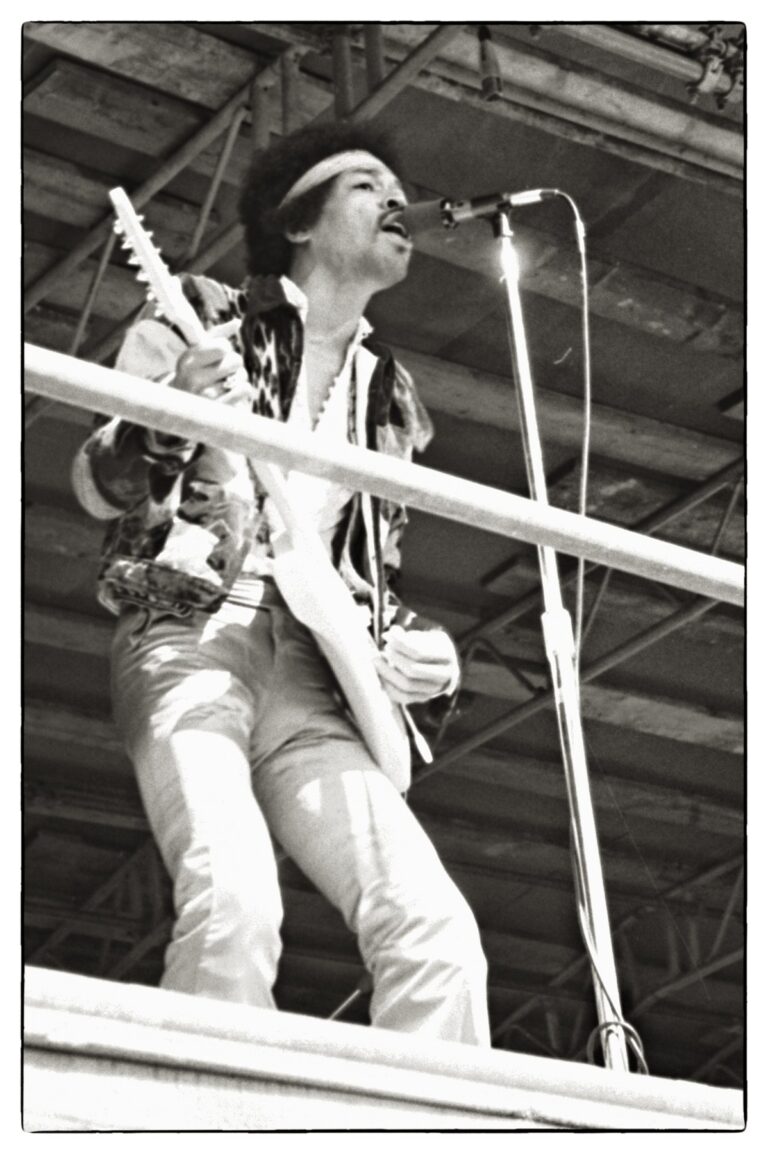
Jimi Hendrix played a Duo-Sonic in the early years of his career — backing up the Isley Brothers in the early 1960s under the name Jimmy James, and later during his time with Curtis Knight and the Squires in New York in late 1965. This predates the Stratocasters that would define his iconic sound by several years; the Duo-Sonic was the working tool of a session and club musician finding his feet. The fact that one of the greatest guitarists in history learned his craft on a short-scale student model is, as the guitar industry occasionally needs reminding, not an indictment of either Hendrix or the guitar.
Liz Phair: The Duo-Sonic as Art Object
Liz Phair’s relationship with her vintage Duo-Sonic is the instrument’s most well-documented modern story. Phair recorded Exile in Guyville (1993) with her original Duo-Sonic, producing one of the most critically acclaimed debut albums of the decade on a guitar that cost less than many players’ pedals. The guitar — a faded white ’60s model she used across most of her early career — was eventually loaned to the Rock and Roll Hall of Fame, where it toured as part of the Women in Rock and Western Rock exhibits. In a 2021 interview, Phair described the Duo-Sonic simply: “The DuoSonic was the real guitar. The DuoSonic was the main one.” She had Fender build replicas after the original went on tour without her. Her Duo-Sonic’s career trajectory — from cheap vintage find to Hall of Fame exhibit — is a near-perfect encapsulation of what happens when the “wrong” guitar ends up in the right hands.
Patti Smith, Molly Rankin, and the Indie-Rock Thread
Patti Smith’s use of the Duo-Sonic goes back to the punk era, namechecking it directly in her lyrics on “Radio Ethiopia/Abyssinia” from the 1976 album Radio Ethiopia. Molly Rankin of Alvvays used a Duo-Sonic on the band’s self-titled debut LP and early live performances, threading the instrument into the shoegaze-adjacent indie pop sound that made the record a cult favorite. Other historical users include Walter Becker of Steely Dan, David Byrne of Talking Heads, and Rory Gallagher, who used a Musicmaster-necked Duo-Sonic configuration. The pattern across this roster is consistent: the Duo-Sonic keeps appearing in the hands of artists who prioritize tone and feel over orthodoxy.
Full Specifications — Fender Duo-Sonic HS (Player Series / 2016 Offset Series)
The current Player Duo-Sonic HS (Fender’s most recent actively marketed variant) retains these fundamentals with slightly updated Player Series pickups rather than the Offset Series units from 2016, and a maple fingerboard across all configurations. A Squier Classic Vibe Duo-Sonic HS also exists at a lower price tier with Fender-Designed pickups, an Indian laurel or pau ferro fingerboard, and string-through-body hardtail bridge.
What the Short Scale Actually Does
The 24-inch scale length isn’t just a beginner convenience — it has genuine tonal consequences that distinguish the Duo-Sonic HS from full-scale Fender alternatives. Shorter scale means lower string tension at the same pitch, which translates to a slightly warmer fundamental tone, easier bending, and a different feel under the picking hand — strings respond a little more loosely and immediately. Musicians often describe the sound as “rounder” or “chunkier” than a full-scale guitar, particularly in the low-to-mid range, while still retaining the brightness that Fender single-coil pickups produce.
There’s also a practical consideration: for players with smaller hands, shorter arms, or who simply find 25.5-inch-scale guitars fatiguing to play, the Duo-Sonic’s shorter reach is a genuine quality-of-life improvement rather than a compromise. The guitar is notably lighter and more compact than a Stratocaster, sits differently on the knee, and is less physically demanding for extended playing sessions. These are reasons Liz Phair, Patti Smith, and many other players chose Duo-Sonics as primary instruments rather than as stepping stones to something bigger.
The HS Pickup Configuration: Why It Works
The original Duo-Sonic paired two identical single-coil pickups; the HS variant replaces the bridge unit with a humbucker, creating a pickup asymmetry that the guitar uses to its advantage. The neck single-coil produces the bright, glassy, slightly compressed tone that Duo-Sonics are associated with historically — perfect for clean indie chord playing, arpeggios, and the jangly textural quality of Liz Phair’s rhythm parts. The bridge humbucker adds a warmer, thicker, more sustaining voice that the single-coil configuration couldn’t manage, useful for lead work or for adding body to heavier rhythm passages.
The push/pull coil-split on the tone pot is the feature that makes the HS configuration genuinely versatile rather than just adequate. Splitting the bridge humbucker produces a tone that reads as a brighter, more traditional Fender single-coil character from the bridge position — not quite a Stratocaster bridge pickup, but close enough in character to give the guitar a three-sound palette (humbucker bridge, split bridge, and the neck single-coil) that spans a broader range than its simple control layout suggests. The split tones are particularly effective in the middle toggle position, where both split coils combine into something resembling a Strat’s classic in-between voice.
Tone Recipes
1. Indie-Rock Clean (Liz Phair/Alvvays Territory): Neck pickup, amp clean with a moderate amount of reverb. The single-coil neck pickup through a clean combo — a Fender Deluxe Reverb or any Fender-voiced clean channel — produces exactly the warm, jangly brightness that made the Duo-Sonic a tool of choice for indie singer-songwriters. Dig into the strings for a percussive attack; the short scale responds immediately. A subtle chorus pedal adds sheen without obscuring the guitar’s natural voice.
2. Coil-Split Middle Position (the Strat Approximation): Toggle to center, push/pull the tone pot to split the bridge humbucker. Both coils in this configuration produce a tone that approximates a Strat’s classic middle-position quack and glassiness. Useful for country, funk, or any context where you want that specific sparkle without having to buy another guitar.
3. Bridge Humbucker Crunch: Bridge pickup (full humbucker), a mild overdrive — an Ibanez TS9 set with moderate gain and a slight mid boost — into a clean amp. The short scale adds a slightly woolly warmth to the humbucker character that full-scale guitars don’t produce, making the Duo-Sonic HS crunch a little differently from a Les Paul or a Telecaster in the same setup. Not a high-gain monster, but genuinely usable for classic rock and indie-rock rhythm work.
4. Blues Lead (Rory Gallagher Energy): Neck pickup, amp set at the edge of breakup, no pedals. The single-coil neck pickup’s round, warm response into a slightly driven combo produces a bluesy lead voice that benefits from the short scale’s looser string tension for bends. This is the setting where the Duo-Sonic most clearly sounds like a guitar with a personality of its own rather than a simplified version of something else.
5. High-Gain (With Pedal Help): Bridge humbucker, a proper high-gain overdrive or distortion pedal. The Duo-Sonic HS doesn’t have the output for metal saturation on its own, but with a pedal doing the heavy lifting it handles punk and heavier indie rock perfectly well. Players who have replaced the stock bridge humbucker with a Seymour Duncan JB or similar hot wind report significantly expanded high-gain capability while retaining the guitar’s fundamental character.
Duo-Sonic HS vs. the Alternatives
Duo-Sonic HS vs. Fender Stratocaster: The Strat has more pickups, five-position switching, a longer scale, and a deeper catalog of recorded tone behind it. The Duo-Sonic HS is simpler, shorter, lighter, and cheaper — and sounds notably different, not just “less.” Players who want the full Strat experience should get a Strat. Players who want a distinctive, compact alternative with its own character should consider the Duo-Sonic.
Duo-Sonic HS vs. Fender Telecaster: The Telecaster’s bridge single-coil produces a twangier, more cutting tone than the Duo-Sonic’s bridge humbucker. The Duo-Sonic’s short scale makes it feel more comfortable for smaller hands; the Tele runs full 25.5-inch scale. Both are simple, straightforward guitars with minimal electronics — the choice is fundamentally about whether you want Tele twang or Duo-Sonic warmth at the bridge position.
Duo-Sonic HS vs. Gibson Les Paul Standard: The Les Paul is a fundamentally different proposition — heavier, warmer, more sustain-forward, significantly more expensive. The Duo-Sonic HS is lighter, more compact, brighter even with a humbucker at the bridge, and costs a fraction as much. They’re not really competing for the same player or the same sounds.
Duo-Sonic HS vs. Fender Mustang: The most direct family comparison. Both run 24-inch short scale and share Fender’s offset heritage. The Mustang’s distinctive feature is its floating vibrato and the original’s in/out-of-phase pickup switching; the Duo-Sonic HS drops the vibrato for a more stable hardtail and replaces complex switching with the HS pickup configuration. The Duo-Sonic is simpler and more stable; the Mustang has more tonal switching options and the floating trem. Player preference between them often comes down to whether you want a vibrato.
Buying Guide: Which Version?
The Duo-Sonic HS has appeared under several Fender sub-lines since its 2016 relaunch, which creates some confusion at the used market level.
The 2016 Offset Series Duo-Sonic HS (the original modern reissue) runs a rosewood or pau ferro fingerboard, Offset Series pickups, and the same fundamental specs. These are widely available used and represent excellent value — the pickups and hardware quality are entirely solid.
The Player Duo-Sonic HS (2019 onward) updated the pickup design to Player Series units, added a maple fingerboard option, and refined the finish quality somewhat. This is the current production variant and the one most commonly in new stock at retailers.
The Squier Classic Vibe Duo-Sonic HS is the budget entry point — Indonesian-made with Fender-Designed pickups rather than Fender-branded ones, laurel or pau ferro fingerboard, and simplified hardware. A sensible starting point for players who want to try the format before committing to the Fender-brand version.
Practical Ownership Notes
The 9.5-inch fingerboard radius is the same as most modern Fenders — flatter than vintage models, comfortable for both chording and lead bending without the choke-out risk of vintage 7.25-inch radius necks. The strings-through-body hardtail bridge is stable, requires minimal maintenance, and intonates precisely — a significant upgrade over the original Duo-Sonic’s simpler three-saddle bridge arrangement.
Players who find the stock bridge humbucker too polite for their needs often upgrade it to a Seymour Duncan JB or similar medium-to-hot humbucker, which keeps the guitar’s character while expanding its high-gain capability. The coil-split function works better than on many budget guitars — the split tones are genuinely usable rather than merely technically present.
The lighter strings Fender ships with the Duo-Sonic HS (.009s) can feel a little loose at 24-inch scale. Many players upgrade to .010 or .011 gauge strings to add tension and definition, particularly noticeable in the bridge humbucker’s response. At heavier gauges, the short scale stops feeling “different from a full-scale guitar” and starts feeling like a deliberate tonal choice.
Frequently Asked Questions
Is the Duo-Sonic HS really just a beginner guitar?
No — it started as a student model in 1956, but it has been used by serious artists at every level of the industry for decades. Liz Phair’s Duo-Sonic is in the Rock and Roll Hall of Fame. The short scale and simple controls are features, not limitations, once you stop thinking of them as compromises.
What’s the difference between the Duo-Sonic HS and the standard Duo-Sonic?
The standard Duo-Sonic has two single-coil pickups; the HS replaces the bridge single-coil with a coil-splittable humbucker. The HS is noticeably more versatile at higher gain levels while the standard Duo-Sonic maintains a purer, more consistent single-coil character throughout.
What scale length does the modern Duo-Sonic HS use?
24 inches — shorter than the Stratocaster’s 25.5 inches but longer than the original 1950s Duo-Sonic’s 22.5-inch scale. The 24-inch scale is also used by the Fender Jaguar and Mustang, giving the Duo-Sonic HS the same string-tension feel as those models.
Can the Duo-Sonic HS handle heavy music?
With a pedal, yes. The stock bridge humbucker is medium-output rather than high-gain hot, so it benefits from distortion or overdrive to reach heavier territory. Many players upgrade to a hotter aftermarket humbucker for more headroom at high gain.
Is the coil-split actually useful on this guitar?
More so than on many guitars in this price range. The split tones, particularly in the center toggle position, produce a genuinely Strat-adjacent character that’s useful for clean and lightly overdriven playing. It’s not a perfect single-coil simulation, but it expands the guitar’s tonal range meaningfully rather than just being a checkbox feature.
How does the Duo-Sonic HS compare to a Mustang?
Both run 24-inch short scale. The Mustang’s floating vibrato is its defining feature — ideal for subtle vibrato and the feedback-shimmer techniques of shoegaze and surf players. The Duo-Sonic HS’s hardtail bridge is more stable and better for tuning consistency; its HS pickup configuration is more versatile at higher gain. Neither is objectively better; the choice depends on whether you want a vibrato.
Which finish variants have pau ferro vs maple fingerboards?
This varies by production run. On the 2016 Offset Series, certain finishes paired with pau ferro; newer Player Series versions tend toward maple. Check the specific listing for the exact fingerboard material, as Fender has changed this across production runs.
Image credits
- Jimi Hendrix: Detlef Hansen, Wikimedia Commons, CC BY-SA 4.0.
