
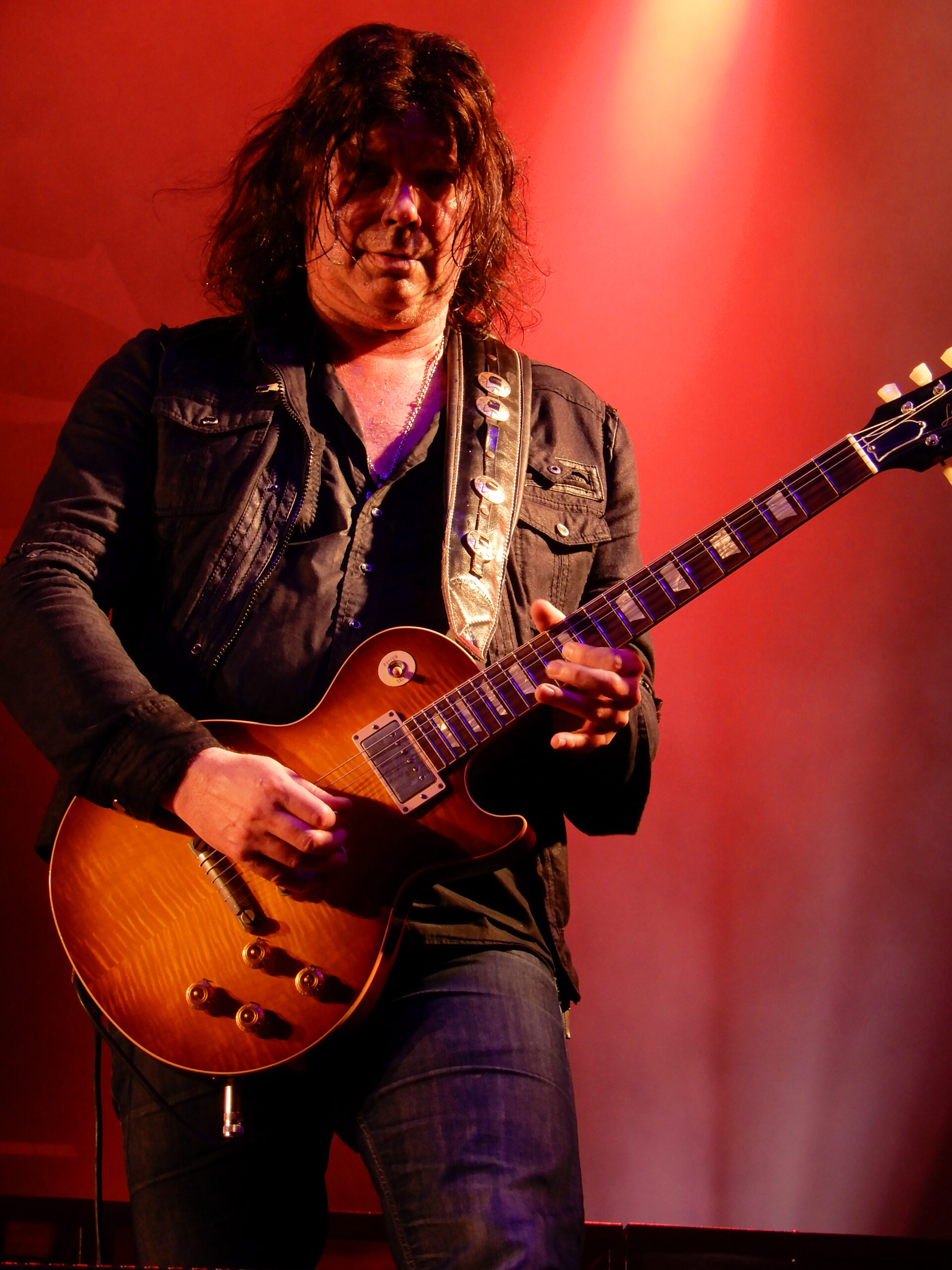
John Norum guitars gear is the story of the man who played one of the most recognisable guitar solos in the history of rock and roll — and who, with characteristic independence, left the band just before that solo took the world by storm. Norum was Europe’s guitarist from the band’s 1979 formation through 1986, when he departed before the release of “The Final Countdown” and left a generation of rock fans wondering what the guy playing those melodic, bluesy, emotionally direct lead lines had gone on to do with his career. The answer: a series of solo albums of considerable quality, a return to Europe in 2003, and four decades of consistently excellent guitar playing that makes his status as one of Scandinavia’s greatest rock guitarists inarguable.
The Journey
Gear Timeline
His approach to the guitar is fundamentally different from the shred players who dominated the mid-1980s context he worked in. Where the shred era prioritised speed, technical complexity, and neoclassical vocabulary, Norum was listening to Gary Moore, Thin Lizzy, and the classic British hard rock tradition — and his playing reflected those influences with an emotional directness and a blues-informed expressiveness that set him apart from virtually every contemporary. John Norum guitars gear reflects this aesthetic: vintage-influenced instruments, Marshall amplification, and a signal chain built for feel and tone rather than technical demonstration. This is the complete breakdown.
Background
John Norum was born on February 23, 1964, in Värmland, Sweden — a rural county in the west of Sweden that has produced a remarkable number of significant musicians relative to its population, perhaps because the combination of long dark winters, a strong folk tradition, and the cultural isolation of rural life creates the conditions for intense, self-directed musical development. He began playing guitar at age twelve, initially absorbing the hard rock and heavy metal of the late 1970s before discovering the Gary Moore, Thin Lizzy, and classic British hard rock traditions that would become the primary influences on his mature style.
He co-founded Europe in 1979 with vocalist Joey Tempest, initially calling the band Force. The band’s early development — through the early Swedish albums Europe (1983) and Wings of Tomorrow (1984) — established Norum as an exceptional player with a distinctive melodic and emotional lead style. The transition toward a more mainstream, keyboard-dominated sound that eventually produced “The Final Countdown” created artistic tensions that led to Norum’s departure in 1986, shortly before the album’s release. He reportedly wanted a heavier, more guitar-focused direction; the band’s commercial strategy pointed elsewhere.
His departure proved less career-ending than it might have been. His solo debut Total Control (1987) demonstrated that his guitar playing stood completely on its own outside the Europe context, and a series of subsequent albums — Face the Truth (1992), Worlds Away (1995), Another Destination (1999), and later records — maintained his profile in the hard rock and AOR communities. His 2003 return to Europe — rejoining to record Start from the Dark and participating in all subsequent Europe albums and tours — brought him back to the band with a more settled relationship to its commercial reality, and the post-reunion Europe albums have been musically satisfying for all involved.
His personal battle with addiction, documented in various interviews, adds a dimension to his story that goes beyond the technical discussion of gear — but his continued recovery and his current position as one of the most consistently excellent hard rock guitarists working anywhere in the world demonstrate that the musical commitment that drove him to master the guitar survived everything else.
John Norum Guitars Gear: The Complete Rig
Guitars
John Norum’s relationship with the Gibson Les Paul — specifically the late-1950s “burst” era instruments with PAF humbuckers — is one of the most famous and most thoroughly documented vintage guitar relationships in hard rock. He is not merely a Les Paul player in the generic sense; he is a connoisseur who has studied, played, and acquired specific vintage Les Paul Standards with the knowledge and dedication of a serious collector who also happens to be one of the finest Les Paul players in the world. His primary Les Pauls are genuine late-1950s sunburst examples — instruments from the 1958–1960 production window that represents the pinnacle of Gibson’s original Les Paul Standard production, featuring hand-carved AA-grade figured maple tops over Honduras mahogany bodies, PAF humbucking pickups wound to the characteristic 7.5k–9.0k ohm range with Alnico II magnets and plain enamel-coated wire, slim taper mahogany necks with rosewood fretboards and trapezoid inlays, and the original ABR-1 Tune-O-Matic bridges with aluminium stop-bar tailpieces.
Norum’s specific playing approach to the Les Paul reflects a deep understanding of the instrument’s specific qualities. He uses the neck pickup as his primary lead voice — the PAF neck humbucker’s warm, full, singing character is the core of his signature tone. He rolls the tone control back slightly from full (typically to 7–8) for a slightly softened high-frequency response that gives sustained notes a more rounded, vocal quality, and he uses the guitar’s volume pot as an active dynamic tool rather than leaving it full up — a technique that exploits the PAF’s cleaning-up-with-volume characteristic to give him a range from near-clean to full saturation from a single pedal-free control. This intimate knowledge of the PAF Les Paul’s capabilities — the interaction between pickup output, amplifier gain, and guitar volume control — is the kind of tonal intelligence that comes from years of playing the same instrument through the same amplifier and learning exactly what each control contributes to the complete tonal picture.
A 1960 Les Paul Standard — with the thinner, faster slim taper neck profile that made 1960 examples particularly appealing to lead guitar players, Heritage Cherry Sunburst finish, and late-production PAF humbuckers — also appeared in Norum’s documented collection. The 1960 neck’s reduced depth (approximately 0.800 inches at the first fret versus the rounder 0.870–0.920 inches of 1958–1959 examples) gives a different playing feel under the hand — faster, more accessible for technical passages, with slightly less physical mass to grip through the back of the neck. Some players find the 1959 neck’s rounder profile more comfortable for sustained chord work; others prefer the 1960 slim taper for lead playing. Norum has both, and uses each where its specific feel suits the material most naturally.
Gibson Les Paul Customs — ebony fretboard, multi-binding, gold hardware, PAF or Patent Number humbuckers in various configurations — appeared in Norum’s setup for specific applications where the Custom’s ebony fretboard brightness and slightly different resonant character from the Standard’s rosewood board gave a distinct tonal quality. The Custom’s ebony board contributes a faster, more articulate attack transient to each note — useful for passages requiring maximum note definition — while the multi-binding’s additional wood mass around the body edges gives a slightly different acoustic resonance character.
Modern-production Gibson Les Paul Traditionals and Standards appeared in Norum’s touring setup as backup instruments when travelling with irreplaceable vintage instruments would be impractical or risky. The modern Les Paul Traditional (which Gibson positions as the more historically accurate production model, using classic-spec humbuckers, a traditional weight-relieved or solid body, and more vintage-spec neck profiles) gave a reasonable approximation of the vintage tone for live performance backup. His specific preference within the modern production range: the Traditional’s more vintage-accurate construction over the Standard’s chambered body, which he found gave a slightly different acoustic resonance that affected the amplified tone in subtle but perceptible ways.
Vintage Fender Stratocasters appeared in Norum’s setup for specific clean and semi-clean applications where the Strat’s transparent, single-coil character gave a different tonal quality from the Les Paul. His Strat use was selective — deployed when the specific tonal character of the single-coil suited the material better than the humbucker’s warmth and sustain — consistent with the pragmatic, music-first approach that characterises all his gear choices.
When using modern production Les Pauls as backup or touring instruments, Norum has installed vintage-spec or vintage-inspired replacement pickups to give the modern instruments a tonal character closer to his original PAF-equipped vintage examples. His preferred replacements: Seymour Duncan Seth Lover SH-55 (designed by PAF’s original creator Seth Lover, wound to PAF specifications with Alnico II magnets and scatter-winding technique), Lindy Fralin Pure PAF (scatter-wound, Alnico II, approximately 7.5k ohms), or Throbak SLE-101 PAF clones (among the most historically accurate PAF reproductions available). These replacements give the warm, round, harmonically complex character of the vintage PAFs without the financial and practical risks of touring with irreplaceable original instruments.
Norum uses Ernie Ball Regular Slinky (.010–.046) or GHS Boomers (.010–.046) on his Les Paul guitars — the standard light gauge for most hard rock lead playing. The .010–.046 gauge on the Les Paul’s 24.75-inch scale gives a slightly lower string tension than the same gauge on a Fender’s 25.5-inch scale, contributing to the bending ease that his blues-influenced, wide-bend technique requires. His specific string material preference: nickel-plated steel for the standard bright, articulate tone; pure nickel for the specific warmth and vintage character of his older recordings.
Amps
The Marshall JCM800 Model 2203 — 100 watts, four EL34 output tubes, cascaded high-gain preamp — was Norum’s primary live amplification during the classic Europe period and much of his solo career. However, his specific use of the JCM800 differed from the high-gain-maximising approach of many contemporaries: Norum ran the JCM800 at moderate preamp gain settings (6–7 rather than 8–10), using the amplifier’s natural character rather than pushing it to maximum saturation. At moderate preamp gain, the JCM800’s cascaded topology gives a warm, harmonically complex crunch rather than the maximum-saturation heavy distortion that the same circuit at full preamp input produces — a tone with more dynamic range, more response to pick attack variation, and more of the PAF humbucker’s natural character preserved within the distortion. This moderate-gain approach reflects Norum’s blues and classic rock influences: he was pursuing the warm, expressive saturation of a cranked amplifier rather than the high-gain compression of a maximally driven preamp, and the JCM800’s cascaded preamp at moderate settings delivered exactly this.
In more recent years, Norum has increasingly used Marshall Plexi-circuit amplifiers — either the Marshall 1987X 50-watt Plexi reissue (which accurately reproduces the circuit topology and component values of the original 1960s Marshall 1987 Super Lead 50-watt head) or genuine vintage Plexi examples — as his primary amplification. The Plexi’s tonal character is fundamentally different from the JCM800 in ways that specifically suit Norum’s mature playing approach: the Plexi’s long-tailed pair phase inverter and the absence of the JCM800’s cascaded gain stages give a more dynamic, more touch-sensitive overdrive that responds to pick attack and guitar volume variation more directly than the more consistent, more predictable JCM800 gain character. This touch sensitivity — the Plexi’s characteristic of giving a clean tone when played softly and a saturated tone when played hard, using the same amp settings — is perfectly matched to Norum’s technique of using the guitar’s volume and his pick attack as primary tonal controls.
Vintage Marshall 1959 Super Lead 100-watt heads — the original Plexi-panel and early JMP-panel examples from the late 1960s and early 1970s — appeared in Norum’s studio setup for specific recording applications. His preference for the 100-watt over the 50-watt in studio contexts reflected the different compression character of the larger output stage: the 100-watt’s four EL34 output tubes give a different saturation characteristic than the 50-watt’s two, with the larger output stage requiring more drive before reaching the same saturation level but giving a richer harmonic texture when it does. In a studio context where the volume can be managed independently of the tonal requirements, the 100-watt Plexi gives the most musically complete expression of the classic Marshall tone.
The Bogner Ecstasy — Reinhold Bogner’s three-channel EL34 boutique amplifier — appeared in Norum’s documented setup for specific applications where the Bogner’s more refined, smooth high-gain character suited the recording context better than the Plexi’s more dynamic, variable character. The Ecstasy’s Lead channel’s exceptional note definition at high gain levels gave specific recording passages a quality of harmonic clarity and definition that the Plexi’s more responsive, less consistent saturation could not guarantee in a single take.
Norum runs his Marshall amplifiers into 4×12 cabinets loaded with Celestion speakers — primarily the Vintage 30 (30-watt ceramic-magnet, upper-midrange emphasis, tight bass response) for the Bogner and the G12M Greenback 25 (25-watt ceramic-magnet, 75Hz resonant frequency, compressed harmonic character) for the more vintage Plexi applications. The Greenback’s specific interaction with the Plexi circuit — the 25-watt speaker’s earlier onset of speaker compression giving additional dynamic compression and harmonic complexity to the combined amp/speaker system — suits the Plexi’s character better than the tighter, more extended Vintage 30. With the Bogner’s smoother saturation, the Vintage 30’s presence and definition add appropriate clarity that the more compressed Greenback might reduce.
Effects
The Dallas Rangemaster Treble Booster — the single-transistor germanium OC44 booster that Tony Iommi, Rory Gallagher, and Brian May used to push British amplifiers into additional harmonic richness — appeared in Norum’s signal chain for specific applications where additional harmonic density and upper-midrange emphasis was needed ahead of the Marshall. The Rangemaster’s frequency-selective boost — emphasising the upper midrange while providing a degree of harmonic saturation — gives the PAF Les Paul’s warm output additional presence and harmonic complexity when pushed through a Plexi’s front end. Norum uses either original Dallas Rangemaster units (which have become extremely valuable) or high-quality clones (Catalinbread CB30, Analogman Beano Boost, or custom OC44-based builds) that replicate the original’s OC44 transistor character.
The MXR Distortion+ — LM741 op-amp, 1N270 germanium diode asymmetric clipping, transparent overdrive character — appeared in Norum’s early signal chain as a front-end boost and light overdrive device. His use of the Distortion+ reflected a classic British hard rock approach: a relatively transparent boost with mild asymmetric clipping to push the Marshall’s front end harder without adding the more pronounced midrange emphasis of a Tube Screamer. The Distortion+’s lower-mid frequency character gave a fuller, less mid-forward boost that complemented the JCM800’s already-forward midrange without excessive emphasis.
The Tube Screamer — in TS808 or TS9 configuration — appeared in Norum’s signal chain as a lead boost for specific applications requiring the TS’s characteristic midrange emphasis. His TS use was more selective than constant — reaching for the Tube Screamer when he needed the mid-forward character to cut through a dense ensemble mix, using the Distortion+ or the Rangemaster for passages where a more transparent boost better served the musical context.
The Boss CE-2 — MN3007 BBD chip, 12–15ms delay line with LFO modulation — appeared in Norum’s setup for specific clean and semi-clean chord work textures. His chorus use was characteristically restrained — light, slow modulation for specific passages requiring dimensional width rather than obvious chorus effect. The CE-2’s BBD warmth gave a more organic quality than digital chorus alternatives, consistent with Norum’s consistent preference for vintage and analog signal processing over digital alternatives.
The MXR Phase 90 appeared selectively in Norum’s setup for specific phase modulation effects. His Phase 90 use — at slow speed settings for specific passages — gave sustained chord work a dimensional sweep that complemented certain passages in Europe’s more atmospheric material and in his solo recordings’ more expansive arrangements.
Both the Dunlop Cry Baby and the original Vox V846 wah appeared in Norum’s setup for expressive wah-filtered lead work in the Gary Moore-influenced tradition. His wah use was musically committed and physically engaged — the wah deployed as an expressive lead tool for specific passages rather than as a constant tonal modifier, with the physical rocking motion becoming part of the performance language of his lead playing.
Digital delay units provided spatial enhancement for lead passages. Norum’s typical settings: 200–300ms, one to two repeats, 15–20% mix for lead depth without clutter. His delay use was moderate and selective — adding dimension to specific lead passages rather than using delay as a constant ambient background.
The Electro-Harmonix Big Muff Pi — various versions depending on period — appeared in Norum’s setup for specific maximum-sustain lead passages where the Big Muff’s smooth, compressed fuzz gave a different and more extreme tonal character than the Marshall’s natural overdrive. His Big Muff use was selective and purposeful — reaching for the fuzz when the specific passage required it rather than using it as a constant tonal environment.
Playing Style & Tone Philosophy
John Norum is the most complete embodiment of the Gary Moore tradition in Scandinavian rock — a player whose primary influences are British blues-rock and classic hard rock, whose technique is built on wide vibrato, expressive bending, and emotional directness rather than technical demonstration, and who has spent four decades developing those influences into a genuinely personal playing vocabulary that is immediately recognisable and emotionally communicative. His playing makes you feel something before you’ve had time to analyse what he’s doing technically, which is the correct order of operations for a blues-influenced guitarist.
His vibrato is the defining characteristic of his playing — wide, slow, and produced from the wrist in the manner of the British blues-rock tradition he absorbs from Gary Moore, Peter Green, and Rory Gallagher. The specific character of his vibrato: it begins after the note has been picked and the initial attack has settled, giving the note a moment of “straight” tone before the modulation begins (this attack-then-vibrato approach, characteristic of classical string playing and absorbed into the British blues guitar tradition, gives sustained notes a more composed, musical quality than immediate vibrato); it uses a full wrist rotation rather than the narrower finger-only vibrato of some players, giving a wide deviation range that adds emotional weight to sustained notes; and it is consistently applied — not rushed or curtailed, but given the time it takes to complete properly, which means sustained notes receive their full vibrato treatment rather than a token modulation before moving to the next phrase.
His string bending is equally specific and equally blues-derived. The bends arrive at their target pitch — not just “up a tone” abstractly but at the precise pitch that the harmonic context requires. The release is controlled — the string comes back down to the starting pitch without splattering or losing intonation. Wide bends (one-and-a-half tones and two tones) are executed cleanly and held at pitch rather than wavering. These qualities require years of careful practice and a musical ear that hears the target pitch clearly enough to consistently arrive there. Norum’s intonation on bends is among the most consistent in hard rock guitar, and this precision contributes as much to his emotional impact as the width of the bends themselves — a bend that arrives at the right note and stays there is more emotionally satisfying than a wider bend to an uncertain pitch.
His pick attack is medium-heavy and firm — a confident, authoritative approach that gives each note a clear fundamental and a specific presence in the ensemble mix. He uses medium-to-heavy picks (typically 1.0mm–1.2mm celluloid or Tortex) held at a slight angle to the string for a rounded attack transient that suits the Les Paul’s naturally warm, rich tonal character. The angle and force of his pick contact are consistent enough that his tone has an even, coherent quality across different strings and positions — each note sounding like it comes from the same instrument, played by the same hand, with the same conviction.
Tonally, John Norum guitars gear philosophy is built on the oldest and most enduring foundation in British hard rock guitar: a vintage PAF Les Paul through a Plexi-circuit Marshall at the precise gain setting where natural amp saturation begins, with minimal processing in between. This approach — maximising the interaction between the guitar’s pickup and the amp’s natural distortion characteristics, using the guitar’s volume and the player’s picking intensity as the primary tonal controls — is the most direct route to the expressive, dynamically alive tone that distinguishes great British hard rock guitar from its more processed alternatives. His increasing preference for the Plexi over the JCM800 reflects a maturing appreciation for this principle: the Plexi’s greater sensitivity to playing dynamics makes it a more complete expressive tool, even if it requires more skill to use effectively than the JCM800’s more consistent, less demanding gain character.
The PAF humbucker’s specific interaction with the guitar’s volume control — the “cleaning up with volume” characteristic that Norum exploits as a primary tonal control — deserves specific technical explanation because it is one of the most important but least-understood qualities of passive humbucker designs. When the guitar’s volume pot is reduced from full, it does not simply reduce the signal level linearly; it also loads the pickup’s output impedance differently, and this loading changes the pickup’s frequency response as well as its level. At full volume, the pickup’s output sees the relatively high input impedance of the amplifier’s input stage (typically 1MOhm) with the volume pot’s resistance in parallel — giving a high impedance load that allows the pickup’s full frequency range to be delivered to the amplifier. As the volume pot is reduced, the effective impedance presented to the pickup decreases (because the pot is loading the pickup’s output with a progressively lower resistance), and this lower impedance causes the pickup to roll off high frequencies more aggressively — giving a warmer, less bright sound at reduced volume settings. The combination of lower signal level (reducing the amplifier’s saturation) and reduced high-frequency content (from the increased pickup loading) gives the “cleaned up” tone its characteristic warmer, less aggressive quality. A player who understands this — who knows that rolling back to 6 doesn’t just reduce the volume but also changes the tonal character toward warmth and cleanliness — can use the volume control as a complete tonal management tool rather than merely a level attenuator. Norum’s mastery of this technique is a function of his deep, long-term familiarity with his specific PAF Les Pauls through his specific Marshall amplifiers — knowledge accumulated through years of play that gives him an intimate understanding of exactly what each volume and tone setting produces.
The Celestion Greenback versus Vintage 30 speaker choice in John Norum guitars gear reflects a sophisticated understanding of how speaker characteristics interact with specific amplifier circuits. The G12M Greenback 25-watt and the Vintage 30 30-watt are both ceramic-magnet Celestion speakers, but their specific parameters differ in ways that matter musically. The Greenback’s 75Hz resonant frequency (the frequency at which the speaker’s mechanical system resonates) and 98dB sensitivity give a specific compression character: because the speaker’s resonant frequency is in the lower-mid range, bass frequencies near this resonant point drive the speaker into mechanical excursion more easily, contributing to a soft, natural compression of the low-frequency content. This compression — the speaker contributing its own dynamic limitation to the amplifier’s signal — gives the combined amp/speaker system a character that is different from the amplifier alone and that many players describe as the “organic” quality of a great vintage rig. The Vintage 30’s higher power handling (30 watts versus the Greenback’s 25) and its stiffer, less compliant mechanical system gives less of this mechanical compression but more extended bass response and a brighter, more present high-frequency character. For the Plexi’s natural compression and harmonic complexity, the Greenback’s additional mechanical compression complements rather than competes with the amplifier’s own character — the combination giving more compression than either alone and a rich, three-dimensional quality that the less compliant Vintage 30 cannot quite replicate in this specific context. With the Bogner’s smoother, already highly compressed lead character, the Vintage 30’s tighter, more extended character adds the definition and presence that prevents the smooth saturation from becoming too thick and indistinct.
How to Sound Like John Norum
Guitar Approach
A vintage or vintage-specification Gibson Les Paul Standard with PAF humbuckers is non-negotiable for John Norum guitars gear tone. Options: a genuine late-1950s “burst” Les Paul Standard (if the budget is unlimited), a Gibson Custom Shop ’59 Les Paul (the most accurate modern reproduction of the 1959 specification), or a standard production Les Paul Traditional with Seymour Duncan Seth Lover SH-55 or Lindy Fralin Pure PAF pickup replacements. Use the neck pickup as the primary lead voice — Norum’s signature tone comes from the warm, full PAF neck humbucker, not the bridge pickup. Set the tone control to 7–8 for a slightly rounded high-frequency character that enhances the vocal quality of sustained lead notes. Use the volume pot actively: roll back to 6–7 for a cleaner, more chimey tone on verse passages; push to full for maximum sustain on chorus and solo passages.
Vibrato is the most important technique to develop for Norum’s tone — wide, wrist-rotated, applied after the initial note attack rather than immediately. Practice on a single note: pick it, let the initial attack settle for a quarter to a half second, then apply wide, even vibrato from the wrist. The vibrato should be wide enough to be clearly audible but controlled enough to stay centered on the correct pitch. This is the single most distinguishing element of his playing.
Amp Approach
A Marshall Plexi-circuit amplifier — the Marshall 1987X 50-watt reissue (most historically accurate production option), a quality boutique Plexi clone (Ceriatone 1987, Metropoulos Metroplex), or a vintage 1987 50-watt Super Lead — is the correct foundation. Run into a 4×12 cabinet with Celestion G12M Greenback 25-watt speakers for the full vintage tone. The Plexi must be driven by the pickup’s output and the picking attack rather than by high preamp gain — set the input volume to give natural overdrive when picking firmly, clean when picking softly. This is the essence of the Norum approach and the hardest thing to get right, because it requires discipline to resist cranking the gain and let the picking dynamics do the work.
| Control | Setting (0–10) | Notes |
|---|---|---|
| Marshall Plexi Input Volume | 6–8 | Moderate-high — natural saturation, not maximum preamp gain. Pick attack controls the tone. |
| Bass | 5–6 | Warm but controlled — Les Paul mahogany adds natural low-mid warmth |
| Middle | 7 | Forward — the spine of British hard rock guitar tone |
| Treble | 5–6 | Present for note definition — not harsh; the Les Paul softens extreme treble naturally |
| Presence | 5 | Moderate — adds articulation without brittleness |
| Guitar Volume (lead) | 10 | Full volume for maximum saturation and sustain on solo passages |
| Guitar Volume (rhythm) | 6–7 | Rolled back for cleaner chord tone — exploit the PAF’s cleaning-up characteristic |
| Guitar Tone Control | 7–8 | Slightly rolled back — softens the top end for a more vocal, singing lead quality |
| Rangemaster (if using) | Full | Germanium OC44 booster ahead of Plexi — harmonic density and upper-mid focus |
| TS808 (lead passages) | Drive 3, Level 6–7 | Low drive as mid-boost — selective use when needing additional lead presence |
The Dallas Rangemaster (or Catalinbread CB30, Analogman Beano Boost) for harmonic density ahead of the Plexi. The TS808 at minimal drive as a selective lead boost for specific passages. Boss CE-2 at light settings for specific clean chord textures. Phase 90 at very slow speed for atmospheric passages. Minimal delay (200–300ms, one repeat, 15% mix) for lead spatial depth. Wah (V846 or Cry Baby) for specific expressive lead passages. Keep the chain simple — the PAF Les Paul through the Plexi is the complete tone; everything else is selective enhancement.
Influence & Legacy
John Norum’s influence on Scandinavian rock and on the European hard rock guitar tradition is profound and direct — he was the first genuinely world-class rock lead guitarist to emerge from Sweden, and his example gave subsequent generations of Scandinavian rock musicians evidence that European players could achieve the standard set by the British and American guitar heroes they admired. His specific approach — blues-influenced, emotionally direct, vintage-instrument-and-Marshall-focused in the manner of the British hard rock tradition — gave European hard rock guitar a connection to the blues roots that pure technical shred could not provide.
His departure from Europe before “The Final Countdown” has become one of rock history’s more poignant what-ifs — a demonstration that artistic integrity and commercial timing don’t always align, and that choosing artistic values over commercial opportunity can cost you the most famous moment of your career while preserving the musical authenticity that makes your work endure. His subsequent career and his 2003 return to Europe have given him a different kind of recognition: the respect of musicians and serious listeners who understand what he actually plays rather than the mainstream celebrity that “The Final Countdown” might have produced.
The comparison with Gary Moore — his primary guitar influence and the player whose emotional directness and blues-rock vocabulary most clearly shaped Norum’s approach — is the essential reference for understanding what he was pursuing and achieving. Moore’s combination of technical facility and emotional directness, his commitment to the blues vocabulary within a rock context, and his specific instrument choices (Les Paul into Marshall) were absorbed by Norum and developed into something that was genuinely his own rather than merely derivative. The parallel with Kee Marcello — his successor in Europe and a player who shared some of his influences while developing a different stylistic approach — illuminates the specific character of Norum’s contribution to the band’s sound by contrast. And the connection to Bernie Marsden — the Whitesnake guitarist who shared Norum’s deep commitment to the Les Paul/Marshall/British blues-rock tradition and whose approach to the instrument reflected the same combination of technical accomplishment and emotional directness — places John Norum guitars gear in the broader lineage of British and European players who carried the blues-rock torch into the hard rock era.
Frequently Asked Questions: John Norum Guitars & Gear
What guitar does John Norum play?
John Norum’s primary electric guitars are vintage Gibson Les Paul Standards from the 1958–1960 “burst” era — instruments with Heritage Cherry Sunburst finishes, hand-carved figured maple tops, Honduras mahogany bodies and necks, PAF humbucking pickups wound to approximately 7.5k–9.0k ohms with Alnico II magnets, and rosewood fretboards. He is a knowledgeable and serious vintage Les Paul collector whose understanding of what distinguishes exceptional examples from average ones within the period’s production is well-documented. For touring backup, he uses modern Gibson Les Paul Traditionals with vintage-spec replacement pickups (Seymour Duncan Seth Lover SH-55 or Lindy Fralin Pure PAF clones).
What amplifier does John Norum use?
Norum’s primary amplification has evolved from the Marshall JCM800 2203 (his primary amplifier during the classic Europe period and early solo career) to increasingly favouring Marshall Plexi-circuit amplifiers — the Marshall 1987X 50-watt reissue, vintage 1987 Super Lead 50-watt heads, and the 1959 Super Lead 100-watt in studio contexts. The Plexi’s greater dynamic sensitivity and touch-responsiveness suits his mature playing approach better than the JCM800’s more consistent, less variable gain character. The Bogner Ecstasy appears for specific studio applications requiring a smoother, more refined high-gain character. All amplifiers run into 4×12 cabinets, typically with Celestion Greenback 25 speakers for the Plexi and Vintage 30 for the Bogner.
Why did John Norum leave Europe before “The Final Countdown”?
Norum departed Europe in 1986, shortly before the band recorded and released The Final Countdown, due to artistic differences about the direction of the band’s music. He reportedly wanted a heavier, more guitar-focused sound that prioritised hard rock guitar over the keyboard-dominated pop-rock direction that The Final Countdown represented. The commercial strategy of the album — emphasising the keyboard riff and the hook-driven songwriting — conflicted with his vision for the band. His departure was amicable enough that he eventually returned in 2003, and his relationship with the remaining Europe members has been positive in the reunion era.
What is John Norum’s vibrato technique?
Norum’s vibrato uses full wrist rotation — rotating the wrist away from and toward the headstock rather than merely rocking the finger — giving a wide deviation range of approximately a quarter-tone to a half-tone above and below the fundamental pitch. The vibrato begins after the initial note attack has settled, giving the note a moment of “straight” tone before the modulation starts — an approach inherited from the classical string tradition through the British blues-rock players he admired (particularly Gary Moore). The width, speed, and musical timing of his vibrato give sustained notes their characteristic emotional weight and distinguish his playing immediately from technically accomplished players who apply narrower, more mechanical vibrato.
What is the Dallas Rangemaster Treble Booster and why does Norum use it?
The Dallas Electronics Rangemaster Treble Booster — a single-transistor germanium circuit using an OC44 PNP transistor in a common-emitter configuration — is a frequency-selective boost device that emphasises upper midrange and treble frequencies while providing a degree of harmonic saturation. Used ahead of a Marshall amplifier’s input, it pushes the amp’s front end harder with specific frequency emphasis, adding harmonic density and upper-midrange presence to the combined tone. Norum uses it (or high-quality OC44-based clones) to give his vintage PAF Les Paul through the Plexi additional harmonic richness and presence — pushing the already warm, PAF-Plexi combination into a more saturated, tonally complex territory without requiring the preamp gain levels that would compromise the Plexi’s dynamic sensitivity.
What are John Norum’s most important recordings?
For the classic Europe period: the albums Europe (1983) and Wings of Tomorrow (1984) capture Norum’s playing at its most raw and energetic within the band context. For solo work: Total Control (1987) is the essential document — a hard rock album of considerable quality that demonstrated his playing stood fully on its own outside the Europe framework. Face the Truth (1992) showed his continued development. For the reunion era: War of Kings (2015) and Walk the Earth (2017) demonstrate his mature playing at full accomplishment, with the blues and British hard rock influences fully integrated into a completely personal style.
What effect has the blues tradition had on John Norum’s playing?
The British blues-rock tradition — specifically the playing of Gary Moore, Rory Gallagher, and Peter Green — has been the foundational influence on Norum’s guitar style. From this tradition he absorbed: the wide, wrist-rotated vibrato that gives sustained notes their emotional weight; the precise, musical string bending that arrives at specific target pitches rather than merely going “up” by a general interval; the dynamic pick attack that uses variations in picking force to control the amplifier’s saturation level rather than relying solely on the amp’s gain control; and the general musical philosophy that expressiveness and emotional communication are more important guitar virtues than technical complexity. These blues-derived values distinguish his playing sharply from the neoclassical and shred approaches that dominated the 1980s hard rock guitar landscape.
Related stories
Warren Haynes Guitars & Gear: The Complete Guide to Gov’t Mule’s Guitar Master’s Rig
Warren Haynes' guitars, amps, and effects — the complete guide. Gibson Les Paul Chester, Soldano SLO-100 modified, Klon Centaur, Emma Discombobulator, and how to nail that Gov't Mule blues-rock tone.
Wayne Kramer Guitars & Gear: The Complete Guide to MC5’s Proto-Punk Guitar Insurrectionist’s Rig
Wayne Kramer guitars & gear: MC5's proto-punk guitar insurrectionist. Star-spangled Strat, Big Muff Triangle, Marshall stacks, MXR Jail Guitar Doors Drive — the complete rig.
Wes Montgomery Guitars & Gear: The Complete Guide to the Jazz Master’s Rig
Wes Montgomery's guitars, amps, and effects — the complete guide. Gibson L-5 CES, Standel amps, thumb picking technique, flatwound strings, and how to nail that warm jazz tone.