
Peter Buck Guitars & Gear: The Complete Guide to R.E.M.’s Jangle Architect
Peter Buck performing with The Minus 5 at the Tractor Tavern in Seattle on 27 July 2019. Photo: The Minus 5 by David Lee, via Wikimedia Commons, CC BY-SA 2.0 (https://creativecommons.org/licenses/by-sa/2.0/). Cropped to 16:9, resized and re-encoded for web. Adapted image licensed under CC BY-SA 2.0. Source: https://www.flickr.com/photos/davidjlee/48982893231/
His Telecaster was stolen in 1980. He went to a music store called Chick Piano and found a blonde Rickenbacker 360 with flatwound strings. That was his main guitar until 1981, when it also got stolen.
He went to a shop in Hartford, Connecticut. They pulled out a black Rickenbacker 360. He played it. It was in tune. “That’s the one that’s been on every R.E.M. record except the first single, and I bring it to pretty much every session I do.”
He still keeps it at the foot of his bed. “I like playing guitar in my pajamas.”
Peter Buck is one of the defining rhythm guitarists of the alternative rock era — the creator of the jangling Rickenbacker arpeggio pattern that made R.E.M. immediately identifiable from the first two notes of any recording. He is explicit about his own role: “I’m more of a rhythm player than a soloist.” He doesn’t like guitar solos. On “What’s the Frequency, Kenneth?” his entire solo is played backwards. On “Driver 8” he avoided the solo section altogether and returned to the opening riff. These are not failures of technique — they are deliberate compositional choices by someone who understood what his songs needed and chose not to indulge what they didn’t.
The gear is appropriately minimal. One Rickenbacker, used on every album. Flatwound strings in heavy gauge. Vox AC30 live, Ampeg Gemini on the first album, Fender Twin as a workhorse. Almost no pedals until 1985. Plastic toy dinosaurs on top of the AC30, because why not.
This is the complete gear story of the anti-guitar-hero who helped define what alternative rock guitar sounded like.
Background: Athens, Georgia, The Record Store, and the Band That Changed American Music
Peter Lawrence Buck was born December 6, 1956, in Oakland, California, and grew up in various places including Atlanta, Georgia. He attended the University of Georgia in Athens, where he worked at Wuxtry Records — a used record store that would prove to be the most consequential record store in American rock history, as it’s where he met Michael Stipe in 1978. They began a musical partnership that, with the addition of Mike Mills and Bill Berry, became R.E.M. in 1980.
He is self-taught, learning guitar by playing along to records — the standard autodidact route that produced a specific technique shaped by what the music demanded rather than what formal instruction would have prescribed. His influences are explicit and consistently cited: The Byrds (specifically Roger McGuinn’s twelve-string Rickenbacker playing, the source of the jangle that defines the mid-1960s folk-rock sound), Pete Townshend (who also played Rickenbacker), John Lennon, Television (Tom Verlaine’s and Richard Lloyd’s specific approach to melodic guitar interplay), and the entire tradition of British Invasion guitar — tight, bright, forward in the mix, rhythmically committed.
The Rickenbacker connection to McGuinn is explicit in Buck’s own words: “John Lennon, Roger McGuinn and Pete Townsend played Ricks. I’m more of a rhythm player than a soloist, as were all of those guys, generally. It’s the perfect rhythm guitar.”
R.E.M. formed in Athens in 1980 and spent the first part of the decade building from the American college rock circuit into a genuine commercial force. Murmur (1983) — recorded with producer Mitch Easter — was the album that established their sound: Buck’s jangling arpeggios, Mike Mills’s melodic bass lines, Bill Berry’s drums, and Michael Stipe’s cryptic, partially unintelligible vocals creating a sound that was simultaneously mysterious and catchy. The next fifteen years — through Reckoning, Fables of the Reconstruction, Document, Green, Out of Time, Automatic for the People, Monster, and subsequent albums — took R.E.M. from college rock to the largest arena in rock music.
They disbanded in 2011 after Berry’s retirement (1997) and three albums as a trio. Buck continues to perform in multiple projects including Filthy Friends, The Baseball Project, and various collaborations. He lives in Portland, Oregon.
Tone note: He worked in a record store. He learned to play from records. He made the record that defined what college rock was supposed to sound like. The line from listening to records to making records runs directly through the guitar-playing autodidact who couldn’t afford to keep his instruments from getting stolen.
The Rig: Peter Buck’s Guitars, Amps & Gear — Complete Era-by-Era Breakdown
Guitars: One Rickenbacker to Rule Them All
The Fender Telecaster — The Guitar That Got Stolen
Peter Buck’s professional career began on a Fender Telecaster. In his own words: “I was playing a Telecaster in 1980; it got stolen out of my house.” The Telecaster theft directly caused him to find the Rickenbacker that defined his career. This is one of the more consequential guitar thefts in rock history — without it, R.E.M. might have been a Telecaster band rather than a Rickenbacker band, and the entire jangle-pop tradition that their early recordings established would sound different.
The Blonde Rickenbacker 360 Mapleglo — The First (Also Stolen)
After the Telecaster theft, Buck found a blonde (Mapleglo) Rickenbacker 360 with flatwound strings at Chick Piano music store. This was his main guitar until 1981 — used on the earliest R.E.M. recordings including the Chronic Town EP sessions. Then it was stolen too.
The flatwound strings on this guitar were the first version of the string choice that would define his sound. Producer Mitch Easter, who recorded Murmur and the early R.E.M. sessions, confirmed to Guitar Player: “He used larger gauge flatwound strings. That’s what made it all work. Those Rickenbacker pickups sound better the more metal you put over them.”
The Black Rickenbacker 360 Jetglo — Every R.E.M. Album
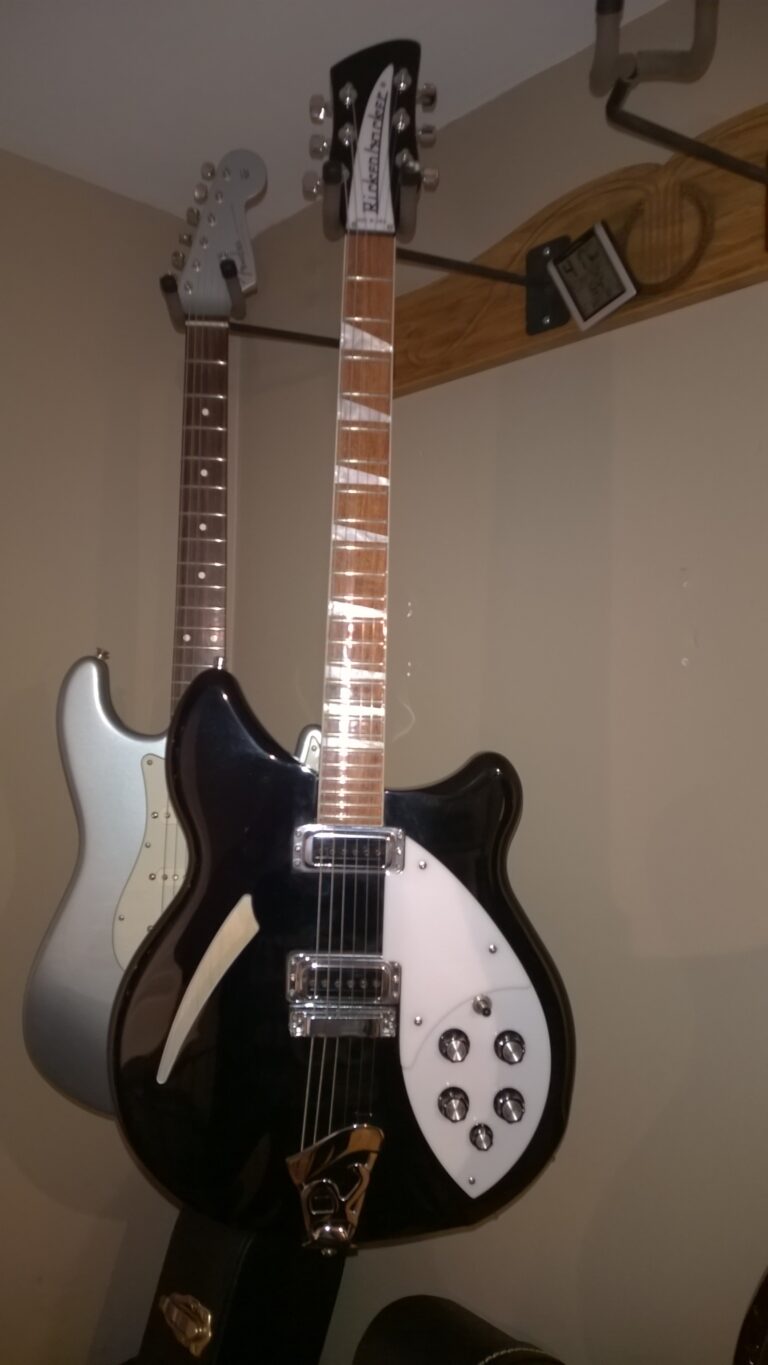
After the Mapleglo was stolen, Buck went to a store in Hartford, Connecticut, and found a black Rickenbacker 360 in Jetglo finish. He played it. It was in tune. He bought it. This guitar has been on every single R.E.M. studio album except the band’s very first single (“Radio Free Europe” on the Hib-Tone label, released before the Jetglo acquisition). It has been his primary guitar for forty-plus years. He keeps it at the foot of his bed.
The Rickenbacker 360 Deluxe is distinguished from the simpler 330 by its bound fingerboard with triangular position markers, as opposed to the 330’s unbound board with dot markers. Both are dual-pickup semi-hollow instruments with the characteristic Rickenbacker construction: a smaller body than a Gibson ES-335, specific “toaster” or “hi-gain” pickups in single-coil configurations, and the distinctive treble-bright, jangly character that Rickenbacker’s electronics and construction produce.
The 360’s specific characteristics contribute to Buck’s sound in ways beyond the general Rickenbacker character:
- Semi-hollow body: The hollow wings of the 360’s body add acoustic resonance that a solid-body guitar can’t produce — a slight airiness and complexity to the sustain that flatwound strings further enhance
- Hi-Gain pickups: Rickenbacker’s specific single-coil design, wound to higher output than vintage Fender single coils, with a specific midrange character that translates particularly well to clean or lightly overdriven amps
- R tailpiece: The standard 360 anchors its strings in a separate R-shaped tailpiece behind the bridge.
- Smaller body scale: The Rickenbacker’s body proportions and neck feel are different from both Fender and Gibson instruments — a specific relationship between player and instrument that shapes technique
Producer Mitch Easter’s comment — that Rickenbacker pickups “sound better the more metal you put over them” — refers specifically to the gauge and type of strings: heavier flatwound strings produce more magnetic field interaction with the pickups, resulting in more output and a thicker, rounder character than light roundwound strings would on the same instrument.
Tone note: He bought the guitar because it was in tune. Not because of its provenance, its year, its specific pickup wind, its collector value, or its tonal reputation. It was in tune. He bought it. Forty years of recordings confirmed it was the right guitar. Sometimes “in tune” is sufficient specification.

Rickenbacker 12-String Models
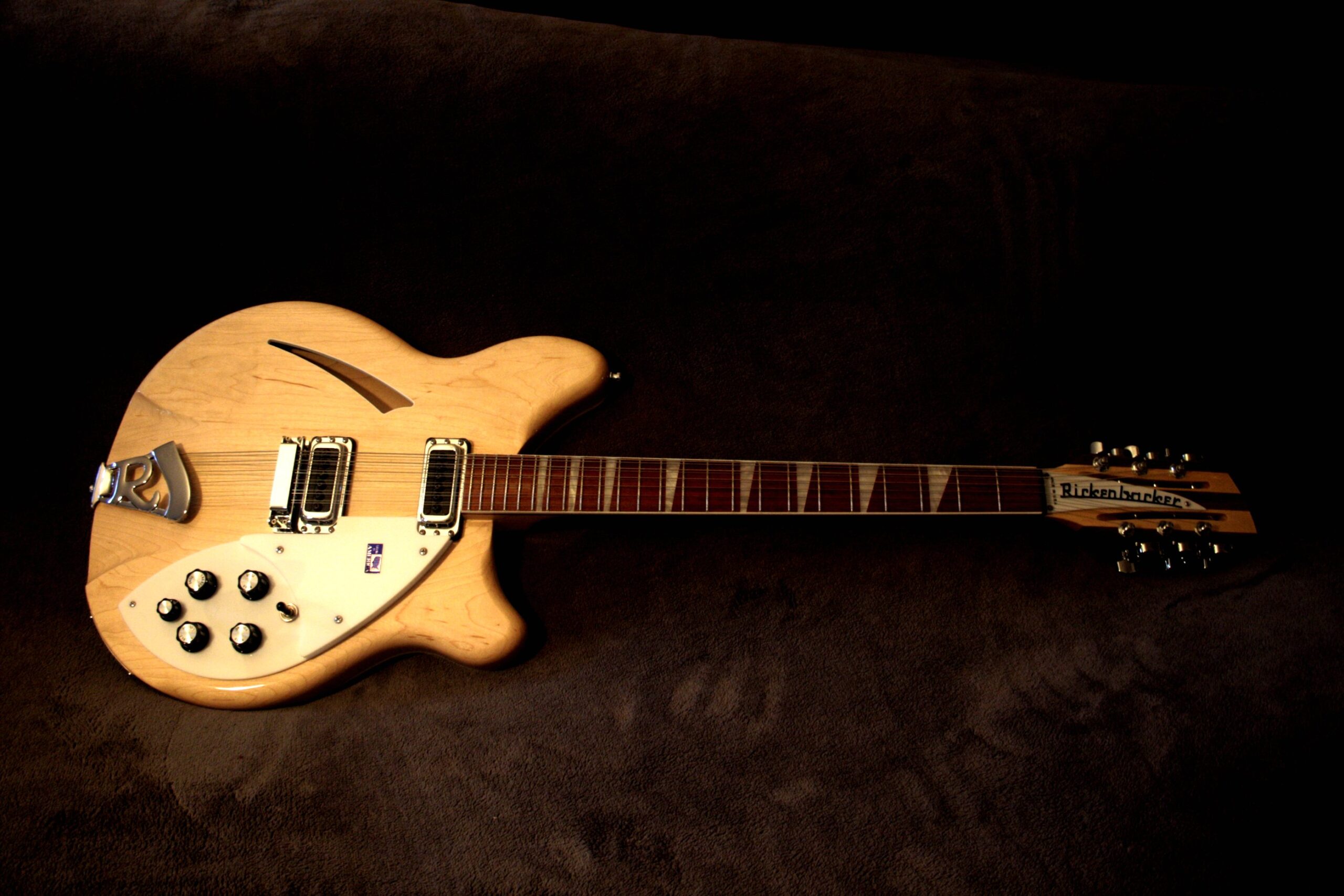
Alongside his primary 360 six-string, Buck uses multiple Rickenbacker 12-string models for the specific sound of the doubled strings. The 12-string appears throughout the R.E.M. catalog — most recognisably on “South Central Rain,” “Superman,” and various tracks across Reckoning and Fables of the Reconstruction. The Rickenbacker 12-string’s specific character — with the second string of each pair tuned one octave above (opposite to the Fender 12-string approach of tuning the octave string below) — produces a particularly bright, complex jangle that suits the R.E.M. aesthetic perfectly.
Documented models: a 360/12 twelve-string, a 620/12 twelve-string (the 620 is a more recent Rickenbacker model), and various others seen in touring photographs.
Gibson Les Paul (Various) — The Humbucker Alternative
Buck uses Gibson Les Pauls for material that doesn’t suit single-coil Rickenbacker character. He has confirmed owning a 1950s Les Paul Goldtop purchased on Reverb: “I don’t use them the same way most people use them: as a solo instrument. I tend to be more chord oriented. But those pickups have a nice, warm, chordal feeling. You can get all the harmonics and stuff out without being too overdriven.”
The Les Paul appears in his live rig when heavier, warmer material requires it — it “tends to split into humbucker (Les Paul) and single coil (Ric 330/360) sides” as one observer noted of his live setup. For Monster (1994) — the album where R.E.M. consciously moved toward a harder, more rock-oriented sound — the Les Paul was more prominent in the set.
Other Notable Guitars
- Fender Telecaster (various) — The first significant guitar (stolen 1980); continues to use Telecasters in specific studio and live contexts
- Kurt Cobain’s Fender Jag-Stang — The Jag-Stang (a custom Fender designed by Cobain combining Jaguar and Mustang elements) was used by Buck in the music video for “What’s the Frequency, Kenneth?” — a significant cultural object in the alternative rock world, used appropriately for R.E.M.’s most aggressive moment
- Rickenbacker 330 (various) — The simpler 330 alongside the primary 360; confirmed in backstage photographs of his guitar rack
- 1960 Rickenbacker (vintage) — Purchased on Reverb; confirmed in the Reverb interview: “a 1960 Rickenbacker that I got from Reverb”
- 1936 Rickenbacker Electro Mandolin (with whammy bar) — “I’m not sure why you’re supposed to have a whammy bar on a mandolin!” — confirming his eclecticism extends to the adjacent string family
- Danelectro (various) — Used in specific studio contexts for the Danelectro’s specific bright, slightly buzzed character
- 1943 Gibson (acoustic) — Confirmed in the Reverb interview as one of three guitars “in my bedroom” alongside the 1960 Rickenbacker and the Goldtop
- Gibson Les Paul Goldtop (1950s) — The vintage Goldtop from the Reverb interview; warm, chordal character
- Various Stratocasters, acoustic flat-tops — Used in studio contexts across the long R.E.M. career
- Ovation mandolin — In the 2016 Reverb interview, Buck describes an Ovation mandolin that somebody gave him.
- Flat Iron mandolin (since 1989) — “I’ve got a Flat Iron I’ve been using since ’89”; confirms interest in the full string instrument family

Amps & Cabinets: Ampeg on Murmur, Fender Twin as Workhorse, AC30 Live
Ampeg Gemini II — The Murmur Amp (That Wasn’t His)
The most historically important amplifier in Peter Buck’s career is one he didn’t own: producer Mitch Easter’s Ampeg Gemini II. Easter described the situation directly on the Rickenbacker forum (one of the more remarkable instances of a major rock producer contributing technical details to a fan forum): “When we did Murmur [in 1983], I remember Peter’s Twin Reverb was dead, so that record was done with my 60s Ampeg Gemini II. It’s on every song on Murmur except Pilgrimage.”
The checkerboard-grill Ampeg Gemini II is a vintage combo from the 1960s with a specific warm, slightly compressed character. Its use on Murmur — the album that defined R.E.M.’s early sound — means that the foundational reference for their guitar tone came from a borrowed amplifier that Buck didn’t own and hadn’t specifically chosen for the recording. The Ampeg’s specific character, combined with the Rickenbacker’s specific character and the heavy flatwound strings, produced the guitar sound of “Gardening at Night,” “Catapult,” and “Talk About the Passion.”
Easter also confirmed the studio used “a little solid state Kasino amp” for certain tracks. The Kasino appears only on “Pilgrimage” — the one track where the Gemini II wasn’t used.
Tone note: Murmur was recorded through an amp Buck didn’t own because his own amp was broken. That’s the guitar tone on every song except one. Sometimes the defining album sounds come from borrowed equipment and deadline pressure.
Fender Twin Reverb — The Primary Workhorse
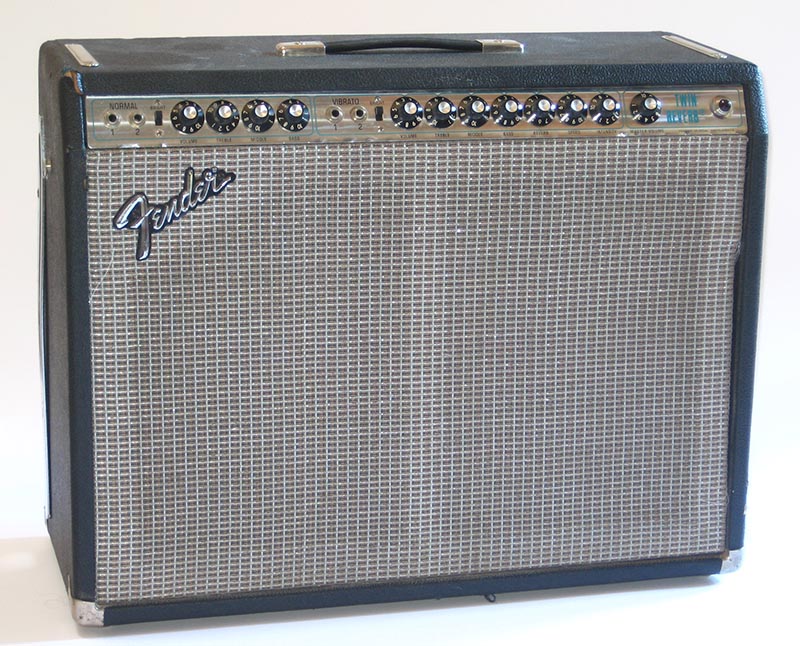
Buck’s primary amp throughout most of the R.E.M. years was the Fender Twin Reverb — the large-cabinet, high-headroom American clean machine. The Twin was his workhorse in the sense that most players use their workhorse amp: reliable, consistent, providing a clean platform for the Rickenbacker’s character to express itself without substantial coloring from the amp itself. It was broken during the Murmur sessions, hence the Gemini loan.
The Twin’s clean headroom — it resists distortion to very high volumes — suited Buck’s early approach of “getting the tone through the amp” rather than through pedals. At high volumes, the Twin’s clean signal let the Rickenbacker’s natural character (and the flatwound strings’ specific tone) dominate. At lower volumes, it was a neutral platform. Either way, it got out of the way of the guitar.
Vox AC30 — The Live Presence
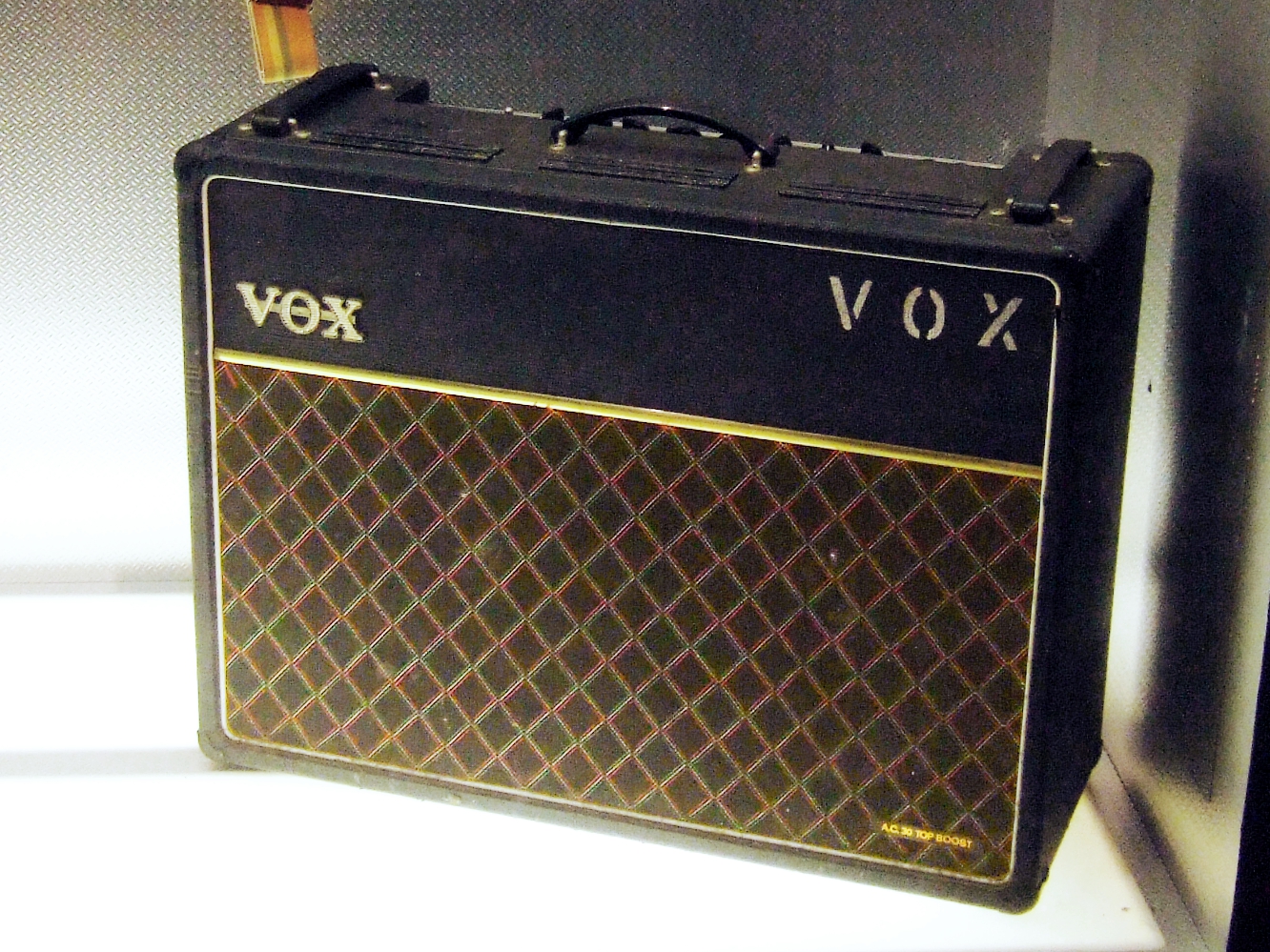
The Vox AC30 became Buck’s primary live amplifier and is the amp most associated with his live R.E.M. sound. Documented AC30 customisation: in concert photographs, his AC30 has plastic toy dinosaurs placed on top of it. This is the most visually distinctive amp modification in this series and one that has no effect whatsoever on the sound.
The AC30’s class-A topology — running the output tubes fully on all the time, as opposed to the class-AB push-pull design of most American amps — produces a specific natural compression and harmonic saturation when pushed toward breakup. For a player who described getting his tone “through the amp” without pedals, the AC30’s natural breakup at manageable volumes — and its characteristically bright, chimey top end — suited the Rickenbacker’s own character perfectly.
One Rickenbacker forum member noted the specific amp settings that were required to run a Rickenbacker at high volume through an AC30 without unwanted feedback, and Mitch Easter himself responded: “Mr. Buck played a 360 on Murmur, not a 330. And I recall it was the Jetglo one, not the Mapleglo one he had on their first session here in NC.” Mitch Easter contributing to a Rickenbacker fan forum about specific guitar models is one of the more delightful gear documentation moments in this series.
Mesa Boogie Tremoverb — The Monster Era
For Monster (1994) — the deliberate stylistic shift toward heavier, fuzzed-out rock — Buck used a Mesa Boogie Tremoverb amplifier. The Tremoverb is a high-gain Mesa Boogie with built-in tremolo — a specifically American, aggressive character suited to the louder, dirtier Monster aesthetic that departed significantly from the earlier Rickenbacker/AC30 jangle. The “One I Love” from Document is also cited as a Marshall tone, confirming his willingness to change amps when the music requires it.
Silvertone Amp and Various Small Amps
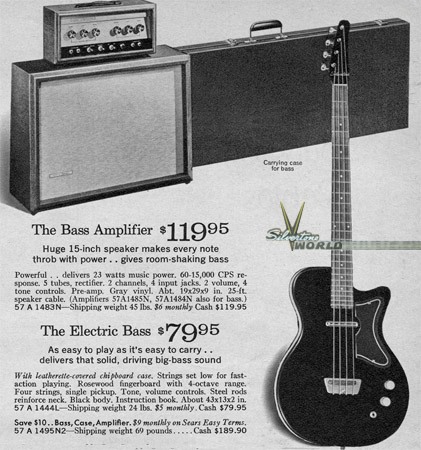
The Silvertone 1483 is a vintage bass amplifier with a separate speaker cabinet, also used for guitar.
In later career configurations, a vintage Silvertone head playing through an open-back 2×12 cabinet with Tone Tubby Alnico speakers has been documented alongside the AC30. The Silvertone’s specific character — a distinctly American, slightly lo-fi tone very different from either the Fender Twin or the Vox AC30 — suits specific material. Buck has also confirmed his general preference: “I prefer not to use any effects, but when you’re touring you tend to need to change tone, sometimes radically. I might be playing really, really loud, or I might be using a small amp, turned up, distorted.”
| Amp | Era / Context | Notes |
|---|---|---|
| Mitch Easter’s Ampeg Gemini II (checkerboard grill, 1960s) | Murmur (1983) — borrowed | “On every song on Murmur except Pilgrimage” — Buck’s Twin was broken; Easter’s Gemini was borrowed; the defining early R.E.M. guitar tone came from someone else’s amp |
| Kasino (solid state) | Murmur, “Pilgrimage” only | Studio’s small solid-state combo; used only for the one track the Gemini wasn’t on |
| Fender Twin Reverb (with JBL speakers) | Primary workhorse through most of career | High-headroom clean platform; JBL speakers for neutral tonal character; workhorse amp; broken during Murmur |
| Vox AC30 | Primary live amp (most of career) | Class-A natural compression; chimey top end complements Rickenbacker; plastic dinosaurs on top (no tonal effect) |
| Marshall (various) | Specific recording contexts (Document) | “The One I Love” reportedly through a Marshall; confirms tonal flexibility in studio contexts |
| Mesa Boogie Tremoverb | Monster era (1994) | High-gain with built-in tremolo for the deliberately heavier Monster aesthetic |
| Silvertone head + Tone Tubby 2×12 (open back) | Later touring | Vintage American lo-fi character alongside AC30 |
Pedals & Signal Chain: “I Didn’t Use Any Pedals Until Probably ’85”
Buck’s approach to effects is one of the most explicitly minimal documented cases in this series for a major rock act. He stated directly in the Reverb interview: “I didn’t use any pedals until probably ’85. I just got the tone through the amp and then kept it.”
This is significant: Murmur, Reckoning, and much of Fables of the Reconstruction — the recordings that defined what R.E.M. sounded like and that influenced an entire generation of alternative rock guitarists — were made with essentially no effects. Guitar, flatwound strings, borrowed Ampeg or Fender Twin, Rickenbacker. That’s the signal chain on the most influential college rock records of the 1980s.
The Ibanez UE400 Rack Effects — First Effects Unit
When Buck did begin using effects around 1985, his first significant effects unit was the Ibanez UE400 (or UE-400) — a rack-mounted analog multi-effects processor containing compression, phase shifting, overdrive, and a combined chorus/flanger. He confirmed in a 1985 Musician magazine interview that he wasn’t entirely sure what the unit was doing: “He has an Ibanez 4001E effects unit that he uses live though he isn’t too sure what it actually does.” The subsequent clarification identifies it as a UE400. The specific effects he confirmed using: “Fuzz on ‘Feeling Gravity’s Pull’; a chorus effect ‘I have on every once in a while to get that little ringy sound, and a compressor I use only if I want to get feedback or noise.'”
Core Pedals (Post-1985)
- Ibanez UE400 (rack-mounted analog multi-effects) — First effects unit; compression, phase shifting, overdrive, chorus/flanger; confirmed not entirely sure what it does
- Maxon AD80 Analog Delay — Confirmed on Maxon’s artist page; bucket-brigade analog delay for warm, natural echo effects
- Pro Co RAT distortion — Used for occasional distortion passages, particularly in the Monster era and subsequent louder material
- Boss Chorus (various) — The chorus that gives “that little ringy sound”
- Line 6 Tonecore effects — Documented in later touring setups
- Malekko Heavy Industry pedals — From the Portland pedal company run by Paul Barker (Ministry); confirmed in Reverb interview: “The pedals are tiny and they’re really great. We don’t have a road crew. We have one guy, so I would just as soon my pedal board not weigh 50 pounds.”
- Compressor — Confirmed but used only for feedback and noise, not conventional compression
- Fuzz — “Feeling Gravity’s Pull” from Fables of the Reconstruction; occasional use
Tone note: The entire R.E.M. early catalog — the records that defined alternative rock guitar in the 1980s — was made with no effects pedals. Guitar directly to amp. No chorus, no delay, no overdrive. The “jangle” is not a pedal. It’s a Rickenbacker, flatwound strings, and an amp running at the right volume. That’s the whole setup.
Strings, Picks & Setup
Strings: Heavy flatwound strings — one of the most specific and most important gear choices in any guitarist’s documented catalog. Confirmed by Rickenbacker themselves when setting up a copy of his primary guitar:
- 1st: .013 Plain — Swedish Steel
- 2nd: .017 Plain — Swedish Steel
- 3rd: .026 Wound — Nickel Steel
- 4th: .036 Wound — Nickel Steel
- 5th: .046 Wound — Nickel Steel
- 6th: .056 Wound — Nickel Steel
These are Dean Markley individual strings — heavy gauge, flatwound on the wound strings. The .013 high E is dramatically heavier than the standard .009 or .010 used by most electric guitarists. The .056 low E is heavy enough to be used by some bass guitarists.
Why flatwounds? Flatwound strings have their outer wrap wound flat rather than round — they feel smoother under the fingers, don’t produce the “squeaking” sound of finger slides that roundwound strings make, and have a warmer, less bright, more compressed tone. On a Rickenbacker — whose hi-gain pickups are naturally bright and forward in the upper midrange — flatwounds roll off some of the potential harshness and add warmth and sustain.
Easter’s comment is the definitive explanation: “Those Rickenbacker pickups sound better the more metal you put over them. And you develop a very deliberate way of playing. That’s what you can hear in his playing. You can hear everything he did. He really mastered it.”
The heavy gauge produces a more deliberate, less fast-casual playing style — you can’t absent-mindedly strum heavy flatwounds and produce the clean, well-defined chords that Buck’s playing requires. The strings demand commitment and precision from the player. He mastered it.
Picks: Thin picks — specifically noted as important for his tone in multiple forum discussions. The thin pick produces the characteristic “clack/chime” of his Rickenbacker attack — a brighter, more percussive initial transient than a heavy pick produces. With heavy flatwound strings on a Rickenbacker through a Vox AC30, a thin pick gives the specific combination of attack clarity and body warmth that his tone requires.
Tuners: Gotoh tuning machines and Schaller tuners documented in his confirmed setup. Heavy strings require more precise tuners — cheaper tuners may not hold under the string tension of a .056 low E.
Tone note: .013 to .056 flatwound strings. On an electric guitar. Most players use .009 to .042 roundwound. This is not a subtle difference. His strings feel almost like playing a baritone guitar or a very light acoustic. Combined with the thin pick, the specific interaction of heavy flatwound strings and a thin pick through a Rickenbacker is the physical foundation of the R.E.M. guitar sound. The gear serves the technique serves the sound.
Tunings & Tone Philosophy
Standard E tuning across the R.E.M. catalog. He confirmed: he plays electric “more like it’s an acoustic in some ways” — the heavy flatwound strings producing a feel closer to an acoustic guitar’s string resistance than conventional light roundwound electrics.
His tone philosophy is the most explicitly anti-hero in this series. He doesn’t like solos. He doesn’t use many effects. He plays rhythm. He is explicit about all three. To Guitar World: “I know that when guitarists rip into this hot solo, people go nuts, but I don’t write songs that suit that, and I am not interested in that. I can do it if I have to, but I don’t like it.”
This is not false modesty or inability — it’s a specific artistic position. Buck is a songwriter and an ensemble player before he’s a guitarist. His guitar parts exist to serve the song, which means knowing when not to play lead, when to return to the opening riff instead of soloing, when to play the part backwards instead of conventionally. These are musical judgments available only to someone who hears the song first and the guitar second.
His description of his current approach in Filthy Friends: “It helps having the Rick and an amp set up so that it’s real chimey and has a little bit of overload. Essentially, his approach is to find new ways of operating within a tight set of parameters, working with familiar gear to create new sounds.”
Tone note: “Find new ways of operating within a tight set of parameters.” That’s the specific creative challenge he sets himself. One Rickenbacker. One basic amp setup. Heavy flatwounds. No pedals if possible. Everything that’s interesting has to come from within those constraints. Most players add gear to expand the parameter space. He restricts it to force creativity.
Playing Style & Tone Philosophy: The Anti-Guitar Hero Who Defined Alternative Rock
Peter Buck is the clearest example in this series of a guitarist whose influence operates through restraint rather than display. He is not the fastest player. He does not sweep-pick. He rarely solos. His effects are minimal. His gear is consistent to the point of obsession. And yet his specific approach — the arpeggio patterns, the jangle, the deliberate avoidance of guitar heroics — defined what an entire genre of rock guitar was supposed to do.
The Arpeggio Approach — Playing Lead as Rhythm
The R.E.M. guitar technique is fundamentally arpeggio-based: rather than strumming chords, Buck breaks them into ascending or descending single-note patterns, creating a melodic riff from each chord position. The result — heard most clearly on “Radio Free Europe,” “Talk About the Passion,” and “Driver 8” — is a guitar part that is simultaneously rhythmic (providing the pulse) and melodic (outlining the harmony note by note). Neither purely lead nor purely rhythm, it occupies a third space that suits the specific sonic context of R.E.M.: Michael Stipe’s vocals carrying the melodic foreground, Mills’s bass providing the harmonic bass, and Buck’s arpeggios creating the mid-range melodic architecture.
Guitar Player’s description of the Buck/Johnny Marr comparison: “both men’s talent for melody. Until then, I was accustomed to hearing guitar as a rhythm, riff and solo instrument, but both of these guys approached their music as if they were the lead player on an instrumental record.” The arpeggio technique makes rhythm guitar melodic without making it lead guitar. That’s the specific achievement.
Tone note: The arpeggio technique requires the guitar to be clearly audible — every note individually defined rather than blurred into a chord wash. This is why the heavy flatwound strings and the Rickenbacker’s naturally clear, defined character matter so much. If the strings or the guitar or the amp blurred the individual notes, the technique wouldn’t work. Everything in the rig serves the clarity of the individual note within the arpeggio pattern.
The Anti-Solo Philosophy
Buck’s explicit disinterest in guitar solos is one of the more intellectually honest positions in rock guitar: he knows what he’s good at, he knows what his songs need, and he knows that conventional guitar solos don’t serve either. The specific solutions he’s found — the backwards solo on “What’s the Frequency, Kenneth?”, the return to the riff on “Driver 8,” the avoidance of convention wherever convention would be less musical than the alternative — demonstrate genuine compositional thinking rather than technical limitation.
He confirmed: “I can do it if I have to, but I don’t like it.” The “can do it” is important — this isn’t someone who avoids solos because he can’t play them. He can. He chooses not to.
The Byrds Connection — Jangle as Heritage
Buck’s debt to Roger McGuinn and the Byrds is explicit and permanent. The Byrds’ 1965–1966 recordings — “Mr. Tambourine Man,” “Turn! Turn! Turn!,” “Eight Miles High” — established the 12-string Rickenbacker jangle as one of rock guitar’s most distinctive sounds. McGuinn’s specific technique — bright, forward, arpeggiated, with the 12-string’s doubled strings creating a ringing, complex texture — is the direct ancestor of Buck’s approach on the 6-string 360.
The influence is not imitative — Buck developed his own vocabulary, his own rhythmic approach, his own melodic sensibility. But the instrument, the technique, and the tonal aesthetic all descend from McGuinn’s 1960s work. This kind of acknowledged lineage — a guitarist explicitly citing where his approach comes from and making music that sounds like its own thing despite the debt — is the healthiest possible relationship between influence and originality.
How to Sound Like Peter Buck: The R.E.M. Rickenbacker Jangle
Buck’s tone is achievable without vintage equipment and without expensive modifications. The non-negotiable elements are the Rickenbacker and the heavy flatwound strings. Everything else can be approximated.
The Guitar
Rickenbacker 360 or 330. The 360 has the bound fingerboard and triangular markers; the 330 has an unbound board with dot markers. Both have the essential Rickenbacker character. Buy the one that’s in tune when you play it.
- Rickenbacker 360 Jetglo — The authentic choice; black finish matches his primary instrument; bound fingerboard
- Rickenbacker 330 — Slightly different but same core character; unbound fingerboard
- Any Rickenbacker 6-string — The key is the instrument and the strings; specific model matters less than the combination
Non-Rickenbacker alternatives for the tone:
- A Telecaster with heavy flatwound strings through a Vox AC30 gets surprisingly close to the character, particularly for the rhythmic arpeggio approach
- A Gibson ES-335 or similar semi-hollow with flatwounds also approximates some elements, though the tonal character is different
The Strings — The Most Important Modification
Install flatwound strings in heavy gauge. This is the single most important element of Buck’s tone beyond the guitar itself. Use Dean Markley individual strings matching his documented gauges: .013 plain high E, .017 plain B, .026 wound G, .036 wound D, .046 wound A, .056 wound low E.
If .056 is too heavy for your playing, start with .013–.056 flatwound sets from D’Addario, Thomastik-Infeld, or La Bella. The flatwound requirement is non-negotiable; the specific gauge can be adjusted to your comfort while maintaining the heavy-flatwound character.
The Amp
Vox AC30 for live tone; Fender Twin Reverb for the clean studio platform.
| Control | Vox AC30 (Live) | Fender Twin (Studio Clean) | Notes |
|---|---|---|---|
| Volume / Gain | 6–7 (edge of natural breakup) | 5–6 (clean headroom) | AC30 natural compression at edge of breakup is the live tone; Twin keeps it clean |
| Treble | 6 | 6 | Moderate — Rickenbacker with flatwounds is naturally warm; don’t over-brighten |
| Middle | 6 | 5–6 | Mid presence for the arpeggiated note clarity |
| Bass | 5 | 5 | Controlled — flatwounds on Rickenbacker add natural warmth; bass doesn’t need boosting |
| Top Boost (AC30) | On (engaged) | N/A | The AC30’s Top Boost circuit adds the specific high-frequency presence essential to the chimey character |
| Reverb | None or minimal | Light spring | Buck’s early tone was notably dry; reverb was added later in career |
Tone note: No effects. Especially for the early R.E.M. sound — Murmur, Reckoning, Fables — the correct signal chain is Rickenbacker → flatwound strings → Ampeg or Twin or AC30 → no pedals at all. If it sounds like you need a chorus pedal, try turning the amp up slightly instead.
No Pedals (Early Era)
The early R.E.M. tone requires literally no pedals. If you have a Rickenbacker 360, flatwound strings, and a Vox AC30 or Fender Twin, you have everything you need for Murmur. The bass-roll interaction between the Rickenbacker’s hi-gain pickups and the amp’s natural EQ curve, with flatwound strings reducing harshness and adding warmth, produces the jangle without any processing.
If you want the later R.E.M. tone (post-1985): add an Ibanez UE400 or equivalent analog multi-effects in the chain. Use the chorus occasionally — “to get that little ringy sound.” Keep the fuzz for specific songs. Don’t build a complex pedalboard. One pedal at a time.
Budget vs Pro Rigs
Budget:
- Guitar: Rickenbacker 330 (the cheaper 330 is tonally very close to the 360)
- Strings: D’Addario Flatwound set, .013–.056 gauge — this is non-negotiable
- Amp: Vox AC15 or AC30 (reissue) — the genuine AC30 is the target
- Picks: Thin pick — Fender Extra Light or similar
- Pedals: None needed for the early sound
Pro:
- Guitar: Rickenbacker 360 Jetglo (if you find one in tune, buy it)
- Strings: Dean Markley individual flatwounds at his specific gauges
- Amp: Vintage Vox AC30 (1960s, with original Alnico Blue speakers) or high-quality reissue
- Pedals: Maxon AD80 Analog Delay + Boss chorus for the occasional “ringy sound”
Tone note: Buy the strings before the amp upgrade. Heavy flatwound strings on whatever Rickenbacker-style guitar you have will immediately move you toward Buck’s tone more than any amp change. The strings are where his specific character begins.
The Technique
Arpeggio patterns. Take any chord shape and play the notes individually from low to high — don’t strum. Then listen to the chord’s implied melody and try to play the arpeggio pattern in the rhythm that makes the melody clear. This is the R.E.M. guitar technique in its most basic form.
Specifically: learn “Talk About the Passion,” “Radio Free Europe,” and “Driver 8” note for note. Not for the purpose of performing them, but to understand how Buck builds a melodic guitar line from a chord progression without ever strumming the chord. The technique requires precision — each note must be individually audible — which is why the heavy flatwound strings matter: they demand precision rather than enabling fast, casual playing.
And: no solos unless the song genuinely needs one. If you’re not sure, don’t. Return to the opening riff instead.
Influence & Legacy: The Anti-Hero Who Defined What Alternative Rock Guitar Was
Peter Buck’s influence on alternative rock guitar is one of the most specific and most traceable in this series. The specific combination of instrument (Rickenbacker), technique (arpeggiated chords), strings (heavy flatwound), and amp (AC30 or Twin), plus the explicit philosophy of restraint over display, created a template that an entire generation of independent and alternative rock guitarists adopted.
The comparison to Johnny Marr is the most frequently cited parallel — both players using Rickenbacker guitars, both developing arpeggio-based melodic rhythm guitar as their primary vocabulary, both influenced by McGuinn and the Byrds, both avoiding conventional guitar heroics. The parallel is real and documented; both players acknowledged the comparison without claiming priority over each other.
The specific influence of the flatwound string choice is underappreciated: many guitarists who absorbed the R.E.M. sound and tried to replicate it on their own Rickenbackers couldn’t understand why it sounded different. The answer, usually, was the strings. Flatwound .013s produce a fundamentally different interaction with Rickenbacker pickups than standard roundwound .010s, and no amount of amp or pedal adjustment can replicate that specific character through the wrong strings.
His influence extends beyond specific guitar players to the broader philosophy of what an “indie rock guitarist” should be: someone who serves the song, who understands that the guitar is one instrument among several rather than the featured voice, who knows when not to play and when not to solo. The 1980s and 1990s alternative rock world — from The Smiths and Hüsker Dü to Pavement and Guided by Voices — is full of guitarists who absorbed this philosophy from R.E.M., even when they chose different instruments to realise it.
He was inducted into the Rock and Roll Hall of Fame in 2007 as a member of R.E.M. He continues to make music across multiple projects. The black Jetglo Rickenbacker is still at the foot of his bed. He still likes playing guitar in his pajamas.
Tone note: He influenced an entire genre’s understanding of what a guitarist’s role should be. The influence is not in a specific lick, a specific pedal, or a specific amp setting. It’s in the philosophy: serve the song, play fewer notes than you can, and never, ever play a guitar solo just because the guitarist traditionally plays a guitar solo there. That’s the R.E.M. guitar lesson, and it has informed thirty years of alternative rock.
At the foot of Peter Buck’s bed in Portland, Oregon, there is a black Rickenbacker 360 Jetglo on a stand. It was bought at a shop in Hartford, Connecticut, in 1981 because it was in tune when he played it in the store. It has been on every R.E.M. album since. It sounds like it has very heavy flatwound strings because it has very heavy flatwound strings. When he plays it — in his pajamas, at whatever hour — it sounds immediately like itself.
The Vox AC30 is somewhere in the house, with plastic toy dinosaurs on top of it. The dinosaurs don’t affect the sound. He knows this. He keeps them there anyway.
He doesn’t use many pedals. He doesn’t play many solos. He has been doing this for forty years and the guitar is still at the foot of the bed and the dinosaurs are still on the amp and the flatwound strings are still heavy and the guitar still sounds like an R.E.M. record the moment he touches it.
That’s the gear philosophy: find the thing that works. Keep it. Buy the strings that make it work. Don’t add more than you need.
Play guitar in your pajamas.
If Buck’s arpeggio-based, jangle-forward approach to rhythm guitar has you exploring the tradition that inspired him, check out our complete guide to the player he cites as his primary influence: Roger McGuinn of The Byrds established the 12-string Rickenbacker jangle sound that Buck built his entire approach on, using many of the same instruments in the decade before R.E.M. existed.
And for the guitarist who developed the closest parallel approach simultaneously — same Rickenbacker, similar arpeggio technique, similarly anti-heroic philosophy, but from a slightly different British post-punk tradition — don’t miss our complete breakdown of Johnny Marr’s guitars and gear.
FAQ: Peter Buck Guitars & Gear
- What guitar is Peter Buck most associated with?
- A black Rickenbacker 360 Jetglo — purchased at a store in Hartford, Connecticut in 1981 because it was in tune when he played it. This guitar has been on every single R.E.M. studio album except the band’s very first single. He keeps it at the foot of his bed. He described it to Reverb: “It’s still the guitar I go to every day. It has real clarity of tone. I like playing guitar in my pajamas.”
- What strings does Peter Buck use on his Rickenbacker?
- Heavy flatwound strings — specifically confirmed by Rickenbacker when they set up a copy of his primary guitar: 1st .013 plain Swedish Steel, 2nd .017 plain Swedish Steel, 3rd .026 wound Nickel Steel, 4th .036 wound Nickel Steel, 5th .046 wound Nickel Steel, 6th .056 wound Nickel Steel (Dean Markley individual strings). Producer Mitch Easter explained why: “He used larger gauge flatwound strings. That’s what made it all work. Those Rickenbacker pickups sound better the more metal you put over them.”
- What amp was used on Murmur?
- Primarily a borrowed Ampeg Gemini II belonging to producer Mitch Easter, used on every track except “Pilgrimage” (which used a small solid-state Kasino amp). Buck’s own Fender Twin Reverb was broken at the time of the Murmur sessions. Easter confirmed this directly on the Rickenbacker fan forum: “Peter’s Twin Reverb was dead, so that record was done with my 60s Ampeg Gemini II. It’s on every song on Murmur except Pilgrimage.”
- Did Peter Buck use effects pedals on the early R.E.M. albums?
- No. Buck stated: “I didn’t use any pedals until probably ’85. I just got the tone through the amp and then kept it.” Murmur (1983), Reckoning (1984), and much of Fables of the Reconstruction (1985) were recorded with essentially no effects — guitar directly to amp. His first effects unit was an Ibanez UE400 rack-mounted analog multi-effects (compression, phase shifting, overdrive, chorus/flanger), which he described in a 1985 interview as not being entirely sure what it was doing.
- Why doesn’t Peter Buck play guitar solos?
- By deliberate choice — not limitation. He told a biographer: “I know that when guitarists rip into this hot solo, people go nuts, but I don’t write songs that suit that, and I am not interested in that. I can do it if I have to, but I don’t like it.” Notable examples of his anti-solo approach: on “What’s the Frequency, Kenneth?” the entire solo is played backwards; on “Driver 8” he avoids the typical solo section and returns to the opening riff.
- What is the connection between Peter Buck and Mitch Easter?
- Mitch Easter was the producer of R.E.M.’s first two albums — Murmur (1983) and Reckoning (1984) — and the Chronic Town EP. He is the person whose Ampeg Gemini II provided the guitar amp tone on virtually all of Murmur. Easter has provided the most detailed technical documentation of Buck’s early recording setup, including confirming specific guitar models (the Jetglo 360, not the Mapleglo), string choices (flatwound, heavy gauge), and amp configurations. He notably contributed detailed answers directly to the Rickenbacker fan forum.
- How do I get Peter Buck’s guitar tone?
- The core requirements: a Rickenbacker 360 or 330, fitted with heavy flatwound strings (.013–.056 gauge), played through a Vox AC30 (for live tone) or Fender Twin Reverb (for clean studio tone) with no effects pedals for the early R.E.M. sound. The flatwound string gauge is the single most important non-guitar element — they produce the fundamental tonal character that the Rickenbacker’s hi-gain pickups require. Use a thin pick for the characteristic “clack/chime” attack. The technique — arpeggiating chord shapes rather than strumming — is as important as the gear. No solos unless the song genuinely needs one.
Sources & image credits
Gear references: Peter Buck interviewed by Reverb, 2016; Rickenbacker Model 360 specifications and parts diagram; Sears Spring/Summer 1965 catalog, model 1483, preserved by Silvertone World.
- Featured image: Peter Buck with The Minus 5, Seattle, 27 July 2019. Photo: David Lee. Source · CC BY-SA 2.0. Existing 16:9 crop, resized and re-encoded; adapted image under the same license.
- Peter Buck, Naples, 23 July 2008: Roberto De Martino (Dr.Conati). Source · public domain (PD-self). Full frame; automatic web resizing only.
- Rickenbacker 360/12: Hal Hawkins (BigTown Rube). Source · CC BY 2.0. Full frame; automatic web resizing only.
- Rickenbacker 330 Jetglo: The Hammer. Source · CC BY-SA 3.0. Full frame; resized web versions under the same license.
- 1973 Fender Twin Reverb: Micahmedia. Source · CC BY 3.0. Full frame; automatic web resizing only.
- Vox AC30 Top Boost: wetwebwork; existing crop and contrast/color adjustments by Clusternote. Source derivative · CC BY-SA 2.0. Complete amplifier retained; derivative used unchanged. Resized web versions under the same license.



.JPG)


_clipped.jpg)