
Peter Green Guitars & Gear: The Complete Guide to the Tone Behind “Black Magic Woman”
Peter Green performing with Fleetwood Mac in Hannover on 18 March 1970. Photo: Fleetwood mac peter green 2 by W.W.Thaler - H. Weber, Hildesheim, via Wikimedia Commons, CC BY-SA 3.0 (https://creativecommons.org/licenses/by-sa/3.0/). Cropped to 16:9, resized and re-encoded for web. Adapted image licensed under CC BY-SA 3.0. Source: https://commons.wikimedia.org/w/index.php?curid=13409509
When Guitar Player magazine asked Peter Green about his “magic” guitar in 2000, he gave an answer that tells you everything you need to know about the man.
“I never had a magic one,” he said. “Mine wasn’t magical. It might have looked similar to others from a distance, but it was an old-fashioned one with a funny-shaped neck — a kind of semicircle neck. It just barely worked.”
The guitar he was dismissing was a 1959 Gibson Les Paul Standard that he had bought for £110 in London. It had, for reasons nobody fully understood for nearly two decades, an out-of-phase neck pickup that produced a tone somewhere between a Les Paul’s warmth and a Stratocaster’s clarity — a sound that puzzled and enchanted listeners, that made “Black Magic Woman” what it is, that made “Oh Well” what it is, that made everything Green played with early Fleetwood Mac sound unlike anything else being made in British rock at the time.
When Green left Fleetwood Mac in 1970, he sold the guitar to a young Irish guitarist named Gary Moore for roughly what he’d paid for it. Moore played it throughout his career — on Thin Lizzy records, on “Parisienne Walkways,” on Blues for Greeny. When Moore eventually sold it, it passed through dealers and collectors until Kirk Hammett bought it in 2014.
Three guitar legends. One Les Paul. One reversed pickup. And a man who thought the whole thing was much ado about nothing.
This is the gear story of Peter Green — the most melodically gifted British blues guitarist who ever lived, and the most modest about it.
Background: Bethnal Green, the Bluesbreakers, and the Band He Founded
Peter Allen Greenbaum was born October 29, 1946, in Bethnal Green, East London — the same working-class neighbourhood that would give Orange Music (and subsequently Orange Matamp amplifiers) its name. He grew up in a Jewish family, the son of Joseph and Anne Greenbaum, and took the stage name Peter Green in the early 1960s. His older brother Michael was also a guitarist, providing the initial exposure to the instrument.
Green started playing professionally in his late teens, working through various small London bands. In 1966, Eric Clapton left John Mayall’s Bluesbreakers to form Cream. Mayall needed a replacement. The unenviable task of following arguably the most celebrated British blues guitarist of the moment fell to Peter Green — then twenty years old, relatively unknown, carrying a 1959 Les Paul that he’d bought at Selmer’s music shop in London.
He was more than up to the task. The Bluesbreakers’ A Hard Road (1967) — featuring Green as lead guitarist — demonstrated immediately that he was not Clapton’s inferior replacement but a genuinely different and in some ways more sophisticated player: quieter, more melodic, with a vibrato that was fast and light rather than the wide, slow approach of many blues players, and an understanding of dynamics that allowed him to create tension through restraint rather than through aggression.
In July 1967, Green and drummer Mick Fleetwood left the Bluesbreakers together to form their own band. They recruited bassist John McVie (still, initially, working for Mayall) and slide guitarist Jeremy Spencer, and recorded an album — Peter Green’s Fleetwood Mac — that reached number four on the British charts and established them immediately as a genuine commercial and artistic force.
The Fleetwood Mac period — four albums from 1968 to 1969, plus the instrumentals “Albatross” (UK number one) and “Man of the World” (UK number two) and “Oh Well” — produced some of the finest blues-influenced rock recordings of the era. Green was writing, singing, and playing at a level that earned him comparisons to the American blues masters he was drawing from, while sounding entirely his own.
Then came the unravelling. In 1970, after reportedly being given LSD without his knowledge at a party in Germany, Green began experiencing mental health problems that would eventually be diagnosed as schizophrenia. He gave away much of his money, including royalties he felt guilty about receiving. He quit Fleetwood Mac in May 1970, telling the band he no longer wanted to be in it. He sold his guitar to Gary Moore.
The following decade was marked by severe mental illness, periods of institutionalisation, and complete withdrawal from the music world. He worked as a gravedigger, a hospital porter, a gardener. He lived rough at times. It was a long, difficult, painful chapter in the life of a man who had, at his peak, been considered by B.B. King to be the finest blues guitar player in the world.
He returned to music gradually from the late 1970s onward. The Peter Green Splinter Group, formed in 1996, toured and recorded extensively. Albums including Splinter Group (1997) and Reaching the Cold 100 (2000) showed a player regaining his technique and his voice, though never quite reaching the heights of the Bluesbreakers and early Fleetwood Mac period. He received a belated Grammy Lifetime Achievement Award in 2014.
Peter Green died on July 25, 2020, in his sleep at the age of 73. He had been living in sheltered accommodation in London in his later years, having never fully recovered from the mental health struggles that had derailed his career half a century earlier.
Tone note: B.B. King said he was the finest blues guitarist in the world. Green himself dismissed the magic in his guitar and called his tone the result of “a lot of genuine practice and worry.” Both things are true: extraordinary ability developed through genuine work, denied as such by the man who did the work.
The Rig: Peter Green’s Guitars, Amps & Gear — Complete Era-by-Era Breakdown
Green’s gear history divides naturally into three periods: the brief but historically towering Bluesbreakers and Fleetwood Mac era (1966–1970), the long absence, and the Splinter Group return (1996–2020). The first period produced the recordings for which he is most celebrated; the gear choices of that period are the most historically significant.
Guitars: “Greeny” and Everything That Came After
The 1959 Gibson Les Paul Standard “Greeny” — The Most Important Guitar in British Blues

Peter Green bought his 1959 Gibson Les Paul Standard at Selmer’s music shop in Charing Cross Road, London, for approximately £110 (some accounts say sixty guineas) sometime in 1964 or 1965. He had been using a Harmony Meteor — his previous main guitar — when Mayall called him for the Bluesbreakers audition. Seeking something more powerful, he went into Selmer’s and found the Les Paul.
The guitar has the serial number 9 2208. Its sister guitar — built from what is believed to be the same piece of wood, with the sequential serial number 9 2204 — is “Gemini,” currently owned by Gibson Brand President Cesar Gueikian. Between those serial numbers sit the numbers for amplifiers. The two guitars were made together and separated by history.
For approximately fifteen years after Green sold the guitar, players and collectors were fascinated by the specific tone it produced in the middle pickup position — a sound described as having the body and sustain of a Les Paul combined with the clarity and definition of a Stratocaster, but different from both. The out-of-phase character of the combined pickups produced a nasal, cutting quality unlike any normal Les Paul in the middle position.
The mystery was finally solved in the early 1980s when Gary Moore took the guitar to Jol Dantzig, founder of Hamer Guitars. Both men had assumed the pickups were wired out of phase — a deliberate modification that produces a characteristically thin, hollow sound. But Dantzig discovered something different: the neck pickup’s magnet had been installed in reverse. This is not the same as wiring the pickups out of phase; it produces the out-of-phase effect in combination with the bridge pickup without the typical thinness of a conventionally out-of-phase setup. The reversal means both pickups are energetically working in opposite directions when used together, creating a tone that is full-sounding rather than hollow — the “nasal honk” that players and critics had described for years without being able to explain.
The further mystery: how did the reversed magnet get there? Green’s own account varied. In one version, he put the neck pickup “back on the wrong way around” after taking it off to emulate Eric Clapton’s bridge-pickup-only approach. In another version, the pickup had always been that way. Jol Dantzig’s forensic examination of the guitar suggested a third possibility: the pickup was installed that way at the Gibson factory, as a production error. Joe Bonamassa later acquired a 1959 Les Paul with the same factory error — suggesting it wasn’t unique to Green’s specific instrument. The “Peter Green mod” — deliberately reversing the neck pickup magnet — has since become a common modification among players seeking to replicate the tone.
Green’s own response to the “magic guitar” mythology was consistent and characteristically self-deprecating: “I never had a magic one.” He said this after having played on some of the most celebrated guitar recordings in the history of British blues. He meant it, which is either profound modesty or a genuinely different relationship with his own work than most musicians have.
After Green left Fleetwood Mac in 1970 and gave up music, he offered the guitar to Gary Moore, who was then eighteen and opening for Fleetwood Mac with his band Skid Row. Moore regarded Green as one of his biggest influences and the two had befriended each other. Green asked Moore to sell his own guitar (a Gibson SG) and give him whatever he got for it. Moore sold the SG for £160; Green refused the money and charged him only £100–£110 — roughly what he’d originally paid. “No,” Green said when Moore offered to give it back. “I’ll never ask for it back.”
Moore used the guitar throughout his career, recording “Parisienne Walkways” and the entire Blues for Greeny album with it. Due to financial difficulties, Moore sold it in 2006. It passed through collectors until Kirk Hammett acquired it in 2014 for an undisclosed sum. Hammett has used it on Metallica recordings and live shows, including a full-circle appearance at the London Palladium’s Peter Green tribute in 2020.
Gibson has released multiple replicas: a Custom Shop version in 2010, a Collector’s Edition in 2022 (limited to 50, priced at $50,000), and additional models through 2023.
Tone note: He put the neck pickup back “the wrong way around” — or a factory worker made the same error. Either way, the result was an accident of installation that produced one of the most distinctive guitar tones in rock history. Green himself thought it made no difference. The rest of the guitar world disagreed.
Gibson ES-335 (Sixties model) — The Rhythm Guitar
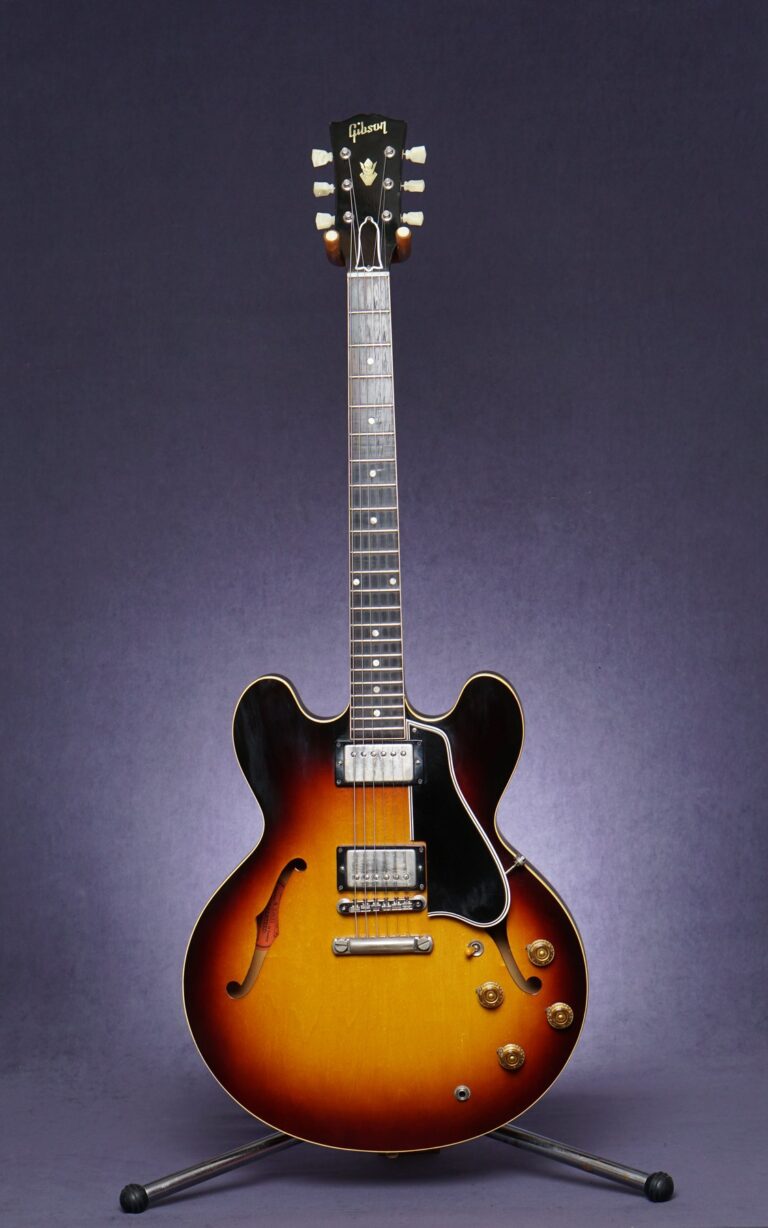
Green used a vintage Gibson ES-335 as a secondary guitar during the Fleetwood Mac period — specifically for slide guitar work on “Albatross” and rhythm parts on “Black Magic Woman,” and for the slide technique on songs where the conventional fretting of the Les Paul wasn’t required. He later gave this guitar to Jeremy Spencer, who used it alongside his own Gibson instruments throughout the late 1960s Fleetwood Mac era. The ES-335’s semi-hollow character suited slide guitar work, with the natural resonance of the hollow wings providing warmth that a fully solid guitar couldn’t match.
1960s Fender Stratocaster (Left-Handed)
In later life — the Splinter Group era and retirement years — Green used a left-handed Fender American Stratocaster despite being a right-handed player. In an interview he confirmed the high action was not for slide but simply because it was a left-handed guitar. The Stratocaster represented a complete departure from the Les Paul he had played throughout his most celebrated period — he never returned to Les Paul guitars after selling Greeny, instead moving through various other instruments including Gibson’s Howard Roberts Fusion model.
Other Documented Instruments
- Harmony Meteor — Pre-professional primary guitar; used for his Bluesbreakers audition before acquiring the Les Paul
- Fender Bass VI — Used in a 1970 photograph through a Fender Dual Showman Reverb amp; the Bass VI is a 6-string bass tuned an octave below standard guitar, used for bass-range parts
- 59 Dallas Tuxedo — Seen on German TV programme Beat-Club during “Man of the World”; sold at Bonhams in 2018 for approximately £10,000
- Gibson Howard Roberts Fusion — Used in later career; the semi-hollow Howard Roberts model with its warm, jazz-adjacent character
- Tanglewood Memphis AS-35 — A Gibson ES-335-style semi-hollow; seen in a video of Green’s personal guitar collection in his later years
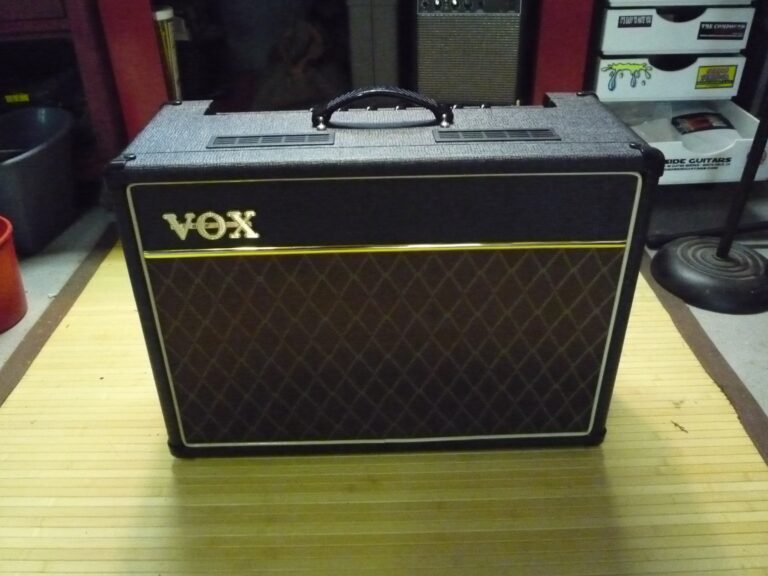
- Vox AC15 Custom Classic CC1 — The personal Vox amplifier sold at auction at Bonhams London in June 2023, confirming ongoing relationship with Vox equipment in his personal collection
- Left-handed Fender American Stratocaster — Splinter Group and later era; high action (left-handed guitar played right-handed)

Amps & Cabinets: Vox to Marshall to Orange to Fender
Vox AC-50 and Marshall JTM45 — The Bluesbreakers Era
Photographs from 1967 show Green using both a Vox AC-50 Tall Box amplifier head and an early 1960s Marshall JTM45 during the Bluesbreakers period. The AC-50 is a large Vox head with more headroom than the classic AC30; the JTM45 is the founding Marshall design based on the Fender Bassman circuit, the amp that defined British blues rock tone in the mid-1960s. Green also described having “a Vox bass amp with a lot of treble settings that I used for my first guitar playing” — suggesting the Vox bass amp was chronologically first, before the AC-50.
The A Hard Road album (1967) was recorded with a Marshall head and 4×12 cabinet — the classic Bluesbreakers setup that Clapton had established and Green continued, though with his own, quieter, more melodic approach to what a Marshall could do.
Orange Matamp — The Early Fleetwood Mac Era
For the early Fleetwood Mac period — the band’s commercial peak and the recordings of “Black Magic Woman” and “Oh Well” — Green used Orange Matamp amplifiers. Orange Music on Denmark Street in London (in the same neighbourhood where Becker and Greenwood would later buy their instruments at Denmark Street) was founded by Cliff Cooper, who collaborated with amplifier builder Mat Mathias to create the original Orange Matamps when major manufacturers refused to supply his shop.
Green was a frequent patron of Orange Music alongside other famous guitarists of the era — Paul Kossoff, Marc Bolan. His touring Fleetwood Mac rig during this period was extraordinary in scale: six 100-watt Orange Matamp heads, combined with sixteen speaker cabinets in a mix of 2×12 and 4×12 configurations. This was a wall of Orange amplification at a time when the company was essentially a small boutique operation. The sheer physical presence of that stage setup — and the sonic impact it created — was part of the early Fleetwood Mac live experience.
Tone note: Six 100-watt Orange Matamps and sixteen speaker cabinets for a blues band. The scale of that rig contrasts sharply with Green’s reputation as a subtle, melodic player — the restraint in his playing was a choice, not a limitation of his setup.
Fender Twin Reverb, Deluxe Reverb, and Dual Showman Reverb
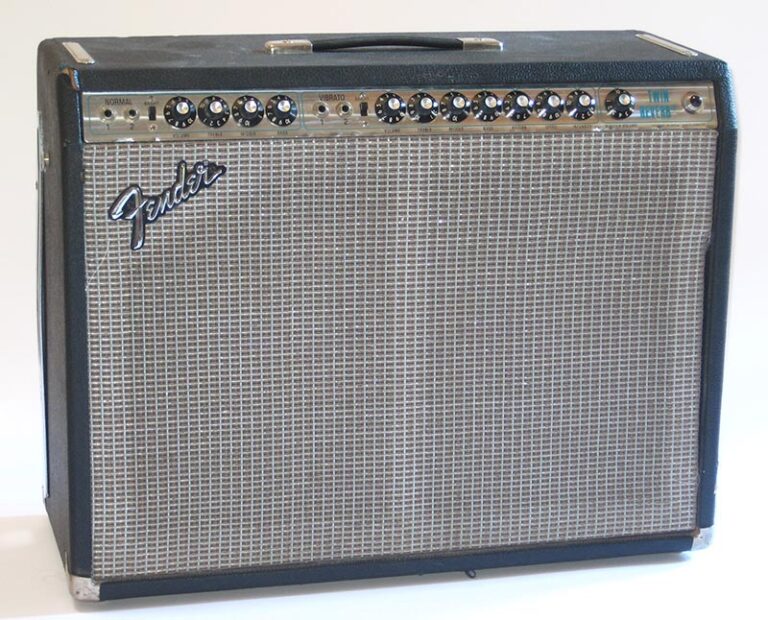
As Green moved away from the Orange Matamps, he transitioned to Fender amplification — the silverface Fender Twin Reverb and Deluxe Reverb combos that he used for later Fleetwood Mac live performances. A 1969 photograph from the Fleetwood Mac in Chicago sessions shows him with a silverface Fender Deluxe Reverb. A 1970 photograph shows him with a Fender Dual Showman Reverb head. Guitar Player described him as most often wailing through “silverface Fender Twin Reverb and Deluxe combos” during the Fleetwood Mac period.
The Fender clean — particularly the Twin Reverb’s characteristic warm, bell-like response — complemented the out-of-phase Les Paul pickup combination in a way that the Orange Matamps’ more aggressive British character didn’t. The Twin’s headroom allowed the guitar’s natural acoustic quality to come through, and the Les Paul’s unique pickup response in the middle position had maximum tonal impact through an amp that wasn’t adding its own substantial coloration.
Splinter Group Amps — The Return
During the Splinter Group era (1996–2020), Green used a variety of Fender amplifiers: a Fender Blues DeVille 60-watt 4×10 combo as his main amp until autumn 1997, sometimes combined with a Fender Twin Reverb. He later used a Fender ProSonic amplifier with 10-inch speakers. He also acquired a mahogany special edition Vox AC30 called “The Collector,” continuing his relationship with both Fender and Vox amplification.
His guitar tech’s Fender Blues DeVille is also documented, suggesting a wet/dry or two-amp configuration for some Splinter Group performances.
| Amp | Era | Notes |
|---|---|---|
| Vox bass amp (early) + Vox AC-50 Tall Box | Pre-Bluesbreakers / early Bluesbreakers | First amp described by Green; Vox AC-50 documented in 1967 photography |
| Marshall JTM45 head | Bluesbreakers (1966–1967) | Documented in 1967 live photographs; A Hard Road recorded through Marshall head + 4×12 |
| Orange Matamp (×6, 100W) + 16 cabs | Early Fleetwood Mac (1967–1969) | Six 100W Orange heads through sixteen 2×12 and 4×12 cabs live; the wall of orange in the original Fleetwood Mac live show |
| Fender Twin Reverb (silverface) + Fender Deluxe Reverb + Fender Dual Showman Reverb | Late Fleetwood Mac (1969–1970) | Transition away from Orange to Fender; Twin and Deluxe for live work; Dual Showman documented in 1970 photography |
| Fender Blues DeVille (60W, 4×10) + Fender Twin Reverb | Splinter Group (1996–1997) | Main amp on return to performance; sometimes used alongside Twin Reverb |
| Fender ProSonic (10″ speakers) | Splinter Group (late 1990s onward) | Confirmed in CD inlay booklet for Reaching the Cold 100 |
| Vox AC30 “The Collector” (mahogany special edition) | Splinter Group era | Special edition AC30 documented in Peter Green’s Authorised Biography |
Pedals & Signal Chain: The Least Important Part of the Equation
Peter Green’s pedal use was, like his amplifier approach, simpler than the complexity of his tone might suggest. For the Bluesbreakers and early Fleetwood Mac period, his signal chain was fundamentally guitar → amp, with minimal effects between them.
The closest thing to a consistently used effect: reverb from the Fender amplifiers’ built-in spring reverb units — Green’s clean tone on later Fleetwood Mac recordings frequently has the warm, slightly washed character of Fender spring reverb, which suits the melodic, slightly elegiac quality of his playing at its most beautiful.
No dedicated overdrive or distortion pedals are documented in his primary signal chain. The driven tone on recordings like “Black Magic Woman” and “Oh Well” came from the amp operating at volume, with the guitar’s pickup output (and the unique out-of-phase character of the combined pickups) determining the harmonic complexity of the distorted sound.
The tremolo effect on “Black Magic Woman” came from the Fender amplifier’s built-in tremolo circuit — not a pedal, not a rackmount unit, but the amp’s own electronic tremolo varying the volume rhythmically. This detail is often forgotten: the hypnotic, cycling pulse of “Black Magic Woman” is not a separate effect but part of the amplifier’s own voice.
Tone note: The tremolo on “Black Magic Woman” is the amplifier’s own built-in circuit. The sustain and harmonic complexity is the amp working at volume with the out-of-phase pickup. The reverb is the amp’s spring tank. Almost nothing between the guitar and the speaker that the amp didn’t already include. That’s the entire “magic” signal chain.
Strings, Picks & Setup
Strings: Not extensively documented in specific commercial terms for the Fleetwood Mac era. The character of his playing — particularly the quick, light vibrato and the ease of bending on a Les Paul — suggests medium-light gauge strings (.010–.046 or similar) rather than the heavy gauges more common in the early British blues scene. His contemporaries at the time often used heavier strings; Green’s more delicate, faster vibrato technique suggests lighter gauge preferences.
Picks: Not specifically documented in commercial detail. His articulate, clean pick attack — each note precisely defined even in complex melodic passages — suggests a medium pick gauge used with controlled pressure rather than aggressive attack.
Guitar setup for “Greeny”:
- Original neck and bridge humbuckers, with the neck pickup’s magnet reversed (whether by Green, a repair tech, or the original Gibson factory installation — the effect is the same)
- Green initially removed the neck pickup entirely to emulate Clapton’s bridge-pickup-only approach, then reinstalled it with the reversed orientation
- No significant other modifications documented — the guitar was otherwise stock
- The neck profile: Green himself described it as having “a funny-shaped neck — a kind of semicircle neck,” suggesting a rounder, more pronounced C-shape than the more flattened D-profiles that many players preferred
Tone note: “I copied Eric. I heard him play one night, and he was on the treble pickup all night long. It sounded so good, I thought I’d take my bass pickup off altogether.” He removed the neck pickup to emulate Clapton, then put it back wrong. The entire signature of his tone began as an act of imitation that went sideways. Sometimes the happy accident is the best musical decision.
Tunings & Tone Philosophy
Standard E tuning for essentially his entire recorded output. Slide guitar passages (particularly on “Albatross”) may have involved open tunings on specific instruments, but Green’s primary Les Paul work was in standard tuning.
Green’s stated tone philosophy is the most self-denying in this series: he consistently refused to take credit for the tonal qualities that made his playing extraordinary. “I never had a magic one.” “Phase — it sounds like a good name for a group.” “It just barely worked.” This pattern of denial — applied to the guitar itself, to his technique, to his reputation — is either profound false modesty or a genuinely different relationship with the idea of individual tonal identity than most guitarists have.
What he did acknowledge was the role of work: “It takes a lot of genuine practice and worry to get a sound like that.” The “worry” is particularly revealing — not just practice, but the anxious, committed attention to what the music requires. The sense that getting a tone right is a matter of responsibility as well as technical skill.
His approach to dynamics — the ability to create tension through restraint, to make a quiet phrase as powerful as a loud one — was the most sophisticated element of his playing and the one that most distinguished him from his contemporaries. He understood that what is not played creates the space for what is played to be heard. In a genre (British blues) that often valued aggression and volume, Green valued space and melody.
Tone note: “A lot of genuine practice and worry.” That is the entire philosophy. The practice produces technique. The worry produces the emotional engagement that technique alone cannot supply. Green had both, denied the first, and never discussed the second.
Playing Style & Tone Philosophy: The Quietest Voice in British Blues
Peter Green was, at his peak, considered by B.B. King to be the finest blues guitar player in the world. This is not a casual compliment from B.B. King. It was a specific assessment from the man who had defined what blues guitar was for a generation, directed at a twenty-something musician from East London who had been playing professionally for fewer than five years.
The qualities that earned that assessment are specific and consistently documented by those who played and listened to Green at his peak.
The Vibrato — Fast, Light, and Devastating
Green’s vibrato was his most distinctive physical characteristic — and the most individual element of his playing. Where most blues guitarists used wide, slow vibrato (the B.B. King tradition), or moderate-width vibrato (the Clapton and Mayall tradition), Green used a fast, narrow, intensely concentrated vibrato that produced a specific kind of emotional effect. Notes under Green’s vibrato sounded as if they were barely contained — as if the pitch itself was trembling with feeling.
Guitar Player described it as a “quick, stinging vibrato” — the dual adjectives are both accurate. Fast enough to feel urgent, intense enough to feel painful. This vibrato combined with his melodic sensitivity to produce notes that communicated grief, longing, and beauty simultaneously.
Tone note: The vibrato is where the “magic” actually lives, not in the out-of-phase pickup. A player with conventional vibrato through “Greeny” doesn’t produce Green’s sound. The reversed magnet contributes; the vibrato is the foundation.
The Dynamics — Playing Quietly in a Loud Genre
Green’s understanding of dynamics was exceptional for his context. British blues rock in the late 1960s was predominantly a loud, aggressive genre — Clapton, Hendrix, and the contemporaries Green was compared to all played with physical intensity and high volume. Green played with restraint. He could be loud — six Orange Matamps through sixteen speaker cabinets is not a quiet system — but he chose to use volume as one expressive option among many rather than as a default.
The instrumental “Albatross” — UK number one in 1968 — is perhaps the clearest demonstration. A slow, floating melody with no vocals, no aggression, no conventional blues vocabulary. Just a melody and space. It sold more copies than virtually anything Fleetwood Mac recorded in the same period, demonstrating that the audience for restraint was larger than the British blues orthodoxy suggested.
The Melodic Instinct
Green’s solos tell stories. Not in the sense that every note has an obvious emotional program, but in the sense that each phrase has a clear beginning, a development, and a resolution — a melodic logic that makes the solo feel composed even when improvised. His phrases breathe: they start, say something, and stop before saying it again. The space between phrases is as deliberate as the notes within them.
This melodic instinct — rooted in his absorption of American blues players (B.B. King, Freddie King, Robert Johnson, Elmore James, Otis Rush) combined with whatever additional sensibility he had developed through his own musical imagination — produced guitar playing that was immediately recognisable and consistently singable. You can sing a Peter Green solo. Not abstractly, but the actual notes, in the actual order, with the actual rhythmic timing he used. That’s the definition of melodic clarity.
Tone note: You can sing his solos. Not just hum them generally — sing the specific notes in the specific order with the specific timing. That’s the measure of melodic clarity, and it’s rarer than it sounds.
The Blues Vocabulary
Green absorbed the full canon of American blues guitar: Robert Johnson, Muddy Waters, B.B. King, Freddie King, Elmore James, Otis Rush. Unlike some British blues players who took specific elements from specific players and deployed them as identifiable borrowed vocabulary, Green synthesised these influences into something that sounded entirely his own. The techniques are recognisable (bending, vibrato, the note choices of the blues scale in minor pentatonic context), but the musical personality expressing them sounds like no one who came before or after.
How to Sound Like Peter Green: The Out-of-Phase Les Paul Tone
Green’s core tone is one of the most specific and most replicable in this series — once you understand the pickup configuration. The out-of-phase neck pickup character is the defining element; the amplifier settings are less critical than the guitar itself.
The Guitar — The Peter Green Mod
The “Peter Green mod” is the single most important element: reversing the magnet in the neck pickup of a humbucker-equipped guitar. This creates the out-of-phase effect in the middle pickup position without the typical thinness of conventional out-of-phase wiring.
- Gibson Custom Shop “Greeny” 1959 Les Paul — The exact replica; accurate out-of-phase configuration; Custom Shop priced; the most authentic available option
- Gibson USA “Greeny” Les Paul — More accessible production model with the same configuration
- Any Gibson Les Paul (or copy) with the Peter Green Mod — Any competent guitar tech can reverse the neck pickup magnet; this is the practical and affordable route to the characteristic tone
- Gibson Les Paul Standard — Standard Les Paul as starting point; add the mod and you’re most of the way there
- Epiphone Les Paul Standard — Budget starting point; Peter Green mod applicable to any humbucker-equipped guitar
The modification: take the neck pickup out, flip the magnet so its polarity is reversed relative to the bridge pickup. Reinstall. The combined bridge + neck position (middle selector) will now produce the characteristic out-of-phase tone. Individual pickup positions are unaffected.
The Amp
Fender clean or early British. The Les Paul through a clean Fender Twin is the most accessible approximation of the later Fleetwood Mac live tone; the Marshall JTM45 or JTM45-type amp approximates the A Hard Road Bluesbreakers tone.
| Control | Fender Twin Reverb (clean) | Marshall JTM45 / vintage British | Notes |
|---|---|---|---|
| Volume / Gain | 4–6 (clean headroom) | 6–8 (natural breakup) | Green’s driven tone came from amp volume, not pedals |
| Treble | 5–6 | 6 | The out-of-phase Les Paul adds clarity; don’t over-brighten |
| Middle | 6 | 6–7 | Midrange presence for the singing, vocal quality of his leads |
| Bass | 5 | 5 | Warm but not boomy — the Les Paul body adds warmth naturally |
| Reverb | 3–5 (spring, present but not washy) | Light (if available) | Fender spring reverb is part of the characteristic tone |
| Tremolo (Fender) | Slow, moderate depth for “Black Magic Woman” feel | N/A | The tremolo on “Black Magic Woman” is the amp’s built-in circuit |
Tone note: Use the middle pickup position — combined neck and bridge, with the reversed neck pickup. That’s the tone. Individual pickup positions sound like a normal Les Paul. The out-of-phase middle position is everything.
No Pedals
Like Grant Green, Peter Green’s documented signal chain is guitar → amp with no effects pedals between them. The driven tone is amp-generated. The tremolo is amp-circuit. The reverb is amp-spring. If you’re adding a pedal overdrive or a separate tremolo unit, you’re already going further than he did.
Budget vs Pro Rigs
Budget — “Black Magic Woman” tone:
- Guitar: Epiphone Les Paul Standard (Peter Green mod applied — reverse neck pickup magnet)
- Amp: Fender Blues Junior or Blues DeVille — Fender clean with built-in reverb and tremolo; set moderate reverb, slow tremolo for “Black Magic Woman”
- Strings: Medium-light gauge (.010–.046)
- Pedals: None
Pro — Authentic approach:
- Guitar: Gibson USA or Custom Shop “Greeny” Les Paul Standard (out-of-phase neck pickup factory-configured)
- Amp: Fender Twin Reverb (silverface or reissue) for live; Marshall JTM45 or clone for “Bluesbreakers” era tone
- Strings: Ernie Ball .010–.046 or similar
- Pedals: None
Tone note: The Peter Green mod is the cheapest and most impactful gear change in this entire series. A competent guitar tech reverses a magnet in one pickup for minimal cost. The result is an entirely different tonal character in the middle position. Do the mod before anything else.
The Technique
The vibrato. Before any other technique consideration, develop the fast, light, concentrated vibrato. Not the wide B.B. King arm vibrato, not the slow finger vibrato of classical technique — a fast, contained vibrato applied with the first or second finger on the bent string, producing rapid, small-amplitude pitch variation. This is the most individual element of Green’s playing and the one that most guitarists overlook when attempting to approximate his sound.
For the dynamics: practice leaving space. Play a phrase. Stop. Wait. Play the next phrase. The discipline of not filling every available space is harder than it sounds for guitarists accustomed to the convention that a guitar solo should be continuous. Green’s solos breathe. That breathing is a learned skill.
Influence & Legacy: The Man Who Made B.B. King Take Notice
Peter Green’s influence on British and global blues guitar is both enormous and somewhat difficult to trace precisely, because his active career was so short. He recorded fewer than five years of music before mental illness ended his professional life. In that time, he shaped what British blues guitar could be.
The specific musicians who cite him as primary influences include Gary Moore (most extensively — Moore dedicated an entire album, Blues for Greeny, to his compositions and played Green’s literal guitar in doing so), Glenn Tipton of Judas Priest (who described his playing style as “Peter Green on steroids”), and numerous blues guitarists who absorbed the Fleetwood Mac recordings.
His influence on the concept of the “singing” guitar tone — the idea that a guitar should sound as if it is a human voice rather than a mechanical string-and-pickup system — is pervasive in British rock. The specifically melodic, emotional, controlled approach to blues guitar that he exemplified became a model for players who wanted to express feeling through the instrument rather than demonstrate technique. Gary Moore absorbed it. The Fleetwood Mac musicians who followed him (Lindsey Buckingham included the band’s history, but the specifically blues-rooted sound is Green’s) absorbed the context. Countless players who learned from the recordings absorbed it without being able to name the source.
The guitar “Greeny” has had its own shadow legacy — as it passed through Gary Moore and Kirk Hammett, each new owner brought it to new audiences and new recording contexts. Moore’s use of it on Blues for Greeny (1995) was an explicit tribute; Hammett’s use of it on Metallica recordings is a more complex inheritance, bringing a 1959 British blues guitar into the context of American heavy metal. The guitar has a documentary film, multiple replicas, and a six-figure price tag. The man who bought it for £110 “just barely” thought it worked.
B.B. King said he was the finest blues guitarist in the world. Green said he didn’t have a magic guitar. Both statements are accurate. The quality of Peter Green’s playing was not in the instrument or the equipment or the famous reversed magnet. It was in the quality of musical attention he brought to every note — the practice and worry he described as the actual source of his sound.
The equipment helps. The hands are everything.
Tone note: B.B. King said he was the finest in the world. Green said his guitar “just barely worked.” The discrepancy between how others heard him and how he heard himself is one of the sadder facts in rock guitar history. He may never have fully understood what he had.
At Selmer’s music shop on Charing Cross Road in London, sometime in 1964 or 1965, a young guitarist bought a used 1959 Gibson Les Paul for sixty guineas. The guitar was five or six years old, had a funny-shaped neck, and as far as the buyer could tell, just barely worked.
He would use it to record “Black Magic Woman” and “Oh Well” and “The Green Manalishi” and “Albatross” — four pieces of music that sold millions of copies and established the blues-rock sound of early Fleetwood Mac as one of the defining tones of British rock.
Then he gave it away for less than he paid for it, telling the young Irish guitarist who received it: “No. I’ll never ask for it back.”
Gary Moore played it for thirty years. Kirk Hammett has played it since 2014. Both are playing it still, in different contexts, for different audiences, producing the same out-of-phase middle position tone that a factory worker in Kalamazoo, Michigan, produced accidentally in 1959 — or that Peter Green produced accidentally when he put the neck pickup back on wrong in the mid-1960s.
Peter Green died on July 25, 2020. He never fully recovered from the mental illness that had taken his career. He had, in his later years, returned to music with the Splinter Group and regained some of what he had been. But the specific quality of the early recordings — the vibrato, the dynamics, the melodic intelligence, the particular interaction between a reversed-magnet Les Paul and a Fender Twin Reverb — had been there for a few bright years in the late 1960s, and then it had not.
It was a lot of genuine practice and worry that got him there.
And it was more than that, too, even if he wouldn’t have said so.
Peter Green’s out-of-phase Les Paul tone has a direct lineage to the player who owned “Greeny” for thirty years after him. Check out our complete guide to Gary Moore’s gear and tone — the guitarist who bought the guitar for £110 and gave it a home for three decades, using it to record some of the finest blues guitar of the 1980s and 1990s.
And for the guitarist who replaced Green in the Bluesbreakers before Green replaced Clapton — understanding the full chain of British blues guitar succession — don’t miss our complete breakdown of Eric Clapton’s tone and gear guide.
FAQ: Peter Green Guitars & Gear
- What guitar did Peter Green play?
- A 1959 Gibson Les Paul Standard — known as “Greeny” — which he purchased at Selmer’s music shop on Charing Cross Road, London, for approximately £110 in 1964 or 1965. He used it throughout his time with John Mayall’s Bluesbreakers and Fleetwood Mac, and it is the guitar on “Black Magic Woman,” “Oh Well,” “The Green Manalishi,” and “Albatross.” After leaving Fleetwood Mac in 1970, he sold it to guitarist Gary Moore for roughly what he had paid. The guitar subsequently passed to Kirk Hammett of Metallica in 2014. Gibson has released multiple replica models.
- What is the “Peter Green mod” on a Gibson Les Paul?
- The Peter Green mod involves reversing the magnet in the neck pickup of a humbucker-equipped guitar. This creates an out-of-phase effect in the combined neck-and-bridge pickup position (middle selector position) without the typical thinness of conventionally out-of-phase wiring. The reversed magnet produces a tone with the body and sustain of a Les Paul combined with the clarity and definition of a Stratocaster — a nasal, cutting quality that defined Green’s sound on the Fleetwood Mac recordings. Guitarist tech Jol Dantzig discovered in the early 1980s that the configuration in Greeny appeared to be a factory installation error rather than a deliberate modification.
- What amplifiers did Peter Green use with Fleetwood Mac?
- In the early Fleetwood Mac period (1967–1969), Green used Orange Matamp amplifiers — six 100-watt Orange Matamp heads through sixteen speaker cabinets (a mix of 2×12 and 4×12) for live performances. He subsequently switched to Fender amplification: silverface Fender Twin Reverb and Deluxe Reverb combos for later live work, and a Fender Dual Showman Reverb head documented in 1970. For the Bluesbreakers recordings, he used a Marshall JTM45 and 4×12 cabinet.
- What is the out-of-phase tone on Peter Green’s Les Paul?
- When the neck and bridge pickups are selected simultaneously on Green’s Les Paul (middle selector position), the reversed neck pickup magnet creates an out-of-phase interaction between the two pickups. Unlike conventional out-of-phase wiring (which produces a thin, hollow sound), the reversed magnet version produces a nasal, biting quality with full body — described as having Les Paul sustain with Stratocaster clarity. This sound is most clearly audible on “Black Magic Woman.” The technique of flipping the neck pickup magnet has since been widely adopted and is called the “Peter Green mod.”
- What happened to Peter Green’s guitar after he left Fleetwood Mac?
- Green sold the 1959 Les Paul to Gary Moore in early 1970 for approximately £100–£110 — roughly what he had originally paid. Moore used it throughout his career including on “Parisienne Walkways” (1979), the album Blues for Greeny (1995), and various Thin Lizzy recordings. Due to financial difficulties, Moore sold the guitar in 2006. It passed through private collectors and dealers until Kirk Hammett of Metallica acquired it in 2014. Hammett has used it on Metallica recordings and live performances, including a Peter Green tribute at the London Palladium in 2020.
- Did Peter Green use any effects pedals?
- No dedicated effects pedals are documented in Green’s primary signal chain during the Bluesbreakers and Fleetwood Mac era. The driven tone on recordings like “Black Magic Woman” came from the amplifier operating at volume; the tremolo effect is the Fender amp’s built-in circuit; the reverb is the Fender amp’s built-in spring reverb. The signal chain was essentially guitar → amplifier. For the Splinter Group return in the 1990s, his setup included Fender Blues DeVille and ProSonic amplifiers, but detailed pedalboard documentation is not available.
- How do I get Peter Green’s guitar tone?
- The most important step is the Peter Green mod: have a guitar tech reverse the magnet in the neck pickup of a humbucker-equipped Les Paul or similar guitar. This creates the characteristic out-of-phase middle pickup position tone without expensive vintage guitars. Then use the middle selector position (both pickups combined). Run into a clean Fender amplifier (Twin Reverb or Blues Junior) with spring reverb and built-in tremolo; set moderate reverb, slow tremolo for the “Black Magic Woman” character. No pedals needed. The other essential element is the vibrato technique: fast, light, concentrated pitch variation that Green developed through what he described as “a lot of genuine practice and worry.”
Image credits
- Gibson Les Paul Standard: DonnyBurger1974, Wikimedia Commons, CC BY-SA 4.0.
- Gibson ES-335: Lightburst, Wikimedia Commons, CC BY-SA 4.0.
- Vox AC15: Roadside Guitars, Wikimedia Commons, CC BY-SA 2.0.
- Fender Twin Reverb: Micahmedia, Wikimedia Commons, CC BY 3.0.
- Greeny: GuitarGangsters AI-generated reference illustration, not a photograph.
- Fender Bass VI: GuitarGangsters AI-generated reference illustration, not a photograph.


.jpg)
