Randy Rhoads – The Classical Rebel of Metal
GuitarGangsters Editorial 13 min read Updated 21 October 2026
You can almost hear it — that razor-sharp Les Paul bite slicing through Ozzy’s voice on Crazy Train. A mix of elegance and fury, like Bach on fire through a Marshall stack. Randy Rhoads didn’t just play guitar; he redefined what it meant to be a metal guitarist with soul, brains, and perfect pitch.
When most players in the early ’80s were chasing louder amps and faster licks, Randy was chasing clarity. He practiced classical études in hotel rooms between shows, wrote down every solo he ever played, and obsessed over tone like a scientist tweaking his first experiment. He was barely in his twenties, but he played like someone who’d already lived ten musical lifetimes.
Background: From Burbank Prodigy to Blizzard Icon
Born in Santa Monica in 1956, Randy grew up surrounded by music. His mother, Delores Rhoads, ran Musonia School of Music in Burbank — a humble building that became the birthplace of his genius. At six, he picked up a guitar that was bigger than he was. By eleven, he was teaching others. By sixteen, he was leading Quiet Riot, packing Los Angeles clubs with a Les Paul Custom slung almost to his knees.
Quiet Riot might have been his first band, but it wasn’t his destiny. That came in 1979, when a soft-spoken Englishman named Ozzy Osbourne walked into a Los Angeles rehearsal studio. Randy plugged in, played a few scales — and Ozzy knew instantly: “You’re the one.”
Within weeks, the unknown kid from Burbank was recording Blizzard of Ozz, shaping the future of heavy metal one riff at a time.
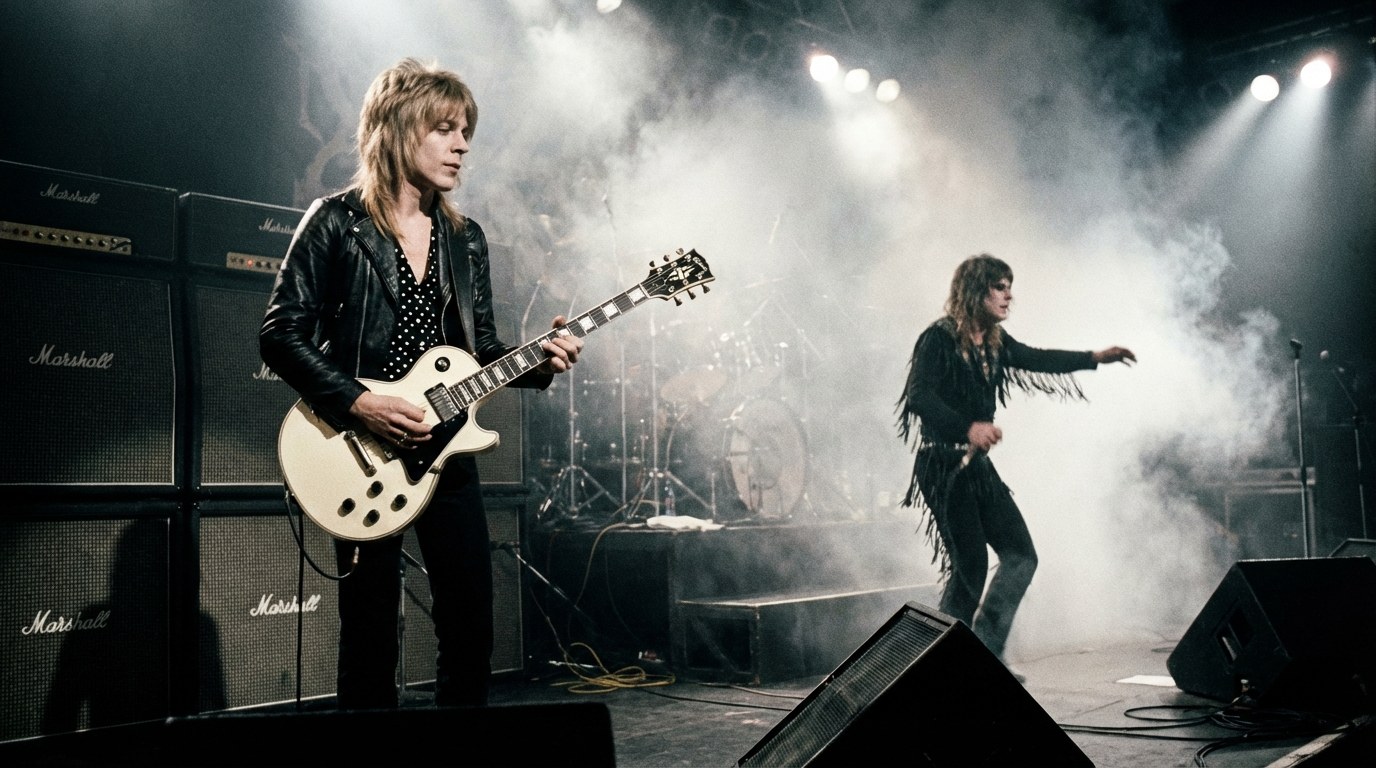
Rhoads didn’t just bring speed and precision — he brought composition. His solos were symphonies in miniature. Listen to Mr. Crowley or Diary of a Madman — they’re not just solos; they’re movements. His phrasing had more in common with Paganini than with Page or Blackmore. He took the neoclassical idea that Yngwie would later commercialize and turned it into something far more emotional — discipline meets chaos.
Rig Deep-Dive by Era
Quiet Riot Era (1975–1979) – The Beginnings of Precision
Before the polka-dot V, before the spotlight, Randy was a Les Paul guy through and through. His main axe was a 1972 Gibson Les Paul Custom Alpine White, aged to a cream finish by the late ’70s.
That guitar was loaded with stock Alnico T-Top humbuckers, but Rhoads constantly experimented — rewiring the bridge pickup for extra bite and swapping pots to get a brighter sweep.
He ran it through a Marshall 1959 Super Lead, dimed almost to the edge of meltdown. Back then, there were no pedals on stage — just pure amp distortion and his fingers doing the talking. Randy’s tone was sharp, articulate, but still warm — like Page with better posture and a metronome welded into his wrist.
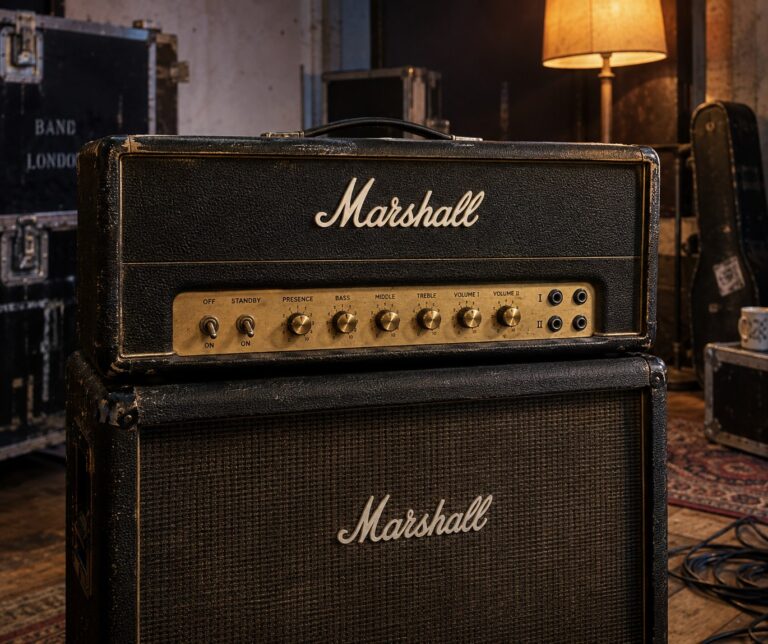
Tone note: You can hear the raw version of his classical phrasing even in Quiet Riot demos — the vibrato is slower, more deliberate, and the gain slightly cleaner. It’s the sound of discipline fighting through chaos.
Blizzard of Ozz Era (1980) – The Polka-Dot Revolution
This was the era where the myth became real.
In 1979, local luthier Karl Sandoval built the now-legendary Polka-Dot Flying V — maple body, ebony fingerboard, DiMarzio Super Distortion (bridge) and PAF (neck). The neck was custom-shaped to Randy’s small hands; he liked a narrow nut and a fast taper.
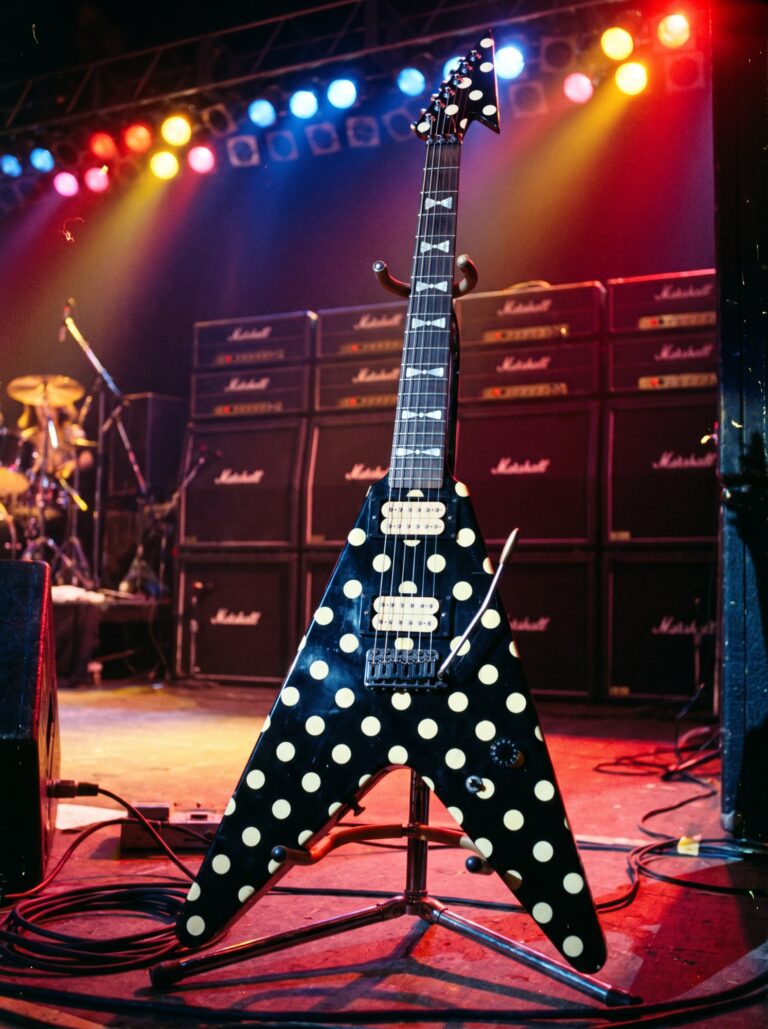
The rig changed too. Randy’s stage weaponry centered around two 100-watt Marshall 1959SLP heads, each feeding 4×12 cabs loaded with Celestion G12-65 speakers. One cab was usually mic’d with an SM57 straight to the board, the other purely for stage volume.
His pedalboard (and this is where things got serious) featured:
-
MXR Distortion+ (for that mid-boosted grind)
-
MXR 10-Band EQ (fine-tuning for different venues)
-
MXR Flanger and Chorus
-
Cry Baby Wah
-
Roland RE-201 Space Echo for ambience
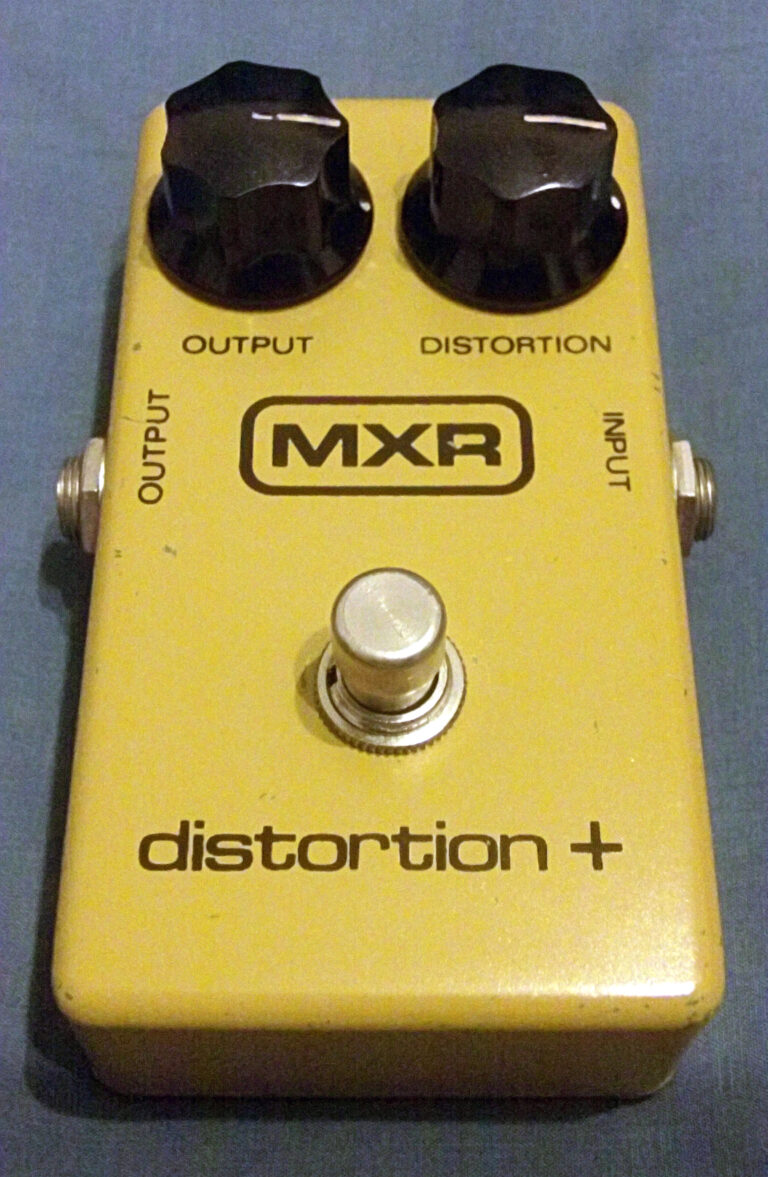
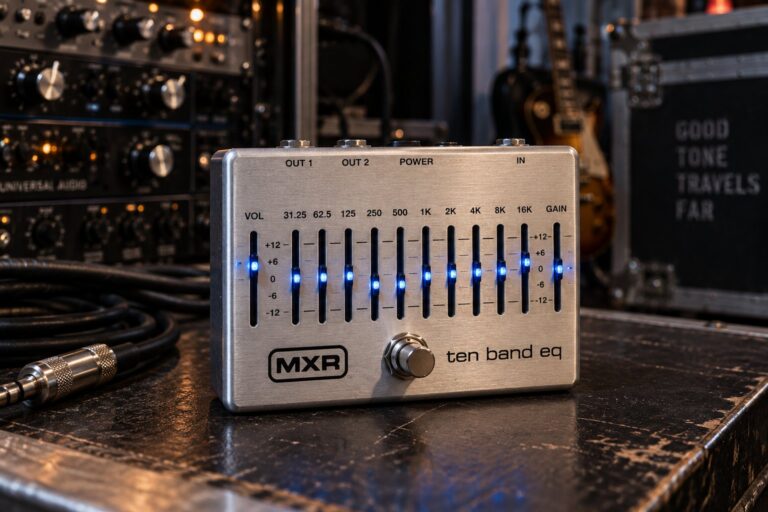
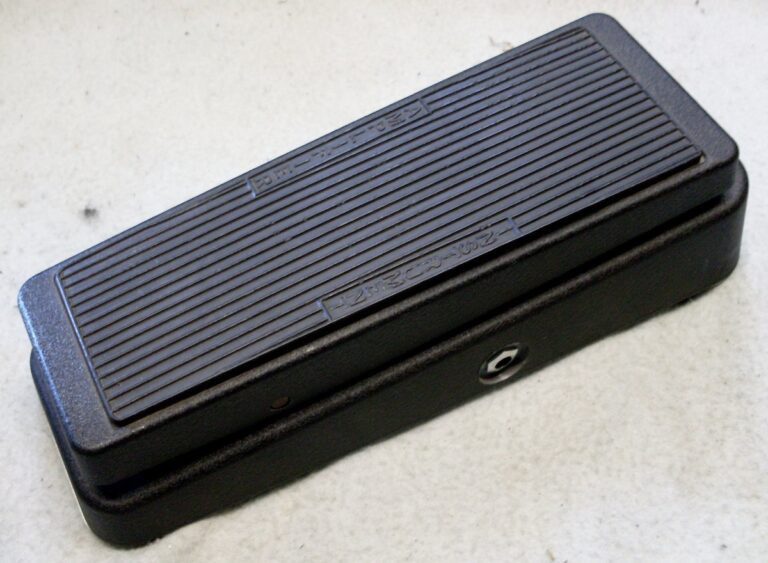
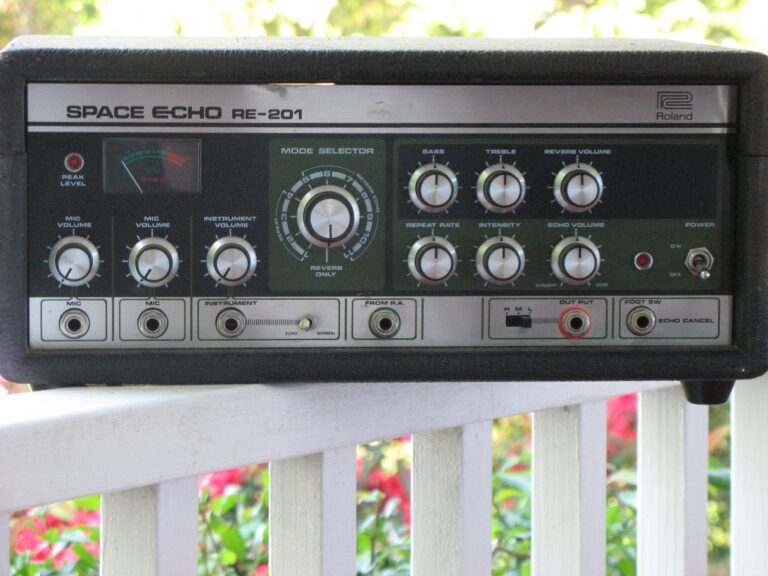
Signal chain: Guitar → Wah → Dist+ → EQ → Modulation → Echo → Marshall.
He’d run the amp volume on 8–9, bass around 4, mids 6, treble 7, presence 5 — a razor balanced on top of thunder.
Tone note: This is the “Crazy Train” tone — tight low end, vocal mids, silky sustain. Every note was like a bullet made of melody.
Diary of a Madman Era (1981–1982) – The Jackson Prototype Legacy
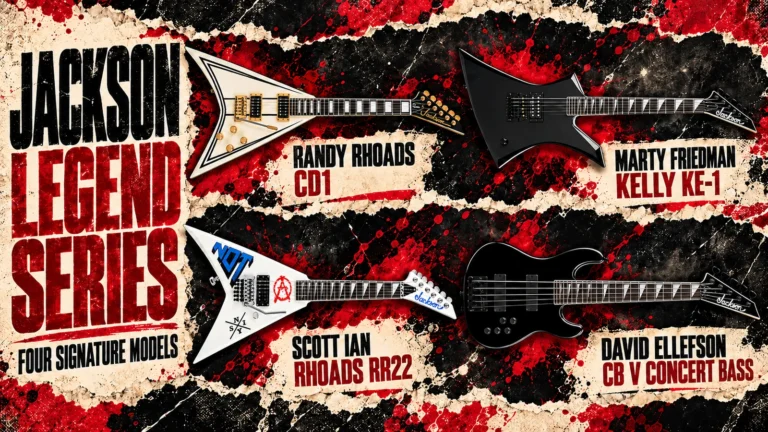
By 1981, Randy wanted something more precise than his V — a guitar that played like a classical instrument but screamed like a Marshall. Enter Grover Jackson. Together they designed the first Jackson Rhoads prototype, the Concorde: a more elegant, offset-winged V with a shorter bass horn.
Specs: alder body, maple neck-through, ebony board, Seymour Duncan Distortion in the bridge, and a brass nut for sustain. That guitar was painted white with gold pinstripes — a weapon fit for a virtuoso.
Amp setup remained the same: dual Marshall 1959 Super Leads, sometimes chained for extra saturation.
Pedals? Same MXR setup, though he occasionally used a Boss GE-10 EQ in the loop for surgical frequency shaping.
Tone note: On “Diary of a Madman,” the gain increased slightly, but so did the refinement — his vibrato became slower, almost violin-like. You can hear it on “Flying High Again.” It’s less about speed now, more about emotional control.
Randy’s sound wasn’t about distortion — it was about articulation. Every note was a statement, every chord had structure. He played metal like a composer, not a shredder.
Strings / Picks / Tunings / Setup
Randy was obsessive about feel. He didn’t just grab whatever strings the roadies handed him — he experimented relentlessly until his Les Pauls and Jacksons responded like living things under his fingers.
Strings
His go-to setup during the Blizzard and Diary tours was GHS Boomers .009–.042, though early in his Quiet Riot days he sometimes bumped to .010s for a thicker feel. He changed strings constantly — sometimes nightly — because he wanted that bright snap on every vibrato.
What’s interesting is that he didn’t chase heavier gauges for tone like Zakk Wylde or Stevie Ray Vaughan. He believed control came from touch, not string tension. As his tech Max Norman once said, “Randy could bend a 9 like it was part of his DNA.”
Tone note: He played with a surprisingly light touch — the sustain came from the amp and his precision vibrato, not brute strength.
Picks
Randy used Picato medium celluloid picks, often around 0.73–0.80 mm, but he had a weird ritual: he’d scratch an “X” or crosshatch pattern into both sides with a razor blade for grip.
He wanted the pick to stick when his hands got sweaty under stage lights. Each one was unique — hand-customized by a perfectionist who treated every detail as part of his sound.
Tunings
For most of his recording career, Randy tuned a half-step down (E♭) — partly to match Ozzy’s vocal range, partly for that smoother, darker resonance.
Songs like Crazy Train and Mr. Crowley live in that E♭ world — punchy yet elastic, letting his bends sing without fighting the tension.
He sometimes returned to standard tuning during lessons or classical exercises, especially when teaching scales and arpeggios at Musonia between tours.
He was known to say, “Metal or Mozart — the rules are the same. Play in tune, then break it with intent.”
Setup & Action
Randy’s guitars were set up low but not buzz-low — about 1.5 mm at the 12th fret — to keep speed without losing sustain.
He preferred a slightly forward neck relief, letting his vibrato breathe naturally.
The brass nut on his Jackson prototypes added chime and sustain, while he often kept his bridge pickup height a little lower than usual to tame the gain edge.
Tone note: Every millimeter of his setup was calculated. The goal wasn’t comfort — it was consistency. He wanted to know exactly how the guitar would respond before he even touched a string.
Randy’s setup was a reflection of his mind — meticulous, balanced, and built for clarity under chaos. He made the guitar behave like a classical instrument, even when the amp was howling.
Playing Style & Tone Philosophy
If Eddie Van Halen was the pyromaniac of the guitar world, Randy Rhoads was the architect.
Where most metal players of the early ’80s were chasing flash, Randy chased form.
He was obsessed with control — every note, every slide, every harmonic had intent.
You can hear it in Crazy Train’s intro riff: that perfect gallop between classical symmetry and hard rock punch.
He picked from the wrist, not the elbow, with a tight, floating right hand, keeping muting precise and surgical.
His left hand moved like a violinist’s — clean, economical, graceful.
Classical Discipline Meets Street Fire
Randy’s technical foundation came straight from classical guitar. He studied Segovia, Sor, and Paganini exercises religiously, applying their logic to distorted tone.
Instead of copying licks from other rock players, he dissected classical etudes and turned them into metal riffs.
Listen to Diary of a Madman — that opening arpeggio sequence? It’s pure Baroque counterpoint, just louder.
He used legato runs, three-note-per-string scales, and pedal tones in ways nobody had done in metal before.
Tone note: Randy wasn’t trying to impress — he was composing. Every solo is like a movement in a concerto, balanced between tension and release.
Vibrato & Control
Randy’s vibrato was his fingerprint — wide but never sloppy, slow but deliberate.
He said once, “You should be able to sing your vibrato.”
Unlike most rock players who yanked the string sideways, he used a circular motion, like a violinist, keeping the note centered while controlling the pitch curve.
He also loved pinch harmonics, but sparingly — he used them as punctuation, not fireworks.
He’d roll off the tone knob slightly to round the edge, making those harmonics bloom like church bells rather than screams.
Right Hand Mechanics
Palm-muting was another secret weapon. He’d hover just over the strings, adding that percussive snap that made riffs like I Don’t Know so tight.
He often angled the pick slightly down, almost like Hetfield does, but used less force — speed through precision, not power.
His alternate picking was metronomic — every note equally strong. He practiced sixteenth-note patterns at half tempo until they were perfect before ever speeding up.
Tone Philosophy
Randy’s tone was built on paradox:
-
High gain, but never messy.
-
Warm highs, but ice-sharp attack.
-
Compression, but full dynamic range.
He always believed the amp should amplify your articulation, not hide it.
He often said, “Distortion should sing, not scream.”
That’s why even through a cranked Marshall, you can hear every note of his chord voicings — minor 9ths, diminished runs, even classical inversions.
Tone note: Where most guitarists fought their amps, Randy conducted his like an orchestra. His tone breathed — controlled chaos made musical.
Randy Rhoads played metal like it was chamber music — precision, phrasing, and purpose over ego. He didn’t chase tone; he engineered it.
How to Sound Like Randy Rhoads
Amp Settings — Marshall Mastery
Randy’s core tone came from two Marshall 1959 Super Leads (100W) running hot enough to melt cables.
If you’re chasing his sound, start here:
| Control | Setting | Notes |
|---|---|---|
| Gain | 8.5–9 | Slight breakup on chords, endless sustain on solos |
| Bass | 4 | Keeps low end tight, not muddy |
| Mid | 6–7 | The “vocal” part of his sound |
| Treble | 6–7 | Clarity without harshness |
| Presence | 5 | Adds air and attack |
| Master | 7–8 | Needs volume to breathe – he never played quiet |
Tone note: Don’t scoop mids. Rhoads’ tone lived in the middle frequencies where guitars actually cut through.
If you’re using a modern amp, a Marshall DSL40CR, JCM800 2203, or even a Friedman BE-100 can nail the feel.
Digital players? The Neural DSP Soldano or Helix Brit Plexi Brt blocks get scary close.
Pedal Settings
Randy’s pedalboard was minimalist but deadly precise.
MXR Distortion+
-
Output: 6
-
Distortion: 7–8
He used it not for fuzz, but for texture — just enough to push the Marshalls into liquid sustain.
MXR 10-Band EQ
-
Boost around 800 Hz
-
Slight cut around 4 kHz
That’s the secret to his warm, vocal midrange.
MXR Flanger / Chorus
-
Rate: 3
-
Depth: 4
Used mainly for width, never for swirl.
Roland RE-201 Space Echo
-
Delay Time: 180–220 ms
-
Feedback: 2–3 repeats
-
Mix: 40 %
He used it subtly — just a ghost following each note.
Signal Chain: Guitar → Wah → Distortion+ → EQ → Mod → Echo → Amp.
Modeler Presets
Helix / Fractal / Kemper setups that hit his tone fast:
-
Helix: “Brit Plexi Brt” → LA Comp → Tilt EQ (boost 1.5 dB @ 800 Hz) → Room Reverb.
-
Fractal Axe-Fx III: “Brit JM45 Jumped” → Drive Block (Dist+ model, Drive 7, Level 6) → 4×12 Greenback IR.
-
Kemper: Profile — “1959SLP Hot Plexi Pack #3”; add a Studio EQ boosting 1 kHz + 1.5 dB.
-
Neural DSP: Soldano SLO plugin → Gain 6.5, Bass 4, Mid 6.5, Treble 6, Presence 5.
Budget vs Pro Rigs
Budget Rig
-
Epiphone Les Paul Custom + DiMarzio Super Distortion
-
MXR Distortion+ Pedal
-
Marshall Code 50 / DSL Combo
Pro Rig
-
Jackson RR1 / Sandoval V
-
MXR Dist+ + 10-Band EQ + RE-201
-
Marshall 1959SLP Heads + 4×12 Celestion G12-65 Cabs
Tone note: Even the cheap rig works if you focus on articulation. Randy’s tone is 70 % hands, 30 % hardware.
Technique Drills
1. Controlled Vibrato Drill
Play sustained notes on the G string, 7th fret.
Use slow, even wrist vibrato — aim for full-tone bends returning perfectly to pitch.
→ 3 minutes per day until each note “sings.”
2. Classical Sequence
Run E minor harmonic scale (E–F♯–G–A–B–C–D♯–E) three notes per string using legato.
Keep right hand relaxed — think violin bow, not hammer.
3. Arpeggio Sweep Study
C major (E–C–G) on 12th fret shapes, down-up sweep, accent the top note.
Repeat descending for fluidity.
4. Diary Arpeggio Pattern
From “Diary of a Madman”: play descending E minor arpeggios with pedal-tone open E string.
Start 60 BPM, build to 120 BPM clean.
5. Pinch Harmonic Control
Bridge pickup, light OD, alternate between natural and pinch harmonics on B string 5th–7th frets.
Adjust pick angle ~45°.
Randy’s rig wasn’t complicated. His secret was balance — a clean chain, moderate gain, and surgical control. Every setting was tuned to highlight the player, not the pedalboard.Read our guide to the Marshall 1959 Super Lead Plexi for a deeper look at the amplifier design behind this rig.
FAQ – Randy Rhoads Essentials
Q: What pickups did Randy Rhoads use?
A: Early on, he used Gibson T-Top humbuckers in his Les Paul Custom, but by Blizzard of Ozz he switched to a DiMarzio Super Distortion in the bridge and a PAF in the neck. His later Jackson Concorde prototype used a Seymour Duncan Distortion. The key is high-output with clarity, not mud.
Q: What amps did Randy Rhoads use live and in the studio?
A: Always Marshalls. His main setup was two 100-watt Marshall 1959 Super Leads, each driving 4×12 cabs loaded with Celestion G12-65s. He often chained the heads for more saturation. Studio engineer Max Norman captured that tone with an SM57 close-mic and sometimes a room condenser for air.
Q: What pedals did he use?
A: A minimal but legendary chain:
-
MXR Distortion+ (his main overdrive)
-
MXR 10-Band EQ
-
MXR Flanger and Chorus
-
Cry Baby Wah
-
Roland Space Echo RE-201
Each pedal served one purpose — no gimmicks, just tone shaping.
Q: What tuning did Randy Rhoads use?
A: Almost always E♭ standard (half-step down). It gave Ozzy’s voice breathing room and made string bending smoother. He occasionally used standard tuning during lessons or classical pieces at Musonia.
Q: What strings and picks did he prefer?
A: GHS Boomers .009–.042, changed constantly to stay bright.
Picks were Picato mediums (~0.73–0.80 mm), each hand-etched with an X pattern for grip. Every pick was personal.
Q: Did Randy Rhoads design the Jackson RR shape?
A: Yes. In 1981, he co-designed it with Grover Jackson as a sleeker, more ergonomic V. The result — the Jackson Concorde prototype — became the foundation of the RR series, still produced today.
Q: What’s the secret to Randy Rhoads’ tone?
A: Precision and restraint. He didn’t drown his tone in gain — he balanced clarity with sustain. Moderate overdrive, focused mids, and that violin-like vibrato did the magic.
Q: How can I get his tone with modern gear?
A: Try this quick recipe:
-
Guitar: any Les Paul-style with a Super Distortion pickup.
-
Amp: Marshall Plexi / JCM800 or Helix “Brit Plexi Brt”.
-
Pedal: MXR Dist+ clone.
-
Settings: Gain 8, Bass 4, Mid 6, Treble 6, Presence 5.
Add a short room reverb and a light delay for space.
Randy’s entire rig was a lesson in discipline. He built a cathedral of tone using nothing but a few pedals and perfect technique.
Randy Rhoads didn’t chase volume or vanity; he chased truth in every note. That’s why his tone still cuts like glass and his lines still read like melody-first manifestos. The polka-dot V, the white Concorde, the dimed Marshalls, the MXR grit — none of it mattered without the discipline behind his hands. He treated metal like chamber music and made it sing, turning hotel-room études into arena anthems. If you want a piece of that magic, don’t start with more gain — start with more intention. Tune down a half-step, push the mids, breathe with your vibrato, and make every phrase say something. Then light the fuse.
Image credits
- Top image: GuitarGangsters AI-generated reference illustration, not a photograph.
- Marshall 1959 Super Lead Plexi: GuitarGangsters AI-generated reference illustration, not a photograph.
- MXR M108S Ten Band EQ: GuitarGangsters AI-generated reference illustration, not a photograph.
- Dunlop Cry Baby: Roadside Guitars, Flickr, CC BY-SA 2.0.
- Randy Rhoads’ polka-dot V: GuitarGangsters AI-generated reference illustration, not a photograph.
- MXR Distortion+: tpeck111, Wikimedia Commons, CC BY-SA 3.0.
- Roland RE-201 Space Echo: Bdjames, Wikimedia Commons, Public domain.
- Randy Rhoads (illustration 1): GuitarGangsters AI-generated reference illustration, not a photograph.