Marshall 1959 Super Lead Plexi: The Amplifier That Taught Rock Music How Loud It Was Allowed To Be
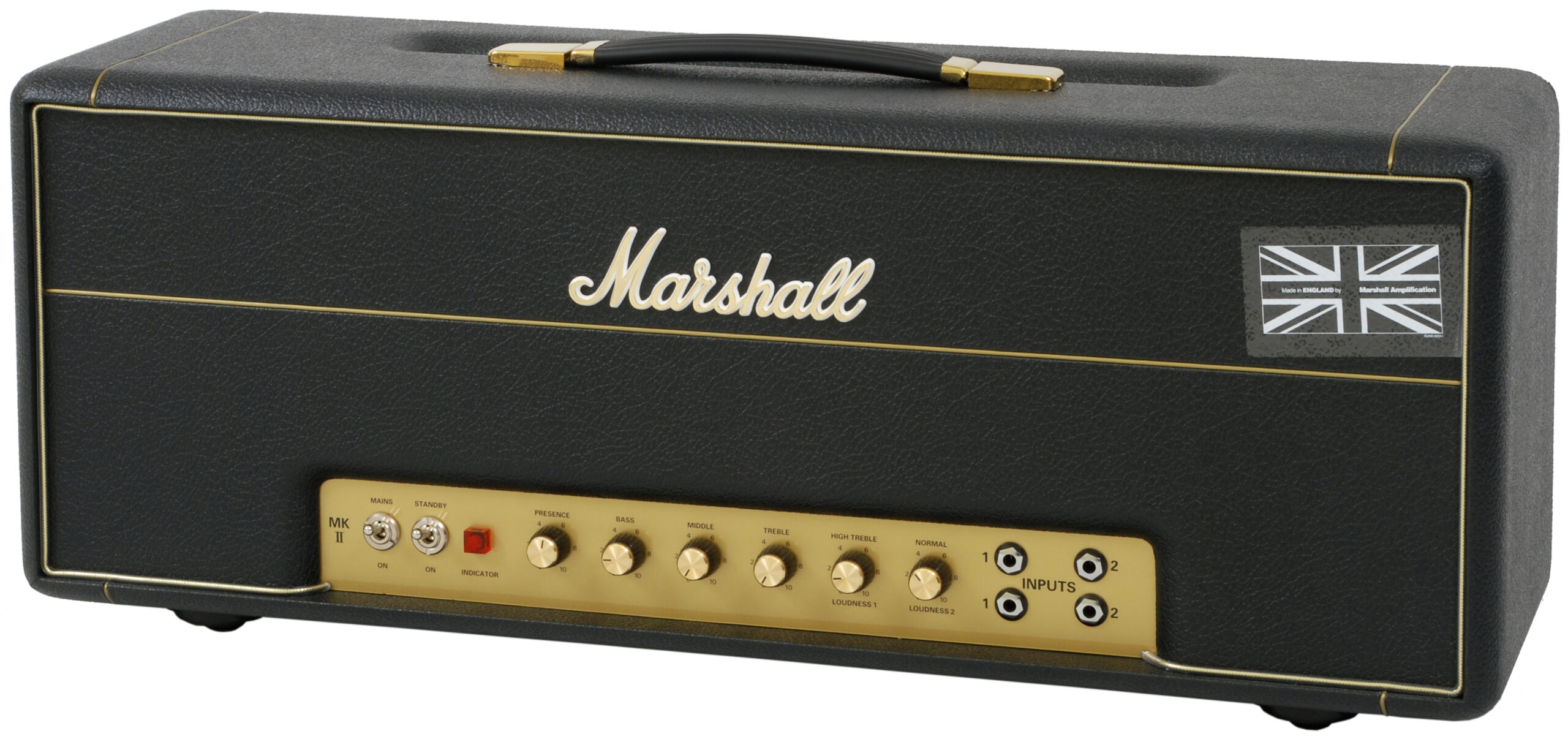
Marshall 1959SLP reissue, photographed in 2011.
The Marshall 1959 Super Lead Plexi explained: circuit history 1965-1981, full specs, verified Hendrix and Van Halen facts, tone settings and buying advice.
There is a short list of objects without which rock music would sound like a different art form. A Les Paul plugged into a 1959 Super Lead is most of that list in one sentence.
The strange thing about the Super Lead is how little it does. There is no gain control. There is no master volume. There is no channel switching, no reverb, no effects loop, no DI, no boost, no footswitch, no anything. Four input jacks, two volume knobs, three tone knobs, a presence knob, a mains switch and a standby switch. That is the entire user interface of the most influential amplifier ever built. Everything people love about it — the chest-thump, the midrange snarl, the way a chord blooms and hangs in the air, the way it cleans up when you roll your guitar volume back to seven — is a byproduct of running four EL34 valves flat out into a transformer that was never really designed to take it.
It is also, in 2026, an amplifier Marshall does not sell. Their current Vintage Reissues page lists seven amps — the JTM45 2245, the 1962 Bluesbreaker, the 1987X, the JCM800 2203, the JCM900 4100, the Silver Jubilee 2555X and the 1974X — and not one of them is a 100-watt Super Lead. The most famous amp in rock is presently available new only as a 20-watt miniature. That fact tells you almost everything about why this amp matters and why almost nobody can actually use one.
What follows is the whole thing: where it came from, what is actually inside it, which of the legendary player stories survive scrutiny and which quietly do not, how to set it, how to tame it, what to check before you spend serious money on a vintage one, and what to buy instead if you have neighbours.
Origins: The Amp That Existed Because Pete Townshend Complained
Jim Marshall’s first amplifier, the JTM45, arrived in 1963 out of a drum shop in Hanwell, West London. It was, and nobody at Marshall has ever seriously denied it, a British reading of the Fender Bassman: 5881/KT66 power valves, GZ34 rectifier, a circuit close enough to the American original that the differences are the interesting part. British components, British transformers, a different speaker, and a very different result.
It was not loud enough. Specifically, it was not loud enough for The Who. Pete Townshend and John Entwistle were playing to rooms that kept getting bigger with a PA system that was not getting bigger at all, and they wanted more. So did Ritchie Blackmore. So did most of the young players who were coming into the shop. Jim Marshall’s answer was to hand the problem to his two technical men, Ken Bran and Dudley Craven.
Three prototypes and one lucky accident
The route to 100 watts was not obvious, and Bran and Craven took three swings at it.
Prototype one paired the JTM45 preamp with four 6L6 power valves and a GZ34 rectifier. The concept was sound; the available output transformers were not. Nothing on the market could handle it.
Prototype two went brute-force: four 6L6s again, but now with two GZ34 rectifiers and two output transformers. It made about 80 watts and was, functionally, two JTM45s crammed into one chassis. It worked. It was also an engineering compromise held together with hope.
Prototype three swapped in KT66 power valves and — crucially — abandoned the valve rectifier for a silicon solid-state one. A solid-state rectifier does not sag. It delivers its voltage immediately and holds it, which is why the amp hits harder and stays tighter under a heavy pick attack than any JTM45 ever will. This version did not merely reach the 100-watt target, it sailed past it. Marshall put it into production in 1965 as the JTM45/100.
In September 1965 Marshall’s transformer supplier Drake delivered the first proper 100-watt output transformers, and the dual-transformer arrangement was retired. The rear panel started reading “Super 100 Amplifier.” Voltages, chokes and component values kept moving as Bran and Craven refined the thing in real time — which is the single most important fact about early Marshalls and the reason no two are identical.
1966: the model number that is not a year
By 1966 Marshall had a coherent pair of new products: the 50-watt tremolo-equipped model 1987, and the 100-watt model 1959. Both numbers are catalogue codes assigned by Marshall’s then-distributor Rose-Morris, not years. A 1959 Super Lead built in 1968 is a 1968 amp. This confuses people constantly, including sellers, and it is worth internalising before you go shopping.
The earliest 1959s went out with leftover JTM-branded front panels, because Marshall was a small company that used up what it had. The rear panel is where the identity lived, and from early 1967 it read Super Lead 100W. Shortly after launch came the change that made the amp what it is: a new Drake output transformer and a quartet of EL34 power valves in place of the KT66s. Louder, dirtier, bolder, more aggressive in the midrange. That was the first Marshall to use the European EL34 pentode, and the EL34 is the single component most responsible for what people mean when they say “Marshall sound.”
Rose-Morris, meanwhile, was unimpressed. The distributor did not properly list the 100-watt Super Lead in its catalogue until 1967, apparently unable to imagine who would want such a thing. By then Townshend, Jimi Hendrix and Eric Clapton had simply gone directly to Marshall and bought them, and the resulting exposure left the factory unable to keep up with demand. There is a lesson in there about distributors and about what happens when the three most-watched guitarists in London all turn up with the same amp.
Where “Plexi” comes from — and what it does not mean
The front and rear control panels of these amps were made from a gold-anodised acrylic sheet. Acrylic is generically called Plexiglas, after a manufacturer whose brand name became the word for the material, in the way Kleenex became the word for tissue. Players shortened it to “Plexi,” and the nickname stuck so hard that it now functions as a tone descriptor in plugin menus and amp-modeller presets.
Three clarifications, because this term is used sloppily everywhere:
- Not all Plexis are 100 watts. The JTM45 had an acrylic panel. So did the 50-watt model 1987. Both are legitimately “Plexis.”
- Not all 100-watt Plexis are Super Leads. The Super Lead designation did not appear on the rear panel until early 1967, so a 1965–66 100-watt Plexi may be a Super 100 or a JTM45/100 instead.
- Not all Super Leads are Plexis. Marshall switched the front panel to cheaper aluminium in mid-1969 — though acrylic stock continued to be used alongside it until it ran out around 1973 — and the Super Lead name carried on for another twelve years after that.
There is one further irony worth keeping in your pocket: the acrylic Marshall actually used was not made by the Plexiglas company. It was closer to what Britons call Perspex, which is itself another brand name for the same material. The world’s most famous amplifier nickname is, technically, wrong twice over.

Marshall themselves have never sold an amp called simply “Plexi.” The closest they came was the 1959SLP reissue, where SLP stands for Super Lead Plexi — a retrospective acknowledgement that the players had already named the product for them.
Inside the Box: What the Circuit Actually Does
The Super Lead is a straightforward non-master-volume design, and understanding its handful of design decisions explains every one of its behaviours.
Preamp and inputs
Three ECC83 (12AX7) valves handle preamp duties. The four input jacks feed two parallel preamp channels: Channel I is the bright channel, Channel II is flatter and fuller. Each channel gets a High and a Low input, with the Low input attenuated by 6 dB — a genuinely useful facility with a hot humbucker or a boost pedal in front.
The two channels share a single three-band tone stack (Bass, Middle, Treble) plus a Presence control. Presence is not an EQ knob in the normal sense: it works in the power amp’s negative-feedback loop, reducing feedback at high frequencies so the power stage opens up on top. It is why turning Presence up on a Marshall feels like removing a blanket rather than boosting a treble band.
Channel I carries a 500 pF bright capacitor across its volume control. That capacitor is the reason Channel I sounds thin and glassy at low volumes and comes alive as you turn it up, and it is also the single component that separates the Super Lead from its bass sibling.
Jumping the channels
Because the two channels are parallel rather than switchable, players worked out early that a short patch cable between Channel I’s low input and Channel II’s high input feeds your guitar through both preamps at once. The two paths then blend, and the relative settings of Volume I and Volume II become a genuinely powerful tone control: more Volume I for cut and bite, more Volume II for weight and body, and a slight phase interaction in the middle that thickens everything.
Jumping is not a hack or a workaround. It is documented in Marshall’s own owner’s manual for the 1959HW, and it is how the vast majority of famous Super Lead recordings were made. If you own one and you are not jumping the channels, you are using roughly half the amp.
Power amp
Four EL34s, fixed bias, class AB, driving a Drake output transformer, fed by a solid-state rectifier that does not sag. Nominally 100 watts; in practice, more, because Marshall rated conservatively and the amp is capable of a great deal more than 100 watts once it is distorting.
Here is the defining consequence: the Super Lead’s overdrive comes almost entirely from the power amp. The preamp does not generate meaningful distortion at usable settings. To get the sound, you have to physically drive four EL34s and an output transformer into saturation, which means the volume control has to be somewhere north of seven and the room has to be somewhere north of unbearable. There is no way to cheat this with the amp alone. Everything else in this article — attenuators, Variacs, low-power reissues, pedals — is an attempt to negotiate around that one immovable fact.
The payoff is a dynamic range no preamp-distortion amp has ever matched. A cranked Super Lead tracks your picking hand with something close to violence, and it cleans up almost completely when you roll the guitar volume back. That is not romanticism; it is a direct result of the distortion happening after the tone controls, in a stage that responds to input level continuously rather than through a fixed clipping threshold.
The year-by-year moving target
There is no such thing as “the” Super Lead circuit. It changed constantly, and the changes are why players fetishise particular years.
- 1965–66: KT66 power valves, dual output transformers early on, then the single Drake unit. Warmer, rounder, closer to a very loud JTM45.
- February 1967: new Drake transformer plus EL34s. This is the moment the Marshall sound as we know it arrives — dirtier, more aggressive, more midrange.
- Late 1967: the JTM logo on the front gives way to JMP — Jim Marshall Products.
- 1968: the split-cathode preamp arrangement is introduced, tightening the response and sharpening the attack. Later that year, preamp filter values change again. The 1968 amps are the ones with the deepest mythology attached, largely thanks to one Californian.
- 1969: a resistor value on the bright channel is adjusted. Mid-year, the front panel starts appearing in aluminium. Hendrix’s and Eric Johnson’s preferred year.
- 1970s: further revisions push the amp rawer and dirtier still — which is exactly what the incoming generation of hard rock bands wanted. Thin Lizzy, Judas Priest and AC/DC all gravitated to early-70s examples.
- 1973: printed circuit boards replace hand-wiring. Every Marshall built from the company’s founding in 1962 until this transition was hand-wired; none after it was, until the deliberate reissues decades later.
- 1975: the master-volume 2203 arrives and begins the long process of making the Super Lead commercially obsolete.
- 1977–78: Marshall tries variations — a 2×12 combo (model 2159), then a head with footswitchable reverb and boost (model 2959). Neither takes.
- 1981: the entire Super Lead family is discontinued.
A 1959T tremolo version existed until 1972 and sold poorly — with one notable exception. Pete Townshend preferred them.
The siblings: Super Bass and Super PA
Marshall launched the Super Lead in 1966 alongside two near-identical relatives.
The JMP 1992 Super Bass 100 shares a virtually identical circuit. The headline difference is the absence of the Super Lead’s 500 pF bright cap, along with some minor component values and a signal cap change that lets more low end through. Result: mellower, more headroom, less top-end spike. It was discontinued in 1981 alongside the Super Lead, and its bass-playing devotees included Jack Bruce, Chris Squire and Lemmy.
Here is the part guitarists need to know: plenty of guitarists preferred the Super Bass. Jimmy Page and Paul Kossoff both did. If your mental image of the Super Lead is built on Led Zeppelin II or Fire and Water, adjust it — you are hearing the mellower sibling, and if a Super Lead has always sounded too spiky to you, the 1992 is the amp you actually want.
The JMP 1968 Super PA 100 had four channels and eight inputs and was, absurdly, the only 100-watt Marshall Rose-Morris was initially willing to advertise. It was discontinued in 1975. Its chassis turn up regularly as donor units for Super Lead conversions, which matters for the buying guide below.
Specifications
| Feature | Detail |
|---|---|
| Model | Marshall model 1959 / JMP Super Lead 100 (a Rose-Morris catalogue number, not a year) |
| Production years | 1966–1981 (reissued 1988 onward in several forms) |
| Output | 100 watts nominal, class AB, conservatively rated |
| Power valves | 4 × EL34 (earliest examples 4 × KT66) |
| Preamp valves | 3 × ECC83 / 12AX7 |
| Rectification | Solid-state silicon (no sag) |
| Channels | 2, parallel, non-switchable, commonly jumped with a patch cable |
| Inputs | 4 × 1/4″ jack — High and Low per channel, Low attenuated 6 dB |
| Controls | Presence, Bass, Middle, Treble, Volume I, Volume II |
| Master volume | None |
| Effects loop | None (added on later 1959SLP reissues from 2000) |
| Channel I voicing | Bright, with 500 pF cap across the volume pot |
| Channel II voicing | Flatter, fuller, no bright cap |
| Construction | Hand-wired to 1973; printed circuit board thereafter |
| Output transformer | Drake (single 100-watt unit from September 1965) |
| Panel material | Gold-anodised acrylic (“Plexi”) to mid-1969, aluminium after, acrylic stock used until c.1973 |
| Cosmetics | Black tolex, gold piping, gold panel, block Marshall logo (JTM to late 1967, JMP after) |
| Standard cabinets | 1960A angled and 1960B straight 4×12; briefly an 8×12 at launch |
| Variants | 1959T (tremolo, to 1972), 2159 (2×12 combo, 1977), 2959 (reverb/boost head, 1978) |
| Siblings | 1992 Super Bass 100, 1968 Super PA 100 |
| Reissues | 1959S (1988), 1959X (1991–93), 1959SLP (1993–2017), 1959HW hand-wired (from 2005) |
The Stack: How the Amp Got Its Silhouette
The 100-watt head needed a cabinet capable of surviving it. Marshall’s first answer was an 8×12, and it was a disaster of ergonomics — enormous, unliftable, and impossible to get through a stage door. It was quickly replaced by a pair of 4×12s: the angled 1960A on top, the straight 1960B underneath.
That accidental solution to a logistics problem created the visual language of rock. Head on top, angled cab, straight cab, all of it stacked to roughly the height of a person — the Marshall stack. Within a few years bands were renting empty cabinets to build walls of them, which is its own commentary on how quickly the object became a symbol.
Speaker choice matters as much as the head. The classic 60s pairing is the 25-watt Celestion G12M Greenback, which compresses, breaks up and adds its own woody midrange honk — a genuine part of the sound of nearly every record cited below. As output climbed through the 70s, higher-power Celestions took over: the G12-65 is the speaker in Angus Young’s cabinets. If you put a modern high-headroom speaker in front of a Super Lead you will get something louder, cleaner and considerably less characterful.
Famous Players: What Holds Up and What Does Not
The Super Lead’s player list is arguably the strongest of any single piece of gear ever made. It is also, for exactly that reason, the piece of gear most likely to have loose claims attached to it. Here is what survives checking.
Pete Townshend
The amp exists because of him. Townshend pushed Marshall toward 100 watts, was among the first customers, and bought directly from the factory when the distributor was still ignoring the product. He is also the documented exception on the tremolo model — the unpopular 1959T was his preference. This is about as well-attested as gear history gets.
Eric Clapton
Clapton traded in the Bluesbreaker combo that carries his nickname for a Super Lead in 1966, after co-founding Cream. That is a meaningful detail: the man who made the 1962 combo legendary personally moved on from it the moment a louder option existed. Cream-era Clapton is Super Lead Clapton.
Jimi Hendrix
Hendrix and the Super Lead is the most-documented pairing on the list, and unusually for gear folklore, there is paperwork. The head he used at Woodstock in August 1969 was built in March 1969 and entered his rig around April. It went on to be used at Rainbow Bridge in July 1970, the Isle of Wight that August, and Fehmarn in Germany that September, as well as for rehearsals and the Band of Gypsys sessions. When it was offered for sale on Reverb in 2021 with a $350,000 asking price, the listing included a letter from Marshall’s own heritage and archive department in Bletchley attesting to its originality.
At Woodstock he ran a pair of these heads into 4×12s loaded with Celestions — the setup he described from the stage as “a couple of great refrigerators.” Note the year: Hendrix’s preference, like Eric Johnson’s, was for 1969 amps. Note also what was in front of it — Fuzz Face, Octavia, wah — because a Super Lead’s behaviour with germanium fuzz in front is a huge part of that sound and is discussed below.
Eddie Van Halen
Van Halen’s 1968 Super Lead, serial 12301, is probably the single most analysed amplifier in existence. The verified essentials: it was a 1968 100-watt Super Lead; he ran the controls flat out; and he used a Variac — a variable transformer — to reduce the mains voltage feeding the amp, commonly reported as around 89 V from a 110 V nominal supply, using the Variac itself as his volume control.
Two honest caveats. First, whether the amp was modified is disputed to this day, with the more careful accounts landing on “not modded, but with component value changes” — which is a distinction that generates forum threads running to fifteen pages and no consensus. Second, the Variac story is routinely misunderstood: lowering the mains voltage does not add gain. It softens the power supply, browns out the power stage, reduces headroom and changes the feel and the harmonic content. It also runs the valves outside their design conditions and is genuinely hard on an amp. Eddie went through power valves at a rate most people cannot afford, and he had techs. Copying this at home is a good way to destroy a vintage amplifier.
The third factor everyone forgets is that Van Halen’s “brown sound” also involves a specific guitar, a specific room, an Echoplex, a Univox-style tape delay and a player with an extraordinarily hard, precise right hand. The amp is a necessary condition, not a sufficient one.
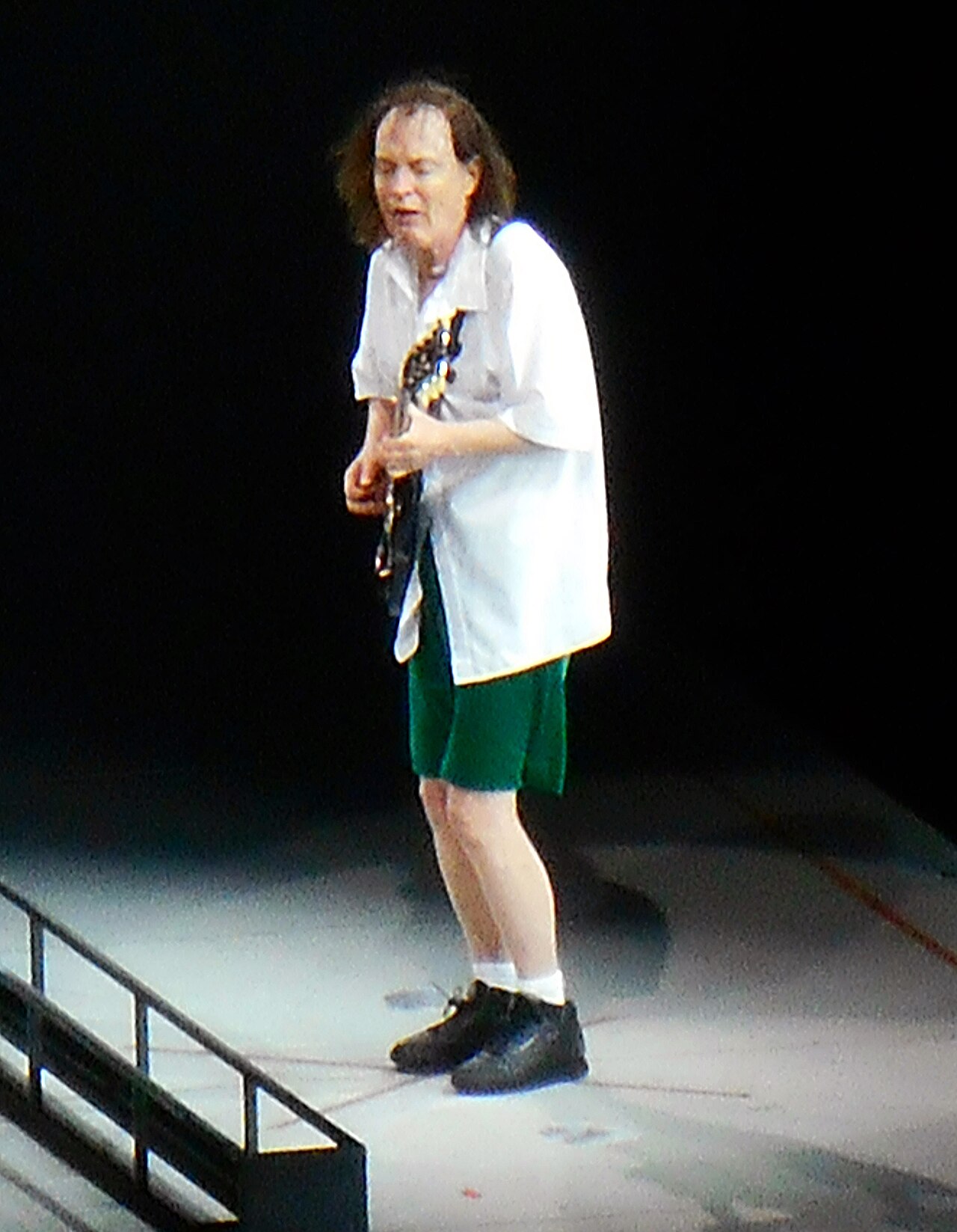
Angus Young — with an important correction
Marshall’s own artist page states plainly that Angus Young primarily used a four-input 1959 Super Lead 100-watt Plexi head with 1960AX/BX cabinets loaded with Celestion G12-65s, alongside a JTM50, and quotes him: “I eventually came to the conclusion that the Marshall 100W stack was the best way to go.” That is manufacturer-sourced and solid.
But the widely repeated claim that Highway to Hell and Back in Black are pure Super Lead needs correcting, and so does the even more common claim that the second amp was a JTM45. According to reporting in Guitar.com, Angus used his 1970s four-input 100-watt 1959 Super Lead in combination with a Marshall JTM50 — a rare transitional model made in 1966–67, not a JTM45. He specifically preferred the solid-state-rectifier JTM50s for their tighter, punchier response. Some of the JTM45s seen on stage with him had been converted to JTM50 specification because genuine JTM50s were so scarce.
Two further pieces of the AC/DC tone are not the amp at all. One is the Schaffer Vega Diversity System, the mid-70s wireless unit whose receiver contained a preamp that functioned as a permanent boost in front of the amp — Angus confirmed to Guitar Player in 1984 that it was the only “effect” on Back in Black, and he had been using it since 1977. Gilmour, Van Halen and Frampton used the same unit. The other is sheer volume: Angus’s tech Trace Foster has described setting the amp “to where it seemed like it was going to explode at any minute,” and put Angus’s stage wedge level at around 128 dB. Foster’s blunt summary — “it’s not from a pedal” — is the most useful sentence anyone has said about Marshall tone.
Jimmy Page — the caveat
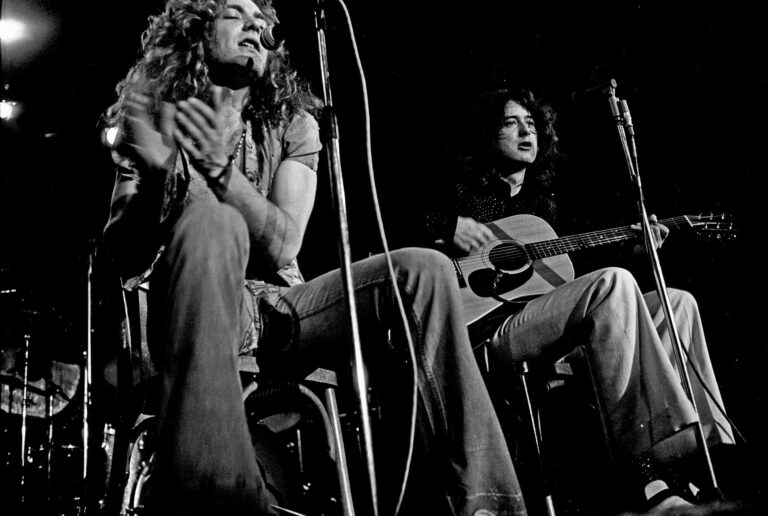
Page appears on every Super Lead list, including Wikipedia’s, and he did use 100-watt Marshalls. But the same source notes that Page, like Paul Kossoff, preferred the Super Bass 1992 — the mellower, no-bright-cap sibling. If you are chasing Zeppelin tones and finding the Super Lead too aggressive on top, that is not you doing it wrong. That is a different amplifier.
The rest of the roll call
Sweetwater’s Nick Bowcott — himself a former professional player — lists the following as 100-watt Plexi users: Hendrix, Cream-era Clapton, Duane Allman, Page, Jeff Beck, David Lee Roth-era Van Halen, Johnny Ramone, Billy Gibbons, Wayne Kramer, Kossoff, Malcolm and Angus Young, Eric Johnson and Yngwie Malmsteen. Wikipedia adds the year preferences: Van Halen’s 1968, Hendrix’s and Eric Johnson’s 1969s, and early-70s examples favoured by Thin Lizzy — Scott Gorham and Brian Robertson — Judas Priest and AC/DC.
That last cluster is worth pausing on, because it is a whole genre. The twin-guitar British hard rock sound of the early 1970s is essentially two Super Leads and no pedals. Tony Iommi, Ritchie Blackmore and Michael Schenker all built their sounds on 100-watt Marshall heads of this era, each arriving somewhere completely different with the same starting point — which is the best argument there is that this amp is a canvas rather than a sound.

What the Super Lead is not
An honesty note, since this article is about a piece of equipment that attracts attribution the way a magnet attracts filings. A great many recordings credited to “a Plexi” were made with 50-watt 1987s, with Super Basses, with JMP master-volume amps, with the JCM800 that succeeded it, or with a Marshall of some kind modified beyond recognition by a tech whose name never made it onto the sleeve. The 100-watt Super Lead is genuinely everywhere in rock — but “Marshall stack in the photo” is not evidence of “1959 Super Lead on the record,” and the number of amps in that photo is frequently not the number that were plugged in.
Tone Recipes: How To Actually Set One
The classic jumped rhythm sound (Cream, early Zeppelin, Free)
Volume I 7, Volume II 5, Bass 6, Middle 7, Treble 6, Presence 4. A humbucker in the bridge position, guitar volume at 8. The bright channel dominates for cut, the second channel fills in underneath. Roll the guitar volume to 6 and it becomes a clean-ish rhythm tone with grit at the edges; push to 10 and it sings. If you are not hearing the dynamic range, your guitar volume is too high, not too low.
The AC/DC sound (as close as a mortal gets)
Everything on 10 or near it — Presence 6, Bass 5, Middle 7, Treble 7 — with a bridge humbucker, a very hard pick attack, and a clean boost in front standing in for the Schaffer Vega. The crucial part is not the settings. It is that the amp needs to be at a volume that is legally problematic and the strumming needs to be violent. Angus’s rhythm tone is his guitar volume at around 8, and his lead tone is that same knob at 9.5. He rarely touches his tone control at all.
The Hendrix sound
Volume I 10, Volume II 6, Bass 5, Middle 6, Treble 7, Presence 6, with a germanium Fuzz Face in front and a Strat with the guitar volume around 7. Germanium fuzz is extremely sensitive to what is in front of it and what is behind it: it wants to see a guitar pickup directly (no buffered pedal before it) and it wants to hit a cranked amp, not a clean one. The wah goes before the fuzz. Most of the “impossible” Hendrix tones are a fuzz already saturating a power amp that is already saturating — two stages of distortion stacked, neither of them a preamp.
The single-channel bright sound (Channel I only)
Skip the jumper. Plug into Channel I High. Volume I 8, Bass 4, Middle 6, Treble 5, Presence 3. That 500 pF bright cap gives you a very cutting, aggressive, slightly thin sound that sits beautifully in a dense mix and is horrible on its own in a bedroom. Studio engineers have exploited this for sixty years.
The dark sound (Channel II only)
Channel II High, Volume 8, Bass 7, Middle 6, Treble 6, Presence 2. Rounder, thicker, no top-end spike — the closest a Super Lead gets to what the Super Bass does natively. Good with a Telecaster or any bright single coil.
With an overdrive out front
A Tube Screamer into a Super Lead is one of the great combinations, but not in the way people set it. Drive at 2, Tone at 6, Level at 8. You are not using the pedal for distortion; you are using it as a mid-humped level boost that tightens the low end and pushes the power amp harder. The same logic applies to a Klon or an SD-1. Setting the drive high and the level low gives you a fizzy preamp sound and defeats the entire point of owning the amp.
Every setting below assumes the channels are jumped with a short patch lead from Channel I Low to Channel II High, unless stated otherwise. All controls run 0–10. There is no master volume, so the volume controls are the gain controls, and where you set them is where the amp lives.
Living With 100 Watts: Attenuators, Variacs and the Volume Problem
The Super Lead’s fundamental problem is that its good sound and its usable volume are not available at the same time. There are four ways around it, all imperfect.
Power attenuators sit between the head and the cabinet and turn amplifier output into heat, allowing the power valves to work while the speaker moves less air. This is the most honest solution and it does work. It is not free: at heavy attenuation you lose the physical interaction between speaker and room that is part of the sound, and the load an attenuator presents is not identical to a speaker’s varying impedance, so the tone shifts. Attenuators also put stress on the output transformer, and a 1968 Drake transformer is not a replaceable item.
A Variac lowers the mains voltage into the amp. It is the Van Halen route and it produces a real, distinctive, browner sound. It also runs the amp outside its design envelope, shortens valve life and, badly done, damages things. Do not do this to a vintage amp you cannot afford to repair.
Lower-wattage amps are the sane answer and are covered below.
Modelling and profiling is the answer most working players have actually chosen. The Plexi is the single most-modelled amplifier in history and the good captures are extremely convincing at recording volume. What they cannot reproduce is the physical experience — the compression in your chest, the way the guitar starts feeding back sympathetically at a specific point in the room. That part is not tone. It is architecture.
Comparisons: What Else To Consider
Marshall JCM800 2203
The JCM800 2203 is the direct descendant and, for most players, the more practical amplifier. Its ancestor the 2203 arrived in 1975 with the thing the Super Lead lacked: a master volume, which meant preamp-derived distortion at a volume a human could tolerate. The trade is that the JCM800’s gain comes from the preamp, so it sounds tighter, more focused and more modern, but it does not have the Super Lead’s enormous dynamic swing. If you want one Marshall for a working band, it is the 2203. If you want the sound of 1969, it is not.
Marshall 1987X — the 50-watt Plexi
The 1987X is the 50-watt reissue of the model 1987, and it is currently in Marshall’s catalogue at $2,299.99 while the 100-watter is not. Halving the power does not halve the volume — you lose about 3 dB — but it does mean the power amp saturates meaningfully earlier. A great many classic records were made on 50-watt Marshalls that people assume were 100s. For most players this is the more sensible Plexi.
Marshall JTM45 2245
The JTM45 is where the whole story starts, and at $2,299.99 it is also currently available. It is 30 watts of clean power — not 45; the 45 refers to peak output at full distortion, a distinction that explains why old Marshall power ratings feel so conservative and why these amps blow up speakers rated for them. Tube-rectified, warmer, spongier, closer to a Bassman. If the Super Lead’s aggression is not what you want, this is the amp you actually mean.
Marshall 1962 Bluesbreaker
The 1962 combo that Clapton made famous and then abandoned. Currently $2,899.99. Different animal entirely — a 2×12 combo, JTM45 circuit, and the sound of Blues Breakers with Eric Clapton. Worth remembering that Clapton himself moved to the Super Lead the moment he needed more.
Marshall Studio Vintage SV20H
The SV20H is Marshall’s current answer, and in 2026 it is the only new Plexi-circuit head the company sells. It is based on the 1959SLP: two ECC83 preamp valves plus one as phase splitter, two EL34s, 20 watts with a switch to drop it to five, four inputs with high and low sensitivity, two bridgeable channels, three-band EQ with Presence, a series effects loop, speaker outs at 16/8/4 ohms and a DI. It weighs 9.25 kg against a full-size head’s considerable heft.
What it gets right is the important part: it is a genuine non-master-volume Plexi circuit that saturates its own power amp, just at a wattage that does not require a warehouse. What it cannot do is move four twelve-inch speakers with 100 watts. If you want the feel, five watts in a small room will get you closer than 100 watts you are too frightened to turn up.
Hiwatt DR103
The Hiwatt DR103 is the British 100-watt alternative and the anti-Plexi: military-grade point-to-point wiring, Partridge transformers, enormous clean headroom, and a refusal to break up where a Marshall would have surrendered twenty minutes ago. Townshend’s later sound and Gilmour’s are Hiwatt sounds. If the Super Lead’s midrange bark is what you dislike about it, this is the corrective.
Buying Guide
Vintage: what you are actually buying
A genuine 1967–69 Plexi-panel Super Lead is a five-figure instrument in original condition, and even a scruffy 1968 example changing hands privately has traded around the mid-four-figures. Prices vary enormously with originality, and originality is the entire game. Things to check:

- Serial numbers and dating. Amps from this period are genuinely hard to date precisely. Marshall introduced a date-code letter after the serial number beginning with A in July 1969, which gives you a firm reference point: an amp claimed as a 1968 should not have one.
- Transformers. Original Drake units matter more than almost anything else, both sonically and to value. Learn the correct part numbers for the claimed year before you go looking. Replaced transformers are common and are not automatically a dealbreaker — but they must be priced in.
- Chassis conversions. Super PA and Super Bass chassis get converted to Super Lead specification regularly, sometimes decades ago, sometimes by Marshall themselves. A converted amp can sound superb and is worth substantially less than an untouched one. Ask directly.
- Modifications. Master volume mods, extra gain stages, cascaded preamps, altered feedback loops — a huge proportion of surviving Super Leads were modified in the 1970s and 80s when they were merely second-hand amps rather than artefacts. Reversible mods are acceptable; drilled chassis are not.
- Filter capacitors. Sixty-year-old electrolytics are a fire and shock risk. Any vintage amp you buy needs a full electrical safety check before it is switched on, regardless of how confident the seller sounds. Recapping is normal maintenance, not vandalism.
- The plexiglass itself. Acrylic panels crack. A broken panel is cosmetic and does not affect function, but it does affect price, and replacement panels are available — which also means panels can be swapped to make an aluminium-era amp look older than it is.
Reissues: which one
Marshall reissued the amp four times. The 1959S (1988) came first; the 1959X ran 1991–93; the 1959SLP ran from 1993 and stayed in the line, with modifications from 2000 that added a hum-balance pot to lower the noise floor, reverted the negative-feedback resistor to the 1968–69 value of 47 kΩ, and added an effects loop. The SLP was sold until 2017.
The 1959HW, introduced in 2005, is the serious one: hand-wired, based on the 1967–69 circuit with the 1969 negative-feedback value. Guitar Player called the 1959 line “monumentally huge, frightfully loud, and painfully expensive,” and described the HW as “quick, percussive, articulate” while requiring a “total commitment to volume,” which is about as fair a summary as exists. Note that not all reissues are hand-wired — every original vintage 100-watt Plexi was, but reissue construction varies by model, so check before paying a hand-wired premium.
None of these are in current production. The used market for reissues is where most people should be looking, and a clean 1959HW is a genuinely great amplifier at a fraction of vintage money.
New in 2026
Your only new-from-Marshall Plexi-circuit options are the 20-watt Studio Vintage head and combo, and the 50-watt 1987X. That is it. This is worth stating plainly because a great deal of retail copy implies otherwise: as of Marshall’s own current catalogue, you cannot buy a new 100-watt Super Lead from Marshall. Third-party builders — a healthy cottage industry of Plexi-spec boutique amps, several of them building to specific serial numbers including EVH’s 12301 — fill that gap, and some of them build to a higher standard than the originals ever were.
Ownership Notes
Valve life. Four EL34s run hard are a consumable. Expect to rebias whenever you replace them, and expect to replace them more often than a hobbyist would like if you actually run the amp the way it wants to be run. Matched quartets and a competent tech are not optional.
Never run it without a load. A valve amp with no speaker connected will destroy its own output transformer. On a vintage Marshall that is a catastrophic, expensive and sometimes irreplaceable failure. Check the cable and the impedance selector every single time.
Standby discipline. Use the standby switch on power-up to let the heaters come up before high voltage hits the valves, and on the way down. It is thirty seconds of patience against the cost of a valve set.
Speaker ratings. Marshall’s power ratings are conservative and the amp puts out considerably more than 100 watts when it is distorting. A 4×12 of 25-watt Greenbacks is nominally 100 watts and will be pushed beyond it. That is part of the sound, and it is also why those speakers fail.
Hearing. There is no polite way to put this. A cranked Super Lead in a small room is genuinely capable of permanent hearing damage in a short exposure, and 128 dB — the figure Angus Young’s tech quotes for his stage wedge — is comfortably in that territory. Wear plugs. Musicians’ filtered plugs preserve the frequency balance and cost less than a valve set.
Weight and transport. A full-size head plus two 4×12s is a two-person job and a large vehicle. The stack is iconic partly because it was a status symbol, and status symbols are rarely convenient.
Insurance and provenance. If you buy vintage, document it. Marshall’s heritage and archive department has authenticated amps before — the Hendrix Woodstock head being the highest-profile example — and paperwork is a meaningful part of the value of anything in this category.
Frequently Asked Questions
Is the Marshall 1959 from 1959?
No. 1959 is a model number assigned by Marshall’s distributor Rose-Morris, not a year. The amp was made from 1966 to 1981. The same applies to the model 1987 (a 50-watt amp, not a 1987 product) and the model 1962 Bluesbreaker. Sellers get this wrong regularly, sometimes deliberately.
What is the difference between a Plexi and a Super Lead?
“Plexi” refers to the gold acrylic control panel Marshall used until mid-1969, and by extension to the sound of amps from that era. “Super Lead” is the model name for the 100-watt model 1959, applied to the rear panel from early 1967. There are Plexis that are not Super Leads (the JTM45, the 50-watt 1987, the early Super 100) and Super Leads that are not Plexis (anything after the aluminium panel arrived). The two words only overlap for amps built roughly 1967 to 1969.
Why does it have four inputs but only two channels?
Each of the two parallel preamp channels has a High and a Low input, with the Low attenuated by 6 dB for hotter pickups or pedals. They are not switchable channels in the modern sense — both are always live, which is precisely what makes jumping them with a patch cable possible.
What does jumping the channels do?
A short cable from Channel I Low to Channel II High sends your signal through both preamps simultaneously. The two volume controls then blend the bright and the full voicings, giving you a thicker, more complex sound and more overall gain than either channel alone. It is documented in Marshall’s own manuals and is how most famous Super Lead recordings were made.
Can I use a Super Lead at home?
Realistically, no — not in a way that gets you the sound. The distortion is generated entirely in the power amp, so it needs to be run at a volume that is unusable in a house even with a power attenuator, and heavy attenuation costs you a real part of the tone. If you want Plexi character at domestic levels, the 20-watt Studio Vintage switched to five watts, or a good digital capture, will get you far closer than a 100-watt head at volume 2.
How many watts is it really?
Nominally 100, measured clean. Like all Marshall ratings of the period it is conservative, and the amp delivers considerably more when distorting. This is the same convention that makes the JTM45 a 30-watt amplifier despite its name — the 45 is peak output at full distortion, not the clean rating manufacturers normally publish.
Is a Super Bass better for guitar?
For some players, yes. The 1992 Super Bass runs a virtually identical circuit without the Super Lead’s 500 pF bright cap, plus small component differences that pass more low end. The result is mellower, with more headroom and less top-end spike. Jimmy Page and Paul Kossoff both preferred it for guitar, so if the Super Lead has always sounded harsh to you, this is a genuine alternative rather than a compromise.
Does the Variac trick actually work?
It does something real — lowering the mains voltage browns out the power supply, reduces headroom and changes the harmonic content and feel. It does not add gain, which is the usual misunderstanding. It also runs the valves outside their design conditions, shortens their life and, done carelessly, damages the amp. Eddie Van Halen had a technician and a budget. Attempting it on a vintage amp you cannot afford to repair is a bad trade.
Should I buy vintage or a reissue?
Unless you specifically want the investment or the provenance, a used 1959HW is the sensible purchase: hand-wired, based on the 1967–69 circuit, and available for a fraction of vintage money without sixty years of unknown repair history. Vintage makes sense if you can verify originality — transformers, chassis, absence of drilled holes — and if you accept that it is a collectible object requiring a recap and a safety check before it is ever switched on.
Image credits
- Pete Townshend: Heinrich Klaffs, Wikimedia Commons, CC BY-SA 2.0.
- Jimmy Page: Avda, Wikimedia Commons, CC BY-SA 3.0.
- Angus Young: TheACDCDoctor, Wikimedia Commons, CC BY-SA 4.0.
- Top image: Marshall 1959SLP reissue amplifier head, photographed in 2011. Photo: muzyczny.pl, Wzmacniacz gitarowy (head) 1959SLP-01 firmy Marshall, CC BY-SA 4.0. Full original frame retained; displayed at reduced size. No crop or retouch by GuitarGangsters. Adaptations must use the same or a compatible license.
- Jimmy Page: Heinrich Klaffs, Wikimedia Commons, CC BY-SA 2.0.
- Angus Young: Harry Potts, Wikimedia Commons, CC BY 2.0.
Latest News
Related
On This Day
Monday 9 November
From this week: