Ibanez S570AH: No Famous Name, Real Saber Pedigree
No documented player owns an Ibanez S570AH specifically. But the Saber shape behind it has real shred history — just not from the names on this spreadsheet.
The S570AH breaks from the RG and RGA family entirely — a different body shape, a different design lineage, and, after a genuinely thorough search, no documented individual artist who plays this specific guitar. That’s not a research failure. It’s an honest finding about a Standard-tier, Indonesia-built guitar that’s barely five years into its life and already discontinued. What makes it worth writing about anyway is the shape underneath it: the S series has real shred pedigree, even if none of it points to this particular model.
The Saber That Almost Wasn’t
A Name Change Forced by a Bass Guitar
The S series launched in 1987 under the name Saber, arriving the same year as the RG and built around the same philosophy: an ultra-thin Wizard maple neck and a sleek, contoured body aimed at players who wanted speed above everything else. The name didn’t last. Ernie Ball had already used “Sabre” for a bass guitar line years earlier, and when they revived it shortly after Ibanez launched the Saber guitar, Ibanez agreed to shorten their own name to simply “S” to avoid confusion between the two products — a rare case of a now-iconic guitar series losing its original name to a bass.
A Different Kind of Superstrat
Where the RG uses a flat-top body, the S series is built around a carved top and back that meet at a thin, blade-like edge — the literal “saber” the original name referenced. Early Sabers used individual mini-toggle switches for each pickup rather than a single selector, a control layout Ibanez replaced with a conventional five-way switch starting in 1988. The vast majority of S-series guitars, including the S570AH, use mahogany or, as here, ash bodies rather than the basswood common on many RGs, and favor HSS or HSH pickup layouts that lean toward tonal versatility rather than the RG’s more single-mindedly high-gain focus.
From Korea Back to Japan
The series’ top tier, S-Prestige, has its own small manufacturing history worth noting: after years of Japanese production, Ibanez shifted S-Prestige manufacturing to Korea between 2005 and 2008, before moving it back to Japan in 2009 — a reversal that’s relatively unusual among Ibanez’s tier movements, which more often shift production toward cheaper markets over time rather than back. The S series also spun off several distinct derivative lines over the decades: the SZ and SZR series used thicker, heavier bodies and shorter set-in necks closer to a Gibson-style feel than the S series’ own thin, bolt-on construction; the SA series kept the S body shape but flattened the back and swapped in a different, single-locking tremolo system. None of those offshoots relate directly to the S570AH, which sits within the standard S-series lineage, but they illustrate how far Ibanez pushed the basic Saber concept over nearly four decades.
Anatomy of the S570AH
Body and Neck
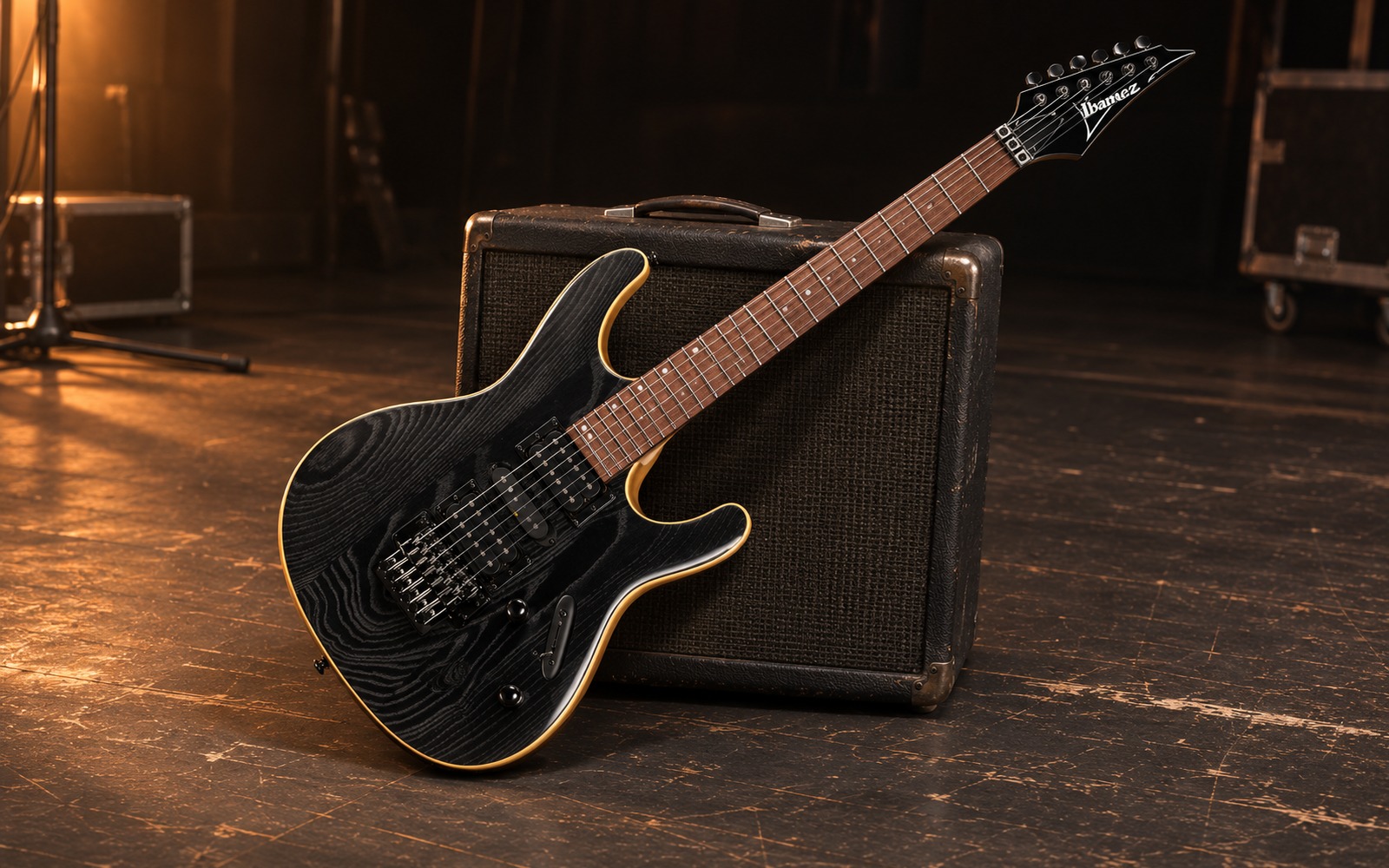
Introduced in 2019 as part of Ibanez’s Indonesia-built Standard range, the S570AH pairs an ash body — brighter and more resonant than the mahogany used on many other S-series guitars — with a bolt-on Wizard III maple neck, the third generation of the profile that’s defined the series since 1987. At 25.5 inches scale with a 15.75-inch fingerboard radius, it’s built for low action and fast playing rather than chunky rhythm work, with white body binding adding a clean visual detail against the darker Cosmo black hardware.
Electronics and Bridge
Three Ibanez Quantum pickups make up the electronics: ceramic humbuckers in the neck and bridge positions flanking an Alnico single coil in the middle, an HSH layout that covers more tonal ground than a simple two-humbucker guitar. A five-way switch with coil-tap wiring pushes that further, and the whole package runs through an Edge-Zero II double-locking tremolo with a locking nut — the same general tremolo family used on the RG652AHMFX Prestige, here in a more budget-appropriate form. The fingerboard changed wood partway through the model’s run: jatoba at launch in 2019, replaced by rosewood starting in 2021, a swap consistent with the supply-driven tonewood substitutions that have shown up repeatedly across Ibanez’s Indonesian-built lineup.
The S570AH’s Immediate Family
Two close siblings sit alongside the S570AH within Ibanez’s Standard S-series lineup. The S670QM steps up to a quilted maple top on a meranti body, a more visually striking finish aimed at players who want a bit more flash for a modest price increase. The S561 goes the opposite direction, trading the S570AH’s HSH configuration and locking tremolo for a simpler HSS layout with a fixed bridge — a lower-maintenance option for players who don’t need dive-bomb capability and would rather not deal with a floating trem’s tuning quirks at all. Both share the same basic Wizard III neck and ash or mahogany body construction that defines the current Standard S-series identity.
Famous Players: A Real Series, No Documented Player Here
Checked against Ibanez’s own artist roster, Wikipedia’s “List of Ibanez players,” and Equipboard — whose dedicated page for this exact guitar shows zero confirmed artist usage — there’s no documented individual who plays the S570AH specifically. That includes all five names: Steve Vai, Joe Satriani, Paul Gilbert, Nita Strauss, and Tim Henson. None has any connection to this model.

What’s worth understanding is why the S series keeps generating this kind of list in the first place, even when the specific guitar comes up empty. The S shape does have real signature history: Herman Li of DragonForce plays a custom Ibanez model built on the S-series platform. Chris Broderick, during his years in Megadeth, switched to six-string S-series guitars painted with Megadeth album artwork for studio work on the album Endgame, specifically because bandleader Dave Mustaine didn’t want him using his usual seven-strings in the studio. Nita Strauss’s own association with the S series dates to her time with Alice Cooper, well before her signature JIVA line existed. None of that history transfers to the S570AH — a 2019 Standard-tier guitar released well after all three of those connections were established — but it explains why “S series” and “shred icon” keep appearing together in generic gear copy regardless of which specific model is actually being discussed.
Tone Recipes
Versatile Rock Rhythm
Middle and neck pickups combined (position 4), tone around the midpoint: this pulls on the Alnico single coil’s clarity alongside the neck humbucker’s warmth, a genuinely different texture from a straight HH guitar and one of the S570AH’s real advantages over its RG-family siblings in this run.
High-Gain Lead and Rhythm
Bridge humbucker alone, gain pushed hard: the ceramic pickup’s higher output handles metal and hard rock rhythm work cleanly, while the Edge-Zero II keeps pitch stable through aggressive palm-muted picking and dive bombs alike.
Cleaner, Blues-Adjacent Tones
Middle single coil alone, tone rolled back slightly: a genuinely clean, articulate voice that leans into the S series’ original HSS-style versatility — proof the S570AH can cover more stylistic ground than its RG-adjacent branding might suggest.
How It Stacks Up
Against the RG-family guitars — the RG652AHMFX Prestige, RG8570Z J.Custom, RGA42FM, and RGAIX6FM Iron Label — the S570AH is the first genuinely different body shape. Where all four RG-family guitars share a flat-top, double-cutaway superstrat silhouette with variations in tier and hardware, the S570AH’s carved, blade-thin body and HSH pickup layout make it a meaningfully different playing experience even at a broadly similar price point to the RGA42FM and RGAIX6FM.
Against the RG550 Genesis Collection that opened this Ibanez run, the comparison lands on a fitting closing note: the RG550 leaned on 1987 nostalgia and a design lineage traceable to Steve Vai’s JEM, while the S570AH represents the S series’ own, less mythologized branch of that same 1987 launch year — a guitar built around the same era’s design philosophy without any of the same origin-story mystique attached to it.
Buying Guide
The S570AH was discontinued after 2024, so new stock is limited to remaining retailer inventory. List price ran around $599.99 through Sweetwater, Guitar Center, and zZounds; used examples on Reverb have traded as low as the $400 range. As with the RGA42FM and RGAIX6FM, confirming production year matters: 2019–2020 units have a jatoba fingerboard, while 2021-onward guitars switched to rosewood. Neither wood is better outright, but the difference affects both look and a subtly different top-end response worth knowing about before buying used.
Owner discussions on Reddit and forums flag a consistent set of setup quirks rather than build-quality problems: the stock trem springs are frequently described as inadequate, with several owners recommending stiffer replacement springs or added foam damping in the spring cavity to improve the Edge-Zero II’s return-to-pitch consistency. The floating trem system can also introduce tuning drift during string bends without a stabilizer like a Hipshot Tremsetter installed. A handful of owners mention rough-turning control knobs and minor fretwork inconsistencies that a professional setup resolves quickly. None of this is unusual for a guitar at this price point, but it’s worth budgeting a setup into the purchase regardless of condition.
One recurring piece of owner advice worth flagging for anyone considering a heavier, more metal-focused setup: several forum threads describe converting the S570AH’s factory HSH wiring to a simpler H-H configuration, leaving the middle single coil unwired and swapping the five-way switch for a three-way. It’s a reversible modification that trades away the guitar’s blues-and-clean versatility in exchange for a more straightforward two-humbucker metal voicing — worth knowing about if a used listing’s electronics don’t match the stock spec sheet, since it’s a common enough change that it may not be disclosed as a modification at all.
Living With an S570AH
Owner sentiment is consistently positive on the fundamentals that matter most for a guitar in this price bracket: the Wizard III neck draws repeated praise for feeling comfortably slim without tipping into flimsy, and the ash body’s brightness comes through in reviews as a genuine tonal advantage over heavier, darker-sounding alternatives. Several long-term owners specifically highlight the versatility of the HSH pickup configuration, noting that the guitar comfortably covers everything from clean and blues tones to full high-gain metal without needing a pickup swap — a meaningfully different reputation from the RGA42FM’s more polarizing stock pickups. One reviewer who owns both an S570AH and a considerably pricier RG652AHM Prestige rated the two as close in overall playability, a strong vote of confidence for a guitar at roughly a third of the price. The most common owner modification isn’t a pickup swap at all, but hardware tweaks to the tremolo system — new springs, added dampening, or a replacement trem arm — aimed at refining an already solid foundation rather than fixing something broken.
Closing This Ibanez Chapter
Five guitars into this run — the RG652AHMFX Prestige, RG8570Z J.Custom, RGA42FM, RGAIX6FM Iron Label, and now the S570AH — the same five-name shred list turned up on every single spreadsheet entry, and it was wrong four times out of five. What actually surfaced in its place was more interesting than the recycled list ever could have been: a Turkish rock musician on a $1,700 flagship, Ibanez’s own demo footage confirming a YouTube fusion guitarist, a hardcore band’s guitarist on a $400 budget model, and — just once — the list finally landing on its own claim when Tim Henson turned up exactly where the spreadsheet said he would. The S570AH closes the run on the other end of that spectrum: a solid, versatile, entirely real guitar that simply doesn’t have a famous name attached to it, and doesn’t need one to be worth writing about honestly.
FAQ
Does any famous guitarist play the Ibanez S570AH specifically?
No confirmed individual artist connection exists for this exact model, based on Ibanez’s own artist roster, Wikipedia, and Equipboard’s dedicated page for the guitar, which shows no documented artist usage.
Why does the S series keep getting linked to shred icons if this guitar doesn’t have one?
The S series has genuine signature history elsewhere — Herman Li’s custom S-based model, Chris Broderick’s Megadeth-era S-series guitars, and Nita Strauss’s earlier association with the series during her Alice Cooper years — but none of those connections involve the S570AH, a 2019 Standard-tier model released after all three had already moved on.
Is the S570AH still in production?
No, it was discontinued after 2024. It’s available only through remaining retailer stock or the used market.
What’s the difference between the jatoba and rosewood fingerboard versions?
Ibanez used jatoba on 2019–2020 production before switching to rosewood from 2021 onward. Both are functionally similar, with a subtle difference in look and top-end response rather than a meaningful playability gap.
Is this a good guitar for genres beyond metal?
Yes — the HSH pickup configuration with an Alnico middle single coil gives it real versatility for blues, rock, and cleaner styles, a genuine point of difference from the more metal-focused RG-family guitars.
Image credits
- Top image: GuitarGangsters AI-generated reference illustration, not a photograph.
- Nita Strauss: Frank Schwichtenberg, Wikimedia Commons, CC BY-SA 4.0.
Latest News
Related
On This Day
Monday 9 November
From this week: