ESP LTD Alexi Ripped: The Signature Guitar Alexi Laiho Never Got to See Released
The story behind the ESP LTD Alexi Ripped, one of Alexi Laiho's final guitar designs, its dual-pickup spec, and how it compares to his earlier signatures.
Some signature guitars get designed in a weekend. Others take years of back-and-forth between an artist and a custom shop, refined across tours and NAMM booths and late-night phone calls about pickup voicing. The ESP LTD Alexi Ripped belongs firmly in the second category — except the guitarist whose name is on the headstock never lived to see it hit the market. It’s one of the last designs Alexi Laiho worked on with ESP before his death in December 2020, and it carries that history in every detail, from the offset V body he’d been refining for over a decade to a neck pickup configuration that had never appeared on any of his previous signature models.
A Design Born From an Unfinished Conversation
ESP’s own account of the Alexi Ripped and its companion model, the Alexi Hexed, is direct about the timeline: the company had been working closely with Laiho on both guitars for over a year before he passed away. They were the first new additions to his signature series since 2013, and by ESP’s telling, he was genuinely excited about them — not a contractual obligation he was fulfilling, but a project he wanted to see through. He didn’t get to. ESP finished the guitars anyway and released them in 2021, explicitly framing the Ripped and Hexed as a way to honor his memory and put his final design ideas into players’ hands.
From Custom Shop Original to a Full Production Tier
Like most ESP signature designs, the Ripped launched across three tiers simultaneously: the handmade ESP Custom Shop version built in Japan, the mid-tier E-II built at the ESP factory (also in Japan, with Gotoh locking tuners and an active MM-04 boost circuit), and the LTD version most players will actually encounter, built to the same core spec at a more accessible price point. All three share the offset V silhouette, the scalloped upper frets, and the sawtooth inlay motif that had become visually inseparable from Laiho’s stage presence by the 2010s — but the Ripped introduced something none of his earlier signature guitars had: a second pickup.
Alexi Laiho — The Man Behind the Model
Born in Espoo, Finland in 1979, Laiho co-founded Children of Bodom in 1993, initially under the name Inearthed, and built the band into one of Finland’s best-selling musical exports — a run that included four consecutive Finnish No. 1 albums and international festival headline slots built almost entirely on the strength of his playing. His style fused black metal aggression, power metal’s melodic sensibility, and a classically-trained ear for harmony, delivered at a speed that drew immediate comparisons to Yngwie Malmsteen from the moment Children of Bodom played their first Helsinki show opening for Dimmu Borgir in 1997. Guitar World later ranked him among the fastest guitarists in the world and among the 100 greatest heavy metal guitarists of all time; Metal Hammer’s readers voted him world’s best guitarist in 2006.
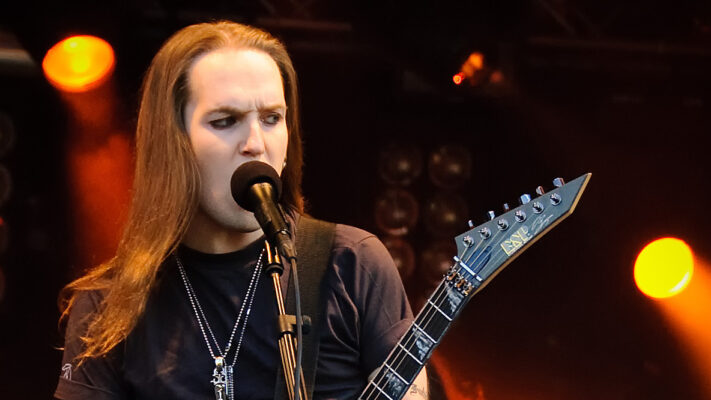
Children of Bodom played their farewell show in December 2019, after which Laiho immediately formed a new project, Bodom After Midnight, with COB co-guitarist Daniel Freyberg. The band recorded a handful of songs through the summer of 2020 before Laiho’s death that December, at age 41, following long-term health complications tied to alcohol dependency he had spoken about publicly in interviews years earlier. Those final recordings were released posthumously in April 2021 as the Paint the Sky With Blood EP — the same year the Alexi Ripped reached stores, meaning fans got Laiho’s last music and his last guitar design within months of each other.
Children of Bodom’s Legacy, Album by Album
Understanding why a signature guitar built by committee after an artist’s death still feels this personal means understanding what Laiho built over the two-plus decades before it. Children of Bodom’s 1997 debut, Something Wild, was recorded while the band was still finishing high school, but it was 2000’s Follow the Reaper that became the breakthrough — the band’s first Finnish gold certification and the record that established the template later albums would refine: keyboard-and-guitar duels traded at absurd tempo, black metal aggression softened just enough by genuine pop songcraft to make it radio-adjacent without losing an ounce of extremity.
The four albums that followed — Hate Crew Deathroll, Are You Dead Yet?, Blooddrunk, and Relentless Reckless Forever — each debuted at number one in Finland, an almost unheard-of run of chart dominance for a death metal band anywhere in the world. Along the way, Laiho picked up Metal Hammer’s Golden Gods “Dimebag Darrell Shredder” award in 2008 and was voted the magazine’s best guitarist that same year, cementing a reputation that Guitar World would later formalize by ranking him among the 100 greatest metal guitarists of all time. Children of Bodom played their final show together in Helsinki in December 2019 — appropriately titled A Chapter Called Children of Bodom — before Laiho and guitarist Daniel Freyberg immediately regrouped as Bodom After Midnight, determined to keep writing rather than stop.
Two Decades With ESP
Laiho joined ESP’s artist roster in 2002, and the company released his first signature series guitars in 2006, beginning a relationship that ran for nearly two decades and produced one of the most recognizable signature lines in modern metal — the V-shaped, sawtooth-inlaid silhouette that’s as identifiable from a festival’s back row as any Flying V or explorer shape ever was. It’s worth noting, since we flagged this honestly in our piece on the ESP LTD Arrow-1000, that Laiho’s connection to that particular ESP shape was more of a spiritual and naming lineage than a direct signature link. The Ripped carries no such ambiguity — this is, unambiguously, his guitar, designed under his direct involvement and released in his name.
Anatomy of the Alexi Ripped
The Ripped keeps the offset V body — alder wings around a neck-thru-body maple neck, in a three-piece thin U profile with a natural satin back for fast, low-friction playability. The scale sits at ESP’s standard 25.5″, topped with a Macassar ebony fingerboard carrying 24 extra-jumbo frets and Laiho’s signature sawtooth inlays, plus glow-in-the-dark side markers for stage visibility in low light. True to the model’s shred pedigree, the fingerboard is scalloped from frets 19 through 24, letting the player dig in harder for vibrato and bends in the upper register without the wood getting in the way.
The real spec news is in the electronics. Every prior Alexi Laiho signature model shipped as a single-pickup guitar — a passive EMG HZ F-H2 humbucker in the bridge and nothing else. The Ripped is the first Alexi Laiho model to add a second pickup: an EMG HZ S2 passive stacked single coil in the neck position, giving players access to clearer, more articulate tones for leads and clean passages that the bridge-only Hexed simply can’t produce. It’s a small addition on paper but a meaningful one for anyone who actually gigs the guitar — a genuine three-way switch and two distinct voices instead of one pickup and a volume knob.
Hardware carries a double-locking Floyd Rose 1000 bridge (Floyd Rose Original on the higher-tier E-II and Custom Shop builds) with Grover tuners on the LTD and locking Gotoh tuners further up the range, all finished in chrome. The whole package ships in Purple Fade Satin with painted black satin “ripped” pinstripes — the finish the model takes its name from — with a matching headstock and a deluxe ESP hardshell case included at every tier.
Dialing In the Alexi Ripped’s Tone
Laiho’s tone was built around clarity at speed — fast alternate picking and sweep runs that needed to stay legible even at tempo, layered with genuinely melodic lead lines rather than pure noise-wall shred. The EMG HZ F-H2 bridge pickup is voiced for exactly that: high output and ceramic-magnet punch without losing note definition, so pull the amp’s gain back slightly further than you would with a standard active EMG 81 setup and let the pickup’s own output do more of the work. The neck-position HZ S2 stacked single coil is the tool for cleaner, more Malmsteen-inflected passages — try it with moderate gain and a touch of delay for classic melodic-death lead tone, and switch to the bridge humbucker for rhythm work.
For a period-accurate amp platform, a high-gain tube head with a tight low end works better than a scooped modern metal tone — Children of Bodom’s guitar sound always kept enough midrange to let the melodic lines cut through the keyboard interplay that defined the band. A Tube Screamer ahead of the amp helps tighten palm-muted rhythm parts without smothering the pickup’s natural clarity.
Because Laiho’s writing constantly traded lead lines with a keyboardist, the guitar tone in Children of Bodom recordings was rarely allowed to dominate a mix the way pure death metal guitar tones often do — there’s headroom left for the melody to breathe. Players chasing that specific sound on the Ripped should resist maxing out gain and presence; a slightly cleaner, more dynamic high-gain tone tracks fast alternate picking more accurately than a fully saturated, compressed metal wall, and it lets the neck pickup’s clarity actually register as a distinct voice rather than just a quieter version of the bridge tone.
The Alexi Ripped vs. the Rest of the Signature Line
Within Laiho’s own signature catalog, the Ripped’s closest sibling is the Alexi Hexed, released the same year and sharing the same offset V body and scalloped upper frets — but the Hexed keeps the single-pickup, single-volume-knob simplicity of every earlier Alexi model, making it the more purist option for players who want the exact voice of his 2013-era guitars. The Ripped is the more versatile, more modern instrument of the pair, built for a player who wants both the bridge-pickup aggression Laiho was known for and a genuinely useful clean/lead voice alongside it.
Buying Guide: LTD vs. E-II vs. ESP Custom Shop
The LTD Alexi Ripped is the accessible entry point, built to the same core spec as the higher tiers with Grover tuners and a standard Floyd Rose 1000. Step up to the E-II and you get Japanese factory construction, locking Gotoh tuners, and the active MM-04 preamp/boost circuit for up to +18dB of extra gain on tap — a genuinely useful feature for solo boosts live. The full ESP Custom Shop version is hand-built in Japan to the same electronics spec as the E-II, at Custom Shop pricing and lead times. Left-handed builds exist across the E-II and LTD tiers for left-handed players, an increasingly rare accommodation among boutique signature models and a detail worth checking availability on directly with ESP if you need one, since left-handed runs are typically smaller and sell through faster than right-handed stock.
Collector demand across Laiho’s entire signature catalog has climbed noticeably since his passing, and the Ripped is no exception — as one of only two designs released posthumously, it carries an extra layer of significance that earlier, more common Alexi-200 and Alexi-600 models don’t share. Discontinued runs and early-production examples have appreciated meaningfully above original MSRP on the secondary market, which is worth factoring in if you’re buying to play rather than to collect: a lightly used LTD example at a fair price is a far more sensible entry point than chasing a boxed, unplayed Custom Shop unit purely as an investment.
Frequently Asked Questions
Is the ESP LTD Alexi Ripped Alexi Laiho’s own guitar?
It’s based on one of the final guitar designs Laiho developed directly with ESP, worked on for over a year before his death in December 2020 and released posthumously in 2021 as a tribute to his legacy.
What’s the difference between the Alexi Ripped and the Alexi Hexed?
Both share the same offset V body and scalloped fingerboard, but the Ripped adds a second pickup — an EMG HZ S2 in the neck position alongside the bridge humbucker — making it the first two-pickup guitar in Laiho’s signature line. The Hexed keeps the single-pickup, single-volume-knob layout of his earlier models.
What pickups does the Alexi Ripped use?
An EMG HZ F-H2 passive humbucker in the bridge and an EMG HZ S2 passive stacked single coil in the neck, wired to a three-way selector and single volume control.
Is the Alexi Ripped available for left-handed players?
Yes, ESP has produced left-handed versions across the E-II and LTD tiers, though availability is more limited than right-handed stock and worth checking directly with ESP or an authorized dealer.
Image credits
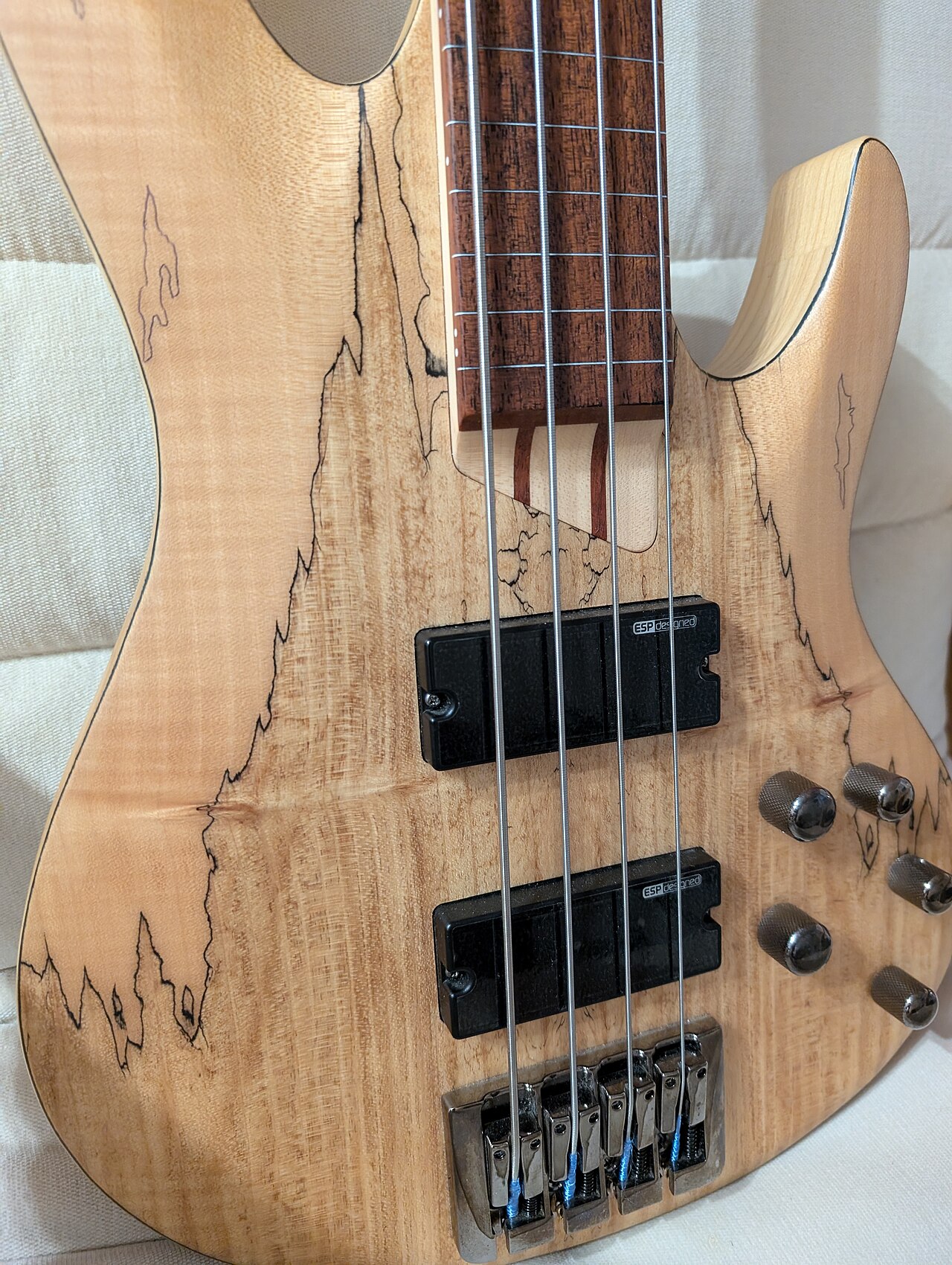
- An ESP LTD B204 SM FL fretless bass body and pickups: Elmschrat, Wikimedia Commons, CC BY-SA 4.0.
- Alexi Laiho: Tuomas Vitikainen, Wikimedia Commons, CC BY-SA 3.0.


Latest News
On This Day
Tuesday 10 November
From this week: