ESP E-II M-II: The Superstrat Behind Metallica’s Most Famous Horror-Themed Guitars
Kirk Hammett's "Mummy" and "Ouija" guitars are both built on this exact superstrat platform — the real history behind the ESP M-II. (135 characters)
If you’ve ever seen a photo of Kirk Hammett holding a guitar wrapped in Ouija board graphics, or wrapped in bandages and hieroglyphics like something out of a 1930s Universal horror poster, you’ve already seen this shape in action — you just might not have known its name. The ESP M-II is the superstrat platform underneath two of the most recognizable custom guitars in metal history: Hammett’s “Ouija” and “The Mummy,” both built on the KH-2 model, both directly descended from the M-II.
What Is the ESP M-II Shape
The ESP M-II belongs to the “Super Strat” category — guitars that draw heavily on the Fender Stratocaster’s basic outline while modifying it for higher performance, typically with a larger lower-body cutaway for upper-fret access and a Floyd Rose-style locking vibrato for tuning stability under heavy string-bending. The shape emerged from the same late-1970s and 1980s wave of hot-rodded superstrats that Eddie Van Halen helped popularize — bolt-on or neck-through Strat-derived bodies, high-output humbuckers, and double-locking tremolos built for the increasingly extreme string-bending and dive-bombing techniques of the era’s hard rock and metal guitarists.
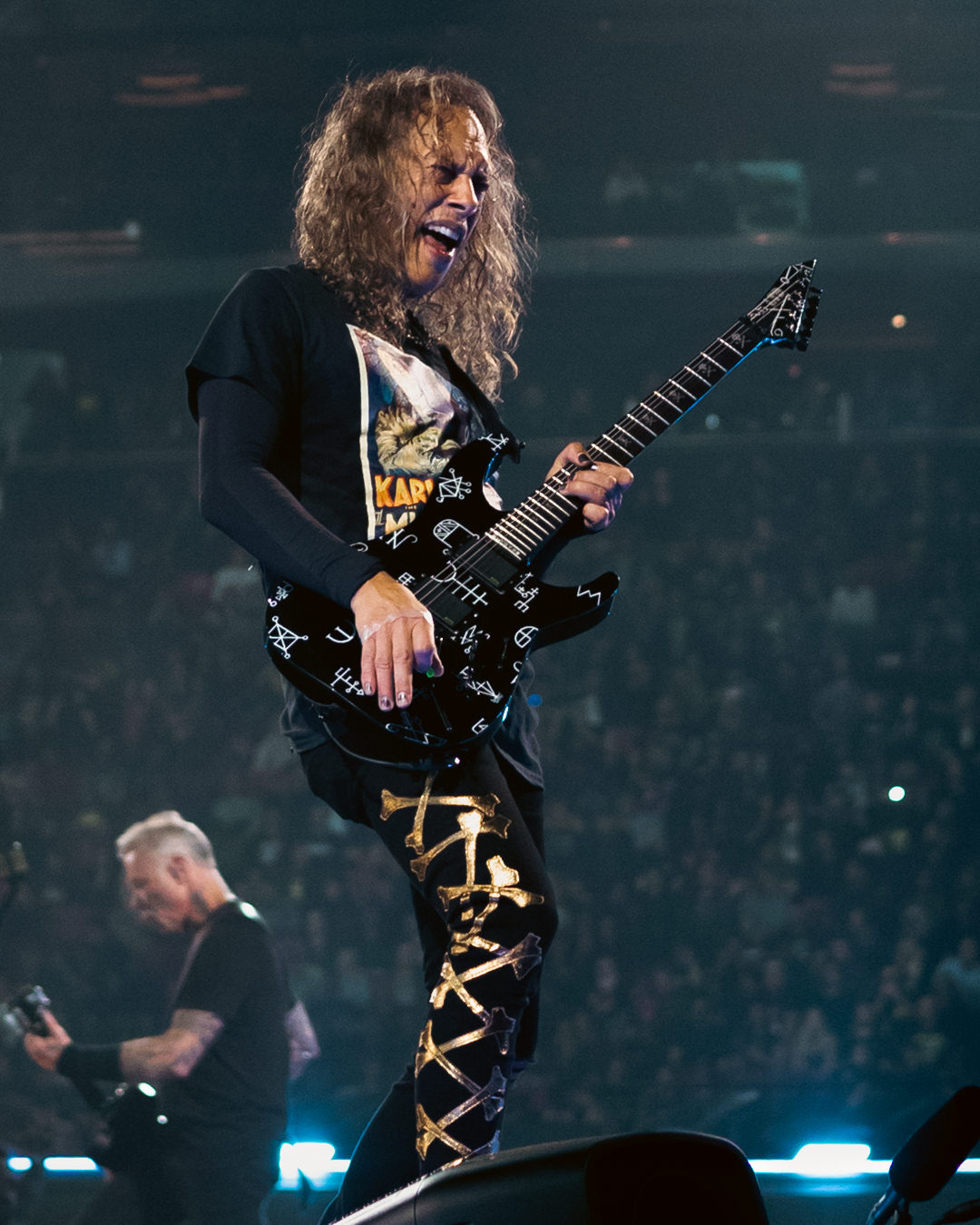
Ove the years, the M-II has been offered in several configurations: bolt-on neck versions with either a maple fingerboard paired with Seymour Duncan JB (bridge) and ’59 (neck) pickups, or a rosewood fingerboard with dual EMG 81 active humbuckers, alongside a neck-through-body version also running dual EMG 81s. A notable limited edition, the Urban Camouflage, arrived in ESP’s 2005 catalog with a satin camo finish, neck-through construction, and dual active EMG 81 pickups — a good snapshot of the shape’s core metal-oriented identity across different production runs.
Kirk Hammett’s KH-2: Decades of M-II History
The most famous user of the M-II is, by a wide margin, Metallica’s Kirk Hammett, who has used an M-II-derived guitar from the 1980s era of the band all the way through to the present day, in the form of his custom KH-2 signature models. His two most iconic instruments — nicknamed “the Mummy” and “the Ouija” for their distinctive graphics — are both built on the M-II platform, differing from standard production M-IIs mainly in their custom artwork, separate volume and tone controls, and a flatter fingerboard radius.
The Ouija: Born From a Board Game and a Fax Machine
The Ouija’s origin story is one of the more charmingly low-tech tales in guitar history. Hammett reportedly came up with the concept around 1990, wanting a guitar built around elements from the Hasbro Ouija talking board. The design team bought an actual board game, photocopied it, cut out the lettering and artwork with scissors, and faxed the layout to ESP’s Custom Shop in Japan to be hand-painted in glow-in-the-dark phosphorescent finish — a process so analog that the finished guitar carries a typo inherited from that original fax, misspelling “Fuld” as “Fued” on the board’s fine print, a quirk that’s been faithfully preserved on modern reissues. The Ouija first appeared around 1993, midway through the touring cycle for Metallica’s self-titled “Black Album,” making it Hammett’s earliest major graphic custom, predating the Mummy by several years.
The Mummy: Still His Main Recording Guitar Decades Later
Where the Ouija emerged from board-game aesthetics, the Mummy traces back to classic cinema. Commissioned after Hammett purchased an original poster for the 1932 Boris Karloff film in 1993, the Mummy officially arrived in his hands around 1996, right in time for the “Load” album cycle, featuring custom Eye of Horus fingerboard inlays alongside the bandaged mummy artwork painted by ESP’s Custom Shop. What sets the Mummy apart from most artist customs is its remarkable staying power: according to Hammett’s own guitar tech, he acquired the guitar in 1996 and it has remained his main recording guitar ever since, reportedly because the wood and pickups on this specific instrument sound just slightly better than his other examples of the same model. Unlike the Ouija, which has largely retired from stage use in favor of newer guitars, the Mummy has stayed in constant rotation for essentially Hammett’s entire post-Black-Album career — a rare case of an artist’s custom one-off outlasting decades of gear trends and equipment changes.
Hammett has been famously protective of the Mummy’s exclusivity, too. Fan requests for ESP to release a production “Mummy” model have circulated for years, but Hammett has stated repeatedly that there will never be an official Mummy release — it remains his personal, one-of-a-kind instrument, in contrast to the Ouija, which did eventually see limited production runs available to the public.
The Rest of the Horror Collection
The Mummy and Ouija are the two most famous KH-2 variants, but they’re far from the only ones. Hammett’s collection includes an M-2 nicknamed “Frankenstein,” featuring a “Warning! The Monster Is Loose” caption that glows in the dark alongside LED-lit eyes on the artwork, and a companion “Bride of Frankenstein” variant. A “White Zombie” graphic, based on the 1932 Victor Halperin film starring Bela Lugosi, became an officially released ESP LTD production model, making it one of the more accessible ways for fans to own a version of Hammett’s horror-themed M-II lineage. A “Dracula” edition, based on the 1931 Bela Lugosi film, adds bat-and-cross inlays to the same basic KH-2 template. Across nearly all of these variants, the underlying construction stays consistent: an M-II-derived body and neck, active EMG humbuckers (typically the 81/60 pairing or Hammett’s own signature Bone Breaker set), and a Floyd Rose vibrato — only the artwork and finish change from guitar to guitar.
Kirk Hammett’s Rig Beyond the Guitar
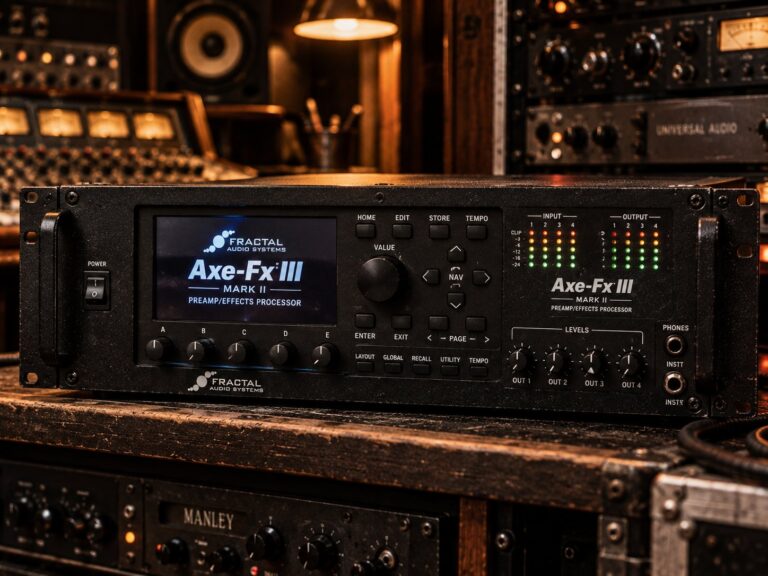
Hammett’s tone owes as much to his amplification and effects choices as it does to any specific guitar. His live rig has long centered on rackmounted Mesa/Boogie Dual Rectifier heads, run through a relatively simple signal chain of DBX Quad noise gates, Digital Music Corp GCX Expander switching racks, and TC Electronic G Major effects processors. In more recent years, Metallica’s touring rigs have shifted to Fractal Axe-Fx modelers, with Hammett’s digital tone profiled directly from his own Mesa/Boogie Dual Rectifier and Fortin Meathead amplifiers — a move driven partly by the practical challenges of maintaining tube amp rigs on tour, and one the band first adopted for a 2013 concert played in Antarctica, making Metallica the first band to perform on all seven continents.
No discussion of Hammett’s tone is complete without his wah pedal. The wah is arguably as essential to his sound as the whammy bar is to other guitarists’ — modeled after his rack-mounted Dunlop Cry Baby wah, later released as his own signature stompbox version. Dunlop’s engineers reproduced Hammett’s own EQ, volume, and tone settings on the pedal, aiming for a wide, musical sweep rather than the more clipped, narrow-band wah tones found on some other signature models. Hammett has cited both Jimi Hendrix and his own teenage guitar lessons with Joe Satriani as foundational influences on his lead playing, a combination that shows up clearly in his wah-driven, melodically minded solo style.
ESP’s Origins and the Rise of E-II
Understanding where the M-II sits in ESP’s catalog requires a quick trip back to the company’s founding. In 1975, a new musical instrument shop called Electric Sound Products opened in Tokyo, Japan, initially operating a small area in the back of the store dedicated to making custom replacement parts for guitars and basses — a modest beginning for a company that would go on to define much of modern metal’s visual and sonic identity. Until the end of 2013, ESP operated two tiers: the handcrafted ESP Custom Shop, and ESP Standard, the latter built at the company’s Tokyo manufacturing facility and responsible for the majority of ESP models seen worldwide over nearly four decades. The E-II name introduced in 2014 was simply a rebrand of that same Standard tier — same factory, same craftspeople, new name, a detail that matters enormously for tracing Hammett’s own guitar history, since his earliest M-II-derived customs predate the E-II name by roughly three decades.
Today’s E-II lineup spans more than 50 guitars across ten body shapes and styles, including the Eclipse, Horizon, Arrow, Viper, and M-series covered here, with the company positioning E-II guitars as rivaling the detail and quality of considerably more expensive models. Sweetwater’s own marketing copy for the line even lists Rammstein guitarist Richard Z. Kruspe among the “satisfied players” of E-II instruments — a reminder that this superstrat-and-single-cutaway family of shapes has found homes well beyond just Metallica’s two guitarists.
The Names That Don’t Fit This Shape
Most of the remaining names don’t hold up under scrutiny for the M-II specifically. James Hetfield’s ESP history runs almost entirely through Explorer-derived shapes — the MX-220 and MX-250 models that defined his 1980s and 1990s stage rigs, and later the Iron Cross, Snakebyte, and Vulture signature series — none of which are M-II or superstrat-shaped at all. Stephen Carpenter’s signature lineage runs through his own dedicated extended-range SC baritone series; Alexi Laiho’s signatures were built on an asymmetric V-shaped body; and George Lynch’s decades-long ESP partnership centers on his own Kamikaze design. All three are legitimate, well-documented ESP artists — just not connected to this particular superstrat platform.
Construction and Specs
The modern E-II M-II lineup carries forward the shape’s superstrat DNA with several finish and hardware variations. The E-II M-II HT (hardtail) version pairs a Hipshot string-through-body bridge with a burled maple top in a Black Natural Fade finish, a three-piece maple neck with satin finish, and an ebony fingerboard with 24 extra-jumbo stainless steel frets. Electronics on this variant come from a pair of direct-mounted Bare Knuckle Aftermath Tyger pickups, a British boutique pickup brand known for tight, articulate high-gain output — a step up from the EMG-dominated pickup choices found on many other ESP metal models.
Other E-II M-II variants — such as the Black Natural Burst finish — pair gold hardware with a Floyd Rose Original double-locking bridge, Gotoh locking tuners, and Bare Knuckle Aftermath pickups with a push-pull tone control for coil-splitting, giving players access to a thinner, more single-coil-adjacent voice without switching guitars. Body binding details are a consistent style marker across the range: natural masked body binding paired with white binding on the neck and matching headstock gives the M-II a more visually ornate look than some of ESP’s plainer superstrat offerings.
Neck Feel and Playability
The E-II M-II carries a U-shaped neck profile — a shape with more pronounced “shoulders” than a typical C-profile neck, generally favored by players with larger hands or a preference for a vintage-style neck feel, measuring roughly 20mm at the first fret and 22mm at the twelfth. The pickup configuration across the E-II M-II range is HH (dual humbucker), prioritizing warmth and output over the tonal versatility of single-coil-equipped alternatives. Scale length runs the standard 25.5 inches, and current pricing for the E-II M-II tier generally sits in the $2,600–$3,700 range depending on finish and hardware configuration.
Tone Recipes
Thrash rhythm attack: Bridge humbucker, high gain, tight palm-muting. This is the tone that defined Hammett’s KH-2 through three decades of Metallica’s catalog — compressed, aggressive, and built for precise alternate picking.
Singing lead tone: Neck humbucker or blended position, moderate-to-high gain with a touch of delay. The neck pickup on EMG-loaded M-II variants delivers a smoother, more vocal lead voice well-suited to sustained bends and melodic soloing.
Coil-split cleans: On push-pull-equipped Bare Knuckle models, engage the split for a thinner, more Strat-like clean tone — useful for genre-hopping players who want superstrat metal tones and lighter textures from a single instrument.
Comparisons and Family Tree
Within ESP’s own catalog, the M-II sits alongside other superstrat-adjacent shapes across different tiers — the E-II Horizon and Horizon-III series occupy similar territory with different cutaway and body proportions, while ESP’s Original Series and LTD lines offer M-series-adjacent shapes at premium and budget price points respectively. Hammett’s own KH-2 signature models represent the most famous artist-driven variant of this platform, distinct from the standard E-II M-II mainly through custom graphics, a flatter fingerboard radius, and separate volume/tone controls rather than the master-volume-only wiring found on some production M-IIs.
It’s also worth noting how Hammett’s guitar choices have shifted across eras without ever fully abandoning the M-II. Early in his career, before joining Metallica, he played a Gibson Flying V with the thrash pioneers Exodus; once in Metallica, he moved through a Fernandes Stratocaster-style guitar and a Jackson Randy Rhoads model (heard extensively on “Master of Puppets”) before his ESP partnership solidified around 1986 or 1987 with the MM-270, the direct precursor to the KH-2 and M-II lineage. In more recent decades, Hammett has also become known for his extensive vintage Gibson collection, most famously the 1959 Les Paul nicknamed “Greeny” (formerly owned by Peter Green and Gary Moore), which he purchased in 2014 and has used on record and on stage for tracks like “Fade to Black” — but for the riff-driven, high-gain rhythm and lead work that defines most of Metallica’s catalog, the M-II-derived KH-2 remains his most consistent tool.
Buying Guide
The E-II M-II suits players chasing classic superstrat versatility with a metal-oriented pickup lineup — a strong fit for anyone wanting Van Halen-lineage playability updated with modern high-gain electronics. Players specifically chasing Hammett’s KH-2 tone should prioritize EMG 81/60-loaded variants and a Floyd Rose-equipped model for the dive-bomb capability heard throughout his recorded work; those who prefer more tonal range should look toward Bare Knuckle-equipped variants with coil-splitting for a broader palette. The U-shaped neck profile is worth testing in person if you have smaller hands, since it runs noticeably chunkier than ESP’s slimmer Eclipse-series necks.
Players drawn specifically to the horror-movie aesthetic of Hammett’s personal collection should note that most of those graphics — the Mummy above all — were never commercially released and exist only as Hammett’s personal, one-of-a-kind instruments. The White Zombie graphic remains the most accessible way to own an officially licensed piece of that visual lineage, while players wanting the underlying platform without any of the artwork should look to the plain E-II M-II models covered in the construction section above.
Ownership Notes
Owner feedback on the E-II M-II consistently highlights its build quality relative to price, with reviewers noting the guitar’s placement in ESP’s high-end/boutique tier reflects genuinely premium components and construction. The thin-U neck profile on camo and other variants draws consistent praise for facilitating fast playing and complex fingerwork, making the guitar a popular choice among shred-oriented players. As with other ESP models in this catalog, the locking tremolo variants deliver excellent tuning stability even under heavy whammy-bar use, a detail owners specifically credit for reliable dive-bombs and pitch-shift effects without detuning.
Read our guide to the ESP E-II Eclipse to compare the other ESP body shape discussed here.
FAQ
Are Kirk Hammett’s “Mummy” and “Ouija” guitars really M-IIs?
Yes. Both are built on ESP’s KH-2 signature platform, which is directly derived from the M-II shape, differing mainly in custom artwork, fingerboard radius, and control layout rather than the underlying body design.
Does James Hetfield play the M-II?
No. Hetfield’s ESP history runs through Explorer-derived shapes (MX-220, MX-250) and his own signature Iron Cross, Snakebyte, and Vulture models — none of which are related to the M-II superstrat platform.
What’s the difference between the Ouija and the Mummy?
The Ouija (1993) was based on the Hasbro Ouija board and eventually saw limited public production runs; the Mummy (1996) is based on the 1932 Boris Karloff film and has remained Hammett’s personal, never-released instrument, reportedly still his primary recording guitar today.
What pickups does the standard E-II M-II use?
Current production models typically use Bare Knuckle Aftermath humbuckers, while EMG 81/81 or 81/60 configurations are more common on Hammett’s own KH-2 signature variants and some other M-II production runs over the years.
Image credits
- An ESP LTD B204 SM FL fretless bass guitar: Elmschrat, Wikimedia Commons, CC BY-SA 4.0.
- Kirk Hammett: Kreepin Deth, Wikimedia Commons, CC BY-SA 4.0.
Latest News
Related
On This Day
Monday 9 November
From this week: