The JTM45 Reborn Dirty: How Dave Friedman Bottled Jimmy Page’s Led Zeppelin Crunch in 40 Watts
The Friedman Dirty Shirley 40 channels Jimmy Page-era JTM45 crunch in a hand-wired 40-watt head. Full specs, tone recipes, and famous players guide.
There’s a very specific guitar tone that’s been haunting rock players since 1969. It lives on the first two Led Zeppelin records — that fat, harmonically rich, slightly-compressed crunch that sounds like a Marshall amp on the verge of melting, singing with warmth and authority you simply cannot fake with modern gain circuitry. For decades, chasing that sound meant hunting down original late-1960s JTM45 and Super Lead heads, hoping the transformers hadn’t turned to dust, and then praying you could actually afford the asking price.
Dave Friedman had a different idea. Having spent years inside the rigs of rock royalty at his Los Angeles shop Rack Systems — modifying, repairing, and rebuilding amps for artists ranging from Eddie Van Halen to countless touring heavyweights — Friedman understood the JTM45 circuit at a cellular level. When he launched his own amp brand, one of his first designs was a deliberate attempt to bottle that Jimmy Page early-Zeppelin tone in a road-reliable, hand-wired head with just enough modern thinking to make it genuinely usable. He called it the Dirty Shirley.
Debuted publicly at the 2010 LA Amp Show — where Premier Guitar’s Chris Kies declared it sounded “like Jimmy Page on the early Zeppelin records” — the Dirty Shirley established itself immediately as something special. It wasn’t the most powerful Friedman design, the highest-gain, or the most feature-laden. It was, arguably, the most honest: a single-channel, 40-watt love letter to the golden age of British rock, built by hand in the USA by someone who had literally touched more legendary amps than most players have ever seen.
Over fifteen years later, the Dirty Shirley 40 Head (DS-40) remains one of the most respected boutique amp purchases you can make in the classic rock and blues-rock space. Here’s everything you need to know about it.
Dave Friedman and the Road to the Dirty Shirley
To understand the Dirty Shirley, you need to understand Dave Friedman’s background. Through Rack Systems, his Hollywood-based repair and modification studio, Friedman spent the 1990s and early 2000s building a reputation as the go-to tech for serious working guitarists. Eddie Van Halen trusted him with his rigs. So did Steve Stevens. The list of clients reads like a who’s-who of classic rock. In that environment, Friedman developed a deep, practical knowledge of vintage British amp circuits — not the academic kind, but the kind earned through hands-on troubleshooting and enhancement of the real thing.

When Friedman Amplification launched, the Brown Eye circuit (better known today as the BE, which evolved into the BE-100 series) got the most attention. It was the amp that became synonymous with the Friedman brand’s high-gain reputation. But from the beginning, Friedman also wanted to build something softer, more vintage, more “classic” — and the Dirty Shirley was that amp.
The design philosophy was straightforward: take a modified JTM45 topology as the starting point, retain the fundamental character of a 6L6-powered (5881) class AB British amp, and add just enough gain structure and volume control to make it versatile without surrendering the vintage soul. Early versions of the amp — as documented in the 2010 PG coverage — had a strikingly pure approach: no effects loop, no switching, just a Gain control and a Master Volume added to the JTM45 platform for modern usability. The amp was designed to be a working player’s instrument, not an esoteric collector’s piece.
The current DS-40 is a refinement of that original vision. Friedman added an ultra-transparent series effects loop and a three-position gain structure switch (important additions we’ll address below), but the fundamental soul of the amp — a warm, harmonically complex, touch-responsive single-channel British machine — remained intact.
Specifications
The 5881 / 6L6 Question
A note on the power tubes: When the original Dirty Shirley debuted at the 2010 LA Amp Show, Premier Guitar described it as a “6L6-based head.” The current production DS-40 spec sheet lists 5881 tubes. These are not contradictory — the 5881 is a military-spec variant of the 6L6 family, originally developed for rigorous industrial and military applications. It shares the same pinout and operates in the same circuits as a 6L6GC with marginally different plate voltage tolerances. In a Friedman Dirty Shirley running at 40 watts, the difference is essentially academic; the tonal character is fundamentally 6L6 — rounder, warmer, and fuller in the low end than an EL34 design, with a characteristic midrange bloom that suits vintage British voicings beautifully.
This is a meaningful distinction from the rest of the Friedman lineup. The BE-100 series runs EL34 tubes (the more aggressive, biting British sound). The Dirty Shirley runs 5881s. The result is a tonally softer, more pillowy character that responds differently to overdrive — less cutting and aggressive, more enveloping and warm. It’s why the Dirty Shirley often gets described as “more vintage” than its BE-100 siblings even though the manufacturing quality and component-level craftsmanship are identical.
The Gain Structure Switch: A Crucial Feature
One of the most practically important features of the current DS-40 is the three-position gain structure switch. This switch alters the overall gain architecture of the preamp, moving from a very vintage, low-gain voicing (think 1960s JTM45 levels of breakup) through to a more modern, compressed setting with additional harmonic saturation. The middle position represents what most players will use as their everyday setting — enough gain for classic rock crunch while retaining the amp’s famous touch sensitivity.
This switch effectively triples the amp’s tonal range without changing the fundamental character. In position 1, the Dirty Shirley can function as a near-pristine platform for pedal-based tones. In position 3, it has enough on-tap saturation for everything through early metal. The amp was designed to take pedals beautifully — its transparent series FX loop, combined with a naturally musical input stage, means boosts, overdrives, phasers, flangers, tremolos, and wahs all sit perfectly in the Dirty Shirley’s signal chain.
Famous Players
Ryan Waters — Heart
In February 2026, Premier Guitar published a full Rig Rundown covering Heart’s Royal Flush Tour. Guitarist Ryan Waters confirmed the Friedman Dirty Shirley as his main amp, running it through an Orange 4×12 cabinet with a vintage 18-watt Marshall plexi-style head as his only backup. Waters is a classic rock player whose tonal requirements — warm crunch, excellent pedal response, reliability under live conditions — map perfectly onto the Dirty Shirley’s strengths. The amp’s ability to cover Heart’s catalog, which spans the roaring boogie-influenced rock of “Barracuda” through to more delicate classic material, demonstrates exactly the kind of versatility the DS-40 offers.
Mikael Åkerfeldt — Opeth
In a March 2020 Rig Rundown from Premier Guitar, covering Opeth ahead of their Ryman performance, guitarist Fredrik Åkesson and singer/guitarist Mikael Åkerfeldt discussed their transition from traditional tube heads to Synergy modular systems for fly gigs. Mikael’s module pairing: a Friedman Dirty Shirley module alongside a Soldano SLO module. The Dirty Shirley handled clean and crunch duties; the Soldano delivered the heavy rhythm and lead weight. That Åkerfeldt — a guitarist known for extreme tonal range, from delicate acoustic-style passages to crushing progressive metal riffing — chose the Dirty Shirley as his clean/crunch foundation speaks volumes about the amp’s musical flexibility and natural feel.

George Lynch
The Dokken and Lynch Mob guitarist George Lynch has been documented test-driving the Friedman Dirty Shirley 40 on video (a YouTube session with Dangerous Guitar). While Lynch’s live touring rig is not consistently documented as using the DS-40, his association with the amp — and his evident enthusiasm during the demo — reflects the kind of player the Dirty Shirley attracts: guitarists whose roots are in 1970s and ’80s hard rock, who want a platform that rewards technique and dynamics over brute forcing through a high-gain wall of sound.
A Candid Note on Other Claimed Players
The Dirty Shirley’s manufacturer-published artist roster lists Jerry Cantrell, Steve Stevens, Phil X, and Dave Grohl. Cantrell, Stevens, and Phil X are all documented users of their own respective Friedman signature amplifiers (the JJ-100, SS-100, and Phil X signature head respectively) — not the standard production models. The same recycled roster appears here for the Dirty Shirley, and we were unable to find primary-source documentation (Rig Rundowns, verified interviews, or manufacturer pages with photo or video confirmation) specifically linking any of these four artists to the DS-40 in a live or studio context. We mention them in the context of Friedman’s broader artist relationships, not as confirmed Dirty Shirley users.
Tone Recipes and Settings
Jimmy Page Classic Rock (Gain Switch: Middle)
This is what the amp was born to do. Set the Gain at around 9 o’clock, Master Volume as high as your room allows (the amp rewards volume — at gigging levels it opens up significantly), Bass at noon, Middle at 1–2 o’clock, Treble at 11 o’clock, Presence at 10 o’clock. The result should be a full, woody crunch with excellent note separation — think “Whole Lotta Love” rhythm tones, where each note blooms individually rather than blurring into a high-gain smear. Roll back your guitar’s volume knob and the amp cleans up naturally. This is the DS-40’s defining trick, and it’s one of the best examples of touch sensitivity in any modern production amp.
ZZ Top Texas Blues-Rock (Gain Switch: Middle/Position 2)
Gain up to around 10:30–11 o’clock. Master at a healthy level. Bass at noon, Middle slightly boosted at 1–2 o’clock, Treble at noon, Presence at noon. Add a mild overdrive or boost pedal in front (a transparent Tube Screamer-style unit works beautifully) and you’re in sharp, twangy blues-rock territory. The 5881 tubes give the Dirty Shirley that sinewy, elastic low end that’s essential to the Texas sound — tight, punchy, without flabbiness.
Classic Van Halen-Adjacent Brown Sound (Gain Switch: Position 3)
Gain at 1–2 o’clock. Master pulled back to control room volume. Bass at 10 o’clock (tight and controlled), Middle at 2 o’clock, Treble at 11 o’clock, Presence at 11 o’clock. This is the gain switch’s high position doing the heavy lifting. The result won’t match a modded plexi running full power into a 4×12, but it gets surprisingly close to that harmonically saturated, slightly compressed “brown” character. Add a flanger (an MXR M117 or equivalent) in the effects loop for the classic late-1970s textural enhancement.
Opeth-Style Dynamics (Gain Switch: Variable)
The Dirty Shirley rewards players who move between clean and crunch mid-performance. Set Gain at 10:30 o’clock (gain switch at position 2 for this), then use your guitar’s volume knob as the primary dynamic controller. Humbucker in the bridge at full volume delivers a satisfying edge-of-breakup crunch. Roll back to 6–7 and you’re clean. This is exactly what Mikael Åkerfeldt uses the Dirty Shirley module for — a single-setting foundation that responds to playing dynamics without requiring channel switching.
Country/Americana Clean Platform (Gain Switch: Position 1)
Gain at 8:30 o’clock, Master as loud as you can. Bass at 10 o’clock, Middle at noon, Treble at 1 o’clock, Presence at noon. In position 1 of the gain switch, the Dirty Shirley becomes an exceptionally musical clean platform — shimmery, warm, with a gentle compression that makes single-coil pickups sing. It’s not a Fender, but it’s a beautiful counterpoint: a British clean that preserves low-end warmth while staying clear in the high end.
How the Dirty Shirley Compares to Other Amps
vs. Friedman BE-100 Deluxe
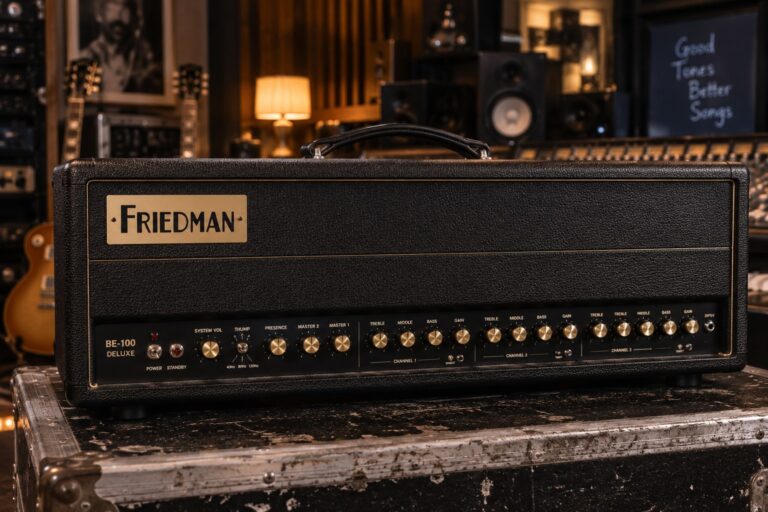
The Friedman BE-100 Deluxe shares DNA with the Dirty Shirley in terms of build quality and philosophy, but these are fundamentally different amps. The BE-100 Deluxe is a three-channel, EL34-powered, 100-watt monster built for high-gain modern rock. The Dirty Shirley is a single-channel, 5881-powered, 40-watt vintage machine. If you’re primarily playing Metallica, Foo Fighters, or Tool-style heavy rock, the BE-100 Deluxe wins. If you’re playing Led Zeppelin, ZZ Top, early Van Halen, or blues rock with a broad dynamic range, the Dirty Shirley is the more appropriate tool — and at $2,699.99 vs $3,999.99, it’s also the more affordable Friedman option.
vs. Friedman Runt 20
The Friedman Runt 20 is a different proposition: a lower-powered, more affordable entry into the Friedman ecosystem, with its own character. The Dirty Shirley is considerably more powerful (40W vs 20W), features a different tube complement, and delivers a more specifically vintage-voiced character. The Runt 20 skews toward the higher-gain Friedman signature; the Dirty Shirley is definitively the vintage-flavored option in the lineup.
vs. Friedman Pink Taco V2
The Friedman Pink Taco V2, inspired by Dave Friedman’s work with Steve Stevens, has more in common with the BE channel voicing. It’s EL84-powered, which gives it a very different character — chimey, articulate, with a British bite that leans more Vox than Marshall. The Dirty Shirley’s 5881 tubes produce a warmer, fatter sound. They’re complementary amps for different sonic needs rather than direct competitors within the Friedman range.
vs. Marshall JTM45 Reissue
The amp the Dirty Shirley is spiritually descended from. A Marshall JTM45 reissue delivers the original circuit at considerably lower cost (typically $1,000–$1,500 used), but what Friedman adds is significant: better build quality consistency, modern reliability for touring use, the three-position gain switch for additional versatility, the series effects loop, and the hand-wired construction that gives every component room to breathe. The DS-40 sounds like what a JTM45 might have been if Marshall had continued refining it for another twenty years — same bloodline, meaningfully evolved.
vs. Bogner Ecstasy 101B
The Bogner Ecstasy offers more tonal range (three full channels, extensive switching) but at a higher price and with a more complex interface. The Dirty Shirley’s appeal is partly its simplicity — one channel, a handful of knobs, maximum focus. Players who want a deep feature set should look at the Bogner; players who want a pure, focused vintage tone machine should look here.
Buying Guide
New vs. Used
The Dirty Shirley 40 Head lists at $2,699.99 new. Used examples appear on Reverb in the $1,400–$1,800 range depending on condition and year. Older units (pre-2014) will differ in one important respect: they lacked an effects loop and gain structure switch. If you rely on modulation pedals in a loop, or want the gain switch flexibility, target the current-production version or post-2014 models. The core circuit hasn’t changed fundamentally across generations.
Head vs. Combo
The 1×12 combo version ($2,899.99) is a popular choice for players who gig regularly but don’t want to haul a separate cab. The internal speaker in Friedman’s combo configuration is well-matched to the DS-40 circuit. However, head-plus-cabinet configurations allow you to swap speakers and experiment with different cab voicings — a meaningful advantage if you’re dialing in a specific reference tone. For home and studio use, the combo is often the more practical choice.
Which Cabinet Pairs Best?
The Dirty Shirley’s 5881 tube complement and vintage voicing respond beautifully to a range of cabinets. Celestion Greenbacks (25W rating, characteristically warm and “British”) are a natural pairing — they reinforce the amp’s warmth without hardening the high end. A 2×12 with Greenbacks is arguably the ideal match for playing environments where a 4×12 is impractical. Vintage 30s work well for players who want more upper-mid presence and projection in a live mix. G12H speakers bring a focused, darker character that works especially well for classic rock and blues applications. Avoid particularly bright speakers (the G12T-75 in a sealed cab, for instance) — they can push the DS-40’s high end into territory it wasn’t designed for.
Pedals and the Dirty Shirley
The DS-40 takes pedals brilliantly. The high-input-impedance design means fuzz pedals, wah pedals, and vintage-style overdrives all respond naturally. Light touch-sensitive overdrives (a Klon-style circuit, an EP Booster, or a mild Tube Screamer) in front of the amp push it into sweet harmonic saturation without muddying the low end. Modulation (phaser, flanger, tremolo, chorus) works best in the effects loop, where the amp’s transparency preserves the original effect character. Time-based effects (delay, reverb) are traditional loop assignments that work cleanly here.
Ownership Notes: What to Expect Over Time
Hand-wired amps require periodic maintenance. The 5881 power tubes in the DS-40 have a finite lifespan — most players report retubing every 1–2 years under regular gigging conditions, or every 3–5 years in a studio-only context. When retubing, the amp requires biasing (check your Friedman documentation or consult a qualified technician; incorrect bias will shorten tube life and affect tone). A matched pair of JJ Electronics 5881s or Tung-Sol 5881s are the most commonly recommended replacements and are widely available.
The Baltic birch cabinet construction is robust and designed for road use, but like any wood cabinet, it responds to extreme humidity changes. Standard protective measures apply: cover the cab when not in use, avoid storing it in environments with extreme temperature or moisture swings. The black Tolex covering is durable; touch-ups are straightforward if the corners take damage from regular transport.
Early used examples (pre-2014) should be inspected for cold solder joints on the board — not because the original construction was poor, but because any hand-wired amp that’s been gigged extensively will benefit from a fresh inspection every decade. Most Friedman dealers and qualified technicians can perform a health check for a reasonable fee.
On the question of long-term value: the Dirty Shirley holds its used value exceptionally well. Unlike mass-produced amps that lose significant value at the dealership door, boutique hand-wired instruments — particularly from respected builders like Friedman — tend to depreciate modestly and then stabilize. Older DS-40 units from 2013–2016 now regularly sell used at 60–70% of their original purchase price. If you maintain the amp properly, it’s an instrument that retains meaningful resale value.
FAQ
What tubes does the Friedman Dirty Shirley 40 use?
Two 5881 power tubes (a military-spec 6L6 variant) and three 12AX7 preamp tubes. The 5881 designation is essentially interchangeable with 6L6GC in this circuit; popular replacement options include JJ Electronics 5881, Tung-Sol 5881, and standard 6L6GC tubes from Electro-Harmonix or Sovtek. Always re-bias after replacing power tubes.
Is the Dirty Shirley 40 based on a JTM45?
Dave Friedman describes it as “loosely based on a JTM45 platform” — his words in the original 2010 Premier Guitar coverage. The fundamental topology (cathode-biased preamp feel, 5881/6L6 power stage, British EQ stack) draws from the JTM45 lineage, but Friedman adds a Gain control, Master Volume, three-position gain structure switch, effects loop, and his own transformer and component selections. The result has JTM45 DNA without being a straight clone.
How does the three-position gain structure switch work?
Position 1 (low gain) delivers the most vintage, open, clean-breakup character — closest to an original JTM45. Position 2 (middle) is the sweet spot for most classic rock and blues-rock players; it adds compression and harmonic saturation while keeping excellent touch response. Position 3 (high gain) introduces additional preamp gain for crunchier rhythm tones without requiring extra boost pedals. All three positions retain the amp’s fundamental character; they simply alter the gain architecture of the preamp stage.
Does the Dirty Shirley 40 have an effects loop?
Yes — the current DS-40 features an ultra-transparent series effects loop. Note that the original 2010 version (as documented at the LA Amp Show) had no effects loop. The loop was added in a later revision, and all current-production and post-2014 used units include it. If you’re buying used, verify the presence of the loop jack on the rear panel before purchasing.
What’s the difference between the Dirty Shirley 40 Head and the Dirty Shirley Mini?
The Dirty Shirley Mini (introduced later) is a compact, lower-wattage version designed for home use and small gig environments. It uses a different circuit configuration and different tube complement. The DS-40 Head is the full-size, 40-watt, hand-wired flagship — built to professional touring standards with the full original circuit. Most players choosing between them should consider the DS-40 if they gig regularly; the Mini if they primarily play at home or in recording contexts.
What cabinet works best with the Dirty Shirley 40?
There’s no single correct answer, but the most widely praised pairing is a 2×12 or 4×12 loaded with Celestion Greenbacks. Greenbacks complement the 5881 tube voicing with warmth and dimension. For players who want more projection and upper-mid presence in a live mix, Vintage 30s are a popular alternative. The Friedman 2×12 cabinet, loaded with a mix of G12H and G12V speakers, is the builder’s own recommendation and a natural starting point.
Is the Dirty Shirley 40 loud enough for live performance?
Yes — 40 watts through an efficient 4×12 or even a good 2×12 is more than sufficient for the vast majority of live situations, including open stages and medium-sized venues. Many experienced players argue that 40 watts represents the ideal power rating for tonal purposes: enough headroom for clean tones, enough working range in the preamp to get meaningful breakup without needing room-destroying master volumes. In very large venues without full PA support, a 100-watt head would provide additional headroom; for typical live work, the DS-40 covers the territory convincingly.
Why doesn’t the Dirty Shirley 40 have multiple channels?
By design. Dave Friedman built the Dirty Shirley as a single-channel purist instrument. The amp is intended to be controlled dynamically — via your guitar’s volume knob, via the gain structure switch, and via your picking attack. Many players who gravitate to the DS-40 specifically want to avoid channel switching, finding it interrupts their relationship with the instrument. If you need multiple distinct channels with channel-switching capability, Friedman’s BE-100 Deluxe or similar multi-channel designs are the appropriate tools. The Dirty Shirley is for players who want one great voice, deeply interactive with their technique.
Image credits
- Jimmy Page: Avda, Wikimedia Commons, CC BY-SA 3.0.
- Steve Stevens: Stefan Brending (2eight), Wikimedia Commons, CC BY-SA 4.0.
- Friedman BE-100 Deluxe: GuitarGangsters AI-generated reference illustration, not a photograph.
Latest News
Related
On This Day
Monday 9 November
From this week: