The Boutique Amp That Out-Voxed Vox: Morgan AC20 Deluxe
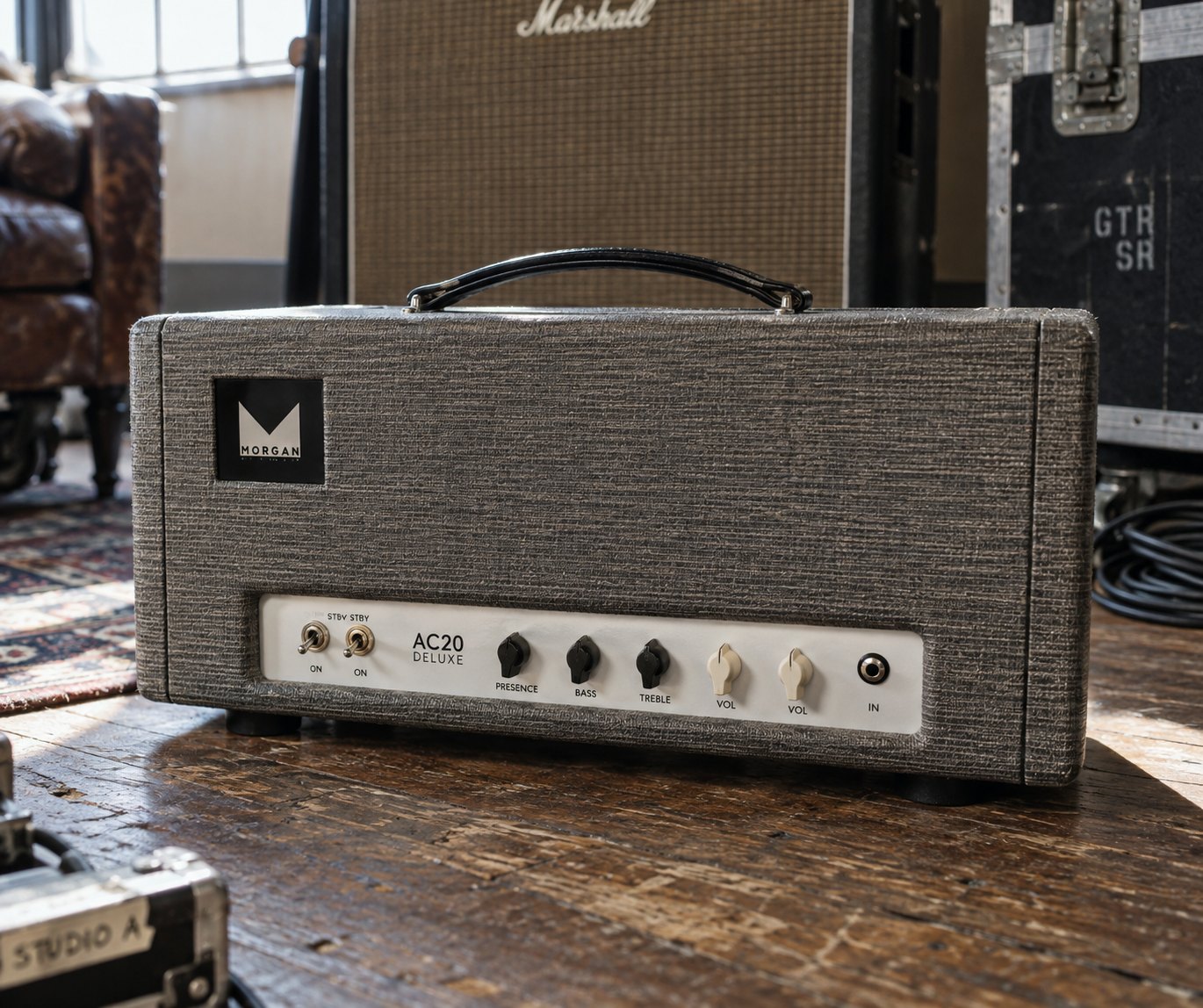
Morgan AC20 Deluxe Head. AI-generated reference illustration, not a photograph.
The discontinued Morgan AC20 Deluxe is a hand-wired EL84 combo with EF86 voicing, power scaling, and a darker Vox character. Here's the full buying guide.
Every guitarist who has ever pulled the top off an AC30 knows the deal. You get that beautiful, chiming, compressed EL84 voice — and then, somewhere around noon on the volume dial, a bright spike that sounds like someone pressing a razor blade against your ear canal. It’s not a design flaw, exactly. It’s what a 1960s British amp sounds like when you push it hard in a well-lit studio at eleven o’clock at night when nobody’s told the engineer to back off the top end. Vox calls it “presence.” Boutique builders call it a problem to solve.
Joe Morgan called it an opportunity. Around 1996, Morgan — a man whose day job had previously involved engineering the first GPS satellites — started building and modifying tube amplifiers out of sheer conviction that the classic British EL84 circuit could be improved without ruining what made it great. The result, after years of refinement, was the Morgan AC20 Deluxe: a hand-wired, USA-built, 20-watt 1×12 combo that took the Normal channel of an AC30, darkened it deliberately, added a switchable EF86 preamp tube, bolted in a variable power level control, and shipped it to a roster of Nashville touring guitarists and indie rock players who quietly used it to make some of the most convincing British-flavored clean tones of the 2010s.
It is now discontinued. That matters less than it sounds. The used market has plenty of them, the circuit is well-documented, and Fractal Audio built it into the Axe-Fx II as one of Cliff Chase’s personal favourite Class A models. This is a guide to understanding exactly what the AC20 Deluxe was, what it does that its competitors don’t, and how to buy one intelligently in 2024 and beyond.
Joe Morgan: From GPS Satellites to Hand-Wired Tube Amps
The biographical detail about GPS satellites is not a marketing stunt. Joe Morgan was genuinely part of the engineering team that developed the first GPS satellite systems before he pivoted to building guitar amplifiers full-time. He started building, modifying, and repairing amps in 1996, and Morgan Amplification — based in the United States — grew from that into a respected boutique brand whose products appear in stadiums, arenas, and recording sessions worldwide. Morgan describes his approach simply: “Joe designs for the working musician, whether that means a Sunday morning church gig or touring the world with James Taylor.”
The practical consequences of a rocket-science background show up in the AC20 Deluxe’s engineering. Morgan’s Power Level control, for instance, is not a master volume. It is conceptually closer to what other builders call power scaling — a system that limits the maximum output the power tubes can produce rather than choking the signal after it leaves them. The difference, audibly, is significant. A traditional master volume is, as Morgan puts it, “a spigot on a garden hose” — it restricts the flow but changes the character. The Power Level control behaves like a zoom lens: it limits the output window from one quarter of a watt to twenty watts without altering the relationship between the preamp and power section, which means your pedals interact with the amp the same way at bedroom volumes as they do at stage volumes. That is not a small engineering achievement, and Morgan has shipped it as a standard feature since the AC20 Deluxe launched.
The other detail worth flagging is Morgan’s attitude toward components. Custom-designed transformers are standard across the Morgan range, and every amp ships with a limited lifetime warranty. At a time when boutique builders routinely charge for entry-level print-and-solder boards, Morgan hand-wires every amp in the United States — and prices accordingly, which is why the AC20 Deluxe landed in the $1,500–$1,800 range during its production life and why comparable hand-wired British-voiced boutique combos still cost around $1,800–$2,000 today.
What Exactly Is the Morgan AC20 Deluxe?
The AC20 Deluxe starts from the Normal channel of a Vox AC30 — not the Brilliant channel, not a guess at what the whole amp sounds like, but specifically the bass-heavy, warmer, less aggressive of the two input channels that Vox shipped on every AC30 from the early 1960s onward. Morgan then voiced it “a bit darker,” in the words of his own product description, to eliminate the high-frequency spike that makes full-volume AC30s difficult to use in a band mix without running a Cut pedal or wrestling with the cab mic position.
The result is an EL84-based Class A circuit that delivers all of the compression, harmonic complexity, and pick-attack sensitivity of the classic British sound without the frequency spike that makes an AC30 unusable at gigging volumes unless you know exactly how to manage it. Guitar.com’s Darran Charles describes the sonic territory well: “intimate and small in a good way” — meaning the AC20 Deluxe occupies the same emotional register as a Vox but never bites you.
The circuit has no traditional tone stack. There is no Bass knob, no Middle, no Treble. The only controls on a standard AC20 Deluxe are Volume, three voicing switches (Normal, Brilliant, EF86), a Global Cut control (which attenuates high frequencies from the power section itself — essentially the equivalent of the “Cut” knob on the original AC30 Top Boost, but applied at the power stage rather than the preamp), and the Power Level control. That minimalism is intentional. Without a passive tone stack absorbing signal, the amp runs hotter and more directly into the output section — which is a large part of why the touch sensitivity is exceptional and why the amp plays so well with pedals.
The Three Switches — Normal, Brilliant, and EF86
The three voicing switches on the AC20 Deluxe are the heart of the instrument, and understanding them is the key to getting the most from the amp or evaluating a used unit intelligently.
The Normal switch engages the standard EL84 voicing — full-bodied, bass-present, the sound closest to the AC30 Normal channel. This is where the amp sounds warmest and most compressed, and where the EL84 output section’s characteristic bloom under pick attack is most audible. With a Stratocaster or a Telecaster, the Normal position is where the amp sits closest to the jangly chime of early 1960s British pop; with a Les Paul or a P-90-equipped semi-hollow, it pushes into a thicker, more compressed voice that starts to approach the territory of a pushed Matchless DC30.
The Brilliant switch cuts bass — similar in function to the Brilliant input on the original AC30, which sacrificed low-end weight for treble presence. With the Brilliant switch engaged, the AC20 Deluxe gains articulation and high-frequency clarity while shedding some of its low-mid fullness. This is the setting for players who need cut in a busy band mix, for single-coil guitars that already have plenty of low-mid content from the room, or for pedal overdrives that tend to pile up low-end mud through the Normal position.
The EF86 switch is the genuinely unusual feature. In its standard configuration, the AC20 Deluxe uses a 12AX7 as the preamp tube — producing the glassy, sparkling Vox character most players associate with Class A EL84 amps. Flipping to EF86 substitutes a pentode preamp tube, which behaves fundamentally differently from a triode. The EF86 is fuller-bodied and fatter in the midrange; it has more inherent gain available as the drive increases; and it produces a different harmonic character under compression — rounder, with more of a push in the lower midrange and less of the glittery top-end shine that defines the 12AX7 position. The Fractal Audio write-up on the AC20 model notes the practical consequence: “Some players use the EF86 setting with single-coil pickups and the 12AX7 setting with humbuckers, for matched response and output.” The logic is that single coils already have natural treble and sparkle, so the EF86 adds body without becoming harsh; humbuckers already have body and warmth, so the 12AX7 adds clarity without becoming muddy.
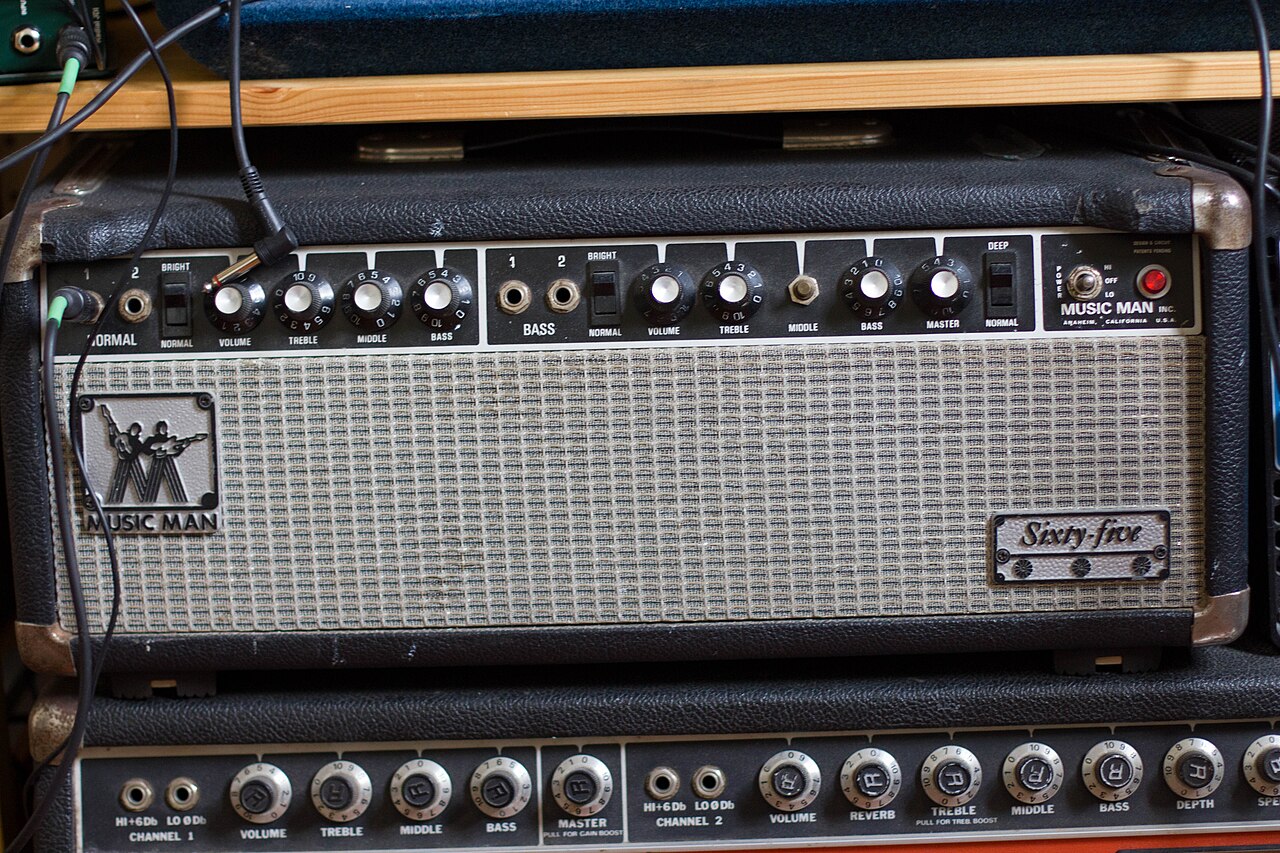
Cliff Chase at Fractal Audio, whose team physically measured and modeled the AC20 Deluxe for the Axe-Fx II, described it as his personal favourite Class A amp model in the Fractal library — a strong endorsement from someone who has modeled most of the boutique amp world.
Full Specifications — Morgan AC20 Deluxe
Two notes on the spec table. First, the Celestion G12H75 Creamback is a 75W speaker, which means the cabinet is over-specified by 55W relative to the amp’s maximum output — a deliberate engineering choice that keeps the speaker clean and tonally neutral even when the amp is pushed, rather than adding speaker distortion to the mix. Players who want to introduce speaker breakup have been known to swap in a Celestion Blue (rated 15W, AlNiCo magnet) or a Celestion Gold (50W), and used AC20 Deluxe combos occasionally appear on the market with these speaker upgrades already installed. Second, the 24-inch-wide combo cabinet is noticeably larger than the 20-inch cabinet used on the current non-Deluxe AC20 — relevant if you’re buying used and comparing listings by size.
Famous Players — Who Actually Used the AC20 Deluxe
The AC20 Deluxe roster, as documented on Morgan’s own artist page (last updated 2026), is almost entirely Nashville country touring guitarists and indie rock players — which tells you something important about who found this amp useful in the real world. This is not a stadium rock amp, not a heavy-gain instrument, and not the amp whose headstock logo ends up in the guitar press. It is the amp that session and touring professionals in specific contexts — clean-to-crunch country, indie alt-rock, worship music — found irreplaceable once they plugged in.
The most recognizable name on the Morgan AC20 Deluxe artist roster is Jeff Tweedy, the songwriter and guitarist of Wilco (and bandmate of Nels Cline). Tweedy’s connection to the Morgan is brand-confirmed via Morgan’s own artist page and a 2014 Twitter post from Morgan Amplification: “Jeff Tweedy started his new solo tour with an AC20, AC40 and Abbey.” He’s listed on the Morgan site as an AC20 Deluxe and AC40 Deluxe user alongside Morgan’s 112 and 212 speaker cabinets — making him a consistent Morgan player across multiple amplifier formats. Tweedy’s use of the amp aligns with what the AC20 Deluxe does well: articulate, detailed clean tones with enough headroom for a full touring rig, and a compressed harmonic character that flatters his fingerpicked and strummed Americana approach without adding artificial sparkle. It should be said that this documentation comes from Morgan’s own platform and a brand social media post, not from a Rig Rundown or third-party deep-dive — but for a low-profile boutique brand, that is the strongest form of evidence that typically exists.
The country touring contingent on the AC20 Deluxe roster is substantial. Dave Levita used the amp as the lead-guitar guitarist in Tim McGraw’s band. Andy Davis had it onstage with The Band Perry. Kevin Arrowsmith ran it in Luke Bryan’s touring setup. Evan Milby used it on the road with Lauren Alaina. These aren’t session cats playing it once in a demo video — these are guitarists with multiple touring album cycles behind them who chose the AC20 Deluxe as a primary amp in high-volume, high-stakes country touring contexts. The amp’s defined low-mid balance (darker than a Vox but not soft) and its consistency across Power Level settings make it a logical choice for players who need the same tone at soundcheck at 9 AM and during the headline set at 11 PM.
Kirk Fletcher, the California blues guitarist known for his work with the Fabulous Thunderbirds and an extensive solo career, demoed the AC20 Deluxe at the 2011 LA Amp Show — captured on camera by Premier Guitar. Fletcher’s playing on that demo is worth tracking down: his single-note blues lines through the EF86 position demonstrate exactly how the pentode preamp adds body and midrange authority to an otherwise glassy Class A circuit.
Dustin Lynch, the country artist who appears on the Morgan roster in his own right rather than as a guitarist-for-hire, also used the AC20 Deluxe during the amp’s production life. Matt Kearney, the singer-songwriter based between Nashville and Los Angeles, is another Morgan artist page entry. The pattern — creative artists in folk-adjacent, country-adjacent, and indie-adjacent genres — is consistent. This is an amp that rewards players who listen carefully to how the strings speak through it rather than players who are primarily focused on adding distortion.
One honest acknowledgement: unlike the Tommy Emmanuel / Maton EBG808TE situation where an artist’s own website confirms the SKU, or the Guthrie Govan / Victory Countess MKII where the manufacturer’s artist page explicitly describes a design collaboration, the Jeff Tweedy documentation here is a social media post from the brand and an artist page entry. It is the best documentation available for this brand at this level, and it is consistent across sources — but readers should be aware that for indie-tier artists on boutique amp rosters, the documentation chain is rarely longer than this.
How the Morgan AC20 Deluxe Sounds — The Tone Blueprint
The AC20 Deluxe occupies a specific sonic register that is worth mapping carefully before discussing individual settings. In frequency terms, the amp is voiced to emphasize the 500Hz–4kHz range — the midrange and upper midrange where guitar is most audible in a band mix — while deliberately softening the 6–8kHz presence peak that makes a bright Vox AC30 sound shrill. The low end is generous in the Normal position and trimmed in the Brilliant position; in neither case does it extend deep below 100Hz the way a British push-pull output stage might. This is a Class A amp with a Class A bass response: present, rounded, and contributing to the overall warmth rather than anchoring the low end of the mix.
Touch sensitivity is exceptional. The EL84 output section, running in Class A, is operating in a region of its transfer characteristic where small changes in input signal produce large changes in output signal — meaning the amp responds to pick angle, pick weight, and picking position in ways that solid-state and Class AB tube amps typically do not. The Morgan’s lack of a tone stack means there is no passive network between the preamp and the power section absorbing this information, so every nuance of the player’s attack arrives at the output stage intact. At lower Power Level settings, the output tubes are working harder relative to their available headroom, which compresses these dynamics further — giving the amp a thick, sustaining quality at low volumes that players associate with a pushed AC30 but at volumes where you can actually have a conversation.
The pedal response is a particular strength. Morgan designed the AC20 explicitly as a pedal platform — the absence of a tone stack means that drive pedals, overdrives, and modulation effects see a high-impedance, mostly-flat input rather than a loaded tone network, which makes them behave more consistently and more musically. Where a Tube Screamer into the front of an already-mid-heavy tone stack produces a congested, honky overdrive, a Tube Screamer into the AC20 Deluxe produces a controlled midrange push that sits cleanly in a band mix. It is the difference between adding and stacking.
Five Tone Recipes
1. Clean Chime (Early 60s British Pop)
Switch: Normal / 12AX7. Volume: 12 o’clock. Power Level: 7–8 (roughly 10–12 watts). Global Cut: 9 o’clock. Guitar: Fender Stratocaster, bridge or middle pickup. This is where the amp sounds most like a cleaned-up AC30 Normal channel — compressed, chimey, with individual string notes sitting cleanly in the decay. Suitable for jangly pop, clean picking parts, and fingerstyle passages where each note needs space. Think early Wilco, early R.E.M., and the fingerpicked solo sections of The Edge‘s approach to atmospheric clean parts. No pedals needed; let the amp breathe.
2. Nashville Clean (Session Tone)
Switch: Brilliant / 12AX7. Volume: 1 o’clock. Power Level: full 20 watts. Global Cut: 10 o’clock. Guitar: Telecaster, bridge pickup. The Brilliant switch trims the low end and pushes articulation — this is what makes the amp work in a band context with a bassist and a drummer at stage volume. Individual note attack is clear without being harsh, and the treble content cuts through a mix without the “icepick” bite of a full-brightness Vox AC30. This setting is how Nashville touring guitarists with Tim McGraw or Luke Bryan would have used this amp as a clean foundation for a pedalboard-driven set, with overdrives and delays stacked in front.
3. EF86 Blues Push
Switch: Normal / EF86. Volume: 1–2 o’clock. Power Level: 6–7 (roughly 8–10 watts). Global Cut: 9–10 o’clock. Guitar: Gibson Les Paul or P-90-equipped instrument. The EF86 preamp adds lower-midrange body and increases gain availability — at this setting the amp produces a warm, pushed overdrive that is rounder and more vocal than the 12AX7 position. With a Les Paul, the combination of the guitar’s natural midrange and the EF86’s fullness produces a sound that lives somewhere between a pushed AC15 and a Matchless DC30. The compression increases noticeably as the pick attack gets harder, giving the notes a satisfying bloom. An Ibanez TS9 in front with the tone at 9 o’clock and gain minimal pushes the front end without adding treble edge.
4. Indie Jangle (Post-Punk Clean)
Switch: Brilliant / 12AX7. Volume: 11 o’clock. Power Level: full. Global Cut: 12 o’clock. Guitar: Stratocaster, neck pickup, tone rolled back to 7. This is the setting where the AC20 Deluxe sounds most like a Vox AC15 in the hands of players like Johnny Marr or John Frusciante — arpeggiated chords with long decay, string harmonics that sit in the upper midrange, and a pick attack that comes through without hardness. Add a chorus pedal in front of the amp (set low) and a large ambient reverb in the effects loop if the amp is equipped with one; otherwise use a reverb pedal in front.
5. Full-Power Push (Late-Night Studio Crunch)
Switch: EF86. Volume: 2 o’clock (full). Power Level: full 20 watts. Global Cut: 9 o’clock. Guitar: Les Paul, both pickups, tone at 10. At full power and volume, with the EF86 engaged, the AC20 Deluxe is the loudest and most aggressive it gets — which is still not a high-gain amp by any modern standard, but produces a lively, harmonically complex pushed crunch that the 12AX7 position cannot match. This is the setting that gave Kirk Fletcher’s LA Amp Show demo its authority: bluesy, articulate, with individual note character even in fast single-note passages. At full output the amp is genuinely loud — equivalent to a pushed AC15 or a Fender Deluxe Reverb near its breakup point — and should be used at this setting only with proper monitoring or in a room that can handle it.
How It Compares
Vox AC30C2 (approx. $1,200 new)
The AC30C2 is the amp the AC20 Deluxe was designed to improve upon, which makes the comparison both obvious and instructive. The AC30 has two channels, twice the wattage, and a genuinely iconic legacy in British pop and rock history — from the records of Pete Townshend to the stages of Noel Gallagher. What it does not have is the Morgan’s controllable Power Level, its EF86 voicing option, or its deliberately darkened high-frequency response. At stage volumes, an AC30C2 pushed hard into its Top Boost channel is a challenging amp to work with in a band mix; the frequency spike at 6–8kHz can be aggressive and requires careful management through speaker placement and microphone positioning. The AC20 Deluxe solves this by design. For players who want the AC30’s essential character without its rough edges — and who are willing to pay more for a hand-wired USA-built version of a British-derived circuit — the Morgan is the better amp. For players who want the AC30 specifically, including its history, its two-channel versatility, and its 30W headroom, the Vox remains the reference.
Vox AC15C1 (approx. $750 new)
The AC15 is the more affordable, more tractable half-scale version of the same circuit: 15W, single channel, single 12″ Greenback speaker, no power scaling. Where the AC20 Deluxe adds EF86 voicing and variable power, the AC15 gives you a warm, compressed Class A tone in a smaller package for significantly less money. The AC15 breaks up earlier (15W into a 25W speaker is closer to its limit than 20W into a 75W speaker), which some players prefer. The AC20 Deluxe is the better engineering achievement and the better gigging tool; the AC15C1 is the more affordable gateway into the same tonal territory.
Victory V40 The Duchess (full guide here)
The Victory V40 Duchess is the closest modern analog to what the AC20 Deluxe does, and is still in production at around $1,099 (head) or $1,849 (combo). Like the Morgan, it is a clean pedal platform designed around British-voiced voicing with power scaling; unlike the Morgan, it has two voice modes (American and British) switchable on the front panel, built-in digital reverb, and a footswitchable design that the AC20 Deluxe never offered. The Duchess is the more practical amp for a working gigging guitarist who needs controllable reverb and channel switching without a separate unit. The AC20 Deluxe, for players who have found one used, has a more specific, more fully realized Vox-adjacent character and the EF86 option that the Duchess doesn’t offer.
Fender Deluxe Reverb (approx. $1,400 new)
The Deluxe Reverb is the American equivalent of the boutique clean-platform conversation: 22W, 12AX7 preamp, 6V6 output, two channels, spring reverb and tremolo onboard. Where the Morgan sounds British — compressed, harmonically dense, midrange-forward — the Fender sounds American: open, airy, with more clean headroom and a scooped midrange that sits differently in a mix. Both amps love pedals. The Fender’s spring reverb is genuinely useful; the Morgan’s absence of reverb forces the player to bring it externally. For players who already own a reverb pedal and prioritize the specific harmonic character of EL84 compression, the Morgan is the more distinctive choice. For players who want one amp with a complete sound, the Deluxe Reverb is the more complete package.
Current Morgan AC20 vs. AC20 Deluxe
The current Morgan AC20 Combo ($1,899.99 new) is a simplified version of the same essential circuit. It uses 2× EL84 and 2× 12AX7 (no EF86 option), replaces the three-position Normal/Brilliant/EF86 voicing system with a single Bright switch and a Bass Cut switch, and sits in a 20-inch-wide cabinet rather than the Deluxe’s 24-inch cab. The Power Level control and Global Cut carry over. Joe Morgan confirmed via Facebook that the regular AC20 “far outsold” the Deluxe because most players didn’t need the EF86 complexity: “If you don’t need the EF86, the regular AC20 is an awesome amp and you can save a good amount of money.” The Dual 20 (head, $1,999.99) goes the other direction — two complete AC20 channels with full independent voicing on each. The AC20 Deluxe sits between these two current products: more versatile than the simplified AC20, less elaborate than the Dual 20, and available only on the used market.
Buying Guide — Navigating a Discontinued Boutique Amp
The Morgan AC20 Deluxe was discontinued some time in the early-to-mid 2010s when demand consolidated around the simpler AC20. Used examples appear regularly on Reverb and Sweetwater’s used marketplace. Pricing typically runs $700–$1,200 for a combo in good condition, depending on finish and speaker configuration; AC20 Deluxe head units (which were also produced) tend to run slightly less, at $600–$950, since they require a separate cabinet. Speaker upgrades (Celestion Blue, Celestion Gold, WGS speakers) on used units can raise prices toward the higher end of these ranges. Budget another $100–$200 for any speaker upgrade you’d want to make if the listed unit still has the stock Creamback.
When evaluating a used AC20 Deluxe, the following checks matter. First, confirm the EF86 tube is present and functional: it is a pentode tube that some owners have removed or replaced with a 12AX7 adapter when the original EF86 became noisy, and while the amp still works in this configuration, you lose the entire EF86 voicing option that distinguishes the Deluxe from the standard AC20. Ask the seller to confirm the EF86 socket has the correct tube installed and that the switch produces a noticeably different character. Second, confirm the Power Level control sweeps smoothly without crackle through its full range. The control is a critical part of the amp’s functionality and a dirty pot in this position produces noise that becomes very apparent at bedroom volumes. Third, check the speaker cone and surround for tears or deformation — Baltic birch plywood cabinets are durable, but any cab that has been through a decade-plus of touring can show speaker wear. Fourth, ask about the tube complement generally; the standard 12AX7 preamp tubes can be upgraded inexpensively, and NOS Amperex EF86 tubes (considered among the best for this application) command a premium on the used tube market but improve the EF86 position substantially.
One honesty note: Morgan’s lifetime warranty does not transfer to second owners in the way that some boutique brands’ warranties do. Confirm the warranty position with Morgan directly before purchasing used if this matters to you. The hand-wired build quality means that repairs, when needed, are straightforward for any competent tube amp technician — but out-of-warranty service on a boutique amp should be budgeted for.
Ownership Notes
The AC20 Deluxe has no reverb. This is not an oversight — it is the same design philosophy that produced the no-tone-stack circuit: keep the signal path as short and uncluttered as possible, and let the player add reverb externally where they can control its quality. The amp has no effects loop in the standard configuration, which means reverb pedals go in front of the amp. The Fractal Audio write-up notes that the amp was specifically designed so that “modulation pedals like reverb and delay sound best in front of the amp” — and in the experience of players who have used it extensively, this is accurate. A quality reverb such as a Strymon Flint or a Catalinbread Talisman in front of the amp produces results that are consistently better than running a reverb in a conventional loop because the reverb’s wet signal interacts with the preamp’s natural compression rather than being added after the fact.
Tube rolling matters on this amp more than on most. The EF86 position in particular benefits significantly from quality tubes: the stock Chinese EF86 is functional but lacks the full, round character of NOS European alternatives. Amperex (Dutch) and Mullard (UK) EF86 specimens from the 1950s–60s are the most recommended options in the Morgan community. Expect to spend $80–$150 for a good NOS EF86 — more if you find tested matched pairs. The 12AX7 positions are less critical, but a quality 12AX7A in V1 (the first gain stage) adds a perceivable improvement in harmonic complexity.
The Celestion G12H75 Creamback in the stock combo is a strong speaker — its 75W rating keeps it clean across the amp’s full power range, and its midrange character complements the AC20 Deluxe’s tonal priorities well. Players who want earlier speaker breakup or a more vintage Vox character typically swap in a Celestion Blue (AlNiCo, 15W) or a Celestion Gold (AlNiCo, 50W). The Blue produces speaker distortion at relatively low amp output levels and dramatically changes the character of the EF86 voice; the Gold offers a compromise — a warmer, rounder version of the Creamback’s response with some AlNiCo compression without the early breakup of the Blue. The stock speaker outputs include a 16Ω main output and two 8Ω secondary outputs, accommodating most external cabinet options if you’re running the head unit.
Frequently Asked Questions
Is the Morgan AC20 Deluxe still available new?
No. Morgan discontinued the AC20 Deluxe several years into its production run, replacing it with a simplified AC20 (currently $1,699.99 for the head, $1,899.99 for the combo) that drops the EF86 voicing switch, and the Dual 20 head ($1,999.99) that adds a second full independent channel. The AC20 Deluxe is available only on the used market, with pricing typically in the $700–$1,200 range for combos in good condition.
What is the EF86 tube and why does it matter?
The EF86 is a pentode preamp tube, as opposed to the triode 12AX7 that most tube amplifiers use. In a pentode preamp stage, the signal gain is higher and the harmonic character is different — rounder and more full-bodied in the midrange, with a different compression envelope under hard picking. The EF86 preamp position on the AC20 Deluxe essentially adds a second distinct preamp character to what would otherwise be a single-voiced amp, broadening the tonal range significantly without adding tone controls.
Does the Morgan AC20 Deluxe have reverb or an effects loop?
No to both, in the standard configuration. Morgan designed the amp around the philosophy that reverb and modulation effects belong in front of the amp, where they interact with the preamp’s natural compression. Players who require reverb should use a pedal in front of the amp; the Fractal Audio community and Morgan users generally report that quality reverb pedals interact unusually well with the AC20 Deluxe’s front end.
How loud is 20 watts of Class A EL84 power?
Louder than you expect. Class A tube watts are not louder than Class AB watts in terms of physics, but EL84 output sections have a soft compression character that makes them feel efficient — the amp cuts through a mix at volumes where a comparably powered Class AB amp might feel thinner. With the Power Level at full and a sensitive 1×12 cabinet, 20W of EL84 power is comfortably loud enough for small-to-medium venue gigging with drums. The Power Level control’s ability to scale down to ¼W makes the same amp practical for home recording.
What is the Global Cut control?
The Global Cut is a high-frequency attenuation control that acts on the output from the power section rather than the preamp. It is equivalent to the “Cut” knob on a Vox AC30 Top Boost — rotating clockwise removes treble from the output stage, controlling the high-frequency response of the overall amp at the power-stage level rather than through a passive tone stack. Fractal Audio’s Cliff Chase noted: “As with the real amp I dial in quite a bit of Hi-Cut” — suggesting the correct approach is to start with the Global Cut moderate and reduce treble from there rather than starting at minimum cut and adding.
How does the Power Level control differ from a master volume?
A conventional master volume control is placed between the preamp and the power section — it reduces the signal going into the power tubes, which changes the way the power section behaves and, critically, changes the way pedals interact with the amp (because pedals see a lower signal level at the amp’s input rather than the power section’s operating point changing). The Morgan Power Level control functions more like power scaling — it limits the maximum output the power tubes can produce by adjusting the operating window rather than the input signal. The practical result is that the amp sounds and responds identically at ¼W as it does at 20W; the volume is lower but the character and the pedal response remain consistent.
Can I use the Morgan AC20 Deluxe as a recording amp?
It was designed with recording in mind. The Power Level control makes it possible to record at genuinely quiet volumes — ¼W through the stock Creamback is audible in a quiet room but below conversation level — while retaining the compression and harmonic character of a pushed output stage. Multiple session guitarists on the Morgan roster used the AC20 Deluxe specifically in recording contexts because of this consistency. A dynamic microphone (SM57 on the speaker cone) or a ribbon microphone (Royer 121, approximately 6 inches off-axis) are the standard starting points; the amp’s tonal character works particularly well with a ribbon’s natural high-frequency roll-off, which aligns with the already-darkened Vox voicing.
What replaced the Morgan AC20 Deluxe and should I buy that instead?
Morgan’s current range relevant to AC20 Deluxe buyers includes the simplified AC20 (same EL84 circuit, no EF86, smaller cabinet, currently in production and available new) and the Dual 20 (two full independent AC20 channels, head only, $1,999.99). If you need the EF86 voicing and the three-switch tonal range, the Deluxe is the only Morgan that has it — used market only. If you need a current-production, warranty-covered amp with the core AC20 character, the standard AC20 is the sensible choice. If you need two independent clean platforms in one head, the Dual 20 is the answer. The Victory V40 Duchess is the closest current-production competitor from a different manufacturer if you need reverb and footswitching built in.
Image credits
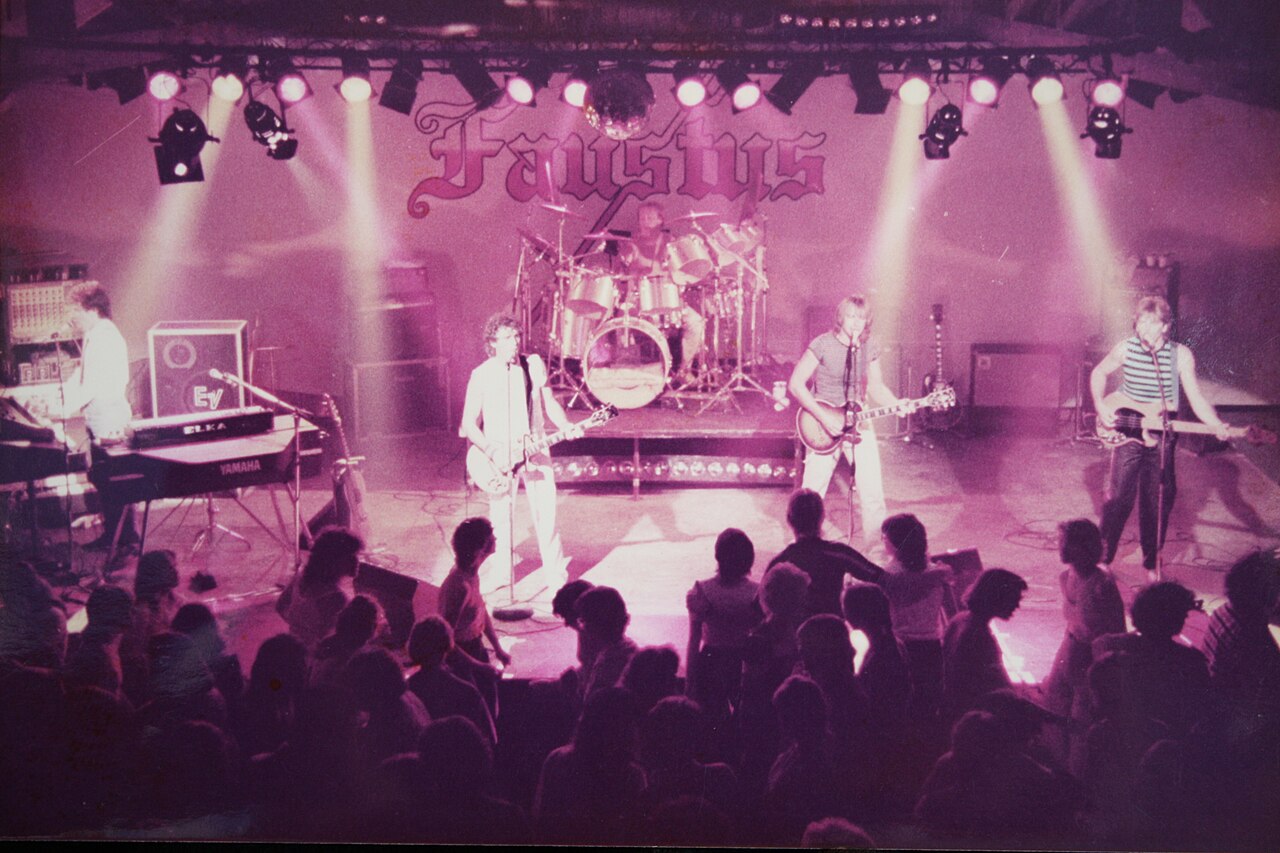
- A band on a lit stage in front of a crowd: Dhagely, Wikimedia Commons, CC BY-SA 4.0.
- A tube amp head: David Hilowitz from San Antonio, USA, Wikimedia Commons, CC BY 2.0.
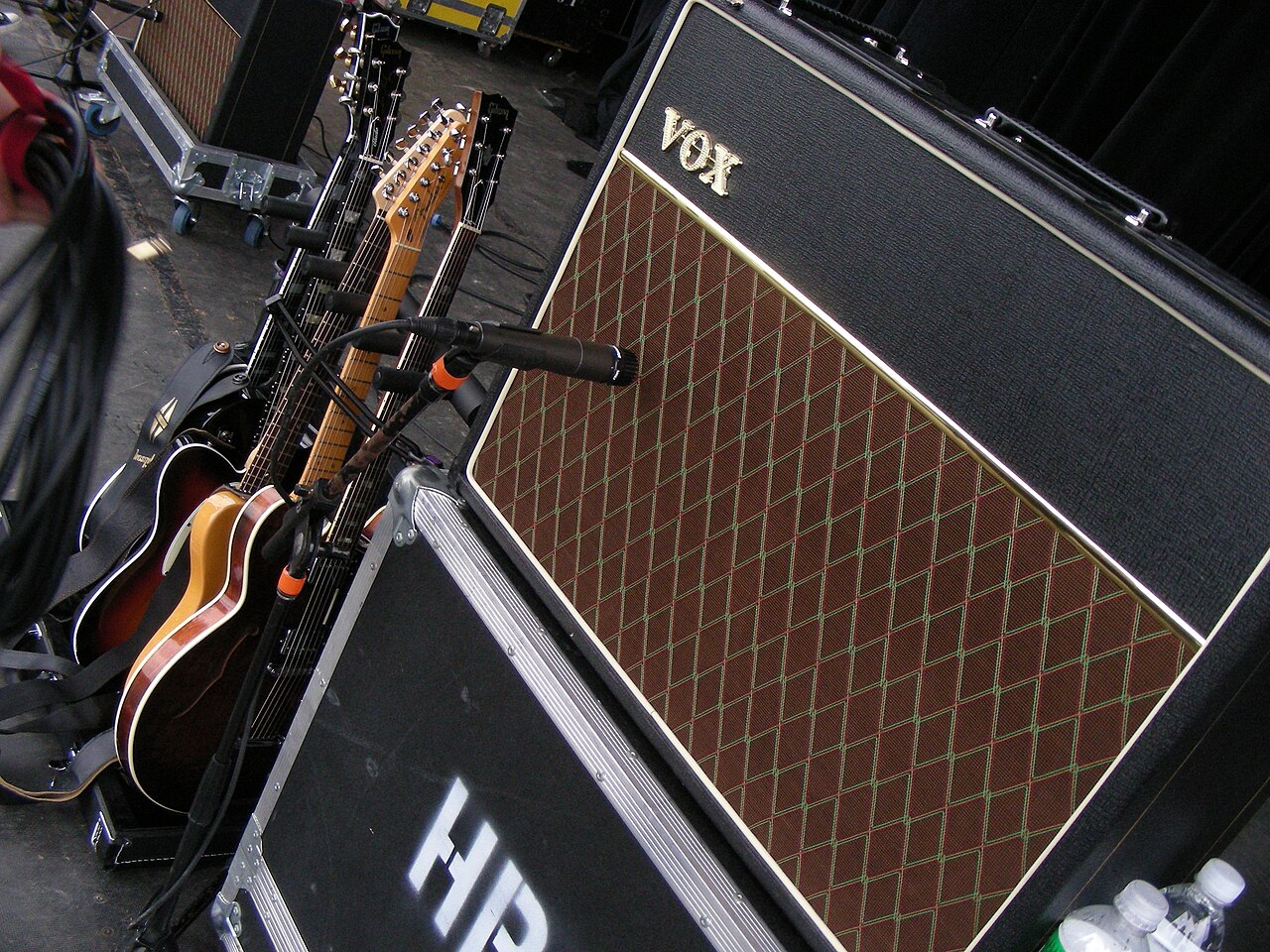
- A Vox AC30 amplifier on tour with guitars in front of it: John Athayde, Wikimedia Commons, CC BY 2.0.
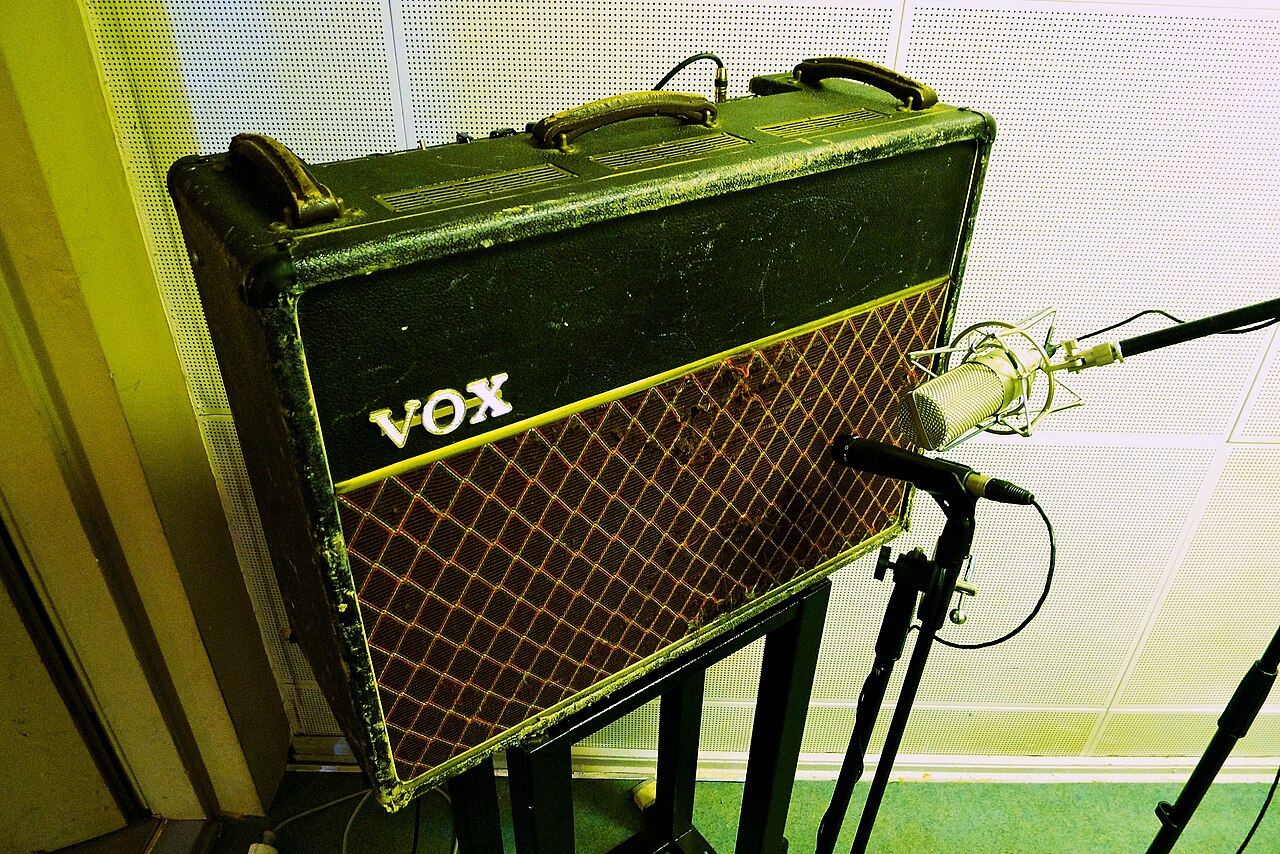
- A Vox AC30 with a ShinyBox microphone and a Shure SM57 in a studio: Marc Wathieu from Huy, Belgium, Wikimedia Commons, CC BY 2.0.
- Top image: GuitarGangsters AI-generated reference illustration, not a photograph.
Latest News
Related
On This Day
Monday 9 November
From this week: