Nine Switches to Rule Them All: How the Fractal Audio FM9 Turbo Killed the Pedalboard and Rewrote the Live Rig
The Fractal Audio FM9 Turbo packs four DSP cores, Cygnus X2 amp modeling, and 2,200+ cabs into nine footswitches. Here's what it actually does on stage.
There is a specific moment that happens to every serious guitarist who picks up the FM9 Turbo for the first time. It arrives somewhere around the third preset, when the amp feels alive under your fingers—when pick attack blooms and softens the way a pushed 6L6 does, when the reverb tail doesn’t just decay but breathes. The unit is on the floor. There’s no amp in the room. The only cables going anywhere are a guitar jack in and a pair of XLRs to the PA. And yet.
The Fractal Audio FM9 Turbo is not a multi-effects unit with amp models bolted on. It is a purpose-built live performance computer wearing a floor unit’s shoes, and the distinction matters enormously when you’re trying to understand what you’re actually buying. At $1,799.99 it costs roughly what a good American-made amplifier costs. The comparison is not accidental. Fractal Audio is specifically, deliberately, and with enormous engineering conviction making the case that you no longer need the amplifier.
Whether that argument lands for you depends on your gigs, your monitors, and your willingness to spend time in the editor. But the raw sonic capability on offer is not in dispute. Guthrie Govan—a man with access to essentially any instrument or amplifier on earth—uses an FM9 as his live rig. That fact alone warrants a closer look.

A Cliff Chase Problem: The Origins of Fractal Audio
Fractal Audio Systems was founded by Cliff Chase in Plaistow, New Hampshire, and the company’s founding logic was radically simple: why couldn’t digital audio technology model the physical behaviour of real vacuum tube circuits well enough that even professional guitarists couldn’t tell the difference in a blind test? In 2006, when the original Axe-FX Ultra shipped, most of the industry assumed the answer was “because it can’t.” Cliff Chase politely disagreed.
The Axe-FX Ultra stunned players in 2007 with amp models that responded dynamically to playing dynamics rather than producing a fixed frequency response curve. The Axe-FX II in 2011 expanded the library dramatically. The Axe-FX III in 2018 introduced a dual-DSP architecture that could run presets of a complexity no previous unit could manage. And in 2020, Firmware 12.0 for the Axe-FX III introduced Cygnus—a new modeling approach that moved beyond approximation and into component-level simulation. Every tube stage. Every transformer. Every capacitor and resistor in the signal path, modeled to behave individually and to interact with adjacent components the way they do in real circuits.
The FM3, Fractal’s first true floor unit, launched in 2019 with three footswitches. It was powerful but constrained for solo live use—three switches demand a lot of switching logic. The FM9, announced in 2021, solved the problem with nine footswitches and a more generous I/O layout. It gave touring musicians a genuinely self-contained floor unit capable of running complex presets without a separate pedalboard, a MIDI switcher, or a rack of any kind. The FM9 Turbo added a DSP boost. The FM9 Mark II Turbo, which is the current production model at $1,799.99, increased DSP headroom again to four cores—enough that many Axe-FX III presets run without compromise—and added larger mini displays with nearly twice the viewing area of the original FM9’s scribble strips.
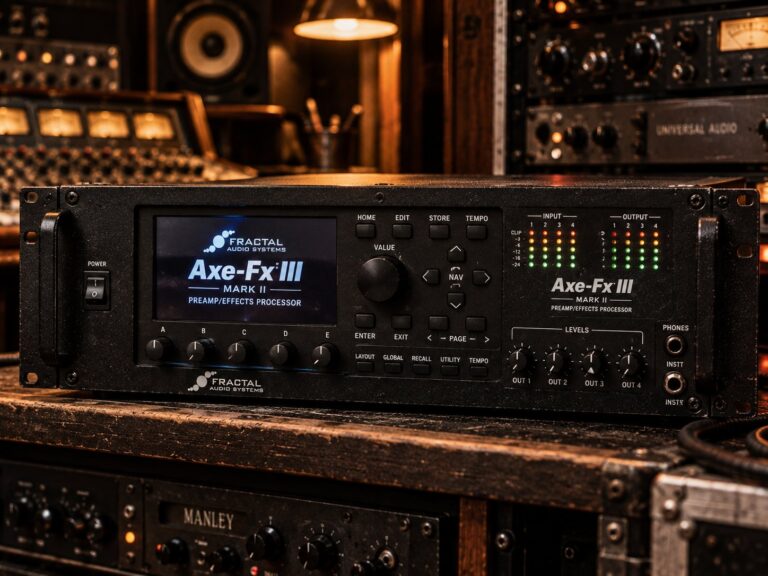
The Axe-FX III remains in the lineup as a rack preamp at $2,499.99, intended for players who want rack integration and the absolute maximum headroom. The FM9 Mark II Turbo sits below it with a different philosophy: everything the Axe-FX III does tonally, in a box you can put on the floor and carry in one hand.
Specs: What’s Actually Inside
| Feature | Detail |
|---|---|
| Current model | FM9 Mark II Turbo |
| Street price (US) | $1,799.99 (direct from Fractal Audio) |
| DSP cores | 4 (Turbo — 10%+ more than original FM9) |
| Amp modeling engine | Cygnus X2 — component-level physical modeling |
| Amp blocks | Two simultaneous amp blocks per preset |
| Speaker simulation | DynaCab™ + UltraRes™ — 2,200+ factory cabs, 1,024 user IR slots |
| Effects library | Derived from Axe-FX III — hundreds of stompbox and studio effects |
| Presets / Scenes / Channels | 512 presets / 8 scenes / 4 channels per block |
| Switching | Gapless preset and scene switching |
| Footswitches | 9 with color LED rings and large mini displays |
| Main display | Large high-contrast color display, 5 push encoders |
| Looper | Built-in (48 seconds) |
| USB audio | 8×8 audio interface + MIDI over USB |
| Inputs | Instrument in, 2 stereo inputs, 3 expression pedal inputs |
| Outputs | 3 stereo outputs with Humbuster™ technology |
| Digital I/O | S/PDIF in/out |
| MIDI | 5-pin DIN in/out/thru |
| Foot controller expansion | FC-12 or FC-6 via proprietary connector |
| Editor software | FM9-Edit (Mac/PC, free) |
| Chassis | 16-gauge steel with protective endcaps |
| Firmware updates | Free, ongoing — adds amps, effects, and features |
A few figures deserve unpacking. The Cygnus X2 engine is not a marketing name for the same underlying algorithm—it represents a genuine architectural shift from look-up tables and convolution approximations to iterative circuit simulation. When you adjust the Master volume knob on an FM9 amp model, you’re not changing a gain multiplier in a DSP chain. You’re changing the operating point of a simulated power amp stage, which in turn changes how the simulated output transformer saturates, which in turn changes the harmonic content of the signal before it hits the simulated speaker. That’s why it feels different when you dig in with a hard pick attack versus rolling off the guitar’s volume knob. The physics are being modeled, not approximated.
The Humbuster outputs deserve a mention. Most pedalboards on stage deal with ground loops at some point—those 60Hz hum artifacts that appear when your signal interacts with a lighting rig or another guitarist’s rig sharing the same power. Humbuster is Fractal’s own asymmetric cable technology that functions like a balanced output even when connected to an unbalanced input. It’s not a feature you notice until you need it, and then you notice it immediately.
The 8×8 USB interface means the FM9 is also a recording interface the moment you connect it to a computer. You can reamp through it, record wet and dry simultaneously, and edit presets in FM9-Edit at the same time. For a player who records at home and performs live, it eliminates one more box from the signal chain.
Famous Players: Honest About Who Uses What
Fractal Audio’s artist roster on fractalaudio.com includes some of the most prominent names in guitar history—Steve Vai, John Petrucci, Alex Lifeson, The Edge, John Mayer, Neal Schon, Dave Mustaine, Guthrie Govan, Tosin Abasi of Animals as Leaders, Misha Mansoor and Mark Holcomb of Periphery. But the artist page lists the Fractal ecosystem, not specific floor or rack units. The honest answer is that the majority of those flagship names use the Axe-FX III—the rack preamp—as their primary live rig. The FM9 is the floor unit, and its specific verified users are a more targeted group.
Guthrie Govan is the most prominent verified FM9 user with clear primary-source documentation. A 2022 Premier Guitar Rig Rundown with The Aristocrats (published August 11, 2022) shows Guthrie running his full live setup through an FM9. In a subsequent forum post confirmed by Fractal Audio’s admin, the distinction is laid out plainly: “Axe-Fx III in the studio, FM9 on the road.” Guthrie’s choice is philosophically significant—he told attendees at Steve Vai’s Vai Academy that the FM9 running direct through FOH was sonically indistinguishable from a traditional amp rig in a live context. The quote circulating from that session is characteristically blunt: “For anyone who thinks there’s a difference, they are wrong because there fucking isn’t one.”
Brad Whitford of Aerosmith is another FM9-specific confirmation. Fractal’s own artist page carries his direct quote: “I switched my main amp, cab, and effects over to the FM3 in rehearsals, then moved up to the FM9 for the Aerosmith residency in Las Vegas. Sounds amazing in the in-ear monitors and house. Makes my playing onstage effortless.” The progression—FM3 for rehearsal, FM9 for the actual residency—is telling. The FM9’s nine switches gave him the layout he needed for a full professional live set without additional equipment.
Chris Traynor of Bush documented his FM9 use in a 2023 Premier Guitar Rig Rundown, noting that it handles the band’s full set through 4-5 key scenes per song.
The broader Fractal ecosystem, while impressive, requires the same brand-vs-unit honesty this series applies to every gear claim. John Petrucci‘s Axe-FX III endorsement is genuine and well-documented; his live rig is a rack-based system, not a floor unit. Guthrie Govan runs the Axe-FX III in the studio and the FM9 live—same engine, different form factor. Players listed on the Fractal artist page without specific unit mentions are endorsing the modeling technology, not necessarily the FM9 specifically.
Tone Recipes: Five Starting Points
1. Classic British Crunch (AC30 / Plexi territory)
Load the Hiwatt DR-103 Brilliant or the Plexi 100W Treble amp model. Set Input Drive to 5.5, Bass 5, Mid 6, Treble 6, Presence 6, Master Volume 7. Add a light Treble Booster drive block in front (Rangemaster type, gain at 3, tone at 7). Cab: any 4×12 Greenback IR at room mic blend. Output Level trim to taste. This is your Stonesy rhythm tone—spitting at the bridge, chiming at the neck. Roll back the guitar’s volume knob to 7 and you’ve got a completely different animal.
2. Modern High-Gain Metal
Dual amp setup: two instances of the Recto Red Modern amp model, one hard-panned left and one right, with a slight low-cut (80Hz) on each cab block. Gate block first in the chain with fast attack and threshold around -65dB. No drive block—the amp model has enough gain. Presence at 7, Bass at 5.5, Mid scooped to 4, Treble 6. Add a parallel Pitch block in a second effects row for a subtle +/-3 cent chorus on the stereo signal—adds width without obvious detuning. This is the Periphery/Animals as Leaders sound at its most direct.
3. Clean Funk with Edge of Breakup
Fender-type model (Twin or Deluxe Reverb). Input Drive at 3.5, just short of distortion. Add a Wah block (auto-wah mode, sensitivity 55%) and a BBD-style Chorus (Rate 0.4Hz, Depth 15%). Output to a 2×12 Jensen IR. The Humbuster outputs let you run straight to a house DI without hum even if the PA shares dirty power with stage lighting. Clean that still breathes when you dig in—the Cygnus engine handles the edge-of-breakup response honestly, not like a clean amp with “soft clipping” bolted on.
4. Ambient Swell and Infinite Reverb
Use a clean amp model (Roland JC-120 simulation) with the amp gain below 2. Add a Volume/Swell block assigned to an expression pedal—fast attack, slow release. Chain into a Delay block (1/4-note dotted, 600ms, trails on) and a Reverb block (Hall type, pre-delay 40ms, decay 8 seconds, mix 60%). Assign one footswitch to bypass the Delay and a second to toggle the Reverb between a 4-second and 12-second setting. This is the texture and atmosphere sound—useful if you play any kind of post-rock, worship, or ambient material.
5. Blues Amp Straight Into the PA
Dumble-style model (FAS Lead or the Dumble ODS sim). Input Drive at 6.5. Treble 7, Mid 6.5, Bass 5, Presence 6.5, Master 8. One 1×12 Alnico Blue IR through a room mic. No additional effects except a tube screamer-type drive block with gain at zero (it’s a tone shaper and input-impedance corrector at this setting, not a dirt pedal). This is the sound of plugging into a great amp with no pedalboard between you and it. Dig in hard: the Cygnus X2 engine compresses the pick attack differently than it does a soft touch, exactly as a real amp does.
How It Stacks Up: Five Comparisons
FM9 Turbo vs. Neural DSP Quad Cortex
The Quad Cortex launched at $1,649 and made the case for on-device neural network capture—you can profile your own amplifier through the front panel without a computer. The FM9 Turbo cannot do this; Fractal’s approach is proprietary component-level modeling of specific amp circuits, not neural profiling. What the FM9 has over the Quad Cortex is the Fractal ecosystem’s depth: 512 presets, dual amp blocks, 2,200+ factory cabs versus the Quad’s 1,024 NAM/EM captures. The FM9 also has more I/O (S/PDIF, full MIDI DIN, more stereo outputs, Humbuster). Choose the Quad Cortex if capturing your own real amp is the priority. Choose the FM9 if you want the most rigorously modeled factory amp library available.
FM9 Turbo vs. Kemper Profiler Head
The Kemper Profiler pioneered the capture concept—you profile a real amp and the Profiler stores its behavioral snapshot. It has been the professional live standard for the better part of a decade, and the commercial capture library is enormous. The Profiler Head is still a rack/desktop unit requiring a separate MIDI floor controller for live switching; the FM9 has everything in one floor box. Tonally, both are extremely capable; the debate between them comes down to approach—Kemper’s profile-based philosophy vs. Fractal’s circuit-simulation philosophy. Kemper profiles are by nature static captures of a specific amp at a specific setting; the FM9’s models respond to knob changes the way the real amp circuit would.
FM9 Turbo vs. Line 6 Helix Floor
The Helix Floor at $1,499.99 is the closest feature-comparison to the FM9 at $1,799.99. Both are floor units with full-size footswitches, both have large color displays, both include an onboard 8×8 interface, and both are used professionally at the highest level. The Helix is generally considered easier to navigate without a laptop—its touchscreen-based workflow is more intuitive for live editing. The FM9 is more powerful in raw DSP terms and its Cygnus X2 engine is more highly regarded for amp feel and dynamic response. The Helix’s HX amp library is excellent but modeled on a different technical approach. The $300 premium for the FM9 buys mostly tone quality and headroom.
FM9 Turbo vs. Kemper Profiler Stage
The Kemper Stage is Kemper’s floor-format answer—same profiles as the head and rack, with onboard footswitches. At $1,899 it’s slightly above the FM9 Turbo. The Stage’s footswitch layout is somewhat less flexible than the FM9’s nine-switch grid. If you are already deep in the Kemper profile ecosystem—with hundreds of paid commercial profiles—the Stage is the obvious floor solution. If you’re starting fresh, the FM9’s factory content is significantly richer on day one.
FM9 Turbo vs. Line 6 POD HD500X
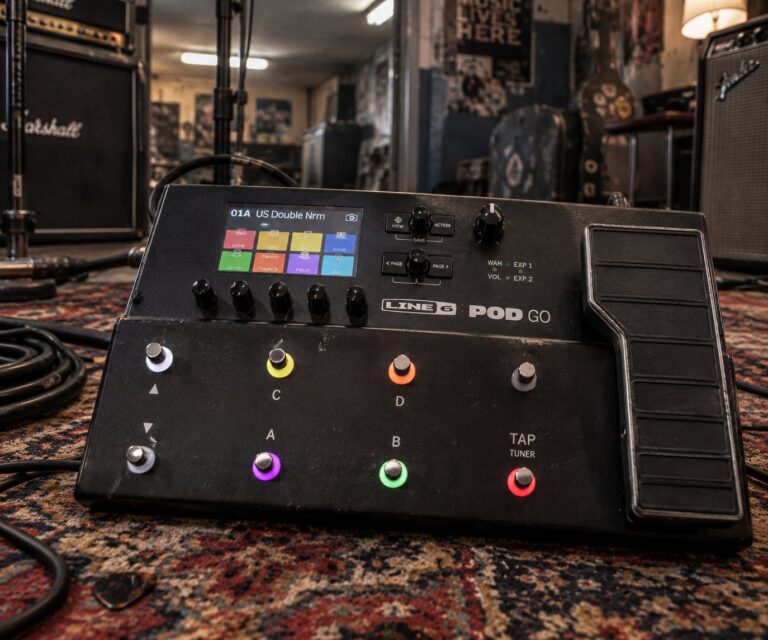
The POD HD500X is the historical comparison point—it was the floor modeler that defined what professional guitarists expected from a single floor unit for most of the 2010s. Used prices now run $150-275. The gap between a $200 HD500X and a $1,799 FM9 Turbo is not cosmetic. The Cygnus X2 engine runs component-level simulation that no HD-series DSP could run; the FM9 has 4 DSP cores versus the HD500X’s single chip. The HD500X is still a capable and affordable option for players who don’t need the absolute ceiling. But the comparison illustrates how far the category has moved.
Buying Guide
The FM9 Mark II Turbo ships direct from Fractal Audio at $1,799.99 with a reported one-business-day turnaround. Fractal’s direct model means no authorized dealer markup; what you see on the shop page is what you pay. The Fractal store ships to most international addresses and accepts standard payment methods. No current competitor ships faster from their own store.
Used FM9 prices run $1,100-1,400 for clean units, depending on firmware version and included accessories. The original FM9 (pre-Turbo) and FM9 Turbo Mk I units are functionally similar to the Mark II in terms of amp library—they run the same Cygnus X2 firmware—but have less DSP headroom. If your presets stay relatively simple (single amp, fewer simultaneous effects), an original FM9 at $1,100 is essentially the same box. If you want to run dual amp setups with heavy parallel effects processing, the Mark II Turbo’s additional cores are meaningfully useful.
Check firmware revision before buying used. FM9 units run free Fractal firmware updates, but the update process requires a USB connection to a Mac or PC running FM9-Edit. Make sure the seller has updated to current firmware before shipping—it’s a straightforward process but it’s worth confirming.
The FM9 does not include an expression pedal. Fractal sells the EV-2 ($199.99) and EV-1 ($299.99); both connect via the 1/4″ TRS expression jacks. Third-party mission engineering pedals work fine. Budget for at least one expression pedal if you intend to use volume swells or wah—the three expression inputs mean you can run three simultaneously.
Optional: the FC-6 ($499.99) or FC-12 ($749.99) expansion controllers add additional footswitches via proprietary cable. Players who want twelve or more footswitches simultaneously—for elaborate preset banks plus scene control—use the FM9 plus an FC-6 as a compact touring system.
Owning the FM9 Turbo: What the Manual Doesn’t Prepare You For
The factory presets are a demonstration tool, not a starting point. They’re designed to show off the unit’s range of capabilities in a fifteen-minute demo session, which means they’re often over-processed. Spend your first week not editing them but listening to them carefully to understand what each amp model and effect type is doing, then start from a blank preset and build your own.
FM9-Edit is the correct interface for serious preset building. The front panel is capable but deliberately compact—the edit flow assumes you’ll use a laptop for deep editing and the front panel for live performance. This is not a limitation, it’s a workflow. Set up FM9-Edit on your computer, build presets there, and use the front panel for scene and channel switching on stage.
The 8 scenes per preset are your primary performance tool. Don’t try to switch presets live—that’s for changing setlists, not for switching from verse to chorus. Build each song as one preset with scenes handling the dynamic changes: clean, crunch, lead, lead with delay, ambient outro. The FM9’s gapless switching means scenes change instantaneously with no audio dropout.
Speaker simulation matters more than any other single parameter. The FM9 comes with 2,200+ factory cabs, but a single carefully chosen third-party IR collection often outperforms all of them for your specific playing style. Commercial IR packs from Ownhammer, York Audio, and Celestion’s own IR library are widely used by FM9 owners. Load them into the 1,024 user IR slots. The DynaCab engine then applies dynamic response modeling to the static IR—it’s not just convolution, it’s a simulation of how the speaker’s behavior changes with excursion level.
Humbuster: always use the Humbuster outputs when running to a PA. The cables are standard TRS on both ends but wired asymmetrically. Fractal sells them; so do several third-party manufacturers. Running standard TS cables into an unbalanced input negates the Humbuster advantage.
The looper is 48 seconds in mono (24 stereo). It’s a simple overdub looper, not a complex phrase sampler. For players who need more complex loop stations, the FM9’s aux loop point lets you run an external dedicated looper in the effects chain at the correct place.
FAQ
What is the difference between the FM9, FM9 Turbo, and FM9 Mark II Turbo?
The original FM9 launched in 2021. The FM9 Turbo was a subsequent release with approximately 10% more DSP processing power. The FM9 Mark II Turbo (the current model at $1,799.99) is the most recent iteration, adding four DSP cores, larger mini displays on the footswitches, and new features introduced via firmware. All three run the same Cygnus X2 amp modeling engine via current firmware. The differences are in DSP headroom—how complex a preset can be before the processor struggles—not in fundamental tone quality for simpler setups.
Is the FM9 Turbo better than the Axe-FX III?
Different, not better. The Axe-FX III ($2,499.99) is a 19-inch rack preamp—it has no footswitches or display hardware beyond the front panel, and it’s designed to be paired with an FC-12 foot controller and installed in a rack. It has more DSP than even the FM9 Mark II Turbo. The FM9 is a self-contained floor unit. Most Axe-FX III presets run on the FM9 Mark II Turbo without compromise; the edge cases are the most DSP-heavy dual-amp plus extreme parallel effects rigs. For most live applications, the FM9 is the more practical choice.
Can the FM9 Turbo replace a real tube amplifier?
For recording and for live performance through a full-range PA or studio monitors, yes—and this is not a contentious claim among professional users anymore. The Cygnus X2 engine’s component-level simulation reproduces the dynamic response that separates tube amps from earlier-generation modeling. The edge case is live performance through a real guitar speaker cabinet without frictionless FRFR monitoring—the FM9 running into a traditional 4×12 produces a different character than into a studio monitor or IEM system, because real guitar speakers have their own strong frequency character that fights the already-applied speaker simulation. Most touring FM9 users run FRFR (full-range, flat-response) stage monitors or IEMs.
What FRFR speaker should I use with the FM9?
The most common professional choices are the Friedman ASC-12 ($699), the Headrush FRFR-112 ($299-349), and the Line 6 Powercab series ($599-899). The Powercab Plus has a speaker modeling mode that adds further guitar-speaker character at the stage; the FM9’s DynaCab can handle this instead. Budget option: a QSC K12.2 ($849) is an excellent dual-purpose PA speaker and FRFR stage monitor. Many touring professionals run two FRFR monitors in stereo for the full breadth of the FM9’s stereo output.
How does Cygnus X2 amp modeling work?
Cygnus X2 is Fractal Audio’s current-generation amp modeling engine, introduced as Cygnus in Axe-FX III Firmware 12.0 (2020) and updated to X2 in subsequent releases. Rather than capturing an amp’s frequency response or using neural network training on audio samples, Cygnus models the actual circuit topology—tube stages, transformers, tone stacks, and output sections are all simulated as individual electrical components. The result is that the model responds to control changes the way the real circuit does: adjusting Presence on a modeled amp changes the negative feedback loop character, not just a shelf EQ curve. It also means the model handles dynamic playing range more accurately than sample-based or convolution-based systems.
Does the FM9 Turbo work as a USB audio interface?
Yes. It’s an 8-channel in, 8-channel out USB interface fully functional alongside FM9-Edit and any DAW. Common routing configurations include recording the processed guitar signal on channels 1-2 and the dry (re-amp ready) signal on channels 3-4 simultaneously. No separate interface is needed for home recording use.
What’s the learning curve like?
Steep on entry, shallow after the first month. The front panel is not designed for from-scratch preset building—FM9-Edit on a laptop is the correct tool for that. Live performance use—selecting presets, switching scenes, adjusting expression—is intuitive once your preset bank is built. The most common complaint from new FM9 owners is that factory presets are over-compressed and over-processed; the second most common is that the sheer depth of the parameter set is paralyzing. The practical solution: start with one amp model and no effects, dial in a tone you like, then add one effect at a time. The depth is an asset once you stop treating it as an obligation.
Is the FM9 Turbo worth the price over cheaper alternatives?
Compared to the Line 6 Helix Floor at $1,499, the $300 premium buys more DSP headroom and a more highly regarded amp-feel engine. Compared to the Neural DSP Quad Cortex at $1,649, you pay $150 more for a richer factory library but lose amp-capturing capability. Against the Kemper Profiler Stage at $1,899, you pay less and get a different technical approach. None of these units will sound obviously inferior to untrained ears in a live PA context—the differences are in workflow, philosophy, and the outer 5% of dynamic response that separates good from excellent. If you’re already invested in the Fractal ecosystem (presets, community, firmware update track record), the FM9 Turbo is the obvious floor unit. If you’re starting fresh, all four are serious contenders at professional level.
Image credits
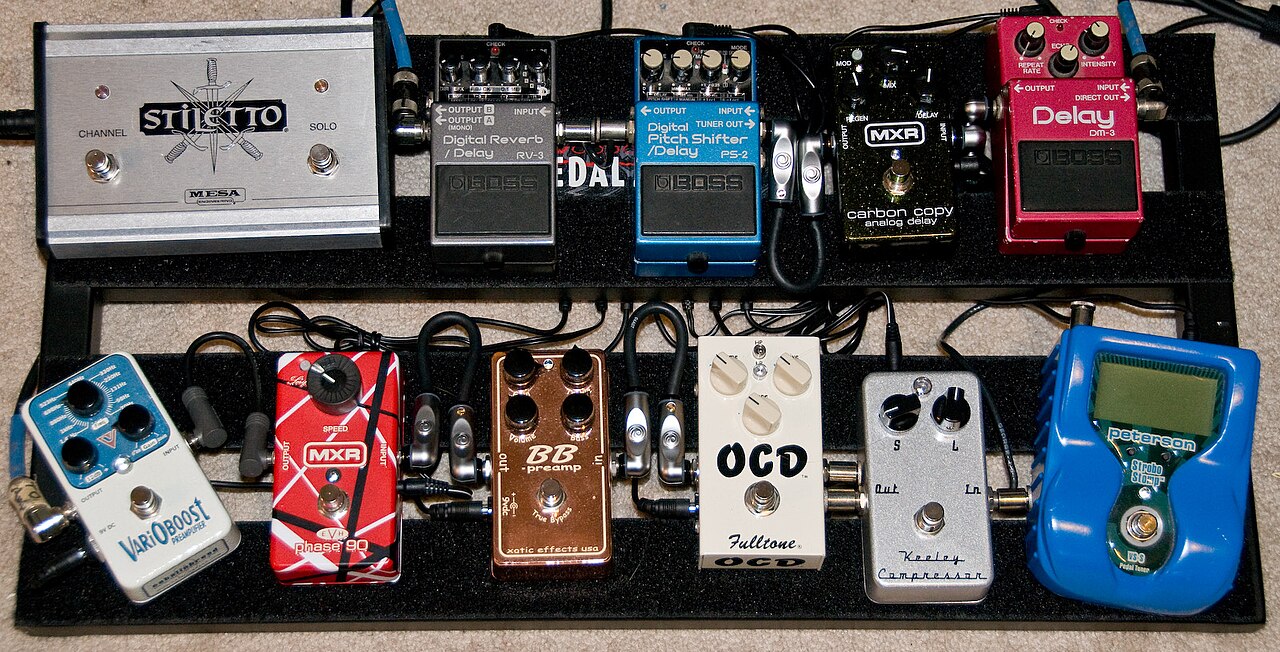
- A pedalboard with wah and effects pedals: John Athayde, Wikimedia Commons, CC BY 2.0.
- A pedalboard with a mix of effects pedals: ArtBrom, Wikimedia Commons, CC BY-SA 2.0.
- Guthrie Govan: ArtBrom, Wikimedia Commons, CC BY-SA 2.0.
Latest News
Related
On This Day
Monday 9 November
From this week: