The Jack White Law: Inside the EHX POG2 Polyphonic Octave Generator, the Machine That Made Octave Mandatory
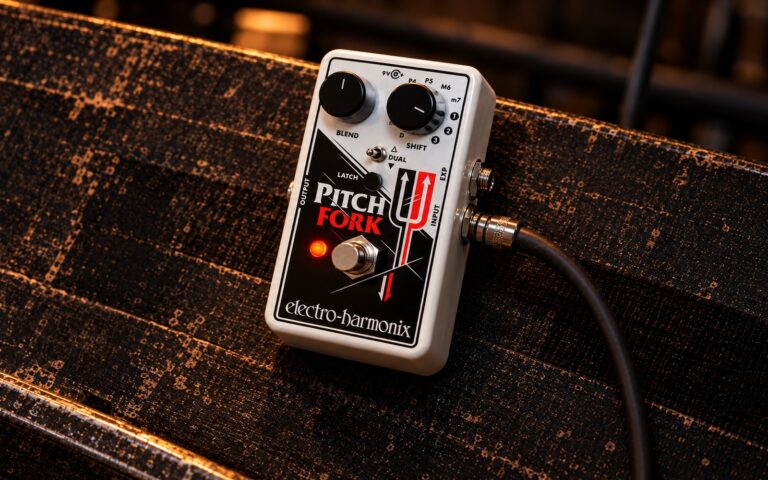
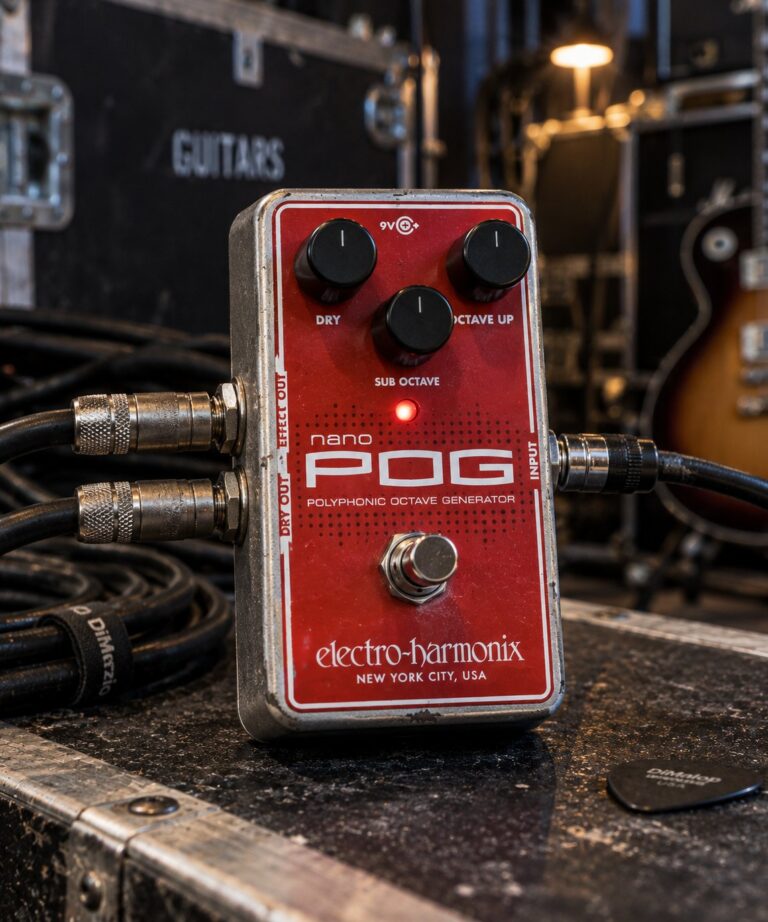
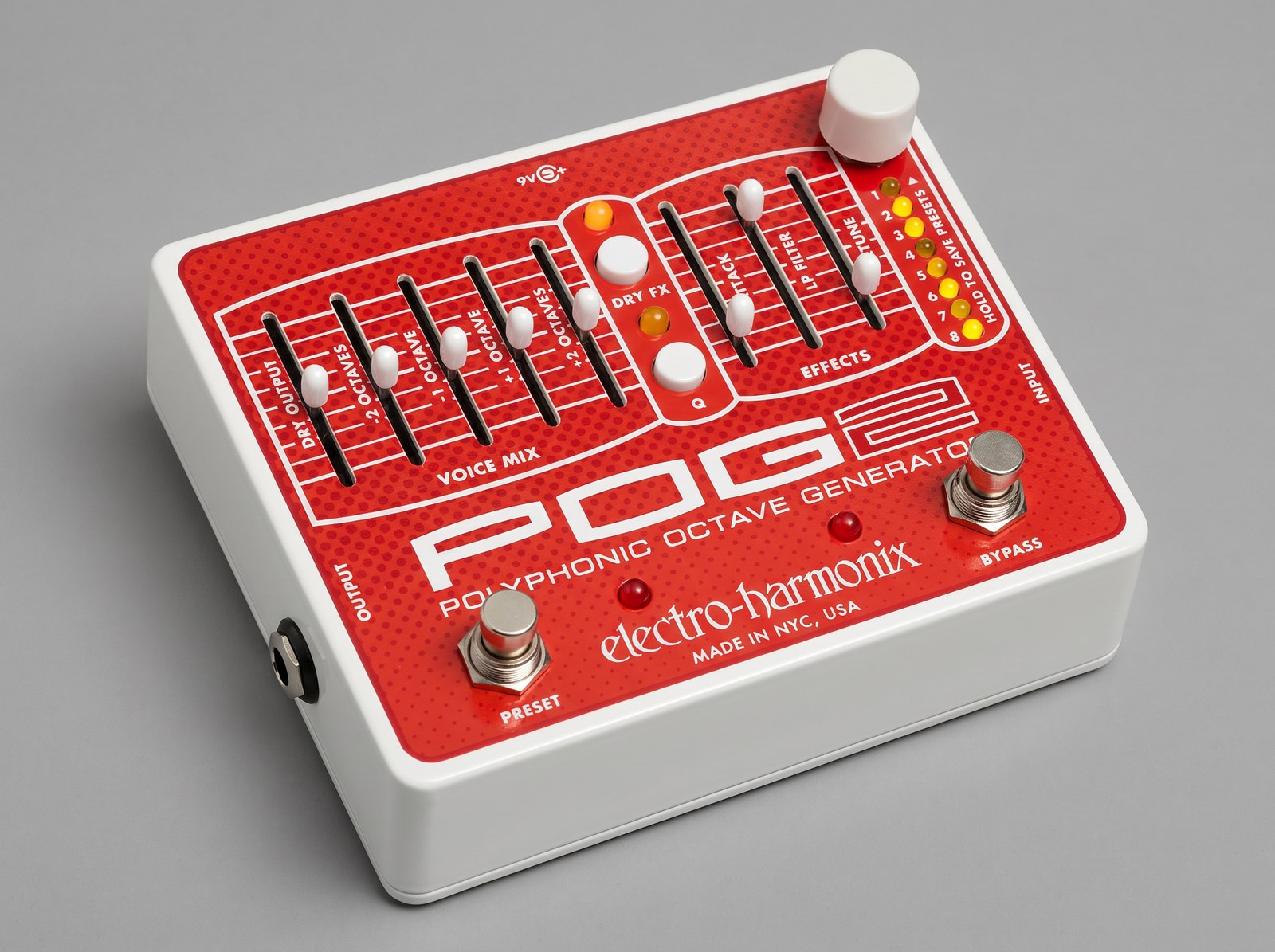
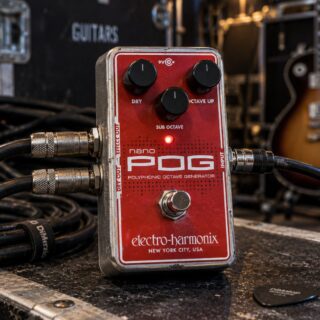
An AI-generated representative illustration of the Electro-Harmonix POG2, made from reference photos of the model.
EHX POG2 octave generator: circuit breakdown, Jack White's original Blue Orchid connection, tone recipes for organ tones and swells, plus full buying guide.
In 2005, Electro-Harmonix mailed a prototype to Jack White while he was in the studio finishing Get Behind Me Satan. Nobody had heard anything like it before — a guitar pedal that tracked polyphonic chords and generated simultaneous octave voices without the monophonic tracking jitter that had plagued every octave divider before it. Two weeks later, “Blue Orchid” was on the radio. The opening riff — that eerie, shimmering, impossibly full sound — introduced an entire generation of guitarists to the polyphonic octave generator as a compositional tool rather than a novelty effect. The pedal was the EHX POG, and Jack White became the first artist ever to record with one.
The association ran so deep that Phish guitarist Trey Anastasio later described the POG as a cornerstone of his live rig. Joe Satriani put one on his board. Jason Isbell coined what he calls “the Jack White law” — a quote EHX now publishes on the product page: “You have to have a POG if you’re gonna play guitar nowadays, cause you can’t play guitar unless you have at least one song that has a POG on it.” He was half-joking. He was also right.
The POG2, released in 2009, took everything the original could do and made it more articulate, more programmable, and more useful in live contexts. It added a second sub-octave generator, an attack delay slider for orchestral swells, a two-pole resonant low-pass filter, and eight-preset memory with instant recall — turning a remarkable effects pedal into a sound design workstation in a pedalboard-sized box. This is what it does, how to use it, and who actually has one on their board.
Origins: The First Guitar Pedal That Could Track Chords
Before the POG, polyphonic octave generation was a problem that hadn’t been properly solved. Analog octave dividers — the Boss OC-2, the MXR Bass Octave Deluxe, the EHX Octave Multiplexer — all operated on the same fundamental principle: detect the fundamental frequency of an input signal and synthesize a division or multiplication of that frequency. That approach works elegantly for single notes. Play a chord, and the tracking algorithm begins guessing, producing artifacts and smearing that made polyphonic octave use largely impractical for anything but isolated single-string lines.
EHX’s solution, developed for the original 2005 POG, was to abandon frequency detection entirely in favor of a direct digital approach. Instead of trying to identify and replicate the fundamental pitch, the POG processes the incoming signal directly through a digital pitch-shifting algorithm capable of handling multiple simultaneous frequencies. The result is glitch-free polyphonic tracking — play any chord shape, anywhere on the neck, and the octave voices follow accurately. This is the technical breakthrough that made the POG, and then the POG2, something categorically different from what came before.
The original POG offered three voices: dry, one octave down, and one octave up. Each had its own output level slider. The POG2, released June 2009, expanded the architecture substantially. It added a second sub-octave two full octaves below the input — dropping not just to bass register but to keyboard bass and organ pedal tone range — and introduced an Attack slider controlling the fade-in speed of all octave voices independently, a Low Pass Filter slider with selectable Q resonance, a Detune function for the upper octave voices, and an eight-preset memory with instant recall via a dedicated footswitch. The preset system is particularly significant for live use: different songs require completely different slider configurations, and the POG2 can store eight of them accessible on the fly without bending down to adjust anything.
The circuit is fully digital throughout, running on a 9.6VDC adapter (included) at 160mA. True bypass means the entire digital circuit is removed from the signal path when disengaged — no buffering, no coloration, no digital artifacts bleeding through on bypass. The POG2 currently lists at approximately $400 new from authorized dealers, though it was briefly out of production as the POG3 ($645, additional voices and 100 presets) launched as the flagship. Used POG2 units on the secondary market typically run $200–300 depending on condition.
Circuit Architecture: Five Sliders and What They Actually Do
Understanding the POG2 means understanding its slider section, which controls five independent voices rather than a simple wet/dry mix. From left to right on the panel:
The Dry slider controls the output level of your unprocessed guitar signal after it enters the POG2. At maximum, this is your clean signal at full level. Back it off and the octave voices become more prominent. Mute it entirely and you’re outputting pure synthesized octave tones with no dry signal — the basis of the organ-pad and bass-swell applications that have become defining POG sounds.
The -2 Octaves slider brings in the signal two full octaves below your input. This is the lowest voice the POG2 offers — on a standard-tuned guitar at the first position, this puts the bottom of your range into sub-bass territory. At low mix settings it adds subterranean weight. Pushed hard with the Dry muted, it produces tones more reminiscent of an organ bass pedal or a contrabass than anything identifiable as guitar.
The -1 Octave slider generates one octave below. This is the most commonly used sub-voice — it sits in the bass guitar range on standard-tuned guitar, adding fullness and supporting the lower frequencies of your chords in a way that reads as harmonic richness rather than a separate instrument. It’s the voice responsible for the doubled, larger-than-life sound that became the POG’s signature in rock contexts.
The +1 Octave slider generates one octave above. At moderate levels with dry present, this is the 12-string effect: each note takes on a shimmer and jangle that implies double strings even at slow tempos. Pushed higher, particularly with some detune dialed in, it creates the crystalline, almost bell-like upper register that characterizes the lush polyphonic textures the POG2 is known for. At extreme levels against a muted dry, you’re in triangle-wave synthesizer territory.
The +2 Octaves slider generates the uppermost voice, two octaves above input. This is the most surgical of the voices — at subtle levels it adds harmonic complexity and presence without obviously sounding like an octave effect. Pushed hard, particularly combined with the LP Filter to control harshness, it creates the glass-like, almost toy-piano quality that some players use for melodic leads.
The Attack slider is the most underexplained feature on the POG2 and arguably the one that generates the most distinctive sounds. It controls the fade-in time of all octave voices — when set away from minimum, the octave tones swell in gradually after you pick rather than tracking your attack immediately. The result is a bowed-instrument effect: the initial transient of the pick or pluck is heard as a brief pure guitar attack, after which the octave voices bloom in smoothly. At maximum, this produces textures that genuinely resemble a cello or upright bass played with a bow rather than a plucked string instrument. Trey Anastasio uses this extensively in live Phish contexts, creating what was described in direct documentation as an “orchestral, spooky, slightly evil, and very cool” effect with sub-octave voices engaged and dry partially muted.
The LP Filter slider applies a two-pole resonant low-pass filter across the octave voices, with the Q button cycling through four resonance modes. The filter’s primary function is to soften the upper octave voices — digital octave generation can produce a bright, occasionally harsh upper register, and the LP filter rounds it off into something warmer and more organ-like. At high resonance Q settings, it adds a peak before the cutoff that gives the filtered voices a formant-like character, usable for synth-bass and vowel-filter textures.
The Detune slider adds pitch modulation to the +1 and +2 octave voices, creating a slight wavering between them. At subtle settings this is a chorus-adjacent shimmer. At more extreme settings it creates the mechanical, slightly seasick quality that characterizes certain vintage keyboard sounds. The Detune is particularly effective for simulating Hammond drawbar organ textures, where pitch variation between tonewheel generators is part of the characteristic sound.
EHX POG2 Specifications
Famous Players: Who Actually Uses One (and Who Doesn’t)
The spreadsheet of claimed POG2 users that circulates in online gear discussions requires significant correction. Because the POG2 launched in 2009 and the original POG in 2005, any artist who predates either of those dates cannot have used them. And because the POG/POG2 occupies a specific sonic niche, not every artist associated with octave effects uses this particular pedal. The verified picture is smaller than often claimed but more interesting for being accurate.
Jack White
Jack White‘s connection to the POG is historically foundational: Electro-Harmonix sent him an original POG prototype in 2005 while he was recording Get Behind Me Satan, and “Blue Orchid” became the first song ever recorded with the pedal. The octave voicing on that track — the stacked, slightly surreal quality of the main riff — established the POG’s sonic identity before most guitarists had ever heard of it. White used the POG extensively through his White Stripes period, and the connection became potent enough that fellow artist Jason Isbell coined the “Jack White law” — a quote EHX features prominently on the POG2 official product page.
It’s worth noting, however, that White’s current live rig has evolved away from the POG family. His 2022 touring board for Fear of the Dawn, documented in detail by Guitar Player, features a Third Man Hardware x CopperSound Triplegraph digital octave divider alongside a DigiTech Whammy as his pitch manipulation tools — not a POG or POG2. His EHX loyalty on current boards runs through a Russian Big Muff Pi and an EHX Bassballs, rather than the POG family. The historical connection is genuine and foundational; the current use has moved to his own Third Man Hardware ecosystem.
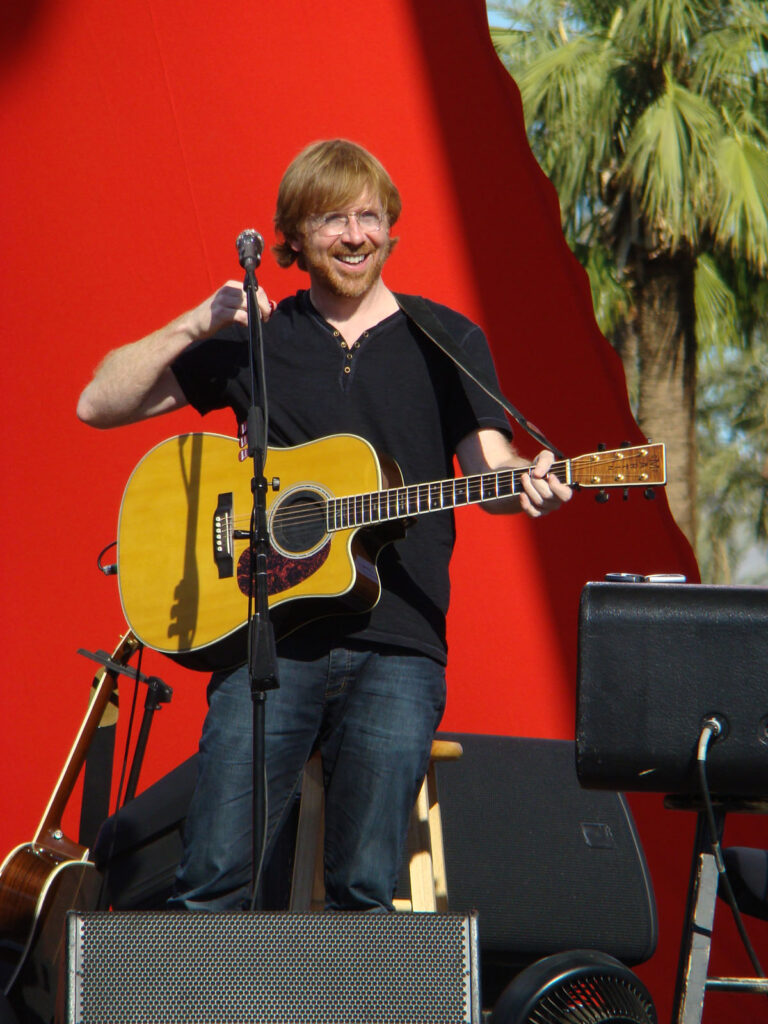
Trey Anastasio (Phish)
The most thoroughly documented current POG2 user is Trey Anastasio, whose rig has been catalogued in extensive detail by the dedicated fan documentation site Trey’s Guitar Rig (treysguitarrig.com). Anastasio uses the POG2 for two distinct applications: a polyphonic octave harmony setting with dry signal and -1 oct blended together, and a more dramatic setting with dry muted and sub-octave voices pushed to create bow-like swell textures when combined with the Attack slider. A documented live use at Madison Square Garden on December 30, 2017 shows him switching between these presets mid-performance, at one point reaching over to tap the preset footswitch with his palm to shift from the harmony setting to the full-attack sub-octave setting — the resulting tone described as “orchestral, spooky, slightly evil.” His POG2 coexists on his board alongside additional octave devices, treating polyphonic octave generation as a palette rather than a single sound.
Josh Homme, Joe Satriani, and the POG Standard
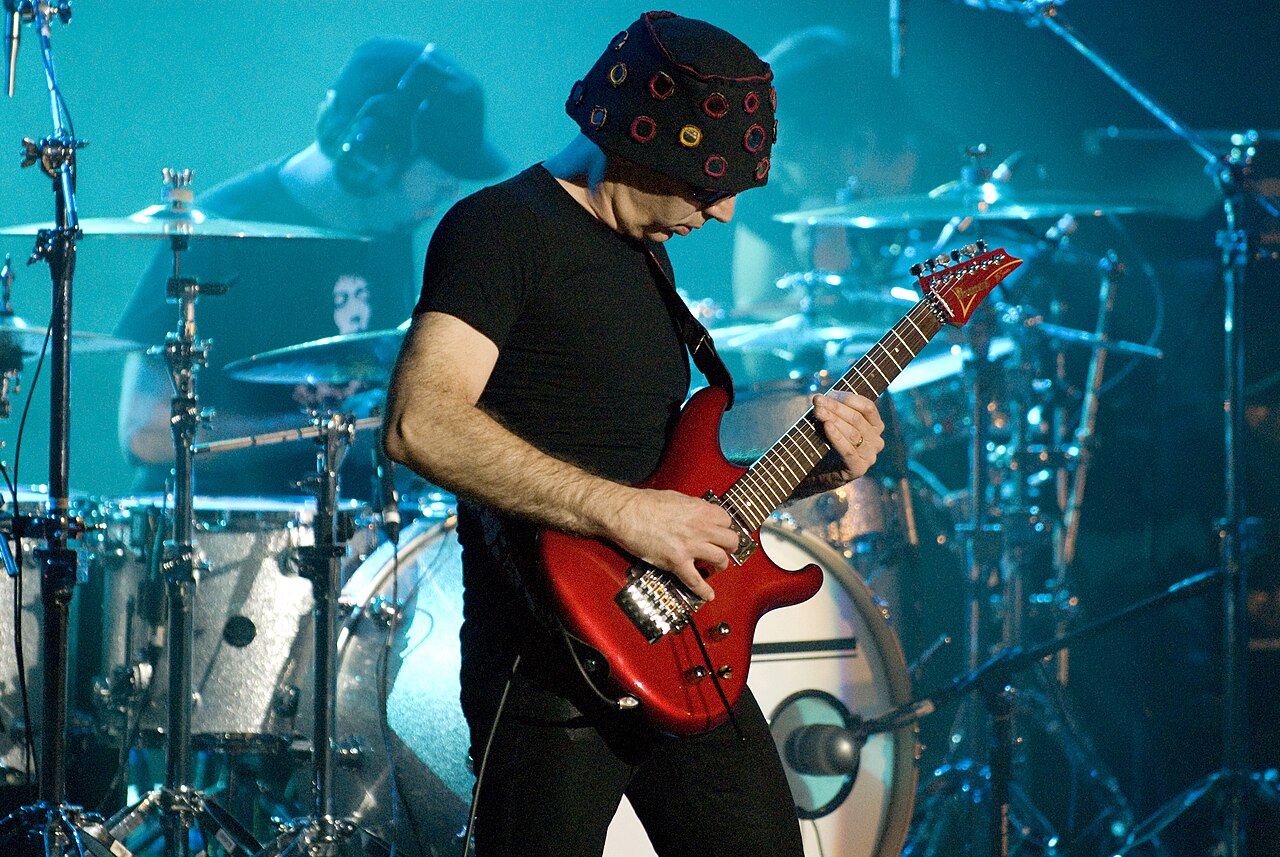
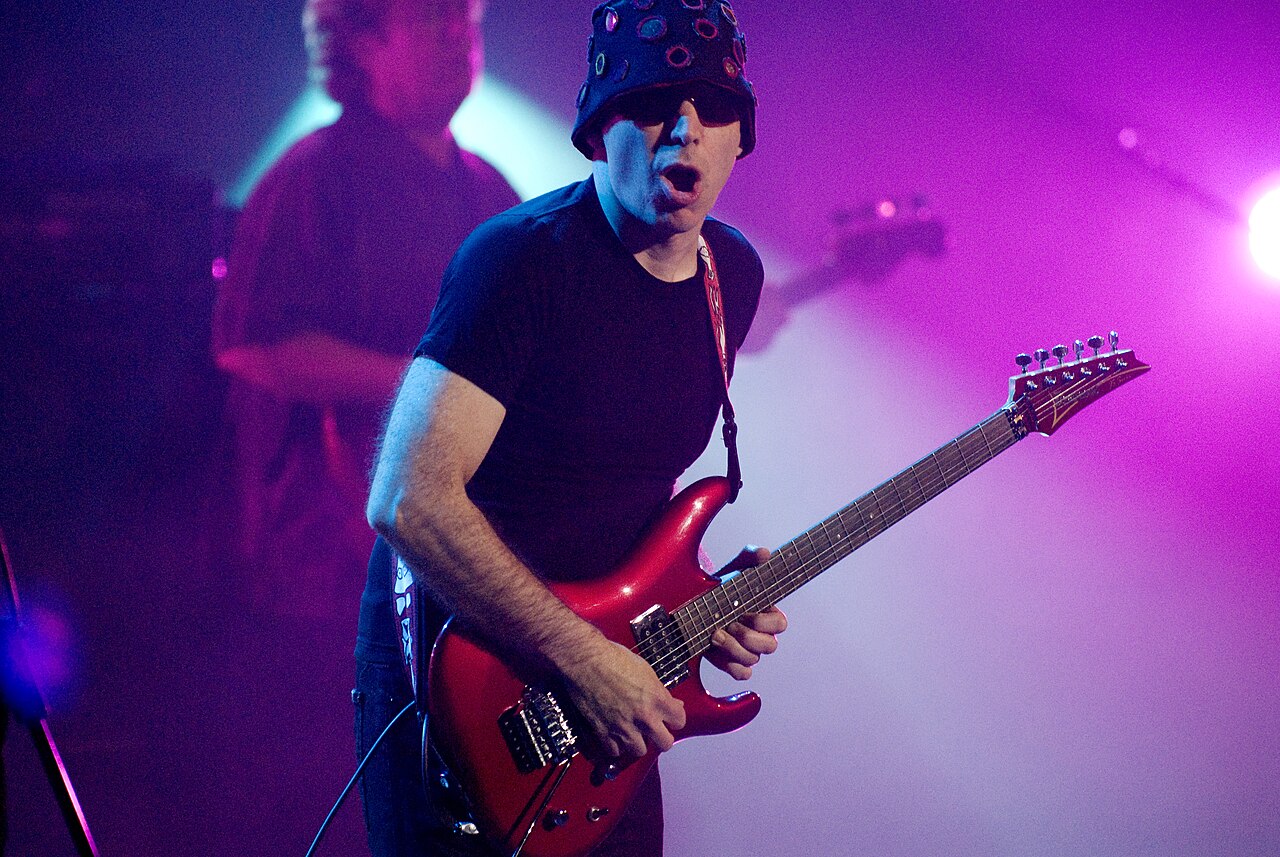
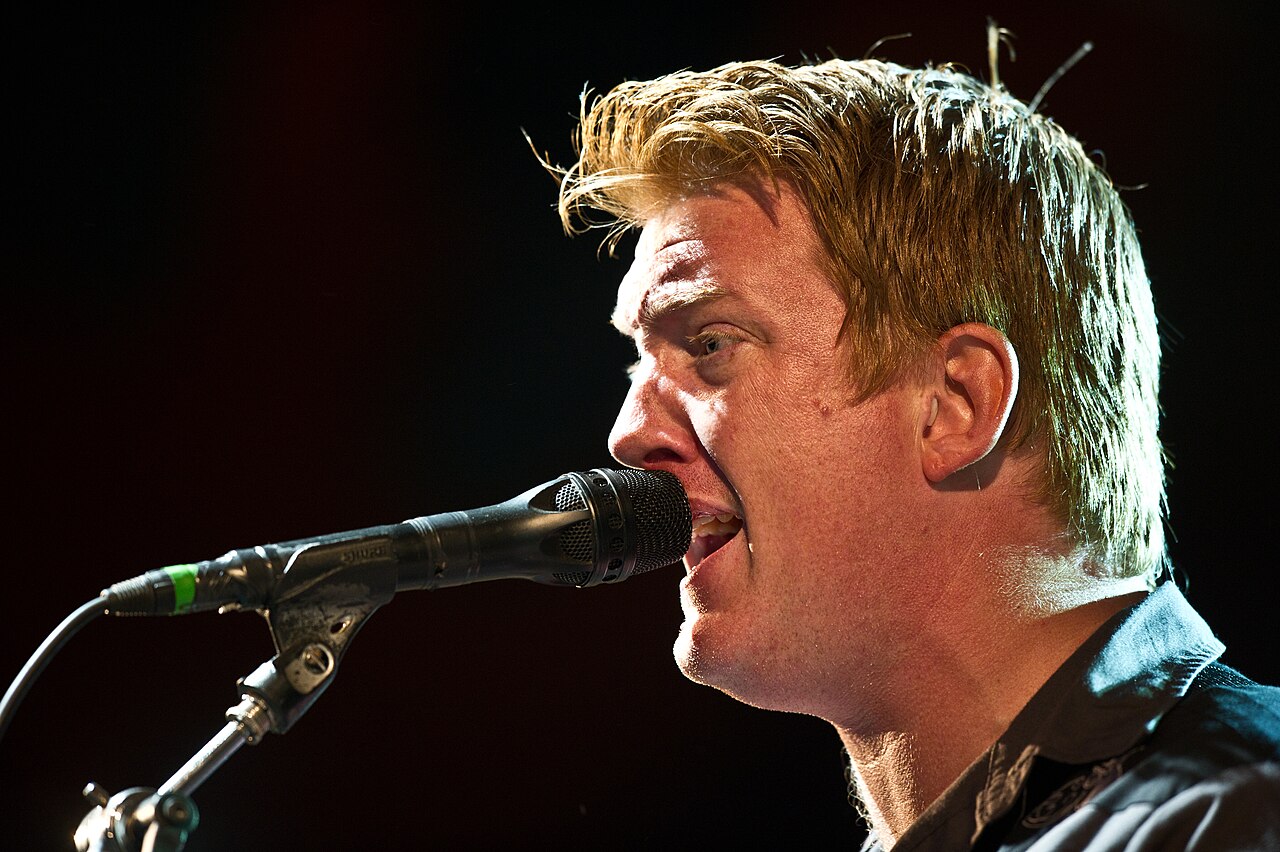
Multiple significant guitarists have been documented as original POG users, with the POG2 as the natural upgrade path. Josh Homme of Queens of the Stone Age appears in POG documentation as an early adopter. Joe Satriani uses the POG family for the expanded harmonic range it provides in fusion and rock contexts. Mark Tremonti and Incubus’ Mike Einziger both appear in verified POG-user documentation. The POG’s penetration across genres — from blues-rock to progressive to singer-songwriter to metal — reflects the universality of the need it fills: a way to extend the guitar’s range into keyboard territory without abandoning pick technique or chord voicings.
Corrections: The Artists Who Don’t Use the POG2
Several artists are frequently associated with the POG2 without adequate sourcing, and some attributions are factually impossible. Kurt Cobain died in April 1994. The original POG was released in 2005. The POG2 followed in 2009. No temporal reconciliation is possible — Cobain could not have used either pedal. His association with EHX runs through the Small Clone chorus, which is genuine and well-documented, but the POG2 attribution is impossible on chronological grounds and should be disregarded entirely.
Jeff Beck, often cited as a POG2 user, built his late-career octave sound primarily around the Boss OC-3 Super Octave and the vintage Mu-Tron Octave Divider, the latter controlled offstage by his tech Stevie Prior during live performances. His estate sale pedalboard, acquired in January 2025 from the Beck estate and documented on Reverb, does not include a POG2 among its documented units.
Graham Coxon uses an Electro-Harmonix HOG — the Harmonic Octave Generator — not the POG2. While both are EHX octave pedals, the HOG operates on a fundamentally different architecture, generating harmonics across a twelve-interval range using a dedicated expression pedal. It appears on Coxon’s documented pedalboards consistently. The two pedals are often conflated due to the EHX branding; they are distinct instruments doing different things.
James Hetfield derives the overwhelming majority of his tone from amp setup and EQ, with a historically minimal pedalboard. A POG2 does not appear in any documented Hetfield rig from primary sources. The few effects he uses — a Mesa Boogie custom EQ, occasional Klon Centaur for solo lift — are well-documented and do not include an octave generator. Nuno Bettencourt uses a Boss OC-2 for his octave applications, confirmed in Premier Guitar rig documentation, not an EHX POG2.
Tone Recipes and Settings
1. The 12-String Effect
Dry: 10 / -2 Oct: 0 / -1 Oct: 0 / +1 Oct: 4–5 / +2 Oct: 0–2 / Attack: 0 / LP Filter: 10 / Detune: 1–2
The most approachable POG application and the one most useful on a standard rock gig. The +1 Oct voice at roughly half level adds a bright shimmer to every note and chord that reads as doubled strings — the sonic impression of a 12-string guitar without the tuning maintenance. A small amount of Detune separates the two voices slightly so they don’t merge into one undifferentiated mass. The LP Filter at or near maximum keeps the upper voice smooth and usable rather than harsh. This setting works under clean tones, under light overdrive, and under heavier gain — the upper octave voice blends backward into the mix as gain increases, adding shimmer without dominating.
2. Organ Drawbars
Dry: 5 / -2 Oct: 4 / -1 Oct: 7 / +1 Oct: 3 / +2 Oct: 0 / Attack: 0 / LP Filter: 6–7 / Detune: 2–3 / Q: medium resonance
The classic organ simulation uses multiple voices simultaneously with the LP Filter rolling off harshness and the Detune adding the slight wavering between tonewheel generators that characterizes a real Hammond. The -1 Oct carries the bass register, the Dry provides the fundamental, and the +1 Oct adds the upper drawbar texture. Adjust the relative levels of -2 and +1 to shift the character from bass-heavy (classic rock organ) to more balanced (gospel/R&B voicing). The Q button cycles through four resonance levels — higher Q at the LP Filter produces a more pronounced midrange peak that emphasizes the vocal, formant-like character of the organ simulation. Pairs exceptionally well with clean or lightly broken-up amp tones.
3. The Jack White “Blue Orchid” Reference
Dry: 7 / -2 Oct: 0 / -1 Oct: 8 / +1 Oct: 5 / +2 Oct: 0 / Attack: 0 / LP Filter: 8 / Detune: 0
The sound that introduced the POG to rock guitar. Heavy -1 Oct weight, significant upper octave shimmer, dry signal present but the sub-octave and upper octave are both prominent in the mix. No attack swell — the picking transient comes through clean. LP Filter at high level (around 8) softens the upper voice. Run this into a driven amp or after a Big Muff Pi for the maximum saturated-octave effect. The combination of sub-octave fullness and upper-octave shimmer is what made the original riff sound like more than one instrument playing simultaneously — that “impossibly large” quality at the center of the effect.
4. Trey Anastasio Bow Swell
Dry: 0–2 / -2 Oct: 8 / -1 Oct: 10 / +1 Oct: 0 / +2 Oct: 0 / Attack: 7–8 / LP Filter: 5 / Detune: 0
The Anastasio setting documented at MSG: dry nearly muted or completely off, sub-octave voices pushed high, Attack slider set to produce a significant swell time. Pick a note and hear a brief ghost of the guitar attack followed by the octave voices blooming in gradually — the result sounds more like a bowed instrument than a plucked one. At maximum Attack, the onset time is long enough that the initial attack becomes nearly inaudible, leaving only the sustained swelled tone. The LP Filter at moderate settings keeps the sub-octave voices from becoming boomy without losing their weight. Best on single notes and sustained power chords; complex rapid lines lose their definition under a long attack setting.
5. Subtle Harmonic Thickening
Dry: 10 / -2 Oct: 0 / -1 Oct: 0 / +1 Oct: 1–2 / +2 Oct: 0–1 / Attack: 0 / LP Filter: 10 / Detune: 0
The most invisible POG application: upper octave voices present but barely perceptible as independent effects, functioning instead as harmonic overtone reinforcement. At very low +1 Oct levels (1–2 on a 0–10 scale), the effect is felt more than heard — the guitar sounds more present, slightly more complex, without anyone in the room being able to identify that an octave pedal is engaged. This is the setting for players who want the POG’s richness without the POG’s obviousness. Particularly effective on single-coil guitars, which benefit from the additional harmonic content the +1 Oct adds to their naturally bright fundamental.
The POG2’s slider architecture gives it an unusual range of distinct applications. These five settings represent the most useful approaches, expressed as approximate slider positions on a 0–10 scale (0 = fully down/off, 10 = fully up/maximum).
The POG Family and How They Compare
EHX has built a substantial POG ecosystem since the original 2005 launch, and understanding where the POG2 sits within it clarifies whether it’s the right choice for a given application.
The Micro POG offers three voices (−1 Oct, Dry, +1 Oct) with three corresponding sliders and nothing else — no attack, no filter, no presets. At approximately $155–180 new, it’s the entry point for players who want polyphonic octave capability without the POG2’s complexity or footprint. If you primarily need the 12-string effect or simple sub-octave weight, the Micro POG does those things competently in a smaller package. The absence of presets means reconfiguring the sliders between songs, and the absence of the Attack slider means no bow-swell applications. For players whose octave use is limited to one or two standard settings, it’s the more practical choice.
The POG3, released as the new flagship, expands the POG2 architecture further: it adds a +5th voice (a perfect fifth above the input, as distinct from an octave), provides 100 user presets rather than eight, and adds expression pedal control over almost every parameter. Its price reflects the expansion — $645 new is a significant step up from the POG2. For players who need the extended harmonic vocabulary or expression-pedal sweeping, the POG3 justifies the cost. For players whose POG2 already covers their needs, there is no compelling functional reason to upgrade.
Against competitors outside the EHX family: the DigiTech Whammy’s pitch-shifting approach operates on a fundamentally different philosophy — continuous pitch shift via expression pedal rather than fixed octave blending via sliders. The Whammy is a performance tool for dramatic real-time pitch movement; the POG2 is a layering tool for textural octave combinations. They solve different problems, and many players use both (Jack White’s current board demonstrates exactly this combination). The Deluxe Memory Man and the POG2 represent opposite ends of the EHX product philosophy — one is a pure analog signal modifier, the other is entirely digital — but they coexist effectively as EHX’s two flagship stompboxes for ambitious signal manipulation.
Buying Guide
The POG2 at $400 new occupies an unusual price point — it’s expensive for a single-function effects pedal by the standards of compact stompboxes but reasonable by the standards of what it replaces (rack-mount pitch processors from the same era cost significantly more). For most players encountering the POG2 for the first time, the used market represents better value: a used POG2 in excellent condition typically runs $200–300, and because the circuit has been unchanged since 2009 and there are no production-run variations with collector premiums, the cheapest well-maintained unit is acoustically identical to any other.
The decision between POG2 and Micro POG comes down to whether you need the attack/filter/preset features. If your POG application is fundamentally textural — one or two fixed settings, deployed consistently across your set — the Micro POG handles it for less money in less pedalboard space. If you need the bow-swell application, if you’re running the organ simulation, or if you need multiple preset configurations available at a footswitch press, the POG2 is the right tool and the Micro POG is genuinely limiting.
The POG3 at $645 is the better long-term investment if you’re building toward an ambitious rig and want the extended vocabulary available. The 100-preset memory is transformative for players with complex set lists. If you’re uncertain whether you’ll use those additional features, a used POG2 is the lower-commitment entry point into the ecosystem.
Ownership Notes
The POG2 draws 160mA at 9.6V. This is not a standard 9V pedal in the conventional sense — it requires the included 9.6V/200mA adapter or a power supply that can deliver the slightly elevated voltage. Most multi-output pedalboard power units offer 9V outputs at various current ratings; the 9.6V requirement means checking your supply’s specifications carefully before patching the POG2 into a daisy chain or multi-output unit. EHX includes the correct adapter in the box; use it until you’ve confirmed your power supply is compatible.
Signal chain placement for the POG2 is typically before drive effects. Running into a Tube Screamer or similar overdrive after the POG2 lets the drive stage saturate the blended octave signal — all five voices get compressed and harmonically enriched together, producing a thicker, more organ-like distorted sound. Running the POG2 after distortion lets the clean octave voices sit on top of a driven dry signal, which can produce useful textural contrast but also means the octave voices remain cleaner than the dry when the two are mixed together. Try both approaches; the results depend strongly on what downstream drive you’re using and what character you’re chasing.
The preset system rewards time invested. The POG2’s eight presets are saved by holding the Preset footswitch while the sliders are in the desired configuration — it takes a moment to learn the saving procedure, but once your most-used settings are locked in, the preset footswitch becomes one of the more powerful performance tools on a pedalboard. Cycling through presets live allows the POG2 to cover 12-string shimmering on one song, bass-swell atmospherics on the next, and subtle octave thickening on the bridge of a third, all without touching a single slider during the set.
True bypass means there are no digital artifacts when bypassed, but it also means no trails on the octave voices when you disengage the pedal. Sustained notes cut abruptly on bypass. This is generally desirable in a utility sense but worth noting if your performance style involves switching the POG2 off mid-sustained-chord.
FAQ
What is the EHX POG2 and how is it different from a regular octave pedal?
The POG2 is a polyphonic octave generator — it generates octave voices (up to two below and two above the input) while tracking chords accurately. Standard analog octave pedals like the Boss OC-2 work by detecting the fundamental frequency of the input signal, which means they work well on single notes but produce glitching and artifacts on chords. The POG2 uses a digital pitch-shifting algorithm that processes the input signal directly, allowing it to track any chord shape on any part of the neck without tracking artifacts. This is the fundamental technical difference that makes it a different category of effect.
Is the POG2 discontinued?
As of 2026, the POG2 is not officially listed as discontinued, though its availability from new dealers can be intermittent as the POG3 has launched as the current flagship. New units list at approximately $400 from authorized dealers; used units on the secondary market are typically $200–300. The POG3 at $645 adds significant features (additional voice, 100 presets, expression control) but the POG2 remains a functionally complete and compelling option at its lower price point.
Was Kurt Cobain a POG2 user?
No — this claim is chronologically impossible. Kurt Cobain died in April 1994. The original EHX POG was released in 2005. The POG2 followed in 2009. Cobain’s EHX use was genuine but ran through the Small Clone chorus, not the POG family. Any source attributing POG2 use to Cobain is incorrect.
What is the “Jack White law”?
The phrase comes from Jason Isbell, who coined it in reference to the ubiquity of the POG pedal across professional pedalboards following Jack White’s use of the original POG on “Blue Orchid” (2005). Isbell stated: “You have to have a POG if you’re gonna play guitar nowadays, cause you can’t play guitar unless you have at least one song that has a POG on it. It’s called the ‘Jack White law.'” EHX publishes the quote on the official POG2 product page. Jack White himself has since evolved beyond the POG family toward his own Third Man Hardware octave tools, but his foundational role in establishing the POG as a rock guitar standard remains.
How much power does the POG2 require?
The POG2 requires 9.6VDC at 200mA — a slightly higher voltage than the standard 9V compact pedal. The correct adapter is included with the unit. Most multi-output pedalboard power supplies offer 9V outputs rather than 9.6V; check your supply’s specifications carefully before assuming a standard 9V output will work. Using an underpowered supply can result in reduced headroom, digital artifacts, or instability. The 160mA current draw is also higher than most analog compact pedals and needs a supply output rated at or above that figure.
Where should I put the POG2 in my signal chain?
Typically before drive effects. Placing the POG2 first lets its polyphonic output feed into the drive stage, which saturates all voices together for a thick, organ-like distorted sound. Placing it after drive means the clean octave voices sit on top of an already-driven dry signal — useful for certain textural applications but generally less cohesive. If you’re using the POG2 with a Big Muff Pi for the classic EHX combination, try POG2 → Big Muff → amp first: the Muff will saturate the full blended signal with characteristic fuzz character. Delay and reverb effects are typically placed after the POG2.
What’s the difference between the POG2 and the Micro POG?
The Micro POG is a simpler, smaller version offering three voices (−1 Oct, Dry, +1 Oct) with three corresponding sliders. It has no attack slider, no LP Filter, no detune, and no preset memory. It’s the right choice for players who primarily want the 12-string shimmer or simple sub-octave bass weight and don’t need the full POG2 feature set. The POG2 is the right choice if you need the attack swell, the organ simulation (which requires multiple sub-octave voices and filtering), or multiple stored configurations recallable without manual slider adjustment. The Micro POG is simpler; the POG2 is more capable.
Can the POG2 be used for bass guitar?
Yes, and it tracks polyphonically on bass just as on guitar. Bass-specific applications include adding a sub-octave two full octaves below for genuine subwoofer-range reinforcement, using the +1 Oct to add guitar-register presence to bass lines, and using the organ simulation settings to give bass a more keyboard-like character. The Attack slider bow-swell effect is particularly interesting on bass — it creates a cello-like bowed quality that has no equivalent in conventional bass effects processing. The 160mA power requirement and 9.6V voltage apply regardless of instrument.
Image credits
- Joe Satriani: livepict.com, Wikimedia Commons, CC BY-SA 3.0.
- Josh Homme: Bill Ebbesen, Wikimedia Commons, CC BY 3.0.
- Joe Satriani: livepict.com, Wikimedia Commons, CC BY-SA 3.0.
- Top image: GuitarGangsters AI-generated reference illustration, not a photograph.
- Trey Anastasio: Dan Shinneman, Wikimedia Commons, CC BY-SA 2.0.
Latest News
Related

On This Day
Tuesday 10 November
From this week: