DigiTech Whammy 5: How the Pedal That Rewired Guitar Culture Finally Got True Bypass
The DigiTech Whammy 5 brings true bypass and chordal pitch-shifting to the pedal Tom Morello made legendary. Here's everything you need to know.
There are a handful of moments in the history of the electric guitar where a single piece of gear changes what the instrument is capable of — not subtly, not incrementally, but seismically. The DigiTech Whammy is one of those moments. When the original WH-1 landed in 1989, it handed guitarists something that had previously existed only on synthesizers and in the fevered imagination of pedal-steel players: real-time, expression-controlled pitch shifting. Tom Morello heard it and realized he could play hip-hop turntable scratches and dive-bombing synth lines on a six-string. Jonny Greenwood heard it and understood that a standard guitar riff could be transformed into something genuinely alien. Dimebag Darrell heard it and immediately ordered two.
The DigiTech Whammy 5 — released in May 2012 as the fifth-generation evolution of that original WH-1 — didn’t need to reinvent anything. The Whammy was already one of the most recognizable pedal silhouettes in the world. What the fifth generation did was address every practical complaint the touring and recording community had accumulated over three decades: the lack of true bypass, the incompatibility with standard pedalboard power supplies, the absence of polyphonic chord-shifting. The Whammy 5 resolved all three. It kept the pitch-shift algorithms that made the earlier versions legendary. And it added a Classic/Chords toggle that bridged the gap between old-school Whammy grit and modern clean tracking.

This is the story of the pedal that started a revolution, and the version that grew up without losing its voice.
From WH-1 to WH-5: A Brief History of Pitch Terrorism
DigiTech — at the time operating under DOD Electronics — introduced the original Whammy as the WH-1 in 1989. It was the first mass-market pedal to offer real-time digital pitch bending via an expression rocker. The circuit was built around Rockman’s pitch-detection chip and allowed players to sweep from unison up to two octaves above or below, or to dial in fixed harmonies triggered by the rocker position. Units manufactured between 1990 and 1993 are now considered vintage and command significant prices on the used market — partly for tone reasons, partly for provenance.
The WH-1 had no true bypass, required a proprietary power supply, and tracked monophonically with a characteristic glitchy lag that guitarists either loved or tolerated. Tom Morello used the glitch as a compositional tool. The WH-1’s tendency to stumble on complex chords and produce digital chirps at extreme intervals became sonic signatures on songs like “Bulls on Parade” and “Killing in the Name.”
The WH-2 followed as a cosmetically updated version, maintaining the same core circuit. DigiTech skipped the WH-3 designation entirely — it’s a collector’s curiosity that the company never addressed publicly — and moved to the WH-4, which updated the algorithm and added more interval options but retained the buffered bypass and proprietary power requirement that kept frustrating pedalboard builders. The WH-4 is the version Jonny Greenwood was documented using on his Austin City Limits board in 2012, the same year DigiTech shipped its successor.
The Whammy 5 arrived in May 2012 at a launch price of $299.95. It represented the most comprehensive overhaul of the platform since the original, adding true bypass, standard 9V DC compatibility, 24-bit/96kHz analog-to-digital and digital-to-analog conversion, MIDI input for remote switching, dual 1/4-inch outputs, and the headline addition: a Classic/Chords mode toggle that let players choose between monophonic tracking (with all the attendant grit of older Whammy versions) and polyphonic chord processing for clean, glitch-free pitch-shifting across full voicings.
What the DigiTech Whammy 5 Actually Does
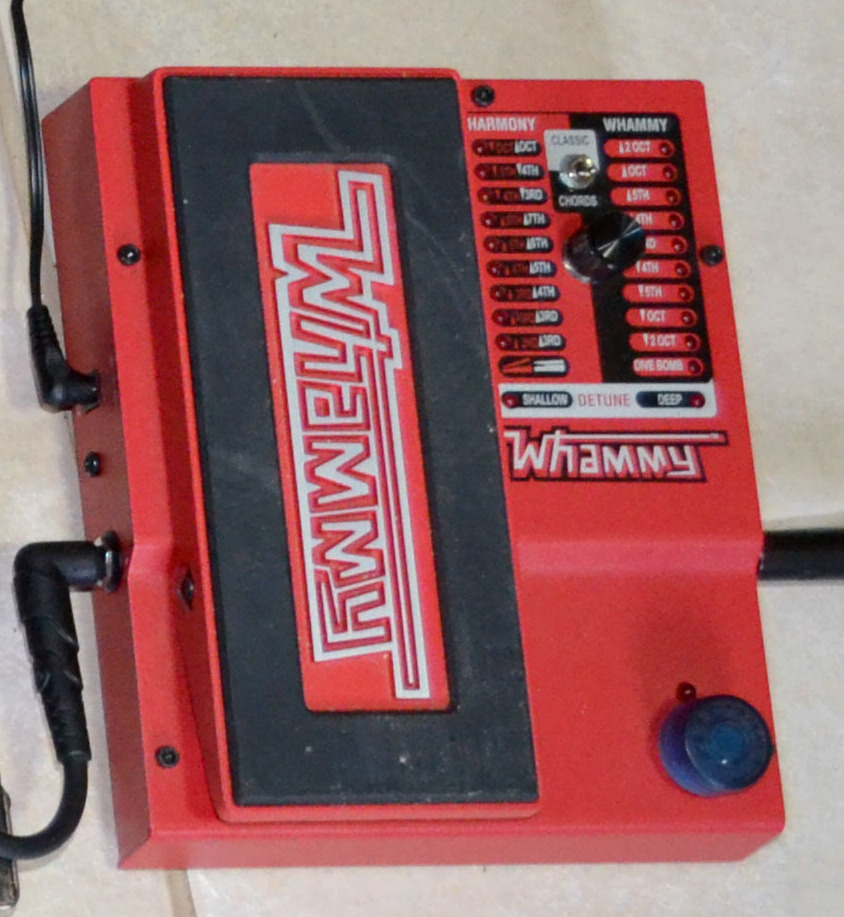
The fundamental concept of the Whammy is simple: a rocker pedal controls pitch shift amount in real time. Heel down is unison; toe down applies whatever interval is selected on the rotary switch. The Whammy 5 offers two operating modes accessible via the front switch — Whammy mode for live expression-controlled pitch shifting, and Harmony mode for fixed-interval harmonization that tracks with your playing regardless of rocker position.
In Whammy mode, the pedal offers intervals from one octave down to two octaves up, plus a Dive Bomb setting that plummets the pitch downward as you sweep the rocker. In Harmony mode, you select a fixed interval — from minor 2nd through major 10th — and the pedal adds that harmony voice alongside your dry signal. The Detune modes sit in the same selector and add subtle pitch modulation for thickening and chorus-style widening without going to full intervals.
The Classic/Chords switch is the Whammy 5’s most consequential addition. Classic mode runs the pitch detection monophonically, which produces the iconic tracking behavior of earlier Whammy generations — single notes track cleanly, chords and double-stops introduce the harmonic artifacts and glitchy overtones that define the Whammy sound on countless recordings. Chords mode switches to polyphonic processing, allowing full chord pitch-shifting without artifacts. The tracking in Chords mode runs on 24-bit/96kHz converters and is clean enough for studio use without corrective EQ.
MIDI input allows preset changes and parameter control via external controllers, making the Whammy 5 genuinely usable in complex live rigs where preset recall matters. The dual outputs allow wet/dry splitting — one output carrying the processed signal, the other carrying the dry signal — useful for studio parallel processing or for sending a clean signal to a tuner or second amp.
Technical Specifications
| Specification | DigiTech Whammy 5 | DigiTech Whammy 4 | Electro-Harmonix POG2 |
|---|---|---|---|
| Release Year | 2012 | ~2000 | 2009 |
| True Bypass | Yes | No (buffered) | Yes |
| Expression Control | Built-in rocker pedal | Built-in rocker pedal | External expression input |
| Polyphonic Mode | Yes (Chords mode) | No | Yes (full polyphonic) |
| Power | Standard 9V DC | Proprietary 9.6V | 9.6V DC 200mA |
| MIDI | Yes (in) | No | No |
| Outputs | 2 × 1/4″ | 1 × 1/4″ | 2 × 1/4″ |
| Converters | 24-bit/96kHz | Not specified | 24-bit |
| Dimensions | 2.5″ H × 6.3″ W × 8″ D | Comparable | 5.75″ × 4.75″ × 2.5″ |
| Weight | 3.5 lbs | ~3 lbs | ~1.5 lbs |
| Street Price (new) | ~$150–200 (current) | Discontinued/used only | ~$400 |
Famous Players — Honest Accounting
The Whammy 5 inherits one of the most distinguished user rosters in pedal history — but that roster is primarily associated with the WH-1 and WH-4, not specifically the fifth-generation model. Being accurate about this matters, because the Whammy’s iconic status comes precisely from those earlier units and the specific imperfections that made them legendary.
Tom Morello
Tom Morello is the guitarist most responsible for putting the Whammy on the cultural map. When he formed Rage Against the Machine in 1991, he immediately incorporated the WH-1 into a playing vocabulary that nobody had heard before: interval jumps mid-riff, pitch-glide solos that emulated gangster-rap record scratches, synth-like portamento swells. Songs like “Bulls on Parade,” “Killing in the Name,” and “Guerrilla Radio” are built around Whammy-driven guitar parts that would be impossible to reproduce without a pitch-shift expression pedal. Morello has stated that he’s used “the same four pedals for the last 30 years” — a Wah, a Whammy, a delay, and a phaser — and that Guitar World credited his use of the original WH-1 with selling “more units than every other early adopter combined.”
The critical honest note here: Morello’s documented preference is the original WH-1. He built his vocabulary on its specific tracking behavior and tonal character. Whether he specifically uses the Whammy 5 is not independently verified — but the Whammy 5 is the direct descendant of everything he helped popularize, and its Classic mode is explicitly designed to reproduce that original algorithm’s character.
Jonny Greenwood
Jonny Greenwood’s relationship with the Whammy is quieter than Morello’s but equally musical. He’s used the pedal since the mid-1990s, most famously on Radiohead’s “My Iron Lung” (1994), where he exploits the WH-1’s inaccurate chord tracking to create a deliberately glitchy, lo-fi octave texture during the song’s introduction. The Whammy also appears on “Paranoid Android” and across Radiohead’s mid-period catalog, used not as a party trick but as a legitimate compositional texture — pitch as a timbral modifier rather than a performance gimmick.
Greenwood’s documented board photography from Austin City Limits in 2012 shows a fourth-generation Whammy, placing him as a WH-4 user around the time the Whammy 5 launched. His use of the Whammy’s tracking artifacts as intentional texture is a masterclass in treating technical limitations as sonic assets.
Jack White
Jack White’s Whammy use has been most associated with the original WH-1 era. His current touring setup, documented by Guitar Player in 2022, moved away from the DigiTech platform toward the Third Man Hardware × CopperSound Triplegraph digital octave divider — a custom development consistent with White’s ongoing investment in the Third Man Hardware ecosystem. His historical connection to the Whammy family is real and foundational, but the current rig reflects a deliberate departure from the DigiTech platform toward bespoke Third Man hardware.
Dimebag Darrell
Dimebag Darrell ran not one but two DigiTech Whammy WH-1s in his Pantera stage rig — a redundancy system that should tell you everything about how essential the pedal was to his vocabulary. In a 1994 Guitar World interview, he described using the Whammy to affect feedback and create pitch effects on tracks including “Becoming” and “Good Friends and a Bottle of Pills” from Far Beyond Driven. Dime’s Whammy use was characteristically over-the-top: wide interval sweeps, sudden octave jumps mid-riff, feedback manipulation. He treated it as a chaos agent, not a precision instrument.
Like Morello and Greenwood, Dime’s documented connection is to the WH-1, not the Whammy 5. He passed away in 2004, before the fifth generation existed. But the Whammy 5’s Classic mode tracks the WH-1 algorithm, and for players trying to approximate his technique, the Classic setting is the entry point.
Mike Einziger
Incubus guitarist Mike Einziger is a documented Whammy 4 user, with the pedal confirmed on his pedalboard in Premier Guitar’s rig rundown. Einziger’s use skews more experimental and textural than the heavy-rock applications of Morello and Dimebag — he uses pitch-shifting as part of a broader sonic palette that includes unusual tunings, layered clean tones, and unconventional rhythm approaches. His connection is to the fourth generation specifically, but the continuity of Whammy use from WH-4 to WH-5 is direct; players migrating from his documented rig to current hardware land on the Whammy 5.
Tone Recipes and Settings
The Tom Morello “Killing in the Name” Dive
Set the selector to 2 Oct Up. Use Classic mode. Play a single note — usually a fretted 5th or root — and sweep the rocker from heel to toe slowly, then snap it back. The tracking lag in Classic mode creates the characteristic pitch swoosh. For the “Bulls on Parade” solo, try combining a half-up sweep held mid-rocker with a wah pedal — the combined pitch manipulation creates the horn-like midrange bark that defined the early RATM sound. Your Dunlop GCB95 Cry Baby Wah is the period-correct companion here.
Jonny Greenwood’s “My Iron Lung” Octave Glitch
Switch to Chords mode off — use Classic. Select 1 Oct Up. Play a power chord and sweep the rocker. In Classic mode, the chord will produce harmonic artifacts and tracking glitches at the octave interval. These are not defects; they are the sound. Hold the rocker at roughly 80% toe-down for maximum harmonic instability, and let the note decay into feedback. Run into a mid-scooped amp — a Fender Deluxe Reverb pushed into light breakup works well.
The Harmony Lead
Switch to Harmony mode. Select Maj 3rd or Min 3rd depending on the key. Set the rocker to heel position (full Harmony, no expression sweep). Play single-note leads and the Whammy 5 adds a parallel harmony voice. In Chords mode, this tracks cleanly and is usable in studio contexts. In Classic mode, there’s subtle warble. This approach works exceptionally well over a clean amp — try a bright Fender Stratocaster into the Deluxe Reverb clean channel.
Detune for Chorus-Without-Chorus
Set the selector to one of the two Detune positions. Engage the pedal. The Whammy 5 adds a subtly pitch-modulated double of your signal — thicker and less washy than a conventional chorus, closer to a 12-string simulation at low detune amounts. This is effective for rhythm playing where you want presence without adding reverb. Stack it after your overdrive — a Ibanez TS9 Tube Screamer into the Whammy Detune mode produces a layered mid-forward tone that cuts in a live mix.
Dimebag’s Dive Bomb Without a Floyd
Select the Dive Bomb position. Play a sustaining note — a bent, held power chord works well. Sweep the rocker from heel to toe in a slow continuous motion. The pitch drops downward without a floor, simulating a Floyd Rose dive without the hardware. For maximum Dime impact, run into a high-gain amp — a Marshall JCM800 2203 with the presence cranked — and let the divebomb feedback into amp saturation at the bottom of the sweep.
Whammy 5 vs. The Competition
The Whammy 5’s competitors fall into two categories: other expression-pedal pitch-shifters, and standalone polyphonic pitch processors. Within the first category, the Whammy 5 has essentially no direct competition. Nothing else offers the same combination of rocker-controlled real-time pitch shifting, the specific Whammy tracking algorithm, and the compact rocker form factor. The Whammy is sui generis in this regard.
Against polyphonic pitch processors like the EHX POG2, the distinction is form factor and control method. The POG2 adds preset memory, multiple simultaneous octave voices with independent level controls, and Attack and Filter sliders — but it offers no expression-controlled sweep. It is a different tool. Players who want “set a fixed octave sound and leave it” gravitate toward the POG family; players who want “sweep pitch in real time with a rocker” reach for the Whammy.
The Whammy DT (Drop Tune) added a drop-tuning mode for simulating alternate tunings, making it popular in metal contexts where drop-D or lower tunings are common. The Whammy Ricochet, introduced later, is a smaller mini-pedal format with expression input for external control but no built-in rocker. Neither replaces the Whammy 5’s combination of integrated rocker and algorithm options, but both represent valid alternatives depending on the use case.
The MonoNeon Signature V5 Whammy, announced at NAMM 2025, brought the platform forward again with expanded features while keeping the core expression-control paradigm intact — a sign that DigiTech continues to view the Whammy 5 architecture as a foundation rather than a dead end.
Buying Guide
The DigiTech Whammy 5 has settled into a comfortable used-market price range of $100–$160 for clean units, and new-old-stock examples appear regularly in the $150–$200 range. This represents excellent value for a pedal with true bypass, 24-bit converters, MIDI, and dual outputs.
When buying used, the main thing to verify is rocker functionality. The expression treadle mechanism sees heavy use in live contexts and can develop dead spots or rough spots in the pot travel. Test the sweep across the full range, toe to heel and back, listening for any sudden jumps or flat zones in the pitch tracking. The switch mechanism is robust — it uses a standard momentary footswitch that can be replaced if it fails. The rocker hinge has been known to develop play over time; it’s cosmetic rather than functional, but check the treadle for lateral wiggle.
The Whammy 5 is 9V DC, standard center-negative, drawing approximately 250mA. This is on the high side for digital pedals — budget for a supply port that can handle it. Most quality pedalboard power supplies have at least one high-current port; the Whammy 5 should go on one of those, not daisy-chained off a low-current supply.
If you’re specifically chasing the WH-1 vintage sound rather than the Whammy 5’s improved tracking, the Classic mode brings you meaningfully close. For most players, the improvement in true bypass and standard power compatibility makes the Whammy 5 the more practical instrument — you lose nothing on the signal chain when it’s off, and you never have to find a proprietary wall wart.
Ownership Notes
The Whammy 5 responds dramatically to playing dynamics and picking attack. Light picking into Classic mode produces cleaner tracking; heavy picking introduces more artifacts and harmonic instability. This is a feature, not a bug — the algorithm was always semi-dynamic in this way, and learning to use picking intensity as a control variable extends the Whammy’s expressive range considerably.
Position matters in the signal chain. The Whammy is traditionally placed first in the chain, before any dirt pedals, for cleanest pitch tracking. Running it after overdrives or fuzz can produce interesting harmonic interactions, but tracking becomes less predictable. Some players run it last of all, after reverb and delay, for a completely different sonic character. Experiment deliberately: the Whammy 5 sounds different in every position, and there’s no universal correct answer.
The MIDI input allows program change messages to switch between Whammy and Harmony modes remotely, which is valuable in sophisticated live rigs where you want to change the pedal’s mode without bending down. Check the manual for the implementation; it’s straightforward but requires a controller that sends program change messages on the correct channel.
The dual outputs are worth using even in simple rigs. Running one output to your main amp and one to a tuner keeps the tuner off the main signal path and eliminates the common scenario where a tuner pedal’s buffer affects your tone. The second output can also split to a recording interface for a direct-in signal while the first goes to your amp — a useful recording flexibility.
FAQ
What’s the difference between the DigiTech Whammy 4 and Whammy 5?
The Whammy 5 adds true bypass (the WH-4 had buffered bypass), standard 9V DC power compatibility (the WH-4 needed a proprietary supply), 24-bit/96kHz converters, a MIDI input, dual 1/4-inch outputs, and the Chords/Classic mode toggle for polyphonic processing. The WH-4 had none of these. Tonally, the Classic mode on the Whammy 5 is designed to approximate the WH-4 algorithm; players who specifically prefer the WH-4’s character report that Classic mode is a close but not identical match.
Does the Whammy 5 have true bypass?
Yes. This was the major practical upgrade from the WH-4, which used a buffered bypass that many players felt colored their tone. With true bypass, the Whammy 5 is completely removed from the signal path when disengaged — no coloration, no buffer, no loading effect on pickups.
Can the Whammy 5 shift full chords cleanly?
Yes, in Chords mode. Set the Classic/Chords toggle to Chords, and the 24-bit/96kHz polyphonic processing tracks full chord voicings without glitching. For single-note leads with the classic Whammy tracking behavior, use Classic mode.
What power supply does the Whammy 5 need?
Standard 9V DC center-negative, drawing approximately 250mA. Unlike the WH-4, it does not require a proprietary supply. Use a high-current port on your pedalboard supply — don’t daisy-chain it off a low-current output.
Did Tom Morello use the Whammy 5 specifically?
Morello’s documented and stated preference is the original WH-1. He’s been explicit about using “the same four pedals for 30 years,” and the Whammy in his rig traces back to the early 1990s WH-1. Whether he uses the Whammy 5 is not independently verified. The Whammy 5’s Classic mode is designed to approximate the WH-1 algorithm, making it the closest current-production equivalent to his vintage unit.
Where should I put the Whammy 5 in my signal chain?
Convention places it first in the chain, before any dirt, for cleanest pitch tracking. After your dirt pedals produces a different, more complex interaction. After reverb and delay produces the most dramatic and least predictable results. All three positions are valid; the “correct” position depends entirely on the sound you’re after.
What’s the Whammy 5’s range of pitch-shift intervals?
In Whammy mode: 1 octave down, minor 2nd down, major 2nd down, 4th up, 5th up, 1 octave up, 1.5 octaves up, 2 octaves up, and Dive Bomb. In Harmony mode: minor 2nd, major 2nd, minor 3rd, major 3rd, 4th, 5th, minor 6th, major 6th, minor 7th, major 7th, 1 octave, major 10th. Plus two Detune modes.
Is the Whammy 5 still available new?
Yes, as of 2026, new and new-old-stock units are available from dealers and on the used market. DigiTech continues to support the platform — the MonoNeon Signature V5 Whammy announced at NAMM 2025 confirms the Whammy architecture remains in active development. Street prices have settled well below the original $299.95 launch price.
Image credits
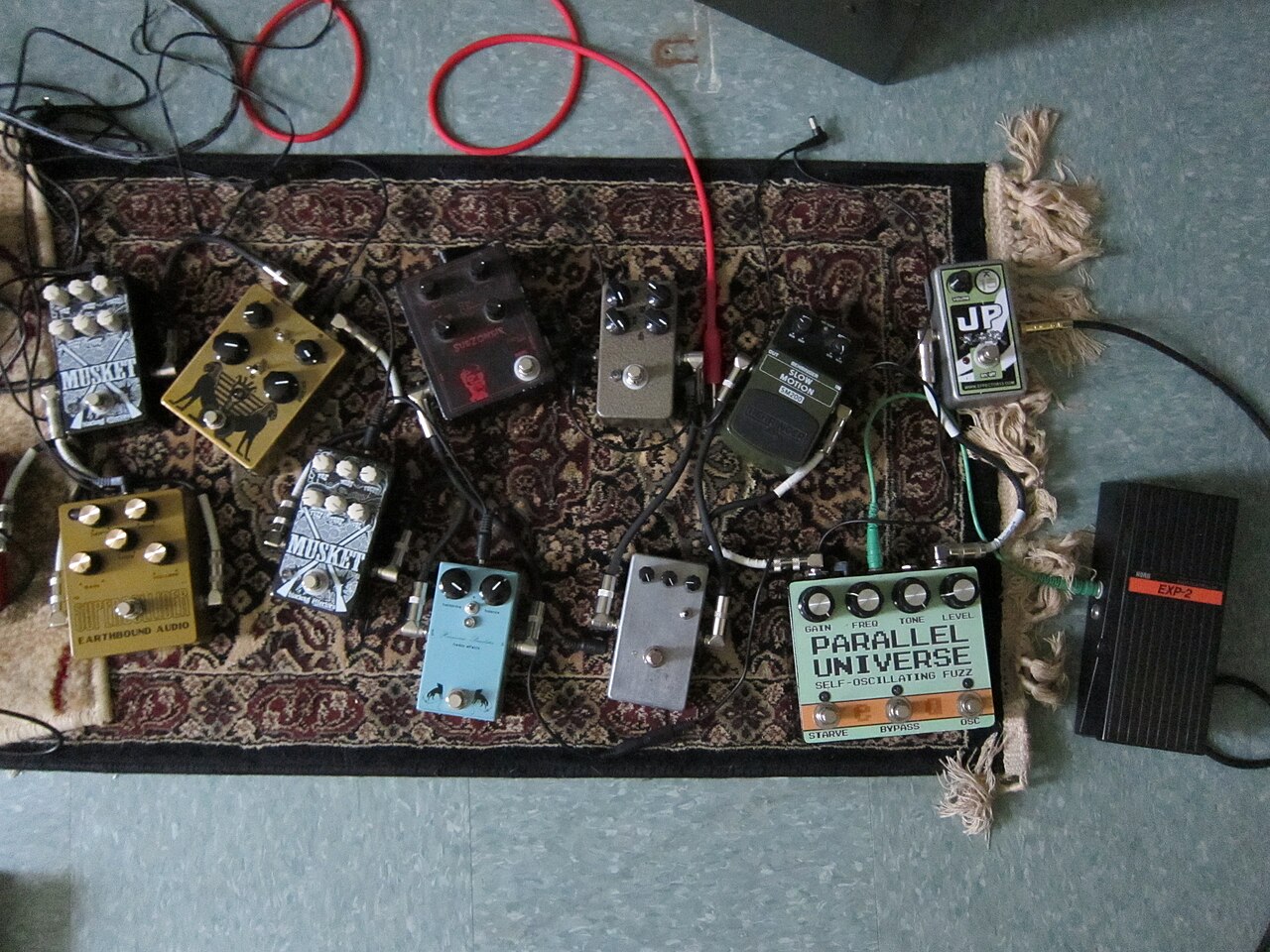
- Guitar pedals on a rug: Oldangelmidnight from Northampton, MA, Wikimedia Commons, CC BY-SA 2.0.
- Tom Morello: deep ghosh, Wikimedia Commons, CC BY 2.0.
- Top image: DigiTech Whammy V, photographed 9 June 2020. Photo: marcelodonati. Source photograph · CC BY 2.0. Existing Commons crop by Skimel, extracted from “PEDALBOARD MAIO 2020”, used unchanged by GuitarGangsters.
Latest News
Related
On This Day
Monday 9 November
From this week: