Seven Ways to Warp Reality: Inside the Boss PH-3 Phase Shifter
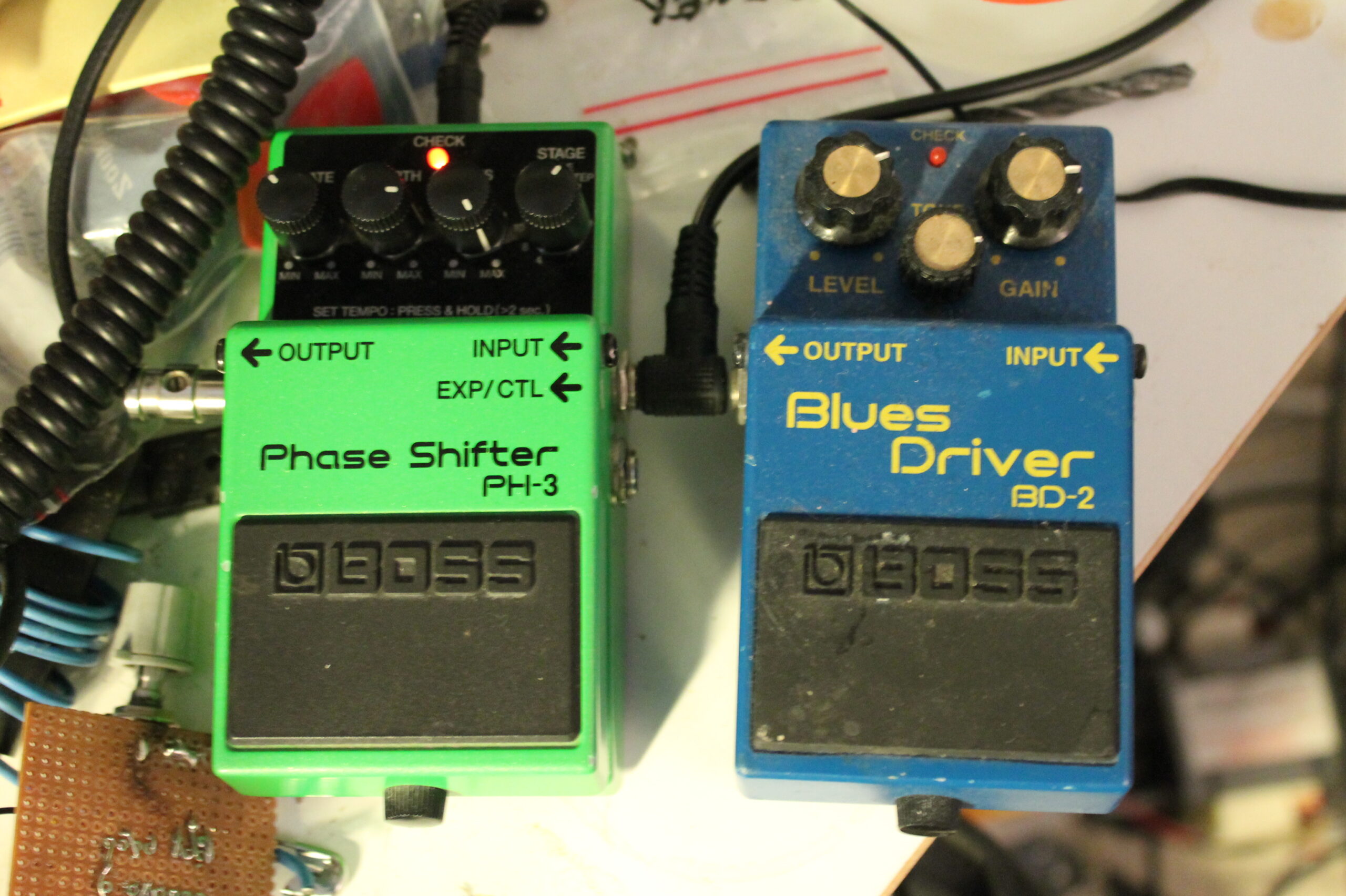
Boss PH-3 Phase Shifter (left) beside a Boss BD-2 Blues Driver (right), photographed 20 February 2013. Photo: ZngZng. CC BY-SA 3.0 (https://creativecommons.org/licenses/by-sa/3.0/). Full source frame retained; resized web versions are licensed under CC BY-SA 3.0. No crop or retouching. Source: https://commons.wikimedia.org/wiki/File:Boss_FX.JPG
The Boss PH-3 packs 7 phaser modes into one compact pedal — from classic 4-stage to radical Step mode. Complete tone guide, settings, and buying advice.
When Boss released the PH-3 Phase Shifter in October 2000, they made a decision that would have horrified analog purists: they killed the analog phaser. The beloved PH-2 Super Phaser — a lush, two-mode, twelve-stage analog machine that had defined the company’s phaser legacy since 1984 — was quietly discontinued in March 2001, just a few months after the PH-3 arrived. Boss wasn’t replacing one analog phaser with another. They were replacing analog phasing with something fundamentally different.
The result, over two decades later, is arguably the highest-selling phaser pedal in guitar history. Boss says so themselves — a claim that becomes easier to accept when you understand what the PH-3 actually does. Where its predecessors offered one or two character modes within an analog circuit, the PH-3 packs seven discrete phaser types into a single compact pedal. Not seven flavors of the same effect — seven architecturally different approaches to phase shifting, from the classic 4-stage sweep that defined the effect in the 1970s to the utterly alien Step mode that sounds like nothing analog has ever managed. The PH-3 is not a vintage-correct analog phaser. It is something more ambitious and, in its own terms, more successful.
From Hammond Cabinets to Digital Versatility: The Boss Phaser Story
The phaser pedal was born from a desire to replicate the sound of the Hammond organ’s rotating Leslie cabinet on guitar. When Boss released its first three compact pedals in November 1977, one of them was the PH-1 Phaser — a simple two-knob, 4-stage analog circuit with controls for Rate and Depth. The PH-1 was designed with Leslie emulation in mind, but guitarists immediately recognized that the slow, undulating sweep of a phaser had its own distinct character that had nothing to do with organ. The effect spread into rock, funk, new wave, and progressive music through the late 1970s on its own merits.
The PH-1R arrived next, adding a Resonance control that allowed players to supercharge the feedback in the phaser circuit, turning the gentle sweep into something more aggressive and pronounced. Then in 1984, the PH-2 Super Phaser took the concept into deeper territory with twelve stages of adjustment and two modes: a standard phasing mode and a deeper, richer mode suited to the New Wave sounds of the era. The PH-2 stayed in production for seventeen years — a remarkable run that ended only when Boss had something genuinely better to offer.
That something was the PH-3, introduced in October 2000 as Boss’s first digital phaser. The decision to go digital was deliberate and consequential. Analog phaser circuits, however warm and characterful, are constrained by their physical components. The number of stages, the sweep range, the behavior of the LFO — these are all determined by the circuit itself. A digital phaser answers to no such constraints. You can implement a 4-stage phaser and a 12-stage phaser in the same circuit simply by changing the processing parameters. You can create modulation behaviors that have no analog equivalent at all. The PH-3’s seven modes are a direct expression of this freedom.
What the PH-3 Phase Shifter Actually Does
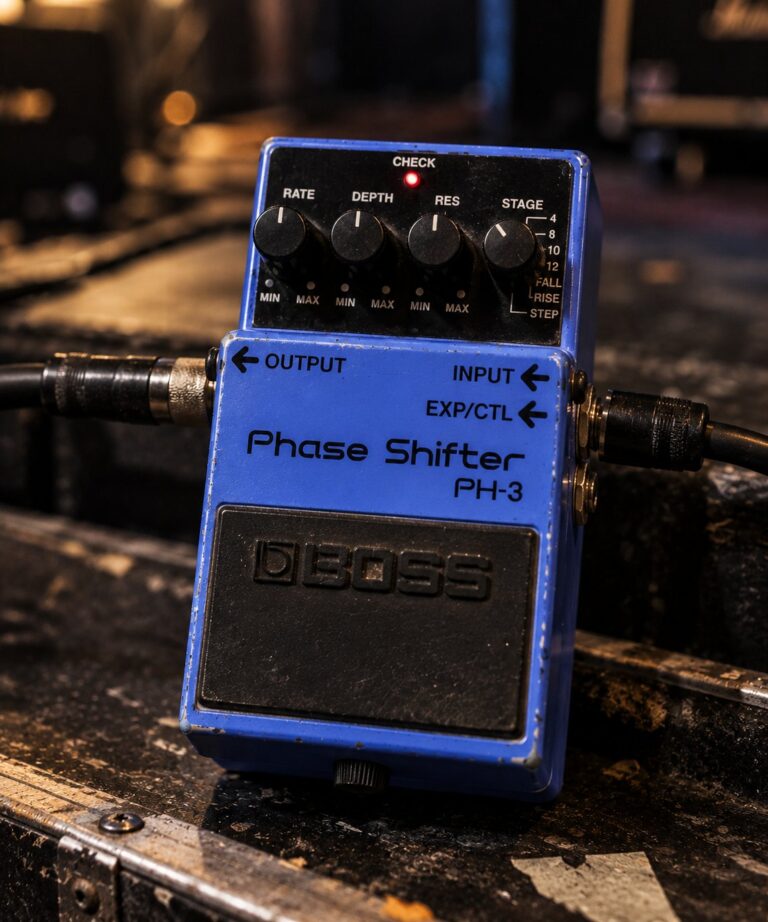
The PH-3 is a compact pedal in the standard Boss format — 73mm wide, 129mm deep, 59mm tall — powered by a 9V battery or PSA-series adapter at 40mA. It sits comfortably in the Boss compact family, drawing more current than the simpler drive pedals but less than the high-current modulation heavyweights like the DC-2W Dimension C. Battery life is approximately 9.5 hours on alkaline, which is genuinely reasonable for live use.
The control layout gives you Rate, Depth, and Resonance — the three classic phaser parameters — plus a seven-position STAGE rotary switch that selects between the pedal’s effect modes. There is also an EXP/CTL jack for connecting an optional expression pedal, which gives real-time foot control over Rate, Filter, or Tempo depending on configuration. A tap tempo function is built into the footswitch: hold it down for more than two seconds and the pedal locks the Rate to whatever tempo you tap. This is not a gimmick — syncing phaser sweeps to song tempo can transform the effect from atmospheric texture into something rhythmically precise and musically structured.
The input impedance is 1MΩ (standard Boss) and output impedance is 1kΩ. The bypass is buffered — Boss FET buffered bypass as with all Boss compact pedals. The signal passes through a low-impedance buffer even when the effect is off, which is relevant for anyone considering chain position relative to germanium fuzz pedals or other impedance-sensitive circuits.
The Seven Modes: A Field Guide
The seven-position STAGE switch is the heart of the PH-3, and each position deserves independent consideration.
4-Stage is the most familiar phaser character — the classic sound of the original PH-1 and the vast majority of analog phasers ever made. Four all-pass filter stages create a notch sweep that is open, warm, and immediately recognizable. With Rate set low, it produces the slow “breathing” effect associated with early 1970s rock and funk guitar. Faster settings create the more agitated, rotor-like sweep used in new wave and psychedelic contexts. This mode is the PH-3’s most vintage-referenced setting, and it is extraordinarily good at what it does.
8-Stage deepens the effect noticeably. More filter stages means more notches in the frequency response, which translates to a thicker, more pronounced phasing sweep. The character shifts toward the lush, complex modulation associated with later-period analog phasers and boutique phaser circuits. Players who find 4-stage slightly thin often settle here.
10-Stage takes the density further. At this point the phasing is genuinely lush and multi-layered in a way that would be extraordinarily difficult to achieve in a purely analog design at this price point. The effect has weight and presence without becoming muddy.
12-Stage is the most complex phasing mode — the maximum density setting, comparable to the deeper mode of the old PH-2 Super Phaser but with greater control over depth and resonance. This is progressive rock and ambient territory: big, orchestral phasing that dominates the sonic picture rather than subtly decorating it.
Rise and Fall are the PH-3’s genuinely innovative contributions. Standard phasing sweeps up and then down in a continuous cycle — the LFO oscillates symmetrically. Rise and Fall modes break this symmetry by creating unidirectional sweeps. Rise mode continuously sweeps upward and then resets, creating a sense of perpetual ascent. Fall mode sweeps downward continuously, creating a sensation of endless descent. These sounds have no real analog equivalent and are distinctive enough to function as compositional elements rather than just textural enhancements. Applied to a clean guitar with high Resonance and moderate Rate, Rise mode can sound like a signal being beamed into deep space.
Step mode is the most radical departure from conventional phasing. Rather than a continuous sweep, Step mode quantizes the phaser’s filter position into discrete steps that jump abruptly between positions. The result is something between a rhythmic envelope filter and a keyboard arpeggiator — a non-linear, stutter-like modulation that has no precedent in analog phaser design. At low Rate settings, Step mode produces measured, deliberate jumps that can sync effectively with a tempo. At high Rate settings, the jumps become rapid and unpredictable. This is not everyone’s idea of a guitar effect, but it is something genuinely new, and it works well in industrial, electronic, and experimental contexts.
Specs at a Glance
| Parameter | Specification |
|---|---|
| Released | October 2000 |
| Status | In production (2026) |
| Circuit type | Digital phaser |
| Modes | 4-Stage, 8-Stage, 10-Stage, 12-Stage, Rise, Fall, Step (7 total) |
| Controls | RATE, DEPTH, RES (Resonance), STAGE switch, Pedal switch |
| Expression input | EXP/CTL jack — controls Rate, Filter, or Tempo |
| Tap tempo | Yes (hold footswitch >2 seconds) |
| Bypass | Buffered bypass |
| Current draw | 40 mA at 9V DC |
| Battery life | ~9.5 hours alkaline |
| Input impedance | 1 MΩ |
| Output impedance | 1 kΩ |
| Dimensions | 73 × 129 × 59 mm (standard Boss compact) |
| Weight | 420 g (15 oz) with battery |
| Price new | ~$100–161 USD (2026) |
| Price used | ~$50–80 USD (excellent condition) |
| Warranty | Boss 5-year |
Famous Players: Who Actually Uses the PH-3
The PH-3 is documented on Equipboard with approximately 90 professional users, which sounds impressive, but Equipboard community listings are not primary sources. What matters is where we can point to interviews, Rig Rundown videos, or verified pedalboard photographs with the PH-3 specifically identified.
The clearest confirmed connection belongs to Robert Smith of The Cure, and it comes from an unusually well-documented source. Guitar World’s November 2024 feature on Smith’s rig for “Songs of a Lost World” — the photography and gear documentation accompanying the cover story — catalogued his pedalboard setup in detail. Smith’s approach to guitar gear is famously unorthodox: he uses exclusively Boss compact pedals, mounted on plastic Boss BCB-series pedalboards, powered by wall-wart adapters, running into Roland Cube amplifiers. The November 2024 documentation listed his pedalboard as including, among other items, a PH-3 Phase Shifter alongside his trio of Boss BF-3 Flangers. This is the same rig documentation that confirmed his BF-3 usage — the two pedals coexist on the same boards.
For Smith, the PH-3 fits naturally into a pedalboard philosophy built entirely around Boss’s compact range. The PH-3 is not his most prominent effect — the flangers are the modulation signatures of The Cure’s guitar sound — but the phaser serves the same atmospheric function within the all-Boss ecosystem that a boutique phaser would serve in any other player’s rig. Smith’s approach is intentionally spartan: every pedal on the board is doing a specific job, and the PH-3’s job is phasing. That it costs a fraction of what boutique alternatives command is entirely consistent with Smith’s documented indifference to gear prestige.
The Smashing Pumpkins’ use of Boss phase pedals across various eras is also documented, though the specifics require care. A 2012 Premier Guitar Rig Rundown with Billy Corgan during the Oceania tour documented his pedalboard as including a Boss PS-2 Phase Shifter — not a PH-3. Corgan uses different rigs for different tours, and community databases including the Smashing Pumpkins Equipment Archive at spfc.org list PH-3 usage in other documented configurations. But the primary-source confirmation for that specific model is less clean than for Smith, and the 2012 Rig Rundown specifically names the PS-2. Corgan’s relationship with Boss phase pedals is real and well-documented; the specific model attribution requires verification against each individual tour rig.
Among the broader pool of Equipboard-documented PH-3 users, Graham Coxon of Blur and Daron Malakian of System of a Down and Scars on Broadway appear as confirmed users in community documentation. Both are players whose known affinity for Boss pedals makes the association plausible, but independent primary-source verification — a Rig Rundown video naming the PH-3, or a studio interview quote — would strengthen these attributions. We note them as Equipboard-documented users rather than independently verified players.
What is genuinely true of the PH-3 is that it is the kind of pedal that works quietly in the background. Phasing rarely announces itself the way fuzz, wah, or heavy delay does. Players who use the PH-3 often do so as ambient texture — a slow, gentle sweep running at low depth under clean guitar that adds movement without calling attention to itself. This makes the PH-3 harder to catalog from listening to records alone, and probably underrepresents its actual prevalence on professional pedalboards.
Five Tone Recipes
1. Robert Smith Atmospheric Texture (4-Stage, very slow)
Mode: 4-Stage. Rate: 8 o’clock. Depth: 9 o’clock. Resonance: 10 o’clock. This is the PH-3 at its most invisible — a slow, gentle sweep that adds movement to clean guitar without announcing itself as a phaser effect. At this setting the modulation is felt more than heard, creating the subtle sense that the guitar’s frequency content is breathing. Run through a Fender Deluxe Reverb with the reverb at moderate depth, using a Fender Stratocaster on the bridge or middle pickup. This is phasing as texture rather than effect, which is how Smith deploys it in the context of The Cure’s soundscapes.
2. Classic 4-Stage Sweep (vintage phaser reference)
Mode: 4-Stage. Rate: 10 o’clock. Depth: 2 o’clock. Resonance: 11 o’clock. This is the PH-3 doing its best impression of a vintage analog phaser — the slow, hypnotic sweep associated with 1970s rock guitar, Eddie Van Halen’s clean playing, and early new wave. The Depth here is high enough that the sweep is clearly present and musical without becoming an obvious special effect. Adjust Rate to taste: slower for ambient ballads, faster for more agitated rhythmic contexts.
3. Thick 12-Stage Orchestral Phase
Mode: 12-Stage. Rate: 9 o’clock. Depth: 1 o’clock. Resonance: 2 o’clock. Twelve stages of phase shifting produce a dense, orchestral sweep that sits between a phaser and a flanger in character. The higher Resonance here emphasizes the notch filtering, adding a slightly metallic, laser-like quality to the top end of the sweep. This is a dramatic effect best used in sections rather than throughout entire songs — into a clean or lightly overdriven amp, single-note melodies through this setting acquire an almost synthesizer-like presence.
4. Rise Mode Deep Space
Mode: Rise. Rate: 8–9 o’clock. Depth: 2 o’clock. Resonance: 3 o’clock. With the Rate set slow and the Resonance pushed high, Rise mode creates a continuous ascending sweep that sounds like signal being transmitted into orbit. The high Resonance setting makes each sweep pass through a dramatic peak before resetting and starting the ascent again. This setting works exceptionally well with volume swells — engage the pedal as you bring up the volume from zero, and the ascending phaser sweep becomes part of the attack envelope of the note. Into a clean amp with some spring reverb, this is psychedelic ambient territory.
5. Step Mode Rhythmic Stutter
Mode: Step. Rate: 10–11 o’clock. Depth: 2 o’clock. Resonance: 12 o’clock. Step mode at a moderate Rate produces rhythmic jumps in the filter position that create a machine-like rhythmic accent pattern. This setting works best with the tap tempo function — hold the footswitch to set the pedal’s Rate to your song’s tempo, then the Step jumps fall on beats or subdivisions rather than at arbitrary intervals. Into a heavily distorted Marshall JCM800, Step mode adds an industrial, syncopated quality that has no analog equivalent. It is the mode most likely to polarize listeners — some find it genuinely creative, others find it gimmicky — but on the right track it is unlike anything a conventional phaser can produce.

These settings use the Boss convention of describing knob positions as clock hours (7 = fully counterclockwise, 5 = fully clockwise, 12 = noon).
How the PH-3 Compares
PH-3 vs. MXR Phase 90
The Phase 90 is the most iconic analog phaser in rock history — a single-knob, 4-stage pedal whose simplicity is both its greatest strength and its fundamental limitation. The Phase 90’s circuit character is warm, slightly mid-forward, and completely characteristic: it sounds like a Phase 90 in the best possible way. The PH-3’s 4-Stage mode can approximate the Phase 90’s character, but it cannot replicate the Phase 90’s analog warmth with complete accuracy. What the PH-3 offers in return is the other six modes, the expression pedal input, the tap tempo, and the greater parametric control over Depth and Resonance. If you want specifically a Phase 90 sound, buy a Phase 90. If you want a phaser that can do many more things including a reasonable approximation of the Phase 90, the PH-3 is the rational choice.
PH-3 vs. Electro-Harmonix Small Stone
The Small Stone is another legendary analog phaser — older than Boss’s entire phaser lineup — with a distinctly goopy, filtering character and a color switch that adds feedback. Where the Phase 90 is slightly bright and articulate, the Small Stone is thick and liquid. The PH-3 occupies a different position: cleaner, more controlled, and dramatically more versatile. The Small Stone’s character is irreplaceable for players who specifically want that tone, but it does nothing the PH-3 cannot approximate, while the PH-3 does much that the Small Stone cannot touch at all.
PH-3 vs. Boss PH-2 Super Phaser (vintage)
The PH-2 that the PH-3 replaced is a genuinely different pedal — not better or worse, but different in character. The PH-2’s analog BBD circuit has the warmth and organic feel of analog modulation; its frequency response behaves in ways that are subtle, complex, and difficult to quantify. The PH-3 is cleaner, more precise, and more consistent. Vintage PH-2 units in good condition command $60–100 on the used market, which is comparable to a used PH-3. The choice between them is the same choice that runs through Boss’s entire catalog: analog warmth and character versus digital precision and versatility.
PH-3 vs. TC Electronic Helix Phaser
The Helix Phaser is TC’s digital competitor in the comprehensive phaser category — multiple modes, expression pedal support, tap tempo, and TonePrint programmability via the TC app. The Helix offers true bypass where the PH-3 offers buffered bypass, which some players prefer for passive-electronics signal preservation. TonePrint allows custom firmware tones downloaded from TC’s library. The PH-3 has no equivalent customization capability but offers the EXP/CTL input and the proven Boss build quality. Both are strong choices; the preference often comes down to chain philosophy (buffered vs. true bypass) and whether TonePrint programmability is relevant to your workflow.
Buying the Boss PH-3: What to Know
The PH-3 has been in continuous production since October 2000 — over twenty-five years of essentially unchanged design. Unlike the BF-2 Flanger (which had distinct Japanese and Taiwanese manufacturing phases with audible differences) or the CH-1 Super Chorus (which transitioned from analog BBD to digital circuit in 2001), the PH-3 is and has always been a digital circuit. There are no manufacturing variants that affect tone. A PH-3 purchased today is functionally identical in sound to one purchased in 2003. This is both the digital design’s great advantage and its great equalizer for the used market.
New street prices in 2026 range from approximately $100 to $161 USD depending on retailer, with the $100–120 range being the most common. Sweetwater lists the PH-3 at $160.99; discounting at major retailers regularly brings this below $130. Used units in excellent condition typically sell for $50–80 USD on Reverb — a significant saving for a pedal that sounds identical regardless of year of manufacture.
When buying used, inspect the STAGE rotary switch carefully. This is a multi-position rotary knob that gets more use than the individual pot controls; worn or intermittent contact at specific positions is the most likely failure mode on older units. Test all seven positions sequentially and verify clean contact in each. The EXP/CTL jack is worth testing with an expression pedal if possible, as TRS jacks can develop intermittent contact from moisture or dust. Beyond these points, the PH-3 is built to Boss’s standard durability specifications and extremely unlikely to fail on an otherwise well-maintained unit.
Living with the PH-3
The PH-3’s 40mA current draw is moderate — well within the capacity of any standard isolated power supply, and compatible with daisy-chain setups when combined with lower-draw pedals. An isolated 100mA output is always preferable, but the PH-3’s 40mA is not the kind of draw that creates problems in typical pedalboard configurations the way that 60mA+ pedals can.
The buffered bypass means that the PH-3 should come after any impedance-sensitive pedals — germanium fuzz pedals in particular work best when they see the guitar’s passive pickups directly, not through any buffer. If you run a germanium fuzz (or a treble booster that expects unbuffered input), place it before the PH-3 in the chain. For all other standard pedal types — Ibanez TS9 Tube Screamer style overdrives, Dunlop Cry Baby Wah (which includes its own buffer), Boss drives — the PH-3’s buffered bypass is not a concern.
Phaser placement in the signal chain has no single correct answer. Conventionally, modulation effects go after drive pedals in the chain, allowing the phaser to process the already-distorted signal and sweep through its notch frequencies across the full harmonic content of the driven sound. This produces the “classic” phased drive tone. Placing the PH-3 before overdrives produces a different result — the phaser modulates the clean guitar signal, and the overdrive then processes a signal that already has the phaser’s notch filtering applied. The two approaches are not better or worse; they are genuinely different sounds. Before-overdrive phasing tends to produce a slightly more transparent modulation effect that lives inside the distortion rather than sitting on top of it.
For players using the tap tempo feature: remember that the STAGE switch controls not just which mode you’re in but also the response of the tap function. In standard stage modes, tap tempo sets the Rate of the oscillation. In Step mode, tap tempo governs the step rate — how quickly the filter position jumps between steps. Programming the step rate to a song’s tempo in Step mode can create remarkably precise rhythmic effects that would be difficult to achieve by manually dialing the Rate knob.
Frequently Asked Questions
Is the Boss PH-3 an analog phaser?
No. The PH-3 is a digital phaser — the first digital phaser in Boss’s compact lineup, released in October 2000. Its predecessors, the PH-1, PH-1R, and PH-2, were all analog designs. The digital circuit enables the PH-3’s seven modes, including Rise, Fall, and Step, which are not achievable in practical analog designs. Whether you prefer analog warmth or digital versatility is a matter of taste, but the PH-3 is unambiguously a digital pedal and makes no claim to be otherwise.
What is Step mode and how do I use it?
Step mode applies the phase filter in quantized jumps rather than a continuous sweep. Instead of the filter position moving smoothly up and down, it snaps abruptly between set positions. The effect is rhythmic and mechanical — unlike any conventional phaser sound. Use it with the tap tempo function to sync the step rate to your song’s tempo, and experiment with Rate and Depth to control how dramatic the jumps are. Lower Depth settings make the steps more subtle; higher Depth with moderate Rate produces the most dramatic rhythmic effect. It works particularly well in industrial, post-punk, and experimental contexts.
What is the difference between Rise and Fall modes?
Standard phase shifters use an LFO that oscillates symmetrically — the sweep goes up, reaches its peak, then comes back down, continuously cycling. Rise mode creates a continuously ascending sweep that never descends — it reaches the top of its range and then resets to the bottom to begin ascending again. Fall mode is the inverse: perpetually descending. The audible result is a sense of constant directional motion that has no equivalent in standard phasing. Rise mode creates a sensation of perpetual ascent; Fall mode creates a sense of endless descent. Both are most effective at moderate to slow Rate settings where the directional motion is clearly perceptible.
Can I use an expression pedal with the PH-3?
Yes. The EXP/CTL jack accepts a standard TRS expression pedal (Boss EV-5 or equivalent) or a control switch. An expression pedal connected to this jack can control the Rate, Filter position, or Tempo in real time. Rate control allows you to sweep from slow phasing to fast phasing with your foot — the equivalent of the “auto-wah with your foot” concept applied to phasing. Filter control lets you manually scan the phaser sweep position rather than having the LFO do it automatically. Refer to the Boss PH-3 owner’s manual for the specific connection procedure, as the behavior depends on how the expression pedal is configured.
How does the PH-3 compare to the vintage PH-2 it replaced?
They are genuinely different tools. The PH-2 is an analog BBD phaser with the warmth and organic character of analog modulation — it has a specific texture that many players love and that cannot be perfectly replicated digitally. The PH-3 is cleaner, more precise, and vastly more versatile: where the PH-2 had two modes, the PH-3 has seven, including effects that have no analog equivalent. Neither is strictly better. Players who need specifically the PH-2’s analog character should seek out a vintage unit; players who want maximum versatility in a single phaser should choose the PH-3.
What is the best way to position the PH-3 in a signal chain?
The conventional position is after drive pedals and before delay and reverb. This allows phasing to operate on the full harmonic content of a driven signal, with reverb and delay placed after to add space around the phased tone. However, placing the PH-3 before overdrives produces a different but equally valid sound — the overdrive then processes an already-phased signal, which tends to embed the modulation inside the distortion rather than layering it on top. If you use germanium fuzz pedals, place those before the PH-3 to avoid impedance loading from the PH-3’s buffered input.
Is the PH-3 suitable for bass guitar?
The PH-3 works on bass but was not specifically designed for it — there is no dedicated bass input as on the Boss BF-3 Flanger. The standard 1MΩ input impedance is appropriate for bass, and phasing on bass can produce excellent results, particularly in funk and R&B contexts. The 4-Stage and 8-Stage modes tend to work best on bass, as the higher-stage modes can sometimes interact awkwardly with bass frequencies. The Step mode on bass creates an unusually dramatic rhythmic effect that is worth exploring specifically for studio applications.
Does the PH-3 work well with drop tunings and extended-range guitars?
Yes, without specific caveats. Unlike some pedals that struggle with extended low-end content, the PH-3’s digital design handles the full frequency range of 7- and 8-string guitars cleanly. The step mode and 12-stage mode can produce particularly interesting results on extended-range guitars playing in the lower register, where the phase filtering operates on fundamentals that analog phasers can sometimes struggle to process without muddiness.
Image credits
- Robert Smith: Bill Ebbesen, Wikimedia Commons, CC BY-SA 3.0.
- Top image: Boss PH-3 Phase Shifter (left) beside a Boss BD-2 Blues Driver (right), photographed 20 February 2013. Photo: ZngZng. Source contributor · Source photograph · CC BY-SA 3.0. Full source frame retained; resized web versions are licensed under CC BY-SA 3.0. No crop or retouching.
- Boss PH-3 Phase Shifter: GuitarGangsters AI-generated reference illustration, not a photograph.
Latest News
Related
On This Day
Thursday 12 November
From this week: