Boss SY-1 Synthesizer: The Guitar-to-Synth Pedal That Actually Delivers
Boss SY-1 Synthesizer: 121 polyphonic synth sounds, latency-free tracking, parallel send/return loop. Specs, settings, and buying guide for guitarists.
You’ve heard the pitch a hundred times. Strap on your guitar, stomp a pedal, and suddenly you’re a keyboard player. The reality, historically, has been tracking lag, monophonic misery, and sounds that belong in a 1983 dental waiting room. The Boss SY-1 Synthesizer, announced at Summer NAMM in July 2019, changed the conversation. Built on the same DSP foundation as the full-size SY-300 rack processor, squeezed into a standard Boss compact enclosure, and priced at $199.99 — it made guitar synthesis genuinely playable for the first time at a pedalboard-friendly price point.
The SY-1 doesn’t try to be a MIDI controller or a pitch-to-CV converter. It doesn’t require a GK-3 divided pickup or a hex cable. You plug your guitar into it like any other stompbox, and you get 121 polyphonic synth voices that track your playing in real time with essentially no perceptible latency. Single notes, chords, raked arpeggios — all tracked. That’s the headline, and for once the headline is true.
This isn’t a review. This is a complete breakdown of what the SY-1 actually does in a signal chain, what it sounds like across its eleven type categories, how to integrate it with the pedals you already own, and when it’s genuinely the right tool versus when something else will serve you better.
From SY-300 to Compact: The Technology Behind the SY-1
Boss’s guitar synthesizer history stretches back to the Roland GR-500 in 1977, which required a specially modified guitar with a divided pickup. The chain continued through the GR-300 (1980), the GR-700 (1984), the VG-8 (1995), and eventually the SY-300 (2014) — a full-size floor processor with three parallel synthesis engines, no special pickup required, and a price of around $499.
The SY-300 proved that modern DSP could analyze a guitar’s audio signal in real time and generate synthesized sounds without the tracking failures that had plagued earlier systems. Boss engineers were essentially running pitch detection and waveform synthesis simultaneously at audio sample rates, with the detection algorithm fast enough that the human ear perceives no gap. When they developed the SY-1 in 2019, the goal was to distill the core of that technology — polyphonic tracking, latency-free response, authentic synthesis character — into a compact enclosure without the SY-300’s deep programming architecture.
The result is a pedal with no patch memory, no screen, no MIDI. What you get instead is a well-curated library of 121 sounds organized into eleven types, each with eleven variations, and four knobs to shape them in real time. It’s Boss’s philosophy applied to synthesis: make it simple enough that a player can get a great sound in thirty seconds without reading the manual.
The SY-1 debuted alongside a sibling platform context that positions it clearly. Below it in simplicity is nothing — it is the entry point for Boss’s self-contained guitar synthesis. Above it came the SY-200 in 2022, with 200 sounds, more parameter control, and additional connectivity. The SY-1 remains in production as of 2026 and continues to be the default recommendation for guitarists approaching synthesis for the first time.
Boss SY-1 Specifications
Controls Explained: What Each Knob Actually Does
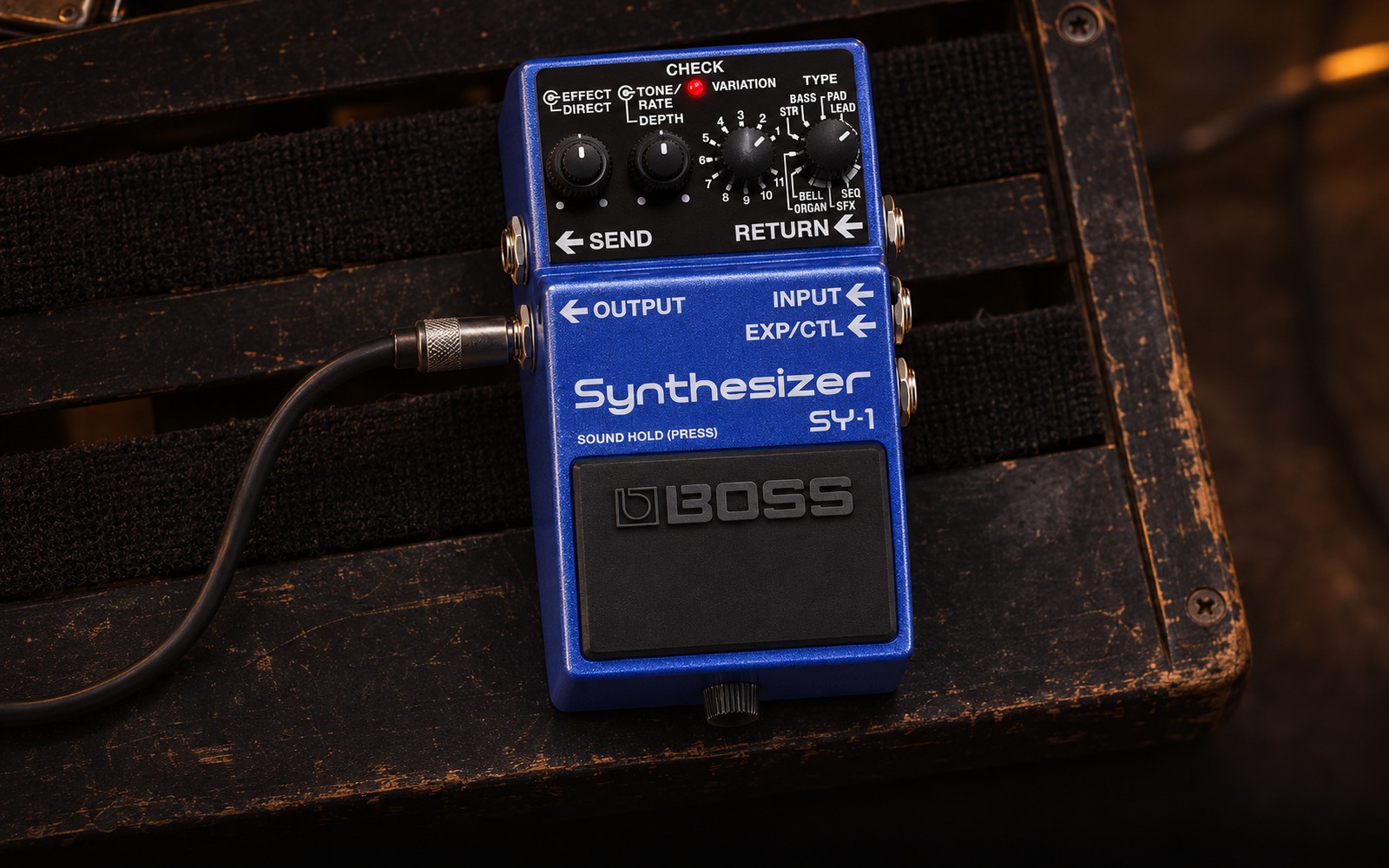
The SY-1’s interface is denser than it looks. Six knobs and a toggle switch control a synthesis engine capable of significant tonal variation, and understanding what each parameter actually affects changes how useful the pedal is.
TYPE selects between the eleven sound categories. LEAD 1 and LEAD 2 cover single-note lead voices — LEAD 1 is brighter and more cutting, LEAD 2 warmer and more legato-friendly. PAD delivers chord-appropriate sounds including layered pads and synth brass. BASS covers filtered and sub-octave synth bass that works remarkably well on guitar when the GUITAR/BASS switch is set to GUITAR. STR produces classic analog strings from tight quartet textures to sweeping orchestral washes. ORGAN is a large selection including many with rotary-style modulation built in. BELL delivers percussive metallic resonance — more Roland JD-800 than vibraphone. SFX 1 and SFX 2 produce one-shot sounds, animated pitch and filter voices, and textures that function as transition effects rather than sustained tones. SEQ 1 and SEQ 2 are the most rhythmically active: pulsating sounds with pitch or filter changes synced to your picking velocity and tempo.
VARIATION steps through the eleven sub-sounds within each type. This isn’t a smooth morph — it’s eleven distinct voices selected with the knob. Some variations within a type are radically different from each other; others are subtle evolutionary steps.
TONE/RATE is the context-sensitive knob. On most sound types it acts as a tone control, shaping the brightness and filter character of the synthesis. On some sounds — particularly the SEQ types and certain BELL and SFX voices — it shifts to a rate parameter, controlling the tempo of rhythmic patterns or the speed of pitch animation. On a handful of sounds it actually shifts pitch, making it function as a coarse tuning control for the synth voice independently of the guitar’s pitch.
DEPTH controls the intensity of modulation applied to the sound — vibrato speed and depth on LEAD voices, the wobble rate of strings, the filter sweep depth on PAD sounds. At minimum it’s clean and unmodulated; at maximum it’s expressive and alive, sometimes excessively so.
EFFECT is simply the synth signal level. This is your primary volume control for how loud the synthesized voice is relative to your overall output.
DIRECT controls the dry guitar signal level. Setting DIRECT to zero gives you pure synth only. Setting it high with EFFECT lower creates a subtle synthesis layer under your guitar sound — useful for adding texture without committing fully to a synth identity.
The GUITAR/BASS switch optimizes the synthesis engine’s pitch detection and harmonic analysis for the instrument connected. Set to GUITAR for six-string electric or acoustic. Set to BASS for four and five-string bass guitars. Running a bass through the GUITAR setting produces muddier tracking; using the BASS setting on a guitar produces thinned-out results. Use the right setting for the instrument in the chain.
The Hold Function and SEND/RETURN Loop: Advanced Routing
Two features separate the SY-1 from a simple stomp-and-play synth pedal: the Hold function and the SEND/RETURN parallel loop.
Hold works by pressing and holding the footswitch while the pedal is engaged. The last-played synth sound sustains indefinitely — including chords — while the pedal effectively passes your live guitar signal through dry. You can then improvise, play riffs, or solo over the held synth pad. This turns the SY-1 into a two-instrument performance tool without a loop station or a second player. For solo guitarists, the Hold function combined with a sustained PAD or STR voice provides an instant bed of texture to play over.
The SEND/RETURN loop is architecturally more interesting. The SEND jack outputs the pure guitar signal (post-tracking) so you can route it through pedals — an overdrive, a wah, a fuzz — and return the processed signal into the RETURN jack. The synthesis engine then processes the combined dry+effect signal and the synth voice is produced at the OUTPUT. This lets you, for example, run an Ibanez TS9 Tube Screamer in the SEND/RETURN loop to add grit to the dry signal alongside the synth voice, all blended at the output. The SEND jack can also be used as a direct out, splitting the guitar and synth to separate amplifier destinations — guitar signal to your standard rig, synth signal to a keyboard amp or PA for a cleaner, fuller sound on both sides.
The EXP/CTL jack accepts a standard TRS expression pedal or Boss footswitch. With an expression pedal connected, you get continuous real-time control of the TONE/RATE parameter — turning the SY-1 into a wah-style filter synth or giving you gradual pitch control on sounds that respond to TONE as pitch. With a Boss FS-5U (unlatching type), you unlock tap tempo for the SEQ sounds, which otherwise use your picking rhythm as tempo reference, and an octave shift function that drops the synth voice an octave instantly.
Famous Players
The Boss SY-1 was positioned as a tool rather than a signature item, which means its player list on Equipboard — 22 documented professional users as of 2026 — skews toward players who value its utility over artists with a marketing relationship with Boss.
Buckethead is the highest-profile artist documented using the SY-1, with a pedalboard photo from a 2022 Praxis show confirming the pedal on his rig. Given Buckethead’s documented history of dense pedalboard construction and sonic experimentation across his prolific solo catalog, the SY-1 fits naturally alongside his approach to guitar-as-instrument-without-genre. The documentation here is community-level photographic evidence, not a formal rig rundown. See also his full Buckethead gear guide for the broader context of his signal chain.
Mike Kerr of Royal Blood appears on the SY-1’s Equipboard listing. Kerr’s documented rig is built around Electro-Harmonix POG2 octave generators that split his bass signal to create a full guitar-and-bass sound without a second player — a famously guarded setup he kept secret for years. Whether the SY-1 appears in his current touring rig is not confirmed by a primary source interview or Premier Guitar Rig Rundown as of this writing. Treat the Equipboard listing as community-level documentation pending verification.
Ola Englund — guitarist for Six Feet Under and previously Feared, and one of YouTube’s most-followed guitar gear educators — is documented as an SY-1 user on Equipboard, with notes referencing its use on a Scar Symmetry recording. Englund’s production work and transparency about his signal chain on his YouTube channel make him a credible community reference even without a formal rig rundown, though again this falls into community-documented rather than primary-source confirmed territory.
The honest takeaway from the SY-1’s player profile is that this is a pedal used by working musicians for specific textural purposes — to add a string pad behind a rock riff, to build a pulsating SEQ voice for a breakdown, to hit a sustained synth chord at the climax of a song — rather than a signature instrument associated with one player’s iconic sound. That’s not a weakness. It’s the right framing for what the pedal is.

Tone Recipes: Seven Settings to Start From
1. The Lush Synth Pad Layer (PAD type)
TYPE: PAD, VARIATION: 3–5 (experiment with the sweeping brass and layered pad voices), TONE: 9–10 o’clock (darker, warmer), DEPTH: 8–9 o’clock (mild modulation), EFFECT: 1 o’clock (synth present but not dominant), DIRECT: 2 o’clock (guitar clearly heard). This setting creates a layered texture under your guitar rather than replacing it — ideal for ambient sections, introspective verses, or playing clean Stratocaster chords with an orchestral swell underneath. Best with your Fender Stratocaster neck pickup and a clean Fender Deluxe Reverb.
2. The Lead Synth Solo Voice (LEAD 1 type)
TYPE: LEAD 1, VARIATION: 1–3 (brighter cutting voices), TONE: 12–2 o’clock (bright, present), DEPTH: 9 o’clock (minimal modulation), EFFECT: max or near-max, DIRECT: zero (pure synth, no dry guitar). This puts you fully in synthesizer territory for single-note lead lines. Slow picking articulation and even pick attack help the tracking read your intentions cleanly. Works particularly well over a verse of riff-based heavy music where a keyboard player would normally take the bridge. The SY-1’s SEND jack routing the synth to a separate keyboard amp at this setting removes any guitar character entirely.
3. Analog Strings Behind Chord Progressions (STR type)
TYPE: STR, VARIATION: 6–8 (fuller, more sustained string textures), TONE: 9 o’clock (warm and dark, not bright), DEPTH: 10–11 o’clock (gentle slow-attack modulation), EFFECT: 10 o’clock, DIRECT: 1 o’clock. Strum clean chord progressions slowly and the SY-1 builds an analog string orchestration under each chord. The modulation at this depth setting creates a natural warmth rather than audible wobble. This is the setting that makes you wish you’d bought this pedal five years ago — classic Mellotron string territory without the Mellotron’s weight, expense, or mechanical unpredictability.
4. The Hold Function Ambient Drone
TYPE: PAD or STR, VARIATION: 5–7, TONE: 8 o’clock (very dark), DEPTH: 12 o’clock, EFFECT: 12 o’clock, DIRECT: 11 o’clock. Play an open-string chord (Em or Asus2 work particularly well), press and hold the footswitch to sustain the synth pad, then let go and play melodic single-note lines over the sustained background. The combination of STR-type sustain and your guitar’s natural decay creates a textured ambient landscape that sounds larger than one player. Pair with the Boss RE-202 Space Echo after the SY-1 for cavernous spatial depth.
5. Organ Drawbar Chords (ORGAN type)
TYPE: ORGAN, VARIATION: 3–5 (rotary-modulated voices), TONE: 11 o’clock, DEPTH: 1–2 o’clock (active rotary modulation), EFFECT: 11–12 o’clock, DIRECT: 9 o’clock. Play short, staccato chord stabs and the SY-1 produces full Hammond-style organ hits with rotary speaker simulation built into the voice. The DEPTH knob at higher settings produces more pronounced rotary movement — useful for gospel-style chord work or psychedelic chord washes. Pick attack matters here: softer attack produces smoother organ swells, harder attack gives you more percussive drawbar realism.
6. Pulsating Sequence Rhythm Texture (SEQ 1 or SEQ 2)
TYPE: SEQ 1, VARIATION: 1–4, TONE/RATE: 2 o’clock (medium-fast rate for the rhythmic pattern), DEPTH: 12 o’clock, EFFECT: 11 o’clock, DIRECT: 12 o’clock. The SEQ sounds generate rhythmic pitch or filter changes against your held notes. Connecting a Boss FS-5U via the EXP/CTL jack unlocks tap tempo, letting you sync the SEQ pattern to a specific BPM before the song starts. Use this setting to create an arpeggiated synthesizer part from simple held chords — something a Minimoog arpeggiator would do, achieved from your guitar without programming. The SEQ voices respond to pick dynamics: softer picking produces subtler pattern expression.
7. Subtle Synth Texture Under Heavy Riffing (BASS type on guitar)
GUITAR/BASS switch: GUITAR (important — stay in guitar mode), TYPE: BASS, VARIATION: 2–4 (filtered synth bass voices), TONE: 10 o’clock (low pass filter closed down), DEPTH: 9 o’clock (minimal), EFFECT: 9 o’clock (low in the mix), DIRECT: max. The BASS type on the GUITAR setting adds a sub-frequency synthesized underpinning to power chord riffing — you still hear your guitar fully (DIRECT at max), but there’s a subsonic synthesizer pulse beneath each note that adds weight without changing the tonal character. Best before a Marshall JCM800 for a riff that fills a room differently than amp-only distortion. Keep the BASS type level conservative; too much EFFECT here makes the low frequencies fight with your amp’s low end rather than complement it.
Pedalboard Placement and Signal Chain Integration
The SY-1’s position in your signal chain matters more than most pedals because of how its tracking algorithm works. The synthesis engine reads the raw guitar signal to determine pitch and dynamics — which means anything that significantly alters the fundamental frequency or attack before the SY-1 will affect how well it tracks.
Practical placement rules: the SY-1 works best directly after your tuner, before any overdrive, distortion, or modulation. A compressor before the SY-1 can actually improve tracking by evening out pick dynamics, but avoid heavy compression that kills the attack transient (the SY-1 uses the attack to detect note onset). Do not place heavy fuzz or high-gain distortion before the SY-1 — the harmonically dense signal confuses the tracking engine and produces garbage output.
After the SY-1, all effects work normally — the OUTPUT is a clean blended signal of dry guitar and synth. Delay and reverb after the SY-1 are both strongly recommended; the Boss RC-500 Loop Station after the SY-1 allows you to loop a Hold-sustained pad and build a performance over it. The Boss RC-5 Loop Station in the same position works for simpler one-track looping over held pads.
The 115mA current draw is moderately high for a compact pedal. It won’t run off daisy chain power — the voltage sag on a daisy chain produces tracking failures and audio artifacts. Use an isolated 150mA+ output from a quality power supply (Strymon Zuma, Cioks DC7, Eventide PowerMax, or equivalent). This is a non-negotiable requirement, not a suggestion.
Boss SY-1 vs. The Alternatives
The SY-1 occupies a specific position in the guitar synthesis market: polyphonic, pickup-agnostic, compact, and under $200 new. Its nearest competitors approach the problem differently enough that the comparison is less “which is better” and more “which fits your use case.”
Boss SY-1 vs. Boss SY-200 (2022, ~$369): The SY-200 is the SY-1’s evolved successor with 200 sounds, additional parameter control per type, a secondary footswitch for more live control, and improved connectivity. If budget allows, the SY-200 is a meaningfully better instrument. The SY-1’s advantage is price, simplicity, and the fact that it was designed with a curated 121-sound library that forces decisive choices rather than an overwhelming catalog.
Boss SY-1 vs. Electro-Harmonix Mel9 (~$192): The Mel9 produces specific Mellotron sample-based textures — strings, choir, flute, brass — sampled from the original tape machine. It doesn’t try to synthesize; it tries to accurately recreate those specific vintage instrument sounds. The SY-1 synthesizes, so its string and organ sounds are synthetically generated rather than sampled. For authentic vintage Mellotron textures the Mel9 wins. For breadth of synthesis types — leads, basses, sequences, SFX — the SY-1 wins.
Boss SY-1 vs. Boss OC-5 Octave (~$149): The OC-5 is not a synthesis pedal — it generates suboctave and superoctave tones from your guitar signal, which creates a fundamentally different sound than the SY-1’s synth voices. The OC-5 sounds like a guitar shifted in octaves; the SY-1 sounds like a synthesizer. Players sometimes choose between them for bass-register textures, but they are not direct substitutes.
Read our guide to the Electro-Harmonix Nano POG.
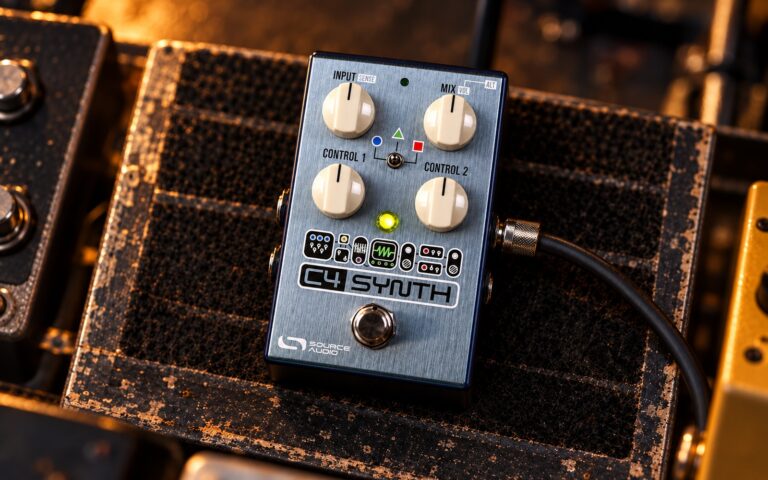
Boss SY-1 vs. Source Audio C4 Synth (~$299): The C4 is a more deeply programmable synthesizer pedal with four synthesis engines, hundreds of presets, MIDI control, and a companion app for deep editing. It can do things the SY-1 cannot — custom envelope shapes, complex modulation routings, LFO-synced filter sweeps. It also takes longer to program and costs $100 more. For players who want to dial in custom synth patches and save them, the C4 wins. For players who want to stomp and play without programming, the SY-1 wins.
Boss SY-1 vs. Boss SY-300 (~$280–350 used): The SY-300 is the SY-1’s predecessor — a large floor processor with three parallel synthesis engines, deep parameter control, MIDI connectivity, and expression pedal integration. It does significantly more than the SY-1. It’s also the size of a multi-effects unit, draws far more current, and requires real programming time. The SY-1 took the SY-300’s tracking technology and simplified the interface radically. For live use on a standard pedalboard, the SY-1’s simplicity is a feature, not a compromise.
Buying Guide: New, Used, and What to Watch For
The Boss SY-1 has been in continuous production since 2019, which means the used market has units across the full age range. Boss compact pedals are mechanically robust — the enclosure, footswitch, and jacks are built to touring standards — so a used SY-1 in excellent condition should perform identically to a new one. There are no known hardware revisions between production runs.
When buying used, check: (1) the GUITAR/BASS toggle switch — this is a physical switch that toggles frequently and can develop contact issues if the pedal has been gigged heavily; (2) the SEND and RETURN jacks — less commonly used jacks sometimes accumulate oxidation; clean with DeoxIT if they show crackle; (3) the EXP/CTL jack — same issue, use a plug and unplug test before purchase.
New retail price is typically $199.99 USD. Used in excellent condition runs $120–155 USD depending on included box and accessories. The price has been stable since introduction. Boss’s 5-year warranty covers new purchases; used units outside the warranty window are unprotected but Boss’s reputation for long-term parts availability means repair is feasible if a jack or switch fails after years of use.
The SY-1 ships with a 9V battery included, which provides approximately two hours of playing time. For rehearsal or gigging, the PSA-series AC adaptor is essential — treating a 115mA pedal as a battery-powered unit is impractical. Budget accordingly.
Ownership Notes: What Nobody Tells You
The SY-1 tracks your picking technique more than any other effect pedal in your chain. Players with inconsistent pick attack — varying the force or angle between notes — will notice the synthesis engine responding differently note-to-note. This isn’t a flaw; it’s accurate synthesis. But it means the SY-1 exposes technical inconsistencies in your playing. Spend time with it on SEQ and LEAD types in particular and you’ll notice where your pick attack varies. Many players who have used the SY-1 regularly report measurable improvements in picking consistency as a side effect.
The TONE/RATE knob behaves differently across types in ways that aren’t obvious from the knob label. Sweep it across the full range when auditioning a new sound variation — you’ll occasionally discover that a sound you dismissed at 12 o’clock becomes a completely different instrument at 8 o’clock. Boss’s manual includes a sound list PDF with notes on what TONE/RATE does for each of the 121 sounds, and that document is worth downloading before writing off any individual voice.
Heavy distortion and high-gain overdrive kill the SY-1’s tracking accuracy — period. If you’re a high-gain player who wants synthesis textures, the SY-1’s SEND/RETURN loop lets you put distortion in the loop, but the synthesis engine itself still reads the clean pre-distortion signal and should track cleanly. This is the correct architecture for high-gain synthesis use.
Guitar-to-keyboard amp routing via the SEND direct out changes the SY-1’s character completely. The synth voices are designed for full-range reproduction — not for the colored frequency response of a guitar cabinet. Running the SEND to a keyboard amp or PA speaker while your guitar goes to your regular rig gives you the truest version of what the synthesis engine produces. The difference is substantial on the PAD, STR, and ORGAN types in particular.
Frequently Asked Questions
Does the Boss SY-1 require a special pickup or cable?
No. The SY-1 uses a standard 1/4-inch cable and works with any electric guitar or bass. No divided pickup, GK connector, or MIDI guitar system is required. This is one of the pedal’s primary advantages over older Boss guitar synthesis systems.
Can the SY-1 track chords, or only single notes?
The SY-1 is polyphonic — it tracks chords as well as single notes. The quality of chord tracking depends on the sound type: LEAD voices designed for single-note solos may sound cluttered on complex chord voicings, while PAD, STR, and ORGAN types are specifically designed for chord use and track them naturally.
How does the Hold function work, exactly?
While the SY-1 is engaged, press and hold the footswitch. The last-played synthesized sound sustains indefinitely as long as you hold the switch. When you release, the pedal remains in Hold mode — the sustained sound continues and your live guitar signal passes through in real time alongside it. Tap the footswitch once to exit Hold and return to normal operation. This allows you to sustain a chord or pad and improvise over it with your normal guitar tone.
What is the SEND/RETURN loop for?
The SEND jack outputs the dry guitar signal before synthesis. You can route this through other pedals — drives, wahs, filters — and return the processed signal via the RETURN jack. The synthesis engine processes the returned signal, and the final OUTPUT blends dry (DIRECT) and synth (EFFECT). The SEND also works as a direct out, letting you route the guitar and synth to completely separate destinations — useful for dual-amplifier or guitar-to-PA setups.
Is 115mA current draw a problem for most pedalboards?
Yes, if you’re using daisy-chain power. The SY-1 requires an isolated power supply output. Most quality pedalboard power supplies (Strymon Zuma, MXR M238, Cioks DC7) include at least one 200mA+ isolated output. Daisy-chain power produces voltage sag that causes tracking failures. Use isolated power exclusively with the SY-1.
What’s the difference between GUITAR and BASS mode?
The GUITAR/BASS toggle optimizes the synthesis engine’s pitch detection algorithm for the fundamental frequency range of each instrument. Guitars and basses overlap significantly but the low fundamental of a bass guitar (typically 40–300Hz for the open strings) is outside the primary range the GUITAR engine is optimized for. Running a bass in GUITAR mode produces degraded tracking — muddy and inconsistent. Running a guitar in BASS mode thins the synthesis output. Use the correct setting for your instrument.
Can I use an expression pedal with the SY-1?
Yes. Connect a TRS expression pedal to the EXP/CTL jack. This gives you continuous real-time control of the TONE/RATE parameter — on most voices this functions as a filter or tone sweep. On SEQ and certain BELL/SFX voices, it controls the animation rate. Boss FV-500H/L, EV-30, and Roland EV-5 are all compatible. The result is a synthesizer voice you can sweep in real time like a wah, which opens up expressive filter control not possible with the fixed knob setting alone.
How does the SY-1 compare to the SY-200?
The SY-200 has 200 sounds (versus 121), additional per-type parameter controls, a second footswitch for more live performance options, and expanded connectivity. It’s a meaningfully more capable instrument at roughly double the price. The SY-1’s advantage is simplicity — fewer parameters means faster sound selection in live situations — and price. Players who want the deepest possible synthesis control from Boss should consider the SY-200. Players who want a reliable, simple synth voice available at a stomp should start with the SY-1.
Image credits
- Top image: GuitarGangsters AI-generated reference illustration, not a photograph.
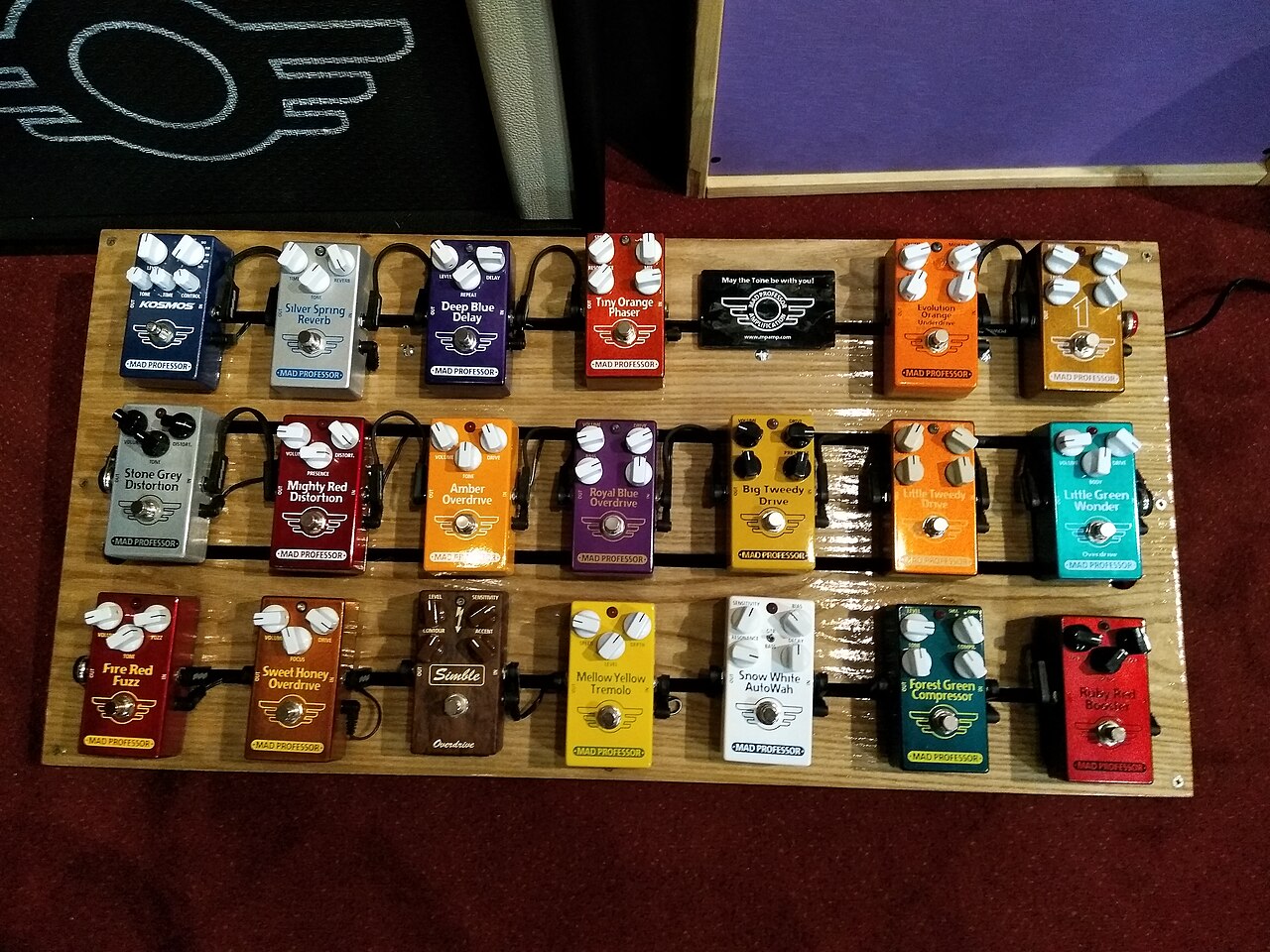
- A pedalboard full of colourful pedals: Skimel, Wikimedia Commons, CC BY-SA 4.0.
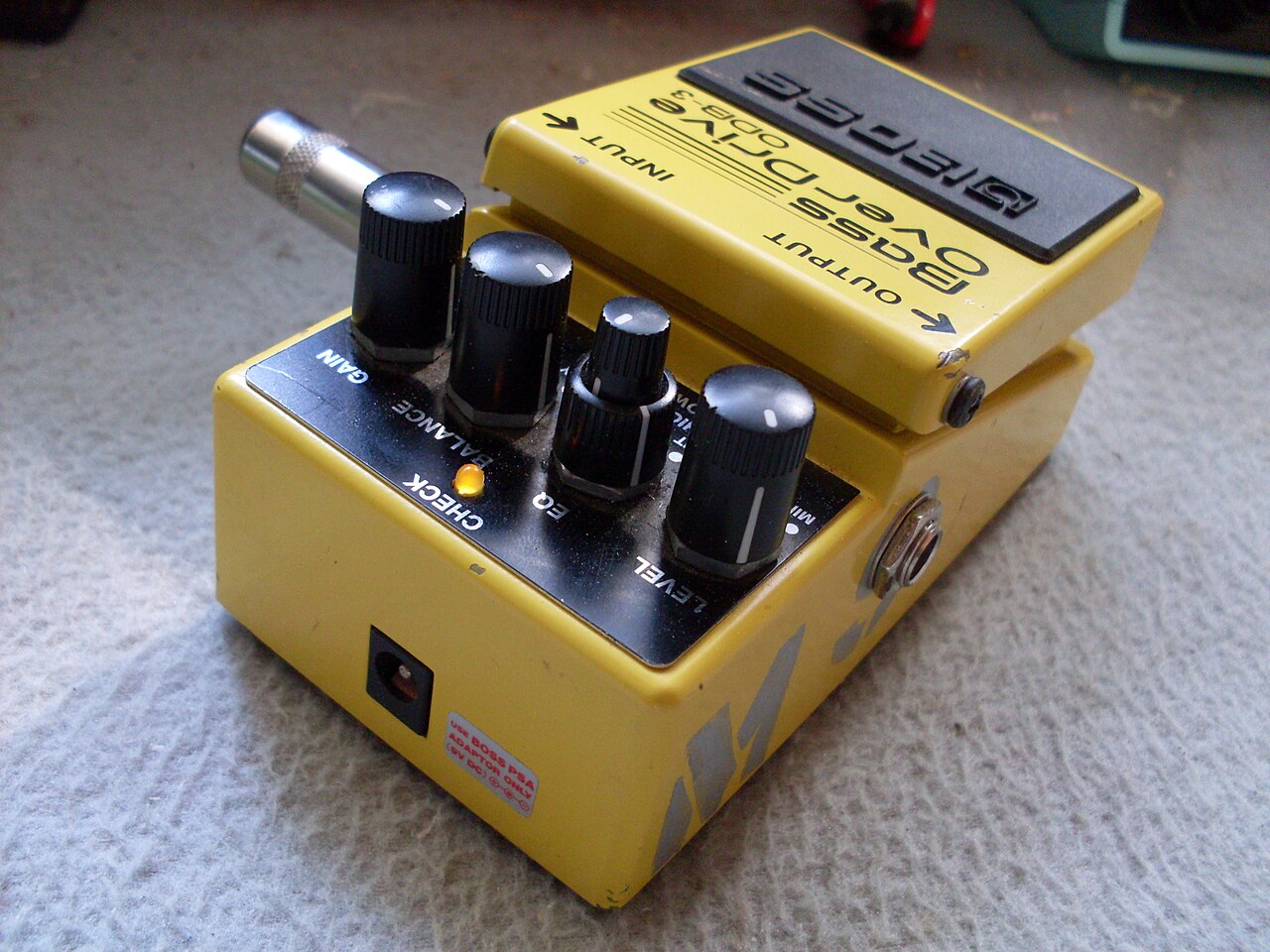
- A Boss ODB-3 bass overdrive pedal seen from the rear: Roadside guitars, Wikimedia Commons, CC BY-SA 2.0.
- Boss OD-2 Turbo Overdrive and OD-2R pedals side by side: Kuriosatempel, Wikimedia Commons, CC BY-SA 4.0.
Latest News
Related
On This Day
Monday 9 November
From this week: