The Whoosh That Launched a Thousand Air-Guitarists: MXR M117R Flanger
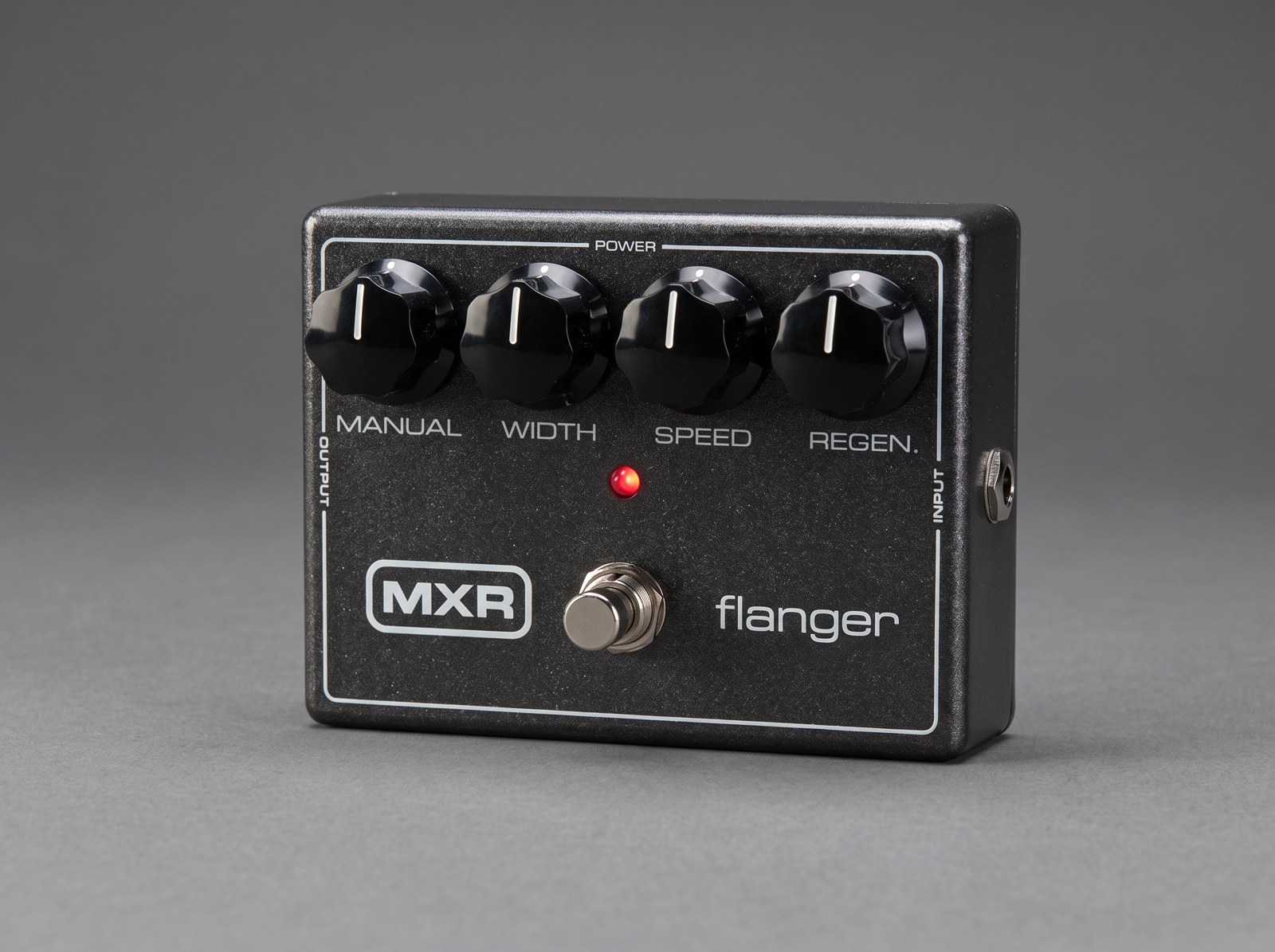
Reference illustration of the model, not a photograph of the player’s equipment.
MXR M117R Flanger guide: EVH settings, verified artists, 7 tone recipes, signal chain placement, and how it compares to Electric Mistress and BF-3.
Before Eddie Van Halen taped it to a piece of plywood with black duct tape somewhere around 1978, the flanger was a studio curiosity — an effect that required two tape machines running in tandem and a producer’s willingness to spend half a session chasing a sound. The MXR M-117 Flanger changed that equation overnight. It put the jet-plane sweep, the queasy time-warp shimmer, and the hypnotic metallic throb into a gray box you could put on the floor and step on. Forty-plus years later, Dunlop’s reissue — the M117R — carries that same bucket-brigade circuit, those same four knobs, and the same capacity to make a guitar sound like it’s simultaneously in the room with you and hurtling through the upper atmosphere at Mach 2. That combination of simplicity and sonic wildness is exactly why the MXR Flanger has never gone out of production, and why it still shows up on serious pedalboards in 2026.
A Brief History of the Swoosh
Flanging as an effect predates guitar pedals by decades. The term itself comes from tape-era studios where engineers would press a finger against the flange of one tape reel to slightly slow it down relative to a duplicate reel playing the same content — the interaction of the two slightly detuned signals produces a comb-filtering effect that sounds like the world is rotating. Les Paul experimented with it. The Beatles’ “Tomorrow Never Knows” used tape flanging. Studios charged accordingly.
MXR changed the access model. Founded in Rochester, New York in 1972, the company built its reputation on dense, no-nonsense stompboxes: the Phase 90, the Dyna Comp, the Distortion+. When their engineers applied bucket-brigade device (BBD) technology to flanging in the mid-1970s, the result was the original M-117 Flanger — a pedal that replicated the tape-flanging effect in real time, triggered by foot, for a fraction of the studio cost. The BBD chip at its heart stores audio samples in capacitors and delays their playback, creating the same short, sweeping delay differential that the tape machines produced. Unlike tape, though, a BBD chip can be swept across its delay range continuously and automatically, controlled by an LFO — which is exactly what the Speed and Width knobs on the M-117 let you do.
The original ran on 18 volts — higher rail voltage than most of its MXR siblings — because the extra headroom allowed the BBD circuit more dynamic range and a lower noise floor. That 18V spec has carried forward unchanged to the M117R reissue, which is one of the reasons Dunlop markets this pedal as a faithful recreation of the original rather than a modernized approximation. The circuit architecture is the same. The character is the same. The controls are the same four knobs, in the same configuration, doing the same things they did when Eddie Van Halen was discovering what happened when you dimed the Regen and chugged an open D chord through a Marshall stack.
Who Actually Played It: Verified Artists
Eddie Van Halen — The Defining User
No conversation about the MXR Flanger happens without Eddie Van Halen, and for good reason. In a 1980 Guitar Player interview with Jas Obrecht, Eddie described his makeshift pedalboard with characteristic directness: “It’s a piece of plywood with two controls for my Echoplex on it, an MXR Phase 90 that I’ve had for years, and an MXR flanger. They’re all taped to a piece of board with black duct tape.” This wasn’t a sponsored arrangement or a record-label endorsement — it was a young guitarist from Pasadena using the tools that sounded right to him. The fact that those tools happened to be MXR’s most interesting designs is a testament to the company’s engineering instincts as much as to Eddie’s ears.

The sounds Van Halen produced with the original M-117 defined what rock flanging meant for the next generation of players. “And the Cradle Will Rock…” from Women and Children First (1980) opens with one of the most recognizable flanged riff introductions in rock history — that churning, metallic sweep over a brutally heavy power chord progression. “Unchained” from the same album features a different application: a tighter, more rhythmically integrated flange effect that seems to breathe with the riff rather than coat it. In a Guitar World interview from 2014, Eddie explained his settings with the kind of precision only someone who’s been playing the same gear for thirty-plus years can provide: “I set the three knobs on the left between 11 o’clock or 11:30, and the last knob on the right is all the way up.”
The M117R is the reissue of exactly that pedal. When Dunlop later worked with Eddie to create the EVH series of signature gear, they developed a separate model — the EVH117 — that added a custom switch dialing instantly to the “Unchained” setting. That pedal is a tribute product. The M117R is the original instrument, in faithful production form, with the same four knobs that Eddie adjusted in dressing rooms and rehearsal spaces across three decades. Eddie Van Halen died on October 6, 2020, but his relationship with this circuit is documented in his own words across multiple decades of interviews. This is as confirmed as guitar history gets.
Kerry King — The Thrash Metal Angle
The MXR Flanger’s reach extended beyond the hard rock world into the emerging heavy metal underground. Kerry King of Slayer has been documented using an MXR Flanger on his pedalboard since the band’s early 1980s days, and the pedal has appeared in subsequent Premier Guitar Rig Rundown coverage of his setup. King’s application is characteristically extreme — where Van Halen used the flanger with musical restraint and dynamic awareness, King deploys it as a textural aggression device, adding a metallic, destabilizing quality to Slayer’s already chaotic sonic landscape. The MXR Flanger on a drop-tuned seven-string through a high-gain amp stack is a different instrument than the same pedal into a modded Marshall in a Pasadena rehearsal room, and Kerry King proved it. The pedal’s ability to function in extreme gain contexts — maintaining its sweep character without dissolving into mud — is one of its genuine engineering achievements.
No Confirmed M117R Connection: Stone Gossard
Various web sources attribute the M117R to Stone Gossard of Pearl Jam, but the documented evidence points to the Ibanez FL-305 Flange with Delay as Gossard’s flanger of choice during the Riot Act era, which is where most of his detailed rig documentation originates. No Premier Guitar Rig Rundown or primary-source interview confirms Gossard on the M117R specifically. He’s a legitimate guitar hero with a documented love of interesting pedals — the attribution has surface plausibility — but surface plausibility isn’t the same as primary-source confirmation. Gossard gets a mention here as a player whose Riot Act-era sonic experiments (particularly the flange-heavy rhythms of that period’s material) represent the kind of musical territory the M117R naturally inhabits, even if his personal flanger of record was a different box.
Specs and Signal Chain Position
Understanding the Four Knobs
Manual is the frequency center control. It determines where along the frequency spectrum the flange effect is anchored when auto-sweep is disengaged. Think of it as selecting which part of the sonic range the comb filtering targets — lower settings emphasize the low-mid frequency sweep; higher settings push it toward the upper harmonics. When auto-sweep is active (Width above zero), Manual serves as the sweep’s center reference point.
Width is the most important operational control on the pedal. Rotate it counterclockwise to zero and the auto-sweep LFO disengages completely — the pedal stops moving on its own and sits at a fixed flange position set by the Manual knob. This is a genuinely useful mode that most players miss: static flange creates a chorus-adjacent thickening effect without the motion, essentially adding a fixed comb-filtering presence to your signal without any audible pulsing. Rotate Width clockwise and you’re introducing automatic sweep, with wider rotation producing a more dramatic sweep range from the effect’s low point to its high point on each LFO cycle.
Speed controls the LFO rate — how fast the sweep cycles from its low extreme to its high extreme and back. At minimum settings, one complete sweep might take ten or fifteen seconds, producing a glacially slow, almost imperceptible movement that works as an always-on subtle thickener. At maximum, you’re in jet-airplane-takeoff territory, with the sweep cycling multiple times per second and producing the rapid, destabilizing wobbly sound that defined early 1980s heavy rock.
Regen (short for regeneration) feeds the wet signal back into the flanger’s input, intensifying the comb-filtering effect and pushing the sound toward more pronounced metallic resonance. Low Regen settings are polite and musical, adding depth without obvious artificiality. High Regen settings are aggressive and distinctive — this is where you dial in that deep, almost machine-like flange character that sounds like the signal is being folded back on itself. Eddie Van Halen’s documented setting has Regen “all the way up,” which explains why his flange sounds as pronounced and self-confident as it does — there’s nothing subtle happening in that circuit when you’re maxing the feedback.

The 18V Power Requirement
The M117R’s 18V power requirement deserves attention before you plug it into a standard 9V daisy chain and wonder why it won’t power on. Two 9V batteries work (the pedal accepts them in series), but for pedalboard use you need an 18V output — the DC Brick, Iso-Brick, and Mini Iso-Brick all have 18V outputs, but not every compact power supply does. The Strymon Zuma, Voodoo Lab Pedal Power 2+, and TrueTone 1 SPOT Pro all offer 18V capability, but budget supplies and basic daisy chains will leave the M117R dead on the board. Check your supply spec before purchase. The 39mA current draw is modest for 18V — any 18V output rated 50mA or higher handles it comfortably.
Signal Chain Placement
Flangers are modulation effects, which means they belong in the modulation slot of a traditional signal chain: after drive pedals, before delay and reverb. The logic is that you want the flanger sweeping a signal that’s already been shaped by gain and EQ, not sweeping raw dynamics that will then get further compressed and filtered by downstream effects. Running drive into flange into delay gives each effect a defined role and a clean input to work with.
The M117R is also worth considering in an effects loop. Many high-gain amplifiers have parallel or series effects loops designed specifically for modulation and time-based effects — routing the M117R through a loop means the amp’s preamp handles gain shaping while the flanger processes the post-preamp signal. The result is often more controlled and musically coherent than running a flanger in front of a high-gain amp stage, where the sweep can interact unpredictably with the preamp’s compression behavior. Kerry King’s use of flanging in extreme-gain contexts speaks to how well the effect can work when the signal chain is organized correctly.
Tone Recipes and Settings
1. The “Unchained” Setting (Van Halen Reference)
This is the documented EVH setup from Guitar World 2014. Manual: 11:00. Width: 11:00–11:30. Speed: 11:00–11:30. Regen: maxed. Into a humbucker-equipped guitar through a high-gain amp with the amp set for substantial saturation. The key is that Eddie ran this into a very loud, very saturated Marshall — the pedal’s sweep is doing work on a signal that’s already complex. At bedroom volumes into a clean amp, the same knob settings will produce a noticeably different result. Adjust to taste, but keep Regen high.
2. The “Cradle Will Rock” Intro Sweep
Manual: 9:00. Width: 2:00. Speed: 8:00. Regen: 3:00. This is a slower, more dramatic sweep that cycles over several seconds, producing the tidal wave quality of the intro riff. Works best with single-note playing or power chords — complex chord voicings blur under this depth of sweep. Let the flanger breathe between picked attacks.
3. Subtle Always-On Thickener
Manual: 12:00. Width: 7:00 (very subtle auto-sweep, nearly at zero). Speed: 9:00. Regen: 9:00. This is the flanger as chorus approximation — a gentle, slow sweep that adds dimensional thickness without calling attention to itself. Useful for clean-channel rhythm playing where you want a shimmer without obvious modulation. Works particularly well with single-coil pickups through a clean Fender-type amp.
4. Static Chorus Mode (Width at Zero)
Manual: 1:00–2:00. Width: 0. Speed: any. Regen: 10:00–11:00. With Width fully counterclockwise, the auto-sweep is off and the Manual knob places the flange effect at a fixed point in the frequency spectrum. This creates a static comb-filter effect that adds harmonic richness without pulsing — a kind of thick, slightly metallic doubling. Experiment with different Manual positions to find the frequency anchor that flatters your guitar’s natural tone.
5. Medium-Speed Rock Flange
Manual: 11:00. Width: 12:00. Speed: 12:00. Regen: 12:00. This is a classic rock flange setting — obvious enough to register as an effect, controlled enough to use under playing rather than as a solo texture. Works for verse-level rhythm flanging where you want the movement to feel musical rather than mechanical. The balanced Regen keeps the feedback from getting self-referential.
6. Thrash Metal Aggression
Manual: 8:00–9:00. Width: 2:00–3:00. Speed: 12:00. Regen: 3:00. Into high gain. Wide sweep, significant Regen, moderate speed — the flange becomes a destabilizing texture that adds metallic instability to down-picked power chords. This is the Kerry King direction: using flanging not as a melodic decoration but as a component of sonic aggression. Best in an effects loop to keep the high-gain amp stage from compressing the sweep into mush.
7. Short Delay / Vibrato Mode
Manual: 3:00. Width: 8:00 (low). Speed: 2:00–3:00 (fast). Regen: 7:00. At specific Manual positions with Width low and Speed elevated, the M117R produces a subtle pitch modulation that approaches vibrato territory. The effect is unique to analog flangers — it’s not true vibrato, but the short, fast delay modulation creates a wavering, unstable quality that works for ambient or experimental applications. Not a common use case, but genuinely available on this hardware.
How the M117R Fits in the MXR Modulation Family
MXR’s current modulation lineup gives players several choices, and understanding where the M117R sits requires knowing what its siblings do differently. The M152 Micro Flanger is the compact alternative: smaller footprint, simpler control set (three knobs instead of four, no Manual), lower price ($125.99 MSRP). The Micro Flanger is appropriate for players who want flange on the board without dedicating significant space or money to it. The M117R wins when you want manual frequency control and the sonic depth that comes from the full circuit implementation — it’s louder, more detailed, and more configurable. The Micro Flanger is a convenience product; the M117R is the serious tool.

The MXR M234 Analog Chorus occupies adjacent sonic territory. Both use analog BBD circuitry to create time-based modulation, but the fundamental character differs: the Analog Chorus produces a smooth, pitch-modulated doubling effect through a fixed short delay that cycles in pitch. The M117R produces a comb-filtering sweep that dramatically reshapes the frequency content of the signal. Chorus tends to sound “wide”; flanging tends to sound “metallic” and “swept.” The M117R can approximate chorus behavior at gentle Width settings with Regen low, but it won’t fool anyone who knows both effects — the character is fundamentally different. Some players use both on the same board, with the Analog Chorus for clean-channel shimmer and the M117R for high-gain modulation duties.
Comparing the M117R to competing flangers: the Electro-Harmonix Electric Mistress is the other legendary analog flanger, preferred by David Gilmour (Pink Floyd) and Robert Smith (The Cure). The Electric Mistress has a looser, more psychedelic quality — its sweep feels less precise than the M117R’s, more impressionistic. The M117R’s four-knob design gives you more surgical control over where the sweep lives and how far it travels. The EHX XO Stereo Electric Mistress adds a Color Blend control and chorus mode. These are genuinely different instruments with different voices; neither is “better” in the absolute sense, but the M117R consistently wins on control precision and the documented heritage connection to Van Halen’s actual recordings.
The Boss BF-3 Flanger at $99–129 is the digital alternative. It has more voices (Standard, Enhancer, Gate/Pan, Bass), tap tempo on some modes, stereo output, and a lower price. What it doesn’t have is the analog warmth of the BBD circuit — digital flangers tend to sound cleaner and crisper where analog flangers sound denser and more organic. Players who want the M117R’s character and have heard the difference in a direct comparison rarely reach for the BF-3. Players who want flanger functionality at minimum cost with maximum flexibility should consider it.
Buying Guide and Ownership Notes
The M117R retails at $199.99 MSRP with street prices in the $150–180 range new in 2026. Used examples in excellent condition typically trade between $80 and $130. This is a well-built pedal that holds its value — it was selling for similar prices in the mid-2010s, and the demand hasn’t eroded. Budget buyers should feel confident about used purchases: the M117R is robust, the circuit is simple, and there are no exotic or hard-to-source components. If the BBD chip fails, a competent tech can source a replacement from the analog pedal parts ecosystem. The main thing to verify on used units is that the Regen and Width knobs turn smoothly through their full range without scratching or intermittent drop-out — pot replacement is inexpensive, but crackly pots on a used pedal are a negotiating tool.
The 18V power requirement is the most common ownership gotcha. Budget for an appropriate power supply if you don’t already have an 18V output on your board. The Dunlop DC Brick ($79 street) is the most natural companion, and it has enough 9V outputs to handle the rest of a typical MXR-heavy pedalboard simultaneously. The Mini Iso-Brick has a single 18V output rated at 250mA — the M117R uses 39mA of that, leaving ample margin for nothing, because the Mini Iso-Brick only has the one 18V port. Plan your power supply purchase around how many 18V pedals you’re likely to run alongside the M117R.
For vintage hunters: the original late-1970s MXR M-117 Flangers trade for $100–300+ depending on condition and provenance. The circuit in the M117R reissue is faithful enough that most players won’t hear a meaningful difference, but collectors value the original for historical reasons and the variable character of aging components. The most significant practical difference is bypass: older MXR units used a buffered bypass circuit that some players find affects their signal chain’s character. The M117R uses true hardwire bypass, which has no tonal influence on the dry signal path when the pedal is off.
Who Should Buy the MXR M117R Flanger
The M117R is the right pedal for three distinct buyer profiles. First: players who specifically want the analog flanger sound that defined Van Halen’s classic recordings and understand that they’re buying a verified piece of that sonic heritage, not just a flanger that happens to be gray. The documented settings, the confirmed circuit history, and the actual recordings this pedal inspired are part of what you’re paying for. Second: players who want a full-featured, four-knob analog flanger with genuine Manual frequency control — the ability to stop the sweep and park the effect at a specific frequency is a practical advantage that most compact flangers don’t offer. Third: players who use both clean and high-gain sounds and want a single modulation pedal that handles both with equal effectiveness — the M117R’s wide Regen range and adjustable sweep depth mean it works as a gentle clean-channel shimmer and as a thrash metal aggressor, often with just Speed and Regen adjustments between the two applications.
It’s not the right pedal if you’re primarily looking for chorus or vibrato — those effects have dedicated tools that do them better. It’s also not right if space and budget are the primary constraints; the M152 Micro Flanger handles the same general sonic territory in a smaller, cheaper package, with the trade-off being the loss of the Manual control and the full depth of the sweep customization. The M117R is a specialist’s choice within the flanger category — the most capable implementation of the analog BBD flanger principle that MXR makes, at a price that reflects its pedigree and capability.
Frequently Asked Questions
What’s the difference between the M117R and the EVH117?
The M117R is the standard reissue of the original 1970s MXR Flanger — the same circuit, same four knobs, same character. The EVH117 is a signature model designed in direct collaboration with Eddie Van Halen and engineer Bob Cedro over a nine-month development process that used Eddie’s vintage 1970s unit as the reference. The EVH117 adds a custom EVH switch that dials in the “Unchained” setting instantly. Both run on the same fundamental circuit; the EVH117 has Eddie’s personal calibration built in as a starting point.
Can I run the M117R on 9V?
The M117R requires 18V DC or two 9V batteries in series. A single 9V adapter will not power the pedal. The 18V requirement is fundamental to the circuit’s headroom and character — it’s not an oversight or a quirk, it’s the design spec inherited from the original 1970s Flanger. Using two 9V batteries works for occasional use, but is impractical for regular pedalboard use compared to an 18V power supply output.
What’s the Width knob’s zero position good for?
With Width at zero, the LFO disengages and the M117R sits at a fixed flange frequency determined by the Manual knob. This creates a static comb-filtering effect — no sweeping motion, just a permanent frequency-selective coloration. It’s chorus-adjacent without being chorus, useful as a subtle always-on thickener, and distinctly different from the dynamic sweep that most people associate with flanging. Many players who don’t regularly use flanger effects find the Width-at-zero mode to be their preferred way of incorporating the M117R into their signal chain.
Where should the M117R sit in the signal chain?
Conventionally, after drive and EQ pedals, before delay and reverb. This means the flanger is shaping a signal that’s already been gain-staged and tonally adjusted, rather than sweeping raw dynamics that subsequent effects will further process. For high-gain applications, an effects loop placement often works better — it keeps the flange sweep out of the preamp compression zone and lets it work on the amp’s shaped signal instead.
Is the M117R’s flange different from a chorus?
Yes, fundamentally. A chorus uses a longer fixed delay (15–35ms typically) with pitch modulation to create a doubling effect. A flanger uses a much shorter delay (1–15ms) that sweeps in time across its range, creating comb filtering — a notch-and-peak pattern across the frequency spectrum that changes position as the sweep cycles. Chorus sounds “wide”; flanging sounds “swept” and “metallic.” The M117R can produce quasi-chorus textures at low Width and Regen settings, but the underlying mechanism and the character of the resulting effect are different from a dedicated chorus pedal.
Does the M117R have true bypass?
Yes. The M117R uses hardwire true bypass, so when the pedal is off, your signal passes through the mechanical switch with no buffering or tonal influence from the pedal’s circuitry. This was an upgrade from the original 1970s MXR Flanger, which used a buffered bypass — a genuine practical improvement for players who care about preserving their dry signal chain’s character when modulation effects are disengaged.
Can the M117R do subtle, always-on flanging?
Absolutely. The combination of Width at low settings (well below 9 o’clock), Speed at minimum, and Regen below 10 o’clock produces a gentle, slow sweep that’s barely perceptible as flanging — it functions more as a dimensional enhancer, adding complexity and movement to clean tones without flagging itself as an obvious effect. This is useful for players who want the analog richness of BBD modulation without the pronounced whooshing that most people associate with the pedal.
How does the M117R compare to the EHX Electric Mistress?
Both are legendary analog flangers with different characters. The Electric Mistress (David Gilmour, Robert Smith) has a looser, more psychedelic sweep — it sounds impressionistic and atmospheric. The M117R is more controlled and precise, with sharper sweep definition and more surgical knob interaction. The M117R has more knobs and more configuration range; the Electric Mistress has a simpler two-knob (Rate, Color) design that some players prefer for its immediacy. Both pedals require 18V for their analog BBD circuits (the current EHX reissue runs on 24V). Neither is objectively superior — they suit different playing styles and sonic goals.
Image credits
- Eddie Van Halen: Joe Bielawa, Wikimedia Commons, CC BY 2.0.
- Top image: GuitarGangsters AI-generated reference illustration, not a photograph.
- Kerry King: Ozzy Delaney, Flickr, CC BY 2.0.
- Eddie Van Halen: Carl Lender, Wikimedia Commons, CC BY 2.0.
Latest News
Related
On This Day
Monday 9 November
From this week: