Four Phasers Walk Into a Bar — and Only One Comes Out: The MXR Phase 95
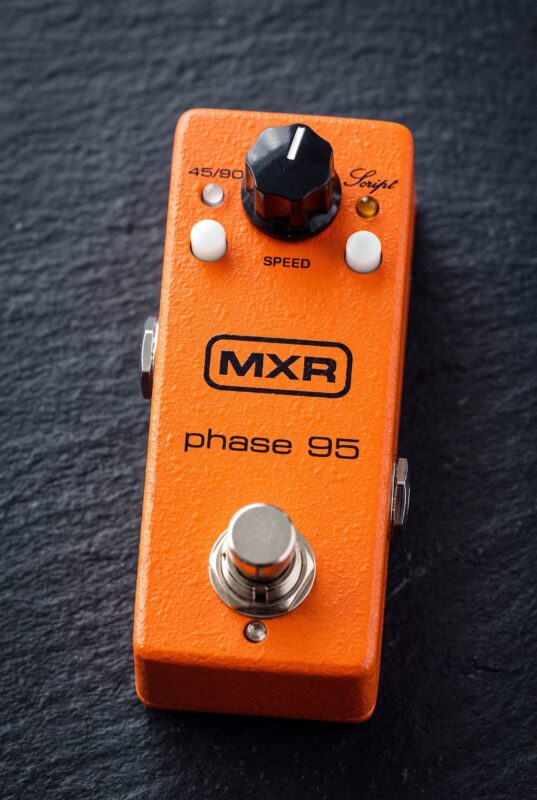
An AI-generated illustration of the MXR Phase 95.
The MXR Phase 95 puts Phase 45 and Phase 90 into a mini pedal. Four analog modes, one knob — and a legacy built on Eddie Van Halen and Jimmy Page.
There is something almost absurd about a pedal this small being this versatile. The MXR Phase 95 sits in a mini housing that is barely larger than a matchbox, yet inside that orange enclosure lives a circuit capable of producing four distinct phaser voices — from the deep, almost woozy sweep of the original Phase 90 to the silky, restrained wash of the vintage Script Phase 45. It is not a compromise. It is not a Swiss Army Knife masquerading as a phaser. It is, by any honest measure, the smartest thing MXR has done with four decades of phaser design — and at just over a hundred bucks, it is also one of the more startling deals in the effects pedal market.
The Phase 95 was the first mini pedal MXR ever made. That arrival in 2016 felt overdue. The Phase 90 had been in continuous production since the company’s founding in Rochester, New York. The Phase 45 had quietly developed a devoted following among players who found the four-stage 90 a little too extroverted. Both pedals had accumulated decades of history on the boards of rock’s most storied players. The Phase 95 was MXR’s decision to stop making you choose.
The Phase Family Tree: From Rochester to Your Pedalboard
To understand what the Phase 95 represents, you have to go back to where MXR started. In 1974, Keith Barr and Terry Sherwood built the Phase 90 in a converted barn in upstate New York. It was the first product the company ever sold, and it sold because it worked: four stages of all-analog phase shifting, a single Speed knob, and a voice that was warm, musical, and capable of everything from barely-there shimmer to a full-on psychedelic tornado depending on where you set that knob.
The Phase 45 followed as a two-stage alternative — fewer stages, less feedback, softer sweep, a subtler character that sat further back in a mix. Where the Phase 90 announced itself, the Phase 45 whispered. Both pedals existed in “script” and “block” variants — named after the typography used on the faceplates of early versus later production runs. Script-logo pedals (generally pre-CBS era, before the company’s financial collapse in the early 1980s) lacked the feedback resistor present in block-logo units, making them warmer, more liquid, and less aggressive in their sweep. The block-logo versions introduced more feedback, which added a slight harmonic distortion component and made the phase effect more pronounced and immediate.
MXR was eventually acquired by Jim Dunlop in 1987, and the Line continued refining the 90 circuit across subsequent decades — the Phase 100, the Phase 99, and various limited editions — but the core dichotomy always remained: Phase 90 vs. Phase 45, block vs. script. The Phase 95 ends that dichotomy by containing all four in one housing, each selectable in real time via two small mini-switches.
What You Actually Get: Controls, Specs, and How It Works
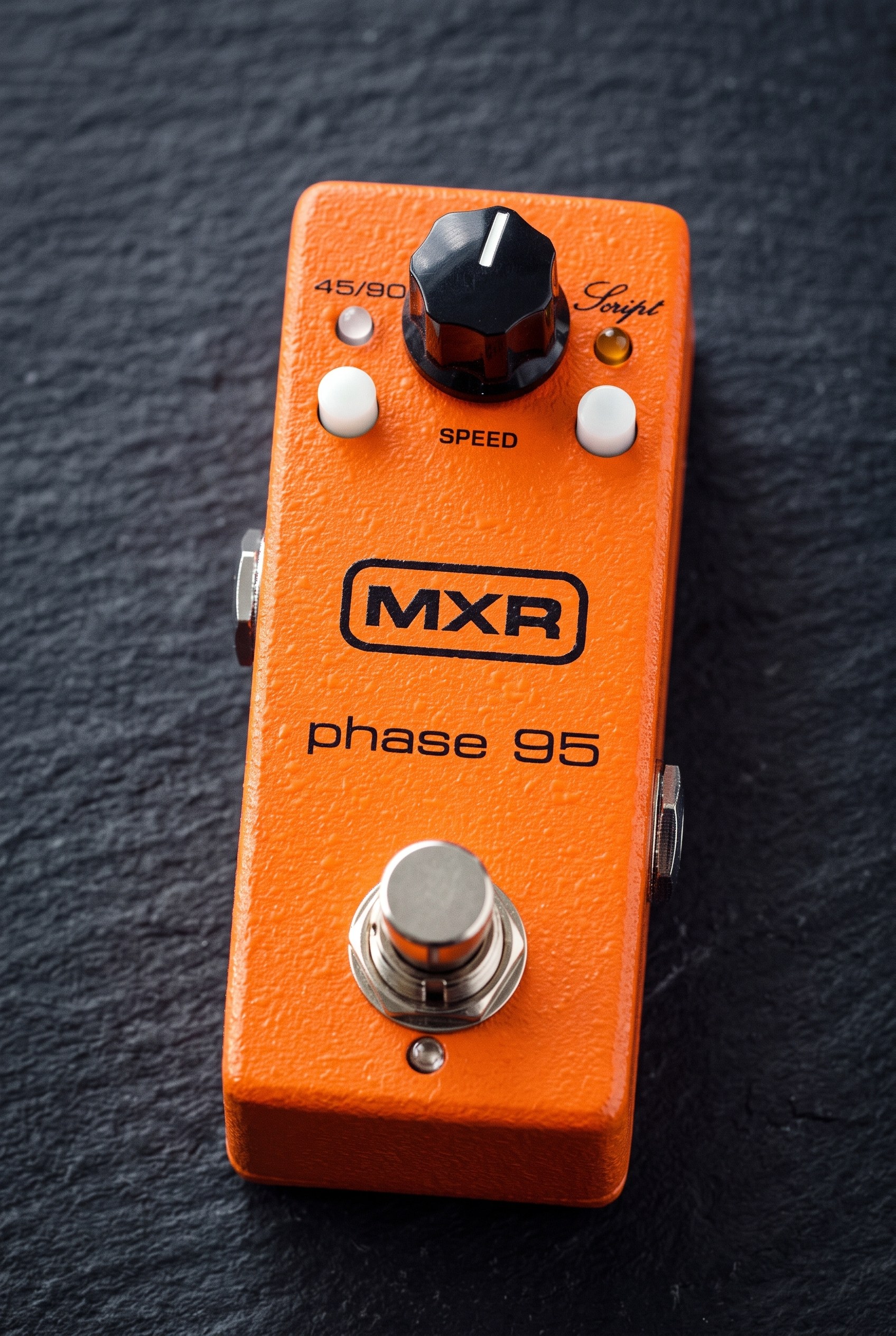
The control set of the Phase 95 is deliberately minimal. There is a single Speed knob on the face, which sweeps the LFO rate from a glacial 0.125 Hz — slow enough that you barely perceive the motion — up to a rapid 10 Hz flutter that lands somewhere between vibrato and tremolo in character. Two small push-buttons sit above the knob: the left one selects between Phase 45 (two-stage) and Phase 90 (four-stage) modes, and the right one toggles between Block (modern) and Script (vintage) operation. A standard footswitch with a blue LED handles bypass.
Because the enclosure is mini, there is no room for a 9V battery. Plan on using a dedicated DC power supply — the current draw is a modest 8 mA at 9V, so essentially any isolated output on any quality pedalboard power supply will handle it without complaint. The absence of a battery socket is the only practical limitation the mini format imposes.
| Specification | Value |
|---|---|
| Controls | Speed knob, 45/90 switch, Script/Block switch, bypass footswitch |
| Modes | Block 90, Script 90, Block 45, Script 45 |
| LFO Speed Range | 0.125 Hz – 10 Hz |
| Input Impedance | 800 kΩ |
| Output Impedance | < 6 kΩ |
| Max Input Level | −8 dBV |
| Max Output Level | 8 dBV |
| Noise Floor | −95 dBV |
| Current Draw | 8 mA @ 9V DC |
| Power | 9V DC center-negative adapter (no battery) |
| Enclosure | Mini die-cast aluminum (orange) |
| MSRP | $115.99 USD |
| Street Price (new, 2026) | ~$100–115 USD |
| Street Price (used excellent) | ~$60–85 USD |
The Phase 90 Legacy: Context for What These Modes Carry Forward
The Phase 95 doesn’t have a famous-player roster of its own to speak of — the M290 is a relatively recent mini that has found homes on the boards of working musicians and gear enthusiasts more than stadium-level headliners, at least in terms of documented primary sources. What it does carry, embedded in every setting, is the genetic code of two of the most historically documented phasers in rock history. Understanding who built their sound with the Phase 90 and Phase 45 is the fastest way to understand what the Phase 95 is capable of.
Eddie Van Halen was perhaps the most famous Phase 90 user of the rock era. His relationship with the pedal was direct and vocal — in a 2014 Guitar World interview he described his approach to the Phase 90 and MXR Flanger as central to creating his signature sound, and Ground Guitar’s primary source research documents the M101 Phase 90 as a consistent piece of his early and mid-career rig. The phase shimmer on tracks like “Eruption” and throughout the first two Van Halen albums runs through the Phase 90’s four-stage circuit, giving his already harmonically dense playing an additional dimension of movement. Eddie Van Halen‘s Phase 90 is one of the most analyzed pedal applications in rock history.
Jimmy Page was among the earliest high-profile Phase 90 adopters in the mid-1970s, using the pedal during Led Zeppelin’s later touring years when phase effects were becoming a defining sound of arena rock. David Gilmour ran the Phase 90 through the recording of Pink Floyd’s Animals (1977), where the cycling sweep of “Dogs” became one of the definitive documents of phaser used as a compositional element rather than a novelty. These are Phase 90 applications — not Phase 95 applications — but since the Phase 95’s Block 90 mode is built from the same all-analog circuit, the connection is direct: what those players found in their original pedals is what you find in the Block 90 setting today.
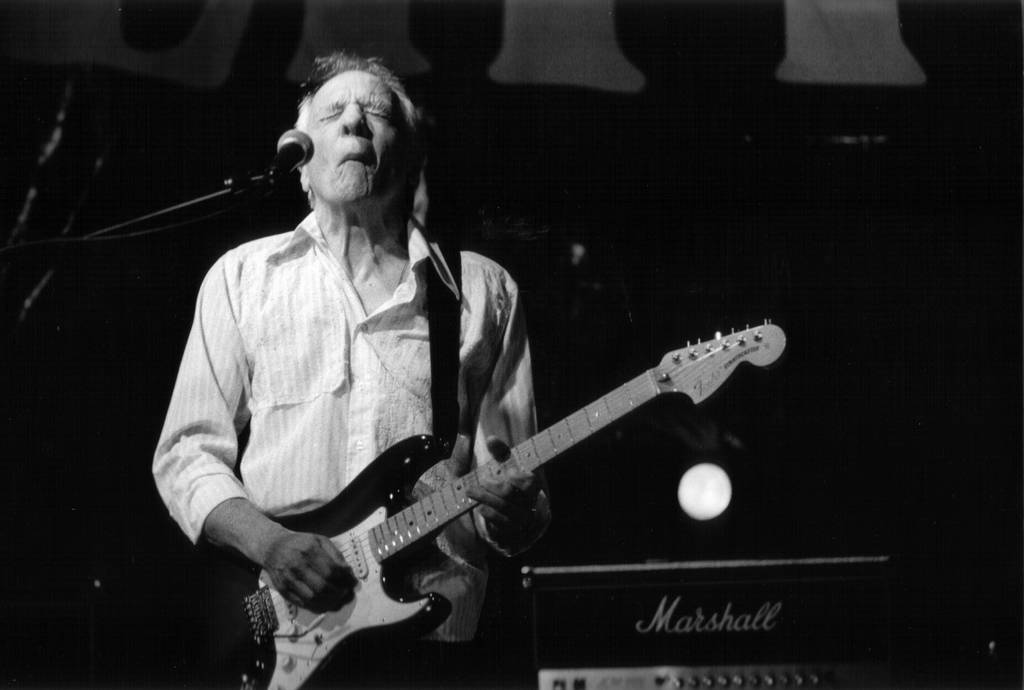
Robin Trower is the less-cited but arguably most committed Phase 90 user of the rock era. Trower came to the Phase 90 as a replacement for the Uni-Vibe units he had used throughout the early-to-mid 1970s, and his sustained, blues-soaked playing style revealed a dimension of the pedal’s character that harder players often missed: at slower speeds with a clean or lightly driven signal, the Phase 90’s sweep produces a slow, rolling quality that is almost vocal. His Bridge of Sighs-era playing remains the best reference point for what a Phase 90 does when you let it breathe.
What Each Mode Actually Does
The two switches on the Phase 95 define its entire character, and understanding what they each do — and why — is the key to using the pedal intelligently rather than just scrolling through settings.
The 45/90 switch selects circuit depth. Phase 90 mode runs a four-stage all-pass filter network, creating four notches in the frequency spectrum that sweep up and down with the LFO. The result is deep, pronounced, and impossible to ignore in a mix. Phase 45 mode uses a two-stage network, which produces two notches — a more subtle, less harmonically complex sweep that sits further back in the mix without fighting for space. The Phase 45 is not a “quieter Phase 90.” It is a genuinely different character: smoother transitions, less mid-range emphasis, and a texture that reads as a shimmer rather than a swoosh.
The Script/Block switch addresses feedback. In Block mode, a feedback resistor is active in the circuit — the same configuration as the newer production Phase 90 and 45 units. Feedback creates a small amount of harmonic distortion within the phase signal itself, which thickens the effect, adds slight grit to the wave peaks, and makes the overall sweep more accentuated and aggressive. This is the “classic rock” Phase 90 voice most people expect. In Script mode, that feedback resistor is removed. The result is a cleaner, airier, more liquid sound with higher headroom and greater clarity — the vintage pre-bankruptcy Phase 90 character that fetches serious money on the used market and that players like EVH were originally using in the mid-1970s.
Premier Guitar’s Charles Saufley, reviewing the Phase 95 at launch in March 2017, identified an important practical nuance about how these modes interact with gain: Block 90 can distort unpleasantly in front of high-gain sources (Saufley noted this with a Tone Bender), while Script modes — particularly Script 45 — often work better when placed before distortion or fuzz in the signal chain, precisely because the reduced feedback gives high-gain sounds more room to breathe. This is the opposite of the common rule-of-thumb (phase goes after fuzz), and it’s worth testing both positions.
Seven Tone Recipes and Settings
1. Classic Rock Phase (Block 90, Speed at 9–10 o’clock)
This is the “Eruption” adjacent setting — slow enough that the sweep is clearly audible but not so fast that it becomes dizzying. Set Speed to about nine o’clock, engage Block 90 mode, and run the pedal after any drive or fuzz in your chain. Fat humbuckers will respond with the characteristic “slide-whistle” rise and fall in the high-mid frequencies that Premier Guitar’s review identified as the Phase 95’s most immediately appealing quality. Telecaster bridge pickups produce a slightly more brittle, glassy version of the same movement that works beautifully for chordal rhythm playing.
2. Subtle Always-On Thickener (Script 90, Speed at 8–9 o’clock)
The Script 90 mode at a slow-to-moderate rate produces a behind-the-mix texture that adds movement and dimension without announcing itself as a phase effect. This is the setting to leave on throughout an entire performance — rolling, organic shimmer that makes a clean amp sound larger. Works particularly well with a Fender Deluxe Reverb or any amp with a naturally open midrange. Keep the speed slow and the phase becomes almost imperceptible as a separate effect; it just makes the guitar sound alive in a way it doesn’t without it.
3. Slow Psychedelic Wash (Block 90, Speed at 7–8 o’clock, after reverb)
Placing the Phase 95 after a reverb reverses the usual signal chain logic but produces genuinely stunning results: the phase sweeps through the reverb tail as well as the dry signal, creating a slow, revolving-room texture that is closer to a Leslie cabinet effect than anything you’d normally call phasing. Dial the Speed back until the LFO period is close to four or five seconds. Best with a neck humbucker or a single-coil with the tone rolled off slightly.
4. Script 45 Before Fuzz (Script 45, Speed at 10–11 o’clock)
Charles Saufley’s key practical discovery from his Premier Guitar review: Script 45 placed before a fuzz or high-gain source — where most players would never put a phaser — produces a “colorful, clear, and phasey” result because the two-stage, low-feedback circuit doesn’t compress or distort under the load of a hot fuzz input. With a germanium fuzz like a Fuzz Face in the chain after the Phase 95, the fuzz excites the notch frequencies in the phase profile in ways that produce harmonics not present in clean settings. A genuinely unexpected sound.
5. Trower-Style Sustained Lead (Script 90, Speed at 8 o’clock, clean amp)
Robin Trower’s use of the Phase 90 as a slow-breathing effect under sustained notes is the template here. Set Script 90 at a slow rate — eight o’clock or lower — and let single notes sustain through the sweep. The Script mode’s higher headroom means the phase effect remains clean and liquid even as the note fades, without the slight crunch that Block mode can introduce in the upper registers. This approach rewards playing with dynamics and feel rather than technique for its own sake.
6. Fast Vibrato-Adjacent Flutter (Block 90 or Block 45, Speed at 2–3 o’clock)
Pushing the Speed control past noon and into the upper register produces an effect that blurs the boundary between phasing and vibrato. Block 90 at high speed becomes intense and slightly dissonant — a churning quality that works for experimental textures or for solo sections where the guitar needs to feel unstable and alive. Block 45 at the same speed is slightly more polished, the two-stage circuit producing a less chaotic sweep that is easier to play melodically over without fighting the effect.
7. Chordal Shimmer for Clean Rhythm (Script 45, Speed at 9–10 o’clock)
The Phase 45 in Script mode at a medium-slow rate produces one of the most usable rhythm guitar textures the Phase 95 offers: a quiet, shimmering movement underneath open chords that adds presence and warmth without any sense of the guitar competing with itself. Think early 1980s polished rock — the phase effect that is felt more than heard. Works across all pickup types, but particularly effective with a Stratocaster through a clean amp, where the single-coil edge benefits from the smoothing effect of the slow phase sweep.
The Phase 95’s single Speed knob is deceptively expressive. Here are seven documented approaches to the four modes and a range of Speed positions:
Signal Chain Placement and Pedalboard Logic
The Phase 95 is flexible enough that the standard “phase goes here” rule needs qualifying rather than following blindly. The traditional position is after all drive and fuzz pedals, before time-based effects like delay and reverb. This is the right starting point, and for Block 90 and Block 45 modes, it is generally correct — the block modes’ feedback makes them sound most musical when the input signal is already processed by any gain stage.
Script modes, as noted in the PG review, often behave better in front of gain — particularly in front of thick, bassy fuzzes where the Script 45 especially can prevent the muddy low-mid buildup that Block 90 can produce in the same position. If your rig includes both clean-boost/OD territory and fuzz territory, consider placing the Phase 95 before your fuzz specifically for Script mode applications. The low 8mA current draw means you can power it from essentially any output without concern.
The mini enclosure’s one real-world limitation: the Speed knob is small enough that nudging it accurately with your foot mid-performance is difficult. PG’s Saufley noted this in the original review, and it remains true — treat the Speed setting as a pre-set rather than a live sweep control unless you’re precise with your feet. If you want real-time Speed adjustment during a performance, a standard-size pedal with a larger knob is more practical. For the vast majority of uses where you set a speed and leave it, the mini format is purely an advantage.

How It Compares: Phase 95 vs. The Alternatives
The most obvious comparison is with the MXR M101 Phase 90, the pedal whose circuit the Phase 95 contains in two of its four modes. The Phase 90 has more presence on a pedalboard — the larger enclosure, the single-knob simplicity, the Script/Block LED modification option available from Dunlop or as a DIY job. But it is exactly half the Phase 95’s feature set. If you want only Phase 90 tones and nothing else, the M101 is the right tool. If you’ve ever wondered whether you might prefer the Phase 45, or whether the Script mode suits your rig better than Block, the Phase 95 removes the need for two separate pedals and approximately $160 in total spending. The math is straightforward.
The Boss PH-3 Phase Shifter offers more modes — four-stage, eight-stage, ten-stage, Rise, Fall, and Step modes — plus the addition of tap tempo and an Expression pedal input. It is a more comprehensive phaser if your application demands those additional options. But the PH-3 is digital, and the Phase 95 is all-analog. Whether that matters to you depends on your rig and your ears. Analog phasing has a particular warmth in the wave peaks and a slightly organic unevenness in the sweep that most players can perceive with careful listening, even if they can’t always identify the source. For players who care about analog signal path integrity, the Phase 95 wins this comparison without contest.
The EHX Small Stone is a four-stage analog phaser with a single Rate knob and a Color switch that adds feedback — structurally similar to the Script/Block distinction in the Phase 95. The Small Stone has its own voice, slightly darker and looser in character than the Phase 90 circuit, and carries a strong legacy in its own right (notably with David Gilmour on The Wall). It offers one phaser circuit versus the Phase 95’s two. The Phase 95 wins on versatility; the Small Stone wins if you specifically want its darker, slightly queasy character that the MXR circuit doesn’t quite replicate.
The MXR Phase 99 is worth mentioning — a dual-phase 90 design that allows independent speed control over two phaser stages and produces more complex, intermodulated sweeps than a single phaser circuit. It is a specialist instrument for players who want to go deep into phaser as a compositional tool. At nearly twice the price and considerably larger footprint, it serves a different purpose than the Phase 95. The 95 is a pedalboard workhorse; the 99 is a studio weapon.
Buying Guide and Ownership Notes
The Phase 95 has been in continuous production since its introduction around 2016, and the used market for it is healthy and predictable. New units consistently land in the $100–115 range in 2026; used units in excellent condition sell for $60–85 depending on whether the box and documentation are included. There are no significant variants or production changes to navigate — the circuit has remained stable since launch, so any used unit you find is functionally identical to a new one.
One practical note before buying: the mini enclosure uses mini jacks for a cable-saver design on one side, but the main I/O is standard quarter-inch. However, the tight spacing between a mini pedal and its neighbours on a crowded pedalboard can create right-angle cable fitment issues. Patch cables that terminate in right-angle connectors from one side are often the better choice than straight-plug cables when building a dense mini-pedal section.
The Phase 95 is also the most space-efficient way to carry a proper analog phaser to a gig where pedalboard space is at a premium. Its footprint is smaller than most tuners, and its 8 mA draw is negligible. For players who carry a stripped-down board for smaller venues — just the essentials — a Phase 95 in Phase 90 Block mode is indistinguishable from a full-size M101 to any audience member in the room.
FAQ: MXR Phase 95
What is the difference between Phase 45 and Phase 90 mode on the Phase 95?
Phase 90 mode uses a four-stage all-pass filter network, producing four notches in the frequency spectrum that sweep up and down — a deeper, more pronounced phase effect that is the dominant character of classic rock phasing. Phase 45 mode uses a two-stage network, producing two notches and a subtler, smoother sweep that sits further back in a mix. They are different circuit topologies, not just volume or intensity adjustments. Phase 45 is genuinely quieter and less harmonically complex in its movement.
What does the Script switch actually do?
The Script switch removes the feedback resistor that is present in the Block (modern) circuit configuration. Feedback adds a small amount of harmonic distortion to the phase effect and makes the sweep more accentuated and aggressive. Script mode without the feedback resistor produces a cleaner, airier, more liquid phase effect with higher headroom — closer to what vintage pre-collapse MXR Phase 90 and 45 units sounded like. Script mode is subtler; Block mode is more pronounced.
Does the Phase 95 have true bypass?
MXR’s documentation for the M290 does not explicitly specify the bypass type in the specs sheet in the way that some pedals do, but the unit uses a standard hardwire bypass footswitch. The blue LED indicates operation. Given the analog signal path and the company’s general approach on mini pedals of this generation, the bypass is a hardwire switching configuration. When in doubt, check whether any high-impedance fuzz pedals on your board interact with the Phase 95 in bypass — that can indicate buffer presence or absence.
Can I use a 9V battery with the Phase 95?
No. The mini enclosure does not have enough physical space for a battery compartment. The Phase 95 requires an external 9V DC center-negative power adapter. The current draw is only 8 mA, so any quality isolated power supply output will handle it. This is standard for virtually all mini-format pedals.
Where in the signal chain should I put the Phase 95?
The standard position is after all drive and fuzz pedals, before time-based effects (delay and reverb). This holds for the Block 90 and Block 45 modes particularly. However, the Script modes — especially Script 45 — can work well placed before fuzz or high-gain sources, where the reduced feedback produces a cleaner, more articulate phase effect than the Block modes achieve in the same position. Experiment with both signal chain positions; the results genuinely differ by mode.
Does the Phase 95 sound like the original vintage Script-logo Phase 90 pedals?
Closely but not identically. Original script-logo Phase 90 pedals from the mid-1970s vary in component aging, specific op-amp spec, and general condition in ways that a consistent production pedal cannot fully replicate. The Script mode on the Phase 95 captures the fundamental character — the absence of feedback resistor, the cleaner sweep, the higher headroom — but original vintage units have component drift and slight aging effects that produce subtle variation. For performance purposes, the difference is academic. For a vintage collector, nothing replaces the original.
Is the Phase 95 the same as the MXR M101 Phase 90 in block mode?
Block 90 mode on the Phase 95 is designed to replicate the current production Phase 90 circuit. In practice, the circuits are very close, though the Phase 95’s smaller PCB layout and slightly different component routing may produce subtle variation that some players can detect in careful AB testing. For most applications, Block 90 on the Phase 95 is functionally equivalent to a current-production M101, while also giving you three additional voices in the same mini enclosure.
What are the best pedals to pair with the Phase 95?
For the classic rock phase-plus-drive combination, a tube screamer-style overdrive like the Ibanez TS9 placed before the Phase 95 in Block 90 mode produces the warm, mid-rich driving phase sound. For cleaner tones, the Phase 95 pairs beautifully with reverb after it — the phase sweep moves through the reverb tail in a musically interesting way. For experimental textures, the Script 45 mode before a heavy fuzz (as noted in the PG review) produces sounds that neither pedal achieves independently. The 8mA draw means you’ll never be hunting for an available power output to accommodate it.
Image credits
- Eddie Van Halen: Anirudh Koul, Wikimedia Commons, CC BY 2.0.
- Robin Trower: Sardognunu, Wikimedia Commons, CC BY-SA 3.0.
- Top image: GuitarGangsters AI-generated reference illustration, not a photograph.
- MXR Phase 95: AI-generated illustration by GuitarGangsters, based on the manufacturer’s product design (not a photograph).
Latest News
Related
On This Day
Tuesday 10 November
From this week: