Michael Denner (Mercyful Fate) Guitars & Gear: The Complete Guide to the Other Half of Heavy Metal’s Greatest Guitar Duo
Michael Denner's guitars, amps, and effects — the complete guide. B.C. Rich Stealth live 1993, Marshall JMP Superlead Dynamo 1983, Fender Stratocaster white Family Ghost, Gibson Flying V guest Halloween, parametric EQ frown curve modded Marshall Plexi Boss SP-1 Spectrum big part of sound, cocked wah like Michael Schenker, father was blues guitarist, NOT invited 2019 Mercyful Fate reunion, Beat Bop record shop Copenhagen Denmark, and other half of heavy metal's greatest guitar duo's complete rig.
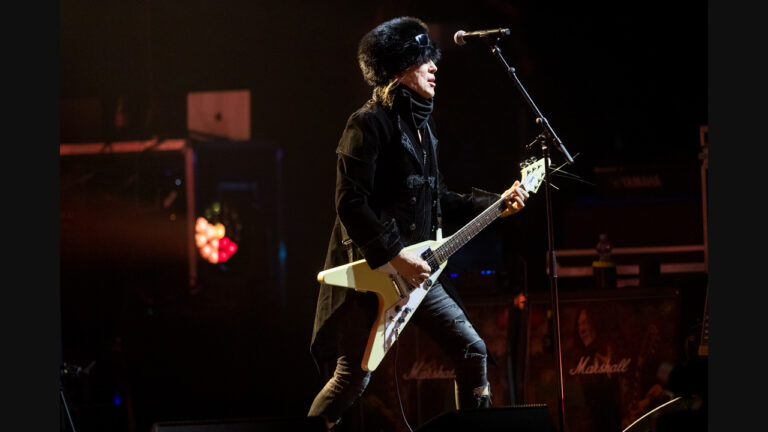
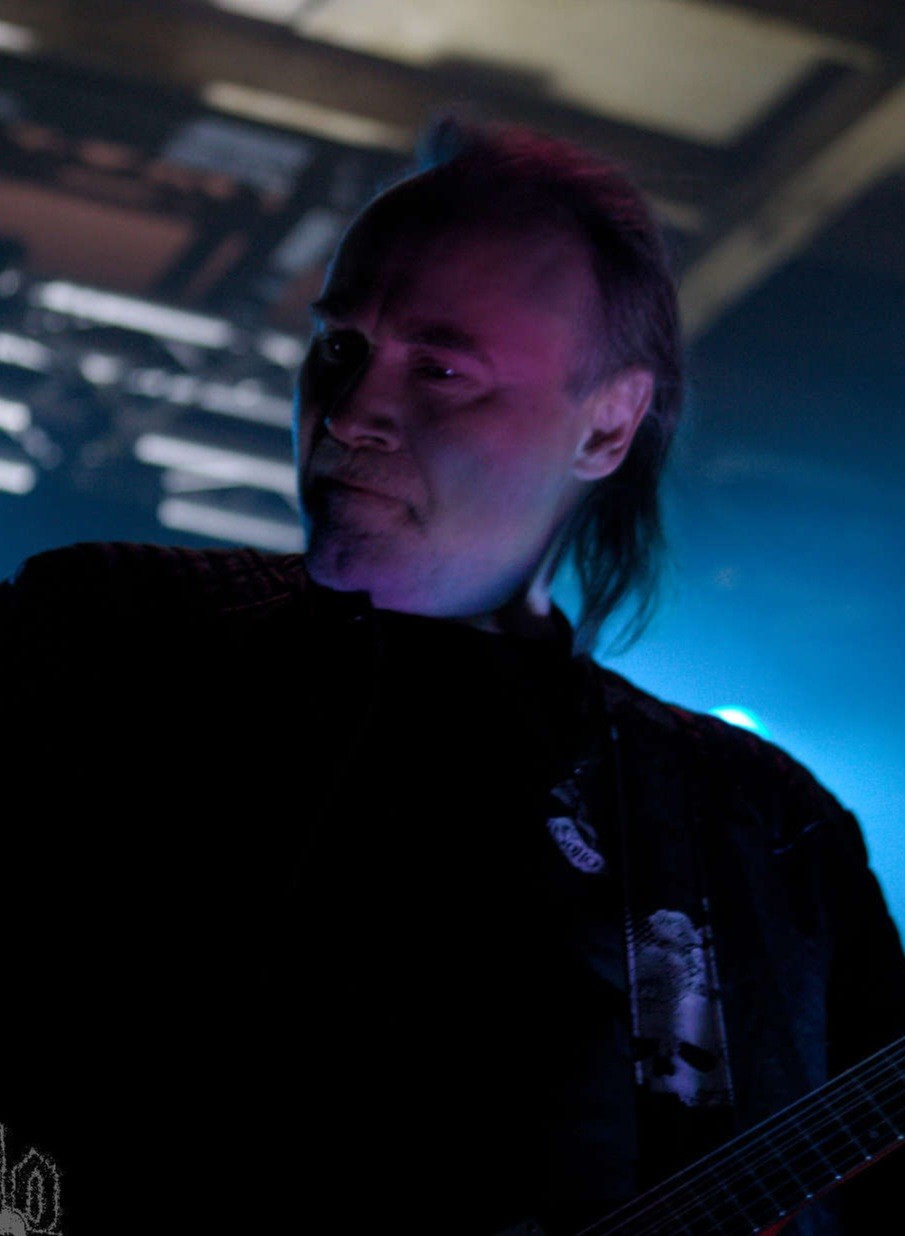
Michael Denner on stage. Photo: Septikphoto, CC BY 4.0. Source: Wikimedia Commons.
Gear Timeline
“Back then, I believe Hank stole the show; I was the more technically skilled guitarist but he was such a powerhouse on stage. He was smokin’, could play fast and aggressive and had the looks and everything. So, I’d say I stood in his shadow during the early BRATS days. I was technically schooled and had much more experience as a guitarist and could play blues chops and all kinds of music. Hank took up guitar after hearing KISS — then he just started practicing, trying to play like Ace Frehley.” Michael Denner said this in the Bardo Methodology interview — and the candor is remarkable: one half of what many consider heavy metal’s greatest guitar duo describing the specific imbalance of their early relationship, the way Shermann’s physical presence and stage power overshadowed Denner’s greater technical sophistication, and the different starting points of both musicians. Denner started at age twelve with a father who was a blues guitarist; Shermann started after hearing KISS. By the time Mercyful Fate was recorded in 1983, both had arrived at a creative synthesis where their differences were the point — Shermann’s aggressive power and Denner’s technical sophistication creating a dual-guitar approach neither could produce alone. The firsthand documentation from The Gear Page forum adds the specific technical detail: a person who met Denner at his Beat Bop record shop in Copenhagen reported that he “used a parametric EQ in front of modded Marshall plexi amps. He said they would boost the mids on the EQ like a frown curve. They also used a cocked wah ‘like Michael Schenker’. Also a BIG part of Denner’s sound was the Boss SP-1 Spectrum. He said the pedals would get stolen all the time. The amps were modded with pre-amp knobs on the back of the amps.” The Boss SP-1 Spectrum. The cocked wah like Michael Schenker. The modded Marshall plexis with preamp knobs on the back. The frown curve on the parametric EQ. This is a complete tonal architecture for one of the most celebrated guitar sounds in first-wave black metal history — documented by a fan who met Denner in person and asked him directly. He owns a record shop in Copenhagen called Beat Bop. He is not in the 2019 Mercyful Fate reunion. He is still playing. He is sixty-six years old.
Michael Denner was born on November 5, 1958, in Denmark. He is a fourth-generation musician. His father was a blues guitarist, which gave Denner a different and earlier orientation to the guitar than Shermann — starting guitar at age twelve with the blues tradition’s technical and emotional vocabulary as his foundational context, rather than starting from the KISS/heavy metal context of Shermann’s development. His influences: Uli Jon Roth (Scorpions), Michael Schenker (UFO/Scorpions), and Ollie Halsall (Patto/Timebox/Kevin Ayers) — a more technically oriented and more eclectic set than Shermann’s, reflecting his blues foundation and his interest in the chromatic and jazz-inflected approach of Halsall. He played with the Brats (alongside Shermann and King Diamond, the pre-Mercyful Fate band that released The Brats LP in 1980) before co-founding Mercyful Fate in 1981. After the classic Mercyful Fate period (EP, Melissa, Don’t Break the Oath, and the 1992-1999 reunion albums), he played with the King Diamond band (Fatal Portrait, Abigail), formed the duo Denner/Shermann with Hank Shermann, and most recently the Denner’s Inferno project. He was not invited to the 2019 Mercyful Fate reunion. He owns Beat Bop records in Copenhagen. He is sixty-six years old.
Background: Copenhagen Denmark, Father a Blues Guitarist, Uli Jon Roth Michael Schenker Ollie Halsall, Brats 1980, Mercyful Fate 1981, King Diamond Fatal Portrait Abigail, NOT in 2019 Reunion, Beat Bop Records
Denner’s specific biographical distinction from Shermann — the blues-guitarist father, the twelve-year-old start, the technical schooling that gave him “blues chops and all kinds of music” — is the specific context for understanding why the Shermann/Denner partnership produced something that neither could have produced alone. Shermann brought the KISS-inspired, physically powerful, hard rock-direct approach; Denner brought the technically sophisticated, blues-rooted, harmonically rich approach. The combination in the Mercyful Fate context — occult themes, King Diamond’s operatic vocals, the specific dark harmonic language of minor keys and chromatic approach notes — required both dimensions: Shermann’s aggression and physicality to ground the music in heavy metal convention, and Denner’s technical sophistication to give it the harmonic complexity that distinguishes Mercyful Fate from simpler extreme metal.
His three primary influences — Uli Jon Roth, Michael Schenker, and Ollie Halsall — are the specific guitarists who shaped his approach. Uli Jon Roth’s Scorpions work (the classical-influenced, chromatically sophisticated lead playing of Fly to the Rainbow, In Trance, and Virgin Killer) gave Denner the template for technically demanding melodic lead playing. Michael Schenker (whose UFO work demonstrated how blues-based melodic lead guitar could be applied in a heavy metal context) gave him the specific blues-metal synthesis. Ollie Halsall (one of the most technically advanced and stylistically eclectic British guitarists of the late 1960s and early 1970s, whose chromatic, jazz-influenced playing was largely unknown outside specialist music circles) gave Denner a specifically unusual reference point — one not shared by most metal guitarists of his generation — that contributed to the specific harmonic unexpectedness of certain Mercyful Fate lead passages.
The omission from the 2019 Mercyful Fate reunion is the most specifically painful biographical fact of his recent career. Mercyful Fate’s 2019 reunion — which has been received as one of the most celebrated metal reunions of recent years — excluded Denner despite his foundational contribution to the classic Mercyful Fate recordings. The Metal Injection interview documents his perspective: he was not invited. Shermann is part of the reunion; Denner is not. The specific reasons have not been fully publicly explained. He continues with his own projects.
The Rig: Michael Denner’s Guitars, Amps, and Effects
Guitars
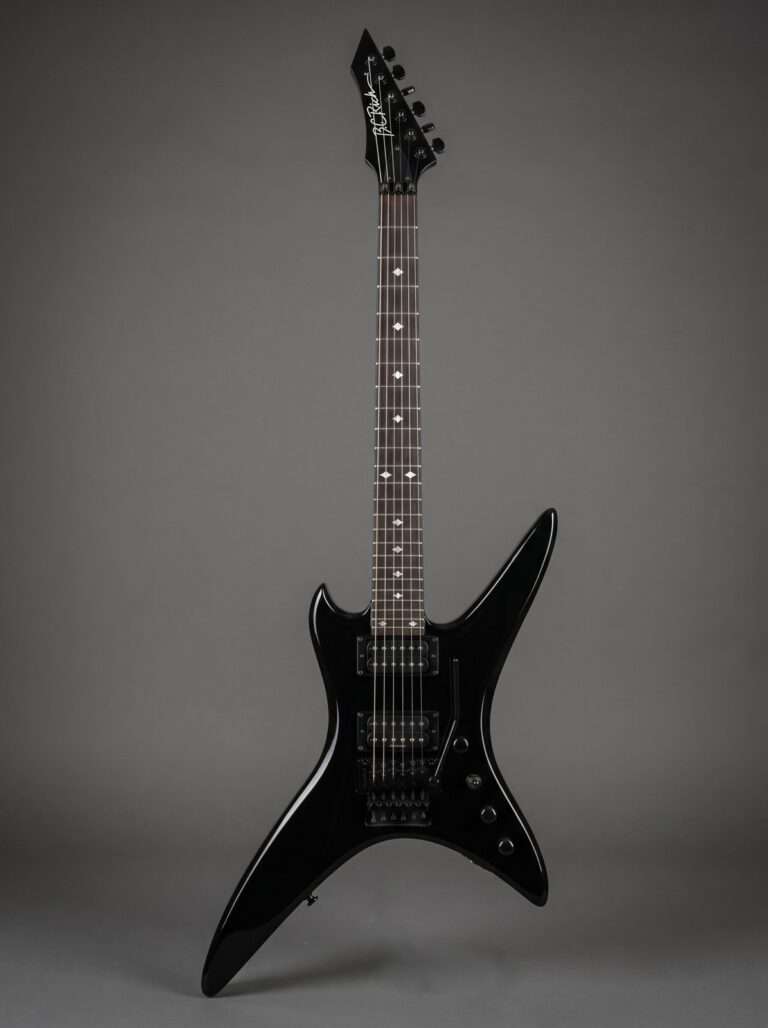
The Equipboard documentation: “From live at Ft. Lauderdale in 1993, for the whole concert Michael uses his BC Rich Stealth guitar, the item can be seen 10:04 into the video.” The B.C. Rich Stealth — the same model documented for Hank Shermann in the band’s live setup — confirms that both Mercyful Fate guitarists used the B.C. Rich Stealth for the 1992-1999 reunion period live performances. The B.C. Rich Stealth’s angular body and through-neck construction provide the specific heavy metal visual identity and the sustaining tonal character of the through-neck design.
The Equipboard documentation: “In the video for the Family Ghost, Denner is seen playing a white Strat.” The white Fender Stratocaster in the “Family Ghost” video (from the King Diamond album) reflects his use of Stratocaster-style guitars — consistent with the Mercyful Fate dual-guitar approach where both Shermann and Denner used Strat-influenced instruments. The white Strat’s visual identity contrasts with the darker aesthetic of the Mercyful Fate/King Diamond visual world but is consistent with the tonal requirements of a Strat’s single-coil brightness for melodic lead work.
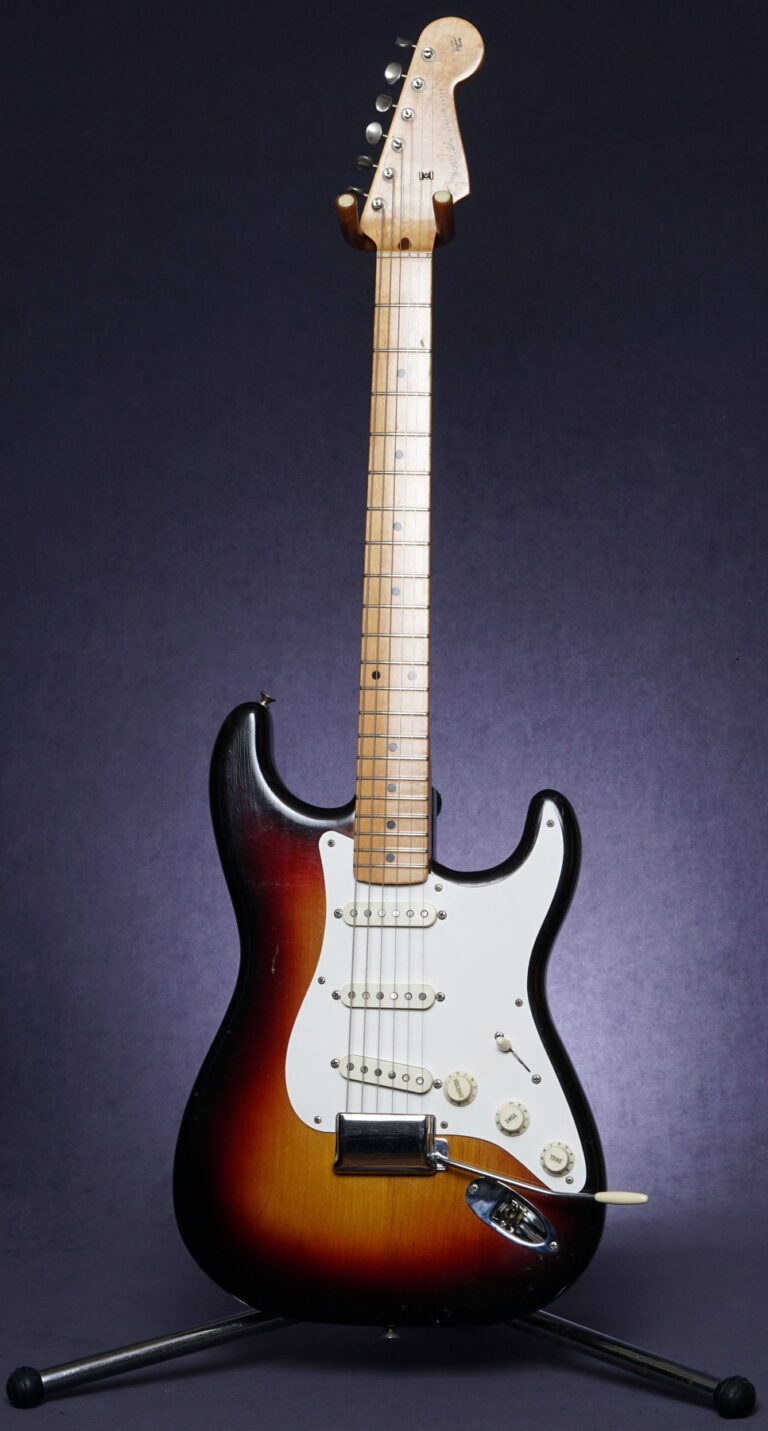
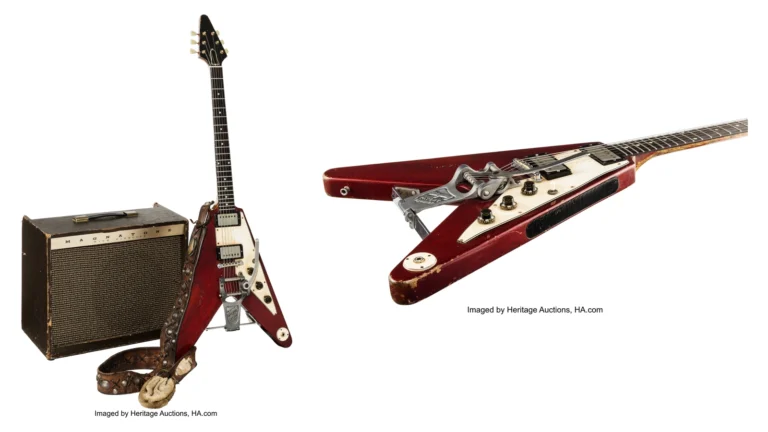
The Equipboard documentation: “In this video Michael Denner joins King Diamond on stage to perform Halloween with his flying V.” The Gibson Flying V — alongside the custom Flying V documented on his current gear page — reflects his relationship with the V body shape as a performing instrument. His johndenner.com biography confirms “Denner currently plays a custom Gibson Flying V guitar.”
The Gear Page firsthand account: “For guitar he used the same Flying V copy w/bolt on neck seen on the cover of The 1980 Brats LP.” The Flying V copy with bolt-on neck is his documented guitar from the Brats period — before the Mercyful Fate recordings — and the specific “bolt-on neck” designation reflects that this was a production or copy instrument (genuine Gibson Flying Vs use set-neck or through-neck construction) rather than an original Gibson. The Brats LP cover appearance makes this guitar visually documented from the pre-Mercyful Fate period.
The johndenner.com biography: “Denner currently plays a custom Gibson Flying V guitar.” The Flying V’s specific character — the angular body’s resonance, the through-neck or set-neck sustain, the visual identity that connects him to the heavy metal and dark metal tradition — has remained his primary guitar throughout his career. The custom designation suggests Gibson-made or luthier-built modifications from the production standard Flying V specification.
His johndenner.com biography: “Michael is a fourth generation musician and lists his Guitar Influences as Uli Jon Roth, Michael Schenker and Ollie Halsall.” The blues foundation (from his father) gives his playing the specific emotional directness and the improvisational quality that technical schooling alone cannot provide. His Bardo Methodology interview: “I was technically schooled and had much more experience as a guitarist and could play blues chops and all kinds of music.” The “all kinds of music” is the specific breadth that his blues background and his eclectic influences (Halsall’s jazz-inflected approach, Roth’s classical influences, Schenker’s blues-metal synthesis) produced.
Amps
The Equipboard documentation: “From live at Dynamo in 1983, Michael uses a Marshall JMP throughout the concert.” The Dynamo 1983 documentation places his Marshall JMP use at the foundational Mercyful Fate period — the same year as the Melissa album recording. The Marshall JMP Superlead — the same handwired, EL34-powered British tube head documented for Shermann — confirms that both Mercyful Fate guitarists used Marshall JMP heads for the classic period live performances.
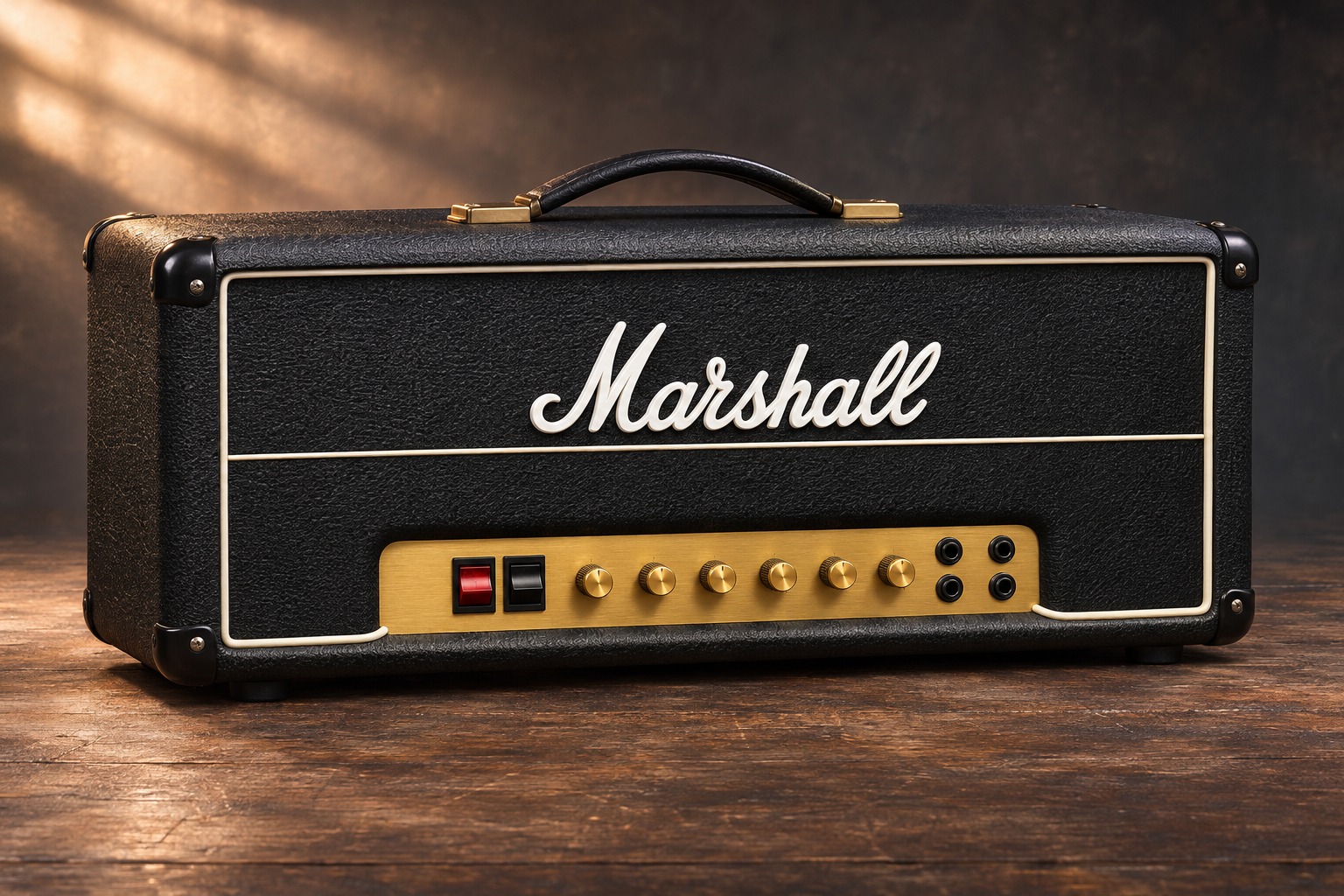
The most specific amplifier documentation for Denner comes from The Gear Page firsthand account of a conversation with him at Beat Bop: “He said they would use modded Marshall plexi amps… The amps were modded with pre-amp knobs on the back of the amps.” This specific modification — preamp knobs on the back of the Marshall Plexi heads — suggests a non-standard internal configuration providing additional gain control or tonal adjustment. Standard Marshall Plexi heads have a limited preamp control set; adding preamp controls would provide the ability to tune the input stage behavior differently from the standard configuration. This “back-of-amp” control placement reflects a practical professional modification: controls accessible during setup without opening the amp chassis, allowing rapid adjustment without the disruption of the standard control locations.
Effects
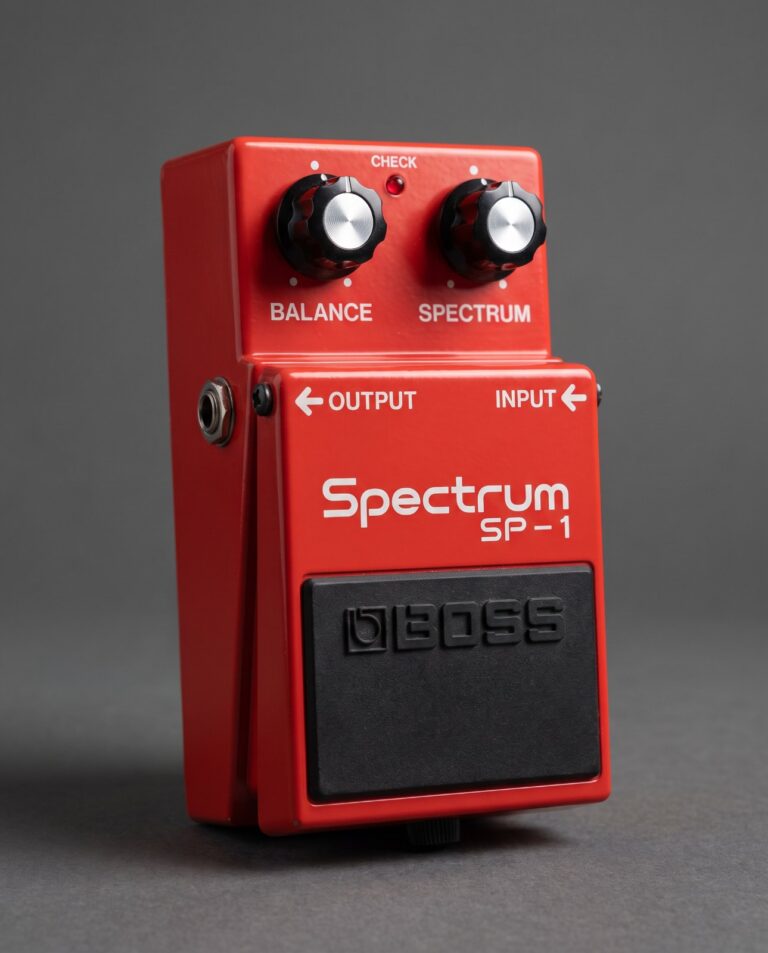
The Gear Page firsthand account is the most important single effects documentation: “Also a BIG part of Denner’s sound was the Boss SP-1 Spectrum. He said the pedals would get stolen all the time.” The Boss SP-1 Spectrum — a rare and now highly sought-after Boss effect from 1977, one of the first Boss pedals ever produced — is an envelope-controlled filter/EQ pedal that sweeps a narrow frequency band across the audio spectrum based on the guitar signal’s dynamics. When set to a fixed position (not swept), the SP-1 acts as a cocked wah — boosting a specific narrow frequency band to produce a nasal, honky, “fixed wah” character. The Gear Page account confirms this is the specific character Denner sought: “Also a BIG part of Denner’s sound was the Boss SP-1 Spectrum” — combined with the parametric EQ’s frown curve mid boost and the Marshall Plexi’s natural saturation, the SP-1’s frequency characteristic contributed the specific “wah-like” tonal color that characterized his lead playing.
The Gear Page: “Denner told me he and Hank used a parametric EQ in front of modded Marshall plexi amps. He said they would boost the mids on the EQ like a frown curve.” A “frown curve” on a parametric EQ means the mid frequencies are boosted while the highs and lows are relatively reduced — the opposite of the “scooped mid” sound that conventional metal tone often sought. Boosting the mids gives lead guitar tones more presence, more “cut,” and a more vocal character — the specific quality that allows melodic lead lines to project through a dense mix. This mid-forward EQ approach is directly analogous to the approach documented for multiple guitarists in this guide (Nels Cline’s Marshall JTM45 interaction with the Hotcake, the standard “mid-forward” wisdom of lead guitar professionals) but applied through a parametric EQ with specific mid-frequency targeting.
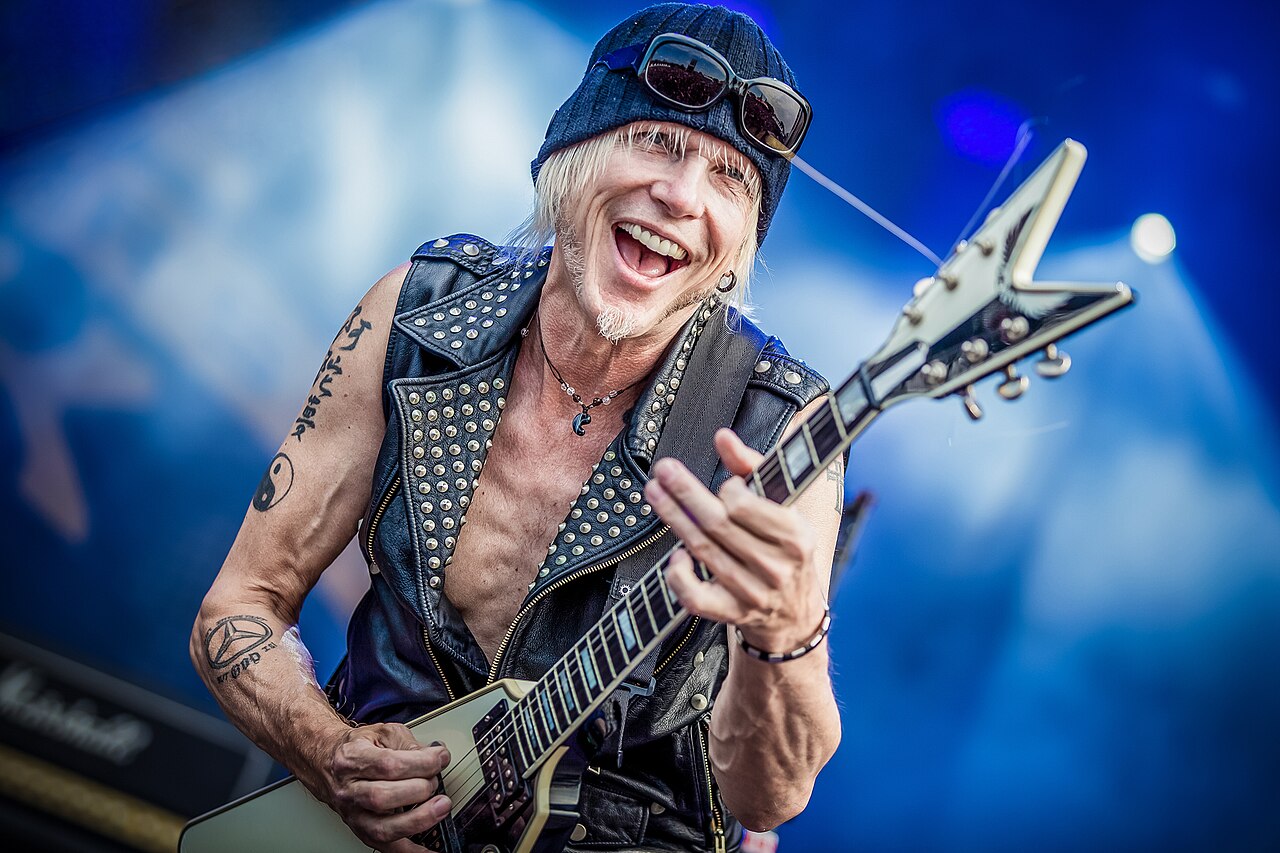
The Gear Page: “They also used a cocked wah ‘like Michael Schenker’.” The “cocked wah” technique — setting the wah pedal at a specific fixed position rather than sweeping it dynamically — produces the specific nasal, honky, vowel-like frequency boost that a fixed-position wah creates. Michael Schenker’s use of a cocked wah (the specific throat-like quality of certain UFO lead guitar passages that results from the wah pedal held in a fixed mid-position) is a documented Schenker technique; Denner’s explicit reference to Schenker as the model reflects both his Schenker influence (listed as one of his three primary influences) and the specific application of the Schenker technique to the Mercyful Fate context.
The combination of the Boss SP-1 Spectrum (fixed frequency boost from the envelope filter held static), the cocked wah (fixed-position wah adding a different frequency boost), and the parametric EQ (frown curve boosting mids) through the modded Marshall Plexi created the specific tonal complex of the Mercyful Fate lead guitar sound. Three separate frequency-shaping tools, all providing different but complementary mid and upper-mid boosts, combined in front of a modified Marshall Plexi at high gain — the specific overlapping character of these three devices through the amp’s saturation producing the unique textural quality of the classic Mercyful Fate lead tone.
Despite the specific complexity of the three-device front-end (SP-1, cocked wah, parametric EQ), the Mercyful Fate lead guitar approach was not effects-saturated in the way of later extreme metal. The three frequency-shaping tools served a specific tonal purpose — producing the specific mid-forward, vocal, slightly nasal character of the lead tone — without the extensive delay, modulation, and pitch effects of the later metal tradition.
Playing Style & Tone Philosophy
Michael Denner’s playing style is the most technically sophisticated in the Mercyful Fate context — the approach of a musician whose blues foundation and eclectic influences (Roth, Schenker, the obscure Ollie Halsall) gave him access to a harmonic and technical vocabulary that most heavy metal guitarists of 1983 did not possess. His Bardo Methodology interview: “I’m a huge record collector and have always been passionate about 70s heavy rock and the very early heavy metal. Long before death metal, black metal, thrash, and all that; I’m more into the doomier sides.” The doom-oriented, 1970s-heavy-rock-rooted aesthetic is visible in the specific emotional weight of his most celebrated Mercyful Fate solos — less speed-based than Shermann, more melodically developed, with the blues-rooted bending and vibrato of his father’s guitar tradition.
His tone philosophy is the three-device mid-forward philosophy: Boss SP-1 Spectrum + cocked wah + parametric EQ (frown curve) before a modded Marshall Plexi with preamp knobs on the back. Three complementary frequency-shaping tools producing the specific vocal, mid-forward, slightly nasal character that gives the Mercyful Fate lead guitar its distinctive quality within the mix. Not the scooped metal tone; not the bright Strat-into-Fender-clean tone; but a specific mid-forward character that allows melodic lead lines to project with maximum clarity and expressiveness.
The “pedals got stolen all the time” is not an incidental detail but a practical reality of the specific touring context of early 1980s European extreme metal — bands playing underground venues, sharing stages, carrying equipment without the security of modern professional touring infrastructure. The Boss SP-1 Spectrum is rare even today; in 1983 it was simply one of the early Boss pedals, stolen from stage or dressing room with the rest of the gear that disappeared on the road.
How to Sound Like Michael Denner
Guitar: Gibson Flying V (custom, set-neck or through-neck) for his current primary character. B.C. Rich Stealth (through-neck, humbuckers) for the 1992-1999 reunion period live character. White Fender Stratocaster for the King Diamond period lead tone. Flying V copy (bolt-on neck) for the classic Brats/early Mercyful Fate period.
Amp: Marshall JMP Superlead (100W, handwired EL34) — with preamp modifications (additional control on back) for the specific Mercyful Fate tonal character. Modded Marshall Plexi with the specific three-device front-end chain.
Amp Settings (Modded Marshall Plexi — Mercyful Fate Mid-Forward Lead Tone):
| Control | Setting (0–10) | Notes |
|---|---|---|
| Volume | 7–9 | HIGH — natural EL34 power-amp saturation |
| Bass | 4 | Moderate — the frown curve EQ handles mid boost without needing amp bass |
| Mid | 7–8 | Forward — mid boosted both by the amp AND the parametric EQ frown curve |
| Treble | 5–6 | Present but not dominant — the three-device chain handles the frequency shaping |
| Presence | 6 | Moderate — attack definition for melodic lead lines |
Signal chain (The Denner Three-Device Front End): Guitar → Boss SP-1 Spectrum (set to a fixed frequency position — not swept dynamically — for the specific nasal, fixed-wah boost character) → Wah pedal (cocked/fixed position “like Michael Schenker” — set at a specific position to add a second, complementary frequency boost) → Parametric EQ (frown curve: boost mids, slight reduction of highs and lows) → Marshall Plexi/JMP input. The result: three overlapping mid-forward frequency adjustments before the amp’s natural saturation — the specific complex, vocal, mid-rich character of the Mercyful Fate lead guitar sound.
Influence & Legacy
Michael Denner’s influence on first-wave black metal guitar is the influence of the technically superior half of heavy metal’s most celebrated dual-guitar partnership — the musician who brought blues sophistication and harmonic complexity to the Mercyful Fate lead guitar approach, creating with Shermann a guitar voice that was simultaneously more aggressive and more technically sophisticated than any equivalent partnership in early extreme metal. His specific contribution to Mercyful Fate’s musical quality — the harmonic richness of the dual-guitar approach, the blues-inflected bending and vibrato of his solo work — is what distinguishes Mercyful Fate from the more harmonically primitive first-wave black metal of Venom and early Bathory.
His connection to Hank Shermann as the essential other half of the Mercyful Fate dual-guitar approach reflects the foundational creative relationship — the Shermann/Denner partnership as the specific combination that produced something neither could have produced alone. His connection to Jeff Hanneman as a fellow first-wave extreme metal guitarist who wrote compositionally sophisticated material within an extreme metal aesthetic reflects the shared territory. His connection to Trey Azagthoth as a fellow guitarist whose approach to the lead guitar encompasses spiritual/emotional states (Azagthoth’s Temple of Ostx, Denner’s blues-rooted emotional directness) rather than pure technical display reflects the shared tradition of emotionally driven lead playing in extreme metal.
Frequently Asked Questions: Michael Denner Mercyful Fate Guitars & Gear
What guitar does Michael Denner use?
Denner’s documented guitars include: B.C. Rich Stealth (live 1993, Fort Lauderdale — full concert), white Fender Stratocaster (Family Ghost King Diamond video), Gibson Flying V (guest performance with King Diamond on “Halloween”), a Flying V copy with bolt-on neck (Brats LP 1980 cover), and his current instrument: “Denner currently plays a custom Gibson Flying V guitar.” The Flying V has been his primary performance guitar across his career.
What amplifier did Michael Denner use with Mercyful Fate?
The Equipboard documentation confirms a Marshall JMP Superlead from the 1983 Dynamo live performance — his primary live amp for the classic period. The Gear Page firsthand account from Beat Bop adds the specific studio/live details: “modded Marshall plexi amps… The amps were modded with pre-amp knobs on the back of the amps.” The modifications gave the Marshall Plexi additional gain control not present in the standard configuration.
What is the Boss SP-1 Spectrum and why was it important to Denner’s sound?
The Boss SP-1 Spectrum is one of the first Boss effects pedals ever produced (1977) — an envelope-controlled filter that sweeps a narrow frequency band. When held at a fixed position (not dynamically swept), it produces a specific nasal, “fixed-wah” frequency boost. According to a firsthand account from a meeting with Denner at his Beat Bop record shop: “a BIG part of Denner’s sound was the Boss SP-1 Spectrum. He said the pedals would get stolen all the time.” The SP-1’s specific frequency character, combined with the cocked wah and the parametric EQ’s frown curve, produced the Mercyful Fate lead guitar’s distinctive tonal complex.
What is the “frown curve” on a parametric EQ?
According to The Gear Page firsthand account: “Denner told me he and Hank used a parametric EQ in front of modded Marshall plexi amps. He said they would boost the mids on the EQ like a frown curve.” A “frown curve” means the mid frequencies are boosted while the extreme highs and lows are relatively reduced — the shape of the EQ curve when drawn graphically resembles a frown (a downward curve at the extremes, raised in the middle). This mid-forward EQ approach gives lead guitar tones maximum projection and vocal character, contrasting with the “scooped mid” approach common in conventional metal production.
Why was Michael Denner not invited to the 2019 Mercyful Fate reunion?
Denner was not invited to the 2019 Mercyful Fate reunion, which included Hank Shermann alongside King Diamond and other members. The specific reasons have not been fully publicly explained. The Metal Injection interview (2019) documents Denner’s perspective in his comments about the “omission from the Mercyful Fate reunion.” This exclusion remains a source of discussion in the Mercyful Fate fan community given his foundational contribution to the classic albums.
What is Denner’s connection to King Diamond?
Beyond the Mercyful Fate partnership, Denner played on King Diamond’s first two solo albums — Fatal Portrait (1986) and Abigail (1987) — after Mercyful Fate’s initial disbanding. These recordings extended the creative collaboration between Denner and King Diamond beyond the Mercyful Fate context. He has subsequently appeared with King Diamond in specific guest performances, including a documented appearance playing “Halloween.”
What was Michael Denner’s musical background before Mercyful Fate?
Denner is a fourth-generation musician whose father was a blues guitarist. He began playing guitar at age twelve — earlier and from a different tradition than Shermann. His Bardo Methodology interview: “I was technically schooled and had much more experience as a guitarist and could play blues chops and all kinds of music. Hank took up guitar after hearing KISS.” Before Mercyful Fate, he played with the Brats (1980 LP with King Diamond and Shermann). He lists Uli Jon Roth, Michael Schenker, and Ollie Halsall as his guitar influences — reflecting both his blues foundation and his eclectic interest in jazz-inflected and chromatic approaches.
Image credits
- Marshall JMP Superlead (Primary Live Amp: GuitarGangsters AI-generated reference illustration, not a photograph.
- Michael Schenker: Robin Looy, Wikimedia Commons, CC BY-SA 4.0.
- Top image: Septikphoto, Wikimedia Commons, CC BY 4.0.
- Fender Stratocaster: Lightburst, Wikimedia Commons, CC BY-SA 4.0.
- Boss SP-1 Spectrum: GuitarGangsters AI-generated reference illustration, not a photograph.
- B.C. Rich Stealth: GuitarGangsters AI-generated reference illustration, not a photograph.